Archive for the ‘Long Island City’ Category
potent interest
“follow” me on Twitter at @newtownpentacle

– photo by Mitch Waxman
A carven forest of infinite sorrow and cosmic loss, Calvary Cemetery here in Queens often brightens the mood of one such as myself.
Deeply jaundiced by the acts and betrayals of the living, a humble narrator has little choice but to reacquaint himself constantly with an era when honor and the keeping of ones word was the masculine ideal. Unfortunately we live in a debased age, wherein petty monsters are allowed to terrorize the townsfolk freely. Such creatures stalk every century of course, but in ours, the acts of vengeance one may enact against an opponent are considerably circumscribed by custom and law.
You just can’t punch a guy in the nose and be done with it anymore.
from wikipedia
The first burial in Calvary Cemetery took place on July 31, 1848. The name of the deceased was Esther Ennis, having reportedly “died of a broken heart.” By 1852, there were 50 burials a day, half of them were poor Irish under seven years of age.

– photo by Mitch Waxman
Moral conundrums such as the one described above were less important than finding a meal for most of the 19th century Catholics who were buried here. They mostly died young, they died poor, and they most often died from avoidable diseases brought on by bad water, poor sanitation, and chronic malnutrition. Most were illiterate, violent, and alcoholics (by modern standards), and the only people looking out for them were their priests.
That “50 burials a day” number in the wiki quotation above represents an interesting organizational question to me. Around the beginning of the Civil War, the technological resources that the Roman Catholic Church would have had access to in performing these interments is easily explained as the sort of gear you’d see in a Cowboy movie- horses and wagon, pick ax, shovels and spades.
That’s a lot of digging, better than eighteen thousand graves a year, which would require a lot of cheap labor.
18,000 funerals a year also indicates a lot of clerical work, performing ceremonial functions for the cemetery itself and organizing the ritual schedules of mass and other votive tasks for funeral goers at the cemetery chapel.
from fordham.edu
In the 1840’s a massive number of Irish-Catholics immigrated to the United States. By 1855, there were over 200,000 Irish in New York City. British land policies, which sought to sweep the Irish peasants off their land, were compounded by the devastating potato famine of 1845 to 1847. A rot attacked the potato crop, on which the Irish population had become dependent. About 2 million people perished. The Irish often arrived in America with few material possessions and were forced to live in squalor.

– photo by Mitch Waxman
As detailed in the past, the first service conducted here, for Esther Ennis in 1848, was conducted by the legendary Archbishop “Dagger” John Hughes.
Hughes was a charismatic firebrand who turned the Archdiocese of New York into a powerhouse player in education, real estate, finance, and politics within a single generation. Based in Manhattan, Hughes’s Archdiocese appointed the official chaplains of the Calvary Cemetery, once a prestigious position to hold. No evidence of a modern chaplain, although there must be some modern prelate who oversees the place, was discovered upon casual inspections.
The monument in today’s posting is that of one such chaplain of Calvary Cemetery.
from wikipedia
On April 8, 1808, the Holy See raised Baltimore to the status of an Archdiocese. At the same time, the dioceses of Philadelphia, Boston, Bardstown and New York were created. At the time of its establishment, the Diocese of New York covered all of the state of New York, as well as the New Jersey counties of Sussex, Bergen, Morris, Essex, Somerset, Middlesex, and Monmouth.
Since the first appointed bishop could not set sail from Italy due to the Napoleonic blockade, Fr. Kohlman was appointed administrator. He was instrumental in organizing the diocese and preparing for the Cathedral of St. Patrick to be built on Mulberry Street. Among the difficulties faced by Catholics at the time was anti-Catholic bigotry in general and in the New York school system. A strong Nativist movement sought to keep Catholics out of the country and to prevent those already present from advancing.
– photo by Mitch Waxman
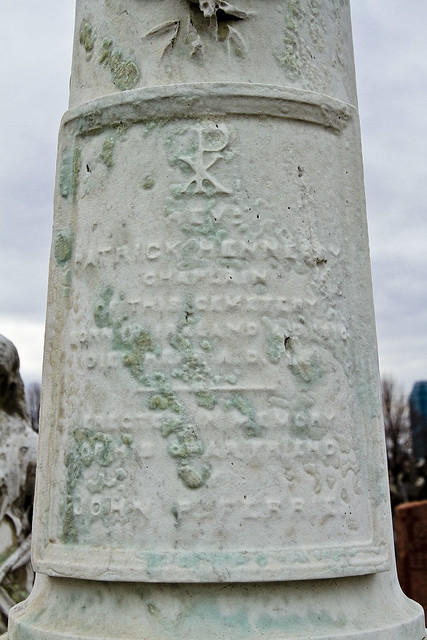
Lords and Ladies, gaze upon the inscription marking this marble as the monument of the First Chaplain of Calvary Cemetery, Rev. Patrick Hennessy.
This column, decorated and inscribed with iconography denoting the burial place of a Roman Catholic Priest, has stood here in section 3 since 1861. It adjoins two other monuments recently described at this, your Newtown Pentacle- the Connell obelisk from “whispered warnings,” and what turned out to be the Jeanne Du Lux and John P. Ferrie monument from “anxious band” and “doubly glad.”
from 1876’s “The visitor’s guide to Calvary cemetery, with map and illustrations” by J. J. Foster, courtesy archive.org
REV. PATRICK HENNESSY, Late Chaplain of the Cemetery, on which are the usual priestly insignia.
In the rear of the monument are statues representing ” Faith,” ” Hope,” and ” Charity,” angels in kneeling posture, and many others. Marble vases containing blooming flowers are scattered around, somewhat relieving the bare aspect of the ground, which is paved with small square-cut flagging, in which is a door leading to the vaults beneath. The whole plot is surrounded with substantial rails of marble.

– photo by Mitch Waxman
According to the quotation above, there is a subterranean vault which lies forgotten below the very spot upon which I stood while shooting the closer in photos which appear above.
Such occluded knowledge and latent danger is nepenthe, of course, for one such as myself. References gleaned from study of ancient tomes indicates that Rev. Hennessy actually lived within the gates of the cemetery itself, but that comes from a single source and is therefore not 100% reliable. If accurate, however, the structure would have been found at the foot of the hill which Section 9 sits upon.
One suspects that unlike myself, who is a vast physical and psychological coward known for his fits of shrieking laughter and terrifying pauses, an Irish priest from the New York of 1861 would have found little problem with straightening his back up and punching some rogue right square in the nose.
an obituary published on January 28 of 1861, found at the NYTimes archive, discusses the passing of Rev. Hennessy
HENNESSY. — At his residence, on Long Island, on Saturday, Jan. 26, Rev. PATRICK HENNESSY, in the 51st year of his age.
His funeral will take place from the Church at Calvary Cemetery, at 10 o’clock A.M., this day, (Monday.) 28th inst. His friends, and the reverend clergy, are respectfully invited to attend.
irresistibly borne
“follow” me on Twitter at @newtownpentacle

– photo by Mitch Waxman
A few more shots from the low light photography exercise I’ve been forcing myself to perform all winter.
Couldn’t believe my eyes when I saw this place. It’s a dinosaur, a relic of the “old” Queens Plaza, which has somehow withstood the arrayed powers and potentates who have completely remade most of the area. One would hope that for the sake of history, and in order to preserve the cultural heritage of the Borough of Queens, that this shop and its signage be granted landmark status and preserved “as is”for all time.
Obscured by the lamp post, one would add, is the signage that reads “Ladies Welcome.”
I’ll bet they are.
– photo by Mitch Waxman
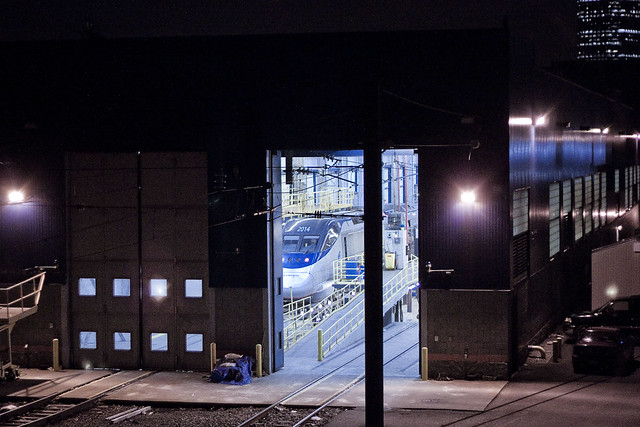
Elsewhere in the neighborhood, Acela was in its bed and snug as a bug in a rug.
Acela maintains a difficult schedule all day and really needs her rest. She is very sweet however, and everyone has nothing but good things to say about her. This is where the modern train receives maintenance and attention from trained mechanics and engineers, at the Sunnyside Yard.
from wikipedia
Generally Amtrak train crews consist of an engineer, a conductor, and at least one assistant conductor. Acela trains also have an On-Board Service crew consisting of two First Class attendants and a Cafe Car attendant. In addition to the food service provided in the Cafe Car, on most trains an attendant will also provide at seat cart service, serving refreshments throughout the train. First Class passengers are served meals at their seats on all services.
At Amtrak, the On-Board Service crew is considered separate and subordinate to the Train and Engine crews. Acela maintenance is generally taken care of at the Ivy City facility in Washington, DC; Sunnyside Yard in Queens, New York; or Southampton Street Yard in Boston, Massachusetts.

– photo by Mitch Waxman
Apologies are offered for any unintentional “artsy fartsy”ness to the shot above, I was just trying to push the exposure and catch the light. This one was on Northern Blvd. incidentally. All of these were handheld shots, at a variety of exposures and iso settings using environmental light, for you photographic types.
lost perspective
“follow” me on Twitter at @newtownpentacle

– photo by Mitch Waxman
Back and forth, forth and back.
On yet another of my perambulations twixt ancient Greenpoint and Astoria, the path which presented itself carried me down Greenpoint Avenue and upon the loathsome expanse of the Long Island Expressway did I find myself staring aghast at. Shivering from chills which were not atmospheric in origin, a humble narrator feverishly crossed the pedestrian pathway between the on and off ramps, an island of safety in a sea of automotive sharks.

– photo by Mitch Waxman
On the northern side of the street, yet another singular and abandoned example of the cobblers art was discovered.
Individual shoes are noticed nearly everywhere these days, by one such as myself, so much so that it seems as if some sort of sinister game might be afoot. Is there be some sort of registry for such matters? Some sort of federal list? Can an amputated consumer product such as a shoe be traced back to an owner? Detective fictions opine that this is the case, but who can guess?

– photo by Mitch Waxman
Wild speculation rules my reactions to these abandoned shoe sightings, lending fuel to flights of blasphemous fancy and outrageous possibility. Commonalities in the sightings of these orphaned singlets include their presence on out of the way, commonly traveled but seldom walked, streets. Most examples seem gently used (with the exception of the damage on the example today,) and that they are conspicuous.
There doesn’t seem to be a bias toward either the left nor right model.
ecstasies and horrors
“follow” me on Twitter at @newtownpentacle

– photo by Mitch Waxman
Peculiar shapes framing the opalescent moon- no doubt due to a dynamic weather system, rather than some external force, intelligence, or madness inducing entity of supra normal scope which can exist only in the imaginings of a madman- caught my attention while returning to Astoria from the hoary lanes of Greenpoint. It seems sometimes that one spends most of his time occupied in perambulating between the two communities and those happy neighborhoods which adjoin the two.

– photo by Mitch Waxman
Trying to ignore the shining parallelogram of clouds which lent our world’s largest satellite a menacing cast, your humble narrator elected to continue working on the whole “night photography” thing, and began fumbling about with camera settings and nervously whispering to myself. Skillman Avenue, normally a well traveled and busy thoroughfare in Western Queens which adjoins the Sunnyside Rail Yard, is a ghost town at night, although there is a feeling of being watched.

– photo by Mitch Waxman
I was not being paranoid either, as dozens of security cameras actually were watching me. Whether someone is ultimately watching the camera feed is another matter, of course, but the machines notice all things. They especially notice a weirdo in a black raincoat waving a camera around in near total darkness. Such thinking kept my mind off the menace of the lunar threat, and the curious way that the parallelogram in the sky unsettled me.

– photo by Mitch Waxman
One supposes that he is just too fragile for this world, a stunted flower straining out from the cracks which mar a post industrial field of pavement. Perhaps it is fated that I follow my ancestors into convalescence and begin the search for an institution of charitable design which might house and insulate me from the terrible possibilities which lurk at the edge of sanity- for if one finds himself a selenophobic, may he not be accused of being a lunatic?
ornate and exotic
“follow” me on Twitter at @newtownpentacle

– photo by Mitch Waxman
Maddeningly, lucky captures like the ones featured in today’s posting have been pretty rare for me of late, but here’s three from the proverbial “right place, right time.” Whilst crossing the devastations of Laurel Hill last week, enroute to a meeting in Brooklyn, those dense atmospheric conditions which had all but occluded the visual presence of Manhattan, just an hour earlier, suddenly cleared up. The burning thermonuclear eye of god itself omnipotently bathed the accursed earth in its radiation, driving away the rain laden clouds.

– photo by Mitch Waxman
Luckily, I was skulking and scuttling the periphery, along an obscure pavement, of the polyandrion of the Roman Catholic Church- called Calvary. Bearing witness to this sudden explosion of majesty and inadvertent stage lighting, for one such as myself, was fraught with danger. Having grown increasingly nocturnal over the winter months, your humble narrator let slip an audibly fearful hiss when that light- which had traveled 93 million miles in seconds and was aimed directly at me- struck my shadow tempered skin. At once, I was moving eastward- and toward safe harbor in the perennial shadows of DUKBO (Down Under the Kosciuszko Bridge Onramp) scuttled I.

– photo by Mitch Waxman
Luckily, as it was late in the day, this luminous event was short lived and the burning thermonuclear eye of god itself now floated low to the horizon in the northwestern sky. Enormous volatility in the air and surrounding cloud systems lent an effusive quality to its emanations, which oddly framed the so called Freedom Tower- a megalith nearing completion on the site of national tragedy and aspiration. To one such as myself, however, such things are better left for others to contemplate, enjoy, and discuss. There is no place for me in the company of others. My place is here, along the Newtown Creek, and amongst the tomb legions.


