Archive for the ‘Long Island City’ Category
fallen over
“follow” me on Twitter at @newtownpentacle

– photo by Mitch Waxman
Thanksgiving weekend is no time to burden you with cares or worries, that’s Walmart and your family’s job, so the Newtown Pentacle tradition is to kick back and present singular images which appeal to the sensibility and tastes of a humble narrator. Above, and I do believe that this shot has run before at this – your Newtown Pentacle, is depicted the corner of 31st street and Broadway in demimonde plagued Astoria. The structure, of course, is the the elevated track of the Subway. There’s just something about the light in this one which I really dig.
nerve powder
“follow” me on Twitter at @newtownpentacle

– photo by Mitch Waxman
Suffer, suffer, suffer. That’s the status on the bad back situation, which I am tired of complaining about. The holiday weekend is upon us, and accordingly, you will see rather short postings here for the next couple of days as most of you will be eating and shopping with loved ones in lesser cities and hopefully have little or no time to listen to me. Pictured above is the never ending stream of traffic entering Queens from the great machine called Queensboro, by the way. We’ll have new conversation on Monday, as in my infirmity I’ve been reading quite a bit about both cannibalism and crocodiles.
unmentionable spheres
“follow” me on Twitter at @newtownpentacle

– photo by Mitch Waxman
Psychological exhaustion, physical decline, and lowered expectations define me. Pedantic depression, paranoid wonderings, and oblique idiocy fills me. Aberrant behavior, heretical ideations, and thought crimes form and obviate into self fulfilling prophecies of dire future tidings. So doomed, your humble narrator nevertheless wanders the concrete devastation of the Newtown Pentacle, seeking what might find him.
from hplovecraft.com
It would not be the first time his sensations had been forced to bide uninterpreted—for was not his very act of plunging into the polyglot abyss of New York’s underworld a freak beyond sensible explanation? What could he tell the prosaic of the antique witcheries and grotesque marvels discernible to sensitive eyes amidst the poison cauldron where all the varied dregs of unwholesome ages mix their venom and perpetuate their obscene terrors? He had seen the hellish green flame of secret wonder in this blatant, evasive welter of outward greed and inward blasphemy, and had smiled gently when all the New-Yorkers he knew scoffed at his experiment in police work. They had been very witty and cynical, deriding his fantastic pursuit of unknowable mysteries and assuring him that in these days New York held nothing but cheapness and vulgarity.

– photo by Mitch Waxman
Embarrassed and awkward, the narration and conduct of interested enthusiasts and tourists on excursions through these blasted heaths and valleys surrounding a historical morass called the Newtown Creek over the last year has ameliorated the caul of profound loneliness one such as myself was born with. That interval, however, is at an end- for now- and omnipresent realities once again rule the day and torment the night. Sleep is no longer eagerly sought, the air is chill, and darkness arrives too early for my taste. All is not right.
from hplovecraft.com
I do not recall distinctly when it began, but it was months ago. The general tension was horrible. To a season of political and social upheaval was added a strange and brooding apprehension of hideous physical danger; a danger widespread and all-embracing, such a danger as may be imagined only in the most terrible phantasms of the night. I recall that the people went about with pale and worried faces, and whispered warnings and prophecies which no one dared consciously repeat or acknowledge to himself that he had heard. A sense of monstrous guilt was upon the land, and out of the abysses between the stars swept chill currents that made men shiver in dark and lonely places. There was a daemoniac alteration in the sequence of the seasons—the autumn heat lingered fearsomely, and everyone felt that the world and perhaps the universe had passed from the control of known gods or forces to that of gods or forces which were unknown.

– photo by Mitch Waxman
Blissful and willful ignorance is craved, and my plans for the immediate future involve fading into the worm eaten woodwork for a time. Missives will continue to be offered at this location, but only by an accident or unforeseen coincidence will they describe interaction with others. Disgusting, the vast human hive has no claims on me for an interval, and into a calcified shell will your humble narrator withdraw.
from hplovecraft.com
The most merciful thing in the world, I think, is the inability of the human mind to correlate all its contents. We live on a placid island of ignorance in the midst of black seas of infinity, and it was not meant that we should voyage far. The sciences, each straining in its own direction, have hitherto harmed us little; but some day the piecing together of dissociated knowledge will open up such terrifying vistas of reality, and of our frightful position therein, that we shall either go mad from the revelation or flee from the deadly light into the peace and safety of a new dark age.

– photo by Mitch Waxman
To the graveyards, and beneath the bridges will your humble narrator hie, where hideous countenance and bizarre behaviors will go unnoticed. Sallow and shrunken, diseased and confused, once more shall only a filthy black raincoat be noticed as it flaps away in those shrill winds which plague and scourge the ancient towns and villages surrounding the Newtown Creek. Always must I remain, appropriately, an outsider.
from hplovecraft.com
I had known that he now remained mostly shut in the attic laboratory with that accursed electrical machine, eating little and excluding even the servants, but I had not thought that a brief period of ten weeks could so alter and disfigure any human creature. It is not pleasant to see a stout man suddenly grown thin, and it is even worse when the baggy skin becomes yellowed or greyed, the eyes sunken, circled, and uncannily glowing, the forehead veined and corrugated, and the hands tremulous and twitching. And if added to this there be a repellent unkemptness; a wild disorder of dress, a bushiness of dark hair white at the roots, and an unchecked growth of pure white beard on a face once clean-shaven, the cumulative effect is quite shocking.
sepulchral resonances
“follow” me on Twitter at @newtownpentacle

– photo by Mitch Waxman
As mentioned earlier this week, a recent rip to St. Michael’s cemetery was accomplished on a lovely autumnal afternoon. Affinity for morbid settings notwithstanding, area cemeteries provide one with a peaceful and introspective interlude, free of the nonstop noise which typifies an existence in western Queens. Back home in Astoria, a never ending series of auditory distractions roll past beneath my windows and often elucidated is a desire for a few minutes of quiet. The well tailored grounds and open sight lines of the graveyard serve this purpose, and I was quite alone on this particular day, except for a rough looking trio who were celebrating a cannabis charged tribute to some departed compatriot.
The original property for St. Michael’s Cemetery was purchased in 1852 by the Rev. Thomas McClure Peters and occupied seven acres. Over the years St. Michael’s gradually acquired additional land to its present size of approximately eighty-eight acres. Because it was Dr. Peters’ intention to provide a final dignified resting place for the poor who could not otherwise afford it, areas within the cemetery were assigned to other free churches and institutions of New York City. These areas are still held for the institutions they were assigned.

– photo by Mitch Waxman
While wandering about, I noticed this magnificent sepulchral portrait attached to a small monument. A once common practice, attaching a photographic portrait of the departed to their monument was accomplished by transferring the image to a ceramic matrix. Modern day mourners seem to be reviving the practice, although modern digital printing techniques involving the four color printing process and laser etching of the monument itself seem to be the preferred fashions. It offends some, referring to such practice as fashion- but if you spend as much time in cemeteries as I do- you discern certain typographic, linguistic, and symbolic patterns which seem to go in and out of vogue. For example- Obelisks, mausolea, usage of footstones or curbs, foliated columns, portraits etc.
The particular sepulchral portrait depicted in these shots is of Maria Concetta Niosi in life. 27 years old, she died on the 1st of April in 1919.
from thehistorychannelclub.com
In 1854 two French inventors patented a method for fixing a photographic image on enamel or porcelain by firing it in a kiln. These “enamels” were used for home viewing well into the 20th century, when the more convenient paper photos replaced them. The custom of attaching ceramic photos to tombstones spread throughout Southern and Eastern Europe and Latin America. In the late 19th and early 20th centuries, Italian and Jewish immigrants brought this practice to the United States. “Ceramic photo portraits . . . represent the first period in the history of gravestone manufacture in the United States when intense personalization became available—and affordable—on a large-scale basis,” says Richard E. Meyer, a professor at Western Oregon State College who has studied American cemeteries for more than 25 years. During the first decade of the 1900s, Sears-Roebuck advertised: “Imperishable Limoges porcelain portraits preserve the features of the deceased . . .” At “$11.20 for a photograph set in marble, $15.75 for one set in granite,” these portraits “competed with the cost of many burial plots.”

– photo by Mitch Waxman
Evidence of her life in the United States is scant, and although I have managed to find two people with similar names who appeared at the Ellis Island immigration facility- neither seems to fit the bill as being this individual. Perhaps Niosi was a married or assumed name she gained after immigration, or perhaps she came to the United States via Baltimore or Boston (with NY, all three were common ports of entry for the Italians).What struck me, other than the haunting image of a clearly formidable woman, was the pure physical size of this portrait. Normally, a sepulchral portrait is of a small oval or round shape and seldom larger than a modern 4×6 inch photographic print. The Niosi plaque was large, the size of a sheet of common day letter sized paper. This would have cost a small fortune in 1919, several times the price of the actual grave, and yet it was attached to this meager and barely noticeable stone marker.
Who was this woman?
rough handling
“follow” me on Twitter at @newtownpentacle
– photo by Mitch Waxman
Rejoice, for this is the day when men and women return to their ancestral villages and seaside hamlets, gathering beneath cobbled roofs and behind garret windows to celebrate “America Recycles Day”. Children shall be offered solemn pledges and vast ritual amalgamations of litter will be assembled for display and dissemination. Many and varied will be the manifestations of this occasion, which is ultimately rooted in the solemn traditions set down by a group known as “Keep America Beautiful”.
from wikipedia
America Recycles Day (ARD) is the only nationally recognized day dedicated to encouraging Americans to recycle and buy recycled products. ARD is celebrated annually on November 15. The World Recycling Day celebrated in most countries, though falls on July 8. Thousands of events are held across the U.S. to raise awareness about the importance of recycling and to encourage Americans to sign personal pledges to recycle and buy products made from recycled materials.

– photo by Mitch Waxman
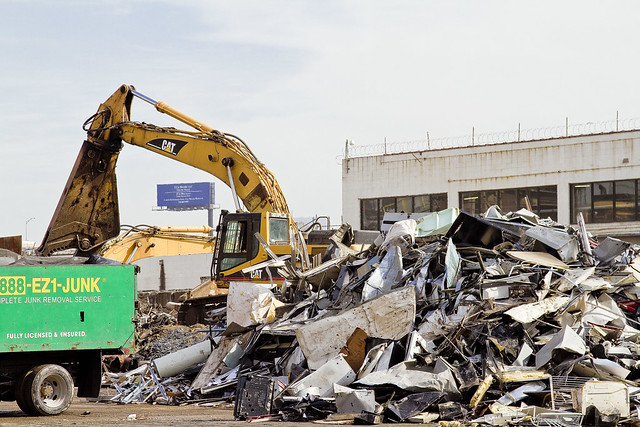
Gaze in astonished wonder at the industry of man, and the tyranny of wealth. Imagine, if you would, the raw tonnages of refined metals displayed in these shots. Surely, just in today’s posting, we are seeing a greater amount of waste metals than an entire nation might be capable of producing just a scant 200 years ago. We waste so much, and our culture- if nothing else- will prove itself a boon to future archaeologists.
The multitudinous middens of the megalopolis, well moistened with motor oil, will stand as our monument.
from wikipedia
Keep America Beautiful was founded in 1953 by consortium of American businesses (including founding member Philip Morris, Anheuser-Busch, PepsiCo, and Coca-Cola) nonprofit organizations, government agencies, and concerned individuals in reaction to the growing problem of highway litter that followed the construction of the Interstate Highway System, and an increasingly mobile and convenience-oriented American consumer. The original goal of the organization was to reduce litter through public service advertising (PSA) campaigns.
Keep America Beautiful conducted many local PSA campaigns early in its history. One of these early campaigns in Pennsylvania (PENNDOT), some attribute to having coined the term “litterbug”, as opposed to the New York Transit Authority. There is some confusion over the origin of the actual word “litterbug” due to several early uses of it in widespread public service advertisements. It was, in fact, coined by Paul B. Gioni, a copywriter in New York City who originated it for The American Ad Council in 1947. Keep America Beautiful joined with the Ad Council in 1961 to dramatize the idea that every individual must help protect against the terrible effects litter has on the environment.
A popular television campaign theme in 1963, with copy written by Paul B. Gioni who also coined the word “litterbug” in 1947, was “Every Litter Bit Hurts”. Another appeared in 1964 featuring character Susan Spotless. In 1970 KAB began distributing a free brochure; more than 100,000 copies were requested within 4 months.
On Earth Day 1971, a new campaign was launched with the theme “People Start Pollution. People can stop it” featuring the now iconic “Crying Indian” played by Iron Eyes Cody.

– photo by Mitch Waxman
Amongst those who tolerate my presence, some work in the recycling industry. A missive they ask a humble narrator to transmit reads as: “Recycle. Please. Don’t do it for us and our business, do it for your kids”. They continue that it’s probably already too late, and that the future is trashed. Perhaps, just perhaps, they are wrong. Until the ultimate answer is found to this disposables issue, they are likely being far more pragmatic than the rest of us. It is they, after all, who see the trucks tipping and collecting, and spend more time than they would like handling putrescent garbage as a loss leader.
Figuring out when, where and how to recycle in your community couldn’t be easier. Log on to www.americarecyclesday.org and select the “Find Recycling” tab and click on the Earth911.com logo. This will direct you their recycling resource page, where you can enter the item type and your zip code to find the nearest recycling facility.

– photo by Mitch Waxman
By no means should this humble narrator be considered a creature of primal intelligence, good hygiene, or high moral turpitude. Neither should it be inferred that the role of exemplar is claimed, as far as the contributions of my own household to the problem. A lone and singular advantage is that I am instead smart enough to realize how smart I’m not, and realize the shallow depths of my grasp on the situation. Around here, we just try not to be too loose with using things that can’t be washed, or reused, or cross purposed. How about you?
from wikipedia
Recycling statistics:
- 251 million – tons of trash in the United States
- 53.4 – percentage of all paper products recycled in the United States
- 32.5 – percentage of total waste that is recycled in the United States
- 100 – approximate percentage of increase in total recycling in the United States during the past decade
- 8,660 – number of curbside recycling programs in the United States in 2006
- 8,875 – number of curbside recycling programs in the United States in 2003
- 95 – percentage of energy saved by recycling an aluminum can, compared with manufacturing a new one
- 4.6 – pounds of trash per person per day in the United States (most in the world)
- 1.5 – pounds of recycled materials per person per day in the United States


