Archive for the ‘Manhattan’ Category
hollow phantoms

Empire State Building 2010 from the oiled shadows of Borden Avenue, Queens – photo by Mitch Waxman
They want to build a competitor to the Empire State Building? The mayor says it’s good for the City?
Forgive my french, but this is one mighty fucking ugly building the oligarchs are going to build, imho. I’d rather see a 20 story fire breathing statue of Mike Bloomberg that proclaims “Remember Me” erected. Well, its finally starting to happen to Manhattan, this odd experience that has been felt by those of us in the lesser boroughs for the last few years.
I wonder where the money to build this monster will be coming from, and how much of the public dime will go into its construction.
from blog.archpaper.com
We know hackers and preservationists are staunchly opposed to Vornado’s 15 Penn Plaza, because the 1,216-foot Pelli Clarke Pelli-designed tower would replace McKim Mead & White’s notable-if-not-renowned Hotel Pennsylvania. Anthony Malkin, president of Malkin Holdings, is also not a fan for the simple reason that Malkin Holdings is holding the Empire State Building. And its views would most likely be compromised by 15 Penn Plaza. Malkin is now speaking out against the project, under the aegis of a group calling itself Friends of the New York City Skyline, a posse which also includes MAS, the Historic Districts Council, and the Landmarks Conservancy. It may be too little, too late.
wonderful epics of a nameless city

– photo by Mitch Waxman
This is not the world you know, this unmentioned and currently undefended border between Brooklyn and Queens, where the requiescant waters of the Newtown Creek gurgle and splash. Beyond the Pulaski Bridge- where an observable and otherworldly colour stains animal, and structure, and vegetable- the heavy industries which conspire to sustain the shining city of Manhattan spread out under the Newtown sun.
from nycedc.com
The Newtown Creek according to the Army Corps of Engineers (ACE) had a listing of 26 piers with a total of 8,483 feet of berthing space. However, only 16 piers with a total of 4,986 feet of berthing space are in use by 12 firms. Furthermore, six firms are using their 1,952 feet of pier berthing space and waterfront facilities occasionally only. The waterfront activity is primarily for ship and barge.

– photo by Mitch Waxman
Along its path, the bulkheaded shorelines of the Newtown Creek reveal the rotted timber and risible decay associated with exposure to the poisons and refuse of the vast human hive, and its associated infestations. The waters have been observed, personally, to host a surprising variety of life forms- including a dizzying array of non vertebrates. Within the cemented and artificial shores, internal voids and long abandoned pipelines shelter teeming populations of rodent forms, and unguessable possibilities present themselves when discussing what else may be hiding down there, in flooded cellar and forgotten basement.
from wikipedia
The creek begins near the intersection of 47th Street and Grand Avenue on the Brooklyn-Queens border 40°43′06″N 73°55′27″W at the intersection of the East Branch and English Kills. It empties into the East River at 40°44′14″N 73°57′40″W (2nd Street and 54th Avenue in Long Island City) opposite Bellevue Hospital in Manhattan at 26th Street. Its waterfront, and that of its tributaries Dutch Kills, Whale Creek, Maspeth Creek and English Kills, are heavily industrialized.
The creek has no natural waterflows. Its outgoing flow of 14,000 million gallons/year consists of combined sewer overflow, urban runoff, raw domestic sewage, and industrial wastewater. Being estuarine, the creek is largely stagnant. Since there is no current in the creek, sludge has congealed into a 15-foot thick layer of “black mayonnaise” on the creek bed.

– photo by Mitch Waxman
Just after passing the yawning mouth of the malign Dutch Kills, one encounters a scrap metal operation, which operates a car shredding operation. The great mill utilizes the “Newtown Creek Dock” and is owned and operated by the Hugo Neu Schnitzer East Co.
In a nutshell, the way that things work is:
Hugo Neu Schnitzer East Co. (HNSEC from this point) receives the metal glass and plastic collected by the DSNY and private contractors at its Hunts Point bulkheads in the Bronx, New Jersey, and Brooklyn…
- HNSEC then barges certain materials to Newtown Creek, where bulk metal is separated from the less valuable plastic and virtually worthless glass.
- A preliminary sorting of plastic and glass is performed, while the bulk metal is loaded onto barges.
- The metals are shipped by barge to other facilities, and offered for sale on the worldwide commodities markets.
According to those principalities who authored and designed this system, it reduces the per ton cost of processing the waste stream as well as reducing the reliance on automotive conveyance for it and nourishes the maritime industry.
from a nytimes.com article of 2004
One of the toughest challenges with recycling has always been finding markets for the recycled goods, whose resale can then help defray the costs of the program. In announcing a 20-year recycling contract yesterday, the Bloomberg administration said it had solved that problem by encouraging a company to find those markets.

– photo by Mitch Waxman
As is the way of things, Hugo Neu merged with Sim Group in 2005, and formed one of the largest recycling conglomerates in the world. According to our friends at Habitatmap, whose stout adherence to the scientific method and stalwart advocacy of the unvarnished truth has both terrified and impressed your humble narrator, the composite company- SimsMetal- is the largest single source of air pollution to be found along the modern Newtown Creek.
from simsmm.com
Sims Metal Management was originally established in 1917 by Albert Sims, a Sydney-based recycled metals dealer. The business was incorporated as Albert G. Sims Limited in 1928 and was renamed Simsmetal Limited in 1968.
In 1970, it merged with Consolidated Metal Products Limited and the merged ASX-listed company was named Sims Consolidated Limited. In 1979, Sims Consolidated Limited was acquired by Peko-Wallsend Limited and subsequently delisted. Sims Consolidated Limited was then acquired by North Limited (previously known as North Broken Hill Holdings Limited, and then North Broken Hill Peko Limited) in 1988. In 1989, North Limited sold the business to Elders Resources NZFP Limited, a diversified resources company.
In 1990, Carter Holt Harvey Limited made a successful takeover bid for Elders Resources NZFP Limited and divested that company’s non-forestry businesses, which included Sims. Sims changed its name to Simsmetal Limited in 1990 and relisted on the ASX in 1991. Simsmetal Limited changed its name to Sims Group Limited in 2003.
Sims Metal Management’s corporate strategy includes leading industry consolidation through acquisitions. Over a number of years, with experience gained from numerous international acquisitions, Sims Metal Management has established strict acquisition criteria. The acquisition criteria require that any acquisition target holds the number one or number two market position, delivers access to domestic and international customers, offers a sound platform for future growth and, above all else, will likely enhance shareholder value. The acquisition criteria have underpinned Sims Metal Management’s strong track record of international expansion.
In October 2005, Sims Group Limited merged with the recycling businesses of Hugo Neu Corporation, a privately owned U.S. corporation. The merger created a new ASX listed company named Sims Group Limited, which is traded under the ASX code “SGM.”

– photo by Mitch Waxman
I am told by knowledgeable sources that much of this scrap metal will eventually find its way to the mercantile courts of far away Asia, with the bulk of it headed to the smokestacks of China. This is less recycling and waste disposal than it is mining, if one actually takes a step back and looks at it.
from wikipedia
The scrap industry contributed $65 billion in 2006 and is one of the few contributing positively to the U.S. balance of trade, exporting $15.7 billion in scrap commodities in 2006. This imbalance of trade has resulted in rising scrap prices during 2007 and 2008 within the United States.[2] Scrap recycling also helps reduce greenhouse gas emissions and conserves energy and natural resources. For example, scrap recycling diverts 145,000,000 short tons (129,464,286 long tons; 131,541,787 t) of materials away from landfills. Recycled scrap is a raw material feedstock for 2 out of 3 pounds of steel made in the U.S., for 60% of the metals and alloys produced in the U.S., for more than 50% of the U.S. paper industry’s needs, and for 33% of U.S. aluminum. Recycled scrap helps keep air and water cleaner by removing potentially hazardous materials and keeping them out of landfills.

– photo by Mitch Waxman
Frequently observed on the East River, these barges of shredded steel and metal maintain a regular schedule back and forth from the Newtown Creek. This particular barge is the 886 gross ton Cape Lucy, a 146 foot long freight vessel operated by the Inland Barge Corporation, and constructed by Bethlehem Steel in 1953.
Always fascinated by minutia, your humble narrator wonders if this barge is a “leave behind” from the construction of the Pulaski Bridge by the self same Bethlehem Steel in 1953.
from nyc.gov
In 1881, the New York City Department of Street Cleaning was created in response to the public uproar over litter-lined streets and disorganized garbage collection. Originally called the Department of Street Cleaning, the agency took over waste responsibilities from the New York City Police Department. In 1933, the name was changed to the Department of Sanitation.
Throughout the 1880’s, 75% of NYC’s waste was dumped into the Atlantic Ocean. In 1895, Commissioner George Waring instituted a waste management plan that eliminated ocean dumping and mandated recycling. Household waste was separated into three categories: food waste, which was steamed and compressed to eventually produce grease (for soap products) and fertilizer; rubbish, from which paper and other marketable materials were salvaged; and ash, which along with the nonsalable rubbish was landfilled. The Police Department, under the direction of its Commissioner, Theodore Roosevelt, enforced the recycling law.

– photo by Mitch Waxman
Heavy equipment and esoteric machinery is always on display at this location, and it attracts no small amount of attention from area photographic enthusiasts. Proximity to the Newtown Creek Waste Water Treatment Plant Nature Walk, with its wide open sight lines and panoramic scope, no doubt aids in the fame of this place. These shots, however, were captured from onboard a boat which was plying the volatile surface of the Newtown Creek.
from wikipedia
Critics dispute the net economic and environmental benefits of recycling over its costs, and suggest that proponents of recycling often make matters worse and suffer from confirmation bias. Specifically, critics argue that the costs and energy used in collection and transportation detract from (and outweigh) the costs and energy saved in the production process; also that the jobs produced by the recycling industry can be a poor trade for the jobs lost in logging, mining, and other industries associated with virgin production; and that materials such as paper pulp can only be recycled a few times before material degradation prevents further recycling. Proponents of recycling dispute each of these claims, and the validity of arguments from both sides has led to enduring controversy.

– photo by Mitch Waxman
Weirdly organic, the Sennebogen hydraulic loaders which effortlessly move the scrap from land to barge seem to be a favored item for the scrap industry to purchase (and Sims Metal in particular), valued for its mechanical advantages and engineering accumen. Sennebogen, like the fabled Steinway clan which has left such an indelible stamp on the surrounding communities, is a German corporation operated by a single family and founded by an enigmatic sire.
from sennebogen-na.com
RICHMOND, CA – The existing pedestal crane at the 18-acre Sims Metal Management scrap metal yard in Richmond, California had become a bit of a production liability for Jesse Garcia, Sims NW Equipment Manager. Repairs to the pedestal crane were difficult and Garcia often found himself having to lease replacement equipment to keep up production on the yard’s shear when the crane went down. When it came time to replace the crane, Garcia chose a SENNEBOGEN 840 R special, a purpose-built material handler that gives him the mobility and problem-free reliability and uptime he was seeking.
“Metal on metal”
“A scrap yard is a tough environment – it’s constant metal on metal. You need dependable equipment that is built for this application. SENNEBOGEN machines are purpose-built for handling scrap metal, they’re not just retrofitted excavators,” says Garcia. “Our tracked SENNEBOGEN 840 R special is perfect for this application. We can move it in and out for quick, easy maintenance, and should the shear go down, we can utilize it elsewhere in the yard.”

– photo by Mitch Waxman
Forgotten by modernity, even your humble narrator had to consult with one of the “Rabbi’s” to double confirm that this dock was originally the location of the “Manure Dock”, where Manhattan’s human waste products, animal carcasses, and organic waste would be barged to.
Journalists of the era referred to it as the “Offal dock“.
Some of the redolant cargo would be shipped untreated to points East by the LIRR to be utilized as fertilizer on the bountiful farms which once typified the eastern counties, and some percentage of it was processed by local commercial rendering operations owned by the likes of Conrad Wessel and Peter Cooper who saw the rotting filth as a raw material for various food products- aspic, isenglass, and gelatin amongst others. The remnants of that process, which involved the usage of high pressure steam and other state of the art victorian technologies, were further processed into glues, waxes, and potent acids.
from wikipedia
Where a cargo is coarser in size than minerals, commonly for scrap metal, then an orange-peel grab may be used instead of a shell. These have six or eight segments of “peel” independently hinged around a central core. They are better able to grab at an uneven load, rather than just scooping at small pieces. If the load is made of long thin pieces, a grab may also be able to carry far more than a single “grabful” at one time.
Although orange-peel grabs may be hung from cables on a jib, they’re also commonly mounted directly onto a jib. This is more suitable for grabbing at awkward loads that might otherwise tend to tip a hanging grab over. They may also use hydraulics to control the segments rather than weight and hoist cables.

– photo by Mitch Waxman
The concept of recycling is nothing new, here in the megalopolis of New York, and then as now- it was the Newtown Creek and its surrounding communities that absorbed and absolved Manhattan’s sins. The stink, as reported in the late 19th century, that arose from this section of the Creek was legendary even to those hardened by close quartered tenement conditions and the press of an unventilated and crowded city which counted its draft animals in the hundreds of thousands.
Imagine a hot August day in Manhattan, 100 years ago, and that same day… on a slick of oily water some 4 miles long that defined the undefended border between the cities of Long Island City, Newtown, Greenpoint, Bushwick, and Williamsburg.
Pictured above is the DonJon towing Tug Peter Andrew, part of the DonJon Marine fleet that handles the metal and other recyclables trade from Newtown Creek to and from the Newtown Creek to the other links in the waste stream scattered about the New York Harbor archipelago. Photo is from last year, and was shot on the East River.
from donjon.com
Donjon Marine Co., Inc. offers the marine community full-service solutions to meet your every need in the field of marine salvage, dredging, material recycling and related services. Founded in 1964 by Mr. J. Arnold Witte, Donjon’s President and Chief Executive Officer, Donjon Marine’s principal business activities were marine salvage, marine transportation, and related services. Today Donjon Marine is a true provider of multifaceted marine services. Donjon’s controlled expansion into related businesses such as dredging, ferrous and non-ferrous recycling and heavy lift services are a natural progression, paralleling our record of solid technical and cost-effective performance.
torment of the Brachyura

– photo by Mitch Waxman
Your humble narrator is a carnivore, as mentioned in the past, despite a somewhat advanced state of understanding of the realities of feedlot and abattoir.
Human beings are ultimately predatory apes, and the greasy taste of flesh is prized by most. Displays of comestible items are commonly observed amongst the human hives, but when one is moving through a neighborhood whose residents enjoy exotic fare- like Manhattan’s famous Chinatown in this case – the careful observer might be rewarded with visions of the fanciful or alien.
from wikipedia
Homo Necans: the Anthropology of Ancient Greek Sacrificial Ritual and Myth is a book on ancient Greek religion and mythology by Walter Burkert, which won the Weaver Award for Scholarly Literature, awarded by the Ingersoll Foundation, in 1992. The book’s core thesis is that when paleolithic man became a hunter, in spite of the generally omnivorous orientation of the great apes, lack of a predator instinct was made up for by turning patterns of intra-species aggression against the prey: Homo necans means “man the killer”. Thus, the animal hunted by ancient man automatically acquired aspects of an equal, as if it were of one of the hunter’s relations. In a first attempt at applying ethology to religious history, Burkert confronts the power and effect of tradition in uncovering traces of ancient hunting rituals so motivated in historical animal sacrifice and human sacrifice (by his thesis unified as deriving from the same fundamental principle) in specific historical Greek rituals with relevance to human religious behaviour in general. Burkert admitted that a decisive impulse for the thesis of Homo Necans derived from Konrad Lorenz’ On Aggression (1963).
The thesis set out in the first chapter, “Sacrifice, hunting and funerary rituals”, is an extension of the hunting hypothesis, which states that hunting as a means of obtaining food was a dominant influence on human evolution and cultural development (as opposed to gathering vegetation or scavenging). The guilt incurred in the violence of the hunt was reflected in sacred crimes, which through rituals of cleansing and expiation served to unify communities.

– photo by Mitch Waxman
A carnivorous glutton your humble narrator may be, but empathy and indignation arose in him when confronted with this display.
Sure that this is a time tested and necessary technique intended to display the freshness and nutritional validity of this cast of crustaceans, demanded by clientele, a certain bile nevertheless rises. Western prejudice no doubt colors my point of view, as the same overt revulsion does not rise at the sight of a counter of European butchers meat.
Paradoxical, but to my reasoning, there isn’t a display of crucified and disemboweled cows overhanging the refrigerated section at the supermarket. Vegan friends would disagree, but I guess it depends on your point of view, and “Krabs ain’t Kosher” either.
from wikipedia
Crabs make up 20% of all marine crustaceans caught, farmed, and consumed worldwide, amounting to 1½ million tonnes annually. One species accounts for one fifth of that total: Portunus trituberculatus. Other commercially important taxa include Portunus pelagicus, several species in the genus Chionoecetes, the blue crab (Callinectes sapidus), Charybdis spp., Cancer pagurus, the Dungeness crab (Metacarcinus magister) and Scylla serrata, each of which yields more than 20,000 tonnes annually.

– photo by Mitch Waxman
It really was just the simple fact that the Cast of Crabs in the bushel bucket beneath this macabre marquee were subtly scuttling which disturbed me and drew this comment.
I am also aware, of course, that given the chance- those in the basket would consume those above them with abandon.
from wikipedia
The problem of animal suffering, and animal consciousness in general, arises primarily because animals have no language, leading scientists to argue that it is impossible to know when an animal is suffering. This situation may change as increasing numbers of chimps are taught sign language, although skeptics question whether their use of it portrays real understanding. Singer writes that, following the argument that language is needed to communicate pain, it would often be impossible to know when humans are in pain. All we can do is observe pain behavior, he writes, and make a calculated guess based on it. As Ludwig Wittgenstein argued, if someone is screaming, clutching a part of their body, moaning quietly, or apparently unable to function, especially when followed by an event that we believe would cause pain in ourselves, that is in large measure what it means to be in pain.[98] Singer argues that there is no reason to suppose animal pain behavior would have a different meaning.
symbolism and phantasm

– photo by Mitch Waxman
Another item in my “catch-up” file was when I got to witness the redoubtable employees of Consolidated Edison blowing off some steam at the South Street Seaport back in June.
from wikipedia
SS Normandie was an ocean liner built in Saint-Nazaire, France for the French Line Compagnie Générale Transatlantique. She entered service in 1935 as the largest and fastest passenger ship afloat; she is still the most powerful steam turbo-electric-propelled passenger ship ever built.
Her novel design and lavish interiors led many to consider her the greatest of ocean liners. Despite this, she was not a commercial success and relied partly on government subsidy to operate. During service as the flagship of the CGT, she made 139 transatlantic crossings westbound from her home port of Le Havre to New York and one fewer return. Normandie held the Blue Riband for the fastest transatlantic crossing at several points during her service career, during which the RMS Queen Mary was her chief rival.
During World War II, Normandie was seized by the United States authorities at New York and renamed USS Lafayette. In 1942, the liner caught fire while being converted to a troopship, capsized and sank at the New York Passenger Ship Terminal. Although salvaged at great expense, restoration was deemed too costly and she was scrapped in October 1946.

– photo by Mitch Waxman
A zone of the greater city that I normally avoid like the plague, South Street Seaport is a tourist mecca which also happens to host a museum. Said museum had initiated an event wherein the vast sonics of the legendary SS Normandie would be activated and displayed for the public.
from youtube
and at travelfilmarchive.com there’s this great newsreel clip that tells the Normandie story

– photo by Mitch Waxman
The engineers of ConEd informed me that these pipes and hoses were connected into the high pressure steam lines that underlie lower Manhattan, and were carrying 150 PSI of steam to the Normadie’s whistle.
The NY Times folks were in attendance, apparently, so here’s what the professionals said.

– photo by Mitch Waxman
Knowing the effects that high pressure steam might evince upon the human body, I stepped backwards a few feet, but in reality- if anything went wrong, there would be pieces of me found across the river in Brooklyn.
from wikipedia
The New York Steam Company began providing service in lower Manhattan in 1882. Today, Consolidated Edison operates the largest commercial steam system in the world, now known as Con Edison Steam Operations, providing steam service to nearly 2,000 customers and serving more than 100,000 commercial and residential establishments in Manhattan from the Battery at the southern tip of Manhattan to 96th Street uptown. Roughly 30 billion lbs. (just under 13.64 megatons) of steam flow through the system every year.

– photo by Mitch Waxman
A small crowd of dignitaries gathered, and the ConEd guys gave the go ahead for the Normandie’s phantom to sound its voice.
from wikipedia
Regular cricket matches were held near Fulton Market in 1780 when the British Army based itself in Manhattan during the American Revolution. Robert Fulton became famous for his steamship in 1809 though he did spend time in Paris during the American Revolution.
Fulton Street is named for Robert Fulton, an engineer instrumental in the development of steam ships in the United States. Ferries connected Manhattan across the East River to Fulton Street in Brooklyn.
The street has a Beaux-Arts architectural feel with many buildings dating back to the Gilded Age or shortly thereafter. The early 19th century buildings on the south side of the easternmost block are called Schermerhorn Row and are a Registered Historic Place.
The Fulton Fish Market was located nearby at the South Street Seaport until 2005, when it moved to Hunts Point in The Bronx.

– photo by Mitch Waxman
At this distance, as the scalar waves of sound were reflecting off the building walls and masonry clad street, it sounded for all the world as if the gates of hell had just fallen off their hinges and that demon trumpeters were signaling the impending war of apocalypse.
from wikipedia
A steam whistle is a device used to produce sound with the aid of live steam, which acts as a vibrating system [1] (compare to train horn). The whistle consists of the following main parts, as seen on the drawing: the whistle bell (1), the steam orifice or aperture (2), and the valve (9).
When the lever (10) is pulled, the valve opens and lets the steam escape through the orifice. The steam will alternately compress and rarefy in the bell, creating the sound. The pitch, or tone, is dependent on the length of the bell; and also how far the operator has opened the valve. Some locomotive engineers invented their own style of whistling.


– photo by Mitch Waxman
Your humble narrator has often found himself vulnerable and sensitive to high volumes, and has noted a curious phenomena in the presence of extreme loudness. The visual field narrows, as one’s brain attempts to make sense of the overload of auditory information, which has been remarked upon scientifically by insurance industry specialists who describe a similar effect when one drives an automobile with loud music playing and it’s corollary of higher accident rates.
from straightdope.com
It’s been well documented that jets of high-pressure gas (which is what superheated steam is) can cause injuries even without the added complication of heat. OSHA warns against possible amputation from high-pressure gas and limits air pressure for industrial cleaning to 30 PSI. High-pressure gases can easily penetrate the skin, especially via an existing cut or wound, and potentially lead to gas embolism–bubbles in the bloodstream that can migrate to the heart, lungs, or brain and cause serious trouble. U.S. Army medical reports tell of numerous gas-penetration injuries suffered during training with blank firearm rounds. Just 12 PSI can likely pop your eyeball from its socket. Less than 80 PSI of air from 12 inches away reportedly swelled up a woodworker’s hand “to the size of a grapefruit.” One source reports that high-pressure nitrogen cut into a worker’s leg like a knife, and other references warn that high-pressure gases can cut fingers, toes, and other body parts. Again, I didn’t find an actual case of high-pressure gas cutting anyone in half, but it’s not going out on much of a limb to say it sure would smart.

– photo by Mitch Waxman
Such incidences of altered perception are commonly encountered at festival concerts, and military science is exploring the strategic use of sonics as we speak. Modern Cruise ships are equipped with sonic devices used to deter piracy, and the United States military possesses an inventory of experimental “non lethal” sonics.
from wikipedia
The Long Range Acoustic Device (LRAD) is a crowd-control and hailing device developed by LRAD Corporation.
According to the manufacturer’s specifications, the equipment weighs 45 pounds (20 kg) and can emit sound in a 30° beam (only at high frequency, 2.5 kHz) from a device 83 centimetres (33 in) in diameter. At maximum level, it can emit a warning tone that is 146 dBSPL (1,000 W/m2) at 1 metre. The maximum usable design range extends to 300 metres. At 300 metres, the warning tone (measured) is less than 90 dB.
The Long Range Acoustic Device (LRAD) is a crowd-control and hailing device developed by LRAD Corporation.According to the manufacturer’s specifications, the equipment weighs 45 pounds (20 kg) and can emit sound in a 30° beam (only at high frequency, 2.5 kHz) from a device 83 centimetres (33 in) in diameter. At maximum level, it can emit a warning tone that is 146 dBSPL (1,000 W/m2) at 1 metre. The maximum usable design range extends to 300 metres. At 300 metres, the warning tone (measured) is less than 90 dB.
Note: Friend of the Pentacle, chronicler of the sixth borough. and oddly peaceful guy Will Van Dorp from tugster was standing right next to me when he recorded the following video.
Now, I didn’t ask him if it was OK to link to his video, but I don’t think he’ll mind if y’all just take a peek…
Bottle Alley

– photo by Mitch Waxman
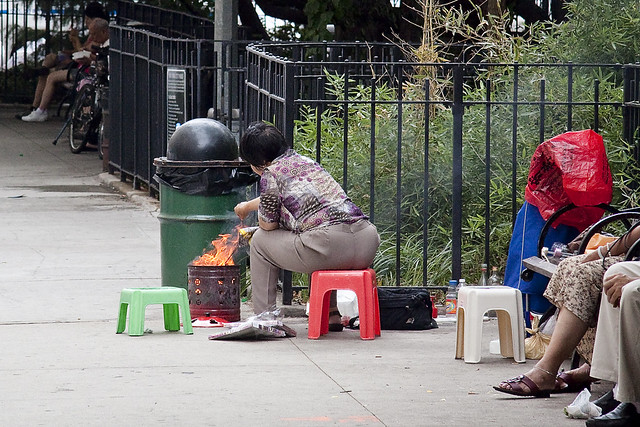
Baxter Street just past Leonard, I noticed this woman tending a little fire. She was part of a small group who were gathered at the Baxter Street side of the Mulberry Bend, where Jacob Riis described Bottle Alley. Getty Images has a watermarked preview image of the place, as photographed by Jacob Riis in 1901 here.
from wikipedia
In Chinese tradition, the fifteenth day of the seventh month in the lunar calendar is called Ghost Day and the seventh month in general is regarded as the Ghost Month (鬼月), in which ghosts and spirits, including those of the deceased ancestors, come out from the lower realm. Distinct from both the Qingming Festival (in Spring) and Chung Yeung Festival (in Autumn) in which living descendants pay homage to their deceased ancestors, on Ghost Day, the deceased are believed to visit the living.
On the fifteenth day the realms of Heaven and Hell and the realm of the living are open and both Taoists and Buddhists would perform rituals to transmute and absolve the sufferings of the deceased. Intrinsic to the Ghost Month is ancestor worship, where traditionally the filial piety of descendants extends to their ancestors even after their deaths. Activities during the month would include preparing ritualistic food offerings, burning incense, and burning joss paper, a papier-mache form of material items such as clothes, gold and other fine goods for the visiting spirits of the ancestors.
– photo by Mitch Waxman
Far eastern correspondent Armstrong happened to be with me this day, welcome company for my otherwise lonely walks, and informed me that this lady was burning “ghost items”- but that it was the wrong season for the Hungry Ghosts. Armstrong further iterated that someone dear to this lady had either died recently, or that it might be the anniversary of a death. Suddenly, your humble narrator remembered an enigmatic fixture observed within the section of St. Michael’s Cemetery in Astoria which is remarkable for the quantity of monuments which display asiatic scripts. Also, this is a photo of an offering of “ghost bucks“, also at St. Michael’s.
also from wikipedia
The Ghost Festival is celebrated during the seventh month of the Chinese Lunar calendar. It also falls at the same time as a full moon, the new season, the fall harvest, the peak of Buddhist monastic asceticism, the rebirth of ancestors, and the assembly of the local community. During this month, the gates of hell are opened up and ghosts are free to roam the earth where they seek food and entertainment. These ghosts are believed to be ancestors of those who have forgotten to pay tribute to them after they had died, or those who have suffered deaths and were never given a proper ritual for a send-off. They have long needle-thin necks because they have not been fed by their family, or it is a sign of punishment so they are unable to swallow. Family members offer prayers to their deceased relatives, offer food and drink and burn joss paper. Such paper items are only valid in the underworld, which is why they burn it as an offering to the ghosts that have come from the gates of hell. The afterlife is very similar in some aspects to the material world, and the paper effigies of material goods would provide comfort to in the afterlife. People would also burn other things such as paper houses, cars, servants and televisions to please the ghosts.[2] Families also pay tribute to other unknown wandering ghosts so that these homeless souls do not intrude on their lives and bring misfortune and bad luck. A large feast is held for the ghosts on the fourteenth day of the seventh month, where everyone brings samplings of food and places them on the offering table to please the ghosts and ward off bad luck.

– photo by Mitch Waxman
Photography makes you rude, exposing the nosey side of your personality- the “yenta”. You’re not just prying into someone else’s life, you are actually recording it and signing your name under their moment as “photgrapher”. Perhaps you really do steal a piece of someone’s soul when you take their picture… it would certainly explain why the politicians and Mel Gibson are the way they are.
Your humble narrator, who was once actually chased across Astoria by a crowd of old Greek ladies screaming “terrorist… camera… terrorist”, has learned the best thing to do is smile and feign genuine connection when they turn around and catch me. This is hard for me- a direct interaction with a stranger- but I’ve observed how humans act, and can create a convincing simulacra of the behavior set.
I’ve been told, though, that my attempt at acting nice is rather creepy- mainly this, but mixed with some of this and a smidge of that.
from wikipedia
There are many superstitions and taboos surrounding the Hungry Ghost Festival. Spirits are thought to be dangerous, and can take many forms, including snakes, moths, birds, foxes, wolves, and tigers. Some can even use the guise of a beautiful man or woman to seduce and possess. One story refers to a ghost who makes the form of a pretty girl and seduces a young man until a priest intervenes and sends the spirit back to hell. Possession can cause illness and/or mental disorders. During the 7th month children are advised (usually by an elder in the family) to be home before dark, and not to wander the streets at night for fear a ghost might possess them. Swimming is thought to be dangerous as well, as spirits are believed to have drowned people. People will generally avoid driving at night, for fear of a “collision”, or spiritual offence, which is any event leading to illness or misfortune. While “ghosts” is a common term used throughout the year, many people take on the phrase “backdoor god” or “good brother” instead so as not to anger the gods. Another thing to avoid is sampling any of the food placed on the offering table, as doing this can result in “mysterious illness”. Any person attending a show at an indoor entertainment venue (Getais) will notice the first row of chairs is left empty. These seats are reserved for the spirits, and it is considered bad form to sit in them. After an offering has been burnt to the spirits, stepping on or near the burnt area should be avoided, as it is considered an “opening” to the spirit world and touching it may cause the person to be possessed.

– photo by Mitch Waxman
The photo I’m not showing is the one after this, where this woman shot me a polite and slightly shy grin. I went on my way, hoping to minimize my intrusions, as she had ghosts that needed feeding.
from wikipedia
Yan Wang (traditional Chinese: 閻王), also called Yanluo (traditional Chinese: 閻羅) is the god of death and the sovereign of the underworld. He is also the judge of the underworld, and decides whether the dead will have good or miserable future lives. Although ultimately based on the god Yama of the Hindu Vedas, the Buddhist Yan Wang has developed different myths and different functions from the Hindu deity. Yan Wang is normally depicted wearing a Chinese judge’s cap in Chinese and Japanese art. He sometimes appears on Chinese Hell Bank Notes.
Guǐ (鬼) is the general Chinese term for ghost, used in combination with other symbols to give related meanings such as gweilo (鬼佬), literally “ghost man”, used to refer to white people, and mogwai (魔鬼) meaning “devil”. Derived symbols such as 魇 (chui) meaning “nightmare” also carry related meanings. There are many types of Guǐ:
- Diào Sǐ Guǐ (吊死鬼): The ghost of someone who has been hanged, either in execution or suicide
- Yóu Hún Yě Guǐ (游魂野鬼):
- The wandering ghost who has died far away from his/her hometown or family, especially when his/her body and spirit haven’t been sent back to home.
- The wandering ghost of the dead, including vengeful spirits who take their revenge, hungry ghosts and playful spirits who may cause trouble during the Hungry Ghost Festival.
- Guǐ Pó (鬼婆): A ghost that takes the form of a kind and friendly old woman. They may be the spirits of servants who used to work for rich families, and who have returned to help around the house.
- Nǚ Guǐ (女鬼): The ghost of a woman who has committed suicide due to some injustice such as being wronged or sexually abused. She returns to take her revenge.
- Yuān Guǐ (冤鬼): The ghost of someone who have died a wrongful death. They roam the world of the living, depressed and restless, seeking to have their grievances redressed.
- Shuǐ Guǐ (水鬼): The spirit of someone who drowned and continues living in the water. They attack unsuspecting victims by dragging them underwater and drowning them to take possession of the victim’s body.
- Wú Tóu Guǐ (无头鬼): A headless ghost who roams about aimlessly.


 The Newtown Pentacle