Archive for the ‘Manhattan’ Category
highly visible
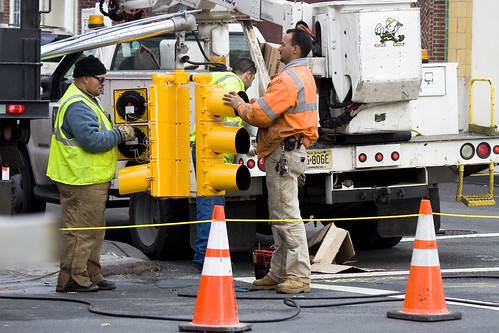
Broadway near Steinway Street – photo by Mitch Waxman
As your humble narrator scuttles from place to place, turning over rocks to see what blind albino abnormalities might lurk beneath, a significant amount of road construction is encountered. New York is always in a state of near collapse and an army of municipal and contractor labor is kept busy filling in the cracks. Conflicted over sneaking pictures of these folks, I nevertheless find them fascinating, for the high visibility colors they wear excite the eye.
from workzonesafety.org
Title: ANSI/ISEA 107-2004: Revised American National Standard for High-Visibility Safety Apparel and HeadwearAbstract: This standard provides a uniform, authoritative guide for the design, performance specifications, and use of high-visibility and reflective apparel including vests, jackets, bib/jumpsuit coveralls, trousers and harnesses. Garments that meet this standard can be worn 24 hours a day to provide users with a high level of conspicuity through the use of combined fluorescent and retroreflective materials. The revised version of the standard expands the product coverage to include high-visibility headwear. It also contains additional testing procedures for knitted fabrics used as background material, and eliminates tests from the previous edition that added no value. Publisher: International Safety Equipment Association

Third Avenue Manhattan – photo by Mitch Waxman
If it won’t blind or distract the crews, don’t forget that this is heavy industry and quite dangerous work, try turning on the camera flash when photographing them. The reflective fabrics, technically retroreflective fabrics (which function like a Cat’s eyeshine), will blaze up and be the brightest point in the photo. New York City street signs also function in a similar fashion, and even the weakest flash will light them up from blocks away. Try it, especially on a dark and stormy day, the effects are somewhat unpredictable and often produce a prismatic and surreal photo.
from simplifiedsafety.org
Class 1: needs to be conspicuous and use retroreflective materials not less than 25mm in width.
- Used when workers are well separated from traffic
- Vehicle speeds of less than 25 mph
- Parking attendants
- Shopping cart retrievers
- Warehouse workers
- Roadside/sidewalk maintenance workers
- Delivery vehicle drivers
Class 2: maintains superior visibility and are more conspicuous than the Class 1 garments. Minimum width of retroreflective material used on these is not less than 35mm.
- Used when workers are on or near roadways
- Vehicle speeds of 25 to 50 mph
- Roadway construction workers
- Utility workers
- Survey crews
- Law enforcement personnel
- Crossing guards
- High-volume parking lot or toll-gate attendants
- Airport baggage handlers and ground crews
- Railway workers
- Emergency response personnel
- Accident site investigators
Class 3: has greatest visibility. Maintains more retroreflective material than Class 2 and must have sleeves with retroreflective material between the shoulders and elbows. Not less than 50mm wide of retroreflective material.
- Used for workers in high risk situations
- Allows them to be seen from a minimum distance of 1,280 ft.
- Vehicle speeds of greater than 50 mph
- Roadway construction workers
- Utility workers
- Survey crews
- Emergency response personnel

31st street, Astoria – photo by Mitch Waxman
All of the municipal and construction rules are meant to conform to the national OSHA specifications, but individual city organizations have their own wrinkle on safety gear. MTA workers, for instance, are often observed wearing goggles and ear protection as they work. No doubt, this is due to individual union agreements and task specific requirements.
from nysdot.gov
All DOT employees, contractor employees and visitors must wear protective helmets and high visibility construction apparel while working within a highway right of way or contract limits. Flaggers must wear high visibility traffic control apparel when directing or spotting traffic. High-visibility apparel is not required for employees and visitors when they are within a completely enclosed cab constructed of steel frame and glass, or inside a motor vehicle.

37th avenue, Dutch Kills – photo by Mitch Waxman
NYFD, of course, has the most stringent series of rules for its crews. In the shot above, a 5 alarm fire at an industrial warehouse was belching black smoke into the street, but the firefighters are clearly identifiable through the murk- due to camera flash. Be careful around NYFD however, as they’re kind of busy people, and you don’t want to distract them. Also, should there be any piezoelectric activated equipment in use- DO NOT use your flash for fear of activating something.
from fasny.com
Back in November of 2008, there was a lot of confusion about the use of high-visibility vests at roadway incidents due to a new Federal Highway Administration (FHWA) Rule. The new regulation, Rule 634, stated that “All workers within the right-of-way of a Federal-aid highway who are exposed either to traffic (vehicles using the highway for purposes of travel) or to construction equipment within the work area shall wear high-visibility safety apparel.”
That regulation created a dilemma for fire departments who were truly interested in protecting their personnel. The training classes and material used by the Emergency Responder Safety Institute (ERSI) for years has suggested the use of high-visibility garments for public safety personnel when working around traffic. NFPA 1500, the Firefighter Health and Safety Standard has included a requirement for firefighters to wear safety vests at traffic incidents in the last two most recent editions. NIOSH Line of Duty Death Investigations have also included recommendations for responders to wear highly visible flagger vests when exposed to moving traffic. In the fire service community it was generally understood that the vests were not appropriate personal protective equipment (PPE) for personnel who were actively engaged in firefighting operations because those garments are not designed for exposure to fire, heat flame or hazardous materials. Rule 634, as originally published however did not outline any exemptions for firefighters engaged in direct firefighting operations and that created the dilemma.

Bridge Plaza North, Queens Plaza – photo by Mitch Waxman
The shot above is fascinating to me, for reasons that have little to do with the safety equipment exhibited. The trench that this trio is working in is down by Queens Plaza, and the cutaway shows a historical record. Notice the top layer of asphalt, then two distinct layers of cobblestones, then dirt and rock fill. Asphalt- modern, cobbles 1- the construction of the Queensboro bridge and associated roadways, cobbles 2- the pre bridge street, dirt and fill- that’s a 19th century, civil war era street. I’d love to have an archaeologist sift through this trench, but there’s nothing of historic importance in Queens… according to the City.
Note- the Charles Rudebaker wiki quote below… I’m a little squirrely on this particular wikipedia entry. The only info I could find on Rudebaker, a New Yorker who supposedly invented the Traffic Cone, parroted this exact wording all across the net. Take it with a grain of salt, until I can find out more. It very well might be a “false meme” which is a sort of “Lulz“.
from wikipedia
Traffic cones, also called road cones, highway cones, safety cones or construction cones, are usually cone-shaped markers that are placed on roads or footpaths to temporarily redirect traffic in a safe manner. They are often used to create separation or merge lanes during road construction projects or automobile accidents, although heavier, more permanent markers or signs are used if the diversion is to stay in place for a long period of time.
Traffic cones were invented in 1914 by Charles P. Rudebaker. Although originally made of concrete, today’s versions are more commonly brightly-coloured thermoplastic or rubber cones. Not all traffic cones are conical. Pillar shaped movable bollards fulfil a similar function.
Don’t Know Jack

– photo by Mitch Waxman
Social obligations carried your humble narrator to the teeming streets of New York City’s famous Chinatown over the weekend, where this enigmatic ovum was observed. Alien to my eyes, this is a Jack Fruit, which is apparently one of asian cuisine’s most popular cultivars. Ignorant of the pacific tropics and their unique biota, my initial thought upon encountering the Jack Fruit was that it was a pod not unlike those utilized by the “Body Snatchers” during one of the many attempts to infiltrate human society by extraterrestrials during the 1950’s. Turns out that the Jack Fruit has been a part of the Asian diet since Ashoka the Great ruled India in 250 BC. The name Jack Fruit is derived from the Portuguese term for it- Jaca, after the Malaysian Chakka.
from wikipedia
The jackfruit (Artocarpus heterophyllus or A. heterophylla) is a species of tree in the mulberry family (Moraceae), which is native to parts of South and Southeast Asia. It is the national fruit of Bangladesh. It is called Kanthal (কাঁঠাল) in Bangla, Katahar (कटहर) in Nepali, Panasa (पनस) in Sanskrit, Katahal (कटहल) in Hindi, Nangka in Bahasa Indonesia,Halasu (ಹಲಸು) in Kannada, Panasa in Telugu, Pala in Tamil (is one of the three auspicious fruits of Tamil Nadu),Chakka in Malayalam language, Phanas in Marathi language and पणस in Konkani language. It is well suited to tropical lowlands. Its fruit is the largest tree borne fruit in the world, seldom less than about 25 cm (10 in) in diameter.

photo from wikipedia

– photo by Mitch Waxman
Armstrong, the Newtown Pentacle’s far eastern correspondent and expert on asian dessert items, simply states that the Jack Fruit is delicious. After a lifetime spent in New York City, with the limited compliment of American staple fruits (banana, citrus, apple, grape, peach, tomato) and their variants available, it is a real pleasure to see that the latest waves of immigration are expanding the variety of foodstuffs. I’ve seen other exotic and alien crops, Durrians and Yuca for example, on sale in Queens markets in the last couple of years. Even the local supermarket here in Astoria carries a remarkable variety.
from crfg.org
In Malaysia and India there are named types of fruit. One that has caused a lot of interest is Singapore, or Ceylon, a remarkable yearly bearer producing fruit in 18 months to 2-1/2 years from transplanting. The fruit is of medium size with small, fibrous carpels which are very sweet. It was introduced into India from Ceylon and planted extensively in 1949. Other excellent varieties are Safeda, Khaja, Bhusila, Bhadaiyan and Handia. In Australia, some of the varieties are: Galaxy, Fitzroy, Nahen, Cheenax, Kapa, Mutton, and Varikkha. None of these appear to be available in the US at this time.
Yet, even as the ever changing ethnic waves bring new and exciting comestibles with them, other traditions fall away. Corned Beef does not sweat in bar room steam tables anymore, I haven’t seen the Krishnas making rice and beans in Thompson Square Park for a while, Jewish Deli is virtually extinct, and…
What ever happened to the Bear Claw?
do they still exist in sticky sweetness, within the City of New York?
more on this Bear Claw business to come…
Manhattan Bridge Centennial Parade 3

Manhattan Bridge Tracks – photo by Mitch Waxman
Under normal conditions, the time it would take to even steady and focus my trusty Canon G10 would have seen your humble narrator reduced to juices by Brooklyn bound traffic.
Directly after the Manhattan Bridge Centennial Parade, I had a good half hour or so to just wander around the roadway (in the company of city officials and with NYPD everywhere) and just take pictures, which was kind of surreal. In the age of the Terror Wars, whose only victor will be the side that scares the other more, such access is rare.
A similar experience was had at Queensboro Bridge, several months ago, and upon the many Working Harbor Committee voyages I attended over the summer and fall.

Brooklyn Bound Manhattan Bridge- photo by Mitch Waxman
A curious defect has emerged after a year of carrying my trusty Canon G10. The lens shutters seem to be less than a tenth of a millimeter too close to the lens, and over time, symmetrical scratches have scribed into the glass. You can see one of them catching the sun in the top of the shot above. These scratches are at the wide angle, and a tiny zoom-in eliminates their effect, but regardless- the thing goes back to Canon this week for repairs- hopefully on warranty. Despite this defect, this is one great camera, whose only real weakness is in low light. Recommended.

Empire State from Manhattan Bridge – photo by Mitch Waxman

Empty Manhattan Bridge roadway perspective, facing infinite Brooklyn – photo by Mitch Waxman

Manhattan Bridge cable perspective, facing infinite Brooklyn – photo by Mitch Waxman

Manhattan Bridge disturbing rust – photo by Mitch Waxman

Manhattan Bridge Centennial Parade Fireworks Show – photo by Mitch Waxman
Later that night, incontrovertibly next to the Williamsburg Bridge in a Lower East Side Manhattan Park, a scheduled fireworks show was performed to celebrate the Bridge Centennial. Additionally, musicians plied their arts as did political speakers.

Manhattan Bridge Centennial Parade Fireworks Show – photo by Mitch Waxman
I won’t bore you with a lot of fireworks, if you could use some shells bursting on high, click over to our flickr page and check them out.
and just as a note: this is Wright Brothers Day is the USA.
Manhattan Bridge Centennial Parade 2

– photo by Mitch Waxman
Both sides of the Manhattan Bridge Centennial parade joined at the Podium, politicians and dignitaries working the crowd. Taking my Parade marshall duties seriously, I threaded back and forth through the crowd reminding attendees to stay away from the edge of the bridge. I missed most of the ceremony.
at theboweryboys.blogspot.com, an immensely satisfying podcast is offered, and they’ve posted this photo of the Bridge under construction.

– photo by Mitch Waxman
The United States Merchant Marine Corps Marching Band (and others) performed, and as the festivities began to congeal around the podium, I was free to take some photos again.
Although I stand by my creed, that DUMBO is the stupidest real estate term EVER, a pretty cool blog about the burgeoning south Brooklyn waterfront scene, called dumbonyc.com can be accessed by clicking here.

– photo by Mitch Waxman
As mentioned in an earlier post, a large number of the attendants were Cantonese speakers, which presented a problem for Parade Marshalls. A chinese friend enlisted as a marshall pronounced “I’m from Singapore, we speak english there”. Luckily, an Irishman from San Francisco was available.
bryanjoiner.com muses on the psychological impact of the manhattan Bridge’s “color”- click here.
There’s something that’s never quite sat right with me about it, and I could never put my finger on it. It dwarfs the Brooklyn Bridge—its smaller, older brother—in stature, but that’s about all. The Brooklyn Bridge is a part of the American consciousness; the Manhattan Bridge just goes to Chinatown. There are no marriage proposals on the Manhattan Bridge, though I wouldn’t be surprised if divorces were finalized there.

– photo by Mitch Waxman
Progeny of the degenerate Californian “Bay area”, my pal Frandy speaks a surprising variety of languages, far more than the normal Art Director or Graphic Designer, and I was relieved when he volunteered to help out with the bridge effort. His Cantonese is limited, but contained the phrase “don’t get too close to the edge”.
As always, the “book” on the Manhattan Bridge was written long before Newtown Pentacle offered its first post– by the omnipresent forgotten-ny.com. Click here for Forgotten Tour 34.

– photo by Mitch Waxman
At the end of the Podium presentations and speech making, a NYFD Fireboat turned up, and began a display of Red, White, and Blue geysering on the East River.
That’s the Kevin C. Kane – FDNY Marine 6. Click Here to read about its role in fighting the fires at the World Trade Center at marinefirefighting.com

– photo by Mitch Waxman
The crew of the Kevin C. Kane rescued a jumper (from the Brooklyn Bridge) who SURVIVED the drop just a few months ago in Summer of 2009. brooklynheightsblog.com has the story- click here.
from limarc.org
Kevin C. Kane, N2MEI, was a New York City Firefighter, and a member of LI-MARC. Early on the morning of September 12, 1991, Kevin responded with Engine Com-pany 236 to a fire in at an abandoned apartment house in the East New York section ofBrooklyn. Despite the knowledge that there might not be enough hose to reach all parts ofthe house, Kevin and his fellow firefighters entered the building in search of victims.Shortly thereafter, a section of burning ceiling fell on Kevin. Despite the frantic efforts ofhis colleagues, they were not able to reach him. Eventually he managed to jump from a win-dow, into the bucket of a fire truck. Having been burned over most of his body, he died thenext day. In his honor, The NYFD named a fireboat The Kevin C. Kane, and created the Kevin C.Kane Medal for bravery.

– photo by Mitch Waxman
Part 3 of the Parade is forthcoming, replete with some of the “artsy-fartsy” shots I was able to get on a traffic free Manhattan Bridge while the parade was clearing out and I was wearing an orange DOT vest.
More tomorrow…
and- just as a note- today is the anniversary of the Boston Tea Party.
Manhattan Bridge Centennial Parade 1

– photo by Mitch Waxman
So, on October 4th, a parade and fireworks show was produced for the Manhattan Bridge Centennial by the NYC Bridge Centennial Commission.
Having been involved with the Queensboro Centennial at the start of the summer, when I was asked to help out, I jumped at the chance and suddenly- I was a parade marshall. Several of my friends were drafted into service as well, including the redoubtable Mike Olshan (who is the safety vested and distant photographer seen in the shots above and below).
from wikipedia
The Manhattan Bridge is a suspension bridge that crosses the East River in New York City, connecting Lower Manhattan (at Canal Street) with Brooklyn (at Flatbush Avenue Extension) on Long Island. It was the last of the three suspension bridges built across the lower East River, following the Brooklyn and the Williamsburg bridges. The bridge was opened to traffic on December 31, 1909 and was designed and built by Polish bridge engineer Ralph Modjeski with the deflection cables designed by Leon Moisseiff, who later designed the infamous original Tacoma Narrows Bridge that opened and collapsed in 1940. It has four vehicle lanes on the upper level (split between two roadways). The lower level has three lanes, four subway tracks, a walkway and a bikeway. The upper level, originally used for streetcars, has two lanes in each direction, and the lower level is one-way and has three lanes in peak direction. It once carried New York State Route 27 and later was planned to carry Interstate 478. No tolls are charged for motor vehicles to use Manhattan Bridge.

– photo by Mitch Waxman
A relict of the countercultural milieu of the 60’s and 70’s (as I am an atavist survival of the 70’s and 80’s), amongst other things, Coney Island Mike is the Newtown Pentacle’s go-to man on all things Red Hook and is associated with one of Forgotten-NY’s great finds- the Yellow Submarine at Coney Island Creek. This isn’t why I call him “Coney Island Mike”, the real reason lies in a filthy and obscene series of office jokes which are not worth repeating. A nocturne like myself, Mike was lured into the early morning sunlight by a promise of photographic access to a traffic free bridge before and upon completion of our function as Marshalls.
from nycroads.com
PLANNING “SUSPENSION BRIDGE NUMBER 3”: The Manhattan Bridge was first planned as a traditional wire-cable suspension bridge to be used exclusively by trains. In 1892, elevated railway magnate Frederick Uhlmann proposed this span just north of the present site of the Manhattan Bridge. The bridge was planned in conjunction with another one of his proposals, the Williamsburg Bridge. While Uhlmann’s railroad bridge was never constructed, the Williamsburg Bridge was approved in 1895 to handle mixed traffic.

– photo by Mitch Waxman
Marshall duties are loosely defined as “keep people away from the edge of the bridge”, “keep the crowd moving on schedule”, and “if you have a problem, hand it over to NYPD”. This is the second time that I’ve witnessed how the City organizes this sort of event- the elaborate choreography of the DOT, NYPD’s matter of fact event scheduling, and the thousands of bureaucratic details which were handled by the Bridge Committee’s capable directors.
from nyc.gov
Daily, the bridge accommodates some 75,000 vehicles, 320,000 mass transit riders and 3000 pedestrians/bicyclists between Manhattan and Brooklyn. It supports seven lanes of vehicular traffic as well as four subway tracks upon which four transit train lines operate.

– photo by Mitch Waxman
The Parade is still an hour or so off, and everyone you see gathered in the shot above is either a Parade Marshall, NYPD, DOT, or one of the dignitaries marching in the Parade. Also, 2 “classic cars” were arranged to carry either Political Leaders or members of the podium presentations who were unable to walk the steep incline of the bridge due to age or infirmity.
from nymag.com
On July 23, a two-minute time-lapse video of the Manhattan Bridge, undulating under traffic, appeared on YouTube. It got 140,000 hits in the first week, and the media, always short on engineering majors, gave it lots of play. WPIX news aired a clip, and Morning Joe played it to uneasy oohs and aahs from its co-hosts. The website Gawker posted it under the headline “The Manhattan Bridge Is Falling Down” (later clarifying that it had been a joke). In fact, suspension bridges are supposed to move, in multiple dimensions. The century-old Manhattan Bridge is in the final stages of a rehab that began in 1982, when it was actually in danger of collapsing. It’ll bounce, without incident, for years to come.

– photo by Mitch Waxman
The crowd began to thicken around Canal street at the corner of Bowery. Complicating the Marshall duties would be the large number of Senior Citizens from Chinatown, who- we were told- would speak absolutely no english at all. Nobody could tell me how to say “stay away from the edge of the bridge” in Cantonese. Concurrently, gathering steam on the Brooklyn side of the bridge, the other half of the parade was just beginning their journey, but our trip to the podium was shorter than theirs, so we left a bit later.
from gothamist.com
A helicopter and police boat rushed to the East River near the Main Street section of Brooklyn Bridge Park this afternoon, where a man miraculously survived after jumping from the Manhattan Bridge. A firefighter at the scene in DUMBO told us it was believed to be a suicide attempt, but it was unclear how the man had survived the fall into the icy waters and was still able to walk to a waiting ambulance.

– photo by Mitch Waxman
Finally happened. There’s my shadow, dead center, in the above shots. Photographic evidence that I exist, or at least that I’m really still alive and not just some disembodied “point of view” floating around New York. It’s an odd thing, I can take a photo of a totally reflective surface and not appear in the shot, but I don’t do it on purpose. In all of these shots I post, such shadows or reflections appear in maybe 5 shots, only once on purpose (I needed an “about the artist” shot for something, and shot my shadow draping over an LIC sewer).
from timeout.com
It has no song celebrating a groovy stroll across its length, nor has it inspired literary reflections (although it is a popular suicide spot in Steve Martin’s 1984 movie The Lonely Guy). The Manhattan Bridge may lack the lore of the Brooklyn and Queensboro, but viewed from a flattering angle, the sweeping steel suspension bridge is undeniably beautiful. The impressive stone archway on the Manhattan side, modeled on the 17th-century Porte St-Denis in Paris, was designed by New York Public Library architects Carrère and Hastings, while the Brooklyn approach once boasted allegorical statues representing the two boroughs designed by Lincoln Memorial sculptor Daniel Chester French (they now reside in the Brooklyn Museum).

(full disclosure- above shot was from a couple of days earlier) – photo by Mitch Waxman
The last paragraph actually sounds crazy to me, can’t imagine what speculations it unleashes in you- Lords and Ladies of Newtown. As I’ve mentioned in the past, your humble narrator is all ‘effed up, and the Manhattan Bridge has some actual personal history associated with it. I will admit that I was honored to be part of this event, and happy that I got to share it with several friends, old and new.
Then, the drums rolled…
from nycsubway.org
The Manhattan side of the subway tracks originally were connected as follows: The north side tracks to the BMT Broadway Subway at Canal Street; the south side tracks to the BMT Nassau Street subway north of Chambers Street. The south side tracks were used mostly during rush hour for services provided via the Nassau Street loop (which connected the BMT 4th Avenue and BMT Brighton Line to Manhattan via the Manhattan Bridge on the north end and the Montague Street tunnel on the south end). The configuration of the tracks at the Manhattan side was changed in 1967 as part of a large project known as the Chrystie Street connection. This project severed the connection to the under-used Nassau Street line on the south side. The south side tracks were then connected to the BMT Broadway Line, and the north side tracks connected via new construction to the IND 6th Avenue Line.

– photo by Mitch Waxman
And, this being my second Parade, I can be confident in saying- when the drums roll and the band (in this case the NY Chinese School Marching Band) marches, the Parade is begun.
More tomorrow…
and- just as a note- today is the anniversary of the Ratification of the United States Bill of Rights in 1791.


 The Newtown Pentacle