Archive for the ‘Photowalk’ Category
luminous aether
“follow” me on Twitter at @newtownpentacle

– photo by Mitch Waxman
Maritime Sunday is suspended this week in honor of St. Patrick’s day. Last week, I had an opportunity to wave my camera around at St. Patrick’s Old Cathedral in Manhattan, and was allowed to photograph the Irish Language Mass they were conducting. Here’s what I saw…
from oldcathedral.org
Designed by architect Joseph Francois Mangin, St. Patrick’s has great dignity and character in its restrained simplicity. Her sidewalls rise to a height of 75 feet, and the inner vault is 85 feet high. The church is over 120 feet long and 80 feet wide. Near the west wall stands the huge marble altar surrounded by an ornately carved, gold leaf reredos.

– photo by Mitch Waxman
To begin with, these shots are a combination of tripod and handheld. It’s not that bright in the cathedral, but it is lit like a movie set by the interaction of sunlight and stained glass which is augmented by well placed electrical fixtures. Sculptural elements and motifs are plentiful, and it is easy to get lost in photographing small details.
from wikipedia
In 1836, the cathedral was the subject of an attempted sack after tensions between Irish Catholics and anti-Catholic Know-Nothing nativists led to a number of riots and other physical confrontations. The situation worsened when a brain-injured young woman wrote a book telling her “true” story – a Protestant girl who converted to Catholicism, and was then forced by nuns to have sex with priests, with the resulting children being baptized then killed horribly. Despite the book being debunked by a mildly anti-Catholic magazine editor, nativist anger at the story resulted in a decision to attack the cathedral. Loopholes were cut in the church’s outer walls, which had just recently been built, and the building was defended from the rioters with muskets

– photo by Mitch Waxman
Long has one enjoyed the pursuit of photographing ritual spaces of all kinds around the City of New York, but fascination with the era surrounding this cathedral lent a certain nervous excitement to my task. This was the “House of Dagger John“, after all, and its connections with Calvary Cemetery along the Newtown Creek have given it a special status in my eyes.
from wikipedia
John Joseph Hughes (June 24, 1797 – January 3, 1864), was an Irish-born clergyman of the Roman Catholic Church. He was the fourth Bishop and first Archbishop of the Archdiocese of New York, serving between 1842 and his death in 1864.

– photo by Mitch Waxman
The plan for the service (and one must remember that a humble narrator was raised in the Hebrew faith as I stumble through this part- I’m not being vague, sarcastic, or anti anything- rather I’m Jewish and have no real idea what the meshuggenah goyem do) was for the Mass to be vocalized in the Irish Language. There was an Organist and a Cantor performing music, and the adherents stood up and sat back down a couple of times while the Priests said things (in Irish).
from wikipedia
Irish was the predominant language of the Irish people for most of their recorded history, and they brought their Gaelic speech with them to other countries, notably Scotland and the Isle of Man, where it gave rise to Scottish Gaelic and Manx. It has the oldest vernacular literature in Western Europe. In the Elizabethan era the Gaelic language was viewed as something barbarian and as a threat to all things English in Ireland. Consequently, it began to decline under English and British rule after the seventeenth century. The nineteenth century saw a dramatic decrease in the number of speakers especially after the Great Famine of 1845–1852 (where Ireland lost 20–25% of its population either to emigration or death). Irish-speaking areas were especially hit hard. By the end of British rule, the language was spoken by less than 15% of the national population. Since then, Irish speakers have been in the minority except in areas collectively known as the Gaeltacht.

– photo by Mitch Waxman
I met the fellow on the left earlier in the day, one Msgr. Donald Sakano, who was a very nice fellow. He and the other Priests performed several actions while saying things which I’m sure would be familiar to adherents of the Roman Catholic Church, or at least Irish speakers, but not to this Jewish kid from Brooklyn.
The gaps in my knowledge just astound sometimes, actually, how can I not know every single detail of this altar ceremony?
from urbanomnibus.net
Monsignor Donald Sakano is one of those urbanists who certainly possesses a singular perspective, forged from his work at the intersection of ministry, social work and affordable housing development and policy.
For the past four years, as Pastor of the Basilica of Saint Patrick’s Old Cathedral, he has presided over the restoration and transformation of Old Saint Patrick’s buildings — which include The Old Cathedral, the school, the Parish House, St. Michael’s Chapel, the Youth Center and the iconic wall — into a series of community facilities available for outreach, assembly and cultural events, such as our benefit event, which will begin at the St. Patrick’s Youth Center at 268 Mulberry Street.

– photo by Mitch Waxman
It’s funny, as I can bore you to death about Arius, Origen, or Loyola. Want to talk about the Renaissance, Reformation, or Second Great Awakening- I’m all in. Recognizing the common tools and long practiced performance of catholic mass?
No.
I can describe the effects of nearly all the known forms of kryptonite, however.
from wikipedia
The Roman Missal contains the prayers, antiphons and rubrics of the Mass. Earlier editions also contained the Scripture readings, which were then fewer in number. The latest edition of the Roman Missal gives the normal (“ordinary”) form of Mass in the Roman Rite. But, in accordance with the conditions laid down in the motu proprio Summorum Pontificum of 7 July 2007, the 1962 edition of the Roman Missal, the latest of the editions that give what is known as the Tridentine Mass, may be used as an extraordinary form of celebrating the Roman Rite Mass.

– photo by Mitch Waxman
The ceremony continued, and I decided that maybe it wouldn’t be that terrible to get lost in some of that architectural detail for a frame or two, and opened up the shutter for a long exposure. The big difficulty encountered, of course, were the dichotomous ambient conditions whose luminous contrast stretched into narrow bands of shadow and light.
from wikipedia
The Eucharistic Prayer, “the centre and high point of the entire celebration”, then begins with a dialogue between priest and people. This dialogue opens with the normal liturgical greeting, “The Lord be with you”, but in view of the special solemnity of the rite now beginning, the priest then exhorts the people: “Lift up your hearts.” The people respond with: “We lift them up to the Lord.” The priest then introduces the great theme of the Eucharist, a word originating in the Greek word for giving thanks: “Let us give thanks to the Lord, our God,” he says. The congregation joins in this sentiment, saying: “It is right and just.”
The priest then continues with one of many Eucharistic Prayer prefaces, which lead to the Sanctus acclamation: “Holy, Holy, Holy Lord God of hosts. Heaven and earth are full of your glory. Hosanna in the highest. Blessed is he who comes in the name of the Lord. Hosanna in the highest.”

– photo by Mitch Waxman
Following the moment depicted above, the three priests dispersed to the heads of the aisles, whereupon celebrants of the faith formed lines whose reward seemed to be a small cookie or cracker. One presumes that this is “the host” which figures so prominently in the Catholic Mass.
How am I supposed to know, I’m Jewish- by me it’s a cookie.
Happy St. Patrick’s day- and thanks to Jim Garrity and Msgr. Sakano for allowing so poor a specimen as myself to spend the day with them.
from wikipedia
The absence of snakes in Ireland gave rise to the legend that they had all been banished by St. Patrick. chasing them into the sea after they attacked him during a 40-day fast he was undertaking on top of a hill. This hagiographic theme draws on the mythography of the staff of the prophet Moses. In Exodus 7:8–7:13, Moses and Aaron use their staffs in their struggle with Pharaoh’s sorcerers, the staffs of each side morphing into snakes. Aaron’s snake-staff prevails by consuming the other snakes.
Project Firebox 63
“follow” me on Twitter at @newtownpentacle

– photo by Mitch Waxman
In a sun drunk section of Brooklyn called Greenpoint, there is a corner called Franklin and Green. On this corner is a firebox, which stands nearby the street plumbing that would allow a fire to be fought. This network of alarm boxes and pipes, ultimately, are the reason that structures over two or three stories could be built here in the first place. The density of residential life in Greenpoint was, and is, directly tied to the response of the local Fire brigades. Generally speaking, the older the firebox, the deeper the neighborhood’s roots go. This is a very old firebox.

– photo by Mitch Waxman
On the street facing side of the thing is the embossed legend of “H.P. TEL”. The inscription has been discussed here, at your Newtown Pentacle, before. Check out “Project Firebox 51” and or “Project Firebox 12” for more on the phenomena.
curiously dislocated
“follow” me on Twitter at @newtownpentacle
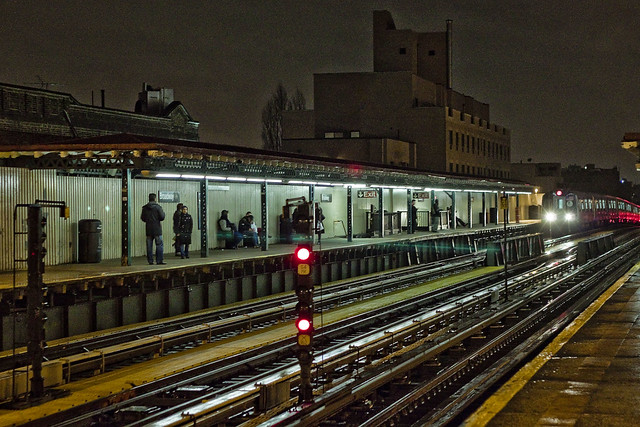
– photo by Mitch Waxman
Although it is the Mother of harlots, entering Manhattan on a regular basis is periodically required of your humble narrator, for none may trade nor sell in the City of New York lest this borough’s mark is upon them. Usually this journey is accomplished along the subterranean R line, but often will one walk over to the elevated N line on the 31st street side of the neighborhood just to mix things up. You take the low road, I’ll take the high road, and I’ll be in midtown before ye…

– photo by Mitch Waxman
The Shining City, a place which your humble narrator actually lived for many years, has become lost in an inferior incarnation of itself. One does not long for the era of sin and fornication recently passed, it is the modern facade of the City which agitates. Many disagree with me, arguing for acceptance of a halcyon and quite modern era of progress and development which will eradicate the mistakes of prior centuries. All I can tell you, in retort, is that I don’t see many autochthonous smiles in Manhattan. Also, $9 is too much for a tuna sandwich.

– photo by Mitch Waxman
An echo chamber, things there are no longer hot, nor cold- rather they are lukewarm. Don’t get me wrong, there ain’t no mountain spring water running out here in Astoria neither, there are oodles of things wrong in Brooklyn and Queens. I’m sure the Bronx and …Staten Island… likely have some problems too. I’m just saying that we don’t export them, unlike the unsustainable island of Manhattan, and that I- for one- am a lot more comfortable and likelier to be smiling here in Queens.
curious noises
“follow” me on Twitter at @newtownpentacle

– photo by Mitch Waxman
Admission that Malthus was probably right in adopting a dire tone is offered, something which occurred to me while sitting in a dank concrete bunker and waiting interminably for a Manhattan bound Subway. The worst of all possible situations – alone with my own blasphemous and fever inducing thoughts. Racing phantasms leapt about behind my brow, as train after train exited Manhattan moving east. Each electrically powered chain of metal boxes which entered and left this dripping subterranean bunker seemed to be full of humans, but it is impossible to say with certainty who- or indeed “what”- might have been cradled within.
Finally, a cyclopean shape appeared in the distance of the cement corridor.

– photo by Mitch Waxman
Realization that the alloyed conveyance proceeding in the particular direction desired by one such as myself was at hand resulted in a humble narrator sitting uncomfortably amongst the many. Judgement and condemnation was surely brewing in their minds, as furtive glances revealed hostile stares. At the other end of the car were a group of teenagers, and I was reminded of media reports describing the peer group’s outré and often violent delinquency as well as rumors detailing their drug fueled rampages. The practice of running rampant is prevalent in the youth of these degenerate days, after all.
Toward the corner which I faced, an older woman was knitting, just a bit too nonchalantly for my taste.
Perspiration began to drip coldly down my back, which was fully hidden beneath a filthy black raincoat which smells of sewers and wood smoke, and my breathing became erratic.

– photo by Mitch Waxman
Imminent, waves of sudden panic eliminated my desire to enter the Shining City of Manhattan onboard this crowded contraption. One departed this underworld, carven into the marshy soils of Queens itself, to once more gaze upon the greasy skies of Long Island City. Standing in a small patch of transmission oil and shattered glass, as a castaway McDonalds bag found its wind blown course to my leg while some strange but obviously relieved inebriate urinated into a phone booth, calm reason once again overtook me. Home, at last.
Down in those concrete catacombs, how can one ever know what horrors are of the mind alone or hint at what there may be that is lurking down there?
inexorably crawling
“follow” me on Twitter at @newtownpentacle

– photo by Mitch Waxman
One is fascinated by the automotive corridor through western Queens that is known as Northern Blvd. It is literally an “automotive corridor” as in the sense of it being a busy vehicular roadway, but it is also an industrial corridor which speaks of a forgotten moment in NY history when automobiles were manufactured in the five boroughs. This is largely a start of the twentieth century sort of thing, of course, but it was a pretty big deal back in the 1920’s.
That’s before the American auto industry consolidated itself around the City of Detroit, of course.

– photo by Mitch Waxman
Standard Motor Products is still located at the corner of Steinway/39th street and Northern, of course, but they don’t make anything here anymore- it’s just offices. At that, SMP only uses a small section of their former factory, which famously carries a modern day rooftop farm at its crown. This “history of the automobile industry in Queens” thing is a topic which has been gathering steam and certain interest for your humble narrator of late, but my research has only just begun and intelligent presentation of fact is still far off in the future.

– photo by Mitch Waxman
There is still a significant amount of auto related commerce going on around these parts, but it’s all about sales these days, not manufacture. An incalculable number of used… sorry… industry parlance is “pre owned”… cars are available along that stretch of Northern Blvd. which sits happily between Queens Plaza and the Grand Central Parkway. Something I’m working on, one of many background tasks and research projects performed and underway here at Newtown Pentacle HQ.


 The Newtown Pentacle