Archive for the ‘Pickman’ Category
Vanderbilt Mansion 2

– photo by Mitch Waxman
William Kissam Vanderbilt II’s great grandfather was the richest man in the world, worth some $105 million in 1877. The upper estimate of what this would be worth in today’s currency would equate to roughly $180 billion dollars. Compare this with the estimate of John D. Rockefeller’s worth at the time of his death in modern terms- the equivalent of $663 billion, or the last Tsar of Russia who was worth approx. $300 billion.
from stfrancis.edu
Cornelius Vanderbilt (May 27, 1794-January 4, 1877) was an American steamship and railroad builder, executive, financier, and promoter. He was a man of boundless energy, and his acute business sense enabled him to outmaneuver his rivals. He left an estate of almost $100 million.
Vanderbilt was born to a poor family and quit school at the age of 11 to work for his father who was engaged in boating. When he turned 16 he persuaded his mother to give him $100 loan for a boat to start his first business. He opened a transport and freight service between New York City and Staten Island for eighteen cents a trip. He repaid the loan after the first year with an additional $1,000. He was rough in manners and developed a reputation for honesty. He charged reasonable prices and worked prodigiously.

– photo by Mitch Waxman
William Kissam Vanderbilt II’s grandfather inherited $100 million from his father- the Commodore. A railroad tycoon, he doubled his inheritance and also died as “the richest man in the world”.
William Kissam Vanderbilt II’s father inherited $55 million from his father and retired from the family business in 1903. After a nasty split with his wife (and mother of his two sons- Henry and Willie K.- her name was Alva Smith), the father retired to France to breed race horses and died in 1920.
from wikipedia
Vanderbilt’s first wife was Alva Erskine Smith (1853–1933), whom he married on April 20, 1875. Born in 1853 to a slave-owning Alabama family, she was the mother of his children and was instrumental in forcing their daughter Consuelo (1877–1964) to marry the 9th Duke of Marlborough in 1895. Not long after this, the Vanderbilts divorced and Alva married Oliver Hazard Perry Belmont.

– photo by Mitch Waxman
William Kissam Vanderbilt II had the well bred Vanderbilt instinct for spending the limitless fortune on houses of splendor and whimsical inspirations. He built a race track on Long Island, the first high speed road other than the Long Island Railroad. Fishermen and farmers, native to the area, commented that it was just so Willie K. could get back to the Eagle’s Nest from Manhattan quicker.
from wikipedia
The Long Island Motor Parkway (LIMP), also known as the Vanderbilt Parkway and Motor Parkway, was the first roadway designed for automobile use only.[2] It was privately built by William Kissam Vanderbilt with overpasses and bridges to remove intersections. It opened in 1908 as a toll road and closed in 1938 when it was taken over by the State of New York in lieu of back taxes. Parts of the parkway survive today in sections of other roadways and as a bicycle trail in Queens, New York.

– photo by Mitch Waxman
All around the property, a strange collection of buildings can be found. A planetarium with a Terra Cotta dome (which was actually an add on by the State of the New York in 1971, Vanderbilt needed no help imagining the heavens)…
from vanderbiltmuseum.org
The Vanderbilt Planetarium opened in 1971 on the grounds of the Vanderbilt estate, and it is the largest facility of its kind on Long Island. The Planetarium’s purpose is to provide visitors with information about the nighttime sky. The Planetarium’s main feature is the domed, 60-foot Sky Theater. The theater’s GOTO star projector can display the sun, moon, stars and planets. It also recreates celestial events during our various Sky Shows. The projector can simulate the heavens at any moment in time, from the distant past to the future, as it appeared from any place on Earth. The projector can show 11,369 stars, the Milky Way and several deep sky objects. This allows Planetarium staff to recreate the visible night sky, as seen under perfect conditions.

– photo by Mitch Waxman
And the Hall of Fishes.
also from vanderbiltmuseum.org
The 43-acre museum complex counts among its collections not only the Gold Coast-era mansion [1910-1936], a marine museum, natural history habitats, curator’s cottage, seaplane hangar, boathouse and numerous other estate features [gardens, fountains, balustrades and pools], but also marine and natural history specimens, house furnishings and fine arts, photographs and archives, and an extensive collection of ethnographic objects that make up the former William K. Vanderbilt II estate. A portion of today’s museum – the Hall of Fish – was actually opened to the public during Vanderbilt’s lifetime. Then, as now, the museum seeks to preserve and interpret artifacts that represent his life, collecting interests and intellectual legacy.

– photo by Mitch Waxman
Moorish rather than Spanish revival, the small museum forbids visitors to its second floor. Attendants and Curator alike claim that the structure is damaged by weather and the upper level is quite inhospitable to specimen and visitor alike.
from examiner.com
The first floor of the Hall of Fishes displays a large collection of mounted animals and marine specimens. The second floor contains hundreds of marine vertebrates and invertebrates. Many of the displayed marine forms are the only such specimens in existence, collected, identified, and named by Vanderbilt and his staff.

– photo by Mitch Waxman
Striking violations of architectural norms are witnessed here. Metalwork not dreamt of in the fevered mind of the hashish addict is observed. When queried, the posted guard described the madly fanciful use of iron as functional instead. Its fabricator and designer shows the skill of a Vesuvian cyclops.
from wikipedia
Samuel Yellin (1885–1940), American master blacksmith, was born in Galicia Poland where at the age of eleven he was apprenticed to an iron master. By the age of sixteen had had completed his apprenticeship. During that period he gained the nickname of “Devil”, both for his work habits and his sense of humor. Shortly after this he left Poland, traveling through Europe to England, where, in 1906, he departed for America.By 1907 he was taking classes at the Philadelphia Museum School of Industrial Art and within a year was teaching classes there, a position that he maintained until 1919.

– photo by Mitch Waxman
William Kissam Vanderbilt II- it is said- on one of his expeditions, was inspired by a church he had witnessed in coastal Guatemala which influenced the whimsical design of the Hall of Fishes.
A hybrid of wholesome Catholic iconography which had become fused with the atavist worship of some lost tribal sea god, its affect is disturbing. Decadent admixtures such as this speak to declining faith in one’s own culture, and seek legitimacy in a postmodern cocktail of Barbarian and Civilized themes.
from archive.org
The Vanderbilt Marine Museum is the privately owned depository of the marine collections of William K. Vanderbilt, Esquire, and is located on his country estate, “Eagle’s Nest,” Huntington, Long Island, New York. It contains extensive collections of natural history and ethnological specimens, all of which were personally collected by Mr. Vanderbilt, in various parts of the world, during the past thirty- odd years.
The scientific publications of the museum consist of a series of Bulletins, designed to disseminate results of research based on the marine zoological collections, every specimen of which was personally collected by Mr. Vanderbilt, during a series of cruises in his yachts, “Eagle,” “Ara” and “Alva.” Volume I of the Bulletin series consists of reports on the fishes collected during these cruises, by Dr. N. A. Borodin.
Volume II consists of a report on the Stomatopod and Brachyuran Crustacea of the cruises of the yachts “Eagle” and ” Ara,” 1921- 1928, by Lee Boone. Volume III consists of a report of the Crustacea : Anomura, Macrura, Schizopoda, Isopoda, Amphipoda, Mysidacea, Cirripedia and Copepoda of the “Eagle” and ” Ara” cruises, also by Lee Boone. Volume IV consists of a report of the Echinodermata, Coelenterata and Mollusca of the cruises of the yachts “Eagle” and “Ara,” 1921-1928, by Lee Boone. Volume V, the present report, consists of a report of the Crustacea : Stomatopoda and Brachyura of the World Cruise of the yacht “Alva,” 1931, by Lee Boone.

– photo by Mitch Waxman
Evocative statuary, owing much to pre columbian native influences, adorns the Vanderbilt collection’s housing. Hybridized and anthromorphized, the relief is icthyan, alien, and ripe with disturbing implications of some forgotten and ancestral memory.
from atlasobscura.com
The Vanderbilt Museum on Long Island, New York is housed in the mansion once owned by William K. Venderbilt II (the great-grandson of Cornelius Vanderbilt, founder of the New York Central Railroad and the Staten Island Ferry). “Willie K.” was an avid sailor and collector. He traveled around the globe, collecting artifacts and natural history specimens, some from the ocean floor by Willie K. himself, as he loved to dive.

– photo by Mitch Waxman
The entrance to the Hall of the fishes, guarded by a medieval vintage fortress door of sturdy arab or north african design, which is studded with iron spikes (that have had their points ground off, for safety reasons).
More tomorrow…
Vanderbilt Mansion 1

– photo by Mitch Waxman
There are unbearable realities hidden all around the Great City. Not so far from the center, geographically at least, is the North Shore of Long Island- the so called Gold Coast. Saturnian splendors adorn the palaces of these 19th century oligarchs, grand decoration and philosophical landscaping owe much to Versailles in these places, and many grand estates dot the coastline. For Pratt, and Whitney, and Dodge– who made their fortunes along the Newtown Creek- sylvan bliss was available on Long Island.
One of these country houses, The Eagle’s Nest, belonged to William Kissam Vanderbilt II- Willie K. to his friends and the press.
Yes, those Vanderbilts.

– photo by Mitch Waxman
Great-Grandson of the Commodore, Vanderbilt was an advocate and early promoter for the sport of automobile racing and was reported on by contemporaneous members of the nautical community as being quite an able mariner.
Born to unnatural splendor, the fortunate son nevertheless launched expeditions to previously unexplored oceanic destinations, creating in the process a splendid catalog of flora and fauna. What else he may have been searching for, and what trophies he held for his private amusement, is the subject of whispered innuendo. His personal navy included the purpose built steamships Tarantula, the Eagle, and especially the Alva and the Ara.

– photo by Mitch Waxman
A hired crew of artisans, engineers, and archaeologists accompanied Vanderbilt on his missions. They captured and preserved hundreds of specimens from the benthic depths, and experienced adventure best described as pulp fiction as they moved amongst the colonial holdings of Europe in the Pacific and along the savage coastlines of the equator. If this sounds like Indiana Jones, it should, just replace Indy with Bruce Wayne or Doc Savage and you’ve got the picture. One of the young Vanderbilt’s buddies was a guy named Howard Hughes.

– photo by Mitch Waxman
Vanderbilt collected, in addition to everything that flops and flaps in the cold darkness of the sea, what he termed “ethnographic” objects. There’s an actual Egyptian mummy in the house, as well as catalogs of other preserved animals. A disturbing heterogeneousness marks the collection, a connection between items and subjects seems missing. Across the inlet from his mansion- which was deep enough to accommodate ocean going ships at his private dock (there is also a sea plane dock down at the water’s edge), is the Northport Power Station. Its towers oddly mimic those found at the balustrade at the house’s entrance.

– photo by Mitch Waxman
The house itself, there are several buildings scattered around the property, is meant to evoke a spaniard’s taste. Such longing for their ancient masters ill befits a Dutch line such as the Vanderbilts, even as it plunged into 20th century degeneracy. Guides at the mansion explained that Vanderbilt was inspired by a church he had seen in Guatemala, which had influenced the design and motif of the entire complex. Vanderbilt was overcome by icthyan motif, one pregnant with hideous implications.

– photo by Mitch Waxman
His city address was 666 fifth avenue, part of the Vanderbilt continuum of mansions present along that stretch of the great thoroughfare, and he took up his ancestral responsibility and assumed a leadership role at the New York Central Railroad.
After the death of his father, Willie K. became known as William K. Vanderbilt II, one of America’s richest and most powerful men. His son, an adventurer in his own right- William K. Vanderbilt III- died in a mysterious auto accident returning from the family estate in Florida- where another fleet of research vessels and another unique collection was maintained.

– photo by Mitch Waxman
When I heard that the first annual Obscura Day tours were going on, and that the New York leg would be visiting the Eagle’s Nest, our Lady of the Pentacle and I jumped at the chance. We travelled via the LIRR, to meet Willie K.
More tomorrow.
Hudson River
Another of those crazy days, I was invited to ride along on the yacht Manhattan recently, as it made its journey home to Scarano Boatbuilders in Albany for a checkup and scheduled maintenance. The day was unfortunately misty, but the slideshow will show you what I saw. There’s a couple of sequences in here which will get the full treatment- Esopus Island for instance- but that’s way off in the future. Right now, check out a trip from Manhattan to Albany via the Hudson River.
City of Marble and Beryl

– photo by Mitch Waxman
Note: One of those things that your humble narrator is guilty of is a tendency, when confronted with something alien or unknown, to “fill in the blanks” via an inexact mixing of logical supposition and impressionist reasoning. The opposite of exactitude, this can result in wild ideas and false assumptions being presented and accepted as fact. I would love to tell you which cultic group these artifacts belong to- but the fact is that I just don’t know. Certain assumptions can be hazarded, based on cursory resemblance and observed phenomena, but they will be guesses. Don’t assume my interpretation of things is correct.
Witness, then, what I observed in St. Michael’s Cemetery on the Saturday before Easter- April 3rd, 2010- right about here.

– photo by Mitch Waxman
In St. Michael’s, there is a hill which faces East and whose tombstones are very old. The graves are in a state of disrepair, and the stones are found to be in a ruined state. This is no fault of the Cemetery, which maintains its grounds in a meticulous fashion, instead it is merely time and weather which have worked their havoc on the monuments. Perambulating through the grounds on Saturday with Our Lady of the Pentacle, we found this scene.

– photo by Mitch Waxman
A variety of Afro-Cuban syncretic faiths use similar iconography, but the one which most of the english speaking community is passingly familiar with is called Santeria (aka Regla de Ocha, La Regla Lucumi, or Lukumi). This appeared to be Santeria to me at first- because of the particular color scheme of the candles (red white and blue) and the co-mingling of coinage and sacrificial bones. But the Santeria folks generally do their thing indoors, in a ritual space consecrated and blessed by their own padrinos, just like the Catholics. Graveyards are usually avoided for rituals as they are negative places.

– photo by Mitch Waxman
My observation has been that the local latino populations in Astoria tend to be South rather than Central American, and the geographic heritage of Santeria is Caribbean and Central American. Afro-Cuban religion sprang up amongst the African Slaves brought to the New World to work the sugar and tobacco fields who were forced to adopt Roman Catholicism. Voodoo in Haiti and Louisiana, Hoodoo in the American South- all products of the French empire- with Santeria, Obeah, and Palo progeny of the Spanish.
The other great Catholic nation that held huge numbers of west africans as livestock was Portugal, and it did so in Brazil- where Umbanda, Candomblé, Macumba, and Quimbanda originate. Brazil is in South America, of course, and there are tremendous populations of Brazilians living nearby St. Michael’s in surrounding Astoria. This is some of that logical supposition I warned you about…

– photo by Mitch Waxman
Folk magic sites like this raise the ire of Eurasian morals, as ritual animal sacrifice is kept out of sight in our modern communities, and commoditized as Kosher or Halal or Organic meat. Blood sacrifice and submission to cultural norms, from circumcision to ear piercings to the elaborate face paint called “cosmetics”, are part of our daily lives. This sort of visceral aftereffect of some unfortunate avian’s end, however, is disturbing. No less though, than a crucifixion or any other blood ritual.

– photo by Mitch Waxman
One of the many ridiculous totems tucked away in my jacket pocket is a small magnetic compass. When I began these long walks around what I would someday call the Newtown Pentacle, it served me well, and today it revealed that this ritual space was lined up exactly on the cardinal points of my trusty little friend.
The scattering of bottles, bones, coins, and candles sits east of the stone which is aligned north south in the long dimension, and its anterior face is west facing. This will become increasingly important.
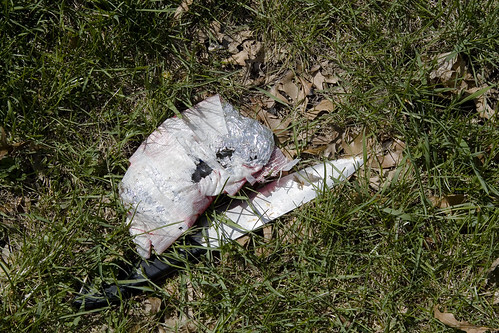
– photo by Mitch Waxman
This little package and knife are north east of the monument which I’ll be referring to as an altar. I did not open it, of course, it is against Newtown Pentacle policy to actually touch any of the odd things I come across, like the Pulaski Bridge, with bare skin. This whole neighborhood could use a good scrub, if you ask me.

– photo by Mitch Waxman
As always, if you click any of these images- a new window will open up its Flickr Page. Clicking the “all sizes” button found there will take you to progressively larger incarnations- all the way up to “actual pixels”. Check these out, I’ve spent some time trying to figure out what’s inside of the package. Do any of you sharp eyed Ladies and Lords of Newtown out there wish to hazard a guess? Use the “leave a comment” link.

– photo by Mitch Waxman
Seeing the blade and little kidney shaped package gave the whole scene a somewhat sinister air, and that’s when I remembered to check what else might be found on the cardinal meridians of the compass.

– photo by Mitch Waxman
The western facing of the altar sits at the pinnacle of a muddy ridge, which bears much subsidence. The underpinnings of the stone, and declination of the hill itself, fall away rapidly. These candles were observed.

– photo by Mitch Waxman
Nothing special about one of them, the other was unusual. Both red.

– photo by Mitch Waxman
The west facing side of the scene, from the bottom of the little hill. Note the tumbled and disorganized state of the masonry. North is to your left, south to the right.

– photo by Mitch Waxman
Moving north, a white candle .

– photo by Mitch Waxman
Back on top of the hill, directly east of the white candle above, and north of the main altar.

– photo by Mitch Waxman
A green and a pink candle on a dish of “some quality”.

– photo by Mitch Waxman
West of altar, a tumbled monument, with odd etchings on it. Can this be some sort of language?

– photo by Mitch Waxman
South of altar, west side of hill, a plastic bottle with some sort of red/brown liquid in it.

– photo by Mitch Waxman
Notice that the ground is depressed here, as if something very heavy- like a tombstone- had been moved recently.

– photo by Mitch Waxman
Just at the other end of the divot was this foil wrapped bottle which looked like it had been in the ground for a long time. Notice how the moss grows right up to it.

– photo by Mitch Waxman
Top of hill, south side, looking north across site. There are feathers scattered around the grass, mainly just north of the altar. Click here for a flickr page which shows some detail of the feathers.

– photo by Mitch Waxman
There was also this upside down cross.
Newtown Creek, and the Mountains of Madness

– photo by Mitch Waxman
A Friday, on March 19th the Hermetic Hungarian had left his laboratory workshop (a set of rooms on Manhattan’s decadent Upper West Side where he is exploring the deeper meanings and implications of esoteric 19th century clockworks) and ventured forth to Newtown.
The Hermetic Hungarian, referred to as HH from this point on, is a pale and sickly genius who has been intrigued by the presence of certain atavist religions and the persistence of modern adherents to these sects who remain extant along the poison shores surrounding an ancient industrial center called the Newtown Creek. HH had procured an automobile for the day’s exertions- as his fragile health precludes him from the long walks favored by your humble narrator which are so pedantically detailed at this- your Newtown Pentacle.

– photo by Mitch Waxman
Returning from a day of exploration, which first described the extensive branching of the transportation network referred to as “The Great Machine“, we proceeded to the currently undefended border of Maspeth and storied Greenpoint and crossed the Grand Avenue Bridge. HH was searching for evidences of a grandiose clockwork mechanism which long hours of research and supposition have led him to believe existed in the days of Trolley and Rail. Influenced by his metaphysical beliefs, which are both Hasidic and Buddhist in nature, the HH’s itinerary required his trip to be brief- and after spending an afternoon exploring the ancient climes of Newtown, Bushwyck, and Greenpoint- and we headed back toward a transportation artery that would allow him egress back to the Shining City and his hierophant isolations.

– photo by Mitch Waxman
On our return, the bascule mechanisms of the Pulaski Bridge suddenly sprang to life, allowing egress to the Newtown Creek for shipping. The first watchtower on the Creek, the Pulaski is also the busiest of its bridges. While traffic on the Newtown Creek is a shadow of what it once was, there is still a significant industrial presence on the maritime highway that requires connection with the vast enterprises of New York Harbor- especially the petrochemical empires that line the shores of the Kill Van Kull in distant… Staten Island. Additionally the car shredders and other recycling facilities, which bless Newtown with their labor, utilize barges to move their wares to distant customers.

– photo by Mitch Waxman
In this case, it is the petrochemical shipping industry which commanded the opening of the Pulaski Bridge, as evidenced by the appearance of the DBL 28 fuel Barge, a 28,000 BBL double hull tank barge (which conforms to the Oil Pollution Act of 1990’s requirements- no mean feat) which was built in 2006 and weighs some 2,146 gross tons.
from allbusiness.com
The 28,000 bbl capacity DBL 28 measures 297.6-feet in length, with a 54-foot beam and 13-foot depth. The DBL 28 is the first of a series of eight units currently in production at BMF for K-Sea. DBL 28 is coupled with an existing K-Sea tug using the state-of-the-art Beacon JAK 200 tug/barge Push-Pin coupler system, which is designed to increase operating efficiency and enhance safety and reliability by operating as a dual mode ITB. The series of barges are manned, non self-propelled, double hulled with a raked shaped bow, with six cargo tanks. The barges are classed Lakes, Bays & Sound (Inland) Tank Barges, ABS +A1 Oil Tank Barge, and USCG certified. The barges are being constructed primarily for bunkering and harbor service in ports on the U.S. East Coast.

– photo by Mitch Waxman
The fuel Barge was being guided by the K-Sea Davis Sea, a 2,000 HP 95 gross ton, 77 foot long tug whose mast spires nearly 57 feet over the water. Online sources describe the Davis Sea as possessing 6 foot diameter propeller screws, which are powered by twin engines, and as having been built in 1982.
from k-sea.com
K-Sea Transportation Partners L.P., headquartered in East Brunswick, New Jersey, is a leading provider of marine transportation, distribution and logistics services in the U.S. From locations in New York, Philadelphia, Norfolk, Seattle and Honolulu, K-Sea operates a large fleet of tugs and tank barges that serves a wide range of customers, including major oil companies, oil traders and refiners.

– photo by Mitch Waxman
The Davis Sea, of course, is named for the oceanic area along the coast of Eastern Antarctica which abutts the Shackleton and West ice shelfs. Lying along the Indian Ocean side of the polar wasteland, it is the coldest, windiest and driest section of the southern pole. Eastern Antarctica is still largely unknown to man, except by aerial and satellite observation- although the Soviet and American hegemonies established scientific research bases as early as the 1950’s in the relatively ice free coastal areas. Today, all of the great nations are represented in scientific exploration of this final frigid frontier.

– photo by Mitch Waxman
The Gamburtsev Mountain Range as well as the prominences of the Transantarctic Mountains, and the East Antarctica Ranges are amongst the oldest ranges on Earth, although some of these great structures are quite nearly buried beneath the glaciers they have formed. Hostile to normal terrestrial life, these mountains of madness are rumored to contain and house several obscure occult constructs including “The black pit,” “the carven rim,” “the protoShoggoths,” “the windowless solids with five dimensions,” “the nameless cylinder,” “the elder Pharos,” “Yog-Sothoth,” “the primal white jelly,” “the color out of space,” “the wings,” “the eyes in darkness,” “the moon-ladder,” “the original, the eternal, the undying,” and other queer occult concepts.

– photo by Mitch Waxman
Of course, your humble narrator digresses, influenced by a day spent with the limitless intellect of the Hermetic Hungarian- and the Davis Sea pictured above is merely a tugboat making it’s way down an urban waterway, and is not the seat of some cosmic horror which would shatter our notion of civilization and man’s place in the universal order.
The HH began frantically gesturing at me as I stood on the roadway of the Pulaski Bridge just then, lost down the soda straw reality of a telephoto lens.

– photo by Mitch Waxman
Its purpose accomplished, the drawbridge had returned to its vehicular roadway duties, and traffic flow between Greenpoint and Long Island City was about to resume. Angry at the inconveniences offered by the delay, anxious drivers were about to rocket forth into Queens, and would have hardly afforded a specimen such as myself the luxury of not being ground to paste beneath their spinning wheels.

– photo by Mitch Waxman
The Davis Sea proceeded up the Creek, no paddles required or missed. She sauntered past FreshDirect and the Newtown Creek Waste Water Treatment Plant at Whale Creek, churning the languid gelatins which line the Newtown Creek as it went. This must be a difficult course, as there is so little room for error in piloting the narrow and tightly populated channel.

– photo by Mitch Waxman
That is Calvary Cemetery on the horizon, with industrial Queens occupying the left side of the image. Just beyond is the Greenpoint Avenue Bridge and the significant petrochemical facilities- recently upgraded and enlarged and enjoyed by those on the Brooklyn shore – that adjoin it.

– photo by Mitch Waxman
Forced to begin speeding up, the Hermetic Hungarian allowed me one or two last shots of the Davis Sea as it passed into that world of ancient mariners and atavist custom which typify Newtown, while angry motorists behind us employed their horns to display displeasure at our lack of enthusiasm for leaving the scene. Their horns formed a mocking chorus, an antiphonal response to our absent haste whose sound can be described only as…
“Tekeli-li! Tekeli-li!” “Tekeli-li! Tekeli-li!” “Tekeli-li! Tekeli-li!”
Driven to madness by the sound, the Hermetic Hungarian began babbling madly, repeating the names of subway stops as we drove.


