Archive for the ‘Subway’ Category
forgotten hands

– photo by Mitch Waxman
On another one of the long marches across the concrete desolations of Western Queens, it occurred to me that I should pay more attention to the steel fingers of the Great Machine than has been formerly applied. This is a problematic notion, of course, as we live in the age of terror- and taking pictures of transportation infrastructure is largely frowned upon by governmental institutions such as the NYPD for understandable and prosaic reasons.

– photo by Mitch Waxman
Part of my outlandish sense of entitlement, imagined largesse, and pompous self importance demands that I do not allow such entities to inhibit my activities.
I’m happy to be questioned by the gendarme whenever they might approach me with queries as to identity and purpose. Law demands that a citizen must carry some form of identification, otherwise the police may detain you with the intention of assessing your identity (for a limited period of time), which is something I always comply with. No such law allows law enforcement to demand that you show them what you’re shooting (they need a warrant for this kind of search), explain why you’re shooting it (that’s what you tell a judge), or to delete images from your camera- or so I am told by those versed in the finer points of law.
If you are in a place which is “in public”, you can feel free to do whatever you want with your camera, within certain limitations (defined around the commercial use of likenesses and editorial implications implied thereof). If on private property, however, the owner or its representatives can ask you to vacate the locale and you must comply with their wishes or be charged with trespassing (however these private entities are similarly restricted in not forcing you to display, delete, or otherwise explain yourself to them).

– photo by Mitch Waxman
Of course, this is an ideal presentation of encounters between photographers and those who wish that the only cameras which existed were those monitoring the citizenry for criminal transgression and evidentiary collection.
Often, one will experience an encounter with a rookie cop, unusually aggressive private security guard, or criminal who does not hold to this liberal interpretation of constitutionally guaranteed free speech. Refer to the recent controversies surrounding the Occupy Wall Street protests, and the widely rebuffed handling of mainstream press photographers by the NYPD for an example of how things can go wildly wrong in the real world.

– photo by Mitch Waxman
Once, whilst capturing an image of the charming St. Irene’s Church here in Astoria, an angry chorus of Greek women took it upon themselves to brand me a terrorist and chased me for several blocks- all the while hurling Hellenic invective. Many of them curled their hands into balls and stuck their thumbs out between middle and ring fingers, and one of them called me “A Bin Laden”.
That’s when I turned around and confronted the group asking “Wouldn’t a Terrorist have a car?”.

– photo by Mitch Waxman
Regardless of risk and the malign attentions of both private and public security, your humble narrator is nevertheless highly motivated to capture and record the magnificent transportation infrastructure which forms the fingers of the Great Machine. I’m sure that they won’t let me take the DSLR into central booking with me, but as I’ve never been accused of anything but driving too fast on the Taconic Parkway and Pennsylvania Turnpike by law enforcement, it sure will be interesting standing in front of a judge.
And by the way, Happy Festivus.
antique state

– photo by Mitch Waxman
This post gets involved with a serious bit of pondering, and will ask a naive question that I’m sure somebody else has thought of and discovered some insurmountable barrier to it’s feasibility.. Something I’ve always wondered about, even as a young but already humble narrator back during the fabled 1970’s…
Why don’t MTA trains ever carry commercial freight?

– photo by Mitch Waxman
The fabled “money train”, garbage trains, and track work flatbed cars prove that you can indeed run freight through the light rail system. Loading, and unloading, cargo is accomplished in a timely fashion. The tracks are generally not “tied up” for long by these specialty trains, nor are they chewed up by doing this kind of duty anymore than they would be during rush hour service when the cars are packed to the gills.
I’m not talking rush hour, but middle of the night sort of bulk deliveries, using a miniature form of the ocean going steel shipping container that is deployed on a specialized (non passenger car) to facilitate speedy cargo handling. How many trucks would that take off the road, and what would decoupling the local food economy from the price of gasoline do for New York City?
The subway is already a sort of distributed node network, which carries a cargo of irregularly shaped meat products from one side of the city to the other, why not just add a second class of cargo and a specialized cargo car. The beautiful part of the cargo containerization concept is that it reduces shipping down to a simple calculation of weight and measure multiplied by distance. A ton of cargo is a ton of cargo, doesn’t matter if it’s engine blocks or rice krispies, as long as it fits in a cargo container it costs the same.
Specify a small shipping container size, make it self powered and wheeled and set it to robotically roll off onto the platform where it’s programmed to and await pickup. Getting it to the sidewalk can be accomplished a half dozen different ways, and I’m not talking system wide either. Load on in Queens or the Bronx, and roll off in Manhattan- where all the trucks are coming from and going to anyway.
Why not?

– photo by Mitch Waxman
As long as the cargo is within the bulk limit of what the tracks and undercarriages are designed to do, and given the proximity to truck depot and railhead alike that so many of the outlying MTA depots enjoy, wouldn’t there be some efficacy to using the subways to move commercial goods around the city? I’m not talking bricks here, but food and dry goods delivered to where the population is densest.
Sure the setup process would be expensive, but amortizing the cost out over a generation or two can’t be that painful. Moving a case of bread or cinnamon buns from a bakery in Long Island City to a supermarket in Harlem using an already electrified third rail and a non passenger subway car which has to be cheaper than using a truck. It would certainly be better for the environment, and probably put a lot of people to work over the course of time.
It would add a new revenue stream to the MTA, and guarantee that items manufactured or cooked or just plain created within New York City were immediately advantaged over any competitors from out of town.
Just asking.
Esoteric Trains at Corona Yard
– photo by Mitch Waxman
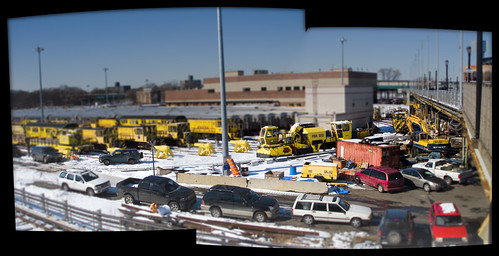
Leaving the broad shoulders of Astoria for a days hike, your humble narrator found himself at the Corona Yard staring over a fence at some of the MTA’s less familiar kit. This is where the 7 train sleeps, and also where one can observe an assortment of “work trains”. Said “work trains” are specialists, non passenger, and rarely seen or commented on by the public. While crossing the pedestrian ramp from Roosevelt Avenue to Flushing Meadow Corona Park, I was on the lookout for the “snow train”, but that wasn’t what I found.
from nydailynews.com
“It’s like your household snow blower but a million times bigger,” agency engineer Edward Macina said late Wednesday as the five-car diesel train chugged past the silent expanse of Kennedy Airport.
The train is a key component in the agency’s comprehensive snow-battle plan.
A six-foot cylindrical brush attached to the front sweeps snow into an even wider metal tube.
Snow is then blasted away — far away — from the rails from the mouth of a chute about eight feet in the air.
The machine can launch the snow 200 feet, removing 3,000 tons of snow an hour. Macina, project manager in the car equipment department, joked ‘Snow Eater’ might be an appropriate nickname.

R125 Ballast Regulator – photo by Mitch Waxman
Corona Yard is a rail fan’s dream. Active rolling stock sits quietly in the sunlight next to a historical catalog of the MTA’s former workhorses and modern utility trains.
from wikipedia
Corona Yard is the yard facility in Flushing, in the New York City borough of Queens, that serves the IRT Flushing Line (7) of the New York City Subway. It is located in Flushing Meadows-Corona Park, near Citi Field, the National Tennis Center, and the site of the 1939 and 1964 World’s Fairs.
Corona Yard opened in 1928 and has seen various models of cars, including Steinway Low-Vs, Brooklyn-Manhattan Transit Corporation/BMT Qs, R12s, R14s, R15s, World’s Fair R36s in 1964, and R62As. It also contains the Casey Stengel Bus Depot.
On August 16, 2006, the original 1928 shop building was demolished, and was replaced by a new, modern shop.

Ballast Tamper TP239 – photo by Mitch Waxman
This mechanism, for instance is a “Ballast Tamper”, which is a track maintenance and repair unit.
from wikipedia
A ballast tamper or tamping machine is a machine used to pack (or tamp) the track ballast under railway tracks to make the tracks more durable. Prior to the introduction of mechanical tampers, this task was done by manual labour with the help of beaters. As well as being faster, more accurate, more efficient and less labour-intensive, tamping machines are essential for the use of concrete sleepers since they are too heavy (usually over 250 kg) to be packed into the ballast by hand.
Early machines only lifted the track and packed the ballast. More modern machines, sometimes known as a tamper-liner or tamping and lining machine, also correct the alignment of the rails to make them parallel and level, in order to achieve a more comfortable ride for passengers and freight and to reduce the mechanical strain applied to the rails by passing trains.

– photo by Mitch Waxman
Hey, those are “Redbirds” back there, weren’t they all supposed to be coral reefs by now?
from wikipedia
Redbird is the name given to 1,408 New York City Subway cars of the following types: R26, R28, R29, R33 ML, R33 WF, R36, and R36 WF. These cars were painted a deep red to combat graffiti, which had become a major problem In the late 1970s and early 1980s. The deep red color was referred to as Gunn Red in honor of its originator David L. Gunn, who was the head of the New York City Transit Authority during this period. Initially entering service in various colors, these cars received the new paint scheme between 1984 and 1989. Some R17s were also given this paint scheme in 1985/86, but were retired well before the name “Redbird” caught on.

– photo by Mitch Waxman
This long walk from Astoria to Flushing Meadow Corona Park will be explored in the coming days, here at your Newtown Pentacle, in the first postings of this new “Year of the Metal Tiger“.
An amazing factoid turned up in researching this walk is that Roosevelt Avenue (the 5 miles which extend from the Great Machine at Queens Plaza all the way out to Willets Point) was designated a National Millennium Trail in the year 2000. This places Roosevelt Avenue alongside the Appalachian Trail in cultural importance, but somehow I think that’ll be forgotten next time someone wants to build a 40 story tower condo along it. We’ll get into this in some detail in the coming days…
from wikipedia
A ballast regulator is a piece of rail transport maintenance of way equipment used to shape and distribute the gravel track ballast that supports the ties in rail tracks. They are often used in conjunction with ballast tampers when maintaining track.


 The Newtown Pentacle