Archive for the ‘Sunnyside Yards’ Category
tower chamber
Getting high in Western Queens.

– photo by Mitch Waxman
As some of you may have discovered, your humble narrator is bringing his personal brand of wide eyed paranoia to Brownstoner Queens in a bi weekly column exploring some the lesser known and esoteric corners of Western Queens for a couple of months now. Recent endeavor found one at the summit of the Standard Motor Products Building at the corner of Northern Blvd. and Steinway/39th st./Harold Avenue visiting the startlingly cool Brooklyn Grange Rooftop Farm. Check out what I saw up there by clicking here.
For a full inventory of what I’ve been doing over at Brownstoner, click here.

– photo by Mitch Waxman
A second posting spawned by the visit looked over the walls and witnessed the majestic Sunnyside Yard from on high, which can accessed by clicking here. Just yesterday, an interviewer working on an unrelated project asked me what my reaction to “demolishing the Javitz Center in Manhattan, then decking over the Sunnyside Yard and building a convention center and hotel complex on the deck” would be.
Roughly an hour later, after a far ranging diatribe about storm water, CSO’s, and endemic PCB contamination- the question I asked the interviewer was “How, in any way, would this benefit Queens other than the creation of low wage service industry jobs?” (and a short interval of construction industry jobs, of course). I suggested we deck over the yards and install 192 acres of farmland or just a plain old park. Didn’t Central Park spur development of underutilized land surrounding it in Manhattan 150 years ago, creating what are today the most valuable residential properties in the entire city if not the world? Why not add something green to spur growth, whatever the hell that is?
I also asked the interviewer what the hell “vibrant and diverse” is supposed to indicate or mean.
Please, planners, leave your air conditioned Manhattan offices and actually come to Queens. Leave the cars and bicycles behind and actually walk around. We don’t need any more of Manhattan’s problems exported to us, as Queens’ biggest problem is the City shitting on us every chance it gets.

– photo by Mitch Waxman
Sorry for the late update today, had a few connectivity problems this morning. I’ll be out and about all weekend, if anyone has anything going on they’d like me to record or write about- please contact me here.
“follow” me on Twitter- @newtownpentacle
Want to see something cool? Summer 2013 Walking Tours-
Glittering Realms– Saturday, August 3rd, 2013
Newtown Creek walking tour with Mitch Waxman and Atlas Obscura, tickets now on sale.
Kill Van Kull– Saturday, August 10, 2013
Staten Island walking tour with Mitch Waxman and Working Harbor Committee, tickets now on sale.
13 Steps around Dutch Kills– Saturday, August 17, 2013
Newtown Creek walking tour with Mitch Waxman and Newtown Creek Alliance, tickets now on sale.
freely generating
If you see something, photograph it and say something.

– photo by Mitch Waxman
Despite the overt messaging offered by security professionals and municipal Police officials concerning the presence of literally millions of desert born sappers hidden alongside the heaving shorelines of a lake called Freedom, there do seem to be quite a few holes in the fence lines of our rail yards. Probably, this is because the security apparatus of these institutions need to strike different nerves to acquire their sources of funds, rather than to rankle the ire of the common proletarians and politicians alike.
Luckily, this homeland insecurity allows one such as myself opportunity to observe some often esoteric kit which the railroad people employ for “maintenance of way.”
from wikipedia
A railroad crane, (US: crane car or wrecker; UK: breakdown crane) is a type of crane used on a railroad for one of three primary uses: freight handling in goods yards, permanent way (PW) maintenance, and accident recovery work. Although the design differs according to the type of work, the basic configuration is similar in all cases: a rotating crane body is mounted on a sturdy chassis fitted with flanged wheels. The body supports the jib (UK; US: boom) and provides all the lifting and operating mechanisms; on larger cranes, an operator’s cabin is usually provided. The chassis is fitted with buffing and coupling gear to allow the crane to be moved by a locomotive, although many are also self-propelled to allow limited movement about a work site.

– photo by Mitch Waxman
That’s a flat bed car coupled to a self propelled rail crane, called a Burro, you’re looking at there. What your humble narrator doesn’t know about the rails is enormous and the scope of my ignorance on the subject is actually breathtaking, so if i misname something or am just wrong on this subject- please instruct and correct via the comments section.
Corrections and additions are always welcome at this, your Newtown Pentacle.
Burro cranes (some were outfitted with shovels, as the one at Roots) were designed to be self-sufficient maintenance-of-way tools. As such, they were self-powered, and could propel not only themselves, but could take along with them a flat car, gondola, dump car or other equipment needed for their work. Therefore, they could take with them rail, ballast, timbers or any other materials needed for track repair or construction.
These utilitarian rail vehicles have been built by several manufacturers, including Cullen-Friestedt, Federal Sign & Signal, and now by the Badger Equipment Company. But they have always retained the name Burro, and if you say Burro to a railroader, he knows that you’re not referring to the four-legged animal.

– photo by Mitch Waxman
Extensive construction and demolition work has been underway at Sunnyside Yards in anticipation of the East Side Access project for several years now, but these fellows with their Burro were MOW workers.
from maintenanceofway.com
Railroad Maintenance-of-Way (MOW) machinery and its design and utilization, is the equipment used by railroads to lay, clear, and maintain railroad track infrastructure and is of paramount importance in keeping the world’s railroads running dependably, safely and profitably. Railroads are a key component of the world economy. Corn, beans and other foods and feeds, coal, oil, manufactured goods, building materials, and virtually everything else that one can name, moves by rail. The volume of goods transported by the railroads is increasing dramatically. Existing railroad track must carry more and heavier traffic. Railroad bridges must be repaired and maintained. Fences, walls, gates, area lighting and other security structures are of increasing importance. Increased traffic and speeds adds to demand on signals. Railroad and railway Maintenance-of-Way equipment and utilization strategies play a key role in keeping all rail traffic running safely and on time. Railroad Maintenance-of-Way equipment and utilization efficiency planning make it possible for railroads to upgrade and maintain track and rights of way.
Want to see something cool? Upcoming Walking Tours
Modern Corridor– Saturday, July 13, 2013
Newtown Creek walking tour with Mitch Waxman and Atlas Obscura, tickets now on sale.
Kill Van Kull– Saturday, August 10, 2013
Staten Island walking tour with Mitch Waxman and Working Harbor Committee, tickets now on sale.
13 Steps around Dutch Kills– Saturday, August 17, 2013
Newtown Creek walking tour with Mitch Waxman and Newtown Creek Alliance, tickets now on sale.
augmented party
Today’s post shows you how to wash a dirty locomotive.

– photo by Mitch Waxman
Hanging about and walking around Queens with a friend one afternoon, our path carried us up Skillman Avenue and past the gargantuan Sunnyside Yards. Luckily, something I’ve been trying to catch as it happens began to happen when Amtrak 934 sauntered into view.
from wikipedia
The Pennsylvania Railroad (PRR) completed construction of the yard in 1910. At that time Sunnyside was the largest coach yard in the world, occupying 192 acres (0.78 km2) and containing 25.7 mi (41.4 km) of track. The yard served as the main train storage and service point for PRR trains serving New York City. It is connected to Pennsylvania Station in Midtown Manhattan by the East River Tunnels. The Sunnyside North Yard initially had 45 tracks with a capacity of 526 cars. The South Yard had 45 tracks with a 552 car capacity.

– photo by Mitch Waxman
It seems that there is an entire industrial sector for whom the manufacture and maintenance of “train washes” is a focal point. It also seems to be the case that having a shiny clean locomotive pays a dividend in terms of aerodynamic drag and that the cleaner your train is, the more efficiently it runs.
from wikipedia
The AEM-7 is a twin-cab B-B electric locomotive that is used in the United States on the Northeast Corridor between Washington DC and Boston and the Keystone Corridor between Philadelphia and Harrisburg in Pennsylvania. They were built by Electro-Motive Division from 1978 to 1988. In the Boston Mechanical Department of Amtrak they are known as “Meatballs” and in the Washington Mechanical Department they are known as ASEAs since some of their major parts and components were designed in Sweden by ASEA (Allmänna Svenska Elektriska Aktiebolaget; translation: General Swedish Electrical Inc), which merged with Brown Boveri in 1988 forming ABB. They are also referred to as “toasters” by railfans, owing to their boxy appearance.

– photo by Mitch Waxman
One is informed by railfans that once upon a time, this was a tedious task accomplished by a sizable crew of laborers, who used pole mounted brushes to clean away the grime. The “modern” system (the unit pictured is somewhat archaic by 2013 standards) is far more efficient and highly automated.

– photo by Mitch Waxman
Fundamentally, its the same thing that happens when you wash your car, except for scale. The train rolls past water jets and a system of rotary brushes which chip away the patina of dead insects and grime which the train picks up during normal operation.

– photo by Mitch Waxman
This train wash is nothing new, of course, and has been on my radar for awhile. Were my methodology the same that is employed by most, I would have just lingered around this spot until I got my shots, but that’s not how your humble narrator rolls.

– photo by Mitch Waxman
Instead, if its not happening while I’m passing by, it might not have happened at all for all I care. You can’t force Queens into revealing herself to you, instead, you must trust in serendipity and that she will position you in the right place and at the right time.
“follow” me on Twitter- @newtownpentacle
Want to see something cool? June 2013 Walking Tours-
The Poison Cauldron– Saturday, June 15, 2013
Newtown Creek walking tour with Mitch Waxman and Atlas Obscura, tickets now on sale.
Kill Van Kull– Saturday, June 22, 2013
Staten Island walking tour with Mitch Waxman and Working Harbor Committee, tickets now on sale.
The Insalubrious Valley– Saturday, June 29, 2013
Newtown Creek walking tour with Mitch Waxman and Newtown Creek Alliance, tickets now on sale.
marshy shore
“follow” me on Twitter at @newtownpentacle

– photo by Mitch Waxman
My fascination with the Sunnyside Yards here in Long Island City is well known, and observation of the modifications to the place demanded by the East Side Access project have been eagerly and enthusiastically observed and recorded accordingly. On this particular afternoon, the esoteric bit of kit on display for the discerning enthusiast was a truck adapted for life and transit upon the railroad tracks. The particular occupation of this vehicle is somewhat beyond me, with a singular observation that it seemed cool and was manufactured by a company called Brandt.
from wikipedia
The Canadian company Brandt has also converted large truck tractor units for use as locomotives that can move by road to where they are needed. Still mostly used for permanent way maintenance, they can also be employed as thunderbird (rescue) locomotives or even used in normal service, where they are suitable for smaller operators.

– photo by Mitch Waxman
Nothing short of byzantine, the operational engineering of this project must be a devilish conundrum. Imagine the combined challenge of rebuilding, and in some cases installing new capability, to one of the busiest rail yards on Earth without disrupting its function. The new installation part of that is adding an additional track, including truss bridges flown over local and quite residential streets, which will fundamentally change the flow of traffic along the entire northeastern United States and parts of Canada while hundreds of passenger trains whizz by as they move between Manhattan and Long Island.
from wikipedia
Extending between Sunnyside, Queens, and Grand Central, the project will route the LIRR from its Main Line through new track connections in Sunnyside Yard and through the lower level of the existing 63rd Street Tunnel under the East River. In Manhattan, a new tunnel will begin at the western end of the 63rd Street Tunnel at Second Avenue, curving south under Park Avenue and entering a new LIRR terminal beneath Grand Central.
Current plans call for 24-trains-per-hour service to Grand Central during peak morning hours, with an estimated 162,000 passenger trips to and from Grand Central on an average weekday. Connections to AirTrain JFK at Jamaica Station in Jamaica, Queens, will facilitate travel to John F. Kennedy International Airport from the East Side of Manhattan.
A new LIRR train station in Sunnyside at Queens Boulevard and Skillman Avenue along the Northeast Corridor (which the LIRR uses to get into Pennsylvania Station) will provide one-stop access for area residents to Midtown Manhattan. The station may spur economic development and growth in Long Island City.

– photo by Mitch Waxman
The specific occupation of this vehicle- given the small crane rig on its bed might be defined as a rail tie loader- but I’ve been excoriated for guessing when it come to the railroad before so if one of you might know for sure, please speak up in the comments section. There are large segments of pre assembled track and sleepers nearby the device, it should be mentioned. This sort of thing is part of the reason that I carry a camera with me whenever I’m transversing the concrete devastations of Western Queens, you never know what you might see.
Also: Upcoming Tours!
A free event, “Watch Wildlife on Maspeth Creek with NCA and DEC!” – Friday, April 26
Meetup at Maspeth Creek at 1 p.m., for more information visit newtowncreekalliance.org.
13 Steps around Dutch Kills– Saturday, May 4, 2013
Newtown Creek walking tour with Mitch Waxman and Atlas Obscura, tickets now on sale.
Parks and Petroleum- Sunday, May 12, 2013
Newtown Creek walking tour with Mitch Waxman and Newtown Creek Alliance, tickets now on sale.
The Insalubrious Valley- Saturday, May 25, 2013
Newtown Creek walking tour with Mitch Waxman and Atlas Obscura, tickets on sale soon.
Hidden Harbor: Newtown Creek tour with Mitch Waxman – Sunday, May 26,2013
Boat tour presented by the Working Harbor Committee,
Limited seating available, order advance tickets now. Group rates available.
irresistibly borne
“follow” me on Twitter at @newtownpentacle

– photo by Mitch Waxman
A few more shots from the low light photography exercise I’ve been forcing myself to perform all winter.
Couldn’t believe my eyes when I saw this place. It’s a dinosaur, a relic of the “old” Queens Plaza, which has somehow withstood the arrayed powers and potentates who have completely remade most of the area. One would hope that for the sake of history, and in order to preserve the cultural heritage of the Borough of Queens, that this shop and its signage be granted landmark status and preserved “as is”for all time.
Obscured by the lamp post, one would add, is the signage that reads “Ladies Welcome.”
I’ll bet they are.
– photo by Mitch Waxman
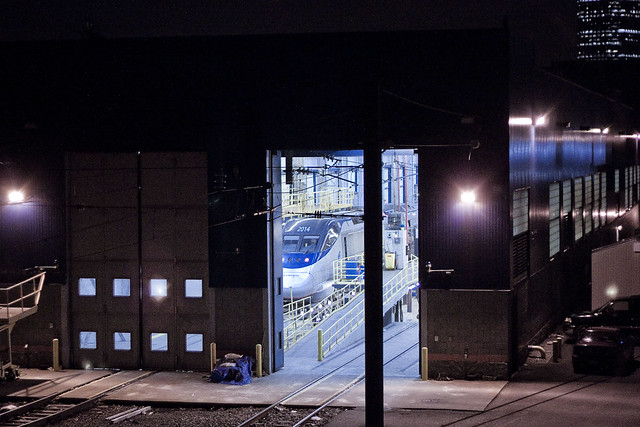
Elsewhere in the neighborhood, Acela was in its bed and snug as a bug in a rug.
Acela maintains a difficult schedule all day and really needs her rest. She is very sweet however, and everyone has nothing but good things to say about her. This is where the modern train receives maintenance and attention from trained mechanics and engineers, at the Sunnyside Yard.
from wikipedia
Generally Amtrak train crews consist of an engineer, a conductor, and at least one assistant conductor. Acela trains also have an On-Board Service crew consisting of two First Class attendants and a Cafe Car attendant. In addition to the food service provided in the Cafe Car, on most trains an attendant will also provide at seat cart service, serving refreshments throughout the train. First Class passengers are served meals at their seats on all services.
At Amtrak, the On-Board Service crew is considered separate and subordinate to the Train and Engine crews. Acela maintenance is generally taken care of at the Ivy City facility in Washington, DC; Sunnyside Yard in Queens, New York; or Southampton Street Yard in Boston, Massachusetts.

– photo by Mitch Waxman
Apologies are offered for any unintentional “artsy fartsy”ness to the shot above, I was just trying to push the exposure and catch the light. This one was on Northern Blvd. incidentally. All of these were handheld shots, at a variety of exposures and iso settings using environmental light, for you photographic types.


 The Newtown Pentacle