Archive for the ‘Things to do’ Category
Astoria zen

Astoria Matthews Model Flats, 31st ave. and 44th street – photo by Mitch Waxman
31st avenue and 44th street is very close to being the apex of an enormous hill which is buried deep below the masonry of modern Astoria. 1 block from the ancient pavings of Newtown Road, which knew British and Hessian armies- and later carried an iron ribbon of Trolley Tracks, and is 2 blocks from Broadway.
31st avenue was, in gentler times, called Jamaica Avenue and 44th street was called 14th avenue. Broadway and 30th (Grand) avenue nearby are the main commercial strips.
Now, I’m taking a shortcut today, and will refer you to Forgotten-NY’s page on the Street Name Necrology of Astoria rather than try to explain the whole affair, as it confuses me, and they are brilliant and own an encyclopedic collection of old maps.
This is an interesting neighborhood, and it is where our Newtown Pentacle is headquartered. 44th street between 30th and 31st avenues is bookended by 1928 vintage Matthews Model flats– “model new law tenements” which fill nearly half of the block in an unbroken line of Kreischer yellow brick. There are 6 units in each building, with the 4 story bookends on each corner. It is a working class section of the ancient village, and it always has been. The surrounding blocks were farms as late as the early 20th century, and despite a long period of abuse and neglect beginning in the late 1950’s the current property owners are performing careful maintenance on these historic structures.

44th street between Newtown Road and Broadway – photo by Mitch Waxman
As you walk down the hill toward Northern Blvd., which is actually a striking drop in elevation for so short a space, the building stock becomes typical of the early 20th century. Enormous, well designed apartment houses line 44th street beginning at Newtown Road- giving way on the Broadway intersection to 3 and then 2 family houses with garages. One or two relict examples of the federal style townhouse, so popular in Long Island City, incongruously continue to stand in centuried glory beneath the burning eye of the Newtown sun.

LIC Turn Verein detail – photo by Mitch Waxman
After the civil war, Long Island City incorporated and became a haven for heavy industry and mechanized production in the Hunters Point, Dutch Kills, and Ravenswood neighborhoods. Astoria developed along the lines of a bedroom community, with the exception of the Steinway factory on the North side.
The huge populations that teemed into New York from European origins in the 19th century, to serve as labor in the new factories, often arrived in tsunami waves of a single ethnicity- resulting in the classic perception of “the XXX’s are taking over!”, followed by the next generation of the “XXX’s” declaring “the YYY’s are taking over!”.
A teacher of mine at college was a genius named Will Eisner, and he did a novel on this phenomena called “Dropsie Avenue” about his old block in the Bronx. If you dig this blog, you will LOVE Dropsie Avenue, available at amazon and other places.
In 1875, Astoria was a German town. Deutche was spoken on the streets, taught in schools, and the population of the area read newspapers shipped in from Vienna and Berlin. They were very much in tune with a radical new political theorem called trade-unionism, which promised to unite the workers of the world against the decaying masters of the middle ages- the aristocracy- and a new menace to the working man called the Industrialist. They also believed that mankind could be bettered and brought into communion with god- by exercise and good diet and education and abstention from the sins of the industrial world.
One must comment on what must have been going through the minds of these people- the whole world was at war, the greatest empire ever known was crumbling, and an antichrist (himself a Turner) had crowned himself emperor of France. And here they were, in post civil war New York City, safe as houses.

LIC Turn Verein detail – photo by Mitch Waxman
So, these Germans built a Turn Verein in Long Island City, on the corner of Broadway and 14th avenue (44th street) near Schuetzen Park, to better mankind through the example of Physical Culture.
The structure currently serves as a catering hall for the Chian Federation, a local Greek ethnic society (island of chios). There are some surprising events here at times. Last winter, for instance, a high ranking member of either the Pakistani or Bangladeshi government held a rally here and was feted amongst the expatriate communities who emigrated into the neighborhood. Mostly, it just seems to do private parties and neighborhood events. This represents two more demographic shifts in Astoria, one finishing up and one just beginning.

LIC Turn Verein detail – photo by Mitch Waxman
The “Turners’, as they call themselves, are still around- here’s their website, and the Newtown Pentacle is pleased to let them tell their own story.

LIC Turn Verein detail – photo by Mitch Waxman
These folks are the inheritors of a genteel middle class society, industrial workers who were considered skilled craftsmen. Known world wide for their skills in working metals and wood alike, the Germans of the 19th century were recruited in large numbers to come to New York, and they were glad to leave behind the catastrophic events which were in living memory of these new Americans. The concept of the coming “fin de siècle” was very much in their minds. It’s part of the reason behind the 19th century religious revival movement, suffrage (New York allowed women to vote in 1917), anti-slavery, and temperance movements all were at their apogee in the final years of the 1900’s. The 20th century is all “-ism’s” in the same way the 19th century is all “movements”, and the 21st seems to be about the “-ists”.

44th street between Northern Blvd. and 34th avenue- photo by Mitch Waxman
Leaving the 19th century, and heading south toward Northern Blvd. the neighborhood suddenly turns a bit seedy, and at night- queer groups of adolescent troublemakers congress with baser elements of Astoria’s underworld in the desolate shadows of sodium light. That’s the west side of the street, though, and on the east- you’ll find some lovely typography adorning the cavernous garage that serves Major Auto World.

Northern Blvd, 44th st., 35th avenue intersection- photo by Mitch Waxman
Looking to your right, you’ll see the Citbank megalith, and Manhattan hidden behind that white sign on the right hand side. We’re not going this way, just reminding you- gentle reader- to look both ways before you cross. Northern Blvd. is more properly described as a six lane highway which is a primary artery connecting vehicle traffic in western Queens with Manhattan via the Queensborough Bridge and the highways leading eastward to Long Island which intersect it on the north shore of Queens. It also serves as a shortcut route to LaGuardia airport for knowledgeable taxi drivers.

Northern Blvd at 44th street, south side- photo by Mitch Waxman
Directly in front of you will be the major world entrance. If you’re an automotive enthusiast, buy a hot dog and go shopping, they have a LOT of used cars.

Northern Blvd at 44th street, looking east- photo by Mitch Waxman
From the appearance of the automobile, this section of Northern Blvd., formerly the Trolley car thoroughfare called Jackson Ave.– and before that the Jackson… oh no…
…alright, here we go-
John C. Jackson was president of the Hunters Point, Newtown and Flushing Turnpike Company, which built Jackson Avenue as a toll road. It allowed ships from Long Island Sound to drop their cargo on the North Shore of Queens, allowing them to avoid the dangerous and crowded East River and Hells Gate- and the infamously criminal controlled docks of Long Island City and Manhattan. Cargo traffic was first transported by mule barge, then wagon team, and eventually electrified Trolleys and automotive vehicles. It also connected the isolated villages of the north shore of Queens with the economic superpowers of the East River metroplex and the world beyond through the Port of New York. It is precisely the freight that the Long Island Railroad was originally sited to carry.
in 1921, Jackson ave. was renamed Northern Blvd., which fit the rational, progressive, and scientific spirit of a world recovering from the shattering horror of the Great War.

Northern Blvd at 45th street, looking east- photo by Mitch Waxman
I first noticed this place a few years ago. It is very well wrought, and has the appearance of a hollywood set piece. I’ve been looking around for quite a while, and scrounging through the usual sources, but I kept on coming up blank on the history of this place. Were I not such an awkward and contentious being, I would have considered calling the realtor advertising the edifice as available. You may have noted my preferences in referential hyperlinking to public information, as I subscribe to the Cory Doctorow theorem that “information WANTS to be free”, but in this case, I need to refer you to copyrighted materials.
Luckily, the footsteps I take around the Newtown Pentacle have been walked by others with an eye for the strange- the antiquarian- the hidden.

Northern Blvd at 45th street, Packard building- photo by Mitch Waxman
A significant resource to the amateur antiquarian here in the Newtown Pentacle is the Greater Astoria Historical Society, the officers of which hold the key to vast archives of historical artifacts and esoteric knowledge. Close examination of their publications, and websites, revealed an identity for this enigmatic holdout from the early 20th century.

Northern Blvd at 45th street, Packard building- photo by Mitch Waxman
This was a Packard dealership in 1929.
Packard Automobiles – from wikipedia
Packard was an American luxury automobile marque built by the Packard Motor Car Company of Detroit, Michigan, and later by the Studebaker-Packard Corporation of South Bend, Indiana. The first Packard automobiles were produced in 1899 and the last in 1958.

Northern Blvd between 45th and 46th streets, Packard building- photo by Mitch Waxman
The building currently houses a series of shops and small offices, and is carved up into small spaces. The GAHS photo below shows the structure in its heyday of 1929, as a two level automotive showroom. Amazing- I love Astoria.
Check out this link to the Greater Astoria Historical Society’s smugmug page– this is the same building, in 1923.
I cannot recommend highly enough the purchase of their excellent Long Island City book.

We’re plunging into a new photowalk, Lords and Ladies of Newtown, from Astoria to Calvary. This has been part one.
John J. Harvey Fireboat trip part 2

-photo by Mitch Waxman
Believe it or not, there is a wide world beyond New York City. The John J. Harvey Fireboat passed under the George Washington bridge, and up the Muhheakantuck (or Hudson River, as we palefaces call it). A “drowned river”, the Hudson is actually a marine estuary with strong tides felt as far north as Troy, New York. If one considers the formation as a whole, from its source in Lake Tear of the Clouds all the way to the submarine Hudson Canyon, the implications of its scale are staggering.
from fireboat.org– official site of the Harvey
In the 1920’s the New York City Fire Department’s fleet of 10 steam fireboats was aging, and it was decided to construct a new fireboat with internal combustion power. Basic plans were prepared in 1928. Contracts were drawn up and construction started in 1930 by Todd Shipbuilding’s Plant at the foot of 23rd Street on Brooklyn’s Gowanus Bay. Launching took place on October 6, 1931 with the boat completed and placed in commission on December 17, 1931. Harvey’s dimensions are 130′ long with a 28′ beam and a 9′ draft. She is of steel construction with a riveted hull. Propulsion is by twin screws six feet in diameter. She was the largest, and most powerful fireboat in the world when built. More importantly, she was the model of modern fireboat engineering, and set the pattern for all subsequent fireboats to follow.
John J. Harvey was Pilot of the steam fireboat Thomas Willett, assigned to Engine Co. 86 at Bloomfield Street. On February 11, 1930 a fire broke out aboard the North German Lloyd Lines ship Muenchen at North River Pier 42, Morton Street. Willett came alongside and her crew started working aboard the burning ship. Soon a series of terrible explosions tore throughMuenchen. One of the worst caused serious damage to the fireboat and swept men overboard. John J. Harvey, knocked over the side by a section of steel plate, was killed instantly. His body was recovered from the river four hours later. It was quickly announced that the new fireboat to be built in Brooklyn would be named in his honor. This was the first time a fireboat was named for a member of the Fire Department.
Harvey’s long life in the Port of New York includes service at hundreds of serious fires, explosions, and marine disasters. One of the first was the five alarm fire that destroyed Cunard’s Pier 54 at West 14th Street in May 1932. In 1942 Harvey worked at the fire that destroyed the French Line’s Normandie, the grandest ocean liner ever built. In 1943 Harvey along with Fire Fighter went into harm’s way to control a raging fire aboard the ammunition ship El Estero. The ship was eventually scuttled, and Harvey’s entire crew received the highest awards for bravery. Harvey has also operated at dozens of major pier fires, in New York as well as New Jersey where FDNY has jurisdiction.

-photo by Mitch Waxman
The John J. Harvey Fireboat History- from Wikipedia
She had a distinguished career in the FDNY, from her launch in 1931 to her retirement in 1994. Among the marine fires at which she assisted were the Cunard Line pier fire in 1932, the burning of the Normandie in 1942, the ammunition ship El Estero during World War II, and the collision of the Alva Cape and Texaco Massachusetts oil tankers in 1966. She was named for marine fireman John J. Harvey, who lost his life when a ship exploded during a fire. Her official designation at the end of her career was Marine 2.
She was sold, at auction, in 1999, to a private consortium of marine preservationists determined to prevent her from scrapping. In June 2000 she was added to the National Park Service’s National Register of Historic Places. Her current owners have thoroughly restored her, and host frequent free trips on the river.

-photo by Mitch Waxman
The John J. Harvey Fireboat History- from Wikipedia
The John J. Harvey had an unexpected encore. During the attacks on the World Trade Center on September 11, 2001, the boat’s owners asked FDNY officials for permission to assist in evacuations from Ground Zero. Meanwhile, firefighters had determined that the vast scale of destruction had damaged many fire mains, depriving fire crews of water. Officials radioed the Harvey to drop off her passengers as soon as possible and return to the disaster site to pump water, reactivating her official designation Marine 2. Alongside two other FDNY fireboats, she pumped water at the site for 80 hours, until water mains were restored.^ The National Trust for Historic Preservation gave the Harvey a special National Preservation Award to recognize this incident. The Harvey‘s story was the subject of a 2002 children’s book.

-photo by Mitch Waxman
As the Harvey moved north, we congregated on deck and marveled at the show passing by. The Tugboat Barbara E. Bouchard was moving a barge. A 1992 engenue from the Moss Point Marine Shipbuilding Yards in Mississippi, Barbara E. Bouchard is a slim 591 tons and looks good in red.

-photo by Mitch Waxman
This is a tug called Falcon, and I’ve got nothing on this one. Had to happen, really. Anyone out there got anything on this tug? Hey Tugster!

-photo by Mitch Waxman
The New Jersey side of the river, with its impressive cliffs. These are hydrologic scars in the earth, the Hudson has been cutting this canyon since the last ice age.

-photo by Mitch Waxman
The tug Sea Service, with its barge. Sea Service was built in 1975 at the VT Halter Marine yard in Mississippi, and weighs 173 tons. It used to known as the “Capt. Paul”, and as the “Sea Star”.

-photo by Mitch Waxman
from fireboat.org– official site of the Harvey
The New York Fire Department operated the largest fleet of fireboats. All fireboats before Harvey were steam, all since were diesel powered. The average specifications for these 28 fireboats was about 100′ in length, over 7000 gallons per minute (gpm) pump capacity, with a speed of 15 knots. This list includes all vessels built as fireboats as well as the four tenders Velox, Captain Connell, Smoke, and Smoke II. Tenders were used as auxiliary boats to assist the big fireboats or as command stations for Chiefs. Some tenders had limited pumping capacity. In the late 19th century the City of Brooklyn had a Fire Department almost as large as New York’s. When the two cities were consolidated in 1898, the Brooklyn fireboatsSeth Low and David A. Boody joined the FDNY fleet. Delivery of the four 105′ boats of the Wilks class, almost completely dieselized the fleet by 1961. Only one steam fireboat remained on the roster. Starting in the 1960s, FDNY sporadically used some converted commercial hulls in seasonal service in outlying parts of the harbor. Some were equipped with small pumps. These fast motorboats were used primarily for water rescues or emergencies. They are not included in this list. Another class not included here were boats not belonging to FDNY but equipped with pumps that could be pressed into service for firefighting when needed. Their use was restricted to the 19th century as the FDNY fleet was being built up. These were the steam tugs John Fuller and Protector, and the Police Department’s steamboatSeneca. In the 19th century the awesome pumping power of fireboats was quickly proven as the only solution to fighting fires that were either uncontrollable or inaccessible with conventional apparatus. The same principle holds true today, and it can still be said that “when you need a fireboat, nothing else will do!”.

-photo by Mitch Waxman
The Tappan Zee bridge suddenly loomed low over the river. My gold standard for reference on New York bridges is nycroads.com. Check out their Tappan Zee page here.
from wikipedia:
With the increasing demands for commuter travel taxing the existing bridges and tunnels, the Port of New York Authority had plans in 1950 to construct a bridge across the Hudson near Dobbs Ferry. The proposal was overridden by Governor of New York Thomas E. Dewey, who wanted to construct a bridge to connect the New York State Thruway across Westchester to the New England Thruway. The Port Authority promised its bondholders that it would not allow any other entity to construct a river crossing within its jurisdiction, which reached to a point one mile (1.6 km) south of Nyack and across to Piermont. A May 10, 1950 editorial in The New York Times suggested that a site in southern Dobbs Ferry or northern Hastings-on-Hudson, where the Hudson narrowed considerably from its three-mile (5 km) width at Tappan Zee, would be a more appropriate site, and suggested that Governor Dewey work with his counterpart, Governor of New Jersey Alfred E. Driscoll, to craft a compromise that would offer Thruway customers a discounted bridge fare at a more southerly crossing.[6] Two days later, Governor Dewey announced that the Port Authority had dropped its plans to construct a bridge of its own. The location would be as close to the Tarrytown-Nyack line just outside the Port Authority’s jurisdiction. Dewey stated that World War II military technology would be used in the bridge’s construction.

-photo by Mitch Waxman
from wikipedia:
The deteriorating structure, which bears far more traffic than it was designed for, has led to plans to repair the bridge or replace it with a tunnel or a new bridge. These plans and discussions were whittled down to six options and underwent environmental review. Part of the justification for the replacement of the bridge has been that it was constructed during material shortages during the Korean War and only designed to last 50 years. The collapse of the I-35W Mississippi River bridge in Minnesota on August 1, 2007 has renewed concerns about the bridge’s structural integrity.
The Metropolitan Transportation Authority (MTA) is studying the feasibility of either including a rail line across the new bridge or building the new bridge so a new rail line can be installed at a future date. The rail line, if built, will be located on a lower level, beneath the car lanes. Commuter rail service west of the bridge in Rockland County is limited, and the MTA is studying expansion possibilities in Rockland County that would use the new bridge to connect with the Hudson Line (Metro-North) on the east side of the bridge along the Hudson River for direct service into Manhattan.
On September 26, 2008, New York state officials announced their plan to replace the Tappan Zee Bridge with a new bridge that includes commuter-train tracks and lanes for high-speed buses. The bridge would cost $6.4 billion, while adding bus lanes from Suffern to Port Chester would cost $2.9 billion. Adding a rail line from the Metro-North station in Suffern and across the bridge, connecting with Metro-North’s Hudson Line south of Tarrytown, would cost another $6.7 billion. The plan is being reviewed for environmental impact.

-photo by Mitch Waxman
River traffic really started to drop off near the Tappan Zee. After we passed it, the shorelines on both sides of the river began to take on a small town feel. Small town with the occasional barge of fill passing by, of course.

-photo by Mitch Waxman
Looks lovely, doesn’t it? Why wouldn’t you want to live here? What could it be, perhaps something just around the next bend on the river?

-photo by Mitch Waxman
The Indian Point Nuclear Power Plant.
Sigh.
I’m a Newtown Creek guy, this is somebody else’s problem. We’re all gonna die of something.
The reactors own website
NY Daily News Omnibus Indian Point Page

-photo by Mitch Waxman
Motor on Harvey, away from the three eyed fishes.

-photo by Mitch Waxman
The Bear Mountain Bridge, New York landing. There’s a train tunnel in the lower right of the shadow, completely hidden in the shadows.
nycroads.com has a great page on the history of the bridge here.

-photo by Mitch Waxman
This is actually pretty neat, a pedestrian, rail, and vehicle bridge in one shot.

-photo by Mitch Waxman
Bannerman’s island. Francis Bannerman VI was a Brooklyn kid of Scottish descent who joined the Union army during the Civil War. At the end of the conflict, massive amounts of military surplus were being auctioned off by the victorious Union. Bannerman bought this surplus and became a successful merchant based at 501 Broadway in Manhattan. By the time that the Spanish American War ended, Bannerman was already a rich man, and the Federal Government sold him 90% of all war surplus in a closed bid. A lot of this surplus was munitions and black powder, which the City of New York did not want him to warehouse within city limits.
from hudsonriver.com

-photo by Mitch Waxman
Bannerman built his castle over an 18 year period, at the end of which he died. In 1920, 200 pounds of powder and shells exploded and destroyed part of the castle. It lost its ferryboat in a storm in 1950, and a fire in 1969 rendered the place a abandoned wreck. Its the New York State Dept. of Parks, Recreation and Historic Preservation’s problem these days.

-photo by Mitch Waxman
The Indians didn’t like this island, with its dangerous tides and reputation of being haunted. There’s meant to be a ghost called Polly Pel in residence, named for the Dutch nomenclature of the landmass- Pollepel Island.

-photo by Mitch Waxman
The Harvey at last made it to Poughkeepsie, and the Crew began preparing to dock.

-photo by Mitch Waxman
As you can see, the ship was lousy with photographers.

-photo by Mitch Waxman
Got it in one toss. Sweet.

-photo by Mitch Waxman
We disembarked in Poughkeepsie, and left the Harvey to its business. The Crew said that they would be participating in 4th of July celebrations through the next day, including a laser show. The John J. Harvey is in dire need of both physical repair and financial support. Visit fireboat.org for information on the Harvey and what you can do to help out.
Next posting- We return to Queens and Newtown Creek. Also, some exciting new information has come to us on the Hook and Ladder 66 building on Northern Blvd that I’ll share later this week.
Dutch Kills, or let the Photos do the Walking
Anything you may experience, in situ, by following these walking directions is at your OWN RISK, and is offered by the Newtown Pentacle for documentary and entertainment purposes only. Remember- the rule we follow at the Newtown Pentacle is to NEVER trespass. Like Vampires, Newtownicans should wait to be invited into a house before they can do their work. To wit.
Feel like taking a walk? I’ll show you something cool… Bring your camera- and ID

Truck at 47th avenue and 28th street, Long Island City -photo by Mitch Waxman
from wikipedia
Dutch Kills is a sub-division of the larger neighborhood of Long Island City in the New York City borough of Queens. It was a hamlet, named for its navigable tributary of Newtown Creek, that occupied what today is centrally Queensboro Plaza. Dutch Kills was an important road hub during the American Revolutionary War, and the site of a British Army garrison from 1776 to 1783. The area supported farms during the 19th Century, and finally consolidated in 1870 with the villages of Astoria, Ravenswood, Hunters Point, Middletown, Sunnyside and Bowery Bay to form Long Island City.
Dutch Kills is one of the extant branches of the Newtown Creek, and located not too far from the Degnon Terminal complex (part of the Sunnyside Yards).
Get to 47th avenue and 28th street, early morning or late afternoon are probably best because of the whole sunlight east west thing. Weekends are good because there is a lot less going on in the industrial zones of the Newtown Pentacle.
Assuming you’re coming from the north (skillman or thomson avenues)- You’ll find a series of construction sites behind and to the left of you, and a cement factory (New York Concrete Supply)in front of you. Cross the street and make a left. Look west, and you’ll be reassured by seeing Manhattan.
I’m going to say this over and over- but be REALLY MINDFUL OF TRUCKS, and… be a smart new yorker- if you’re snapping pics and a guy who looks just like a mobster walks in front of you in Long Island City- He doesn’t just look like a mobster- HE IS A MOBSTER. Don’t be a schmuck.
View Dutch Kills in a google map

Concrete Trucks on 47th avenue, Long Island City -photo by Mitch Waxman
Walk to 29th street, which is a very dangerous place for pedestrians. BE CAREFUL. There is no sidewalk, and it is a shortcut to Thomson Avenue and Queens Blvd for traffic coming off the LIE. To your right is Dutch Kills, at its terminus. By the way, the concrete guys REALLY don’t like having their pictures taken.

Concrete Trucks on 29th street, Long Island City -photo by Mitch Waxman
Make the right at the corner of 29th street. DO NOT CLIMB DOWN ON TO THE RUSTY BARGE, you will get hurt and fall into the water with an open wound. When you smell the water, you’ll understand my warnings. 29th street is VERY dangerous. Lots of great Creek kind of shots, but mind yourself, there’s better stuff ahead with safe vantage points.

Dutch Kills from 29th street -photo by sweetpea212– a member of our Newtown Pentacle Flickr group
All along the Newtown Creek, there are abandoned barges and other vessels. This particular one has been sitting here for at least 3 years. Resist the urge, urban explorers, its not worth it. Also, note the storm sewer in the center of the above shot.

Structure I am desirous of having a chance to get inside legally, with my camera -photo by Mitch Waxman
At the other end of 29th street- Welcome to an insanely dangerous parking and loading dock for the crumbling Hunterspoint Steel building.
Big old factory on Hunters Point Avenue, has severed rail tracks and abandoned waterfront loading docks. Has a “for sale” sign on it. Perfect lair for supervillian, close to highway and trains.
from trainsarefun.com:
track map as of 1966 for the area- legend is
7 Staley Elevator 8 Conran Supply 9 Best Wholesale 9a Masbrook Wholesale 9b Saxon Paper 10 Principe Danna 11 Sunshine Biscuit (Garage) 12 Sunshine Biscuit (Factory) 13 Bell River Corp. 14 American Chicle Corp. 15 Equitable Paper Corp. 16 Wheeling Corrugated 17 Gimbel Bros. 18 R.H. Macy 19 Simons 20 Concrete Steel 21 Phillip A. Hunt 21a Saxon Paper 22 Standard Wine & Liquor 23 Harrison Building 24 J.H. Rhodes 25 Hunters Point Steel 26 Standard Folding Box Company 27 United Parcel 28 Star Liquor 29 Viking Criterion Paper

CAREFULLY cross Hunter’s Point Avenue and make a right. Proceed to the Hunters Point Avenue Bridge.

Water the color of Tea, from Hunters Point Avenue Bridge -photo by Mitch Waxman
Hunters Point Avenue Bridge. Stop and look around. Take pictures- this is a great vantage point. This is the place you are also most likely to exchange friendly greetings with law enforcement or private security. Be nice, smile- you’re not doing anything wrong- and you even remembered to carry ID.

Water the color of antifreeze, from Hunters Point Avenue Bridge -photo by Mitch Waxman
Most of the cops who’ve pulled over and asked me what I’m up to are just doing their job. So are we, lords and ladies of Newtown.
The Police respond to fear and anger in ways injurious to your freedom. You be nice, and so will they. Its really not an adversarial encounter unless you make it so. If they’re jerks, insist on a supervisor or superior officer’s involvement (which may mean a trip to the station house- adventure!). Young cops are zealous and eager to enforce, older cops don’t want their retirement to get jammed up with a civil rights case. An older cop will also realize that you’re “harmless” faster than a young one.
Here’s a great description of your rights as a photographer. Besides, the commish has already pronounced NYPD’s stand on photography.

Dirty Birds, from Hunters Point Avenue Bridge -photo by Mitch Waxman
The Hunters Point Avenue Bridge over Dutch Kills is a Bascule bridge.
from the NYC.gov DOT website:
Easily the most popular type of movable bridge in existence today, bascule bridges are designed to pivot on a fixed axis. Usually this type of bridge consists of movable ‘leaves’ fixed to each end of the channel. The leaves are precisely counterbalanced by weights of sufficient size that relatively little motor power is required for their operation – usually just enough to overcome inertia, frictional resistance, wind and snow loads.
Bascule bridges are simple and speedy to operate, and because of the relatively small amount of electricity needed for movement, cost efficient.
The Hunters Point Avenue Bridge offers spectacular views north and south. That’s the concrete factory from the first photos in the distance.

from Hunters Point Avenue Bridge looking north -photo by Mitch Waxman
There’s a surreal beauty to this tributary of the Newtown Creek, an isolated loneliness. It’s a dead place, the corpse of a mighty age of enterprise.

from Hunters Point Avenue Bridge, looking north -photo by Mitch Waxman
Looking north, the LIE bridges the Dutch Kills.
Yes, these trees and plants are hideously overgrown and show all the signs of having been fed from some morbid nutrition. There is a tenebrous darkness that radiates about them… I know. The fact though, is that if you give nature just a little time, even here in the home of the darkest industrial mills… It’s kind of a nice idea- isn’t it- rebirth.
from Queens Borough, New York City, 1910-1920
During 1914 bulkhead lines were established by the United States Government for Dutch Kills Creek, a tributary of Newtown Creek, thus putting this stream under the jurisdiction of the War Department. The bulkhead lines as approved on October 29, 1914, give a width varying from 200 feet at its junction with Newtown Creek to 150 feet at the head of the stream, and include a large basin in the Degnon Terminal where car floats can be docked. The widths of the channel to be dredged under the appropriation of $510,000 mentioned previously, range from 160 feet at Newtown Creek to 75 feet at the turning basin. The Long Island Railroad plans to establish at this point a large wholesale public market, estimated to cost nearly $5,000,000.
Among the larger industrial plants in the Degnon Terminal served by this stream are : Loose Wiles Biscuit Company, American Ever Ready Works, White Motor Company, Sawyer Biscuit Company, Defender Manufacturing Company, Pittsburg Plate Glass Company, Marcus Ward, Brett Lithograph Company, Waldes, Inc., Norma Company of America, Manhattan-Rome Company, American Chicle Co. and The Palmolive Co.

from Hunters Point Avenue Bridge, looking southeast -photo by Mitch Waxman
Continue down Hunters Point Avenue and make a left at 27th street. (as of 6/27/2009- intersection at Borden still closed due to bridge reconstruction).
A fantastic series of abandoned industrial buildings are on the left. Photograph quickly, Newtownicans, these are being torn to shreds by those dastardly developers right now.

Creek Car, from 27th street -photo by Mitch Waxman
My favorite spot on these 3,000 feet in Queens is (was) undoubtedly the corner of Borden Avenue and 27th street. On your right is an abandoned strip club called Infinity, in front of you is the Borden Avenue Bridge, to your left and below is the Dutch Kills, above you is the LIE.

Water the color of ice -photo by Mitch Waxman
The west bank of Dutch Kills was always an easy shot for me in the mornings and early afternoon. Unfortunately, the construction of the coffer dam for the bridge reconstruction has removed many of the charismatic and idiosyncratic features I’m so drawn to. What foul battrachian horrors might lurk in the slime down there, and who can guess what it is that the construction might have stirred up?

Same vantage as above, in a different season -photo by Mitch Waxman
Ghosts are found here. Phantoms of the clear eyed mariners who inhabited this world, drifting by in wooden ships. Protruding from cement and clinging mud alike are the skeletal remains of rail lines which led from factory floor to dock, defining both building and waterway. Every fallow and abandoned spot finds nature battling to rescue her ruined child from the degradations heaped upon it.

And they built a giant steel highway 106 feet over it.-photo by Mitch Waxman
The pacific quality of the water in these photos, with their mirror like reflectivity, actually betrays a numbing truth. The stillness of the water in this crumbling canal allows it to steadily accrete a sedimentary ichor of pollutants which cake the shorelines, and its percentage of dissolved oxygen is so low that these opaque and stench producing depths can be described as stagnant and injurious to life.
Denied the curative effects of erosion, as provided by strong tide and swift current, the concentration of pollutants here seems worse than anywhere else on the Newtown Creek waterway- except for the lamentable Maspeth Creek. Floating poop is the least of it, there’s lead and arsenic and dioxin in that mud. Who can guess it is that might be breeding down there? What foul congress of poisons awaits the future?
from an army corps of engineers documeent discussing precautions for the collecting, handling, and testing of Dutch Kills sediments:
All individuals involved in handling contaminated sediment are required to use protective equipment and to submit to blood and urine tests. The protective equipment consists of:
from nycroads.com
BEGINNING OUT OF THE TUNNEL: The first section of the Long Island Expressway, a one-mile-long, six-lane viaduct over Long Island City, Queens, opened to traffic in 1940 after one year of construction. The new viaduct, whose opening coincided with that of the twin-tube Queens-Midtown Tunnel at its western terminus, had its eastern terminus at the new Brooklyn-Queens Expressway (I-278). At its highest point, the viaduct rises 106 feet above Dutch Kills

Borden Avenue Bridge -photo by Mitch Waxman
Well, here we are, on the Borden Avenue Bridge. Check out these flashy drawbridge lights. Isn’t that cool? Told you I’d show you something cool…
from the DOT website on the history of the Borden Avenue Bridge, which spans Dutch Kills.
Borden Avenue is a two-lane local City street in Queens. Borden Avenue runs east-west extending from Second Street at the East River to Greenpoint Avenue. The Borden Avenue Bridge over Dutch Kills is located just south of the Long Island Expressway between 27th Street and Review Avenue in the Sunnyside section of Queens. Borden Avenue Bridge is a retractile type moveable bridge. The general appearance of the bridge remains the same as when it was first opened in 1908. The bridge structure carries a two-lane two-way vehicular roadway with sidewalks on either side. The roadway width is 10.5m and the sidewalks are 2.0 m. The west approach and east approach roadways, which are wider than the bridge roadway, are 15.3m and 13.0m respectively. The bridge provides a horizontal clearance of 14.9m and a vertical clearance in the closed position of 1.2m at MHW and 2.7m at MLW.
As part of the construction of Borden Avenue in 1868, a wooden bridge was built over Dutch Kills. This bridge was later replaced by an iron swing bridge, which was removed in 1906. The current bridge was opened on March 25, 1908 at a cost of $157,606. The deck’s original design consisted of creosote-treated wood blocks, with two trolley tracks in the roadway. Character-defining features of this bridge include the stucco-clad operator’s house, four pairs of rails, and a rock-faced stone retaining wall. The gable-on-hip roof of the operator’s house retains the original clay tile at the upper part. Although alterations have been made, the bridge is a rare survivor of its type and retains sufficient period integrity to convey its historic design significance.
The bridge will be closed for construction through July 2009. In addition, there will be parking restrictions in the vicinity of the bridge from January through July 2009 at all times from 25th Street to 30th Place between Borden Avenue and Hunter’s Point/49th Avenue and from 50th Avenue to 51st Avenue between 27th Street and 25th Street.

There are also two LIRR rail bridges, visible from Borden Avenue, which are articulated (moving) across the Dutch Kills. Shot taken from upon the waters of the Newtown Creek looking North -photo by Mitch Waxman
Working Harbor Committee 6/15/09 tour part 1

Brooklyn and Manhattan Bridges from South Street Seaport -Photo by Mitch Waxman
After a driving rainstorm that blackened the skies over Manhattan, the very end of which I experienced while standing on Pier 16 while waiting for the hired Circleline company’s Zephyr Catamaran to return from the first of its two tours of New York Harbor being offered by the Working Harbor Committee. These esteemed maritime enthusiasts will be offering 3 more of these narrated excursions over the course of this summer of 2009. If its convenient, you too- dear reader- should consider booking passage for an interesting and revealing summer evening cruise.

Brooklyn Promenade from South Street Seaport -Photo by Mitch Waxman
The story of the destruction of New York City’s maritime neighborhoods by Robert Moses and the BQE doesn’t end when he cut Astoria in twain or screwed the Bronx up forever with the Cross Bronx Expressway.
His attempt to cleave Brooklyn Heights in half was averted by the massive wealth and political clout of the community who didn’t want to see their neighborhood turned into Long Island City. Instead, the BQE runs along the coast as a double decker highway with a cement cover on it that Moses called “the promenade“. Nobody screwed with Bob Moses, except for the governor who wrested control over federal transportation and public housing money away from him by creating the MTA, which absorbed control over Moses’s powerbase- the Triborough Bridge and Tunnel Authority in 1968.
Governor Nelson Rockefeller was the man who cut the godlike Moses down to size, having seen how the “man who built New York” operated when they worked together on building the United Nations complex.

Red Hook Container Cranes -Photo by Mitch Waxman
Confession:
As I’ve mentioned in the past, I’m a huge nerd. Comic books, Star Trek, and Lovecraft. Lots of H.P. Lovecraft. This next series of photos is from Red Hook- as in “the Horror at Red Hook“. I’m going to try and control myself but… but… MORE PEOPLE ENTER RED HOOK THAN LEAVE IT BY THE LANDWARD SIDE!!! Whew. Got that out of my system. Back to the facts.
If you click the above image, and go to its page at flickr, and then hit all sizes for the zoom-in higher resolution shots- you’ll notice these things are on wheels. They move around, and are the bridge for railroad car sized containers between land to sea transport. These are container cranes- and small ones at that- at the Brooklyn Cruise Terminal. Wait till you see the ones at the other end of the trip.
from wikipedia:
a small map of Atlantic Basin in 1849 (actual size below- sorry)


Red Hook Shoreline -Photo by Mitch Waxman
Good to see that Red Hook’s waterfront is just as available to its residents as the Queens and Brooklyn waterfront is back in the Pentacle. Fenced off, privately owned, used as vehicle parking and storage.

Red Hook approaching Erie Basin -Photo by Mitch Waxman
This was some kind of victorian warehouse, and unless I’m mistaken, this is the Beard St. Pier. Its waterfront had no fence, and it was collapsing.

Entering Erie Basin by (possibly?) Beard St. Pier -Photo by Mitch Waxman
Said collapsing waterfront- I’ve looked around online and have found pictures of this pier existing in this condition all the way back to the early 90’s. This was facing toward shore, over my shoulder were docks…

Erie Basin Tug -Photo by Mitch Waxman
This is the Tug Zachery Reinauer docked in Erie Basin. It was built in 1971 at the Matton Shipyard, and cruises at an average of 9.4 knots. It weighs 271 tons.

Manhattan Skyline from Red Hook -Photo by Mitch Waxman
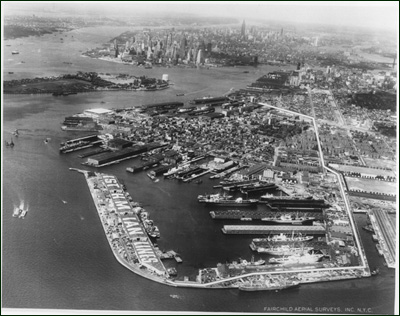
This area was either the location of, or very close to, the site of the Todd Shipyards. The 12th ward is another of New York’s oldest neighborhoods- first settled by the Dutch in 1636- They called it Roode Hoek. In the 1980’s, Life magazine once named Red Hook the “crack capital of the United States”. It’s where Al Capone and Crazy Joe Gallo are from.

Erie Basin -Photo by Mitch Waxman
Red Hook was an early home to the Rapelje (Rapelye) clan- a dutch family who got into New York real estate early in the game.
from gowanuslounge.com. click here for the full post
“Joris Jansen Rapalje was one of the first white settlers on the Long Island. The Rapaljes gave birth to and baptized eleven children—the first child, Sarah, was the first European female born in what would become New York, though whether she was born in Brooklyn or upstate New York is in dispute. It is believed that the Rapaljes have over a million descendants.”
image from statesmarinelines.com/
“Erie Basin Terminal
At the foot of Columbia Street, Red Hook, Brooklyn, NY. Governor’s Island and lower Manhattan Island in the background. Circa early 1950s? Before States Marine Lines bought Isthmian.”

Tug and barge in New York Harbor -Photo by Mitch Waxman
The Tug Austin Reinauer pushes a fuel barge through New York harbor. Built in 1978 as the Morania #20- sold in 1988 as the Mobil-5- then again in 1993 as the Tamarac- as the Morania-1 in 1995- and finally as the Austin Reinauer in 1997. It cruises at an average of 10.2 knots. The barge is the RTC 100, which is a 100,000 barrel capacity fuel barge. I have to post the source for this info- check this out.
note:
Exxon is Esso. Mobil is Esso. Esso is S… and… O. S&O and all its other brand names are ultimately Standard Oil

Looking east into New York harbor from the Kill Van Kull -Photo by Mitch Waxman
All I could think of as we passed through the Kill Van Kull, was that the Newtown Creek must have looked something like this in its day. And that “they” are doing it all over again, this time in Jersey. It was a Monday night, after 7pm, and the industrial complexes on Jersey side were still humming. The Staten Island side of the waterway, however, looked small harbor town sleepy.

Staten Island Waterfront, Kill Van Kull -Photo by Mitch Waxman
Here’s an excellent history of the Staten Island waterfront story from globalsecurity.org. Staten Island’s esoteric past is well outside of my knowledge.
Also- My 2 cents say that once again, New York built a wall between its citizenry and their waterfronts.

Tug nudging ship into place at dock in the Kill Van Kull -Photo by Mitch Waxman
The tug Ellen McAllister was originally built for the U.S. Navy, as the Piqua, at the Marinette Marine Shipyards in Wisconsin in July of 1967. The Piqua’s anchorage for many years was at Holy Loch, Scotland. It spent most of its naval career providing tug services for the 1st naval district and the Atlantic Fleet. It was sold under its current name in 2001 to McAllister Towing.

Tug at dock, Kill Van Kull -Photo by Mitch Waxman
I’m sort of leaning toward this being the tug Durham- but can’t find much about a ship of that name- or a clear photo to match it with.

the Tug K-Sea Falcon -Photo by Mitch Waxman
A New York Harbor barge mover, the 3,200 BHP Falcon has a raised second pilothouse to see over its charges. It’s a youngster– built in 1990 at the Tampa Ship yards in Florida. The gigantic ship in the background is an ocean going transport ship that carries automobiles.

Floating Dry Docks, Staten Island -Photo by Mitch Waxman
That’s a tugboat in that floating drydock. It’s the K-Sea Coral Sea- a 3,280 horsepower, 193 gross ton tug that, along with a long career all along the atlantic seaboard, participated in the evacuation of the World Trade Center site on September 11, 2001. It was built in 1973 as “the Venturer” at the Houma Louisiana Main Iron Works yards. This floating drydock is most likely the Cadell Dry Dock and Repair Co.
from wikipedia:
A floating drydock is a type of pontoon for dry docking ships, possessing floodable buoyancy chambers and a “U” shaped cross-section. The walls are used to give the drydock stability when the floor is below the water level. When valves are opened the chambers are filled with water, the dry dock floats lower in the water, allowing a ship to be moved into position inside. When the water is pumped out of the chambers, the drydock rises and the deck is cleared of water, allowing work to proceed on the ship’s hull.

Newark bay skyline, from Kill Van Kull -Photo by Mitch Waxman
Finally, at the western side of the Kill Van Kull, we near the Bayonne Bridge and see the Newark Bay skyline in the west with the setting sun behind it. Luckily, the date chosen for this excursion was perilously close to the summer equinox (Beltane), and despite the late hour- the burning sun still stared down upon New Jersey- and the culmination of the journey- Newark Bay and Port Elizabeth.

Down under the Bayonne Bridge- aka DUBBO -Photo by Mitch Waxman
But that’s on the other side of the Bayonne Bridge… and another post
as always, if something you read here is contradicted by something you know, contact me. Additions and corrections are always welcomed.
Rare opportunities…
Working Harbor Committee is scheduling 4 Hidden Harbor Tours this summer – we’ll be on the June 15th one. Don’t miss this, get your tickets and ready your cameras!!!


 The Newtown Pentacle