
Nichole East posted this video on Flickr documenting an exorcism performed by her neighbors last week. She also snapped the above photo of the friendly note she left them. (Thanks, Greg Long!)
Altissima quaeque flumina minimo sono labi
Final Vanderbilt mansion post is coming tomorrow, sorry, got busy with something… in the meantime though-

– photo by Mitch Waxman
As a reminder, Forgotten-NY and the Newtown Historical Society are giving a tour of Elmhurst, Queens this weekend. Kevin Walsh and Christina Wilkinson will be leading the tour, check out newtownhistorical.org or forgotten-ny.com for more. Act fast, if there are any tickets left, they’re going fast.

– photo by Mitch Waxman
I also would remind you, Lords and Ladies of Newtown, about the excursions being offered by the Working Harbor Committee this year. An upcoming “Sunset cruise” has piqued my interests, and I would highly recommend the experience.

– photo by Mitch Waxman
Also, the Queens Chronicle recently asked your humble narrator to comment on the plight of the LIC Millstones. Check out the article here.

– photo by Mitch Waxman
In just a couple of weeks, a cool thing to do just might be hanging out with Kevin Walsh of Forgotten-NY and the Newtown Historical Society in Elmhurst.
Newtown Historical Society Walking Tour of Elmhurst – April 18th
The Newtown Historical Society, in conjunction with Forgotten-NY.com, will be hosting a walking tour of Elmhurst on Sunday, April 18th, 2010 at 2pm. We will meet at the token booth of the Grand Avenue-Newtown station on the R line at Broadway and Queens Blvd. Cost is $20 for non-members, $5 for members. Includes the guide services of Forgotten-NY’s Kevin Walsh and an informative historical pamphlet. Non-members will also receive a 1-year NHS membership.
Please RSVP to newtownhistory@gmail.com or call 718-366-3715 and leave your name, phone number and number of participants.

– photo by Mitch Waxman
Benefit to you, Lords and Ladies of Newtown, both spiritually and photographically- is found in the upcoming schedule of Working Harbor Summer Sunset Hidden Harbor Tours. I will be on the June 15th tour, for sure. Check out the Newtown Pentacle posting on last year’s June 15th excursion here:
from workingharbor.com
Working Harbor Committe of New York/New Jersey. Here are the dates & times for our 2010 series of Summer Sunset Hidden Harbor Tours® :
Tickets are on sale now. Click Here to purchase
And thats not all…..
We will announce some additional special tours soon, including Newtown Creek, Circumnavigation of Staten Island and, by popular request, Tugboat Rides!

– photo by Mitch Waxman
Also, and this is goofy, just like my little dog Zuzu- pictured above- but this is from the amazing boingboing– and yes- its NYC
Nichole East posted this video on Flickr documenting an exorcism performed by her neighbors last week. She also snapped the above photo of the friendly note she left them. (Thanks, Greg Long!)

NY Harbor – photo by Mitch Waxman
A recent trip to the cyclopean waterfront of the Port of Newark was marred and occluded by a pervasive blanket of precipitant fog. Suffering from the cold wind and occasional bursts of rain, all around me a ghost city dithered into atmospheric perspectives. Ghosts have been everywhere, during our metropolitan hour of the wolf, in the first decade of the 21st century- here in New York City- where the Terror Wars started.
As the ship carrying the Working Harbor Committee party to its destination left the East River and entered the Upper Harbor approaching Staten Island, one ghost in particular came to mind. A spirit of spectral power is invoked and controlled by knowledge of its true name, according to the hermetic traditions, and the true name of god itself offers the key to mastery of the universe.
Names have power, and in the case of this ghost, the name is Willowbrook.
from wikipedia
The Harbor reached its peak activity in March 1943, during World War II, with 543 ships at anchor, awaiting assignment to convoy or berthing (with as many as 425 seagoing vessel already at one of the 750 piers or docks). 1100 warehouses with nearly 1.5 square miles (3.9 km2) of enclosed space served freight along with 575 tugboats and 39 active shipyards (perhaps most importantly New York Naval Shipyard founded 1801). With a staggering inventory of heavy equipment, this made New York Harbor the busiest in the world.
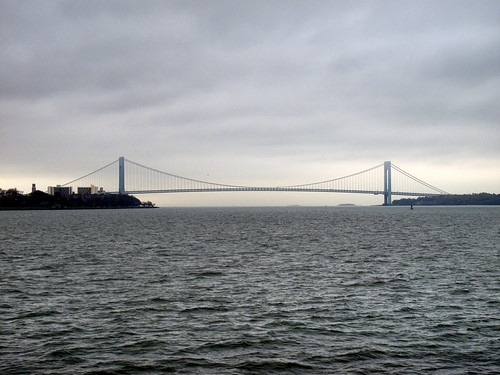
Verrazano Narrows Bridge – photo by Mitch Waxman
A well known film director, whose cinematic subject matter suggests familiarity with Theosophy and other bizarre occult concepts, once opined “that haunted houses are like stone tape decks playing back an endless loop of the suffering and negativity recorded within them”. If one considers such fancies as true, Willowbrook might be considered as a recording studio.
In 1942, a residential hospital facility’s construction was completed on Staten Island. It was commandeered by the Army to act as a hospital for wounded combatants from WW2. In 1947, New York State’s Dept. of Mental Hygiene took over the complex and renamed it the Willowbrook State School. The intended population of the facility was to be the “mentally retarded” (an archaic term from before the advent of modern NewSpeak which describes this group as “Developmentally Disabled“).
from wikipedia
The natural depth of New York Harbor is about 17 feet (5 m), but it has been deepened over the years, to about 24 feet (7 m) controlling depth in 1880. By 1891 the Main Ship Channel was minimally 30 feet (9 m). In 1914 Ambrose Channel became the main entrance to the Harbor, at 40 feet (12 m) deep and 2,000 feet (600 m) wide. During World War II the main channel was dredged to 45 feet (14 m) depth to accommodate larger ships up to Panamax size. Currently the Corps of Engineers is contracting out deepening to 50 feet (15 m), to accommodate Post-Panamax container vessels, which can pass through the Suez Canal. This has been a source of environmental concern along channels connecting the container facilities in Port Newark to the Atlantic. PCBs and other pollutants lay in a blanket just underneath the soil.
In June 2009, the Bloomberg administration announced plans for 200,000 cubic yards of dredged PCBs to be “cleaned” and stored en masse at the site of the former Yankee Stadium, as well as at the Brooklyn Bridge Park. In many areas the sandy bottom has been excavated down to rock and now requires blasting. Dredging equipment then picks up the rock and disposes of it. At one point in 2005 there were 70 pieces of dredging equipment in the harbor working to deepen the harbor, the largest fleet of dredging equipment anywhere in the world. The work occasionally causes noise and vibration that can be felt by residents on Staten Island. Excavators alert residents when blasting is underway.

Drydocks, Kill Van Kull – photo by Mitch Waxman
Willowbrook was notoriously overcrowded, performed experimental and grossly unethical scientific explorations, and because of it- the Federal “Civil Rights of Institutionalized Persons Act of 1980” was instituted to guarantee the civil rights of the vulnerable souls housed in these “snakepits”. Geraldo Rivera, when he used to be a reporter, brought the case to national prominence. Long time New Yorkers still shudder at just the mention of the word.
But, there’s another Willowbrook story- another ghost.
from wikipedia
Geologically, Staten Island was formed in the wake of the last ice age. In the late Pleistocene between 20,000 and 14,000 years ago, the ice sheet that covered northeastern North America reached as far south as present day New York City, to a depth of approximately the same height as the Empire State Building. At one point, during its maximum reach, the ice sheet precisely ended at the center of present day Staten Island, forming a terminal moraine on the existing diabase sill. The central moraine of the island is sometimes called the Serpentine ridge because it contains large amounts of serpentine group minerals.
At the retreat of the ice sheet, Staten Island was connected by land to Long Island because The Narrows had not yet formed. Geologists’ reckonings of the course of the Hudson River have placed it alternatively through the present course of the Raritan River, south of the island, or through present-day Flushing Bay and Jamaica Bay.
As in much of North America, human habitation appeared in the island fairly rapidly after the retreat of the ice sheet. Archaeologists have recovered tool evidence of Clovis culture activity dating from approximately 14,000 years ago. The island was probably abandoned later, possibly because of the extinction of large mammals on the island. Evidence of the first permanent American Indian settlements and agriculture are thought to date from about 5,000 years ago (Jackson, 1995), although early archaic habitation evidence has been found in multiple locations on the island (Ritchie 1963).

Salt Barge, Kill Van Kull – photo by Mitch Waxman
A homeless man who called himself Andre Rand, a one time employee of Willowbrook, set up a squatters residence for himself in the tunnels below and on the grounds of the abandoned hospital (which was finally closed in 1987, although parts of its grounds are used by CUNY in modernity).

Andre Rand at his arrest, from slantmagazine.com
Mr. Rand was convicted for the death of a 12 year old girl who was went missing on Staten Island in 1987. He has since become implicated in a string of area child disappearances stretching back to the 1960’s and refers to himself as “the Ted Bundy of child killers”. Rand is profiled in a recent film I’m anxious to watch, called “Cropsey“.
from wikipedia
The boroughs of New York City straddle the border between two geologic provinces of eastern North America. Brooklyn and Queens, located on Long Island, are part of the eastern coastal plain. Long Island is a massive moraine which formed at the southern fringe of the Laurentide Ice Sheet during the last Ice Age. The Bronx and Manhattan lie on the eastern edge of the Newark Basin, a block of the Earth’s crust which sank downward during the disintegration of the supercontinent Pangaea during the Triassic period. The Palisades Sill on the New Jersey shore of the Hudson River exposes ancient, once-molten rock that filled the basin. Tough metamorphic rocks underlie much of Manhattan, providing solid support for its many skyscrapers.

Salt Barge, Kill Van Kull – photo by Mitch Waxman
I find it disturbing, that a serial killer was loose on Staten Island and I had no idea about it. Even more unsettling, from the “urban explorer point” of view, is that Rand had set up camp in exactly the sort of place that the intrepid photographer is looking for when searching for “locations”. I’ve often mentioned that I don’t cross fences, admonished those who do trespass (while admiring their work), and offered advice on the cultural temperatures and urban hazards encountered when entering certain extant locales. Part of the reason for doing this is that you never know who you’re going to meet back there, alone and cut off from help.
There are weird things that happen, in the City of Greater New York.
a recent clipping from a wire service, for instance, makes me wonder- and more than wonder…
3 Bags Containing Body Parts Are Found in Brooklyn. THE ASSOCIATED PRESS- Published: August 30, 2009- The police said three plastic bags containing the skeletal remains of various body parts were found in Brooklyn. The bags, two of which enclosed suitcases containing the remains, were found Sunday on a street in Bedford-Stuyvesant. The medical examiner was working to identify the parts, as well as the sex, race and cause of death. There have been no arrests.
from sedona.biz
According to the National Research Council, we Americans dump between 8 million to 12 million tons of salt on our roads per year. Massachusetts, New Hampshire and New York report the highest level of salt use, with New York weighing in at 500,000 tons per year. The New York State Department of Transportation requires a road-salt application rate of 225 pounds per lane-mile for light snow and 270 pounds per lane-mile for each application during a heavy snow storm.
When you consider that there are approximately 6,000 miles of paved roadways near New York watersheds, you begin to see how all that road salt adds up. Some roads may get up to 300 tons of road salt per lane-mile each year. Recently, many scientists have begun to study the effects of so much road salt on ecosystems, water quality, public health and road quality. Here are a few things you should know before your break out that sodium chloride, the most commonly used de-icer.
Today’s fun is a chunk of H.P. Lovecraft’s The Dunwich Horror, with photos I shot at the Working Harbor Committee September 15th Sunset tour. For the whole story, at wikisource.org– click here.

– photo by Mitch Waxman
In the meantime a quieter yet even more spiritually poignant phase of the horror had been blackly unwinding itself behind the closed door of a shelf-lined room in Arkham. The curious manuscript record or diary of Wilbur Whateley, delivered to Miskatonic University for translation had caused much worry and bafflement among the experts in language both ancient and modern; its very alphabet, notwithstanding a general resemblance to the heavily-shaded Arabic used in Mesopotamia, being absolutely unknown to any available authority. The final conclusion of the linguists was that the text represented an artificial alphabet, giving the effect of a cipher; though none of the usual methods of cryptographic solution seemed to furnish any clue, even when applied on the basis of every tongue the writer might conceivably have used. The ancient books taken from Whateley’s quarters, while absorbingly interesting and in several cases promising to open up new and terrible lines of research among philosophers and men of science, were of no assistance whatever in this matter. One of them, a heavy tome with an iron clasp, was in another unknown alphabet—this one of a very different cast, and resembling Sanskrit more than anything else. The old ledger was at length given wholly into the charge of Dr Armitage, both because of his peculiar interest in the Whateley matter, and because of his wide linguistic learning and skill in the mystical formulae of antiquity and the middle ages.

– photo by Mitch Waxman
Armitage had an idea that the alphabet might be something esoterically used by certain forbidden cults which have come down from old times, and which have inherited many forms and traditions from the wizards of the Saracenic world. That question, however, he did not deem vital; since it would be unnecessary to know the origin of the symbols if, as he suspected, they were used as a cipher in a modern language. It was his belief that, considering the great amount of text involved, the writer would scarcely have wished the trouble of using another speech than his own, save perhaps in certain special formulae and incantations. Accordingly he attacked the manuscript with the preliminary assumption that the bulk of it was in English.

– photo by Mitch Waxman
Dr Armitage knew, from the repeated failures of his colleagues, that the riddle was a deep and complex one; and that no simple mode of solution could merit even a trial. All through late August he fortified himself with the mass lore of cryptography; drawing upon the fullest resources of his own library, and wading night after night amidst the arcana of Trithemius’ Poligraphia, Giambattista Porta’s De Furtivis Literarum Notis, De Vigenere’s Traite des Chiffres, Falconer’s Cryptomenysis Patefacta, Davys’ and Thicknesse’s eighteenth-century treatises, and such fairly modern authorities as Blair, van Marten and Kluber’s script itself, and in time became convinced that he had to deal with one of those subtlest and most ingenious of cryptograms, in which many separate lists of corresponding letters are arranged like the multiplication table, and the message built up with arbitrary key-words known only to the initiated. The older authorities seemed rather more helpful than the newer ones, and Armitage concluded that the code of the manuscript was one of great antiquity, no doubt handed down through a long line of mystical experimenters. Several times he seemed near daylight, only to be set back by some unforeseen obstacle. Then, as September approached, the clouds began to clear. Certain letters, as used in certain parts of the manuscript, emerged definitely and unmistakably; and it became obvious that the text was indeed in English.

– photo by Mitch Waxman
On the evening of September second the last major barrier gave way, and Dr Armitage read for the first time a continuous passage of Wilbur Whateley’s annals. It was in truth a diary, as all had thought; and it was couched in a style clearly showing the mixed occult erudition and general illiteracy of the strange being who wrote it. Almost the first long passage that Armitage deciphered, an entry dated November 26, 1916, proved highly startling and disquieting. It was written,he remembered, by a child of three and a half who looked like a lad of twelve or thirteen.

– photo by Mitch Waxman
Today learned the Aklo for the Sabaoth (it ran), which did not like, it being answerable from the hill and not from the air. That upstairs more ahead of me than I had thought it would be, and is not like to have much earth brain. Shot Elam Hutchins’s collie Jack when he went to bite me, and Elam says he would kill me if he dast. I guess he won’t. Grandfather kept me saying the Dho formula last night, and I think I saw the inner city at the 2 magnetic poles. I shall go to those poles when the earth is cleared off, if I can’t break through with the Dho-Hna formula when I commit it. They from the air told me at Sabbat that it will be years before I can clear off the earth, and I guess grandfather will be dead then, so I shall have to learn all the angles of the planes and all the formulas between the Yr and the Nhhngr. They from outside will help, but they cannot take body without human blood. That upstairs looks it will have the right cast. I can see it a little when I make the Voorish sign or blow the powder of Ibn Ghazi at it, and it is near like them at May Eve on the Hill. The other face may wear off some. I wonder how I shall look when the earth is cleared and there are no earth beings on it. He that came with the Aklo Sabaoth said I may be transfigured there being much of outside to work on.

– photo by Mitch Waxman
Morning found Dr Armitage in a cold sweat of terror and a frenzy of wakeful concentration. He had not left the manuscript all night, but sat at his table under the electric light turning page after page with shaking hands as fast as he could decipher the cryptic text. He had nervously telephoned his wife he would not be home, and when she brought him a breakfast from the house he could scarcely dispose of a mouthful. All that day he read on, now and then halted maddeningly as a reapplication of the complex key became necessary. Lunch and dinner were brought him, but he ate only the smallest fraction of either. Toward the middle of the next night he drowsed off in his chair, but soon woke out of a tangle of nightmares almost as hideous as the truths and menaces to man’s existence that he had uncovered.

– photo by Mitch Waxman
On the morning of September fourth Professor Rice and Dr Morgan insisted on seeing him for a while, and departed trembling and ashen-grey. That evening he went to bed, but slept only fitfully. Wednesday—the next day—he was back at the manuscript, and began to take copious notes both from the current sections and from those he had already deciphered. In the small hours of that night he slept a little in a easy chair in his office, but was at the manuscript again before dawn. Some time before noon his physician, Dr Hartwell, called to see him and insisted that he cease work. He refused; intimating that it was of the most vital importance for him to complete the reading of the diary and promising an explanation in due course of time. That evening, just as twilight fell, he finished his terrible perusal and sank back exhausted. His wife, bringing his dinner, found him in a half-comatose state; but he was conscious enough to warn her off with a sharp cry when he saw her eyes wander toward the notes he had taken. Weakly rising, he gathered up the scribbled papers and sealed them all in a great envelope, which he immediately placed in his inside coat pocket. He had sufficient strength to get home, but was so clearly in need of medical aid that Dr Hartwell was summoned at once. As the doctor put him to bed he could only mutter over and over again, ‘But what, in God’s name, can we do?’

– photo by Mitch Waxman
Dr Armitage slept, but was partly delirious the next day. He made no explanations to Hartwell, but in his calmer moments spoke of the imperative need of a long conference with Rice and Morgan. His wilder wanderings were very startling indeed, including frantic appeals that something in a boarded-up farmhouse be destroyed, and fantastic references to some plan for the extirpation of the entire human race and all animal and vegetable life from the earth by some terrible elder race of beings from another dimension. He would shout that the world was in danger, since the Elder Things wished to strip it and drag it away from the solar system and cosmos of matter into some other plane or phase of entity from which it had once fallen, vigintillions of aeons ago. At other times he would call for the dreaded Necronomicon and the Daemonolatreia of Remigius, in which he seemed hopeful of finding some formula to check the peril he conjured up.
‘Stop them, stop theml’ he would shout. ‘Those Whateleys meant to let them in, and the worst of all is left! Tell Rice and Morgan we must do something—it’s a blind business, but I know how to make the powder… It hasn’t been fed since the second of August, when Wilbur came here to his death, and at that rate…’
Today’s fun is a chunk of H.P. Lovecraft’s The Shadow Out of Time, with photos I shot at the Working Harbor Committee September 15th Sunset tour. For the whole story, at wikisource.org– click here. (We’ll be returning to Mount Zion Cemetery and its revelations tomorrow)

– photo by Mitch Waxman
There was a mind from the planet we know as Venus, which would live incalculable epochs to come, and one from an outer moon of Jupiter six million years in the past. Of earthly minds there were some from the winged, starheaded, half-vegetable race of palaeogean Antarctica; one from the reptile people of fabled Valusia; three from the furry pre-human Hyperborean worshippers of Tsathoggua; one from the wholly abominable Tcho-Tchos; two from the arachnid denizens of earth’s last age; five from the hardy coleopterous species immediately following mankind, to which the Great Race was some day to transfer its keenest minds en masse in the face of horrible peril; and several from different branches of humanity.

– photo by Mitch Waxman
I talked with the mind of Yiang-Li, a philosopher from the cruel empire of Tsan-Chan, which is to come in 5,000 A.D.; with that of a general of the greatheaded brown people who held South Africa in 50,000 B.C.; with that of a twelfth-century Florentine monk named Bartolomeo Corsi; with that of a king of Lomar who had ruled that terrible polar land one hundred thousand years before the squat, yellow Inutos came from the west to engulf it.
– photo by Mitch Waxman
I talked with the mind of Nug-Soth, a magician of the dark conquerors of 16,000 A.D.; with that of a Roman named Titus Sempronius Blaesus, who had been a quaestor in Sulla’s time; with that of Khephnes, an Egyptian of the 14th Dynasty, who told me the hideous secret of Nyarlathotep, with that of a priest of Atlantis’ middle kingdom; with that of a Suffolk gentleman of Cromwell’s day, James Woodville; with that of a court astronomer of pre-Inca Peru; with that of the Australian physicist Nevil Kingston-Brown, who will die in 2,518 A.D.; with that of an archimage of vanished Yhe in the Pacific; with that of Theodotides, a Greco-Bactrian official Of 200 B.C.; with that of an aged Frenchman of Louis XIII’s time named Pierre-Louis Montagny; with that of Crom-Ya, a Cimmerian chieftain of 15,000 B.C.; and with so many others that my brain cannot hold the shocking secrets and dizzying marvels I learned from them.

– photo by Mitch Waxman
I awaked each morning in a fever, sometimes frantically trying to verify or discredit such information as fell within the range of modern human knowledge. Traditional facts took on new and doubtful aspects, and I marvelled at the dream-fancy which could invent such surprising addenda to history and science.

– photo by Mitch Waxman
I shivered at the mysteries the past may conceal, and trembled at the menaces the future may bring forth. What was hinted in the speech of post-human entities of the fate of mankind produced such an effect on me that I will not set it down here.

– photo by Mitch Waxman
After man there would be the mighty beetle civilisation, the bodies of whose members the cream of the Great Race would seize when the monstrous doom overtook the elder world. Later, as the earth’s span closed, the transferred minds would again migrate through time and space – to another stopping-place in the bodies of the bulbous vegetable entities of Mercury. But there would be races after them, clinging pathetically to the cold planet and burrowing to its horror-filled core, before the utter end.

– photo by Mitch Waxman
Meanwhile, in my dreams, I wrote endlessly in that history of my own age which I was preparing – half voluntarily and half through promises of increased library and travel opportunities – for the Great Race’s central archives. The archives were in a colossal subterranean structure near the city’s center, which I came to know well through frequent labors and consultations. Meant to last as long as the race, and to withstand the fiercest of earth’s convulsions, this titan repository surpassed all other buildings in the massive, mountain-like firmness of its construction.

– photo by Mitch Waxman
The records, written or printed on great sheets of a curiously tenacious cellulose fabric were bound into books that opened from the top, and were kept in individual cases of a strange, extremely light, rustless metal of greyish hue, decorated with mathematical designs and bearing the title in the Great Race’s curvilinear hieroglyphs.
These cases were stored in tiers of rectangular vaults-like closed, locked shelves – wrought of the same rustless metal and fastened by knobs with intricate turnings. My own history was assigned a specific place in the vaults of the lowest or vertebrate level – the section devoted to the culture of mankind and of the furry and reptilian races immediately preceding it in terrestrial dominance.

– photo by Mitch Waxman
But none of the dreams ever gave me a full picture of daily life. All were the merest misty, disconnected fragments, and it is certain that these fragments were not unfolded in their rightful sequence. I have, for example, a very imperfect idea of my own living arrangements in the dream-world; though I seem to have possessed a great stone room of my own. My restrictions as a prisoner gradually disappeared, so that some of the visions included vivid travels over the mighty jungle roads, sojourns in strange cities, and explorations of some of the vast, dark, windowless ruins from which the Great Race shrank in curious fear. There were also long sea voyages in enormous, many-decked boats of incredible swiftness, and trips over wild regions in closed projectile-like airships lifted and moved by electrical repulsion.

– photo by Mitch Waxman
Beyond the wide, warm ocean were other cities of the Great Race, and on one far continent I saw the crude villages of the black-snouted, winged creatures who would evolve as a dominant stock after the Great Race had sent its foremost minds into the future to escape the creeping horror. Flatness and exuberant green life were always the keynote of the scene. Hills were low and sparse, and usually displayed signs of volcanic forces.

– photo by Mitch Waxman
Of the animals I saw, I could write volumes. All were wild; for the Great Race’s mechanised culture had long since done away with domestic beasts, while food was wholly vegetable or synthetic. Clumsy reptiles of great bulk floundered in steaming morasses, fluttered in the heavy air, or spouted in the seas and lakes; and among these I fancied I could vaguely recognise lesser, archaic prototypes of many forms – dinosaurs, pterodactyls, ichthyosaurs, labyrinthodonts, plesiosaurs, and the like-made familiar through palaeontology. Of birds or mammals there were none that I could discover.


 The Newtown Pentacle