alien shadow
Seeing the big rigs in Long Island City.

– photo by Mitch Waxman
One encountered a lonely semi truck on my recent scuttle across a still quite industrial section of LIC. It’s a “class 8” heavy truck, and manufactured by the Kenworth company. “Class 8” are vehicles which serve vocational applications – heavy dump trucks, concrete pump trucks, and refuse hauling – as well as including long-haul 4×2 and 6×4 tractor units such as the one pictured above. Washington state based, Kenworth has been in the truck business since 1912. Don’t ask me to identify what model of truck this is, as I’m sure there’s a gear head reading this who can help with the ID (share in the comments section) and will know far more than I about it. Like taxis and tugboats – when you see a vehicle like this just sitting there parked on the street, the owner is losing money.
I have always been fascinated with this idea of perpetually moving vehicles. Certain vehicles are meant to be operated continuously by multiple crews of drivers, and meant to never stop moving. Police cars and ambulances, subways and trains of all types… cargo ships… all are meant to rest only when undergoing maintenance or changing work crews and operators. That’s interesting, no?
– photo by Mitch Waxman
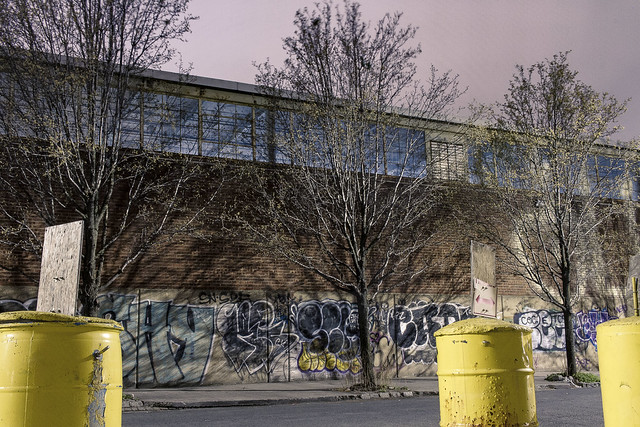
A graffiti crew had obviously taken fairly recent advantage of the expansive warehouse walls (a “building trade” lumber operation) on this particular block in LIC, but I was more interested in the sickly trees lining the sidewalk than the fairly inexpert tags. In these industrial zones, trees are scarce, and often fall victim to the hustle and bustle of getting things done. In this sort of area, the DEP and FDNY have to erect bollards around their fire hydrants to vouchsafe them from getting knocked over or down, and you’ll often notice utility poles which have had huge swaths carved out of them by careless truckers moving multi ton loads about. Stop signs and lamp posts are regularly snapped off their stanchions as well.
As I tell the people who have just discovered Newtown Creek – all the time – be careful, it’s easy to get dead around here if you don’t know the lay of the land. Luckily, I’ve been obliged to sit through literally days of the safety training which the “union guys” get in order to legally enter job sites and facilities with the camera, and I “sprech the deutch” of their acculturations.

– photo by Mitch Waxman
That’s the Queens Midtown Expressway section of the Long Island Expressway in the upper left, and it’s been towering over Borden Avenue in LIC since 1939. The LIE rises from ground level at Greenpoint Avenue all the way to 106 feet over the waters of Newtown Creek’s nearby Dutch Kills tributary before beginning its descent into the Queens Midtown Tunnel in Hunters Point. I refer to the zone underneath the LIE as “the empty corridor,” but there’s actually quite a lot going on down here.
More from the empty corridor tomorrow, at this, your Newtown Pentacle.
Note: I’m writing this and several of the posts you’re going to see for the next couple of weeks at the start of the week of Monday, March 16th. My plan is to continue doing my solo photo walks around LIC and the Newtown Creek in the dead of night as long as that’s feasible. If you continue to see regular updates as we move into April and beyond, that means everything is kosher as far as health and well being. If the blog stops updating, it means that things have gone badly for a humble narrator.
“follow” me on Twitter- @newtownpentacle
Buy a book!
“In the Shadows at Newtown Creek,” an 88 page softcover 8.5×11 magazine format photo book by Mitch Waxman, is now on sale at blurb.com for $30.
brushed boldly
Industrial zones and pandemics, a natural combination.

– photo by Mitch Waxman
The long walks I take often end up taking me to lonely and deserted places wherein the only other inhabitants of the local vicinity are the drivers and passengers of passing motor vehicles. Now, more than ever, my footfalls lead me and the camera to uninhabited places. There’s a section of Long Island City, west of Sunnyside and north of Blissville, which I’ve always found visually interesting. The land slopes down towards the Dutch Kills Tributary of Newtown Creek, affording one interesting views and an easy perambulation. You’ve always got a real sense of vulnerability here, but intellectually know that at any given moment you’re on half a dozen CCTV security cameras and that there’s a sleep deprived night watchman watching you and hoping that they don’t have to get up and yell at you to stop doing something they are supposed to police. I never trespass, and graffiti ain’t my bag, so…
This section of LIC is interesting in terms of the utilitarian architecture encountered here, some of which is actually quite fetching, but I like a good warehouse or factory.

– photo by Mitch Waxman
Pictured above is a nicely maintained structure found at the corner of 48th Avenue and 34th street, which is currently on sale – based on the Realtor’s banner signage hung on its wall. The 4 story building sits in an M2 industrial zone, hosts 141,000 square feet within its walls, and was erected in 1926 (altered and upgraded in 2013). A little detective work reveals that prior to the renaming of streets and avenues in Queens – and LIC in particular – back in the first half of the 20th century (which happened twice, and is very confusing) 48th Avenue was called “Anable Avenue” and that the factory pictured above was the home of the Morganite Brush Company. Here’s one of their advertisements.
Apparently, Morganite Brush (they’re still around, but call themselves Morgan Advanced Materials these days, and seem to do business from the American South East) manufactured electrical components called “carbon brushes” here. Not wanting to research and write a dissertation on carbon brushes, a quick call to my pal Hank the Elevator guy reveals that “it’s a moving component that supplies voltage to motors” and that he replaces a lot of brushes in the elevator motors he maintains as part of his daily round. Suddenly, the existing modern day profusion of elevator industry supply warehouses and maintenance companies in this section of LIC makes all the sense in the world to me.

– photo by Mitch Waxman
As mentioned, one wasn’t really thinking about a destination and was just following the direction which my toes were pointing towards, while trying to consciously stop myself from wandering anywhere close to congregations of the humans. As is always the case with me, I’d eventually end up at Newtown Creek or one of its tributaries on this particular walk, which you’ve probably guessed by now. Along the way, photos were gathered.
One thing which has really taken my notice is how clean the sidewalks and gutters have become with all of us sequestered away in our hidey holes. Have to figure that the rats and pigeons must be wondering where all the free food has gone.
Note: I’m writing this and several of the posts you’re going to see for the next couple of weeks at the start of the week of Monday, March 16th. My plan is to continue doing my solo photo walks around LIC and the Newtown Creek in the dead of night as long as that’s feasible. If you continue to see regular updates as we move into April and beyond, that means everything is kosher as far as health and well being. If the blog stops updating, it means that things have gone badly for a humble narrator.
“follow” me on Twitter- @newtownpentacle
Buy a book!
“In the Shadows at Newtown Creek,” an 88 page softcover 8.5×11 magazine format photo book by Mitch Waxman, is now on sale at blurb.com for $30.
swaggered boldly
Hiding, dodging, weaving.

– photo by Mitch Waxman
My carefully chosen route through the human infestation of Western Queens on a recent evening, a path which was chosen for its probable lack of inhabitants, nevertheless brought me into near contact with the other primates. Given that one such as myself fears others, without delimiting criteria involving their interior microbial population, avoidance of any sort of human interaction is definitively part of my skill set. Despite this, other hardy adventurers were out and about whom a humble narrator afforded a wide berth. In the shot above, captured on 43rd Avenue in LIC, I had spotted a bicycle rider approaching from about three blocks away and flung myself against that brick wall you see.
Luckily, the filthy black raincoat is adaptive for use as urban camouflage. The bicyclist probably perceived a filthy black bag of squirming rats out of the corner of his eye. What? You’ve never encountered a bag of rats? Well, what do you transport your rats in, a box? Wait… I’ve said too much again.

– photo by Mitch Waxman
A rough looking passerby was silhouetted in the distance as my roadway interface scuttled along the pavement, and soon I found myself crouched down behind a garbage bin. Whomsoever left this handy hiding place in the middle of the sidewalk for me to cower behind has my thanks.
While crying for a few minutes as the stress chemicals bled out of the brain and spinal column, a humble narrator began to reconsider his various choices in life.
Regret at having not pursued an interest in product photography, or perhaps macro studio work, gnawed. From behind me came the sound of sneakers shuffling across the diseased cement, and yet another eidolon of “stranger danger” – likely cloaked in a rich cloud of microscopic predators – was turning the corner.
All that fellow was allowed to perceive of me likely appeared to him as a hurtling black shape moving spasmodically away at untold thousands of inches an hour towards Queens Blvd. while uttering a terrorized sound not unlike that of a burning duck mixed with the cry of a newborn goat.
In other words, a black bag of rats with a bunch of camera gear.

– photo by Mitch Waxman
My escape path was arrested by an uncaring traffic signal at Queens Boulevard, the legendary “Boulevard of Death” itself. There did one encounter a sparse amount of passing automotive traffic, and eventually egress to the southern side of this “Via Mortis,” or the “ölim bwlvarı” as you would say in the Kazakh tongue or “leofóros tou thanátou” in modern Greek, was accomplished.
One was sure he could feel the pinpricks of Corona viruses bouncing off his face, a deadly series of plasmic projectiles carried upon the easterly wind. That’s what I thought at first, but luckily it was just some disgusting rain water dripping out of the elevated 7 line tracks overhead.
People, people!
Note: I’m writing this and several of the posts you’re going to see for the next couple of weeks at the start of the week of Monday, March 16th. My plan is to continue doing my solo photo walks around LIC and the Newtown Creek in the dead of night as long as that’s feasible. If you continue to see regular updates as we move into April and beyond, that means everything is kosher as far as health and well being. If the blog stops updating, it means that things have gone badly for a humble narrator.
“follow” me on Twitter- @newtownpentacle
Buy a book!
“In the Shadows at Newtown Creek,” an 88 page softcover 8.5×11 magazine format photo book by Mitch Waxman, is now on sale at blurb.com for $30.
coherent thought
Combination punches are what make a great fighter, and a deadly virus.

– photo by Mitch Waxman
One is forced to continue his incessant marching about, as my very existence is predicated upon regular “cardio” without which my veins and arteries will become plugged up. In accordance with quarantine rules, I’m only leaving the house when the streets will be absolutely deserted. Luckily, I favor lonely paths, enjoy the concrete devastations, and am also a bit of a night owl under best circumstance. Recent endeavor found one wandering through Long Island City on my way to Newtown Creek on a Saturday night. I know how to party.
That’s Skillman Avenue pictured above. Somehow, all the arguing and gnashing of teeth over that bike lane seems pretty silly now, doesn’t it?

– photo by Mitch Waxman
LIC is still home to several yellow cab fleets. These pictures were gathered on a Saturday night, and seemingly all of the yellow cabs operated by this particular outfit were sitting parked and empty. Already in serious trouble due to a changing economy and the rapacious greed of both medallion brokers and the City’s “TLC,” I don’t know if the yellow cab side of the “for hire vehicle” segment is going to survive this quarantine.
There’s a lot of people I know who work in the so called “gig” economy who are experiencing total unemployment and impoverishment already. Personally speaking, there is going to zero demand for any sort of walking or boat tour until at least July, and that’s presuming that things are normal again by then, so I’m actually one of the aforementioned “screwed” as well. Lots of belt tightening is underway at HQ, and my goal of buying a new camera body at the end of the year is pretty much kaput.
Saying that, I’m hoping to just not get sick and die right now, so if I manage that, it’ll soften the blow about the camera. ‘Life and death” versus “things you’d want debates”… so very American of me, huh?

– photo by Mitch Waxman
I do have a bit of sympathy for the cab drivers, as a note. A humble narrator makes it a point of talking to cab drivers, whereas a lot of folks don’t bother. One is often interested in the points of view offered by the mostly immigrant drivers, some of whom are surprisingly well educated and interesting people working at their first job in the U.S. and are just making ends meet by working in this particular trade. Others are knuckleheads and bad conversationalists.
One of the things I observed while wandering around that night was that the ethnic restaurants were empty, while bars and other restaurants were packed. This was on Saturday the 14th, as a note. When I say “ethnic restaurants” I don’t mean the kind that cater to the general population, rather ones which people of that restaurants actual ethnic culture or community frequent – the Comida Typica’s or Greek Tavernas or the Colombian steak and egg joints.
Of course, on this evening restaurants and bars were still open.
Note: I’m writing this and several of the posts you’re going to see for the next couple of weeks at the start of the week of Monday, March 16th. My plan is to continue doing my solo photo walks around LIC and the Newtown Creek in the dead of night as long as that’s feasible. If you continue to see regular updates as we move into April and beyond, that means everything is kosher as far as health and well being. If the blog stops updating, it means that things have gone badly for a humble narrator.
“follow” me on Twitter- @newtownpentacle
Buy a book!
“In the Shadows at Newtown Creek,” an 88 page softcover 8.5×11 magazine format photo book by Mitch Waxman, is now on sale at blurb.com for $30.
empty panel
The darnedest things, you see.

– photo by Mitch Waxman
So, I’m coming home from the Community Board offices one night after a meeting, and I spot a wrecked car body dangling on the end of a tow truck’s wire. Not the sort of thing you see everyday, thought I, and worthy of a picture or two. Well, to be fair, I do see this sort of thing a lot, but most of you probably don’t.
Transiting to and from that Community Board District office is why there’s been a sudden proliferation of shots from the Industrial Business Zone found along the Grand Central Parkway and Astoria Blvd. of late. It’s no industrial Maspeth, mind you, but there’s a few interesting things to point a camera at hereabouts. If only St. Michael’s Cemetery was open at night, huh?

– photo by Mitch Waxman
I’m sure this is the sort of thing that someone who works for the City is just dying to write a fine for, but y’know – it’s the 108th precinct – and they’ve got bigger fish to fry. NYPD has got to be a scary place to work right now, first responder wise. Along with FDNY they’re literally the front line of the epidemiologist response team, and you’ve got to figure that they’re worried about tracking something back home after the shift ends. When all this is all over, rounds and rounds of drinks are on the rest of us for all of your services in these times of trouble, you coppers and smoke eaters.
Fun times, huh?

– photo by Mitch Waxman
The joke which I’ve been trading with friends and family about “social distancing” is that what I normally consider a good time is to wander around a deserted industrial zone by myself, so this is just another day for me. Additionally, as a proud member of Generation X, social isolation and avoiding interaction with other people is imperative and a long denied desire. Don’t stand so close to me, as the old Police song opines.
Cooties.
Note: I’m writing this and several of the posts you’re going to see for the next couple of weeks at the start of the week of Monday, March 16th. My plan is to continue doing my solo photo walks around LIC and the Newtown Creek in the dead of night as long as that’s feasible. If you continue to see regular updates as we move into April and beyond, that means everything is kosher as far as health and well being. If the blog stops updating, it means that things have gone badly for a humble narrator.
“follow” me on Twitter- @newtownpentacle
Buy a book!
“In the Shadows at Newtown Creek,” an 88 page softcover 8.5×11 magazine format photo book by Mitch Waxman, is now on sale at blurb.com for $30.


