gleaming sands
How the other half lives, in today’s post.

– photo by Mitch Waxman
My pals at Atlas Obscura rang me up and asked if I’d be interested in shooting at one of their events in Brooklyn, and since this offered an opportunity to leave the house (a rare treat during this winter of frozen discontent), I packed up Our Lady of the Pentacle and my camera bag and we set off for Williamsburg. Now, I don’t spend a lot of time around these parts, can’t afford it, but its also nice to see how the other half lives.
from wikipedia
Williamsburg is a neighborhood of 113,000 inhabitants in the New York City borough of Brooklyn, bordering Greenpoint to the north, Bedford–Stuyvesant to the south, Bushwick and Ridgewood, Queens to the east and the East River to the west. The neighborhood is part of Brooklyn Community Board 1. The neighborhood is served by the New York Police Department (NYPD)’s 90th Precinct. In the City Council, the western and southern part of the neighborhood is represented by the 33rd District; and the eastern part of the neighborhood is represented by the 34th District.

– photo by Mitch Waxman
This is the Williamsburgh Savings Bank building at 175 Broadway, a building erected just 10 years after the Civil War. A famous structure, its the domed building you can’t help but notice when exiting the Williamsburg Bridge, at least when you’re on the Brooklyn side.
from wikipedia
The Williamsburgh Savings Bank was an important institution in Brooklyn, New York, from the mid-19th to the mid-20th centuries. A series of bank mergers brought it into the HSBC group late in the 20th century. (It is not to be confused with the nearby Dime Savings Bank of Williamsburgh, now known simply as the DIME, a rival local institution that has remained independent.) It is best remembered for two imposing headquarters buildings still standing, the domed original at 175 Broadway in Williamsburg, Brooklyn, designed by George B. Post, and the later Williamsburgh Savings Bank Tower.

– photo by Mitch Waxman
As transmitted by our hosts, the tale of the WSB includes decades of neglect, wear, and tear. The current owners acquired it just a few years ago (and of course it was controversial, it’s in North Brooklyn, not Queens) and set upon a radical architectural restoration of the bank. Pictured is the meticulous work found on the first of the interior domes.
from nyc-architecture.com
To build a new edifice for the WBS the board of trustees hired George B. Post (1837-1913), a man who had just finished the important Equitable Life Assurance Building (1868-1870), was at present finishing the Western Union Building (1873-1875), and who would later go on to design the icon of money, the market, and capitalism in 1903. Architecturally speaking and with vast hindsight, it was upon the hiring of Post that the WBS secured itself as a structural institution and landmark in Brooklyn. For it is through the tie to its architect that this structurally impressive building gains even more notoriety; George B. Post would later go on to design City College (1886-1906), the Brooklyn Historical Society (1881), the New York Stock Exchange (1903), and other notable buildings throughout the country.

– photo by Mitch Waxman
There were three buildings here, the 1875 original and an early 20th century addition (1906, I think) – both domed – and a 1940’s era office building of pedestrian design. The domed buildings were landmarked, but the office building was not and it was torn down. There are plans to erect a modern hotel on the property, a mammoth 40 story affair. The former bank will act as an event space for the hotel.
for a Landmarks Preservation Committee document generated by municipal authorities back in 1996, click here.

– photo by Mitch Waxman
This is the second dome, which I seem to recall as being of 1906 vintage, but might be misstating the date. The oculus in the center was actually boarded up during the Second World War and remained so until the restoration process began. In case you’re curious, yes, I laid down on the floor in the center of the room and shot straight up.
from ny.curbed.com
When Brooklyn hostel owner Juan Figueroa purchased the Williamsburgh Savings Bank for $4.5 million in 2010, the rumor was that he planned to convert the historic bank building into a hotel. That would have been difficult, though, since the structure is an exterior, interior, and national landmark. The actual plan, it turned out, was to meticulously restore it and turn it into an event space and banquet hall, and place a 40-story hotel right next door.

– photo by Mitch Waxman
The other half lives in Williamsburg, I’m told. The Brooklyn patois pronunciation for this neighborhood is “Willemsboig” and my parents – who used to bank with the company once located here – called it “Da Willemsboig Savins Banks.” They stayed with the company all the way till it became HSBC. That’s brand loyalty, folks. Back tomorrow with a few more shots from within the lush interior, including some details on the vault.
“follow” me on Twitter- @newtownpentacle
inscribed thereon
A visit with the god of America.

– photo by Mitch Waxman
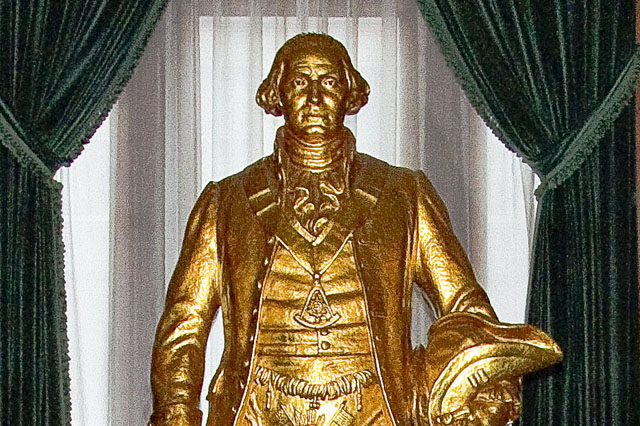
Brazen and gilt, this representation of the American Augustus is appropriately found at the N.Y. Grand Lodge of the Free and Accepted Masons on 23rd street in Mahattan. It adorns a library room, and honors a significant member of that centuried secret society.
The founder of our nation, as General Washington is known, enjoyed a lifestyle that could only be maintained by a subjugate army of slaves. I’d like to believe that he would be resistant to having his birthday celebrated with a crass and consumerist bacchanal, as he’d be embarrassed by it – but as I’m a non-slaver, it’s difficult for me to imagine the mindset of the “founding fathers” and walk a mile in their proverbial moccasins.
from wikipedia
Titled Washington’s Birthday, the federal holiday was originally implemented by the United States Congress in 1880 for government offices in the District of Columbia (20 Stat. 277) and expanded in 1885 to include all federal offices (23 Stat. 516). As the first federal holiday to honor an American citizen, the holiday was celebrated on Washington’s actual birthday, February 22. On 1 January 1971, the federal holiday was shifted to the third Monday in February by the Uniform Monday Holiday Act. This date places it between February 15 and 21, which makes the name “Washington’s Birthday” a misnomer, since it never lands on Washington’s actual birthday, February 22. A draft of the Uniform Holidays Bill of 1968 would have renamed the holiday to Presidents’ Day to honor the birthdays of both Washington and Lincoln, but this proposal failed in committee and the bill as voted on and signed into law on 28 June 1968, kept the name Washington’s Birthday.

– photo by Mitch Waxman
The General died badly, but everybody does that, and one such as myself doesn’t shed tears for a dead slave master even if they did accomplish a lot at their day jobs. Unfortunately, for a fellow so immersed in the “Enlightenment” and who was very much a rationalist and a logician – he thought the answer to illness was exsanguination (which was how his slaves were “cured” of ailments as well). His doctors bled him to death, but the holiday today is about his birth, not his death. This compound holiday (Washington and Lincoln’s birthdays are celebrated coterminously) was offered to the nation, as of 1968, as it was determined that there were too many Monday holidays in February and it was getting in the way of business. I’ve often thought we should celebrate a Monday holiday which specifically mentions the subjugation and forced generational labor of millions, but there you go.
from wikipedia
On Thursday, December 12, 1799, Washington spent several hours inspecting his plantation on horseback, in snow, hail, and freezing rain—later that evening eating his supper without changing from his wet clothes.
That Friday he awoke with a severe sore throat and became increasingly hoarse as the day progressed, yet still rode out in the heavy snow, marking trees on the estate that he wanted cut. Sometime around 3 a.m. that Saturday, he suddenly awoke with severe difficulty breathing and almost completely unable to speak or swallow. A firm believer in bloodletting, a standard medical practice of that era which he had used to treat various ailments of enslaved Africans on his plantation, he ordered estate overseer Albin Rawlins to remove half a pint of his blood.
A total of three physicians were sent for, including Washington’s personal physician Dr. James Craik along with Dr. Gustavus Brown and Dr. Elisha Dick. Craik and Brown thought that Washington had what they diagnosed as “quinsey” or “quincy”, while Dick, the younger man, thought the condition was more serious or a “violent inflammation of the throat”. By the time the three physicians had finished their treatments and bloodletting of the President, there had been a massive volume of blood loss—half or more of his total blood content being removed over the course of just a few hours.
Recognizing that the bloodletting and other treatments were failing, Dr. Dick proposed performing an emergency tracheotomy, a procedure that few American physicians were familiar with at the time, as a last-ditch effort to save Washington’s life; but the other two doctors rejected this proposal.
– photo by Mitch Waxman
One of my little fantasies is the one where I magically pluck General Washington from the back of his horse and draw him into our future to witness that which has been wrought in his name. He gets introduced to the imperial majesty of present day America in this fugue of mine, and witnesses not just the modern military might but the relative luxury (compared to his era) and civil treatment that even the basest members of our society can and do expect. I suspect that the General would be shocked at the size and reach of a standing military which operates out of 900 military bases in 150 countries. I don’t think he’d be surprised that the slaves had been freed and offered citizenship, nor the lousy treatment they’d received. More shocking to him would be the relative importance and status of France and almighty England, which were the Americas of their time.
Of course, that was before an American God came along who did the work of the Great Architect of the Universe.
from wikipedia
Washington was initiated into Freemasonry in 1752. He had a high regard for the Masonic Order and often praised it, but he seldom attended lodge meetings. He was attracted by the movement’s dedication to the Enlightenment principles of rationality, reason and fraternalism; the American lodges did not share the anti-clerical perspective that made the European lodges so controversial. In 1777, a convention of Virginia lodges recommended Washington to be the Grand Master of the newly established Grand Lodge of Virginia; however, Washington declined, due to his necessity to lead the Continental Army at a critical stage, and because he had never been installed as Master or Warden of a lodge, he did not consider it Masonically legal to serve as Grand Master. In 1788, Washington, with his personal consent, was named Master in the Virginia charter of Alexandria Lodge No. 22.
“follow” me on Twitter- @newtownpentacle
Magic Lantern Show at Brooklyn Brainery
The Newtown Creek Magic lantern show returns.

– photo by Mitch Waxman
On February 27th, your humble narrator will be narrating humbly at the Brooklyn Brainery – here’s the details. This is the 2014 version of the thing, btw, updated with newly learned information and recently captured images. In the past, this photo presentation and info dump has been offered to political clubs, historical societies, and to the general public at a variety of venues.
Come with?

– photo by Mitch Waxman
Brooklyn Brainery is a swell operation, located in the nice part of Brooklyn nearby Grand Army Plaza and several Subway lines. I’ve worked with them a few times in the last year, doing walking tours, and they’re very cool folks. Also, the space they’re located in is very nice – physical comfort wise and such.
From their website –
We host classes about all sorts of things: from physics to Australian desserts, from HTML to shorthand and just about every nook and cranny in between.
All of our course topics are dreamed up and suggested by you, and our teachers are a group of awesome people from around Brooklyn and the whole city. Anyone can teach–you just need a passion for the topic and a desire to share it with others. We do all the planning, taking care of sign ups, marketing, and materials, so you can focus on the important stuff (teaching, duh).”

– photo by Mitch Waxman
The presentation will be about 2 hours long, with the actual slideshow and talk occupying roughly one and a half hours. What follows will be a Q&A session, wherein questions will be offered that a humble narrator will endeavor to intelligently answer. Brooklyn Brainery is asking $12 for the class.
There are still a few tickets left, so click on through and join the conversation about Newtown Creek on February 27th at 8 p.m.
“follow” me on Twitter- @newtownpentacle
alluded to
All text today from H.P. Lovecraft’s “Azathoth,” courtesy wikisource

– photo by Mitch Waxman
When age fell upon the world, and wonder went out of the minds of men; when grey cities reared to smoky skies tall towers grim and ugly, in whose shadow none might dream of the sun or of Spring’s flowering meads; when learning stripped the Earth of her mantle of beauty and poets sang no more save of twisted phantoms seen with bleared and inward looking eyes; when these things had come to pass, and childish hopes had gone forever, there was a man who traveled out of life on a quest into spaces whither the world’s dreams had fled.

– photo by Mitch Waxman
Of the name and abode of this man little is written, for they were of the waking world only; yet it is said that both were obscure. It is enough to say that he dwelt in a city of high walls where sterile twilight reigned, that he toiled all day among shadow and turmoil, coming home at evening to a room whose one window opened not to open fields and groves but on to a dim court where other windows stared in dull despair. From that casement one might see only walls and windows, except sometimes when one leaned so far out and peered at the small stars that passed. And because mere walls and windows must soon drive a man to madness who dreams and reads much, the dweller in that room used night after night to lean out and peer aloft to glimpse some fragment of things beyond the waking world and the tall cities. After years he began to call the slow sailing stars by name, and to follow them in fancy when they glided regretfully out of sight; till at length his vision opened to many secret vistas whose existance no common eye suspected. And one night a mighty gulf was bridged, and the dream haunted skies swelled down to the lonely watcher’s window to merge with the close air of his room and to make him a part of their fabulous wonder.

– photo by Mitch Waxman
There came to that room wild streams of violet midnight glittering with dust of gold, vortices of dust and fire, swirling out of the ultimate spaces and heavy perfumes from beyond the worlds. Opiate oceans poured there, litten by suns that the eye may never behold and having in their whirlpools strange dolphins and sea-nymphs of unrememberable depths. Noiseless infinity eddied around the dreamer and wafted him away without touching the body that leaned stiffly from the lonely window; and for days not counted in men’s calendars the tides of far spheres that bore him gently to join the course of other cycles that tenderly left him sleeping on a green sunrise shore, a green shore fragrant with lotus blossoms and starred by red camalates…
“follow” me on Twitter- @newtownpentacle
like shuddering
Winter is coming? Winter will never leave.

– photo by Mitch Waxman
For the record, my fear is that a new glacial age has begun, and TV weather reports back up my suspicions. Problem is that I’m not that good with a spear, and when the mastodons return I’m going to get bossed around by a group of hirsute Pachyderms. This sort of humiliation would be fairly typical for me, as your humble narrator is extremely easy to bully, especially by those megafauna which prosper during Ice Ages. Luckily, I can definitely do the cave paintings, so there will be some rationalized utility by which the strong can justify keeping me alive. Of course, this scenario isn’t all that much different from normal life, as there’s always someone trying to boss me around.
from wikipedia
The energy balance of the snowpack itself is dictated by several heat exchange processes. The snowpack absorbs solar shortwave radiation that is partially blocked by cloud cover and reflected by snow surface. A long-wave heat exchange takes place between the snowpack and its surrounding environment that includes overlying air mass, tree cover and clouds. Heat exchange takes place by convection between the snowpack and the overlaying air mass, and it is governed by the temperature gradient and wind speed. Moisture exchange between the snowpack and the overlying air mass is accompanied by latent heat transfer that is influenced by vapor pressure gradient and air wind. Rain on snow can add significant amounts of thermal energy to the snowpack. A generally insignificant heat exchange takes place by conduction between the snowpack and the ground. The small temperature change from before to after a snowfall is a result of the heat transfer between the snowpack and the air. As snow degrades, its surface can develop characteristic ablation textures such as suncups or penitentes.

– photo by Mitch Waxman
It’s my own fault, being bullyable, as I was born “less than.” Vast physical cowardice, combined with a naturally ugly mind, renders one somewhat less than a “leader.” It has never been my joy to hit the game running home run, rather I’m the fellow who fouls out and sets up the hero for his or her savior moment at the bottom of the ninth. In an ice age overrun by giant Moose and hairy Elephants, it would be vainglorious to suggest that I’d be of much use to society, and admission is offered that one such as myself would have made a terrible Viking.
from wikipedia
Ice was originally thought to be slippery due to the pressure of an object coming into contact with the ice, creating heat, melting a thin layer of the ice and allowing the object to glide across the surface. For example, the blade of an ice skate, upon exerting pressure on the ice, would melt a thin layer, providing lubrication between the ice and the blade. This explanation, called “pressure melting”, originated in 19th century. It however did not account for skating on ice temperatures lower than −3.5 °C, which skaters often skate upon.
In the 20th century an alternative explanation, called “friction heating,” was proposed, whereby friction of the material was the cause of the ice layer melting. However, this theory also failed to explain skating at low temperature. Neither sufficiently explained why ice is slippery when standing still even at below-zero temperatures.
It is now believed that ice is slippery because ice molecules in contact with air cannot properly bond with the molecules of the mass of ice beneath (and thus are free to move like molecules of liquid water). These molecules remain in a semi-liquid state, providing lubrication regardless of pressure against the ice exerted by any object. However, the significance of this hypothesis is disputed by experiments showing a high coefficient of friction for ice using atomic force microscopy.

– photo by Mitch Waxman
Perhaps my bag in this new Cryosphere, or snowball Earth, will be to handle the weaker animals which will populate the nooks and crannies of our world. This wouldn’t put any meaningful protein on the table, but would be a service sought out by others by which some occupation could be found. Squashing bugs and chasing rodentine manifestations would at least keep me busy enough to stay warm. Also, like the Mongols, I could wear clothes made of sewn up amalgamations of Mouse leather.
from wikipedia
Ice sheets are bigger than ice shelves or alpine glaciers. Masses of ice covering less than 50,000 km2 are termed an ice cap. An ice cap will typically feed a series of glaciers around its periphery.
Although the surface is cold, the base of an ice sheet is generally warmer due to geothermal heat. In places, melting occurs and the melt-water lubricates the ice sheet so that it flows more rapidly. This process produces fast-flowing channels in the ice sheet — these are ice streams.
The present-day polar ice sheets are relatively young in geological terms. The Antarctic Ice Sheet first formed as a small ice cap (maybe several) in the early Oligocene, but retreating and advancing many times until the Pliocene, when it came to occupy almost all of Antarctica. The Greenland ice sheet did not develop at all until the late Pliocene, but apparently developed very rapidly with the first continental glaciation. This had the unusual effect of allowing fossils of plants that once grew on present-day Greenland to be much better preserved than with the slowly forming Antarctic ice sheet.
“follow” me on Twitter- @newtownpentacle


