Posts Tagged ‘Astoria’
The Hermetic Hungarian responds

Down under the Hell Gate Bridge Onramp- DUHGBO – photo by Mitch Waxman
A recent posting- Hungry Ghosts– detailed the lengthy and pedantic debate over the merits of Film vs. Digital photography enjoyed by myself and that erudite Manhattanite known to long time readers of this Newtown Pentacle as the Hermetic Hungarian.
The Hungarian responds:
32. Not 22. Two times 16. And they are all great. Ain’t gonna scan ’em. Projected ’em from my 2-1/4″ slide projector. Dee-lish.
And it’s not that I dislike digital, it’s that there is no digital equivalent of black & white. A photo-chemical process which leaves traces of its origins throughout the process. Palimpsests. Ghosts.
I’m probably gonna get a G-11 or used G-10 (it was the stupid human interface that put me off the S-90, not to mention Adobe’s brain-dead policies) to fool with while I wait for version 2 of Leica’s digital M-9 to come out. Upon which I will then be able to attach all but two of my 14 Leica lenses. (To be fair, one of my lenses can only go on my vintage 1948 Leica IIIf due to the extreme distance the rear element projects into the body. It would kill a modern body with a built-in meter).
–Légmentesen Magyar AKA “HH”

Review Ave. trucking – photo by Mitch Waxman
Back on track tomorrow, with a proper posting, did you realize we’re in the midst of the Lemuralia?
effulgent valleys

– photo by Mitch Waxman
I went over to St. Michael’s Cemetery again last week to see if there were any developments on the ritual site which Our Lady of the Pentacle and I found a few weeks ago. A hypothesis of mine that this ritual site is being “worked” on a lunar schedule seems to be bearing fruit.
For the first post on this curious altar- “City of Marble and Beryl“, in Astoria’s St. Michael’s Cemetery- click here
for a link to a google map, showing the location as recorded by GPS, click here

– photo by Mitch Waxman
Intriguing are the differences between the last set of offerings, ritual devices, and this grouping, although the setting remains the same. Also, to be absolutely clear- this is not staged in any way, and represents exactly what I observed in situ.

– photo by Mitch Waxman
The brownish cylinder appeared to be a cigar, and the white candle’s wick was blacked but the wax was nearly pristine.

– photo by Mitch Waxman
A set of bleached bones seemed to have been arranged in some non random pattern.

– photo by Mitch Waxman
There were also holes punched in the dirt, which could just be the action of wildlife of course, but the soil of the graveyard was depressed inward without the characteristic mound of surface tailings left behind by those that burrow. It appeared that something had been stuck into the soil.

– photo by Mitch Waxman
Also, amongst the bones, were coins.

– photo by Mitch Waxman
To the north was a glass with a white candle inside of it, approximately 25 feet away.

– photo by Mitch Waxman
The candle’s glass was broken, if that means anything.
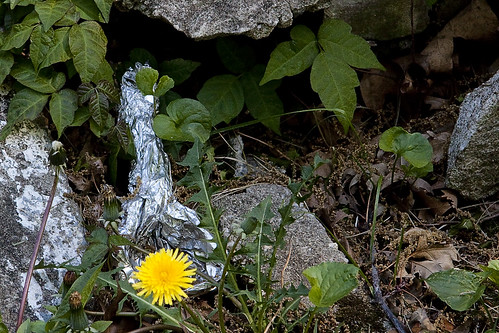
– photo by Mitch Waxman
On the west face, this ladle shaped molding of aluminum foil was extant.

– photo by Mitch Waxman
Here’s the whole scene, the center stone seems to be the main altar- it’s where the cigar, bones, and coins as well as the unconsumed candle were observed. The ladle was to the west, on the downward slope, and candle in the glass to the north at the right of the shot.

– photo by Mitch Waxman
The line of monuments in this section are very old, and many of the legends on the stones are faded away, here in St. Michael’s St. George section.
Circumnavigation 4

– photo by Mitch Waxman
After sliding past the Williamsburg Bridge, the Circle Line narrator began to talk about Queensboro (he called it 59th street bridge- grrrr) and didn’t mention the Newtown Creek. Tourists wouldn’t want to hear about that story, I guess. One thing that really annoyed your humble narrator were the constant references to pop culture icons like the Seinfeld sitcom and the Spiderman movies. Realization that that’s what tourists have as touchstones for NYC is obviated, but still… blurring the line between fantasy and reality is a real issue in the modern world.
from wikipedia
George Louis Costanza is a fictional character in the American television sitcom Seinfeld (1989–1998), played by Jason Alexander. He has variously been described as a “short, stocky, slow-witted, bald man” (by Elaine Benes and Costanza himself), “Lord of the Idiots” (by Costanza himself), and as “the greatest sitcom character of all time”. He is friends with Jerry Seinfeld, Cosmo Kramer, and Elaine Benes. George appears in every episode except for “The Pen” (third season). The character was originally loosely based on Seinfeld co-creator Larry David, but surnamed after Jerry Seinfeld’s real-life New York friend, Mike Costanza.

– photo by Mitch Waxman
The power of cinema and television to present a cogent and absorbing telling of historical events is actually a dangerous thing. Again, I realize that the tourists aboard the Circle Line aren’t looking for hardcore history, but there’s a lot to say about the Queensboro bridge that doesn’t involve the Green Goblin or George Costanza. History is made not by accurate or cogent catalogs of events, but by distribution. The reason we know about Aristotle or Voltaire is that MANY copies of their work were made, distributed across a wide area, and were quoted by others. This means that distaff copies of their work survived the fires and floods. This means that to future eyes, the surviving copies of Spiderman and Goodfellas might be all they have.
Which makes me wonder if Pliny the Younger might have been the Dean Koontz of his time.
from wikipedia
As they watch over May in the hospital, Mary Jane tells Peter she has a crush on Spider-Man, and Peter expresses his own feelings for her. Harry catches them holding hands and tells his father about their love for each other. Now knowing that Spider-Man has feelings for Mary Jane, the Goblin lures him to the top of the Queensboro Bridge by taking Mary Jane and a Roosevelt Island Tramway car full of children hostage, then drops both at the same time. Spider-Man saves them all, but the Goblin takes him to an abandoned building for a fight. Spider-man eventually defeats and unmasks the Goblin, and Norman dies after asking Peter not to tell Harry that he (Norman) was the Goblin.

– photo by Mitch Waxman
As the boat passed Roosevelt Island, the looming hotel construction sites of Queens Plaza rise behind it. Within a few years, tens of thousands of Queens Plaza and Dutch Kills hotel rooms will be serving the self same tourist trade which is satisfied by attractions like these Circle Line cruises. Perhaps this is what we New Yorkers are destined to become, apes in a steel and glass cage put on display for foreigners as we live out our funny lives. Just like on Seinfeld.
from wikipedia
Tourism in New York City includes nearly 47 million foreign and American tourists each year. Major destinations include the Empire State Building, Ellis Island, Broadway theatre productions, museums such as the Metropolitan Museum of Art, and other tourist attractions including Central Park, Washington Square Park, Rockefeller Center, Times Square, the Bronx Zoo, South Street Seaport, New York Botanical Garden, luxury shopping along Fifth and Madison Avenues, and events such as the Tribeca Film Festival, and free performances in Central Park at Summerstage and Delacorte Theater. The Statue of Liberty is a major tourist attraction and one of the most recognizable icons of the United States. Many New York City ethnic enclaves, such as Jackson Heights, Flushing, and Brighton Beach are major shopping destinations for first and second generation Americans up and down the East Coast.

– photo by Mitch Waxman
Of course, the folks whose lives are a little too funny can be found on Ward’s Island at the psychiatric hospitals that serve the City of Greater New York. I’m never quite sure which building is which in this complex, as your humble narrator is convinced that getting too close to a madhouse would be injurious to his freedoms, but this is either the 509 bed Manhattan Psychiatric Center (I lean toward this) or the maximum security Kirby Forensic Psychiatric Center. The Circle Line narration didn’t mention either.
from soundportraits.org
There seem to be two constants to life on Ward 2-West. One of these is violence. The state considers the staffers who work on the ward to hold the single most dangerous job in New York, with the highest injury rate of any profession. The other constant on the ward is noise. There is nowhere to escape it, although there is one patient who seems to have adapted to it quite well. His name is Peter, and you can always find him at the front of the dayroom, hunched over a table peacefully drawing with yellow plugs stuffed deep into his ears. He is about 50 years old, has curly brown hair and a graying beard, gentle eyes behind thick glasses. Before committing his crime, Peter was a successful commercial artist. Today he’s working on a still life with pastels.

– photo by Mitch Waxman
Amongst the more pleasant realities of the trip was this view of the Hell’s Gate with its two spans- the Triborough Bridge(s) and the Hellgate railroad Bridge. The plane taking off from nearby LaGuardia airport was pure serendipity.
from wikipedia
Hell Gate is a narrow tidal strait in the East River in New York City in the United States. It separates Astoria, Queens from Randall’s Island/Ward’s Island (formerly two separate islands that are now joined by landfill).
It was spanned in 1917 by the New York Connecting Railroad Bridge (now called the Hell Gate Bridge), which connects the Ward’s Island and Queens. The bridge provides a direct rail link between New England and New York City. In 1936 it was spanned by the Triborough Bridge (now called the Robert F. Kennedy Bridge), allowing vehicular traffic to pass between Manhattan, the Bronx, and Queens.

– photo by Mitch Waxman
The Hellgate Bridge has long graded approaches which sprawl out all the way to the Sunnyside Yards on one side and continental North America on the other, providing a freight and rail link between the archipelago of islands which form this City-State of ours. Triborough’s approaches and ramps are almost too numerous for me to count.
from wikipedia
The Robert F. Kennedy Bridge, better known as the Triborough or Triboro Bridge, is a complex of three separate bridges in New York City, United States. Spanning the Harlem River, the Bronx Kill, and the Hell Gate (part of the East River), the bridges connect the boroughs of Manhattan, Queens, and The Bronx via Randall’s Island and Ward’s Island, which are joined by landfill.
Often historically referred to as simply the Triboro, the spans were officially named after Robert F. Kennedy in 2008.

– photo by Mitch Waxman
As the boat motored past Ward’s Island, where the Canadian theatrical provocateur’s called Cirque du Soleil had set up a circus tent, the Amtrak Acela rumbled over the Hellgate tracks. The last part of this trip that I can claim intimacy with until we returned to the Hudson, the Circle Line continued Northward.
Venturing into the “not part of my beat” areas of the City of Greater New York which your humble narrator is least familiar with- specifically the northeast sections of Manhattan and La Bronx, I actually got see a few things I didn’t even suspect…
from wikipedia
Acela Express (often simply Acela) is Amtrak’s high-speed rail service along the Northeast Corridor (NEC) in the Northeast United States between Washington, D.C., and Boston via Baltimore, Philadelphia, and New York. It uses tilting technology which allows the train to travel at higher speeds on the sharply curved NEC without disturbing passengers, by lowering lateral centrifugal forces, based on the concept of banked turns.
Acela Express trains are the only true high-speed trainsets in the United States; the highest speed they attain is 150 mph (240 km/h), though they average less than half of that. Acela has become popular with business travelers and by some reckoning has captured over half of the market share of air or train travelers between Washington and New York. Between New York and Boston the Acela Express has up to a 37% share of the train and air market.
hungry ghosts

– photo by Mitch Waxman
On a recent sunlit afternoon, the Hermetic Hungarian ventured forth from the Shining City once again. Recovered from a spell of bad dreams which our recent visit to the Grand Ave. Bridge- with all its loathsome implications- had awakened in him, the studied recluse announced that a new digital camera was in his possession which needed a test drive. Always an atavist and luddite, the Hermetic Hungarian (HH from this point on) had already decided that it was inferior to the chemical emulsion process of image capture- film- which he has spent much time mastering.
This, like the Mac vs. PC debate, is a conversation that your humble narrator does not wish to have anymore.
from wikipedia
Operating system advocacy is the practice of attempting to increase the awareness and improve the perception of a computer operating system. The motivation behind this may be to increase the number of users of a system, to assert the superiority of one choice over another or out of brand loyalty, pride in an operating system’s abilities, or to persuade software vendors to port specific applications or device drivers to the platform.
Operating system advocacy can vary widely in tone and form, from published comparisons to heated debates on mailing lists and other forums. In its most extreme forms it can veer into zealotry. Advocates are often normal users who devote their spare time to advocacy of their operating system of choice; many have a deep and abiding interest in the use, design and construction of operating systems and an emotional investment in their favourite operating system.

– photo by Mitch Waxman
Allow me to lift the curtain for this post- and talk shop.
Once upon a time, in the brash days of youth, I too shot film. I carried a Yashica FX3 fully manual, 1984 vintage camera, which I still have. Unfortunately, the cost of the film itself and the consequent expense of development and printing cramped my urge to shoot and shoot. For years, I had a goofy point and shoot 35mm camera, which has long disappeared into gadget heaven. When the Canon Elph’s first came out, I was hooked on digital and haven’t looked back since. Yes, the recording medium of film is capable of capturing and storing FAR more information than a digital shot can- even today. But- as I’ve mentioned in the past- I work in the advertising industry.
from nycgovparks.org
Astoria Park, on the west shore of Queens, extends from south of the Triborough Bridge to north of the Hell Gate Bridge. With a panoramic view of the skyscrapers of midtown Manhattan in the south to the Hell Gate channel in the north, the scenery presents the diverse landscape of New York City. The Hell Gate channel, formed by faults deep underground, contains some of the deepest water in New York Harbor. Its treacherous reefs bear picturesque names such as “Hen and Chickens,” “Pot Rock,” “Bread & Cheese,” and “Bald Headed Billy.”
Throughout the centuries the stunning natural beauty of this location has attracted visitors and settlers. Before the arrival of European colonists, a trail passed by the site, and an Indian village flourished at Pot Cove. Local inhabitants grew maize on the shores, fished in Hell Gate, and drew water from Linden Brook, a small stream that still flows under Astoria Park South. In the mid-1600s the Dutch parceled out this land to various owners, including William Hallet whose grant embraced hundreds of acres. During the American Revolution, several British and Hessian regiments were stationed in the area. On November 25, 1780 the frigate Hussar and its five-million-dollar cargo sank to the bottom of Hell Gate, where despite some removal of cannons, the treasure still remains.

– photo by Mitch Waxman
What used to happen when a photo entered the agency was that a medium or large format “chrome”- which is a sort of giant slide- would be handed off from photographer to agency (and still does, sometimes). This chrome would then be photostat reproduced (in the very old days) and it’s “for position only or F.P.O.” representation would be worked into a mechanical board so that the printer would understand where to place it or “strip it in”. When the Macintosh came along, the chrome would instead be scanned, at first by highly specialized devices called drum scanners and later by advanced versions of tabletop scanners.
The digital scan actually matters more than the original at this moment, and the tipping point from film to digital was reached when the ad agencies began requesting digital files from their photographers.
from omh.state.ny.us
Kirby Forensic Psychiatric Center, a maximum security hospital of the New York State Office of Mental Health (OMH), opened in 1985 and provides secure treatment and evaluation for the forensic patients and courts of New York City and Long Island. Most patients are received through the courts under Criminal Procedure Law (CPL) or through the OMH Commissioner’s office via the New York State Code of Rules and Regulations (NYSCRR) regarding hospitalization of the mentally ill.
Treatment is provided in accordance with the current standards of professional care outlined by the Joint Commission of Accreditation of Health Organizations (JCAHO) and is carried out with respect for each patient’s privacy and rights, in agreement with his/her level of functioning and need for security. KFPC has an active staff education program as well as academic affiliations with several metropolitan area colleges and universities, to help assure quality treatment and state of the art care.
and from wikipedia
The Manhattan Psychiatric Center is a New York-state run psychiatric hospital on 125th Street on Ward’s Island in New York City. As of 2009 it had 509 beds. The current building is 14-stories tall.
The hospital’s roots date to 1848 when Ward’s Island was designated the reception area for immigrants. Some additional structures were originally part of Blackwell’s Island Lunatic Asylum, which opened around 1863.
The building was significantly enlarged in 1871, and a Kirkbride Plan style building was built. After the immigration entry shifted to Ellis Island in 1892 the state took it over from Manhattan in 1899 and expanded it even further. At the time, it had 4,400 beds and was the largest psychiatric hospital in the world.
At the time it was one of two psychiatric hospitals for residents of Manhattan that had been take over by the state. The other psychiatric hospital would become the Central Islip Psychiatric Center in Central Islip, New York. Both hospitals were referred to as Manhattan State Hospital.
It later became the Manhattan Psychiatric Center. The facility is currently run by the New York State Office of Mental Health.

– photo by Mitch Waxman
Its taken the camera companies a while to catch up with the desktops, but they’re getting close- the high end Canons, for instance, do 25.3 megapixel shots (which I’ve retouched and let me say that these are well wrought images).
My current cameras- the Canon G10 and Canon T1i both hit 15 megapixels, giving me ample detail and clarity. I’ve got fairly quick SDHC cards in them, which allows burst shooting, and at any given time I’m ready to pop off a couple of thousand exposures. The batteries in both are rechargeable, and once the photos are copied to my desktop- the cards are formatted and used over and over. Film never offered me this kind of freedom to just shoot and shoot.
from wirednewyork.com
The massive beauty and advanced technology of the Hell Gate Bridge (more properly the New York Connecting Railroad Bridge) contrast sharply with nineteenth-century descriptions of the channel that it spans. Named for the dangerous rocks and perilous waters at the confluence of the East and the Harlem Rivers, Hell Gate is surrounded by Manhattan, Queens, and three islands: Wards, Randalls, and Roosevelt (formerly called Blackwell’s, then Welfare). Philip Hone (1780 -1851), writing of an 1844 visit there, described “the delightful scene: the clumps of fine old trees clothed in the gorgeous foliage of autumn, the lawn still bright and green, the mild, refreshing breeze, the rapid waters of Hell Gate covered with sailing vessels and steamboats -all combined to present a picture of consummate beauty.“

– photo by Mitch Waxman
HH, however, feels limited by digital- as do other “old school” photographers encountered during my long walks through and around the Newtown Pentacle. He lugs around a gigantic medium format film camera, which is a best of breed sort of machine. Coney Island Mike, another friend of the Pentacle, also decries the prevailing winds of technological advancement and pines for some 1970’s golden age of film availability and creative darkroom techniques.
I really do see the point, as mentioned above, film does capture and contain more information than any digital image can- so far.
from wikipedia
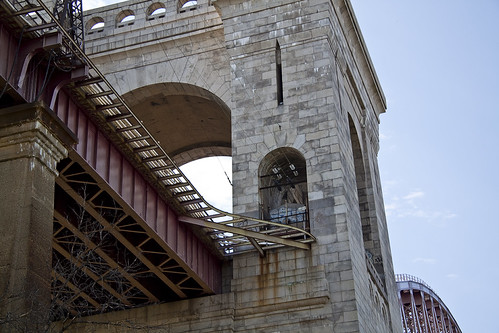
Construction was overseen by Gustav Lindenthal, whose original design left a gap of 15 feet (4.6 m) between the steel arch and the masonry towers. Fearing that the public assumed that the towers were structurally integral to the bridge, Lindenthal added aesthetic girders between the upper chord of the arch and the towers to make the structure appear more robust. The original plans for the piers on the long approach ramps called for a steel lattice structure. The design was changed to smooth concrete to soothe concerns that asylum inmates on Ward’s and Randall’s islands would climb the piers to escape.
The engineering was so precise that when the last section of the main span was lifted into place, the final adjustment needed to join everything together was 1⁄2 inches (12.7 mm). The bridge was completed on September 30, 1916.
– photo by Mitch Waxman
Back at my day job as photo retoucher and advertising industry print production specialist, however, I can tell you that its the digital file that’s going to the printer- not a piece of film. That makes anything shot in film second generation at best. Of course, many of the images I present here are highly processed- shot in raw format, sharpened or color corrected in photoshop, or produced by esoteric digital sleight of hand like “tilt shifting” or HDR.
(all the shots in this post are “straight” shots, raw files which were fed through my normal workflow)
from nycroads.com
PROVIDING A MUCH-NEEDED RAILROAD CONNECTION: In 1892, Oliver W. Barnes, an engineer associated with Pennsylvania Railroad president Alexander J. Cassatt and bridge designer Gustav Lindenthal, conceived plans for the Hell Gate Bridge. Cassatt saw the Hell Gate project – originally called the “East River Arch Bridge” – as an opportunity to bring rail traffic from Pennsylvania Railroad routes in New Jersey and points west through New York City to New England. The project was to also tie into the Long Island Rail Road routes, in which the Pennsylvania Railroad had a controlling interest. Meanwhile, Lindenthal saw the Hell Gate project as his chance to construct his Hudson River Bridge, a suspension bridge with a 2,800-foot-long main span that would have been the longest in the world. That same year, the New York Connecting Railroad was incorporated to help realize this plan.
In 1904, Lindenthal, who oversaw the opening of the Williamsburg Bridge and the construction of the ongoing Manhattan Bridge and Queensboro Bridge projects, was chosen as consulting engineer and bridge architect by the Pennsylvania Railroad, which had just acquired the New York Connecting Railroad. Under these auspices, Lindenthal was engaged in a project to connect the tracks of the Pennsylvania Railroad in New Jersey, the Long Island Rail Road in Queens, and the New York, New Haven and Hartford Railroad in the Bronx. Although the project allowed Lindenthal to design the Hell Gate span, it would not include his long-sought goal: a great suspension bridge across the Hudson River. Instead, the Pennsylvania Railroad decided to use exclusive tunnels for rail traffic across the Hudson and East rivers.

– photo by Mitch Waxman
One of the mantras that I’ve followed since my heady days at art school (School of Visual Arts) where I studied Illustration and Comic Book art is that you don’t need to use expensive mediums to make a good image. In accordance, my friends and I used to draw comics on brown paper bags or whatever other commonplace material we could procure. Later on in life, I will admit to the occasional red sable brush purchase, but by and large most of my “kit” came from staples and I’ve done comic cover art that was colored with Crayola Markers in the past.
I try to follow this philosophy with photography, which is the greatest way to spend money- short of crack addiction- that America has ever found.
from wikipedia
On June 15, 1904, the General Slocum caught fire and burned to the waterline in New York’s East River. At the time of the accident she was on a chartered run carrying members of St. Mark’s Evangelical Lutheran Church (German Americans from Little Germany, Manhattan) to a church picnic. An estimated 1,021 of the 1,342 people on board were killed. The General Slocum disaster was the New York area’s worst disaster in terms of loss of life until the September 11, 2001 attacks.[2] The events surrounding the General Slocum fire have appeared in a number of books, plays and movies through the years.

– photo by Mitch Waxman
Fantasies about radio triggers and tripods that cost more than my first car bounce in my head, and I fiend for trick and ultra wide angle lenses. I pore over the BH Photo catalog in the manner of a fetishist, but it’s just camera pornography to me. I can barely afford to feed my little dog Zuzu these days, and Our Lady of the Pentacle has suggested homespun garments for next winter. HH however, insists that no digital camera he’s yet found suits him. I suggested either a Canon G10 or G11 to him, or if portability was a consideration- the very attractive Canon S90.
from wikipedia
Amtrak is no longer required by law, but is encouraged, to operate a national route system.[ Amtrak has some presence in all of the 48 contiguous states except Wyoming and South Dakota. Service on the Northeast Corridor, between Boston, Massachusetts, and Washington, D.C., as well as between Philadelphia and Harrisburg, Pennsylvania, is powered by overhead wires; for the rest of the system, diesel locomotives are used. Routes vary widely in frequency of service, from three trips weekly on the Sunset Limited (Los Angeles, California, to New Orleans, Louisiana), to weekday service several times per hour on the Northeast Corridor, (New York City to Washington, D.C.) Amtrak also operates a captive bus service, Thruway Motorcoach, which provides connections to train routes.
The most popular and heavily used services are those running on the Northeast Corridor (NEC), which include the Acela Express, and Northeast Regional. The NEC serves Boston, Massachusetts; New York City; Philadelphia, Pennsylvania; Baltimore, Maryland; Washington, D.C.; and many communities between. The NEC services accounted for 10.0 million of Amtrak’s 25.7 million passengers in fiscal year 2007. Regional services in California, subsidized by the California Department of Transportation are the most popular services outside of the NEC and the only other services boasting over one million passengers per annum. The Pacific Surfliner, Capitol Corridor and San Joaquin services accounted for a combined 5.0 million passengers in fiscal year 2007.

– photo by Mitch Waxman
These shots, of course, were accomplished with my increasingly trusty DSLR- the Canon T1i, but the vast majority of photos you’ve endured at this blog have emanated from the Canon G10. The S90 is functionally a G10 with a smaller lens and form factor, will be dramatically discounted around Christmas, and HH ordered one to try out. That’s how we ended up in Astoria Park. Originally, we planned on walking the Triborough Bridge, but last minute information reached me that the Bridge has a series of “Photography Prohibited” signs posted and we decided that it just wasn’t worth the potential hassles with the law.
That’s what the eggheads call a “chilling effect on civil liberties” in action, by the way.
from railroad.net
As a retired TBTA sgt, I can definetly state that photography IS STRICTLY FORBIDDEN on all bridges & tunnels operated by that agency. This edict has been in effect for many years, but it was not strictly enforced before 9/11/01. It is now. Signs prohibiting “filming” are, (and have been all along) posted at all facilities. Summonses can, & usually will be issued (criminal court “C’ summonses) to filmers/videotapers who are seen “filming” on TBTA property (mainly bridges, tunnels and toll plazas, but also in other areas under control of the TBTA).

– photo by Mitch Waxman
Over the course of an hour or so, your humble narrator cracked out a couple of hundred exposures, a few of which were good enough to “show”. HH shot 22. I had mine “developed” and online within 48 hours (I was busy) and HH waited a full week for his transparencies to be shipped to him. Are HH’s shots superior to mine? I still don’t know, because he hasn’t managed to scan them yet. I’m not mocking him, nor deriding film, just stating that immediacy is a selling point for me as well.
As a good American, I crave and demand instant satisfaction, sometimes for urges I don’t know I have yet.
from wikipedia
Ward’s Island is situated in the East River in New York City. Administratively it is part of the borough of Manhattan. It is bridged by rail to the borough of Queens by the Hell Gate Bridge and it is joined to Randall’s Island to the north by landfill. The two Islands together are run by the Randall’s Island Sports Foundation under a partnership agreement with the New York City Department of Parks and Recreation. Together, the two islands form New York County’s Census Tract 240, which had a total population of 1,386 living on 2.2 km² of land area, according to the United States Census, 2000.
Viaducts leading to the Robert F. Kennedy Triborough Bridge and Hell Gate bridges pass overhead. Vehicular access is by the Little Hell Gate bridge from Randall’s Island, while a narrow pedestrian and bicycling bridge, Ward’s Island Bridge, links the island to the east side of Manhattan in Harlem.

– photo by Mitch Waxman
The Hermetic Hungarian of course, feels the least melancholy when surrounded by relict technologies. The upper west side rooms he occupies enjoy shelves of watch making equipment and rare mechanisms which originate in the darkest corners of Europe. His current project is to end time mechanically, freezing the world’s motion by the actions of a vast clockwork which he is assembling in accordance with instructions found on a scroll that might be written in Sanskrit that HH claims were scribed by some mad monk.
At my insistence, he has not installed a battery or self winding mechanism on the device, so sleep easily, my Lords and Ladies of Newtown.
from wikipedia
The Bhavacakra is represented as being held by the jaws, hands, and feet of a fearsome figure who turns the wheel. The exact identity of the figure varies. A common choice for the figure is Yama, the god of death or Kala the lord of time. This figure is also known as the “Face of Glory” or Kirtimukha.
There is always a figure or symbol in the upper left and the upper right. The exact figure or symbol varies; common examples include the moon, a buddha, or a bodhisattva. In the picture of the Tibetan Bhavacakra in Sera, Lhasa the clouds take the shapes of certain Buddhist symbols, eg. svastika.
City of Marble and Beryl

– photo by Mitch Waxman
Note: One of those things that your humble narrator is guilty of is a tendency, when confronted with something alien or unknown, to “fill in the blanks” via an inexact mixing of logical supposition and impressionist reasoning. The opposite of exactitude, this can result in wild ideas and false assumptions being presented and accepted as fact. I would love to tell you which cultic group these artifacts belong to- but the fact is that I just don’t know. Certain assumptions can be hazarded, based on cursory resemblance and observed phenomena, but they will be guesses. Don’t assume my interpretation of things is correct.
Witness, then, what I observed in St. Michael’s Cemetery on the Saturday before Easter- April 3rd, 2010- right about here.

– photo by Mitch Waxman
In St. Michael’s, there is a hill which faces East and whose tombstones are very old. The graves are in a state of disrepair, and the stones are found to be in a ruined state. This is no fault of the Cemetery, which maintains its grounds in a meticulous fashion, instead it is merely time and weather which have worked their havoc on the monuments. Perambulating through the grounds on Saturday with Our Lady of the Pentacle, we found this scene.

– photo by Mitch Waxman
A variety of Afro-Cuban syncretic faiths use similar iconography, but the one which most of the english speaking community is passingly familiar with is called Santeria (aka Regla de Ocha, La Regla Lucumi, or Lukumi). This appeared to be Santeria to me at first- because of the particular color scheme of the candles (red white and blue) and the co-mingling of coinage and sacrificial bones. But the Santeria folks generally do their thing indoors, in a ritual space consecrated and blessed by their own padrinos, just like the Catholics. Graveyards are usually avoided for rituals as they are negative places.

– photo by Mitch Waxman
My observation has been that the local latino populations in Astoria tend to be South rather than Central American, and the geographic heritage of Santeria is Caribbean and Central American. Afro-Cuban religion sprang up amongst the African Slaves brought to the New World to work the sugar and tobacco fields who were forced to adopt Roman Catholicism. Voodoo in Haiti and Louisiana, Hoodoo in the American South- all products of the French empire- with Santeria, Obeah, and Palo progeny of the Spanish.
The other great Catholic nation that held huge numbers of west africans as livestock was Portugal, and it did so in Brazil- where Umbanda, Candomblé, Macumba, and Quimbanda originate. Brazil is in South America, of course, and there are tremendous populations of Brazilians living nearby St. Michael’s in surrounding Astoria. This is some of that logical supposition I warned you about…

– photo by Mitch Waxman
Folk magic sites like this raise the ire of Eurasian morals, as ritual animal sacrifice is kept out of sight in our modern communities, and commoditized as Kosher or Halal or Organic meat. Blood sacrifice and submission to cultural norms, from circumcision to ear piercings to the elaborate face paint called “cosmetics”, are part of our daily lives. This sort of visceral aftereffect of some unfortunate avian’s end, however, is disturbing. No less though, than a crucifixion or any other blood ritual.

– photo by Mitch Waxman
One of the many ridiculous totems tucked away in my jacket pocket is a small magnetic compass. When I began these long walks around what I would someday call the Newtown Pentacle, it served me well, and today it revealed that this ritual space was lined up exactly on the cardinal points of my trusty little friend.
The scattering of bottles, bones, coins, and candles sits east of the stone which is aligned north south in the long dimension, and its anterior face is west facing. This will become increasingly important.
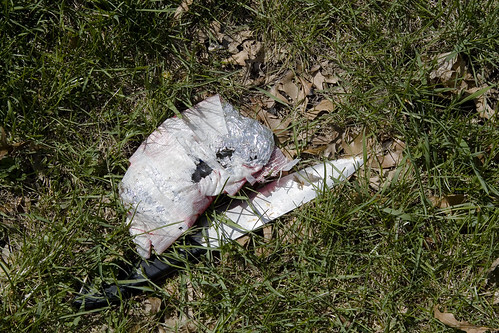
– photo by Mitch Waxman
This little package and knife are north east of the monument which I’ll be referring to as an altar. I did not open it, of course, it is against Newtown Pentacle policy to actually touch any of the odd things I come across, like the Pulaski Bridge, with bare skin. This whole neighborhood could use a good scrub, if you ask me.

– photo by Mitch Waxman
As always, if you click any of these images- a new window will open up its Flickr Page. Clicking the “all sizes” button found there will take you to progressively larger incarnations- all the way up to “actual pixels”. Check these out, I’ve spent some time trying to figure out what’s inside of the package. Do any of you sharp eyed Ladies and Lords of Newtown out there wish to hazard a guess? Use the “leave a comment” link.

– photo by Mitch Waxman
Seeing the blade and little kidney shaped package gave the whole scene a somewhat sinister air, and that’s when I remembered to check what else might be found on the cardinal meridians of the compass.

– photo by Mitch Waxman
The western facing of the altar sits at the pinnacle of a muddy ridge, which bears much subsidence. The underpinnings of the stone, and declination of the hill itself, fall away rapidly. These candles were observed.

– photo by Mitch Waxman
Nothing special about one of them, the other was unusual. Both red.

– photo by Mitch Waxman
The west facing side of the scene, from the bottom of the little hill. Note the tumbled and disorganized state of the masonry. North is to your left, south to the right.

– photo by Mitch Waxman
Moving north, a white candle .

– photo by Mitch Waxman
Back on top of the hill, directly east of the white candle above, and north of the main altar.

– photo by Mitch Waxman
A green and a pink candle on a dish of “some quality”.

– photo by Mitch Waxman
West of altar, a tumbled monument, with odd etchings on it. Can this be some sort of language?

– photo by Mitch Waxman
South of altar, west side of hill, a plastic bottle with some sort of red/brown liquid in it.

– photo by Mitch Waxman
Notice that the ground is depressed here, as if something very heavy- like a tombstone- had been moved recently.

– photo by Mitch Waxman
Just at the other end of the divot was this foil wrapped bottle which looked like it had been in the ground for a long time. Notice how the moss grows right up to it.

– photo by Mitch Waxman
Top of hill, south side, looking north across site. There are feathers scattered around the grass, mainly just north of the altar. Click here for a flickr page which shows some detail of the feathers.

– photo by Mitch Waxman
There was also this upside down cross.


 The Newtown Pentacle