Posts Tagged ‘Astoria’
Bacchanal

Astoria Back Yard – photo by Mitch Waxman
The Romans had a name for March 16th and 17th, specifically for tonight and all day tomorrow, and it was the Bacchanlia. A central holiday for the cult of a fertility and wine god called Bacchus, who was a latin interpretation of the greek Dionysos, the Bacchanal (which was originally a gathering of women, but was made co-ed in 188 BC) would take place on the Aventine Hill. Shackles of conventional morality and licentiousness would be thrown off and vast celebrations of oinoculture would be enacted.
from wikipedia
In the rites, men were said to have shrieked out prophecies in an altered state of consciousness with frenzied bodily convulsions. Women, dressed as Bacchantes, with hair dishevelled, would run down to the Tiber with burning torches, plunge them into the water, and take them out again. Their flames would not diminish as they were made of sulphur mixed with lime.
The rites gradually turned into sexual orgies, particularly among the men, and men who refused to take part were sacrificed. It is said these men were fastened to a machine and taken to hidden caves, where it was claimed they were kidnapped by the gods.
The festivities were reported to Postumius who persuaded the Roman Senate to authorize a full investigation. In 186 BC, the Senate passed a strict law (the Senatus consultum de Bacchanalibus) prohibiting the Bacchanalia except under specific circumstances which required the approval of the Senate. Violators were to be executed.required the approval of the Senate. Violators were to be executed.

Lexington Avenue, Manhattan – photo by Mitch Waxman
Just as our modern Republic seeks favorable comparison with the ancient titans of Rome, so too did the Romans see themselves as the inheritors of the advanced cultures that preceded them in dominance over the Mediterranean world, and which they conquered in the most brutal manner imaginable. The Bacchanal was a conservative Italian version of the wild Dionysian Mysteries and the Greek Bacchanal.
from wikipedia
If the Dionysus Cult first came to Greece with the importation of wine, as seems likely, then it probably first emerged around 6000 BC in one of two places, either in the Zagros Mountains, the borderlands of Mesopotamia and Persia, both with their own rich wine culture since then (arriving in Europe via Asia Minor), or from the ancient wild vines on the mountain slopes of Libya / North Africa. North Africa was the source of early Egyptian wine from around 2500 BC, and home of many an ecstatic rite involving animal possession—notably the goat and panther men of the Aissaoua Sufi cult of Morocco (though it is also possible that this was of later origin and influenced by Dionysian cults itself). Whatever the case it appears Minoan Crete was the next link in the chain of transmission, importing wine from the Egyptians, Thracians and Phoenicians and exporting it to its own colonies, such as Greece. Thus it was in Minoan Crete (c. 3000 to 1000 BC) that the basic Mysteries probably took form—certainly the name Dionysus exists nowhere else other than here and Greece.

Ia, Santorini – photo by Mitch Waxman
Even the Greeks, or “Hellenes” as they would have and do call themselves (Greek is bad latin, a derogatory term meaning short legged- Graeki). When the christians gained power and influence in the latter days of the Roman Empire, Hellenes was the term used for heathen or pagan, and so it fell out of usage.
The Hellenes themselves were late comers to the mediterranean milieu, conquering a civilization which modernity refers to as the Mycenae (which had supplanted the still earlier Minoan) some 10,000 years ago. This culture, which is believed to have traded with Pharonic Egypt and Phonecia (also modern terms), fell to ruin after the explosion of the Santorini (Thera) volcano ca. 1600 BC left them defenseless. The Bacchanal, however, was already an annual tradition by then.
from wikipedia
Cultic rites associated with worship of the Greek god of wine, Dionysus (or Bacchus in Roman mythology), were allegedly characterized by maniacal dancing to the sound of loud music and crashing cymbals, in which the revellers, called Bacchantes, whirled, screamed, became drunk and incited one another to greater and greater ecstasy. The goal was to achieve a state of enthusiasm in which the celebrants’ souls were temporarily freed from their earthly bodies and were able to commune with Bacchus/Dionysus and gain a glimpse of and a preparation for what they would someday experience in eternity. The rite climaxed in a performance of frenzied feats of strength and madness, such as uprooting trees, tearing a bull (the symbol of Dionysus) apart with their bare hands, an act called sparagmos, and eating its flesh raw, an act called omophagia. This latter rite was a sacrament akin to communion in which the participants assumed the strength and character of the god by symbolically eating the raw flesh and drinking the blood of his symbolic incarnation. Having symbolically eaten his body and drunk his blood, the celebrants became possessed by Dionysus.

Kalives, Crete – photo by Mitch Waxman
Crete, which is the true cradle of the western tradition, was an important cultic center for Dionysus- but the Cretans are known and commented on historically for their parties. Come and spend a night out in Astoria, you’ll see what I mean.
from wikipedia
The idea of a mystery religion consisted essentially of a series of initiations which benefited the individual or their society in some way. Initially associated with the passage from childhood to adulthood and maturity, they later became seen as what we might call an evolutionary rite. And it was in the form of a Mystery Religion that the Dionysus Cult was first channeled in a more civilized way, probably first in Minoan Crete.
The notion behind the Dionysian Mysteries seems to have been not only of the affirmation of the primeval bestial side of mankind, but also its mastery and integration into a civilized psychology and social culture. Given the dual role of Ariadne as the Mistress of the Minoan Labyrinth and consort of Dionysus, some have seen the Minotaur story as also partly deriving from the idea of the mastery of mankind’s animal nature, though this remains controversial. The self mastery achieved in this way was not one of domination as in similar cults, most famously preserved in contemporary culture as George and the Dragon, and perhaps the original Minotaur myth, but one of acceptance and integration. Thus while the Mysteries did much to lighten the darker aspects of the cult they often failed to reassure its perhaps excessively civilized critics and continued to be regarded by many as dangerously liberative (particularly given its egalitarian tendencies as well).

Astoria Maenads – photo by Mitch Waxman
Fascinating, the way that some traditions just will not die out. St. Patrick’s day is tomorrow, and when you raise a glass to some wee lass in a pub, or go to some drunken revel at a friends apartment, think of the Maenads and realize that you are enacting the bacchanal- and carrying out a tradition that extends back through time. Watch out for the ladies, though, they have a tendency to go a little wild on this sort of holiday, even the prim and proper ones.
from wikipedia
Carry A. Nation (November 25, 1846 – June 9, 1911) was a member of the temperance movement, which opposed alcohol in pre-Prohibition America. She is particularly noted for promoting her viewpoint through vandalism. On many occasions Nation would enter an alcohol-serving establishment and attack the bar with a hatchet. She has been the topic of numerous books, articles and even a 1966 opera by Douglas Moore, first performed at the University of Kansas.
Nation was a large woman, almost 6 feet (180 cm) tall and weighed 175 pounds (79 kg) and of a somewhat stern countenance. She described herself as “a bulldog running along at the feet of Jesus, barking at what He doesn’t like”, and claimed a divine ordination to promote temperance by smashing up bars.

Kneeling upright

– photo by Mitch Waxman
The local supermarket, a Pathmark on Northern Blvd., has installed a device on its shopping carts that lock the wheels when you try to roll them off the property line. A buried wire, perhaps, or some sort of radio signal keeps the carts from distributing themselves around the neighborhood like the Home Depot and Stop n’ Shop carts that can found in basements and garages across the Newtown Pentacle. Once, this was the preferred cargo carrier for New York’s unfortunates, an uncovered wagon for the concrete prairies.
from wikipedia
Shopping cart theft can be a costly problem with stores that use them. Often the carts end up in apartment complexes, low-income housing, bus stops or locations where the person doing the shopping is unlikely to own a car. The carts, which cost between $75 and $150 each, have been used for such purposes as barbecue pits, go-carts, laundry trolleys and even shelters, or they are simply abandoned. Because such losses can be substantial (up to $800 million globally lost every year), stores have resorted to various systems to prevent theft. Stores may use one or more of these systems (i.e., cart retrieval and electronic).
Cart retrieval service
Some stores utilize a cart retrieval service, which collects carts found off the store’s premises and returns them to the store for a fee. The drawbacks of this measure include that it is reactive instead of proactive (i.e., it can only be used once a cart has been taken from the premises), can become costly, and does nothing to deter hoarders. Some retrieval services have also been caught taking carts from the store’s parking lot and turning them in as stray carts.
Electronic
Electronic systems are being increasingly used by stores because of their successful deterrence. In principle, the system is similar to electric fences that give dogs’ necks a yank when they cross an underground boundary. Each shopping cart is fitted with an electronic locking wheel, or ‘boot’. A transmitter with a thin wire is placed around the perimeter of the parking lot. The boot locks when the cart leaves the designated area. Store personnel must then deactivate the lock with a hand-held remote to return the cart to stock. Often a line is painted in front of the broadcast range to warn customers that their cart will stop when rolled past the line.

– photo by Mitch Waxman
The cheap wire shopping carts offered to perform the curb to house function today just can’t compare. The bottle and can collectors favor this sort of model, and an iteration of it is found in my own kitchen. It’s not sturdy, quite unstable, and has an incontrovertibly high center of gravity making it prone to unexpected tipping. A sudden abundance of laundry here at Pentacle HQ was instrumental in discovering its load capacity was a mere 80 pounds (don’t ask) which causes the wheels to snap off. A sturdy supermarket style cart carries an unknown, but substantially higher weight.
from nyc.gov
To ready your metal, glass and plastic containers for recycling, rinse them clean and place them in a clear bag or blue-labeled container; caps and lids should be removed. You should place paper recycling in a separate clear bag or green-labeled container and tie flattened corrugated cardboard with strong twine.
Collect glass, plastic or aluminum beverage containers with a 5-cent deposit, such as those for beer, soda and other carbonated drinks, and take them to a local grocery, deli or other store for recycling. (You can also put your redeemable cans and bottles out with your other recyclables where needy individuals may find them and turn them in for the nickel deposit.)
If you live in a building that does not recycle, contact your building manager or superintendent to set up a recycling system for tenants. You can report recycling violations anonymously online or by calling 311.

– photo by Mitch Waxman
To a veteran of the 1980’s and early 90’s iteration of New York City- when 42nd street at Times Square was called “dadeuce”- a time when endemic homeless populations ruled the streets, it is disturbing to see their population swelling again. The local Croats and Serbs refer to the village madmen as “sin eaters”, and the more august members of the community have other colorful terms to describe them. New immigrants are typically less than charitable toward such individuals, but to be fair- their perspective is that of having showed up in this country with just a suitcase and then building a life for themselves within just a few years. It is inconceivable to these new citizens to see an American who would live in such a state, when the solution to all their problems is “work”, an opportunity not available or perhaps denied in their countries of origin.
from wikipedia
The term sin-eater refers to a person who, through ritual means, would take on by means of food and drink the sins of a deceased person, thus absolving his or her soul and allowing that person to rest in peace. In the study of folklore sin-eating is considered a form of religious magic.
This ritual is said to have been practised in parts of England and Scotland, and allegedly survived until modern times in Wales. Traditionally, it is performed by a beggar and certain villages maintained their own sin-eaters. They would be brought to the dying person’s bedside, where a relative would place a crust of bread on the breast of the dying and pass a bowl of ale to him over the corpse. After praying or reciting the ritual, he would then drink and remove the bread from the breast and eat it, the act of which would remove the sin from the dying person and take it into himself.

– photo by Mitch Waxman
The fellow pictured above, a “regular” along Northern Blvd., is actually quite mad. I’ve spoken to him- he calls me “Mr. Camera Lens Man”. Back in my merciless youth, a time when I scorned weakness and foreswore empathy, individuals who exhibited similar appearance and behavior were christened Shipwreck Victims. They appear to have been deposited on the sidewalk by some titanic wave, mournfully lost in a foreign city. For many years, I lived on the corner of 100th and Broadway in Manhattan, and the neighborhood had a colorful cast of mendicants.
from nypirg.org
- In its 1998 survey of 30 cities, the U.S. Conference of Mayors found that the homeless population was 49% African-American, 32% Caucasian, 12% Hispanic, 4% Native American, and 3% Asian (U.S. Conference of Mayors, 1998).
- 46% of cities surveyed by the U.S. Conference of Mayors identified domestic violence as a primary cause of homelessness (U.S. Conference of Mayors, 1998).
- Research indicates that 40% of homeless men have served in the armed forces, as compared to 34% of the general adult male population (Rosenheck, Robert, Homeless Veterans, in Homelessness in America, 1996).
- Approximately 20-25% of the single adult homeless population suffers from some form of severe and persistent mental illness (Koegel, Paul, The Causes of Homelessness, Homelessness in America, 1996, Oryx Press.). According to the Federal Task Force on Homelessness and Severe Mental Illness, only 5-7% of homeless persons with mental illness require institutionalization; most can live in the community with the appropriate supportive housing options (Federal Task Force on Homelessness and Severe Mental Illness, 1992).

– photo by Mitch Waxman
Larry “the Wild Man” Hogue haunted 96th street, terrifying residents and attacking random passerby- the Police had him on a revolving door version of jail. This was, of course, before Rudy Giuliani defined the Bill of Rights as containing no provision guaranteeing the right to sleep in the street.
There was Raggedy Andy, who suffered from AIDS, and would tell you as a matter of fact that he didn’t want handout money for food, he was going to use it to buy crack. Andy was meant to take the homeless bus every night to a medical dorm at Riker’s Island, to get his antibiotics for the various infections afflicting his skeletal frame, but the trip from the upper west side would deliver him there at 2:30 AM and wake up was at 6 so he only went 3-4 times a week (or so he said). The original “ship wreck victim”, along with “the suffering man” and my 80 year old friend Bent Willette (who was on heroin since the 1930’s- an astounding run- in her 70’s she started doing crack to “stay alert”) worked the 96th street and Broadway subway stop. On the east side, my pal Ricky lived behind the basketball game in a Third Avenue Irish bar, working for drinks as a bar back and signing his social security check over to the owner as rent for the pile of rags he slept on. An NYU student dormitory is there now.
from the nydailynews.com site, dated May 30, 2009
Larry Hogue, a drug-addicted wacko who terrorized Upper West Siders in the 1990s, strolled away from the Creedmoor Psychiatric Center in Queens on Thursday.
The notorious hell-raiser was arrested “without incident” in his old stomping grounds Saturday morning after being spotted on 96th St. between Broadway and Amsterdam, cops said.

– photo by Mitch Waxman
In the angle between Astoria and Woodside, all along the LIRR tracks- I observe long established homeless camps. There’s a well developed one on Shore Road by Astoria Park at the river bank, down at the bottom of the wall. LIC’s empty corridor, and all along Borden Avenue as it tracks toward the hallowed altitude of Calvary sustains a large population of tyvek tents. A few weeks ago I showed you the Black Crow’s nest at Dutch Kill’s Borden Avenue Bridge, and a while back ran a few shots of the troll who lives up the block (he does live under a bridge).
Don’t get me wrong, I’m not making fun of these people, or making light of their desperate plight or calling for the massive powers of the government to do anything at all. Most of the homeless guys (especially guys) that I know are square pegs, or addicted to something, or stark raving mad. This is one of those societal “things” that cannot be fixed, and its a problem as old as civilization. See, the problem is that this population resists being “civilized” (read civilized as a verb) which they perceive as living in a prison. As always, no moral overlays- not good nor bad- just “is”.
Build all the shelters you want to, but all that Raggedy Andy wanted was to just get high and be left alone, especially when it was snowing.
highly visible
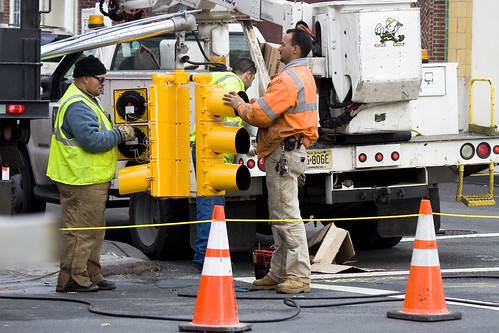
Broadway near Steinway Street – photo by Mitch Waxman
As your humble narrator scuttles from place to place, turning over rocks to see what blind albino abnormalities might lurk beneath, a significant amount of road construction is encountered. New York is always in a state of near collapse and an army of municipal and contractor labor is kept busy filling in the cracks. Conflicted over sneaking pictures of these folks, I nevertheless find them fascinating, for the high visibility colors they wear excite the eye.
from workzonesafety.org
Title: ANSI/ISEA 107-2004: Revised American National Standard for High-Visibility Safety Apparel and HeadwearAbstract: This standard provides a uniform, authoritative guide for the design, performance specifications, and use of high-visibility and reflective apparel including vests, jackets, bib/jumpsuit coveralls, trousers and harnesses. Garments that meet this standard can be worn 24 hours a day to provide users with a high level of conspicuity through the use of combined fluorescent and retroreflective materials. The revised version of the standard expands the product coverage to include high-visibility headwear. It also contains additional testing procedures for knitted fabrics used as background material, and eliminates tests from the previous edition that added no value. Publisher: International Safety Equipment Association

Third Avenue Manhattan – photo by Mitch Waxman
If it won’t blind or distract the crews, don’t forget that this is heavy industry and quite dangerous work, try turning on the camera flash when photographing them. The reflective fabrics, technically retroreflective fabrics (which function like a Cat’s eyeshine), will blaze up and be the brightest point in the photo. New York City street signs also function in a similar fashion, and even the weakest flash will light them up from blocks away. Try it, especially on a dark and stormy day, the effects are somewhat unpredictable and often produce a prismatic and surreal photo.
from simplifiedsafety.org
Class 1: needs to be conspicuous and use retroreflective materials not less than 25mm in width.
- Used when workers are well separated from traffic
- Vehicle speeds of less than 25 mph
- Parking attendants
- Shopping cart retrievers
- Warehouse workers
- Roadside/sidewalk maintenance workers
- Delivery vehicle drivers
Class 2: maintains superior visibility and are more conspicuous than the Class 1 garments. Minimum width of retroreflective material used on these is not less than 35mm.
- Used when workers are on or near roadways
- Vehicle speeds of 25 to 50 mph
- Roadway construction workers
- Utility workers
- Survey crews
- Law enforcement personnel
- Crossing guards
- High-volume parking lot or toll-gate attendants
- Airport baggage handlers and ground crews
- Railway workers
- Emergency response personnel
- Accident site investigators
Class 3: has greatest visibility. Maintains more retroreflective material than Class 2 and must have sleeves with retroreflective material between the shoulders and elbows. Not less than 50mm wide of retroreflective material.
- Used for workers in high risk situations
- Allows them to be seen from a minimum distance of 1,280 ft.
- Vehicle speeds of greater than 50 mph
- Roadway construction workers
- Utility workers
- Survey crews
- Emergency response personnel

31st street, Astoria – photo by Mitch Waxman
All of the municipal and construction rules are meant to conform to the national OSHA specifications, but individual city organizations have their own wrinkle on safety gear. MTA workers, for instance, are often observed wearing goggles and ear protection as they work. No doubt, this is due to individual union agreements and task specific requirements.
from nysdot.gov
All DOT employees, contractor employees and visitors must wear protective helmets and high visibility construction apparel while working within a highway right of way or contract limits. Flaggers must wear high visibility traffic control apparel when directing or spotting traffic. High-visibility apparel is not required for employees and visitors when they are within a completely enclosed cab constructed of steel frame and glass, or inside a motor vehicle.

37th avenue, Dutch Kills – photo by Mitch Waxman
NYFD, of course, has the most stringent series of rules for its crews. In the shot above, a 5 alarm fire at an industrial warehouse was belching black smoke into the street, but the firefighters are clearly identifiable through the murk- due to camera flash. Be careful around NYFD however, as they’re kind of busy people, and you don’t want to distract them. Also, should there be any piezoelectric activated equipment in use- DO NOT use your flash for fear of activating something.
from fasny.com
Back in November of 2008, there was a lot of confusion about the use of high-visibility vests at roadway incidents due to a new Federal Highway Administration (FHWA) Rule. The new regulation, Rule 634, stated that “All workers within the right-of-way of a Federal-aid highway who are exposed either to traffic (vehicles using the highway for purposes of travel) or to construction equipment within the work area shall wear high-visibility safety apparel.”
That regulation created a dilemma for fire departments who were truly interested in protecting their personnel. The training classes and material used by the Emergency Responder Safety Institute (ERSI) for years has suggested the use of high-visibility garments for public safety personnel when working around traffic. NFPA 1500, the Firefighter Health and Safety Standard has included a requirement for firefighters to wear safety vests at traffic incidents in the last two most recent editions. NIOSH Line of Duty Death Investigations have also included recommendations for responders to wear highly visible flagger vests when exposed to moving traffic. In the fire service community it was generally understood that the vests were not appropriate personal protective equipment (PPE) for personnel who were actively engaged in firefighting operations because those garments are not designed for exposure to fire, heat flame or hazardous materials. Rule 634, as originally published however did not outline any exemptions for firefighters engaged in direct firefighting operations and that created the dilemma.

Bridge Plaza North, Queens Plaza – photo by Mitch Waxman
The shot above is fascinating to me, for reasons that have little to do with the safety equipment exhibited. The trench that this trio is working in is down by Queens Plaza, and the cutaway shows a historical record. Notice the top layer of asphalt, then two distinct layers of cobblestones, then dirt and rock fill. Asphalt- modern, cobbles 1- the construction of the Queensboro bridge and associated roadways, cobbles 2- the pre bridge street, dirt and fill- that’s a 19th century, civil war era street. I’d love to have an archaeologist sift through this trench, but there’s nothing of historic importance in Queens… according to the City.
Note- the Charles Rudebaker wiki quote below… I’m a little squirrely on this particular wikipedia entry. The only info I could find on Rudebaker, a New Yorker who supposedly invented the Traffic Cone, parroted this exact wording all across the net. Take it with a grain of salt, until I can find out more. It very well might be a “false meme” which is a sort of “Lulz“.
from wikipedia
Traffic cones, also called road cones, highway cones, safety cones or construction cones, are usually cone-shaped markers that are placed on roads or footpaths to temporarily redirect traffic in a safe manner. They are often used to create separation or merge lanes during road construction projects or automobile accidents, although heavier, more permanent markers or signs are used if the diversion is to stay in place for a long period of time.
Traffic cones were invented in 1914 by Charles P. Rudebaker. Although originally made of concrete, today’s versions are more commonly brightly-coloured thermoplastic or rubber cones. Not all traffic cones are conical. Pillar shaped movable bollards fulfil a similar function.
…this one’s for the birds

– photo by Mitch Waxman
Washington, whose actual birthday is on February 22, would have avoided shopping on this holiday- I would think.
Have no doubt that the American Augustus had significant material aspirations and enjoyed a lifestyle that could only be maintained by a subjugate army of slaves, but I’d like to believe that he would be resistant to having his birthday celebrated with a crass and consumerist bacchanal.
I like to think he’d be embarrassed, but as I’m a non-slaver, it’s difficult for me to imagine the mindset of the “founding fathers”.
from wikipedia
Titled Washington’s Birthday, the federal holiday was originally implemented by the United States Congress in 1880 for government offices in the District of Columbia (20 Stat. 277) and expanded in 1885 to include all federal offices (23 Stat. 516). As the first federal holiday to honor an American citizen, the holiday was celebrated on Washington’s actual birthday, February 22. On 1 January 1971, the federal holiday was shifted to the third Monday in February by the Uniform Monday Holiday Act. This date places it between February 15 and 21, which makes the name “Washington’s Birthday” a misnomer, since it never lands on Washington’s actual birthday, February 22. A draft of the Uniform Holidays Bill of 1968 would have renamed the holiday to Presidents’ Day to honor the birthdays of both Washington and Lincoln, but this proposal failed in committee and the bill as voted on and signed into law on 28 June 1968, kept the name Washington’s Birthday.

– photo by Mitch Waxman
February 15th is also Susan B. Anthony‘s birthday, who is at least as important to our republic as its founder. If Washington was indeed Augustus, Anthony was Trajan. Speaking of pagan times, incidentally, today is the third day of Lupercalia – a Roman spring cleaning ritual that is also known as Februa. The particular deity of this ancient rite is Februus– an Etruscan god of malaria- although its the ritual that lends its name to the calendrical month, not the god.
Closer to home, February 15th is also the birthday of a man who sired one of Astoria’s most important families– Heinrich Engelhard Steinweg.
from wikipedia
Because of the unstable political climate in Germany, Steinweg decided to leave the country. He emigrated from Braunschweig to New York City in 1851 with four of his sons, but before leaving he gave the company to his son, Theodor Steinweg. Once in New York, he anglicized his name to Henry E. Steinway, and he and his sons worked for other piano companies until they could establish their own production under the name of Steinway & Sons in 1853.
The overstrung scale in a square piano earned the Steinway Piano first prize at the New York Industrial Fair of 1855.[3] In 1862 they gained the first prize in London in competition with the most eminent makers in Europe; and this victory was followed in 1867 by a similar success at the Universal exposition in Paris. According to Franz Liszt, Anton Rubinstein, and other high authorities, the Steinways have done more to advance the durability, action, and tone-quality of their instruments than any other makers of Europe or America.
He and his wife, Juliane, had seven children: Albert Steinway, Charles H. Steinway, Christian Friedrich Theodor Steinweg, Doretta Steinway, Henry Steinway, Jr., Wilhelmina Steinway and William Steinway.
Abominable Snowman of Astoria

– photo by Mitch Waxman
Zuzu, our noble dog and faithful subject, demanded reasonable access to the amenities of curb and hydrant and so compelled- I grabbed the camera and we went out into the storm. On the corner of 45th and Broadway, we came across this sinister homunculus.

– photo by Mitch Waxman
Mastery over snow and ice is but one of Zuzu’s many abilities, but her foot pads are vulnerable to ice melting chemicals and road salt. Her pads were prepared for the saline ponds and frozen mounds with an application of Musher’s Wax, which is a commercial variant of Beeswax. We left her comical coats and sweaters at home, since there really was no point in them as Zuzu was punching in and out of snow banks. Cry Havoc, and let slip, declareth the dog, and we went to Newtown Rd. and 43rd street.

– photo by Mitch Waxman
It was decided that Broadway, where we just were, would be a superior spot to sniff. As always, the corner grocery is open. Somehow, these guys had power back during the Astoria black out in 2006, and their sandwich counter is both clean and surprisingly affordable. They even make home made yogurt! Zuzu stared at this corner for a while, it was probably since she knows that this is where yogurt comes from.

– photo by Mitch Waxman
Giving my loyal canine a moment of privacy, Zuzu went about her business while I stared up into the trees. A dogs life has so little dignity, offering a moment of discretion when they need to powder their noses is only polite. Cleaning up her steaming dog egg, I realized that the snow was again taking a turn for the worse. So did Zuzu.

– photo by Mitch Waxman
Zuzu got cold, or hungry, and decided it was time to go home at this point. I followed.

– photo by Mitch Waxman
Zuzu during warmer times.


 The Newtown Pentacle