Posts Tagged ‘Brooklyn’
Historic Tug at Newtown Creek

Vintage Tugboat at Newtown Creek – photo by Mitch Waxman
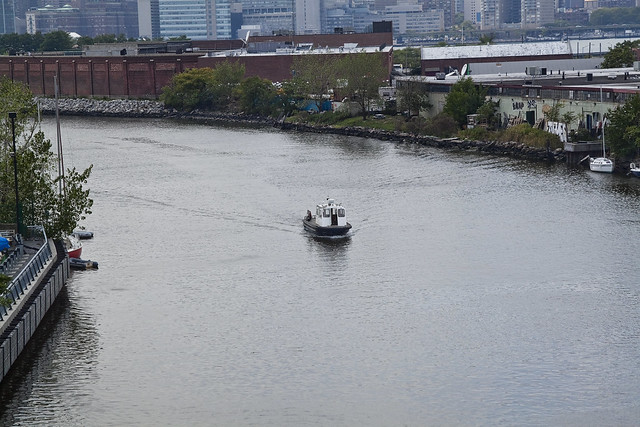
A rare opportunity to ride up the Newtown Creek was recently enjoyed by your humble narrator, and on my journey up that maligned cataract I spotted an artifact of New York Harbor’s glorious past sneaking past Hunters Point.
from epa.gov
Blue-claw crabs, bluefish, weakfish, striped bass, and other species inhabit the creek, and fishing and crabbing for human consumption occurs [Ref. 7, pp. 2, 5; 8, p. 11; 21, p. 13; 22, pp. 1-2; 24, p. 143; 52, p. 93; 68, p. 3; 69, p. 1]. Subsistence fishing has been observed in Newtown Creek at Dutch Kills, and crabbing for consumption has been observed at the end of Manhattan Avenue in Brooklyn [Ref. 7, p. 5; 21, p. 13; 22, pp. 1-2; 68, p. 3; 69, p. 1]. These locations are both within the zone of contamination for the Newtown Creek site [Figure 2 of this HRS documentation record]. Therefore, Actual Contamination is documented, and the target fishery is evaluated for Actual Human Food Chain Contamination.

the W O Decker at Newtown Creek – photo by Mitch Waxman
Wooden hulled, its spitting steam boilers have long been replaced by modern diesel engines, this little (52 feet long) tugboat is the W O Decker.
also from epa.gov
Beginning in the late 1800s and continuing into the 1930s, Newtown Creek was widened, deepened, and lined with bulkheads to accommodate the growing traffic, leading to the destruction of all its freshwater sources [Ref. 8, p. 10; 12,
p. 52]. During World War II, the government commandeered factories along the creek to make military equipment, such as a factory that made aluminum for fighter planes [Ref. 11, p. 14]. At that time, Newtown Creek was the busiest industrial port in the Northeast, with tanker traffic lining its length [Ref. 7, p. 1; 11, p. 13]. The national highway system built after the war took business away from the nation’s waterways, leading to a rapid decline in the level of industry along Newtown Creek [Ref. 7, pp. 1-2].

the W O Decker passing by the “Greenpoint Manufacturing and Design Center” – photo by Mitch Waxman
A “historic place” the Decker was originally called the Russell 1 when it was built in 1930 for the Newtown Creek Towing Company, who were specialists in berthing and towing heavy cargo along the crowded and narrow waterway.
from gmdconline.org
The Greenpoint Manufacturing and Design Center (GMDC) started in the late 1980s as an innovative intersection of two interests: reclaiming derelict factories in North Brooklyn’s Greenpoint neighborhood and sustaining industry and manufacturing in New York City. The organization formally incorporated in 1992.
From its initial purchase and redevelopment of a large facility at 1155 Manhattan Avenue for use by light manufacturers and artisans, GMDC has since expanded and today is the only nonprofit industrial developer in New York City. The organization acquires, develops, and manages industrial real estate that provides small and medium-sized manufacturing enterprises with affordable, flexible production space.

In the shot above, The Decker is passing the Newtown Creek Waste Water Treatment Facility in Greenpoint, Brooklyn – photo by Mitch Waxman
The Decker is currently a high end tour vessel, operated by and out of the South Street Seaport in Manhattan.
from seany.org
The wooden tugboat W.O. Decker was built in Long Island City, Queens in 1930 for the Newtown Creek Towing Company, a firm specializing in berthing ships and barges in the creek that separates Brooklyn and Queens. Originally called the Russell I for the towing company’s owners, she was renamed the W.O. Decker in 1946 after being sold to the Decker family’s Staten Island tugboat firm.

The shield wall of the Shining City, framed by Long Island City on the right and industrial Brooklyn on the left with the Pulaski Bridge just at Horizon – photo by Mitch Waxman
The vessel I was aboard continued on toward the Greenpoint Avenue Bridge, but the Decker turned in the narrow part of the Newtown Creek near the confluence of its tributaries Whale Creek and Dutch Kills.
Check out this 1896 article at the NYTimes, which actually interviews the manager of Newtown Creek Towing Company, John Russell, for whom the Decker was originally named.
Our friends at the Working Harbor Committee are actually doing a few tours this summer on the Decker- click here for more
Ruby M. at Whale Creek

– photo by Mitch Waxman
Someone recently told me that this, your Newtown Pentacle, was a mere paparazzi rag for infrastructure and heavy industry- which made me laugh out loud.
Then, depressed, disturbed, and frightened by even good natured criticism I retreated into a sulking and jealous rage. All ‘effed up, I threw together my little ensemble of camera bag and headphones and set off for the Newtown Creek. When I got to the Pulaski Bridge, it was open and I realized that I had just missed a Tugboat passing through. ARRGHH!!!
What I did see though, was this flatbed truck carrying what appears to be remnants of a Roosevelt Island Tramway tower in the direction of Greenpoint.
“Could this be some sort of super Crow?” thought your humble narrator…
– photo by Mitch Waxman
Brutally hot, vast misty shelves of humid air blanketed the terrain when the Pulaski reconstituted itself into its roadway configuration via those electrical engines that operate its double bascule mechanism. Tepid, the fetid air flow’s tortuous languor augmented that remarkable and certain odor which distinguishes the Newtown Creek watershed. At the apex of the arc which spans this part of that storied rivulet, this small boat was spied.

– photo by Mitch Waxman
As its markings indicate, this is the Emily Miller. A “Job” or Utility boat, Emily Miller is 31 feet long, 185 HP and based at Pier 7 1/2 in Staten Island at Miller’s Launch.
from millerslaunch.com
Miller’s Launch is a marine service company based on the North Shore of Staten Island, New York. With satellite terminals throughout New York, New Jersey and Connecticut, we have provided first-class service to the marine industry since 1977.

– photo by Mitch Waxman
Nothing special, really, but since I missed the Tug… I decided to take some shots of it passing anyway. For a waterway that was once the busiest on Earth, the relative scarcity of traffic on Newtown Creek these days makes any vessel plying its poison expanse notable.

– photo by Mitch Waxman
My endless wanderings found your humble narrator once more at the Newtown Creek Waste Water Treatment Plant Nature Walk, always an easy egress point for observing the malefic realities of Newtown Creek and one of the few water level access points open to the general public along the great canal. To my wonder and joy, I found the tugboat that I had missed when the Pulaski (and this post) opened.

– photo by Mitch Waxman
The tug is the Ruby M. operated by Dann Towing, but once once known as he Texaco Fire Chief when it was built in 1967 at the Jakobson Shipyard in Oyster Bay. Steel hulled, it is 95 feet long and has a gross tonnage of 197. It was sitting astride Whale Creek, and maneuvering a barge into position. Tugboats are seldom observed at work this close, and certainly -in my limited experience- it is a rare thing to see one in such a nearly static position relative to the camera.
Normally, you have to shoot fast to capture one, as it is hurtling past.
The Newtown Creek Waste Water Treatment Plant, incidentally, sits on the site of one those insane fires which Greenpoint seems to have been quite prone to and distinguished by during the heady days of the industrial revolution. Check out this NYtimes article from 1900 which describes the horror.

– photo by Mitch Waxman
Daring contact with that which might exist in the shallow depths, your humble narrator descended those threatening steps found at the Nature Walk, and was rewarded with this found composition. Unlike most of the photos presented here, its presence is not meant to advance a narrative or illustrate a point- I just think its a neat shot.

– photo by Mitch Waxman
Having little else to do, I hung around for a while to see if the Ruby M. was about to do something interesting. It didn’t, just repositioning itself further up the creek and tying off to a different barge than the one they had just delivered. Emily Miller’s role in the transaction seemed to have been completed as well, as it advanced past the rail bridges spanning the Dutch Kills tributary of the Newtown Creek.
Project Firebox 7

Firebox (actual number) 182 – photo by Mitch Waxman
Just down the block from the Grand Avenue Bridge, on the Brooklyn side, one may marvel at this survivor of an earlier time. Oddly, it’s also just up the block from a firehouse which should negate its necessity. The sticker affixed is meant to boost the fortunes of a candidate for high office in the Teamsters union, James P. Hoffa.
Of course, this is Hoffa the younger, as the storied elder Hoffa has been missing from our national dialogue for some time.
from wikipedia
He is the only son of Jimmy Hoffa, who was also a president of the Teamsters, and his wife Josephine (née Poszywak). He is the brother of Judge Barbara Ann Crancer. Hoffa has a wife, Virginia, and two sons, David and Geoffrey.
Born in Detroit, Michigan on May 19, 1941, Hoffa established himself as a leader as early as his high school years while attending Cooley High School. There, he became a member of the National Honor Society, and an all-city and all-state football player.
Hoffa often accompanied his father to Teamster meetings and events, and became a Teamster on his 18th birthday. Hoffa holds a degree in economics from Michigan State University (1963) and a law degree (LL.B) from the University of Michigan Law School (1966). Hoffa was awarded a Ford Foundation Fellowship to work in the Michigan State Senate as an aide to senate and house members doing constituent relations and research. Hoffa is a member of Alpha Tau Omega.
A member of the Teamsters since his 18th birthday (1959), Hoffa was an attorney for the Teamsters from 1968 to 1993.
123rd Annual Feast of Our Lady of Carmel and Saint Paulinus of Nola
– photos by Mitch Waxman
Here’s a slideshow of what was going on in Williamsburg on Sunday the 11th of July. According to the Press Release I was handed when I began brandishing my camera around- the “Giglio” (italian for lilies) is 80 feet tall, weighs three tons, and requires 130 men to dance it around the mean streets of Brooklyn. An additional 120 men are required to perform the locomotive tasks for a second platform, upon which a second band and a life sized representation of a boat ride, which means that 250 “lifters” are required.
Our Lady of Mount Carmel has a continuing series of celebrations next weekend, check them out at OLMCfeast.com.
from catholic.org
Bishop of Nola and writer. Pontius Meropius Anicius Paulinus was born to a wealthy Roman family at Bordeaux, in Gaul. His father was the praetorian prefect of Gaul who made certain that his son received a sound education. Paulinus studied rhetoric and poetry and learned from the famed poet Ausonius. He subsequently became a well known lawyer. He became the prefect of Rome, married a Spanish noble lady, Therasia, and led a luxury filled life. Following the death of his son a week after his birth in 390, Paulinus retreated from the world and came to be baptized a Christian by St. Delphinus in Aquitaine. With Therasia, he gave away their property and vast fortune to the poor and to the Church, and they pursued a life of deep austerity and mortifications. About 393, he was forcibly ordained a priest by the bishop of Barcelona. Soon after, he moved to an estate near the tomb of St. Nola near Naples, Italy There, he and his wife practiced rigorous asceticism and helped to establish a community of monks. To the consternation of his other relatives, he sold all of their estates in Gaul and gave the money to the poor.
Greenpoint Parade

– photo by Mitch Waxman
Memorial Day weekend was a busy couple of days. In addition to certain bacchanal gatherings here in Astoria, where the flesh of lower animals would be roasted over open flame whilst inebriating beverages were consumed by revelers, your humble narrator was meant to meet up with the redoubtable Kevin Walsh of Forgotten-NY fame in Brooklyn. Both Mr. Walsh and myself are associates of the Newtown Historical Society, and we have recently produced certain booklets detailing sites and scenes discussed during two tours of the Newtown area- specifically Elmhurst and Woodside.
Keen on the notion of providing such printed collateral to his own venture, I volunteered to meet him in Bushwick and get some photos for an upcoming June 27th tour of the area. I was a bit early, and decided to walk from Astoria to Bushwick, wandering through and about storied Greenpoint for a awhile.
I found a parade, with soldiers, sailors, and several historic vehicles.
from ironandsteelnyctofortbenning.org/
Engine 343 is a 1951 Mack Fire Truck and is engraved with the names of the 343 Firefighters who gave their lives at the World Trade Center on September 11 2001.
and from firefamilytransport.org
THE FDNY FIRE FAMILY TRANSPORT FOUNDATION s a registered 501(c)(3) not-for-profit corporation dedicated to the well-being of the fire department family; for recognition of the unique sacrifices that firefighters and their families selflessly make for the sake of all; and to honor those sacrifices. The central focus of the Foundation is assisting the families of firefighters in their times of greatest need, in transporting firefighters, family members and department personnel to and from medical institutions both for care and family support. We also are dedicated to the comfort and support of the families of firefighters in their times of bereavement. Our immediate aim is to minimize the negative impact of injuries and fatalities that members of the fire family endure, by providing vehicles and transportation assistance, in conjunction with the Fire Department of the City of New York. On a broader scale, we are dedicated to the good of the community in building awareness of the often-overlooked needs of the fire department family.
The Foundation is all-volunteer, entirely non-profit, and depends on donations of equipment, funds and service to carry out its mission. The Foundation has, through donations, acquired a fleet of vehicles that are commissioned to the Fire Department and are available around the clock to provide transportation services throughout the City of New York and environs. The Foundation also assists fire families in funeral details, tributes and memorials, to preserve the honor of their sacrifices. The Foundation also joins to support other organizations and endeavors in the broader community, in honor of all who serve in the same spirit.

– photo by Mitch Waxman
The usual military honorifics were in effect, color guard and ROTC, a bagpipe brigade, and several on duty soldiers. There was also a few politicians wandering around, which I of course didn’t realize until I closely examined the images later that night. All in all, it was a pretty festive affair, although the troops looked like they were suffering from standing in formation forced to endure the extreme heat and direct sunlight experienced by New Yorkers that weekend.
There isn’t a whole lot of linkage I can direct you towards to explain the green and black “colorway” of the vintage NYPD patrol car (a Plymouth Fury 2) pictured above. Suffice to say that in 1972, it was decided to drop the traditional green, white, and black scheme and adopt the “white on blue” colors that precede the modern “blue on white” so familiar to us. The whole transition is actually best described by scale model enthusiasts, click here.

– photo by Mitch Waxman
Everywhere you looked, incidentally, were examples of Brooklyn “characters”. It’s one of the great things about Greenpoint, to me, that its still old Brooklyn- a neighborhood full of wise asses and jokers. On the faces of many a lifetime resident, one can see a map of the world, drawn in over the course of decades.
from wikipedia
Greenpoint was originally inhabited by Keskachauge (Keshaechqueren) Indians, a sub-tribe of the Lenape. Contemporary accounts describe it as remarkably verdant and beautiful, with Jack pine and oak forest, meadows, fresh water creeks and briny marshes. Water fowl and fish were abundant. The name originally referred to a small bluff of land jutting into the East River at what is now the westernmost end of Freeman Street, but eventually came to describe the whole peninsula.
In 1638 the Dutch West India Company negotiated the right to settle Brooklyn from the Lenape. The first recorded European settler of what is now Greenpoint was Dirck Volckertsen (Dutchified from Holgerssøn), a Norwegian immigrant who in 1645 built a one-and-a-half story farmhouse there with the help of two Dutch carpenters. In was in the contemporary Dutch style just west of what is now the intersection of Calyer St. and Franklin Street. There he planted orchards and raised crops, sheep and cattle. He was called Dirck de Noorman by the Dutch colonists of the region, Noorman being the Dutch word for “Norseman” or “Northman.” The creek which ran by his farmhouse became known as Norman Kill (Creek); it ran into a large salt marsh and was later filled in. Volckertsen received title to the land after prevailing in court the year before over a Jan De Pree, who had a rival claim. He initially commuted to his farm by boat and may not have moved into the house full time until after 1655, when the small nearby settlement of Boswyck was established, on the charter of which Volckertsen was listed along with twenty-two other families. Volckertsen’s wife, Christine Vigne, was a Walloon.

– photo by Mitch Waxman
The enigmatic couple in the shot above are strangers to me, and I apologize for violating this moment between them, but they just seemed to sum up the general mood of the crowd. I’m led to believe that Trashed MC is a motorcycle club which was founded by DSNY sanitation workers.
from flagshipnews.com
Sailors, Marines and Coast Guardsmen supporting Fleet Week New York 2010 gathered in the Greenpoint section of Brooklyn to participate in a Memorial Day Veterans Parade hosted by the American Legion St. Stanislaus Post 1771, May 30.
More than 50 Sailors, Marines and Coast Guardsmen marched in the parade.
“It’s an overwhelming feeling of patriotism as a Navy veteran,” said Jim Feith, co-founder of the Greenpoint Memorial Day Veterans Parade. “For us older veterans, who are now 40 – 50 years removed from our time of service, it has never left us.”
The parade was held in honor of the men and women who have made countless sacrifices in defense of our nation.
“It is a great honor,” said Pat Sparano, a World War II Army veteran and the parade’s Grand Marshal. “I thank everybody that arranged this for me, it’s an honor to have been chosen as today’s Grand Marshal.”

– photo by Mitch Waxman
This was on Driggs and Leonard, by the way, and the whole do was taking place on Leonard.

– photo by Mitch Waxman
Leaving the parade behind and continuing toward Bushwick, I happened across this vintage bus stalled out in the middle of the street around a mile away. The driver of the bus, sitting on an empty bucket nearby, informed me that he had broken down on the way to some parade in Greenpoint, and did I know where the corner of Driggs and Leonard was. He also said that this bus was but one of many relict models that the MTA has hidden away.
this next link takes you to the arcane world of the “foamers” at subchat. A group of railfans, transit workers, and enthusiasts. EVERYTHING- every historical fact, model number, and arcane regulation about nyc transit can be found in their collective hive mind…
this bus is a 1961 GMC 5301 model Fishbowl bus. #1059

– photo by Mitch Waxman
Bushwick, and its curious mix of atavist housing and modern possibility awaited, and I had to go meet up with Kevin Walsh in front of some statue. I learned quite a bit, and visited a few places I hadn’t seen since the hot summers of the 1970’s.
You can too, incidentally, on June 27th.
Check out this page at forgotten-ny.com for info on tour pricing and availability– don’t wait too long, FNY keeps their walking tours down to an intimate number, and space fills up fast with rabid forgotten-fans. There is a photographic wonderland in Brooklyn, let Mr. Walsh guide you through a few of your first steps in this forgotten place.


 The Newtown Pentacle