Posts Tagged ‘Brooklyn’
rustic words

– photo by Mitch Waxman
Recoiling from recent company and time spent amongst the Manhattan elites, your humble narrator retreats into one of his little hobbies, locating and attempting identification of the various hatches observed to be adorning the pavement while aimlessly wandering through the megalopolis.
Contact with the landed gentry and officialdom of that tarted up island on the Hudson often reminds one of the jiggling jowls, legendary flatuence, and debased self obsession of those outrageous and decadent baronial lords found in eighteenth century Germany- resulting in and causing class rage to bubble up within this kid from working class Brooklyn.
from wirednewyork.com
The Manhole Cover Lady maintains an air of mystery. She lives alone in a studio apartment, where her files and photographs — “highly organized,” she says — leave no room for pets. She declines to reveal her age, which is about 50, because she sees herself as “ageless.” She also does not want her borough of origin made public. “Just say I’m a native New Yorker,” she says.
But she makes no secret of her crusade to save the ancient manhole covers, coal-chute covers and vault covers that dapple the city surface by the hundreds of thousands, some of them still-active portals to the netherworld. She estimates that a good 10 percent of the 400 covers featured in her book — “Designs Underfoot: The Art of Manhole Covers in New York City” — have already been paved over or tossed away since its publication in April.

– photo by Mitch Waxman
Thin skinned, opinionated, and -by all accounts- at least half mad, I often react to stimuli in uncommon ways.
For example: having dinner at an otherwise elegant and top notch U.S. Parks lodge restaurant on the rim of the Grand Canyon with the long suffering “Our Lady of the Pentacle” a few years ago, the evenings entertainment drove me into similar turf. A quartet of Native American dancers were presented, including two children. Now, this was obviously a “show biz” family which was likely earning good coin for the gig, but I found the scenario of having these Indian kids dancing for a roomful of pale faced conquerors uncomfortable at best.
Frankly, the analogy that came to mind was that this was a minstrel show, or a bunch of Jewish kids dancing merrily to entertain the Nazis. As mentioned, my world is strangely colored, and filtered through a strange and often disturbingly dark glass.
from wikipedia
Hasty generalization is a logical fallacy of faulty generalization by reaching an inductive generalization based on insufficient evidence — essentially making a hasty conclusion without considering all of the variables. In statistics, it may involve basing broad conclusions regarding the statistics of a survey from a small sample group that fails to sufficiently represent an entire population. Its opposite fallacy is called slothful induction, or denying the logical conclusion of an inductive argument (e.g. “it was just a coincidence”).
Context is also relevant; in mathematics, the Pólya conjecture is true for numbers less than 906,150,257, but fails for this number. Assuming something to be true for all numbers when it has been shown for over 906 million cases would not generally be considered hasty, but in mathematics a statement remains a conjecture until it is shown to be universally true.
Hasty generalization can also be a basis for racist beliefs and prejudices, in which inferences regarding a large group is based upon knowledge of only a small sample size of that group.

– photo by Mitch Waxman
Oddly enough, or logically, every inhabitant of the corridors of power wants to tell me what Newtown Creek is like- followed by their grandiose plans for it. They throw around buzzwords like sustainable, or “green”, peppering their conversation with dire prognostications about climate change and rising sea levels. Cocktail party environmentalists all, few of them have ever visited the watershed and would rather die than visit Queens, let alone Brooklyn.
To the elites of Manhattan, the population and geographic centers of New York City matter little, as long as whatever they flush or throw away disappears reliably down the drain.
from wikipedia
A cognitive bias describes a replicable pattern in perceptual distortion, inaccurate judgment, illogical interpretation, or what is broadly called irrationality. They are the result of distortions in the human mind that always lead to the same pattern of poor judgment, often triggered by a particular situation. Identifying “poor judgment,” or more precisely, a “deviation in judgment,” requires a standard for comparison, i.e. “good judgment”. In scientific investigations of cognitive bias, the source of “good judgment” is that of people outside the situation hypothesized to cause the poor judgment, or, if possible, a set of independently verifiable facts. The existence of most of the particular cognitive biases listed below has been verified empirically in psychology experiments.
Cognitive biases are influenced by evolution and natural selection pressure. Some are presumably adaptive and beneficial, for example, because they lead to more effective actions in given contexts or enable faster decisions, when faster decisions are of greater value for reproductive success and survival. Others presumably result from a lack of appropriate mental mechanisms, i.e. a general fault in human brain structure, from the misapplication of a mechanism that is adaptive (beneficial) under different circumstances, or simply from noisy mental processes.
Project Firebox 45

– photo by Mitch Waxman
Appearing suddenly, in the manner of some disemboweled hollywood revenant, this soldier of the realm stands proudly at the border between residential and industrial sectors in eastern Greenpoint, Brooklyn.
certain villagers

– photo by Mitch Waxman
Recent business brought me to the Greenpoint section of infinite Brooklyn, which offered your humble narrator an opportunity to get high.
Pop cultural references aside, what that meant was a trip to the roof of the so called Pencil Factory, and the chance to slide my lens around the unobstructed vista of the alluvial plane which lies between Newtown Creek, the former Bushwick Creek, and the East River.
from wikipedia
An alluvial plain is a largely flat landform created by the deposition of sediment over a long period of time by one or more rivers coming from highland regions, from which alluvial soil forms. A floodplain is part of the process, being the smaller area over which the rivers flood at a particular period of time, whereas the alluvial plain is the larger area representing the region over which the floodplains have shifted over geological time.
As the highlands erode due to weathering and water flow, the sediment from the hills is transported to the lower plain. Various creeks will carry the water further to a river, lake, bay, or ocean. As the sediments are deposited during flood conditions in the floodplain of a creek, the elevation of the floodplain will be raised. As this reduces the channel floodwater capacity, the creek will, over time, seek new, lower paths, forming a meander (a curving sinuous path). The leftover higher locations, typically natural levees at the margins of the flood channel, will themselves be eroded by lateral stream erosion and from local rainfall and possibly wind transport if the climate is arid and does not support soil-holding grasses. These processes, over geologic time, will form the plain, a region with little relief (local changes in elevation), yet with a constant but small slope.

– photo by Mitch Waxman
The pencil factory of the Eberhard Faber company, recently converted to luxury apartments, from above. Often has it occurred to me that this most be how the elites of Manhattan perceive the North Brooklyn and Western Queens communities, as if from above and with the perspective of Olympians.
from nycgovparks.org
The native Keshaechqueren originally inhabited this part of Brooklyn. Dutch mercantilists and farmers, arriving in 1638, rapidly developed it into a hub of seafaring commerce. In the 1850s, the community swelled with new residents, of primarily Irish and English descent, when two ferry lines began regularly scheduled runs from the Greenpoint coastline to Manhattan’s East Side. With the almost simultaneous addition of big businesses like the shipbuilding firm Continental Iron Works and fuel provider Astral Oil Works, Greenpoint began to compete on a national level with older naval foundries in Boston and Norfolk.
From the decades following the Civil War through the 20th century, Greenpoint’s population has steadily grown. In the early 1950s, the community began to suffer strain as several waves of immigration met with limited economic opportunities in the neighborhood.

– photo by Mitch Waxman
The red building in the right of the shot, for instance, houses one of my favorite saloons in this section- also known as the “Pencil Factory”. They serve hard cider in a pint glass with ice during the summer, and that’s what’s known as “local knowledge”. Can’t see that from up here.
Of course, this angle of view precludes one from understanding the truth of these places, the life and cultural norms of the street, and reduces the population housed therein to statistical groups with the status of mere tenants (from a macro historical and sociological point of view) in a “district”. This isn’t a district, this is a neighborhood.
Hmmm, I guess these Eberhard Faber folks must have been a big deal.
from nyc.gov
The company first opened a factory in Manhattan near 42nd Street and the East River in 1861 as the U.S. branch of Germany’s A.W. Faber Company, a pencil manufacturing company dating to the mid-18th century. In 1872, Eberhard Faber, the great grandson of the company’s founder, moved the operation to Brooklyn after the Manhattan plant – the first pencil manufacturer in the United States — was destroyed by fire.

– photo by Mitch Waxman
The shapes on the far horizon in the shot above are all in Queens, and the dark dome of vegetation are those trees fed by the morbid nutritions of Calvary Cemetery. The reason why this part of Greenpoint Avenue is so wide is that it was built to accommodate the street car lines going to and from Calvary, which met the ferry docks not too far from where the so called “transmitter park” is found today.
from “A history of the city of Brooklyn By Henry Reed Stiles” courtesy google books
The Green-point Ferries are from the foot of Green-Point Avenue, Brooklyn, E. D., to the foot of East Tenth and East Twenty-Third streets, New York. The first named route was established in 1852 (lease dated 1850), by the efforts of Mr. Neziah Bliss, of Green-Point; and was soon transferred to Mr. Shepard Knapp, being now held by G. Lee Knapp. The Twenty-Third street route was established in 1857, and held by St. Patrick’s Cathedral, per G. Lee Knapp. Rent of the Tenth street ferry, $1,300, and of the Twenty-Third street, $600 per annum, both expiring in 1874.

– photo by Mitch Waxman
Remains of the Greenpoint Terminal Market, immolated just a few years ago, persist on the riverfront. They await the application of venture capital and the blade of earth moving equipment, and will begin a conversion to towers of steel and glass.
Soon, one will not be able to see the spectacle of the Shining City of Manhattan from Greenpoint, except via regulated and officially decided “sight lines” or “visual corridors” offered by gaps between high rise apartment buildings- or if you happen to live in one of them.
Just like in Long Island City.
from the “DIGEST OF SPECIAL STATUTES By THE CITY OF NEW YORK” courtesy google books
1865: This act incorporates the Green Point and Calvary Railroad Company, and authorizes the construction of a railroad, to be operated by horse power only, from at or near the Green Point and Tenth street ferry, at the foot of Green Point avenue, in the city of Brooklyn, thence along Green Point avenue to Green Point avenue plank road, across the bridge over Newtown creek; thence easterly along said road to the easterly side of Calvary cemetery at or near the point where the, said road intersects the main road leading from Calvary cemetery to Hunter’s Point; thence to Central avenue; thence along Central avenue and Commercial street to Franklin avenue, to Freeman street, to Washington street, to the place of beginning.

– photo by Mitch Waxman
One view which will remain unoccluded for the foreseeable future, of course, is that which is enjoyed by some hideous thing which cannot possibly exist or lurk within the cupola of a Sapphire Megalith in Long Island City.
Such an entity- with its singular and unblinking eye casting about rapaciously, a global army of loyal acolytes and fanatic employees, and a desire to devour all the wealth that there is, was, or ever will be- this hungry and impossible thing which would be “too big to fail”- were it not entirely mythical- what perspectives on the transformations of North Brooklyn could it offer from atop its hildskjalf?
Of course, such paranoid wonderings often occur, when one spends his time getting high in Greenpoint.
from nyc.gov
Greenpoint is generally defined as the district bounded by North 7 Street on the south, the East River on the West, Newton Creek on the north and the Brooklyn-Queens Expressway on the east, corresponding approximately to the area of ward 17 in the 19 century. th
Once also known as Cherry Point, Greenpoint, got its name from the eponymous spit of grassy land that extended into the East River near the foot of what later became Freeman Street. The name came to designate all of the 17 ward when Greenpoint, Bushwick, and Williamsburg were joined to Brooklyn in 1854. At that time, the 17 ward was home to approximately 15,000 inhabitants. A sandy bluff, over one hundred feet high in some parts, overlooked the shoreline between Java and Milton Streets, but it was leveled before the middle of the 19 century for use as building material and landfill both in New York and locally. The original Greenpoint spit disappeared between 1855 and 1868 when the western half of the blocks along the once white sandy shoreline west of West Street were created by landfilling. During this period, the blocks west of Commerce Street between Ash and Eagle Streets were also created or in the process of being filled.
the sullen shore

– photo by Mitch Waxman
One such as myself is addled by detail and lost in the phantasmagoria of history, an unending torrent of dates and numbers. The “historians” of the world pride themselves on being able to pull such numerals out of a memorized hat, reciting them in the same manner that a rabid sports fan might describe the statistics of their favorite team. On some topics I can accomplish this, but as long time readers will attest- my brain works a bit differently than most.
To me, it’s the story that counts.
from wikipedia
This bridge and the Manhattan Bridge are the only suspension bridges in New York City that still carry both automobile and rail traffic. In addition to this two-track rail line, connecting the New York City Subway’s BMT Nassau Street Line and BMT Jamaica Line, there were once two sets of trolley tracks.
The Brooklyn landing is between Grand Street and Broadway, which both had ferries at the time. The five ferry routes operated from these landings withered and went out of business by 1908.
The bridge has been under reconstruction since the 1980s, largely to repair damage caused by decades of deferred maintenance. The bridge was completely shut down to motor vehicle traffic and subway trains on April 12, 1988 after inspectors discovered severe corrosion in a floor beam. The cast iron stairway on the Manhattan side, and the steep ramp from Driggs Avenue on the Williamsburg side to the footwalks, were replaced to allow handicapped access in the 1990s.

– photo by Mitch Waxman
Mathematics has always been my particular failing, its abstractions and dry logic have always evaded me. During second grade, I had the pox upon me, and missed the introduction to long division- an illness with long term consequence as I’ve never really caught up. Often, I think that I suffer from some sort of numbers based form of dyslexia, which is as close as can be described to what happens to numerals as they swirl about in my head.
The calendrical information is far less important than “the story”. It’s best to refer to careful notes on minor details like day and year, and critical to commit context and theme to memory.
from Mayor Low’s administration in New York By City Club of New York, 1903, courtesy google books
The general plan of the bridge was adjopted by the East River bridge commission on August 19th, 1896, and filed in the department of public works of each of the two cities. In May, 1897, an amended plan was adopted and filed. The first actual work on the bridge was begun on the Manhattan tower foundation on October 28th, 1896.
The tower foundations on both sides of the river rest on solid rock. The north pier on the Manhattan side sinks to a depth of 56 feet below high water and the south pier 66 feet below high water. On the Brooklyn side the north pier extends to a maximum depth of about 101 feet below high water and the south pier to a maximum depth of about 90 feet below high water. The Manhattan anchorage rests on 3,500 piles driven through clay to a bed of sand overlying the rock. The Brooklyn anchorage rests on natural sand.
 \
\
– photo by Mitch Waxman
Is it important to know what day the Williamsburg Bridge was erected, as compared to the tales of those early shipwrights, dry docks, and vast maritime complexes which it obliterated?
To me, it is far more interesting to chew on the fact that the massive shipyards, which included Novelty Iron works, between here and Corlears Hook spawned a lost and forgotten world amongst the wharves and birthed a unique culture whose hidden influence affects our world to this day..
For instance-
- Legend has it that there were once so many ladies of the evening around Corlears Hook, servicing the sailors and working men employed at these yards, that the slang term “hookers” became ubiquitous with prostitution.
- The earliest institutional ancestors of the the NYPD, addressed with the task of cleaning up the neighborhood, were forbidden to wear uniforms by State Law and would instead identify themselves as Police by displaying a six pointed badge made of copper- which is why we call them “Cops” to this day.
also from wikipedia
In 1638 the Dutch West India Company first purchased the area’s land from the local Native Americans. In 1661, the company chartered the Town of Boswijck, including land that would later become Williamsburg. After the English takeover of New Netherland in 1664, the town’s name was anglicized to Bushwick. During colonial times, villagers called the area “Bushwick Shore.” This name lasted for about 140 years. Bushwick Shore was cut off from the other villages in Bushwick by Bushwick Creek to the north and by Cripplebush, a region of thick, boggy shrub land which extended from Wallabout Creek to Newtown Creek, to the south and east. Bushwick residents called Bushwick Shore “the Strand.” Farmers and gardeners from the other Bushwick villages sent their goods to Bushwick Shore to be ferried across the East River to New York City for sale via a market at present day Grand Street. Bushwick Shore’s favorable location close to New York City led to the creation of several farming developments. In 1802, real estate speculator Richard M. Woodhull acquired 13 acres (53,000 m²) near what would become Metropolitan Avenue, then North 2nd Street. He had Colonel Jonathan Williams, a U.S. Engineer, survey the property, and named it Williamsburgh (with an h at the end) in his honor. Originally a 13-acre (53,000 m2) development within Bushwick Shore, Williamsburg rapidly expanded during the first half of the nineteenth century and eventually seceded from Bushwick and formed its own independent city.
obscure world

– photo by Mitch Waxman
As described in prior postings, 58th road and Maspeth Avenue were once connected by a plank road which last crossed the Newtown Creek in 1875 and which was established as early as the 1830’s. What’s important about this is that the street grid in this spot hasn’t appreciably changed since the late 19th century, and it’s one of the few places around the creek where maps require little or no “interpretation”. That’s the Maspeth Avenue side pictured above.
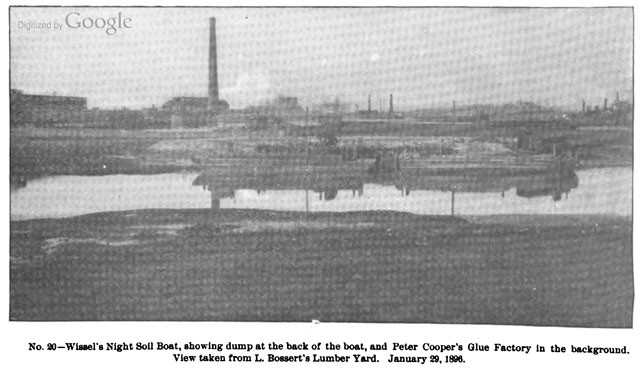
– photo from 1896’s Report By Brooklyn (New York, N.Y.). Dept. of Health, Brooklyn (New York, N.Y.). Health Board, courtesy google books
One of those little nuggets which has fascinated me since beginning to learn about the Creek has been references to “Conrad Wissel’s Dead Animal Wharf” or alternately “night soil dock”. Imagine my surprise when I found a photo of the place from 1896 the other night. In the far left corner of the frame, you can just make out the Maspeth Avenue Plank Road. Wo!
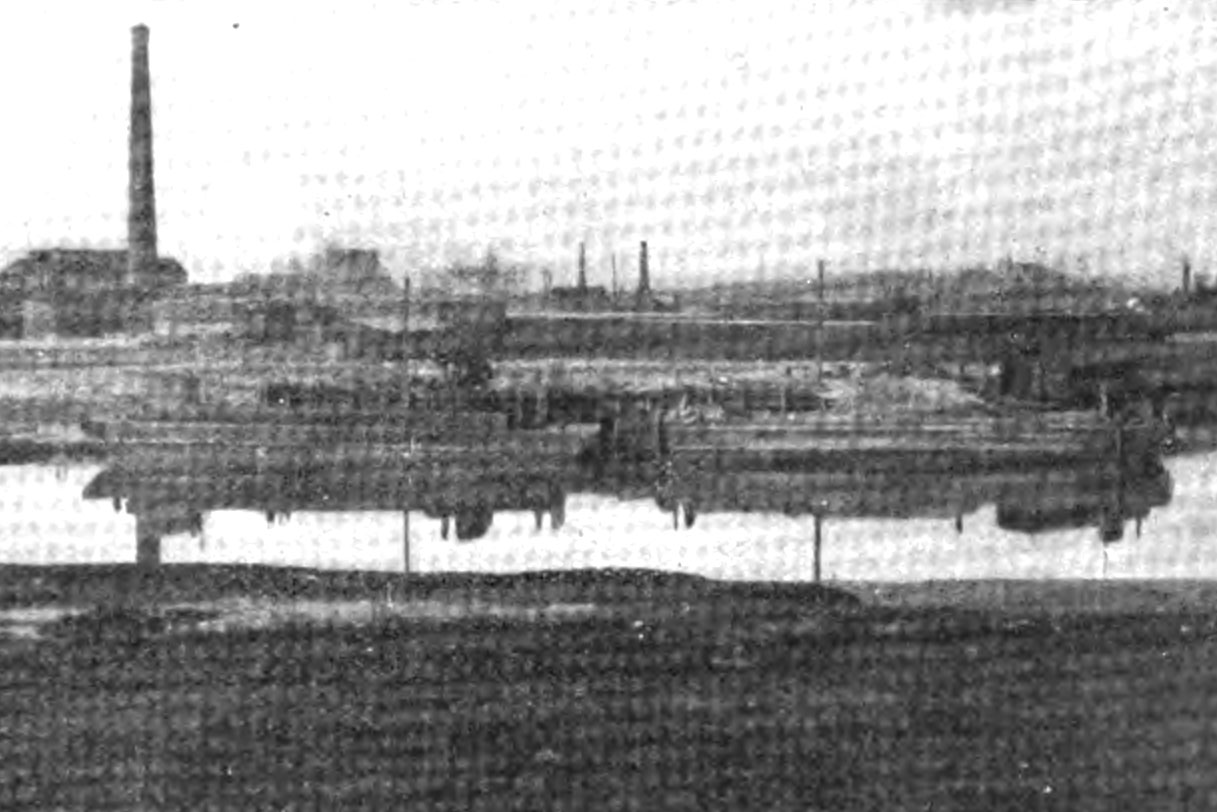
– photo from 1896’s Report By Brooklyn (New York, N.Y.). Dept. of Health, Brooklyn (New York, N.Y.). Health Board, courtesy google books
A little photoshopping has been applied here, improving contrast and attempting to remove some of the moire in google books’s scan of the original.
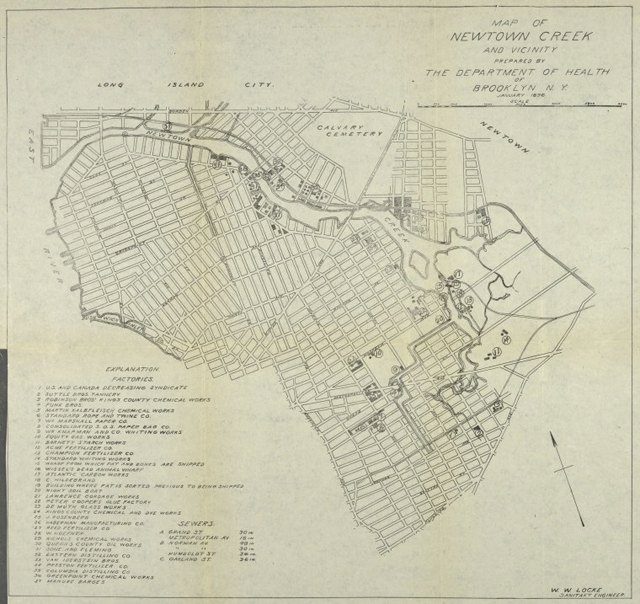
– map from 1896’s Report By Brooklyn (New York, N.Y.). Dept. of Health, Brooklyn (New York, N.Y.). Health Board, courtesy digitalgallery.nypl.org
The NY Public Library hosts the image above, which is the map that was included in the volume that the photo originates in. Click the image to access a zoom able version, whose key lists the Wissel’s dock as number 16.
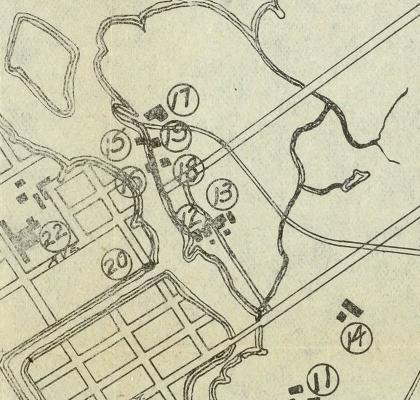
– map from 1896’s Report By Brooklyn (New York, N.Y.). Dept. of Health, Brooklyn (New York, N.Y.). Health Board, courtesy digitalgallery.nypl.org
In this detail from the map, number 16 is clearly just west of the Maspeth Avenue Street end. That’s one mystery solved.

– photo by Mitch Waxman
Here’s another view in modern times, the Wissel property would be just starting on the right side of the frame. The shot is from the Queens side, of course, as is the original- and captured at approximately where the “18” is on the detail of the map. The 1896 photographer would have standing around 500 feet to the right of this vantage point.


 The Newtown Pentacle