Posts Tagged ‘elevated subway’
fallen over
“follow” me on Twitter at @newtownpentacle

– photo by Mitch Waxman
Thanksgiving weekend is no time to burden you with cares or worries, that’s Walmart and your family’s job, so the Newtown Pentacle tradition is to kick back and present singular images which appeal to the sensibility and tastes of a humble narrator. Above, and I do believe that this shot has run before at this – your Newtown Pentacle, is depicted the corner of 31st street and Broadway in demimonde plagued Astoria. The structure, of course, is the the elevated track of the Subway. There’s just something about the light in this one which I really dig.
smoking gulf

– photo by Mitch Waxman
Ask anyone who lives here and they’ll tell you- Astoria Queens rules.
It’s one of the last places in New York City that actually still looks like New York City, and people who live here are generally idiosyncratic and gregarious types who enjoy life’s simpler pleasures wholeheartedly. The ancient village has its problems- of course, too much traffic, a disturbing amount of public inebriation, and when “it hits the fan” around here- things quickly tend to get messy.

– photo by Mitch Waxman
Our streets seem to be collapsing, our sewers back up routinely, everything costs too much, and the new neighbors are noisy. The kids have no respect for the older folks, and litter in a casual manner. The deli guys let bums drink in the back yards of their storefronts, and the social contract which dictates that one should find an appropriate commode for the elimination of bodily wastes seems to have been forgotten. We still haven’t forgotten about the “Great Astoria Blackout of 2006” or the week we spent in the dark while a proverbial “Emperor Nero” fiddled away in City Hall and claimed nothing was wrong.
City services are applied haphazardly (at best) here, except in the case of handing out fines to homeowners and businesses- something handled by the authorities in a fashion best described by the aphorism of “Russian Efficiency”.

– photo by Mitch Waxman
A background hum- caused by highways and rail yards and millions of air conditioners, automobile engines, and oscillating fan blades- colors the air. There is always some sort of yelling, invariably in some foreign tongue, within earshot. Alternatively- kids are playing and squealing with delight, old ladies shuck beans on their stoops, and old men gather in loose groups to complain about the Mets and Rangers or brag about their grandkids.
Everywhere, one might find sidewalk cafes and tavernas glistening with vibrant crowds.
– photo by Mitch Waxman
Indecent development by the real estate industrial complex crowds in on the older building stock, disillusioning long time residents and inflaming the passions of preservationists, but what are you going to do about it? People have a right to do what they want with their own property, and the Astoria way is to mind your own business, unless something directly affects you. The interesting thing about Astoria, as well, is that the whole “race thing” isn’t so much of an issue here. The kids in the neighborhood don’t run in ethnic packs like they do in other parts of the city, it’s more a block by block sort of thing. Brazilian, Irish, Italian, Greek, Korean, Egyptian, whatever- they’re all just “one of the boys” from this avenue or that block or those buildings. Doesn’t matter- as they’re all spoiled rotten, don’t know how good they’ve got it, won’t amount to anything, had it too easy, and all the other things that the old ladies say while making a “tsk tsk” sound.
This is what one might see on the streets, what it’s like to actually live here, and this posting is a response to something someone said to me a couple of weeks ago while I was over in the city- the actual quotation was: “Astoria, I love it there, it’s so diverse”.

– photo by Mitch Waxman
What does that mean? Every description I’ve ever heard of Astoria starts with the “diverse” thing, which connotes that the standard for the rest of the world is rigid social segregation along racial and ethnic lines, and that Astoria is some sort of gulag for foreigners who haven’t figured out that they should shop for clothes at JC Penny at the mall on Queens Blvd. and learn to lose the accent. Additionally, on the “diversometer”, do we score higher than Flushing or Ridgewood or Greenpoint?
If one more Manhattanite asks me if I’ve ever been to a) Elias’s Corner, b) the Bohemian Hall, or c) the Museum of the Moving Image- a humble narrator might just go screaming off into the night.
Anyway, Astoria Queens rules.
You got a problem with that?
cool recesses

– photo courtesy google books, from: Queens Borough, New York City, 1910-1920: The Borough of Homes and Industry
This image was found in one of the many ancient books which your humble narrator is known to haunt. The shot’s vantage point is familiar to regular riders of the LIRR, and would be somewhere very close to Trimble Road’s intersection with 64th street in Woodside. Notice the Woodside Court building on the left, it would have been around 10 years old in the shot above, having been constructed in 1916.
It’s supposed to be the very first apartment house in all of Woodside, or so I’m told.
From the aforementioned book linked to above,
“The importance of this station as a transfer point is directly proportional to the number of Long Island Railroad trains which stop there. About seventy-four percent of the trains stop today. The Queensboro Chamber of Commerce believes that more trains should stop at that point for the interchange of passengers, at the same time realizing that passengers bound for all points in New York City can go through to the Pennsylvania Station and make connections there with the Seventh Avenue Subway”.

– photo by Mitch Waxman, 2011
My shot is from the platform of the modern Long Island Railroad platform, in the summer of 2011. The Woodside Court building is still there, as are the two electrical towers and the elevated train station which crosses over the LIRR tracks along Roosevelt Avenue. The elevated tracks arrived in 1917, so I guess that means that very little has actually changed- from an infrastructure point of view- in the intervening 94 years.
forgotten hands

– photo by Mitch Waxman
On another one of the long marches across the concrete desolations of Western Queens, it occurred to me that I should pay more attention to the steel fingers of the Great Machine than has been formerly applied. This is a problematic notion, of course, as we live in the age of terror- and taking pictures of transportation infrastructure is largely frowned upon by governmental institutions such as the NYPD for understandable and prosaic reasons.

– photo by Mitch Waxman
Part of my outlandish sense of entitlement, imagined largesse, and pompous self importance demands that I do not allow such entities to inhibit my activities.
I’m happy to be questioned by the gendarme whenever they might approach me with queries as to identity and purpose. Law demands that a citizen must carry some form of identification, otherwise the police may detain you with the intention of assessing your identity (for a limited period of time), which is something I always comply with. No such law allows law enforcement to demand that you show them what you’re shooting (they need a warrant for this kind of search), explain why you’re shooting it (that’s what you tell a judge), or to delete images from your camera- or so I am told by those versed in the finer points of law.
If you are in a place which is “in public”, you can feel free to do whatever you want with your camera, within certain limitations (defined around the commercial use of likenesses and editorial implications implied thereof). If on private property, however, the owner or its representatives can ask you to vacate the locale and you must comply with their wishes or be charged with trespassing (however these private entities are similarly restricted in not forcing you to display, delete, or otherwise explain yourself to them).

– photo by Mitch Waxman
Of course, this is an ideal presentation of encounters between photographers and those who wish that the only cameras which existed were those monitoring the citizenry for criminal transgression and evidentiary collection.
Often, one will experience an encounter with a rookie cop, unusually aggressive private security guard, or criminal who does not hold to this liberal interpretation of constitutionally guaranteed free speech. Refer to the recent controversies surrounding the Occupy Wall Street protests, and the widely rebuffed handling of mainstream press photographers by the NYPD for an example of how things can go wildly wrong in the real world.

– photo by Mitch Waxman
Once, whilst capturing an image of the charming St. Irene’s Church here in Astoria, an angry chorus of Greek women took it upon themselves to brand me a terrorist and chased me for several blocks- all the while hurling Hellenic invective. Many of them curled their hands into balls and stuck their thumbs out between middle and ring fingers, and one of them called me “A Bin Laden”.
That’s when I turned around and confronted the group asking “Wouldn’t a Terrorist have a car?”.

– photo by Mitch Waxman
Regardless of risk and the malign attentions of both private and public security, your humble narrator is nevertheless highly motivated to capture and record the magnificent transportation infrastructure which forms the fingers of the Great Machine. I’m sure that they won’t let me take the DSLR into central booking with me, but as I’ve never been accused of anything but driving too fast on the Taconic Parkway and Pennsylvania Turnpike by law enforcement, it sure will be interesting standing in front of a judge.
And by the way, Happy Festivus.
An Iron Road, St. George, and the Copts

31st street, Astoria – photo by Mitch Waxman
When heading east along Northern Blvd. – after navigating and exiting the traffic choked Queensboro bridge complex of off ramps, elevated trains, and vehicular approaches – the elevated iron and steel tracks make a sharp screech of a turn, transiting along the centuries old borderline between those calloused declinations found in semi industrial Dutch Kills- and the tree lined hillocks of sun kissed and sharply tragic Astoria.
from nycsubway.org
The Astoria Line did not come into being until the era of the Dual Contracts, when it and the Corona (Flushing) Line were constructed to serve the northern part of Queens. These were perhaps the most cooperative portions of the project since both the IRT and BMT would share the routes and operate them jointly.
The original arrangement, beginning around 1920, was that the IRT (now the 7) ran through the Steinway Tunnel, and the Second Avenue El ran over the Queensboro Bridge, and met at Queensboro Plaza. From there, trains ran to either Flushing or Astoria.
Queensboro Plaza Station was built with eight tracks on two levels, served by four island platforms. The BMT operated the northern half of the station and the IRT ran the southern half. The north station had two platforms that fit the wider ten foot BMT subway cars and two for the narrower el cars. The southernmost pair of tracks connected to the Steinway Tunnel, while the next set north connected to the Second Avenue El. Both of these could serve either line in Queens via scissors crossovers west of the platforms on either level. The northerly pair of tracks curved to the Astoria Line and the southerly pair connected to the Flushing Line.

31st street, Astoria Elevated Subway- photo by Mitch Waxman
A critical artery, the elevated tracks are also a loud, noisome, and exasperating neighbor for those forced to live near it. The tracks currently carry the N and W subway lines from their Manhattan duties back to the marble cloaked Ditmars section of Astoria, which hurtle along sounding like the chariots of hell itself. Interestingly, the stations along this mechanical Appian Way bear the nomenclature of old Astoria’s street names, – Beebe Avenue, Grand Avenue etc.- which are otherwise extinct and atavist usages. I’ll refer you, once again, to forgotten-ny’s excellent “Street Necrology of Astoria” page- which describes the perplexing maze of street designations far better than I can.
Click here to hear what its sounds like on the street, under the elevated train. (that’s me doing the voiceover time stamp at the end).
note: this is being served by my comics site, and is quite safe for work- its a quicktime movie around 500K, audio only.

31st street, Astoria – photo by Mitch Waxman
A movie or two have used 31st street as their location. I specifically have to mention one of my favorite NY flicks- A Guide to Recognizing Your Saints– which is a good representation of what New York street life used to be like in the 80’s and is a GREAT Astoria movie. The graphic and often violent action in the movie, however, is set on the Ditmars side of 31st street, not below Broadway- where these photos were shot. Seriously… rent it… it doesn’t suck.

31st street, Astoria “the other Shunned House” – photo by Mitch Waxman
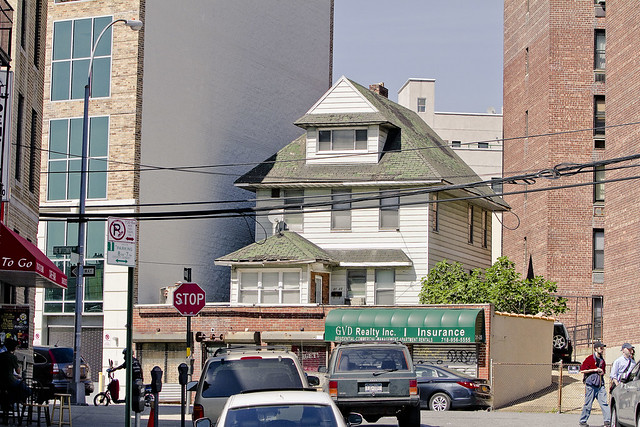
Some of the buildings lining 31st street, like this enigmatic and quite large home which has been abandoned for years, have recently seen new fencelines erected and DOB permits affixed. If the normal patterns of destruction and construction observed in modern Queens play out over the coming months in predictable fashion, an enigmatic structure will be obliterated and replaced by some towering rectangular pile of rebar and cinder blocks.
Rare Political Statement from fence sitter Mitch:
We Plebeians can’t stop the money of the Patrician and Equestrian classes from pushing their plans along except in very rare cases- this is historically true.
The currency that the Political class trades in, ultimately, are votes. If chimpanzees voted, and did so “reliably”, we’d have a lot of bananas growing in Queens and a dedicated effort to bring more Chimpanzees into the neighborhood. The government would ignore the horrific realities of chimpanzee attack.
Community equals constituency. Constituency means that the Politicians will come to YOU, because you vote- reliably. If we can supply a torch bearing mob of angry constituents to a Politician to exploit- anything can happen- because the game rules have changed and the community can out “tweed” the other side. Only 15% of eligible voters went to the polls in the last democratic primary… during wartime.
Community equals constituency.

31st street, Astoria – photo by Mitch Waxman
The Dutch Kills side of 31st street hosts a series of automotive service shops, collision remediation specialists, and large warehouses which offer glimpses of a more prosperous time in fading signage and ornate masonry. These grand structures testify to the wealth and prosperity carried into the area by the elevated tracks. Just a century ago, this was farmland.

31st street, Astoria – photo by Mitch Waxman
All along the southern borderlands of 31st street, the shadows of the “El” part to reveal relict buildings which have been either been cross purposed to modern usage- or just abandoned. Near 36th avenue, there is an avian abattoir.
There are also many churches clustered along 31st street- including the notable St. Demetrios Greek Orthodox Cathedral, an Eastern Orthodox institution. The neighborhood I grew up in was Irish, Italian, Jewish, and African American, with a sprinkling of Boricua here and there. I went to a lot of communions, weddings, and confirmations as a result. This “Brooklyn experience”, and a lifelong fascination with diabolical oppression as represented by Hollywood, my perspective on Christianity is an intrinsically Roman Catholic one- but that might be because of Dio.
note: I was lucky enough to be allowed to take photos inside the St. Demtrios Cathedral back in May, and was given a tour of the place by a young priest. You’ll get to see the photos sometime this winter
As a result, I find the other branches of the cross fascinating- warning- I’m about to go off on a tangent here- might as well go get yourself a coffee because you’ve got links to click.

31st street, Astoria- St. George Christian Coptic Orthodox Church – photo by Mitch Waxman
In the beginning -which in this case is around the 3rd and 4th century AD- there was a great civilization built around an ocean sea that spread out along the coastlines onto three continents.
This civilization had just spawned a new religion, based ultimately around three places
– the civilizations capitol city in the west,
– its intellectual heartlands in the east,
– and in its breadbasket to the south.
As is the case with ecclesiastical communities, disagreements over doctrinal practice and liturgical rites caused schisms to form between various camps. As time went by, and the civilization crumbled into constituent states at war with each other, these schisms widened. The branches of the roseated cross were separated and they became part of emerging nation states.
The western capitol- where the northern barbarians called Normans (specifically Lombards) would rule- was Rome, and its branch of the cross is called Roman Catholic. The intellectual heartland, and the eventual seat of the Greek Roman Empire (or Eastern Roman Empire, whose citizens called themselves Romoloi) was Constantinople. and its church became known as the Orthodox. The southern branch, which is based in Alexandria, is called the Coptic Orthodox. The people who grew up in this tradition can be referred to as Copts.

31st street, Astoria- St. George Christian Coptic Orthodox Church – photo by Mitch Waxman
St. George was a noble born Roman citizen from Cappadocia (modern day anatolia) who joined the legions and made a name for himself during the reign of Diocletian. The emperor found it politically convenient to purge his ranks of noble christians, and George found himself in direct conflict with the world’s most powerful man.
from st-george-church.com
Diocletian gave orders for the issue of a formal edict against the Christians on February 23, in the year 303 A.D., being the feast of Termhlalia. The provisions of this edict which was published on the next day in the market place, were as follows: “All churches should be leveled to the ground. All sacred books to be burned. All Christians who hold any honorable rank are not only to be degraded, but to be deprived of civil rights. Also, All Christians who are not officials are to be reduced to slavery”.
from wikipedia:
Recognizing the futility of his efforts, Diocletian was left with no choice but to have him executed for his refusal. Before the execution George gave his wealth to the poor and prepared himself. After various torture sessions, including laceration on a wheel of swords in which he was resuscitated three times, George was executed by decapitation before Nicomedia’s city wall, on April 23, 303. A witness of his suffering convinced Empress Alexandra and Athanasius, a pagan priest, to become Christians as well, and so they joined George in martyrdom. His body was returned to Lydda for burial, where Christians soon came to honour him as a martyr

31st street, Astoria- St. George Christian Coptic Orthodox Church – photo by Mitch Waxman
There is a large Copt community in Astoria (as well a large Egyptian Muslim neighborhood near Steinway and Astoria Blvd.).
Culturally similar (recipes, style of life, role of women) to the long habitated Greeks, the Copts own many shops and restaurants along Broadway. They often offer a version of the Greek Taverna– an inn which offers light meals and various beverages to weary travelers- but with the addition of Hookah pipes filled with flavored tobaccos and other aromatics. There really does seem to be a Mediterranean culture which crosses state boundaries, but never gets more than 200 miles away from that ancient waterway which was the navel of the world.
There are other ancient branches of the cross out there which also survived the fall of their Roman Empire. The Nestorians, The Chaldeans, The Monophysitists, amongst many others. I haven’t found them yet, however, I’m still searching for the Yazidi– who have got to be somewhere in Astoria.


 The Newtown Pentacle