Posts Tagged ‘Freedom Tower’
curious customs
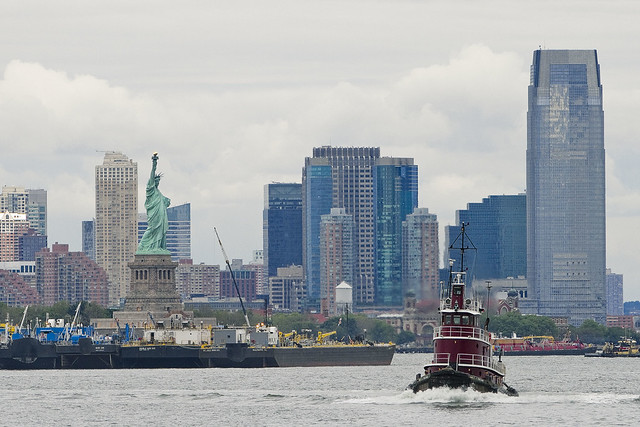
– photo by Mitch Waxman
The Marie J. Turecamo tug presented itself to a humble narrator recently, framing iconic views of the harbor for your perusal on this week’s “Maritime Sunday”. Periodically, when some magazine art buyer or advertising stalwart is looking for a harbor shot, my phone will ring and someone will ask for “a tugboat moving past the Statue of Liberty” or something similar. Invariably, the caller is seeking out free usage of the shot.

– photo by Mitch Waxman
Other photographers get angry with me when I allow free usage of this shot or that to various personages or groups, accusing me of devaluing the craft. “Information wants to be free” is my normal reply, and “an image too dearly held has no intrinsic valuation” is the follow up. This is when I’m called a schmuck, and informed that I’m being “taken advantage of”. Allow me to set the record straight on this subject, lords and ladies.

– photo by Mitch Waxman
A regular beneficiary of my largesse, whether it be the estimable Working Harbor Committee or the Newtown Creek Alliance or any of the other “worthy” harbor groups whom I regularly supply images to, receives a limited license to the photo. They cannot, for instance, use my shots in a manner which I haven’t specified or agreed to- web usage versus printed material. A byline is required, and if at any time I decide to ask them to pull the shot, this is my right as I’m retaining the image copyright and full usage rights. In advertising lingo, the shots are offered and licensed as “stock”, and the compensation asked for use of them is somewhat asymmetrical and seldom monetary.

– photo by Mitch Waxman
What I’m ultimately after is photographic access to people, places, and situations which are normally unattainable. I’ve been inside the Manhattan Bridge, walked on a Queensboro bridge completely devoid of traffic, been privy to dozens of situations that “press” photographers would have killed to get near. I’ve been to off limits spots all around the harbor, delved into the deepest recesses of the City, ascended to unattainable and high vantages, and seen things that most living New Yorkers barely suspect. If a group is doing something worth doing, as in the case of WHC with its education programs and senior citizen programming, or NCA’s quest to save the Newtown Creek from sophistry- I’m happy to donate the usage of a few images. On the other hand, if you see something you’d like a print of, or would like to license an image or two for commercial usage- contact me here.
hideous meaning

– photo by Mitch Waxman
Startling, recent transmissions and recitations from a weird and alien country called Albany brought word that the Governor of New York State has arranged to accelerate the Kosciuszko Bridge project. Complicated planning, difficult execution, and extreme expense hang gruesomely around this project- originally scheduled to commence in 2014, and now expected to begin in 2013.
from nydailynews.com
Construction on a new bridge is now expected to begin in spring 2013 — a year ahead of schedule, thanks to $460 million made available for the job by Gov. Cuomo’s New York Work initiative.
The 73-year-old bridge, which carries the Brooklyn-Queens Expressway over the Newtown Creek, qualified for the money in part because it is on the state’s “deficient bridge” list.
The initial phase of construction will build an eastbound lane next to the existing bridge, according to the state Department of Transportation, the agency overseeing the project. The 1.1-mile bridge is expected to be done in 2017 and will cost about $800 million.
When completed, two new spans with a total of nine vehicle lanes and paths for pedestrians and bikes will replace the original structure.
It’s the single biggest project made possible through the New York Works program, an initiative to create jobs while repairing the state’s infrastructure.

– photo by Mitch Waxman
The 1939 workhorse, erected at the whim of Robert Moses, will no longer soar above that mirrored ribbon of risible metaphor known as the Newtown Creek in just a few years, as scheduled work is meant to conclude in 2017. Area wags shrug and sigh at this, wearily offering that such projects often extend well past their scheduled and budgetary goals, and that the Creek itself will present a series of unexpected problems to be solved.
from dot.ny.gov
Following seven years of alternatives analysis, environmental studies and extensive partnering with community groups and stakeholders, the Federal Highway Administration (FHWA) approved the New York State Department of Transportation’s (NYSDOT) selection of Alternative BR-5 for a new Kosciuszko Bridge in its March 9, 2009 Record of Decision and granted authorization to proceed with Final Design. The Project Team has been working to complete key initial phases of the Final Design which would lay the groundwork to develop and complete the detailed design of the new bridge structure.

– photo by Mitch Waxman
Extensive documentation exists at the State DOT website, with coruscating revelations about both the current structure and anticipations of obstacles and opportunities which will be encountered during pursuit of the new structure. Your humble narrator, threatened by such rapid change, remains nevertheless excited about the idea of a pedestrian walkway overlooking not just the Creek itself- but Calvary Cemetery. Architectural drawings of the future DUKBO (Down Under the Kosciuszko Bridge Onramp) show an intriguing and modernist setting.
from dot.ny.gov
Under all Build Alternatives, excavation of soil would be performed to a depth of about 4.5 m (15 ft), and the walls of the excavation would be braced. Contaminated soil and groundwater would be collected and disposed of. The new foundations would be pile supported, and either large diameter drilled piles or concrete filled driven pipe piles would be used. Drilled pile construction would generate less noise and vibration than driven piles, but may be difficult to install if boulders are encountered. Additionally, there is widespread soil contamination in the area, and contaminated soil and water extracted while drilling would need to be collected, treated and disposed of properly. This construction impact study assumed the use of driven piles.
After pile installation is complete, formwork for the pile cap would be installed, rebar installed, and concrete placed. Pier construction would follow, working from ground level up in approximately 2.5 m (8 ft) segments. Formwork would be installed, rebar installed and concrete placed. After the concrete has cured sufficiently, the forms would be stripped and the sequence would be repeated until the pier was complete.

– photo by Mitch Waxman
A frequent commenter at Newtown Pentacle, “George the atheist”, asked me a while back for clarification and or documentation of my assertion that the reason for the truss bridge’s enormous height over the Creek was to allow egress to ocean going vessels with high stacks (smokestacks). During the course of some general research on Newtown Creek in the first half of the 20th century, this 1951 photo popped up at the NYS Digital collections site which illustrates just such a scene.
from wikipedia
The Kosciuszko Bridge is a truss bridge that spans Newtown Creek between the New York City boroughs of Brooklyn and Queens, connecting Greenpoint, Brooklyn and Maspeth, Queens. It is a part of Interstate 278, which is also locally known as the Brooklyn-Queens Expressway. The bridge opened in 1939, replacing the Penny Bridge from Meeker Avenue in Brooklyn to Review Avenue and Laurel Hill Boulevard, and is the only bridge over Newtown Creek that is not a drawbridge. It was named in honor of Tadeusz Kościuszko, a Polish volunteer who was a General in the American Revolutionary War. Two of the bridge towers are surmounted with eagles, one is the Polish eagle, and the other the American eagle.
maniacal force and fury

– photo by Mitch Waxman
Special Note: I’m going to fill in for Newtown Creek Alliance’s Michael Heimbinder at the DEP speaker series tomorrow night at the Newtown Creek Wastewater Treatment Plant. Mike has a family obligation to fulfill, and Shawn Shaffner of the POOP project asked me to sit in his chair. For more on the (free) event in Greenpoint, Brooklyn on Thursday the 23rd of June, click here. The official press release text follows:
Newtown Creek: Past, Present, and Future
When: Thursday, June 23rd, 6:30-8:30pm
Where: Newtown Creek Wastewater Treatment Plant Visitor Center, 329 Greenpoint Ave.
Join us for the NYC Dept of Environmental Protection’s speaker series where we will be hearing from Michael Heimbinder (Founder and Executive Director, HabitatMap), Kate Zidar (Coordinator, SWIM Coalition) and Paul Parkhill (Director, Place in History). The panel discussion will be moderated by Shawn Shaffner of the The People’s Own Organic Power Project.
Now, on with the Pentacle:
As mentioned in yesterday’s post, I had participated in Working Harbor Committee’s “student cruise” (an effort to introduce the concept of maritime career opportunities to kids from the landlocked core of the City who might otherwise never consider such a path) and found myself with several hours to kill before a second Working Harbor trip in the evening which would be leaving from South Street Seaport and Pier 17.
Luncheon at “the Frying Pan” was achieved, and your humble narrator found himself enjoying the Hudson River Park’s amenities and scenic possibilities. When I lived in Manhattan, of course, I seldom left the apartment except for the bacchanal nights spent at certain favorite bars.
For most of the 1990’s my place was Hogs and Heifers, which was opened by a buddy of mine in a desolate and dangerous stretch of the west side known as the “meat packing district”.
from wikipages.com
The bar was started by Michelle Dell’s husband, Allan Dell, in 1992, when the Meat Packing District was known for transvestite hookers and crack, not fancy restaurants and clubs. Dell slowly built the business, and in the process helped to turn around an entire neighborhood, turning Hogs and Heifers into a major tourist destination, and the Meat Packing District into one of the hottest club and restaurant destinations in the world.
Allan Dell died on June 7th, 1997, at age 31. Michelle Dell continues to operate the bar as its sole proprietor, as well as operating the much larger location, opened in 2005, in Las Vegas, NV.

– photo by Mitch Waxman
A friend of mine from art school, who was a confidant and companion of the infamous Lydia Lunch, gave this neighborhood the unforgettable motto “we’ve got the reddest, we’ve got the rawest, just step inside” and the place was no joke “back in the day”. The high line was the worlds longest homeless camp, and the baser elements of New York society stalked the streets untrammeled by the attentions of police or polite society. Things have changed here, as everywhere else, in the Shining City.
Debauchery and drunkenness is much beloved by the uniformed services of our City, and the early bar soon became a magnet for off duty cops, firefighters, and representatives of the various trade unions. After 911, however, I found myself going there less and less. Not to run away from what had happened of course, but simply speaking- my life had changed when Our Lady of the Pentacle arrived on the scene and my nightlife activities had been tapering off anyway as age began to set in.
from wikipedia
The West Side Highway (officially the Joe DiMaggio Highway) is a mostly surface section of New York State Route 9A (NY 9A) that runs from West 72nd Street along the Hudson River to the southern tip of Manhattan. It replaced the West Side Elevated Highway, built between 1929 and 1951, which was shut down in 1973 due to neglect and lack of maintenance, and was dismantled by 1989. The term “West Side Highway” is often mistakenly used, particularly by the news media traffic reporters, to include the roadway north of 72nd Street which is properly known as the Henry Hudson Parkway.
The current highway, which was completed in 2001, but required some reconstruction due to damage sustained in the 9/11 attacks, utilizes the surface streets that existed before the elevated highway was built: West Street, Eleventh Avenue and Twelfth Avenue. A short section of Twelfth Avenue still runs between 129th and 138th Streets, under the Riverside Drive Viaduct.

– photo by Mitch Waxman
Of course, the demographics of the neighborhood began to change as well, as the success of Hogs had spawned dozens of other- more upscale- watering holes which catered to an entirely different population of fashionable and moneyed customers. You didn’t see Celebrities slumming anymore, they came here instead “to be seen”.
Basically, it just stopped being fun in the meat packing district, in the same manner that the Lower East Side ceased in the late 80’s. In my mind, Manhattan as a whole is no fun anymore, just expensive.
Recently, I noted that a fruit cart on Park Avenue in the lower 20’s was selling oranges at $1 each. A dollar for an orange?
from wikipedia
In 1900, Gansevoort Market was home to 250 slaughterhouses and packing plants, but by the 1980s, it had become known as a center for drug dealing and prostitution, particularly transsexuals. Concurrent with the rise in illicit sexual activity, the sparsely populated industrial area became the focus of the city’s burgeoning gay BDSM subculture; loosely embracing the business model of disco impresario David Mancuso, over a dozen sex clubs — including such notable ones as The Anvil, The Manhole, and the heterosexual-friendly Hellfire Club — flourished in the area. At the forefront of the scene was the members-only Mineshaft on Little West 12th Street. A preponderance of these establishments were under the direct control of the Mafia or subject to NYPD protection rackets. In 1985, The Mineshaft was forcibly shuttered by the city at the height of AIDS preventionism.
Beginning in the late 1990s, the Meatpacking District went through a transformation. High-end boutiques catering to young professionals and hipsters opened, including Diane von Furstenberg, Christian Louboutin, Alexander McQueen, Stella McCartney, Theory, Ed Hardy, Puma, Moschino, ADAM by Adam Lippes, Jeffrey New York, the Apple Store; restaurants such as Pastis and Buddha Bar; and nightclubs such as Tenjune, One, G-Spa, Cielo, APT, Level V, and Kiss and Fly. In 2004, New York magazine called the Meatpacking District “New York’s most fashionable neighborhood”.

– photo by Mitch Waxman
I’ve been watching the so called Freedom Tower rising from the pit of national despair, an aspirant memorial and architectural experiment. Like the towers that were raised by the Rockefellers in the 70’s or the Newsboy Governor’s Empire State Building, it’s meant to connote that no matter how hard times get, NYC will always grow higher and farther than any other city.
What is odd for me, however, are the throngs of tourist pilgrims who make a point of visiting the construction site. During this Hudson walk, I was diverted from my path by the construction project and I found myself taking a sit down break on the gated wall in front of St. Paul’s on Church and Vesey.
Amazing, the numbers of foreign tourists, who make their way here from across the globe.
from wikipedia
The design of 1 WTC generated controversy due to the limited number of floors in the previous design (82) that were designated for office space and other amenities. The overall office space of the entire rebuilt World Trade Center will be reduced by more than 3,000,000 square feet (280,000 m2) as compared with the original complex. The floor limit was imposed by Silverstein, who expressed concern that higher floors would be a liability in another major accident or terrorist attack. In a subsequent design, the highest space that could be occupied became comparable to the original World Trade Center.
An unofficial movement to rebuild the lost towers instead of building a single tower, called The Twin Towers Alliance, collected more than seven thousand signatures supporting the rebuilding of the Twin Towers. Developer Donald Trump proposed a twin building design called World Trade Center Phoenix (Twin Towers II). The twin design would look similar to the original twin towers, but the buildings would be considerably taller with improved safety measures and would feature much larger windows.
Former New York Governor George Pataki faced accusations of cronyism for supposedly using his influence to get the winning architect’s bid picked as a personal favor for a close friend.
The base of the tower (fortified because of security concerns) has also been a source of controversy. A number of critics (notably Deroy Murdock of the National Review) have suggested that it is alienating and dull, and reflects a sense of fear rather than freedom, leading them to dub the project “the Fear Tower”.
In May 2011, detailed floor plans of the tower were displayed on New York City’s Department of Finance website resulting in an uproar from the media and citizens of the surrounding area who questioned the potential use of the plans for a future terrorist attack. New York Police Department Chief Ray Kelly described One World Trade Center as “the nation’s number one terrorist target”.

– photo by Mitch Waxman
My own travels in Europe have often been illuminating, for when these folks are comfortable in their own environment, they discuss the United States in the same context as they would Nazi Germany and I’ve been told by English, Dutch, and Frenchman alike that “we had it coming”.
I find it paradoxical, as there is some truth to their point of view- the same Rockefeller money that built the first World Trade Center was generated by Standard Oil, whose worldwide operations supported and in many cases created the oppressive North African and Arabian governments which would prove to be so friendly to the petrochemical industry back in the 1950’s.
Conversely, the so called “American hegemony” which allowed the petrol companies to guarantee cheap energy to the “west” also created the longest period of peace in European history. The economics of maintaining a large military, or not, is what allowed the shattered landscape of post war Europe to be rebuilt- and many of the modern European birthrights- free or relatively cheap higher education, great roads, and universal health care- are what you can have if you don’t have to maintain a standing army.
from wikipedia
The “Seven Sisters” was a term coined in the 1950s by Italian businessman Enrico Mattei to describe the seven oil companies which formed the “Consortium for Iran” and dominated the global petroleum industry from the mid-1940s to the 1970s. The group comprised Standard Oil of New Jersey and Standard Oil Company of New York (now ExxonMobil); Standard Oil of California, Gulf Oil and Texaco (now Chevron); Royal Dutch Shell; and Anglo-Persian Oil Company (now BP).
In 1973 the members of the Seven Sisters controlled 85% of the world’s petroleum reserves but in recent decades the dominance of them and their successor companies has been challenged by the increasing influence of the OPEC cartel and of state-owned oil companies in emerging-market economies.
betwixt the horns

– photo by Mitch Waxman
Call me paranoid, but the Fireboat Three Forty Three seems to be following me around. Everywhere I go these days, there it is. Has anyone ever been stalked by a crewed ship on its shakedown cruise?
Perhaps.
from wikipedia
140-foot, 500-ton, $27 million dollar boat will be the country’s largest fireboat with a maximum speed of 18 knots. The Three Forty Three will provide the FDNY with the latest technology available for Marine vessels, including the capability of pumping 50,000 gallons of water per minute; nearly 30,000 gallons more than its predecessor. The need for this increased pumping capacity was graphically displayed as FDNY’s existing fireboats supplied the only water available for many days after the September 11, 2001 attack on the World Trade Center. However, the technological advances of these new boats do not end there. The boat’s original design by Robert Allan Ltd. of Vancouver, B.C. will catapult FDNY’s Marine Division into the 21st century and beyond.
Because of the very real threat of additional terrorist attacks after 9/11, the boats will also be capable of protecting firefighters from Chemical, Biological, Radiological, Nuclear agents (CBRN). While performing in any of these hostile environments, the crew will be protected in a pressurized area that will also have its air supply filtered by special charcoal and HEPA filters. Assistance on the design of the CBRN system was provided by engineers from the U.S. military’s Joint Program Executive Office for Chemical and Biological Defense and Naval Sea Systems Command. United States Navy.

– photo by Mitch Waxman
Day two of a particularly interesting summer cold, and as you’re reading this (assuming it’s daylight) your humble narrator is most likely aboard a Circle Line and talking on the microphone describing the sights and hidden meanings of NY Harbor to a group of 700 Octa, Nona, and Centenarians.
Such odd moments in life are, of course, owed to the Working Harbor Committee and the Borough President of Manhattan, who makes money available for his constituents in nursing homes to “get out for a day”.
from mbpo.org
Scott M. Stringer, a native New Yorker, is the 26th Manhattan Borough President.
Since taking office at the start of 2006, he has dedicated himself to making Manhattan more affordable, livable…and breathable – preserving the sense of neighborhood for the 1.6 million residents of what is best known as a world capital of culture and commerce.
The foundation for much of the borough president’s work is the change he’s brought to Manhattan’s community boards. Energizing these formal institutions of neighborhood democracy was a top priority of Stringer’s upon becoming borough president. A new merit selection process, combined with an infusion of badly needed resources – such as dedicating to each board a graduate student from the city’s architecture and planning schools – has served to strengthen the voice of Manhattan’s neighborhoods in debates over city planning.

– photo by Mitch Waxman
It was actually a recent Working Harbor trip, this time a program for kids in which representatives of certain maritime organizations like Coast Guard and Port Authority commune with a group of “city kids” onboard a boat, which had brought me to the Hudson on the day these shots were taken. The goal is to introduce to them the idea of a career on the harbor, something not often considered in the wilds of central Brooklyn or Queens.
Another maritime engagement would require me to be at South Street Seaport in the evening, and I had a few hours to kill so I decided to walk from 42nd street to South Street the long way, around the Battery.
from wikipedia
Battery Park is a 25-acre (10 hectare) public park located at the Battery, the southern tip of Manhattan Island in New York City, facing New York Harbor. The Battery is named for artillery batteries that were positioned there in the city’s early years in order to protect the settlement behind them. At the north end of the park is Castle Clinton, the often re-purposed last remnant of the defensive works that inspired the name of the park; Pier A, formerly a fireboat station; and Hope Garden, a memorial to AIDS victims. At the other end is Battery Gardens restaurant, next to the United States Coast Guard Battery Building. Along the waterfront, ferries depart for the Statue of Liberty and Ellis Island, and there is also a New York Water Taxi stop. The park is also the site of the East Coast Memorial which commemorates U.S. servicemen who died in coastal waters of the western Atlantic Ocean during World War II, and several other memorials.
To the northwest of the park lies Battery Park City, a planned community built on landfill in the 1970s and 80s, which includes Robert F. Wagner Park and the Battery Park City Promenade. Together with Hudson River Park, a system of greenspaces, bikeways and promenades now extend up the Hudson shoreline. A bikeway might be built through the park that will connect the Hudson River and East River parts of the Manhattan Waterfront Greenway. Across State Street to the northeast stands the old U.S. Customs House, now used as a branch of the National Museum of the American Indian and the district U.S. Bankruptcy Court. Peter Minuit Plaza abuts the southeast end of the park, directly in front of the South Ferry Terminal of the Staten Island Ferry.

– photo by Mitch Waxman
In planning my route, however, I forgot to factor in the Freedom Tower and the 911 site, which is something I normally avoid like the plague. As a rule, I stay away from this subject, don’t discuss my dead friends who were Port Authority cops or Fire Fighters, and don’t engage in conversational speculation about the event with either the “Truthers” or the conspiracists.
On the other hand, I think that naming a Fireboat “Three Forty Three” is extremely appropriate while the term “Freedom Tower” is just silly and smacks of bad comic book writing.
from wikipedia
One World Trade Center (1 World Trade Center), more simply known as 1 WTC and formerly known as the Freedom Tower, is the lead building of the new World Trade Center complex in Lower Manhattan in New York City. The tower will be located in the northwest corner of the World Trade Center site, and will occupy the location where the original 8-story 6 World Trade Center once stood. The north side of the tower runs between the intersection of Vesey and West streets on the northwest and the intersection of Vesey and Washington streets on the northeast, with the site of the original North Tower/1 WTC offset to the southeast. Construction on below-ground utility relocations, footings, and foundations for the building began on April 27, 2006. On March 30, 2009, the Port Authority confirmed that the building will be known by its legal name of ‘One World Trade Center’, rather than the colloquial name ‘Freedom Tower’. Upon completion, One World Trade Center will be the tallest building in the United States, standing at a height of 1,776 feet (541.3 m), and among the tallest buildings in the world. It will be taller than the Empire State Building, and will be completed by the beginning of 2014.


 The Newtown Pentacle