Posts Tagged ‘Long Island Expressway’
mold stained facades
“follow” me on Twitter at @newtownpentacle

– photo by Mitch Waxman
Only 14 days left until the 13th b’ak’tun ends, initiating the Mayan Apocalypse on December 21st. Seeking to visit those places special to me- one last time- before the sun blinks, the heavens crash, and the earth splits- your humble narrator journeyed to the Empty Corridor in Long Island City. Empty Corridor, incidentally, is a term of my own invention- the rest of you know it as 50th avenue.

– photo by Mitch Waxman
The feature rich terrain which surrounds the Newtown Creek and its industrial districts is often difficult to categorize without some sort of assigned nomenclature. The Creek itself…long time readers of this, your Newtown Pentacle, have grown accustomed to the appellations DUKBO (Down Under the Kosciuszko Bridge Onramp), DUPBO (Pulaski), DUGABO (Greenpoint Avenue), even DUMABO (Metropolitan Avenue) to describe various sections using bridge crossings for reference. I’ve called a certain route through Greenpoint “The Poison Cauldron” and another that leads from Bushwick to Maspeth “The Insalubrious Valley”. There is a reason for this, beyond my personal amusement.

– photo by Mitch Waxman
Simply put, the historic place names for these spots have fallen out of common memory. If I said, meet me in Arnheim or at Whites Dock near the Plank Road, how many would be able to reach these spots? In my educated estimation, knowing the various players and personalities of the local historical enthusiasts and area wags, approximately eleven people would have any idea what I was taking about. For a time, the nickname of DULIE (Down Under the Long Island Expressway) was considered for this spot, but that fits the eastward section of Borden Avenue a bit better, so “Empty Corridor” was assigned to it.

– photo by Mitch Waxman
There used to be lots of interesting things here, before Robert Moses rammed the steel viaduct and the midtown tunnel which feeds it through in 1939. There were warehouses that were fed by the freight lines of the Long Island Railroad, as well as a thriving manufacturing community. Nowadays, there are nothing but truck based businesses- UPS is the biggest of them. And cats. Lots of cats.

– photo by Mitch Waxman
One thing you will notice as universal in these industrial backwaters is that ferals are everywhere. Cats, that is. These days, you don’t see packs of dogs roaming about. When your humble narrator was a boy, living in the hinterlands of flatlands and canarsie, it was not uncommon to see 10-20 dogs of dissimilar breeds roaming around. Some were escaped or abandoned pets, but most were the product of miscegenation and rough in appearance and demeanor. These days, Cats seem to be the dominant feral animal.

– photo by Mitch Waxman
Another thing you’ll notice is that laborers in the neighborhood look after these creatures, creating shelters out of plastic crates and depositing large quantities of food. This, of course, provides fuel to the fire, and an unsustainable birth rate. There are only so many birds and rats that can be caught under normal circumstances, and without their tenders, life can get pretty grim for these kitties here in the Empty Corridor.
twisting willows
“follow” me on Twitter at @newtownpentacle

– photo by Mitch Waxman, 2012
During this infirmity which has struck me down, a twisting gimlet of overstressed tissue in my lower back (for those of you who haven’t read my endless complaints about it in the last week), an amazing amount of time has been spent combing the vast Internet in search of amusement and diversion. While doing so, a few images at the New York City Municipal Archives provided me with some intellectual whimsy. The shot above is quite modern, captured a few days after Hurricane Sandy. It depicts the “Queens Midtown Highway” section of the Long Island Expressway.
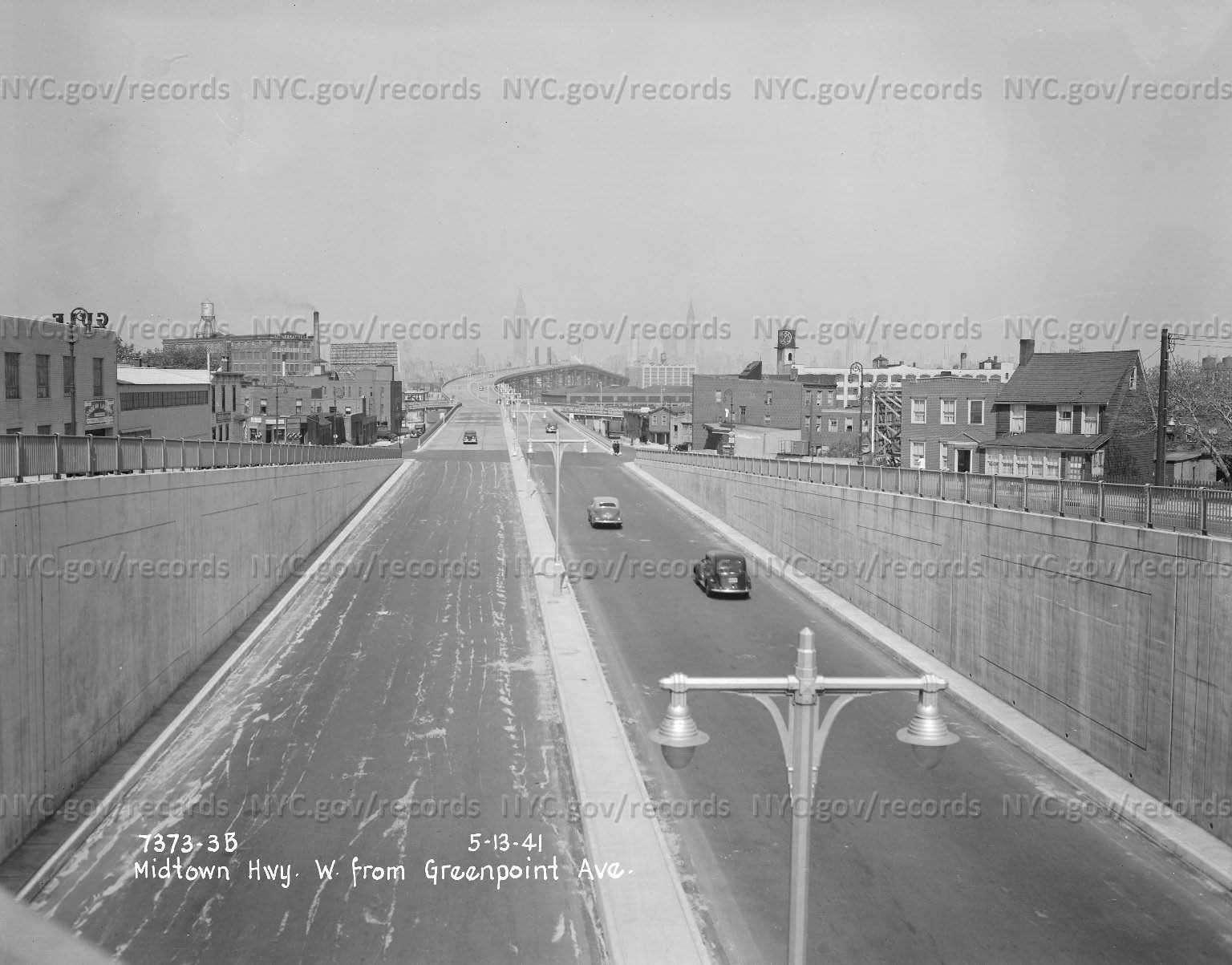
– photo by nycma.lunaimaging.com, May 13, 1941
The historic shot from May 1941, above, is shot from a few hundred feet south of my vantage point. Unfortunately, the spot where that photographer stood is now obscured by both a chain link fence and a highway sign which blocks the historic view. Of particular note in the 1941 shot are the presence of private homes, rather than industrial buildings, along the northern side of the highway. Also, the blanket of vaporous exhaust visible in the air of Long Island City is of some interest.
ordered terraces
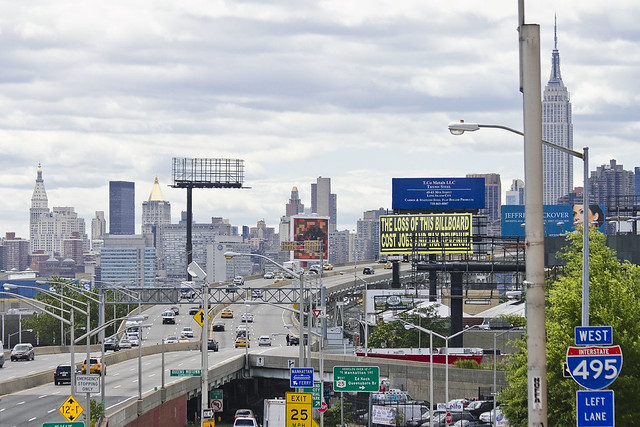
– photo by Mitch Waxman
The blasted heaths of Western Queens, which the art of engineering have conquered fully, must have once been quite lovely. What exists at the dawn of the second millennia, however, represent obeisance to the motor vehicle and “flow”. Gaze in horror upon the Queens Midtown Expressway section of the Long Island Expressway, a 1939 expression of the seeming ennui felt by Robert Moses for the ancient villages and communities of Long Island City.
Your humble narrator is often struck dumb and blind when doing so.
from wikipedia
Symptoms of acute stress reaction
The symptoms show great variation but typically include an initial state of “daze”, with some constriction of the field of consciousness and narrowing of attention, inability to comprehend stimuli, and disorientation.
This state may be quickly followed by either further withdrawal from the surrounding situation (to the extent of a dissociative stupor), or by agitation and overactivity, anxiety, impaired judgement, confusion, detachment, and depression. Autonomic signs of panic anxiety (tachycardia, sweating, flushing) are also commonly present.
The symptoms usually appear within minutes of the impact of the stressful stimulus or event, and disappear within 2–3 days (often within hours). Partial or complete amnesia for the episode may be present.

– photo by Mitch Waxman
At its apex over the Dutch Kills tributary of the languid Newtown Creek, which climbs to some one hundred and six feet over the water, the steel roadway begins a precipitous change in declination which carries vehicular traffic to the subaqueous Queens Midtown Tunnel and into Manhattan. The roadway was elevated to this altitude for no reason other than allow ocean going vessels egress to the turning basin of the Degnon Terminal at the head of Dutch Kills, and the blighting effect it had on Long Island City was quite unintentional. The industrial center became something to be ignored, driven over, forgotten, and quite irrelevant- seemingly by design.
If this is not the case, why are there no entrance or exit ramps between Greenpoint and Vernon Avenues?
from wikipedia
Depersonalization disorder (DPD) is a dissociative disorder (ICD-10 classifies the disorder as an anxiety disorder) in which the sufferer is affected by persistent or recurrent feelings of depersonalization and/or derealization. A diagnosis is made when the dissociation is persistent and interferes with the social and occupational functions necessary for everyday living. Diagnostic criteria include persistent or recurrent experiences of feeling detached from one’s mental processes or body. “Dissociation is defined as a disruption in the usually integrated functions of consciousness, memory, identity and perception, leading to a fragmentation of the coherence, unity and continuity of the sense of self.

– photo by Mitch Waxman
The complicated snare of vehicular access to Manhattan as it all compacts in Long Island City has often caused me to fall into a stupor when contemplated. Subway lines, railroads, passenger and freight vehicles- all form a tight fist gripping the heart of this formerly vital center. Storm water flows freely from exhausts onto local streets, causing temporary lagoons of sooty liquids to agglutinate about garbage choked sewers. Many of these sewers bear the screed “no dumping, drains into waterway” embossed directly on the iron grates.
Perhaps one is entangled in some waking nightmare, and all of what may be observed is merely some fevered ideation?
from wikipedia
Oneirophrenia is a hallucinatory, dream-like state caused by several conditions such as prolonged sleep deprivation, sensory deprivation, or drugs (such as ibogaine). From the Greek words “ὄνειρο” (oneiro, “dream”) and “φρενός” (phrenos, “mind”). It has some of the characteristics of simple schizophrenia, such as a confusional state and clouding of consciousness, but without presenting the dissociative symptoms which are typical of this disorder.
Persons affected by oneirophrenia have a feeling of dream-like unreality which, in its extreme form, may progress to delusions and hallucinations. Therefore, it is considered a schizophrenia-like acute form of psychosis which remits in about 60% of cases within a period of two years. It is estimated that 50% or more of schizophrenic patients present oneirophrenia at least once.
____________________________________________________________________________
Click for details on Mitch Waxman’s
Upcoming boat tours of Newtown Creek
July 22nd, 2012- Working Harbor Committee Newtown Creek Boat Tour

fear eclipses

– photo by Mitch Waxman
The warmth was welcome, but the mists and fog were not. Multiple journeys into and out of the concrete devastations of the Newtown Creek watershed in recent weeks have garnered nothing but terror for your humble narrator. What unknown things, too small to notice, might have been carried aloft by those vapors? After all, if you can smell something… you are breathing it in.
That thing which cannot possibly exist in the cupola of the Sapphire Megalith was surely unaffected by those whose flapping and flopping might be observed only with the aid of microscopy, in its perch high above the mists.
I’m all ‘effed up.
from wikipedia
Delusional parasitosis, also known as Ekbom’s syndrome, is a form of psychosis whose victims acquire a strong delusional belief that they are infested with parasites, whereas in reality no such parasites are present. Very often the imaginary parasites are reported as being “bugs” or insects crawling on or under the skin; in these cases the experience of the sensation known as formication may provide the basis for this belief.
The alternative name of Ekbom’s syndrome derives from Swedish neurologist Karl Axel Ekbom, who published seminal accounts of the disease in 1937 and 1938. This term is also used interchangeably with Wittmaack-Ekbom syndrome, another name for restless legs syndrome (RLS). Although delusional parasitosis and RLS were both researched by Ekbom, and RLS sufferers sometimes describe some of their symptoms as if they have, for example, “ants in my veins”, they are distinctly different disorders. RLS is a physical condition with physical causes, whereas delusional parasitosis is a false belief.

– photo by Mitch Waxman
Intimate associates and clandestine confidants have been acting oddly since those foggy days during the third week of March, leading me to experience entirely uncontrollable and unpermissive pulsations of paranoid wondering. It was so odd, experiencing the weather of early summer at this stage of the year, imparting a sensation to me that we had all somehow skipped ahead a month or two in time according to the whim of some extra dimensional overlord- but only for a short interval.
Perhaps time itself has come undone.
from wikipedia
The Capgras delusion theory (or Capgras syndrome) is a disorder in which a person holds a delusion that a friend, spouse, parent, or other close family member has been replaced by an identical-looking impostor. The Capgras delusion is classified as a delusional misidentification syndrome, a class of delusional beliefs that involves the misidentification of people, places, or objects. It can occur in acute, transient, or chronic forms. Cases in which patients hold the belief that time has been “warped” or “substituted” have also been reported.

– photo by Mitch Waxman
Mayhaps it was was the influence of whatever it was that arose on the billowing fog that caused my reason to falter and imaginings to take on a sinister cast. The miasmic clouds which blanketed and caressed could not have been anything more than mere humidity, not some noxious atmosphere of industrial exhaust and foul microscopic life clinging to those tiny water droplets hanging suspended in the air. Such wonderings are merely paranoia, but one wonders… and more than wonders…
from wikipedia
Between people of different faiths, or indeed between people of the same faith, the term omnipotent has been used to connote a number of different positions. These positions include, but are not limited to, the following:
- A deity is able to do absolutely anything, even the logically impossible, i.e., ( 2 ) pure agency.
- A deity is able to do anything that it chooses to do.
- A deity is able to do anything that is in accord with its own nature (thus, for instance, if it is a logical consequence of a deity’s nature that what it speaks is truth, then it is not able to lie).
- Hold that it is part of a deity’s nature to be consistent and that it would be inconsistent for said deity to go against its own laws unless there was a reason to do so.
- A deity is able to do anything that corresponds with its omniscience and therefore with its worldplan.
Under many philosophical definitions of the term “deity”, senses 2, 3 and 4 can be shown to be equivalent. However, on all understandings of omnipotence, it is generally held that a deity is able to intervene in the world by superseding the laws of physics, since they are not part of its nature, but the principles on which it has created the physical world. However many modern scholars (such as John Polkinghorne) hold that it is part of a deity’s nature to be consistent and that it would be inconsistent for a deity to go against its own laws unless there were an overwhelming reason to do so.

– photo by Mitch Waxman
Your humble narrator must simply be drinking too much coffee.
from wikipedia
Caffeine overdose can result in a state of central nervous system over-stimulation called caffeine intoxication (DSM-IV 305.90), or colloquially the “caffeine jitters”. The symptoms of caffeine intoxication are comparable to the symptoms of overdoses of other stimulants: they may include restlessness, fidgeting, anxiety, excitement, insomnia, flushing of the face, increased urination, gastrointestinal disturbance, muscle twitching, a rambling flow of thought and speech, irritability, irregular or rapid heart beat, and psychomotor agitation. In cases of much larger overdoses, mania, depression, lapses in judgment, disorientation, disinhibition, delusions, hallucinations, or psychosis may occur, and rhabdomyolysis (breakdown of skeletal muscle tissue) can be provoked.
ALSO:

Your humble narrator will be narrating humbly at this year’s Obscura Day event on April 28th, leading a walking tour of Dutch Kills. The tour is already a third booked up, and as I’m just announcing it, grab your tickets while you can.
“Found less than one mile from the East River, Dutch Kills is home to four movable (and one fixed span) bridges, including one of only two retractible bridges remaining in New York City. Dutch Kills is considered to be the central artery of industrial Long Island City and is ringed with enormous factory buildings, titan rail yards — it’s where the industrial revolution actually happened. Bring your camera, as the tour will be revealing an incredible landscape along this section of the troubled Newtown Creek Watershed.”
For tickets and full details, click here :
obscuraday.com/events/thirteen-steps-dutch-kills-newtown-creek-exploration
rhetorical effect

– photo by Mitch Waxman
There is a curious stretch of 50th avenue, a truncated street that starts at 27th street and terminates at 23rd street in the dusty streets of Long Island City, which is orphaned and decapitated. It is dominated by the high flying steel of the Queens Midtown Expressway section of the Long Island Expressway, and the tortured asphalt of the street it shadows often exhibits bursting ruptures revealing century old cobble stones.
Long have I exerted to refer to this area as the “Empty Corridor“.
Pictured above are the relict remains of Irving Subway Grate, which suffered a catastrophic fire a few years back.

– photo by Mitch Waxman
Even during the work week, there are few places in New York City that allow one to feel so isolated and alone as this street. Once it connected with Hunters Point, but that was long before the Queens Midtown Tunnel and the astounding steel viaduct of the Long Island Expressway which sprouts from it were installed and opened to traffic on November 15, 1940.
It was before the Long Island Railroad established its operations that it met with East River, in fact.
Borden and Hunters Point Avenues are the main through way for traffic heading east and west, and this street is little more than relict of earlier times.

– photo by Mitch Waxman
The overhead tracks of the Long Island Railroad are observed at the intersection of 25th street, which govern the passage of large trucks on 50th avenue. Never have these tracks been observed as active by a humble narrator, but those in the know about such matters assure me that they are in fact transited.

– photo by Mitch Waxman
Alongside these tracks, on the loamy midden which surrounds them, one might observe the colonies of feral cats which hunt and frolic around these parts. The kind hearts of area workers insure that these cats are afforded shelter and food, which unfortunately allows them to breed and multiply.
It is not an easy life, to be a feral cat.

– photo by Mitch Waxman
As mentioned in the past, when these nocturnes are observed as my perambulations carry the camera about the concrete devastations of western Queens, a sure notion that the right place and time have been arrived at sets into my mind.
Always, they signal that the path which stretches before me is an appropriate and often revelatory one.

– photo by Mitch Waxman
Beyond the tracks and their feline neighbors, the gargantuan structure with its attendant loading docks on the right are the former Bloomingdales warehouse, and is currently used by the New York City Housing Authority. They refer to it as the “Long Island City Complex” which sounds menacing somehow.
The left (or south) side of the street hosts several garage based businesses, and mainly acts as a parking lot for fleet trucks.

– photo by Mitch Waxman
As the LIE slouches rudely toward the Queens Midtown Tunnel it descends from its 106 foot apex over Dutch Kills, just a few blocks away, and the street noticeably darkens. A guarded parking lot and entrance to the LIRR station lies to the right or north side, which is intended for employee access. To the south, one might follow 23rd street southward, toward Borden Avenue.
An audible hum, the sound of automotive tire spinning upon the elevated roadway above, colors the air.

– photo by Mitch Waxman
The street ends in the driveway of a steel equipment company, which a humble narrator did not feel obliged to explore. What atavist wonders might lurk down there are surely beyond legal access, and are quite visible from the fence which adjoins the LIRR station on Hunters Point Avenue, near the Paragon Oil building. Surely some revelation hides back there, denied to me.
Illegal trespass, however, is not the Newtown Pentacle way.


 The Newtown Pentacle