Posts Tagged ‘Manhattan’
weird perfumes

– photo by Mitch Waxman
As mentioned earlier, my search for information on the questionable death of a merchant from Massachusetts named Gilman has led me to some of the stranger wards of our great city. On this day, a cursory questioning of caretakers at Old St. Patrick’s pointed me in the direction of a certain Chinese mystic who occupies a run down walk up flat some 4 stories above Henry Street in New York’s bustling Chinatown.
from wikipedia
Henry Street is a street in the Lower East Side of Manhattan in New York City. It runs in a northeasterly direction one-way eastbound from Oliver Street in the south and west, passing underneath the Manhattan Bridge and on to Grand Street in the north and east. The poor condition of immigrants living in squalid tenements on Henry Street and the surrounding neighborhood in the late 19th century prompted nurses Lillian Wald and Mary Maud Brewster to found the Henry Street Settlement in 1893. In recent times, Henry Street continues to be an immigrant neighborhood and has been absorbed into an expanding Chinatown.

– photo by Mitch Waxman
A self described healer who claims mastery over the orgone, or Qi as the Chinese call it, he was a disagreeable fellow. Rebuffed in my attempts to gain any knowledge from him, the old man admonished me to stop looking for this Gilman, lest I find something out that I don’t want to know.
from wikipedia
Although the concept of qi has been very important within many Chinese philosophies, over the centuries their descriptions of qi have been varied and may seem to be in conflict with each other. Understanding of these disputes is complicated for people who did not grow up using the Chinese concept and its associated concepts. Until China came into contact with Western scientific and philosophical ideas (primarily by way of Catholic missionaries), they knew about things like stones and lightning, but they would not have categorized them in terms of matter and energy. Qi and li (理, li, pattern) are their fundamental categories much as matter and energy have been fundamental categories for people in the West. Their use of qi (lifebreath) and li (pattern, regularity, form, order) as their primary categories leaves in question how to account for liquids and solids, and, once the Western idea of energy came on the scene, how to relate it to the native idea of “qi”. If Chinese and Western concepts are mixed in an attempt to characterize some of the problems that arise with the Chinese conceptual system, then one might ask whether qi exists as a “force” separate from “matter”, whether qi arises from “matter”, or whether “matter” arises from qi.
pitiful monomania

– photo by Mitch Waxman
East Broadway, in New York’s Chinatown, shot from the Manhattan Bridge.
I had other, mundane reasons for being in Chinatown that day, but my search for Gilman had led me to Old St. Patrick’s Cathedral in search of clues to the whereabouts of the enigmatic Massachusetts man’s grave at Calvary Cemetery.
from wikipedia
East Broadway is a two-way east-west street in the Chinatown and Lower East Side neighborhoods of the New York City borough of Manhattan. East Broadway begins at Chatham Square (also known as Kimlau Square) and runs eastward under the Manhattan Bridge, continues past Seward Park and the eastern end of Canal Street, and ends at Grand Street. The western portion of the street is primarily populated by Chinese immigrants (mainly Foochowese from Fuzhou, Fujian), while the eastern portion is home to a large number of Jews. One section in the eastern part of East Broadway, between Clinton Street and Pitt Street, is unofficially referred to by residents as Shteibel Way, since it’s lined with approximately ten small synagogues (“shteibels”).
passive inconspicuousness

– photo by Mitch Waxman
Walking down the Bowery one evening, crossing Delancey. This was recently the heart of darkness in New York, a mere 20 years ago, a desolation row of flop houses and addiction. It is stunning to see its modern incarnation, sitting at the end of the Williamsburgh financial corridor.
from wikipedia
Delancey Street is one of the main thoroughfares of Manhattan’s Lower East Side, running east from the Bowery to connect to the Williamsburg Bridge to Brooklyn. It is an eight-lane, median divided street.
Businesses range from delis to check-cashing stores to bars. Delancey Street has long been known for its discount and bargain clothing stores. Famous establishments include the Bowery Ballroom, built in 1929, Ratner’s kosher restaurant (now closed), and the Essex Street Market, which was built by Mayor Fiorello La Guardia to avoid pushcart congestion on the neighborhood’s narrow streets. As the Lower East Side becomes gentrified, more upscale retail and nightlife establishments have moved in.
Delancey Street is named after James De Lancey, Sr., whose farm was located in what is now the Lower East Side.
A little experiment…

– photo by Mitch Waxman
As you may have noticed, lords and ladies, your humble narrator has been struggling with deadlines and various other problems for the last couple of months which has resulted in a rather less than daily schedule here at your Newtown Pentacle. Part of the reason that postings have become somewhat sporadic is the enormous amount of research that goes into a 1-3 thousand word posting illustrated with photos. Fear not, long winded exposition is not going out of style around these parts, but I’m going to be experimenting a little bit with the format in the next few weeks- bear with me.
The first thing you’ll notice will be that rather than abbreviate the posting schedule- I’m going to be accelerate it. You very well might want to subscribe to the RSS feed for the next several weeks, as there will be multiple posts per day. There will still be the mega posts, and anything newsworthy will get the “full treatment”, but I’m going to bombard you with shorter postings for a bit.
My reasoning is twofold, first- it’s the time of year when I need to be outside, wandering the Newtown Pentacle itself and photographing its subtle implications. The shorter posts will allow me a little more freedom of movement, as they are simpler to accomplish and the photographic assets are extant- second- well… I’ll tell you that one in a little while…
Let me know what you think… Next post will be in a few hours.
Thus spake the Hermetic Hungarian…
Guest Blogger Hermetic Hungarian returns today, to discuss a curious institution found on the upper west side of Manhattan
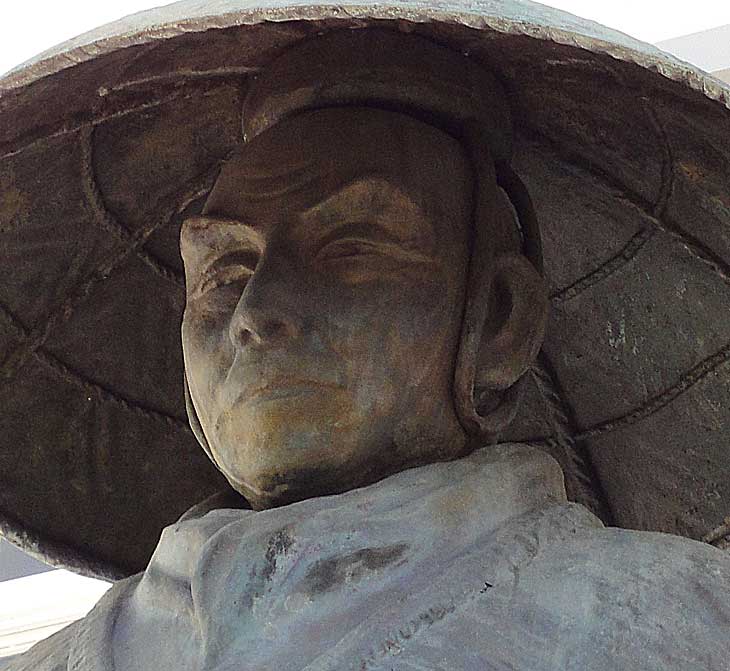
The New York Buddhist Church and its statue of Shinran Shonin
The New York Buddhist Church, 331 – 332 Riverside Drive, is a Japanese “True Pure Land” (Japanese Jodoshinshu) Buddhist temple, founded in 1938.
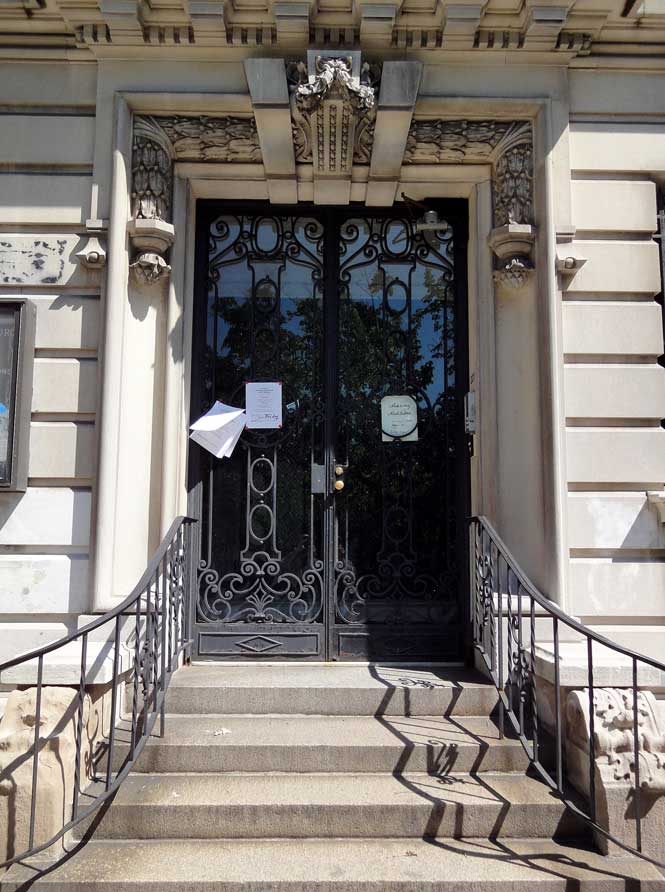
– photo by the Hermetic Hungarian
331 Riverside Drive, the main building, was formerly the Marion Davies House, built in 1902 in the Beaux Arts style by architects Janes & Leo. 332 Riverside Drive, the annex and social center, was built in 1963 in the then-popular International Style by architects Kelley & Gruzen.
Standing in front of the annex, looking out across the Hudson River, is a tall bronze statue of Shinran Shonin (1173 – 1262), the founder of the Japanese True Pure Land school. Statues like this one grace the entrances of Pure Land Buddhist temples worldwide. However, this particular statue was originally in Hiroshima and survived the atomic bomb.
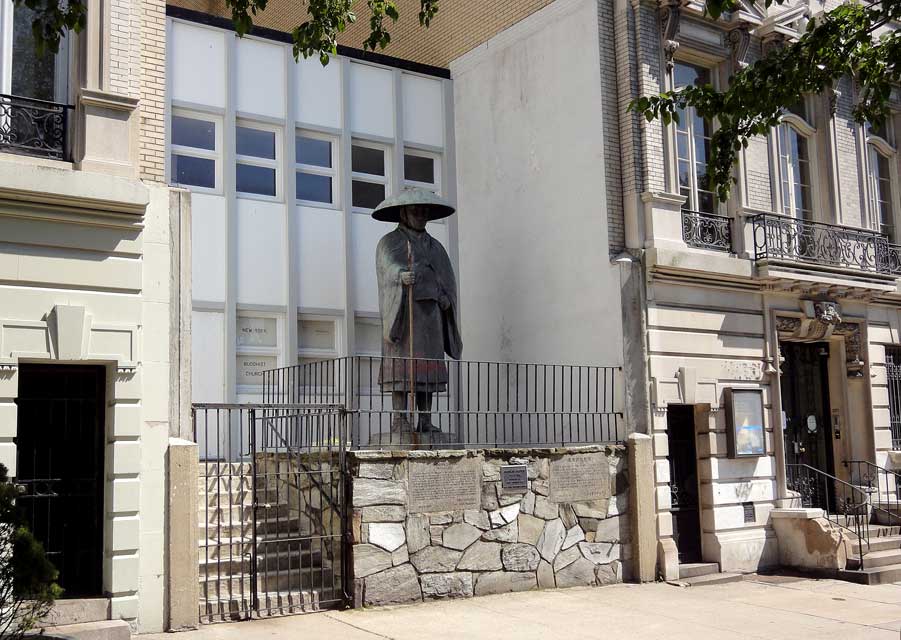
– photo by the Hermetic Hungarian
This statue originally stood about 8,000 feet from Hiroshima’s ground zero. It was one of the few cultural artifacts to survive the blast from that close distance. The statue was brought to the United States and installed in its its current location in 1955. Besides being a symbol of the founder of the Pure Land School, it is a reminder of both the terrible devastation wrought by atomic weapons and of fervent hopes for world peace.
Every August 5th at 7:15pm – corresponding to 8:15am August 6th, Hiroshima time — the temple bell is sounded, and the Buddhist and local communities gather around the statue, silently commemorating the Hiroshima bombing.
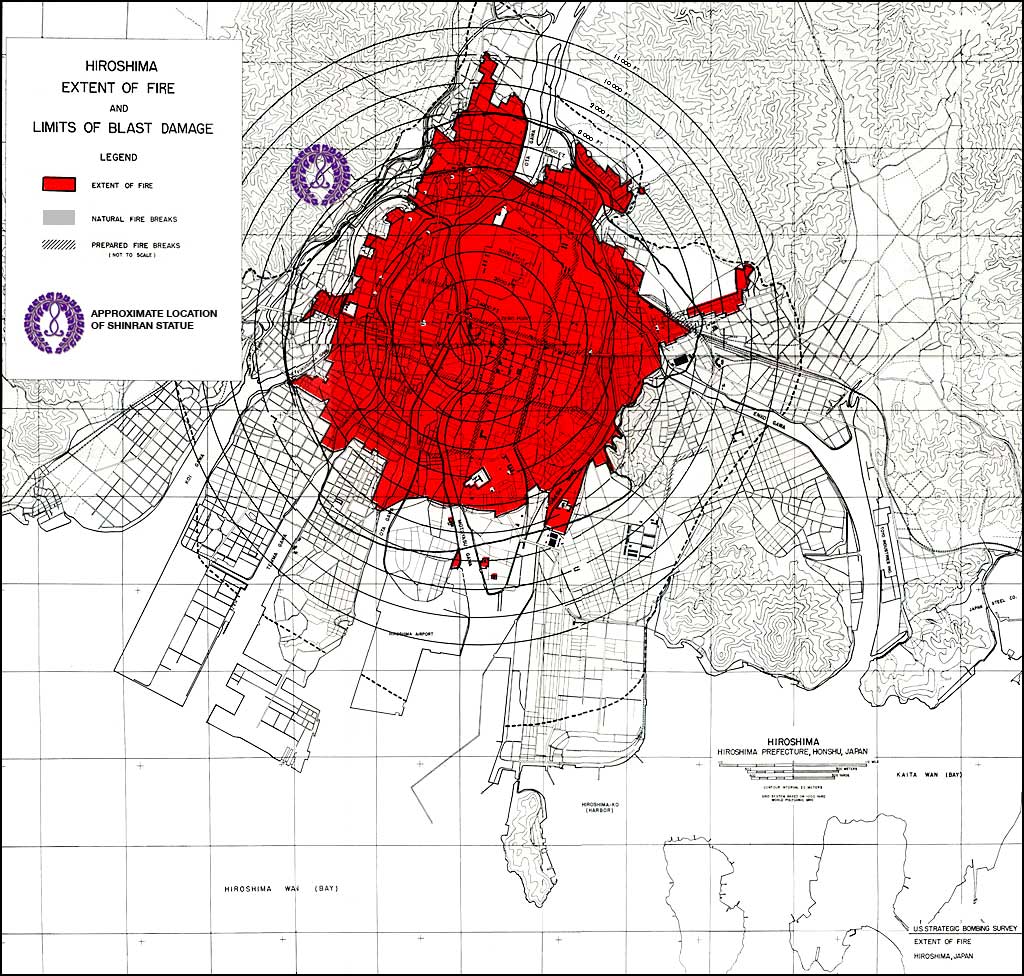
Shinran was born into a powerful Regent family in 1173. Shinran was inducted into the Imperial Court-sponsored Esoteric (Japanese Tendai ) Buddhist community. This esoteric school had been brought from China in the 8th century, and was a favorite among the nobility and educated classes. It was a complex, intellectual, esoteric, and demanding school which required difficult practices of its adherents. For 20 years Shinran tried without success to follow the practices. He became disillusioned, and wanted to leave the monastery to study a simpler Buddhism being taught in Kyoto.
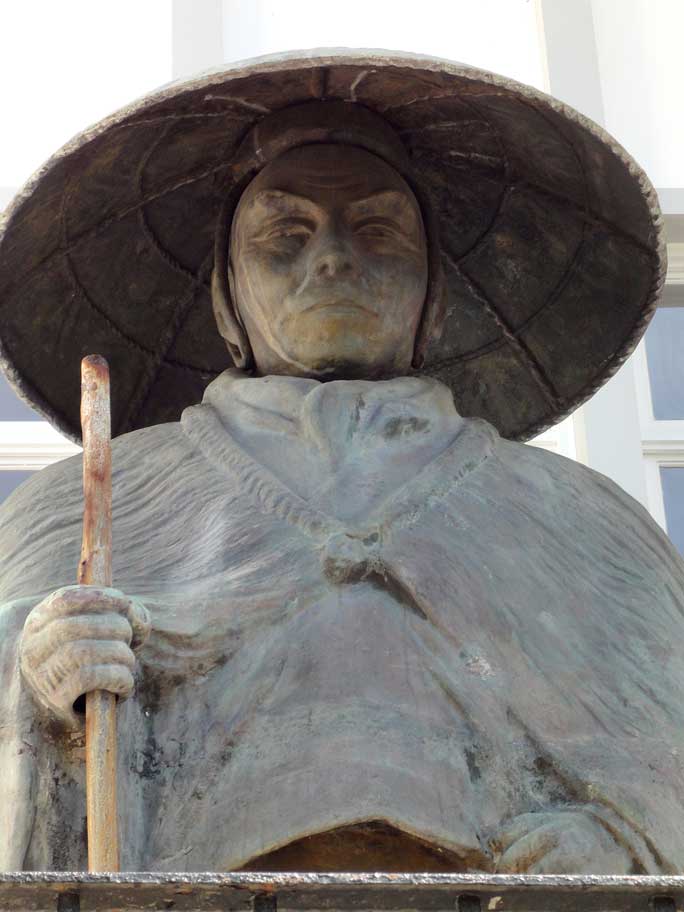
– photo by the Hermetic Hungarian
Because of his abandonment of the Court-supported school, Shinran was exiled to the provinces to live as a commoner, with farmers, merchants, fishermen, and artisans. Living away from the heady atmosphere of the monastery, Shinran soon realized that if he himself was unable to perform the difficult practices required by the Buddhist schools of the nobility, surely people with little education who were busy eking out a living from day to night had little chance of achieving enlightenment through the then-accepted means. He felt strongly that there must be another way – after all the Buddha’s original teaching was one of universal enlightenment.
Having studied with earlier teachers of Pure Land, Shinran was familiar with the teachings which detailed the Buddha Amida’s (Sanskrit Amitabha) vows not to become a fully enlightened Buddha until everyone who had relied upon him had become enlightened.
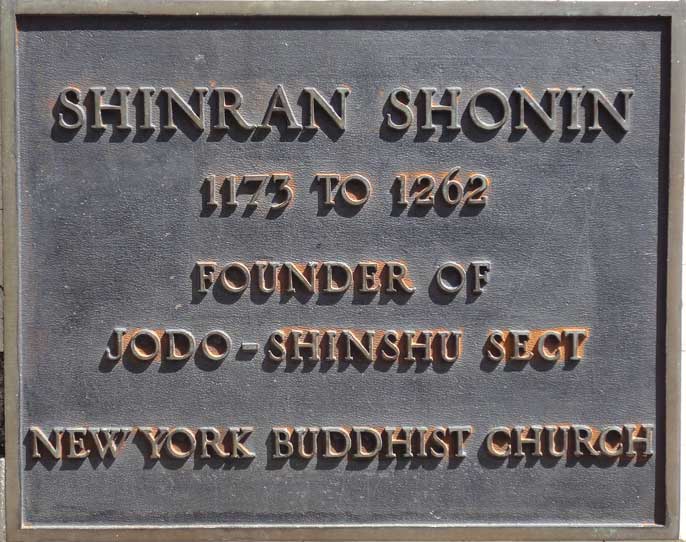
– photo by the Hermetic Hungarian
The primary practice of Pure Land Buddhists, whether Japanese, Chinese, Vietnamese, or Korean, is chanting the name of Amida Buddha. In Japanese the chant is “Namu Amida Butsu”, translated as “I humbly bow to Amida Buddha”.
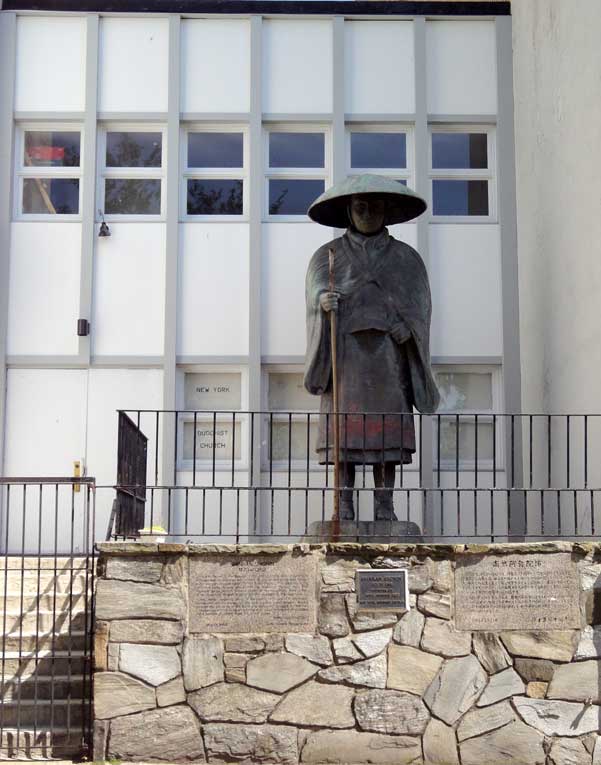
– photo by the Hermetic Hungarian
The external manifestation of this practice is that if one chants with sincerity and respect, asking for Amida Buddha’s help and guidance, then one will be reborn in the Pure Land in the West from which enlightenment is possible for ordinary people.
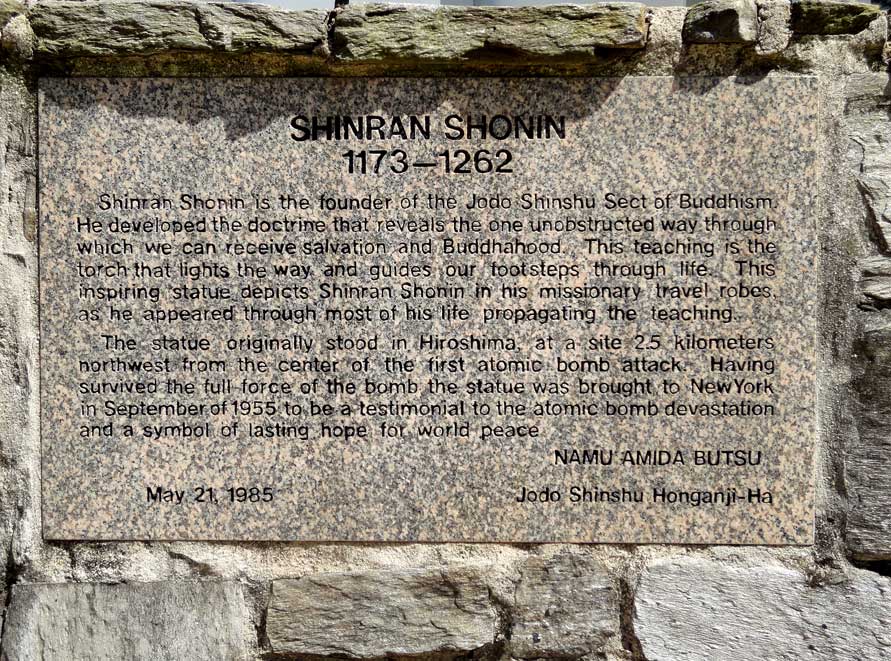
– photo by the Hermetic Hungarian
The corollary is that no matter how difficult and rigorous the practices undertaken in this life, it is almost impossible for ordinary people to transcend mundane existence. Pure Land practitioners place not just their faith but their hopes for eventual enlightenment in the hands of Amida Buddha.
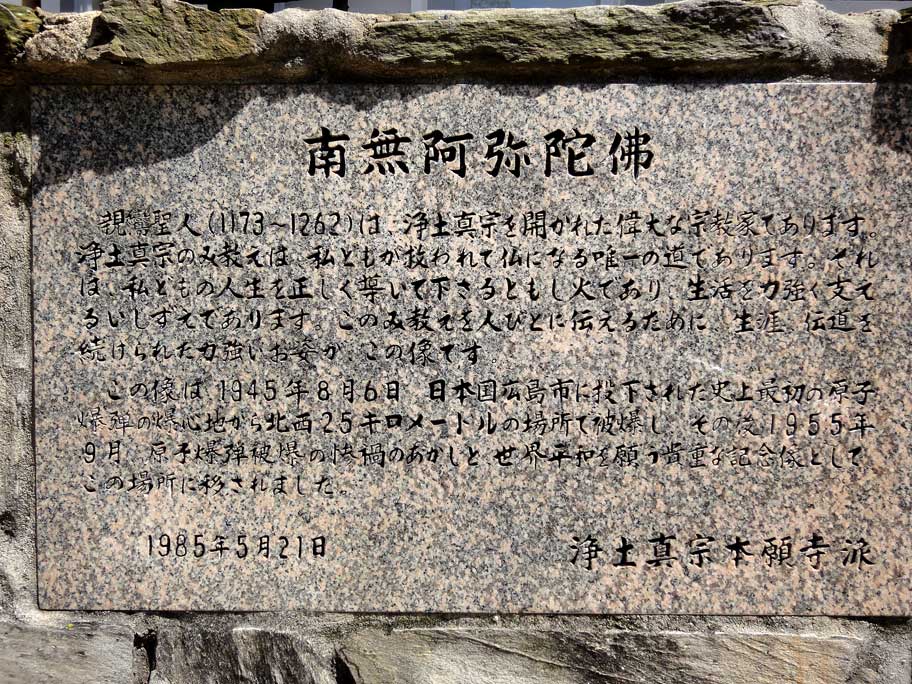
– photo by the Hermetic Hungarian
The internal manifestation of Pure Land practice is that chanting name of Amida Buddha helps practitioners realize that the Pure Land is here and now, within ourselves. Faith in Amida Buddha awakens a deep spirituality, gratitude, and humility in the practitioner. This in turn allows the practitioner to live in the Pure Land while living in the world. And the physical act of chanting slowly leads the practitioner to inner calmness and fosters insight into true reality.
– photo by the Hermetic Hungarian
Pure Land Buddhism has the largest number of adherents of any Buddhist school in the world. In Japan alone there are over 10,000 Pure Land temples. Throughout China and Vietnam there are an unknown number of Pure Land temples, due to historic governmental suppression of religion; however, Pure Land is the largest Buddhist school in both countries. Pure Land has also greatly influenced Korean and Tibetan Buddhist practices. Buddhist practice is heterogenous, and different schools adapt each others’ practices when appropriate.
The members of the New York Buddhist Church, and their leader Rev. T. Kenjitsu Nakagaki, serve the Japanese community of Manhattan with Sunday services, Japanese dharma classes, and special events. They also warmly welcome welcome anyone seeking to understand more about Pure Land, offering services, classes, and discussions in English, hoping to embrace the wider community. They have been enthusiastically welcoming anyone interested for the last 72 years.


 The Newtown Pentacle