Posts Tagged ‘New York City’
greater wildness
Vertigo, in today’s post.

– photo by Mitch Waxman
As mentioned a couple of weeks ago, one had attended a photo industry trade show at the Javitz Center. As this was the first time that circumstance had carried me to the newish Hudson Yards stop on the IRT Flushing line – conventionally referred to as the “7” – I decided to take a few minutes and record a few images.
There you go. Back to Manhattan. Sigh…
from wikipedia
The name “Manhattan” derives from the word Manna-hata, as written in the 1609 logbook of Robert Juet, an officer on Henry Hudson’s yacht Halve Maen (Half Moon). A 1610 map depicts the name as Manna-hata, twice, on both the west and east sides of the Mauritius River (later named the Hudson River). The word “Manhattan” has been translated as “island of many hills” from the Lenape language. The United States Postal Service prefers that mail addressed to Manhattan use “New York, NY” rather than “Manhattan, NY”.

– photo by Mitch Waxman
The thing that kept on striking me about visiting the new station was a sensation of vertigo. Normally, one is possessed of a sound and reliable bit of plumbing in the inner ear, but there was just something about the setup of the incredibly steep escalators which distinguish the new station that induced me to feel as if I was about to fall and tumble.
Given the sort of things I know about escalators, which are – functionally speaking – indistinguishable from industrial meat grinders, this was a real concern for one such as myself.
from wikipedia
Escalators, like moving walkways, are often powered by constant-speed alternating current motors[citation needed] and move at approximately 0.3–0.6 metres (1–2 ft) per second. The typical angle of inclination of an escalator to the horizontal floor level is 30 degrees with a standard rise up to about 18 metres (60 ft). Modern escalators have single-piece aluminum or stainless steel steps that move on a system of tracks in a continuous loop.

– photo by Mitch Waxman
Perhaps it’s the angle at which they’ve been set at. The Hudson Yards station platforms are found fairly deep in the ground, by NYC Subway standards. Comparable but still examples of the depth would be the 7’s Grand Central platform, or the 59th street and 3rd exit on the IND lines. Looking up rather than down, it felt a bit like the Smith/9th street stop on the F and G lines. Mr. Walsh from Forgotten-NY assures me that the deepest station in the system is in upper Manhattan, and I have few occasions to oppose his opinions so I’ll take his word on it, but Hudson Yards is deep.
from wikipedia
In January 2005, the New York City Council approved the rezoning of about 60 blocks from 28th to 43rd Streets, including the eastern portion of the West Side Yard. This did not include the western portion. In June 2005, the proposed West Side Stadium, to be built over the western portion for the New York City bid for the 2012 Summer Olympics, was defeated. Soon after, the Metropolitan Transportation Authority (MTA) thought of ways to redevelop the 26 acres (11 ha) yards. In conjunction with the government of New York City, the MTA issued a Request for Proposal (RFP) for 12,000,000 square feet (1,100,000 m2) of mixed-use space. The space was to be built on platforms over the rail yards, which would still be in use.

– photo by Mitch Waxman
There’s a mezzanine level where you’ll find the turnstiles, which is where the set of escalators in the shots above bring you. The mezzanine is fairly pleasing, design wise. There’s a whole bunch of arcing shapes moving against each other, tiled floors, and other “architect” looking features that are pretty pleasing to the eye. Or, to mine at least.
from wikipedia
The new construction, part of the city’s and the MTA’s master plan for the Far West Side, extended the IRT Flushing Line west from Times Square to Eleventh Avenue, then south to 34th Street. Although the West Side Stadium plan was rejected by city and state planning agencies, the 7 Subway Extension plan received approval to move ahead, as New York political leaders wanted to see the warehouse district west of Eighth Avenue and north of 34th Street redeveloped as part of the Hudson Yards Redevelopment Project, and subway service was to be an essential part of that effort. The extension also serves the Jacob K. Javits Convention Center, which was expanded in 2008–2014 and is located a block away from the station entrances.

– photo by Mitch Waxman
The big kahuna of the escalators, and the ones which caused me to begin to experience vertigo, are the ones which carry you down to the platforms themselves.
from wikipedia
Vertigo is when a person feels as if they or the objects around them are moving when they are not. Often it feels like a spinning or swaying movement. This may be associated with nausea, vomiting, sweating, or difficulties walking. It is typically worsened when the head is moved. Vertigo is the most common type of dizziness.

– photo by Mitch Waxman
The shot above is looking back up at where the previous photo was captured, and just the act of turning myself around forced my non camera arm to reflexively reach for some kind of support.
from wikipedia
The MTA completed excavation of a 150-foot (46 m) long cavern in June 2009. The cavern was dug below the bus entrance ramp to the lower level of the Port Authority Bus Terminal and formed part of the eastern end of the new extension and connected it to the Times Square station. At the same time, tunnels were being dug northward from the machine shaft at 26th Street; soft ground at 27th and 28th Street required 300 feet (91 m) of ground to be frozen so that the tunnel-boring machines could easily dig through the soil. On December 21, 2009, it was announced that a tunnel-boring machine broke through the 34th Street station cavern wall. Both tunnel-boring machines were scheduled to finish the required tunneling in the spring of 2010.

– photo by Mitch Waxman
I think it’s the “leading lines” which did it. There’s a real “THX 1138” vibe to this station, which seems to be part of a modern design aesthetic MTA is following. I’ve been to the Second Avenue Subway construction site and the new stations about to come on line are visually quite similar to the Hudson Yards stop.
from wikipedia
THX 1138 (pronounced “T-H-X Eleven Thirty-Eight”) is a 1971 science fiction film directed by George Lucas in his feature film directorial debut. The film was produced by Francis Ford Coppola and written by Lucas and Walter Murch. It stars Donald Pleasence and Robert Duvall and depicts a dystopian future in which the populace is controlled through android police officers and mandatory use of drugs that suppress emotion, including outlawed sexual desire.

– photo by Mitch Waxman
Down at the bottom, there’s another vaulted tunnel which terminates at yet another barrel vault, which is where the two tracks for the 7 train are found. This is a terminal stop, of course, so there must a turnaround track somewhere down there but I’ll be godamned if I knew where it was. Felt like like I was halfway to hell if truth be told. Dizzy, I got nervous, my chest grew tight, and it was oddly warm on the platform itself – given its depth.
Then again, Manhattan generally makes me experience both agita and angina, and often reminds me of hell.
from wikipedia
The main entrance, located at the southeast corner of the intersection of 34th Street and Hudson Boulevard, has a turtle shell-shaped glass canopy above it that allows light to shine on the upper mezzanine. The elevator is located south of 34th Street in Hudson Park, while the escalator entrance is located further east, closer to the boulevard. The ventilation building will be built over by developers at a future date. The second entrance, which will contain escalator entrances is at the southwest corner of 35th Street and Hudson Boulevard East. At both of the exits, the staircases and four escalators each go down 40 feet (12 m) to a fare control area, then another 80 feet (24 m) to the common lower mezzanine; the main entrance was completed by summer 2014, while the secondary entrance is still under construction and will be completed by 2016.
“follow” me on Twitter- @newtownpentacle
muffled conversation
There was quite a hullabaloo, here in Astoria.

– photo by Mitch Waxman
One received a text from a neighbor on the night of October 30th that there had been a vehicle collision involving the local gendarmes here in Astoria, so I grabbed the camera and headed down to take a look at what happened.
The NYPD unit involved was from the local precinct, the 114, and they had collided – at speed- with a civilian vehicle at the intersection of 45th street here on Broadway.

– photo by Mitch Waxman
Given that I’m a “yenta” and the whole neighborhood knows it, the neighbors began relating the story to me.
Apparently, the NYPD unit was in one of those big hurries that they periodically display, the kind when they don’t have their sirens or lights on. My understanding is that this is procedure when they’re trying to catch someone surreptitiously by sneaking up on them, or they’re enroute to assist another officer who is in a dicey situation.
Observationally, when Cops blow a light just cause they want to, they perform what could be best described as a rolling stop while doing so. They can also park pretty much anywhere they want to, and I see both as perks.

– photo by Mitch Waxman
One of the local Greeks informed me that he had witnessed the incident. The cops were moving through a red light at the corner of 45th street and Broadway at a considerable velocity when they contacted the front end of a sedan which was proceeding at speed through the green light. They tore the front end of the civilian car up, but neither car’s occupants were seriously hurt. That’s what the Greek guy said.

– photo by Mitch Waxman
That’s the bumper of the sedan, which was being operated by a fairly young guy who had two passengers with him. They were instructed to park around the corner, and seemed – to me at least – as quite anxious. On Broadway itself, there were multiple NYPD people investigating the event. There were ambulances, looking loo civilians like me, and the usual emergency crew that the City’s got.
Of course the three kids were anxious, how would you feel if you had just rammed a cop car?

– photo by Mitch Waxman
I ran into a couple of officers from the 114 a couple of days later (long story) and inquired as to the condition and health of their comrades. They informed that the two officers in the unit were fine, but had taken a couple of days off to recuperate nevertheless. No word on the three kids, however.
My personal belief is that all five participants in the accident probably had to go shopping for new underwear.
“follow” me on Twitter- @newtownpentacle
maximum diameter
Well, that sucks.

– photo by Mitch Waxman
One is dismayed at the results of yesterday’s election results, and I’m in fact struck dumb by them. I was hoping that the United States wouldn’t succumb to its baser instincts in this election, but I’ve been disappointed before. It always strikes me as odd that working class people across the country continually vote against their own interests – which is what a vote for either one of the major parties ultimately turns out to be.
Saying that, as I’ve opined several thousand times in the last year – the National level stuff is above my pay grade, and that the only thing we can really have any effect on are the local issues.

– photo by Mitch Waxman
I can offer you predictions – based on having lived through several rightist swings in the White House about what the next half decade holds. There will be war, and recession, an unregulated corporatist nirvana, and the very same rural and rust belt people who voted the new administration into power will be the ones most impoverished by its policies.
This is nothing new, of course, and it hasn’t been so since Marius and Sulla.

– photo by Mitch Waxman
The mistake made by the leftists in this election was in the choice of a technocrat candidate who seemed to be awaiting a popular voter enabled coronation to the Presidency – despite being remarkably unpopular. The national level party bosses repudiated, and destroyed, the chances of the populist wing in their own party structure in the name of ensuring this coronation. As the Book of Revelations says – you are neither hot nor cold, you are lukewarm, and I spit you out.
They ran a 20th century campaign in 2016, and lost.

– photo by Mitch Waxman
The rural/urban divide is something I’ve been talking about for a long time, incidentally. I’m of the belief that we are headed for a second Civil War in these United States, one that isn’t based around a North and South divide, but instead one that is based around whether you live in a City or a Town.
Cities are internationalist, towns nationalist.

– photo by Mitch Waxman
Beyond all of that, one is absolutely speechless and sort of terrified. Apoplectic is an appropriate word.

– photo by Mitch Waxman
Thing is, this election came out of NYC.
“follow” me on Twitter- @newtownpentacle
lustrous balustrade
A few odds and ends, in today’s post.

– photo by Mitch Waxman
An ex-Cat, this skeleton was observed in Long Island City up on the Montauk Cutoff tracks about a week ago. There were raccoon tracks surrounding it, which probably explains a lot about where the rest of the cat is. Pretty gross shot, I guess, but there’s a whole lot of existential reality all over LIC when you peek into its shadowed places.

– photo by Mitch Waxman
A renewal of my previously stated opinion that the 7 line is far and away the most photogenic of NYC’s subways is offered. A comparison to Michelle Pfeifer in the movie “Scarface” would be made, but it’s inappropriate.
– photo by Mitch Waxman
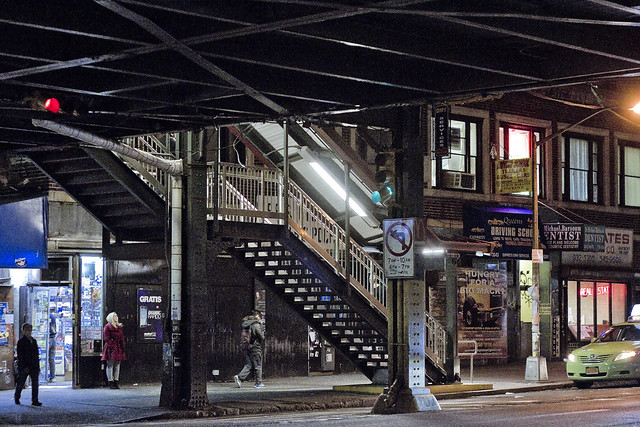
Finally, did you know that the “King of Shwarma and Falafel” food truck people have opened a brick and mortar storefront on Astoria’s Broadway at 31st street? Practically under the El? I do, which is why I was waiting for Our Lady of the Pentacle on that instersection recently, and I cracked out this noirish shot of the N/Q stairs to pass the time.
Mmm… Shwarma.
“follow” me on Twitter- @newtownpentacle
haggard and ghastly
Eldridge Street Synagogue, in today’s post.

– photo by Mitch Waxman
As mentioned in yesterday’s post, a humble narrator was invited to a “thank you” event for the Open House NY weekend site hosts (we produced a Newtown Creek Alliance event at the 520 Kingsland Avenue Green Roof this year). The event was set for six o’clock in what is now Manhattan’s Chinatown, at the 1887 vintage Eldridge Street Synagogue, a 19th century institution which had fallen into disrepair during the middle 20th century, but which has been restored and converted over for use as a museum.
from eldridgestreet.org
The Eldridge Street Synagogue opened its doors at 12 Eldridge Street on September 4, 1887, just in time for the Jewish High Holidays. Hundreds of newly arrived immigrants from Russia and Poland gathered here to pray, socialize and build a community. It was the first time in America that Jews of Eastern Europe had built a synagogue from the ground up.
Dozens of Stars of David decorate the Eldridge Street Synagogue’s façade. Here in America, Jews could worship openly and freely. The synagogue was a proud declaration of newly- found religious freedom for the synagogue’s immigrant founders. The synagogue was also emblematic of their economic aspirations. With its soaring 50-foot ceiling and exuberant Moorish-style interior, Eldridge Street provided an inspiring contrast to the crowded tenements, factories and shops of the Lower East Side.
For fifty years, the synagogue flourished. Men and women came in their finery, and mounted policemen patrolled the crowds. The congregation hired world-renowned cantors and in 1918 hired Rabbi Aharon Yudelovitch, the first in a series of famed Talmudists and speakers. Thousands participated in religious services in the building’s heyday, from its opening through the 1920s.

– photo by Mitch Waxman
One such as myself enjoys being in the company of other historically minded folks, it should be mentioned, but I’ve always found the people I meet at these sort of gatherings to be somewhat stuffy types who take themselves quite seriously, and that my particular and inescapable sense of humor is neither appreciated nor expected by them. Accordingly, a minimal amount of time is devoted to “socializing” with the “Manhattan people.”
Instead, I wander around and take photos.
also from eldridgestreet.org
“It was as though the synagogue was held up by strings from heaven,” said Roberta Brandes Gratz, founder of the Museum at Eldridge Street, of her first impression of the synagogue in the early 1980s. Pigeons roosted in the balconies and benches were covered with dust. Gratz and others rallied to save the building. They formed the non-sectarian Eldridge Street Project, pre-cursor to the Museum at Eldridge Street. The synagogue was designated a National Historic Landmark in 1996 and more than $20 million was raised to restore it to its original grandeur.
The Museum completed the Eldridge Street Synagogue restoration in December 2007, the synagogue’s 120th anniversary. The restoration received nearly every major preservation honor, including the prestigious National Trust for Historic Preservation 2008 Preservation Award. The crowning piece of the Museum’s restoration is a magnificent new stained-glass window by artist Kiki Smith and architect Deborah Gans.
Today the Eldridge Street Synagogue is home to the Museum at Eldridge Street, which welcomes people from around the world for tours, school programs, concerts, lectures, festivals and other cultural events. The building also continues to be home to Kahal Adath Jeshurun. This small Orthodox congregation has never missed a Saturday or holiday service in the more than 120 years since the synagogue first opened.

– photo by Mitch Waxman
The overall architectural impression received from visiting the Eldridge Street Synagogue was that a significant Moorish and or Galician influence was evident in its design. I’ve seen ruins of synagogues in Southern Europe, built during the days of the Ottomans, which this structure reminded me of – but nothing of the size nor as ornate as the one on Eldridge Street. That’s America for you, I guess.
from wikipedia
The Eldridge Street Synagogue is one of the first synagogues erected in the United States by Eastern European Jews (Ashkenazis). One of the founders was Rabbi Eliahu the Blessed (Borok), formerly the Head Rabbi of St. Petersburg, Russia. It opened at 12 Eldridge Street in New York’s Lower East Side in 1887 serving Congregation Kahal Adath Jeshurun. The building was designed by the architects Peter and Francis William Herter, (but unrelated to the Herter Brothers cabinet-makers). The brothers subsequently received many commissions in the Lower East Side and incorporated elements from the synagogue, such as the stars of David, in their buildings, mainly tenements. When completed, the synagogue was reviewed in the local press. Writers marveled at the imposing Moorish Revival building, with its 70-foot-high vaulted ceiling, magnificent stained-glass rose windows, elaborate brass fixtures and hand-stenciled walls.

– photo by Mitch Waxman
The Star of David is everywhere you look on the front of the building, an elder sign meant to act as both a ward and an announcement that “we are here.” Chatting with one of my cousins about this location afterwards, I kept on coming back to the sort of “Sheols” which the Waxman clan frequented in Brooklyn. There are three forms of modern Judaism in the United States – Reformed, Conservative, and Orthodox. I grew up in the former variant, and our ritual centers could best be analogized to Christian churches as being plain and unadorned in the manner of Lutheran or Presbyrterian temples. Eldridge Street was an Orthodox center, and they liked to pour it on in the sort of manner for which the Roman Catholic and Greek Orthodox churches are known for. The modern day Orthodox are fundamentalists, and eschew this sort of “glitz.”
from nytimes.com
By 1910, according to the historian Hasia R. Diner, the neighborhood contained half a million Jews; by contrast, Vienna, one of the largest Jewish centers in Europe, had a Jewish population of 175,000, and Chicago, about 100,000. This neighborhood had one of the largest Jewish populations of any city in the world — and surely one of the poorest. Most of the area’s 60-some synagogues were humble gathering places named after the Eastern European towns and shtetls from which their worshipers had fled, resembling the social clubs that develop among many immigrant communities.

– photo by Mitch Waxman
If you know anything about Jewish mysticism, which the Orthodox are well known practitioners of, you’ll spot instances of Kabbalist motif all over Eldridge Street. The Sephiroth and other occult concepts are omnipresent, and really seem to be governing the designs laid down by architects Peter and Francis William Herter.
from njit.edu
This synagogue was built in part to assert the importance of this Orthodox congregation in opposition to the more liberal German Jewish population which bad preceded them. The feeling was that German Jews had become to Americanized and assimilated and had, therefore, given up many of their traditional Jewish practices in favor of the more liberal reform movement. The construction of Eldridge Street Synagogue was a statement on the part of its congregation that one does not need to abandon strict Judaism to su~ in America. The opulence and ornament of the synagogue compare to German Jewish/Reform synagogues of the same period. The architect of the building was the German firm of Herter Brothers, which went on to build numerous Lower East Side tenement buildings. This was not the first synagogue for this congregation, which was housed in earlier buildings prior to raising the capital for the construction of their own building.
Eldridge Street Synagogue is located on the block bounded by Eldridge Street on the west, Canal Street on the north, Allen Street on the east and Division Street on the south. The immediate neighborhood is a sheltered enclave, set off from the surrounding bustle in part by the Manhattan Bridge, which sits just above it. The building fills most of its lot, which is approximately 60 feet wide by 87 feet deep, but is set apart from its neighbors by narrow areaways. This block is part of the densely packed Lower East Side which is a neighborhood known for role as a point of first contact for immigrants throughout the last two centuries, a role that continues to this day.

– photo by Mitch Waxman
Eldridge Street, btw, is named for a soldier named Lieutenant Joseph C. Eldridge of the 13th U.S. Infantry, who died during the war of 1812. Eldridge was butchered by the Ottawa, in a fashion horrific enough that the British actually petitioned that American prisoners taken by the Ottawa be rendered to the King’s army in exchange for a substantial bounty. Chief Blackbird told the British that money meant nothing to his people, and refused.
from warof1812chronicles.blogspot.com
One of the essays in “THE WAR OF 1812: Writings from America’s Second War of Independence” told of “The Death Of Joseph C. Eldridge…,” a lieutenant with the 13th U.S. Infantry, who was ambushed by Chief Blackbird and other Ottawa warriors. The Ottawas, from Michigan, “joined the British army during the siege of Fort George,” and that is the vicinity where was killed. An investigation conducted by Colonel William Claus, of Canada’s Indian Department, ensued at the request of the Fort George commander after it was reported that Eldridge was tortured and killed in captivity.

– photo by Mitch Waxman
The second floor of Eldridge Street Synagogue is where the ladies would have been seated, but since it’s a museum now, I was allowed to go up there and get my shots. That’s a Bimah, in the shot above, incidentally.
from nyc-architecture.com
READER’S PLATFORM (Bimah) — The table upon which the Torah scroll is read. The location, in the center of the sanctuary, follows the older European tradition. The central location is to insure that all can hear the reading of the Torah, and refers to the location of the sacrificial altar in the Temple in Jerusalem. In many American synagogues the bimah is placed in the front of the congregation near the Ark. In Sephardic synagogues the bimah is generally located in the rear.

– photo by Mitch Waxman
Unfortunately, I didn’t bring my tripod with me on this excursion, but I did find a couple of spots where I could rest the camera for a minute. This allowed me to drop the ISO down to 100, and narrow the aperture for a greater depth of field and infinity focus. Next time I come back to Eldridge Street, I’m bringing the tripod.
“follow” me on Twitter- @newtownpentacle


