Posts Tagged ‘newtown creek’
central chamber

– photo by Mitch Waxman
Recently, while out on the Newtown Creek on a Newtown Creek Alliance mission, the inestimable Executive Director of the group – Kate Zidar- gestured toward a certain structure on the Queens side and asked me what I knew about it. My mandate in the organization is to act as historian, as well as photographer, and the building in question is known to modernity as the “Lukoil Getty Terminal”. It’s waterfront is categorized by Dock Code 616, a 300 foot frontage, and it sits in plain view of the Greenpoint Avenue Bridge.
To me, it will always be referred to as Tidewater.
from wikipedia
Tidewater Oil Company (also rendered as Tide Water Oil Company) was a major petroleum refining and marketing concern in the United States for more than 80 years. Tidewater was best known for its Flying A–branded products and gas stations, and for Veedol motor oil, which was known throughout the world.
Tidewater was founded in New York City in 1887. The company entered the gasoline market just before World War I, and by 1920 was selling gasoline, oil and other products on the East Coast under its Tydol brand. In 1931, Tidewater expanded its reach into the midwestern U.S. by purchasing Northwestern Oil Company of Superior, Wisconsin.
Soon thereafter, Standard Oil Company of New Jersey (now ExxonMobil) gained control of Tidewater, and set up the subsidiary Mission Corporation to operate it. J. Paul Getty’s purchase of Mission in 1937 set the stage for the birth of Tidewater as a major national player in the oil industry.
In 1938, Getty merged Tidewater with Associated Oil Company, based in San Francisco with a market area limited to the Far West. Associated, founded in 1901, had created the prominent Flying A brand for its premium-grade gasoline in 1932.
With the merger and creation of Tidewater Associated Oil Company, Flying A became the primary brand name for the company, though the Tydol and Associated names were also retained in their respective marketing areas. Tydol During the 1950s, the Associated and Tydol brands gradually fell into disuse, and were dropped entirely in 1956. That same year, “Associated” was removed from the corporate name. The Veedol trademark was retained for motor oils and lubricants. BP acquired the Veedol brand when it bought Burmah-Castrol (who then owned the Veedol brand). In February 2011 announced that they wished to sell the Veedol Brand. Tidewater operated refineries on both the Atlantic and Pacific coasts, as well as a small fleet of West Coast-based tankers.

– photo by Mitch Waxman
In the early years of the American Oil industry, it seems, there were literally hundreds of small players who drilled or refined petroleum. A behemoth which emerged from the crowded field, that would dominate the sector in one way or another to this very day, was John D Rockefeller’s Standard Oil. Standard controlled the means of delivery, whether it be defacto control of the rail lines leading from oil rich regions (which were in Pennsylvania, back then) to refinery, or through ownership of the local pipelines which supplied their refined product to end use customers.
This allowed Standard to fix prices at a certain level, manipulate supply and demand in its own favor, or to keep competitors from getting their goods to market.
from 1919’s “Platts power, Volume 50“. courtesy google books
N.Y., Long Island City – The Tidewater Oil Co., 11 Broadway New York City, awarded the contract for the construction of a 2 story 30 x 140 ft warehouse on Greenpoint Ave and Newtown Creek, to H.D. Best, 949 Broadway, New York City. A steam heating system will be installed in same

– photo by Mitch Waxman
Unfair and underhanded, the Standard Trust went out of its way to destroy or stifle its competition and before long it controlled 90-95% of the oil business in the United States. Competitors came along as the years passed, most of which fell before the attentions of the Rockefellers. Some, like Charles Pratt, sold their operations to Standard and joined with it. Others were driven into bankruptcy. Technological advances and invention offered an opportunity to bypass the rail system dominated by the trust, and the dream of a pipeline which would feed oil to the independent refineries on the Atlantic coast of the United States became feasible.
The company that crystallized this challenge to Standard was the Tidewater Oil Company.
from 1889’s “Stoddart’s Encyclopaedia Americana: a dictionary of arts, sciences, and general literature“, courtesy google books

– photo by Mitch Waxman
For many years, Rockefeller and his Standard men (with their armies of bought and paid for politicians and local officials) ridiculed and fought against the pipeline company, but when his independent competitors banded together under the Tidewater brand in the 1870’s – he knew that Standard must innovate. In one of the first business moves of its kind, Standard began purchasing common stock in Tidewater, and by 1883 controlled a majority share in it.
Rather than using the well honed “breaking” techniques of industrial monopoly on the rival company, Rockefeller simply purchased his competition.
from “Harper’s magazine, Volume 72“, courtesy google books
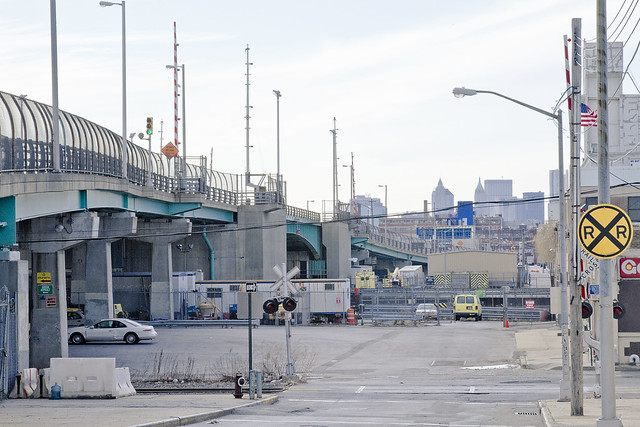
– photo by Mitch Waxman
As an aside, it should be noted that the path Greenpoint Avenue takes, in modernity, as it crosses the Newtown Creek is slightly eastward of its ancient footprint. The modern bridge, which replaced an older swing bridge that carried LIRR and light rail tracks as well as vehicles, actually pulls traffic away from the ancestral road. In the early 20th century LUNA image linked to below, which is the inverse of my recent shot above, notice that only the bridge and rail tracks are still in place.
The Tidewater building would be to the left in the historic shot below.

X

– photo by Mitch Waxman
A recommended primer for anyone interested in the story of the early American Oil industry is “The History of the Standard Oil Company, By Ida Minerva Tarbell“, an admittedly biased and muckraking account told by the daughter of an oil pioneer whose business was wiped out by the Standard Trust. Tarbell disliked the term muckraker, and considering that she was a pioneering female journalist and investigative reporter in an age not exactly known for either- let’s just respect her wishes.
from “The History of the Standard Oil Company, Volume 2 By Ida Minerva Tarbell” courtesy google books

– photo by Mitch Waxman
Like most who opposed Rockefeller, who would die as the richest man in human history (in fact, adjusting for inflation- Rockefeller died richer than Augustus of Rome, and all the Pharoahs of Egypt, and all the kings of England- put together) Tidewater ended up a footnote, and being used as an instrument by which Standard could further dominate the competition.
Standard was broken up by the actions of the federal government in the early 20th century, shattered into several smaller corporations. Standard Oil Company of NY (SOCONY) was one of these, and it would become Mobil. Standard Oil Company of NJ (SOCONJ) would become Exxon.
Rockefeller’s bank account would one day attain sentience and become Chase Manhattan bank.
from wikipedia
In 1904, Standard controlled 91% of production and 85% of final sales. Most of its output was kerosene, of which 55% was exported around the world. After 1900 it did not try to force competitors out of business by underpricing them. The federal Commissioner of Corporations studied Standard’s operations from the period of 1904 to 1906 and concluded that “beyond question… the dominant position of the Standard Oil Company in the refining industry was due to unfair practices—to abuse of the control of pipe-lines, to railroad discriminations, and to unfair methods of competition in the sale of the refined petroleum products”.
effective radius

– photo by Mitch Waxman
A lesser sabbat on the great wheel of the year, at 10:49 this morning, New York City will pass through the fall equinox. Today, the day and night will oppose each other equally, and from now until March, darkness will rule as relative to light. Summer ends, and the harvest time is visited upon all that walk beneath the ever fainter emanations of the burning thermonuclear eye of god itself.

– photo by Mitch Waxman
Before long will we all be sitting before tables of bounty, gazing upon roasted meats and other oven baked fare. Just the other night, a filthy black raincoat was removed from its summer hook, and a humble narrator again filled it. Chill is the night, which grows ever longer. Soon shall we all feast, and learn new ways to laugh and revel and enjoy ourselves, as we give our so called “thanks”.

– photo by Mitch Waxman
Nepenthe is found in this season, as we slouch roughly toward Samhain and the Yule, as it’s the time of tales told. Stories of goblins and werecats, ghosts and ghasts, and the hidden world of the occultist will soon be readily revealed. On the wheel of the year, this is the start of the spooky time- when farmers fields become the property of crows and ravens, and odd occurrences abound- during the endless nights.
something luminous

– photo by Mitch Waxman
Whittling away the remaining days allowed me to scuttle across the mortal coil, recent adventures have taken me to odd places. Last weekend, a humble narrator found himself in a canoe upon the fabled Newtown Creek, participating in a Newtown Creek Alliance survey of avian inhabitants of the waterway. This trip was facilitated via the equipment and skill of the mariners found at the North Brooklyn Boat Club. Discussion of this trip, and those things which we observed, will be explored in future postings as this- your Newtown Pentacle.

– photo by Mitch Waxman
Additionally, revelations of upcoming walking tours and other excursions I will be leading in October and beyond are coming in the next week. A flurry of such endeavors in prior months had laid one low, as to be seen by so many diminishes me. A vow offered to you, lords and ladies, is to return to historical exploration and description in the coming weeks. I’ve tales to tell, which have been sitting on the back burner for months, due to a lack of time to cogently describe and detail.
Suffice to say that we have only scratched the lipid coated surface of the Creek to this point, and we shall be diving deeper into its languid depths in the near future.

– photo by Mitch Waxman
There are several opportunities for enjoyment and exploration at hand, including the Field Trip day in Greenpoint on September 29th.
Queens Borough Historian Jack Eichenbaum will be conducting a Newtown Creek walking tour next week which I am looking forward to attending, also on September 29th.
Additionally, Newtown Creek Alliance has several events (not necessarily “Mitchcentric) and a meeting- at the Onderdonk House on September 27 in Ridgewood- upcoming, which have just been announced. These events include an October 7th boat tour which will be part of the Open House NY Weekend.
This is the end of the summer, officially, as tomorrow we enter into the equinox and the autumn season officially begins. Grateful thanks are offered to all the better than 600 people who have shared my summer- attending the multitudinous walking, bus, and boat tours which I’ve been involved with.
Also, a shout out on the efforts and exertions of the vernal period goes out to the long suffering “Our Lady of the Pentacle” and her infinite patience, and to my “aide de camp” and first officer Mai Armstrong.
something alarming

– photo by Mitch Waxman
Another one of the little mottoes which one such as myself offers “it’s not good, it’s not bad, it just is”. Time spent wandering around the vast human hive, with it’s teeming multitudes and aspirants, has taught me that it makes little sense to adjudicate the values of others. That being said, whilst on a pastoral stroll across the rolling landscape of Calvary Cemetery, your humble narrator found himself in Section Five.

– photo by Mitch Waxman
This is the shot I was seeking, the ennobled Kosciuszko Bridge, as seen from the vantage of Review Avenue and Laurel Hill Blvd. and from atop the high walls of Calvary. Coming to this spot, one noticed something odd- out of place- nearby.

– photo by Mitch Waxman
Upon the ground was some sort of fruiting vine, set behind a small line of high grass and small shrubs.

– photo by Mitch Waxman
Struck by the ideation that some accidental seeding might have taken place, unnoticed by the grounds crew, I looked around a bit.

– photo by Mitch Waxman
That’s when I discovered that somebody had planted a little garden, here in an ancient cemetery.

– photo by Mitch Waxman
Nearby, there were grapes growing as well.

– photo by Mitch Waxman
It’s not good, it’s not bad, it just is. It’s also the sort of thing which really makes one question his own sanity, and thank all that’s holy that I’m able to photograph this as it is exactly the sort of story no one would believe. Tangential thoughts occur- speculations on the morbid nutrition enjoyed by these plants, suppositions about the water table they drink from (which is VERY much Newtown Creek), and other pleasant notions torment and tantalize. It’s not good, it’s not bad, it just is. It’s not good, it’s not bad, it just is. It’s not good, it’s not bad, it just is…
something singular

– photo by Mitch Waxman
The good news is that the fragmented vernal season wherein required sleep was denied a humble narrator has ended, and one can reliably pass into unconsciousness again. The bad news is that the hallucinations which tear through my mind during these biologically mandated times reveal bizarre and disturbing psychological concerns. Likely, this is all due to the upcoming equinox and accordingly one must go to where one belongs to sort such matters out. All roads, after all, lead to Calvary…

– photo by Mitch Waxman
The great working of Dagger John, scratched into the Newtown soil in 1848, First Calvary (as it is known) is the polyandrion of the Roman Catholic Church of New York City. Millions are interred here, princes and paupers, governors and gangsters. Upon entering the gates of the 365 acre property adjoining the Newtown Creek, one shortly realizes that the ephemeral analogies of the spiritual world are a tangible reality in this place. Encountered recently, one of the lagomorphs known to inhabit this section, representative of a population of groundling burrowers.

– photo by Mitch Waxman
The burrowers, according to aboriginal mythologies, carry messages between the bright world of the surface and the fuligin grottoes of the subterrene. Prey animals, the Lagomorpha fear all things- experience has taught them of the brutal indignities of the canine, stealth and pursuit of the feline, and the overarching horror of the high flying raptors. Vulnerable on the surface, and revealed beneath the burning thermonuclear eye of god itself, the burrowers normally bolt when one nears.

– photo by Mitch Waxman
What message the lagomorphs reveal to those who consult them is not to be shared, as it emanates from a place where no light shines. As above, so below- the saying goes, and one who walks in the middle does not wish to anger or prejudice either. As far as the odd dreams and premonitions which occur to a humble narrator during those hated intervals of unconsciousness- nothing transmitted by the red eyed messenger seemed to pertain to current fantasies. Instead, dire warnings of an uncertain future and intimations of seasonal horror were hinted at. More to come on these topics, as we pass through the autumnal equinox, at this- your Newtown Pentacle.


