Posts Tagged ‘newtown creek’
reticence shown

– photo by Mitch Waxman
I fear that I’ve become quite focused on Calvary Cemetery again. Recent caches of primary sources have been discovered which have all but confirmed certain hypothetical precepts, and illumined certain unimagined parameters to my studies. As yellowed maps and time blasted books have passed before my startled eyes, dawning realizations about the structure which underlies the place torment my curiosity.
Allow me to explain…

– photo by Mitch Waxman
Newtown Creek guy, that’s me- part of the history crowd from Queens- harmless.
The history part is what I’m interested in, and everything I’ve read or witnessed around the Newtown Creek indicates that while First Calvary Cemetery was incorporated in 1848- when the first recorded interment took place (more on that in a later post)– an interval of roughly 5-10 years preceded the beginning of an era which saw as many as 20 funerals conducted during a single day. Immigration patterns can explain this, of course, but the primary sources which have been consulted describe something else.

– photo by Mitch Waxman
It’s the sewers.
Two interesting leads have presented themselves, the first having led to:
The Rosary Magazine, in a report from 1908, via Google Books, offers this snippet:
On November 11, Archbishop Farley of New York dedicated a new mortuary chapel which was recently erected under the title of St. Callistus in Calvary Cemetery, Long Island. The Mass on the occasion was sung by Mgr. Lavelle and the sermon preached by Mgr. Mooney. The new structure will serve the double purpose of chapel and mausoleum. Below the chapel floor there is a crypt containing one hundred and fourteen vaults, in which hereafter will be buried the priests of the New York Archdiocese. The idea of such a building was first conceived by Archbishop Farley some four years ago. The structure is quite an imposing one, built of granite and Saracenic in its style of architecture. It is ninety-six feet long and sixty-four feet wide. The auditorium will accommodate two hundred and fifty persons. Surmounting the dome is a fine figure of the risen Christ, designed by Miss Melro Beatrice Wilson. When finished the total cost of the building will approximate $200,000. The building was designed by Raymond F. Almirall.
Here’s the cutaway architect drawing, courtesy again- Google Books:
Long time readers will remember that the Chapel has been previously profiled at this- your Newtown Pentacle- in the post “scenes familiar, and loved“.

– photo by Mitch Waxman
The catacombs beneath the Calvary Cemetery Chapel are fairly old news to long time readers, but… back to those sewers.
The second interesting nugget that I’ve turned up recently is (other than fascinating references to an excommunicated and controversial 19th century Catholic priest named McGlynn) that there seems to have been a legal issue settled by the State of New York which involved the removal of tens of thousands of tons of Calvary topsoil, and it’s eventual disposition on Catholic owned farms in Jamaica which aroused and infuriated the largely Protestant agricultural community of Newtown. This topsoil was removed “during the building of Calvary Cemetery, with its modern sewerage system”.
The building…

– photo by Mitch Waxman
I haven’t screwed the lid down on this one yet, so I’m not sharing links on this, but- the various sources I’m working on have opened up the reality that the hill of Laurels is in fact engineered ground. Discussions of enormous underground culverts and diversion channels for water, titan work forces, and a decade long struggle to turn the marshy waste land around the Newtown Creek into the well drained and immaculately landscaped structure we know today have consumed me- and driven Our Lady of the Pentacle to near madness.
Who can guess, all there is, that might be buried down there?
nemesis bearing

– photo by Mitch Waxman
If only a tugboat was passing by…
The BW shot presented below was shot in 1921, and pictures the Phelps Dodge site which was still Nichols’ General Chemical at the time of the photo.
The color shot above was shot last Friday at Meeker Avenue in Greenpoint, standing on the concrete bulkhead of the long gone Penny Bridge.
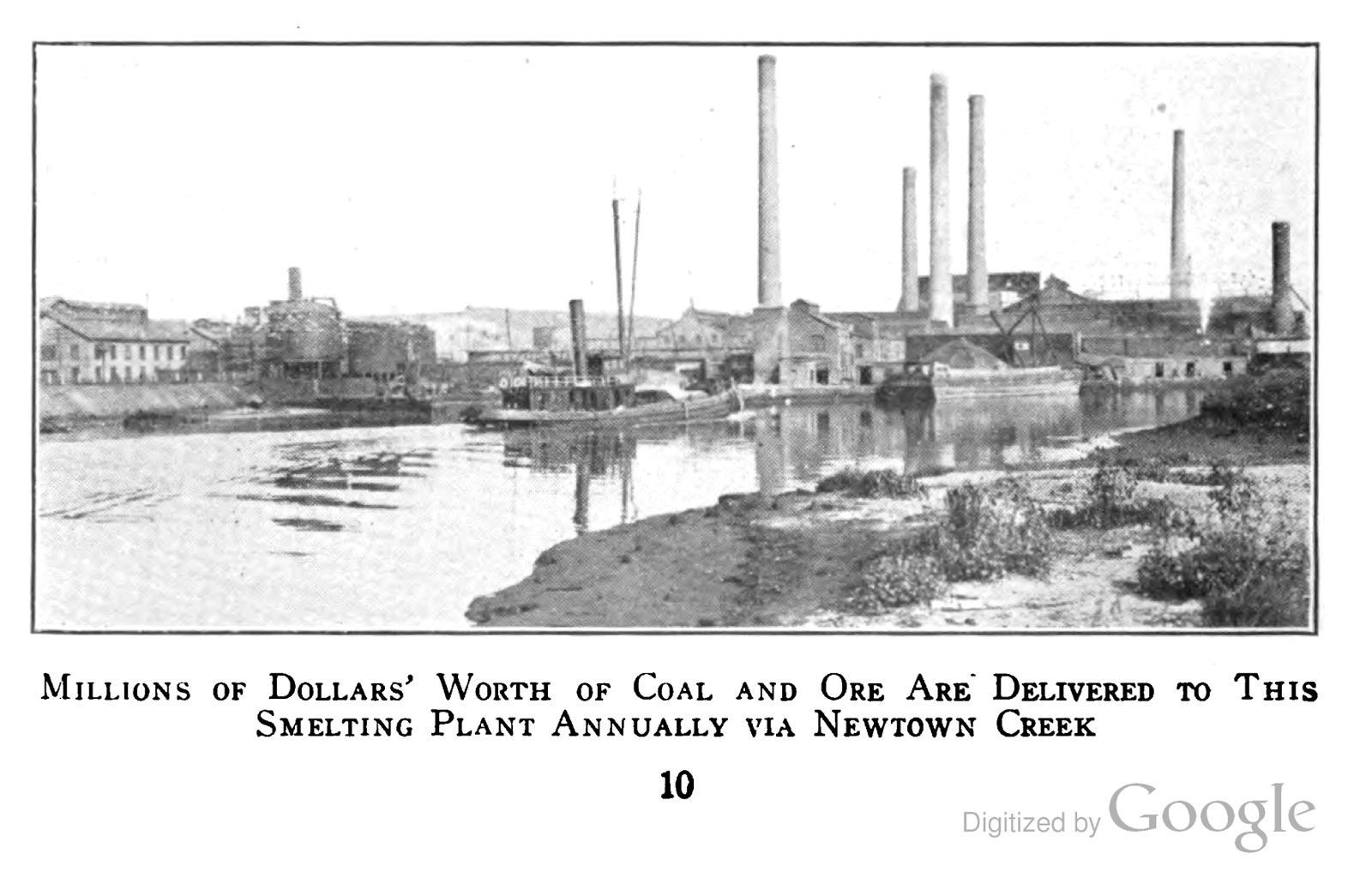
– photo from The Newtown Creek industrial district of New York City By Merchants’ Association of New York. Industrial Bureau, 1921, courtesy Google Books
from queenslibrary.org
1901 On the plant grounds, General Chemical erected the tallest chimney in the United States to blow the smoke and gases from its furnace away from the neighborhood. For the past number of years neighbor surrounding the plant complained vociferously about the pollution from the factory. Only after a study found that nitric, muriatic, and sulphuric acids from the plant were destroying local cemeteries’ tombstones did the company try and alleviate the problem by building the chimney. This same year the company filed plans with the New York City’s Department of Buildings in Queens to build another 150 foot chimney, an ore breaker, a storage tank, a boiler house, and a stable.
1903 A fire, started in a building used to manufacture sulphite of copper, destroys this building and two others causing $250,000 worth of damage, to this date it was the most costly fire in Newtown.
1904 For $42,500 the company purchased from Alice H. Stebbins a major tract of land whose border was 200 feet on Locust Avenue (now 44th Street), 725 feet on River Avenue (47th Street if it extended to Newtown Creek), 825 feet on Clinton Avenue (now 56th Road), and 195 feet on Newtown Creek. That same year for $25,000 they purchased another tract from Alice H. Stebbins, Mary S. Dodge, Mary J. and William J. Schiefflin, and Eleanor J. Taft whose border was 828 feet on Clifton Avenue (46th Street if it extended to Newtown Creek), 200 feet on South Avenue (a street that was on the south side of the South Side Rail Road tracks), 755 feet on River Avenue (47th Street if it extended to Newtown Creek) and 195 feet on Newtown Creek.
1912 Another major fire occurred at the plant causing $100,000 worth of damage to a building 200 feet along Washington Avenue (now 43rd Street) and 200 feet along the Long Island Rail Road tracks.
1913 During this year the landscape of the neighborhood changed considerably with the removal of the streets, Washington, Clay, Hamilton, Fulton, Clifton, and River Avenues, on plant property between the railroad tracks and Newtown Creek. Also the railroad tracks were elevated and the remaining part of Washington Avenue was made a private road. This same year the company stated that they will be increasing their workforce from 1200 to 5000 people.1914 The plant received 150,000 tons of copper ore.
1916 The company received approval from the New York City Board of Estimates to build a boardwalk on the stretch of land on the north side of the railroad tracks, nicknamed “Death Avenue” for the many pedestrian fatalities involving trains.
1919 The company employees 1,750 people. Along with other companies along the creek they petition the city to close the streets that were not officially opened between the railroad tracks and Newtown Creek. The petition was denied by the city and the borough because it would eliminate miles of streets and cut off public access to the waterfront.
1920 Property is expanded when the company filled in some of Newtown Creek. That same year the company was expected to be tried for illegally building a freight shed on a portion of Creek Street (57th Avenue if it extended into the plant).
1920’s In exchange for stock in the company Phelps Dodge invested $3.5 million in Nichols Copper Company’s plant modernization projects. This increased the production of copper dramatically at the plant.
NCA meeting update!!!

– photo by Mitch Waxman
Postponed due to weather, will the scheduled Newtown Creek Alliance meeting for tonight!
The official missive, from NCA Director Kathleen Schmid:
The Newtown Creek Alliance meeting tonight is cancelled due to weather, we will provide a new date as soon as possible. Stay warm!
Current Events

September “officer of the month” award presentation at 114th PCT. Community Council meeting
– photo by Mitch Waxman
Of interest to those of us lucky enough to live in Astoria, the monthly 114th Precinct Community Council meeting will be taking place at 7 P.M. on Tuesday Evening at Riccardo’s by the Bridge (21-01 24th Avenue, Astoria, NY 11102). A presentation of remarkable or infamous instances within the precinct will be offered by high ranking representatives of the local constabulary, the presence of either elected officials themselves or of their official representatives or spokesmen can be counted on, and an opportunity for the citizenry to bring specific complaint and observations to the attention of the gendarme will be engendered.
There has also been, in past meetings, a nice plate of italian cookies offered by the host and hot coffee or tea was freely available. Cookies.

– photo by Mitch Waxman
The Newtown Creek Alliance, on the other hand, is gathering the masses on Wednesday night for the first meeting of 2011 at 6:30 PM at the “Polish Slavic Center, 176 Java St, Greenpoint Brooklyn“.
The agenda as listed is:
At the meeting we will be discussing:
- The recent designation of Newtown Creek as a Superfund Site
- The Greenpoint Oil Spill Settlement Agreement between the NYS AG, Riverkeeper, and ExxonMobil
- The distribution of Newtown Creek Sewage Treatment Plant Environmental Benefit Funds
- DEP’s signage for the Newtown Creek Nature Walk
- The NYC Green Infrastructure Plan and its potential impact on Newtown Creek
- The status of Newtown Creek Alliance’s application to incorporate as a not-for-profit organization.
The “NYC Green infrastructure plan” section of the discussion promises to be VERY interesting. Come and meet some truly smart people, in Greenpoint of all places.
profound discouragement

– photo by Mitch Waxman
With my favored vantage on Dutch Kills, the estimable Borden Avenue Bridge, once more accessible– I’ve been making it a point to aim my wanderings toward its general direction whenever I can summon the fortitude to brave the ice. As crazy as it sounds, and regular readers of this- your Newtown Pentacle- have become fairly accustomed to crazy, I really missed this little bridge for the nearly 2 years it had been undergoing emergency repair.

– photo by Mitch Waxman
Perhaps its because this is the first section of the Newtown Creek that I actively explored, researched, and made it a point of documenting. Maybe its simply because this is the most easily attained of the Creek’s tributaries for one who walks, or that it seems to be the most “down on it’s luck” section of the vast watershed and I’m drawn by nature to the runt of the litter.
English Kills in far off Brooklyn makes for far better cautionary tales, but there’s just something tragic about Dutch Kills that always draws me in.

– photo by Mitch Waxman
An actual “out loud gasp” escaped my food hole when I discovered that the resident Crow of the Borden Avenue Bridge had not been forced out of his shanty by the long construction project, and if anything- the fellow had been building additions to the ramshackle hut constructed from found materials.
Last time that I had pointed my lens at this character was in the February 3rd posting of 2010 titled “affordable housing development on Borden Avenue“.

– photo by Mitch Waxman
The smell of a wood fire was wafting from the Crow’s slapdash of plywood, tyvek, and sheet metal- a vague scent which crowded its way into the otherwise extant perfumes normally associated with Dutch Kills.
For those of you who haven’t been reading the Newtown Pentacle since inception- “Crow” is a term I picked up from the neighborhood in Astoria that describes the armies of itinerant scrap metal collectors who find profit in other people’s waste- “put something shiny out on the sidewalk, and the crows will show up and take it” is a common aphorism around my part of Astoria.
I’ve assigned this crow a name “Blue Crow”, but both the “red crow” and the “burgundy crow” have been mentioned previously.

– photo by Mitch Waxman
There’s a bunch of these folks I’ve been spying on, and I’ve even heard rumors of a criminal group who pilfer the white bronze monuments and copper fittings of area cemeteries to sell the valuable metals on the scrap market, but I have yet to regale you with tales of the other- and quite polychromatic- crows who hold the “Green Recycling Jobs of Tomorrow, Today”.
One has also wondered, and more than wondered, at what foul congress the Blue Crow might have had with that which cannot possibly exist in the velvet deep of the malign Dutch Kills.


