Posts Tagged ‘North Shore’
Low energy adventuring
Monday
– photo by Mitch Waxman
As is my habit, after leaving HQ, a quick shot from the front yard to figure out a median exposure setting for the camera, and gauge average lighting conditions as a staring point for the day’s subsequence. This shot is looking up the fairly steep hill that I often mention. Shlep, shlep, scuttle, scuttle.
The plan for this walk was fairly wide open, and involved using the T light rail to deposit your humble narrator in an interesting area. I was hoping for serendipity, Y’see.
– photo by Mitch Waxman
HQ is located in Pittsburgh’s Borough of Dormont, and the neighbors really embrace Halloween around these parts. One of them set up a ‘Yinzer Cemetery’ in their front yard. It actually made the TV news.
The T Light Rail station is about a half mile, at most, from my front door. It’s just a bit of effort to drag my butt up the hills and get over there.
– photo by Mitch Waxman
Another Dormont porch display of Halloween paraphernalia was encountered along the path. We get actual trick or treaters in Dormont, which is cool as heck, and the way things are supposed to be.
One leaned into it, and boarded a T light rail unit heading into the city.
– photo by Mitch Waxman
This time around, the service was used all the way to its terminal stop on Pittsburgh’s north side, nearby the stadium wherein the Steelers dwell. Your humble narrator vomited forth from the light rail car and onto the platform, a swirling contradiction of black sackcloth and camera gear. The filthy black raincoat, or as I call it – the street cassock – was covering my accursed back. I started moving, which began as a shamble but then sped up into a scuttle.
I was relistening to an old favorite amongst my HP Lovecraft audiobook collection on this walk – ‘The Shadow Out of Time.’ There were a few places on this scuttle where I popped the headphones out of my ear holes, wanting to remain ‘situationally aware.’
In other words, while moving through places where it makes a lot of sense to pay close attention to your surroundings, you should.
– photo by Mitch Waxman
A web of high speed roadways, on-ramps and off-ramps and such, are found in this area. There’s also the elevated trackway of the T up there in the vault. There’s a rail shot which I was ‘hep’ on trying to capture this day, but that ended up being a fruitless pursuit.
North, ever northwards.
– photo by Mitch Waxman
On game days, tens of thousands of people – all adorned in black and gold – can be observed using these sidewalk paths to get to the football stadium. The cops deploy dozens of officers to handle traffic, both vehicular and pedestrian. It’s really something to see.
Of course, wherever your humble narrator goes, it’s all just loneliness, rejection, and isolation. Crowds of children throw rotten fruit and vegetables, their parents light torches and form mobs. The cats hiss.
Back tomorrow with more.
“follow” me on Twitter- @newtownpentacle
Buy a book!
“In the Shadows at Newtown Creek,” an 88 page softcover 8.5×11 magazine format photo book by Mitch Waxman, is now on sale at blurb.com for $30.
316,800 inch long scuttle, part 1
Monday

– photo by Mitch Waxman
One has finally managed to break the pernicious five mile walking threshold which has been actively blocking my activity since September of last year, due to the broken left ankle and dislocated foot incident. I know that five miles – or 316,800 inches – sounds like no big deal, and normally I’d be the first one to say so, but it’s taken me months of physical therapy and self guided exercise to get here.
So, huzzah.
The endeavor began when I walked the hill which I live at the bottom of on up to the T light Rail station, here in Pittsburgh’s Boro of Dormont. I did take a picture of the train I actually rode in on, but the shot above is of a train set heading in the other direction made for a better opening shot.
Lighting, yo, lighting.

– photo by Mitch Waxman
The T was ridden to its terminal stop, which is directly across the street from the actual center of the Pittsburgh universe – Acrisure (Heinz) stadium. On this walk, I was still consciously avoiding uneven or angled paths, as such terrain still gives me a bit of trouble. Instead, I decided to try and work a few flights of stairs into the equation to spice things up.
As I’ve mentioned, a bit of PTSD seems to be floating around in the old Gulliver these days, which is centered around stairs.
Given that the ankle shattering occurred while I was walking down a set of steps it’s fairly understandable, but when confronted with a set of steps these days I freeze up a little bit and get overly cautious. This set of psychological reactions actually endanger me while negotiating a set of stairs, which causes me to move stiffly, in an almost robotic manner, and sets my nervous side on fire.
I’ll get past this because I have to. My whole life has been ‘have to.’

– photo by Mitch Waxman
Luckily, the T station has escalators, which don’t fill me with dread despite being stairs and all the horror stories my pal Hank the Elevator Guy has told me about these devices. Industrial meat grinders use the same design, he opines.
I exited the station and headed north west. I’ve been carrying a little compass with me these days, and like to check in on the cardinal directions periodically to maintain my bearings. Pittsburgh is still very much a foreign place to me, even after a couple of years here.

– photo by Mitch Waxman
Passing by an abandoned building along the way, one was amused by the ‘SPQR’ graffiti. If you don’t know what that means, you should read more, specifically the classics of the pre modern era. The decline of the Roman Republic is very much a to[ic you should be familiar with these days.
Edward Gibbon… read Gibbon. Marius and Sulla are next, for us, and that’s where it gets bloody. Caesar is absolutely coming, but is still a few decades away. It will be very exciting for people to watch on tv, all this. They will feel things… indignation, fear, anger, pride… all of the seven deadlies. They will microwave burritos and watch.
Me, I’m just walking here.

– photo by Mitch Waxman
The major crossing over water for the day was Pittsburgh’s West End Bridge. It crosses the Ohio River, roughly at the waterway’s point of navigable origin where the admixture of the Allegheny and Monongahela Rivers occurs. It’s yellow.
The specific yellow is a color called ‘Aztec Gold,’ which – if memory serves – is manufactured by Pittsburghs own ‘PPG’ or Pittsburgh Plate Glass.

– photo by Mitch Waxman
The ankle was behaving itself. I felt no clicking or the sensation of cords being pulled in my heel or on the top of the foot. I was consciously altering my pace and ‘leaning in’ while walking. A couple of times my brain sent orders down the spine for the legs to move as they normally would have prior to all this trouble. I moved quickly!
Couldn’t sustain it for more than a couple of city blocks at a time, but your humble narrator managed to scuttle along a great deal faster and more surely than at anytime in the last six months.
Top of the world, ma, top of the world.
Back tomorrow with more.
“follow” me on Twitter- @newtownpentacle
Buy a book!
“In the Shadows at Newtown Creek,” an 88 page softcover 8.5×11 magazine format photo book by Mitch Waxman, is now on sale at blurb.com for $30.
Vir Bonus
Wednesday

– photo by Mitch Waxman
The shot above was captured on an entirely different day than the two following it, but it makes for a nice ‘establishing shot’ of where this particular walk started out for me. On the evening that this photo was actually captured, I was attending a work event at the Carnegie Science Center that was produced by the Adobe software outfit.
There was a mixer with food and drink, and a presentation about the company’s latest offerings. The mixer part of the night was fun, and I got to meet a few local artists and photographers. We were allowed out onto an elevated terrace at the Carnegie Science Center, one which overlooks the center of things here in Pittsburgh.
Later in the week, when the other shots were gathered – it was a short walk sort of day. After a ride into town on the T light rail, your humble narrator could be observed scuttling down the very road pictured above.
There wasn’t really a game plan for this walk, other than to just keep moving and kick my feet around.

– photo by Mitch Waxman
Whenever I’m in this area, a visit to the Mr. Rogers memorial occurs.
It’s always a good thing to be reminded that trying to be a good person doesn’t mean that you always are one, but that the most important thing is to try. Everyone is special, in their own way, Mr. Rogers opined. Also, he liked people just the way they are. Try some of that today, I’d suggest. Be kind.
Gosh, the world was a better place with Mr. Rogers in it. It’s no mistake that I wanted to live in his neighborhood (which was actually Pittsburgh’s Squirrel Hill section where I could not afford to live, I’d mention, but there you are) in this part of my life.

– photo by Mitch Waxman
This walk was but a part of my plans for the rest of the day. After the effort, Our Lady of the Pentacle and myself would be meeting up with friends back home and attending what turned out to be an incredibly lame ‘Ghost Tour’ of the Dormont suburb that HQ is located in. What the narrative turned out to be was essentially the top five Google hits for ‘unsolved capital crimes in Dormont.’ Disappointing.
Reflecting on Mr. Rogers’ message of positivity, however, the host did her best and brought a group of thirty or so strangers together on a Friday night for fun. Bless.
Back tomorrow with more.
“follow” me on Twitter- @newtownpentacle
Buy a book!
“In the Shadows at Newtown Creek,” an 88 page softcover 8.5×11 magazine format photo book by Mitch Waxman, is now on sale at blurb.com for $30.
Vanderbilt Mansion 5
check out the prior Vanderbilt Mansion posts: 1, 2, 3, and 4
I’m in a bit of a conversational mood tonight, lords and ladies… forgive the indulgence of a personally opinionated voice in this posting-

– photo by Mitch Waxman
The rest of the Eagle’s Nest Estate are landscaped grounds, whose manicuring has certainly seen better days. No sleight is meant toward the current custodians, of course, but one must assume that the status minded Vanderbilts undoubtedly spent a great deal more on gardening than a museum can. Observation revealed many places where the unlimited budgets of earlier times would be helpful in shoring up the estate.
note: I’ve been to the Hellenic Republic, commonly called Greece, a few times. Those people have the good taste to just accept ruination of aging structures.

– photo by Mitch Waxman
Built fancifully, to satisfy the whimsy and taste of landed gentry, the buildings that dot the Eagle’s Nest are all in differing stages of dissolution. Researching the Vanderbilt Mansion, here at Northport, repeatedly turned up tales of financial strife. The property was willed, ultimately, to the State of New York which has inconsistently funded it. Forced to accede to popular culture by financial reality, the planetarium presents Laser Rock shows- a vestige of Long Island’s 1970’s and 80’s “head culture”.
note: despite the reputation of the five boroughs of New York City as the center of mortal sin and drug culture in the tri-state area held by suburban residents, the psychedelic culture calls Long Island, New Jersey, Upstate New York, and Connecticut home. How many Fish bumper stickers do you see in Brooklyn?

– photo by Mitch Waxman
The actual mansion is a hodge podge of architectural themes and styles. Bas reliefs, which repeat and amplify the hideous battrachian implications found on the Hall of Fishes, seem to be randomly placed throughout the main building. On the lowest level of the place is a room of taxidermy, whose prize possession is a whale shark. An accidental byproduct of the stuffed skins is produced by the searching horror of their glass eyes. I chose not to showcase this section of the trip, as blood sport is not something which Newtown Pentacle editorial policy is very fond of, and because of some misguided sympathy for the long dead animals which line this rich man’s walls.
note: Your humble narrator is a carnivore, and is more aware than most of how an animal’s flesh hits his plate. The companionship of many a Vegan has been enjoyed at Newtown Pentacle HQ, and that group of folks aren’t exactly shy about sharing their viewpoints with me. Hypocritical, I nevertheless don’t see the value of publishing a photo of a stuffed Tiger skin which is caked with dust.

– photo by Mitch Waxman
As is the case with many quasi public-private institutions, signs adjuring the practice of photography abound. I can understand a regulation saying “Not Tripod, No Lights”, but am flabbergasted by the notion that a public building or Non-Profit corporation which welcomes visitors forbids the collection of photons. As mentioned in the past, your humble narrator is employed sometimes as a photo retoucher and all around desktop publishing guy at major metropolitan advertising agencies, and has developed a rather sophisticated knowledge of intellectual property law and custom. Did you know that the Empire State building itself, I mean the actual building, is a zealously protected and trademarked intellectual property? If you want to use an image of New York and the Empire State appears in it as a main element (over 30% of the shot), you need to seek permission from some landlord.
note: Yes, I claim copyright on the photos and text that appear in this blog. Yes, I want to use a “creative commons” approach, but counsel has informed me that while it sounds great, there is no significant legal precedent or body of case law covering such status- especially in international agreements. Yes, the Empire State people need to protect their “brand” and try to make a few bucks at the same time. Should the Catholics claim copyright on the cross, by this logic?

– photo by Mitch Waxman
Remnants of the Eagle’s Nest’s role as a port can be observed just at the water’s edge, beyond fences of brush and bush. Shame, the beach was unreachable along any path I attempted. Signage forbade the use of stairs as unsafe, but I felt that the area was closed merely in the name of not having to maintain it in the expensive manner required for disabled access which would be demanded under state law. The entire estate, incidentally, was not geared well for wheelchairs or other ambulatory contrivances. It is constructed on a steep and sloping shoreline which is subsected by a series of smaller yet remarkable hills and the connective tissue of the place are stairs.
note: Northport hosts many impressive and attractive homes, and is obviously a moneyed community even today. My family has one of its branches here, in nearby Melville, which established itself in the 1960’s as part of the enormous eastward migration from Brooklyn and Queens of the same ethnic urban hordes which the Vanderbilts and other “bosses” had established these country home communities to escape from in the early 20th century. I would mention that my Uncle’s down payment for his house near “Old Country Road” was accomplished via the GI Bill and the sweat of his brow, not by inheritance. He’s a depression era Jewish kid from Brooklyn.

– photo by Mitch Waxman
There’s no possibility, you see, that I cannot react to this vulgar display of financial power without comment. Another one of the little things about history that emerged when researching this series of posts is this- the Vanderbilt family won the battle. So did Carnegie, and Rockefeller. Their wealth, won by the literal slaughter of their workers, built a series of these monumental structures across the Americas and endowed University, Library, and Charitable Organ. Within a mere three generations, who they were and what they did- these Robber Barons- is forgotten by the population at large. The names of these men and women are carved in modern stone as benificent, yet their business practices and corrupting influence over government and finance are overlooked. Philanthropy, as a strategic tool of historical reputation, works.
note: I ain’t no commie, don’t get a humble narrator wrong- however- the obscene splendor enjoyed by these few at the expense of the many resulted in a lot of death and trauma in the 19th century. Conveniently, the working class then as now were willing to focus in on comical personnages of the “dirty politician” like Boss Tweed- who had risen from their own social group- rather than focus on the real bosses in the overclass. The banks, the trusts, the corporations- Andrew Jackson and Dwight Eisenhower warned us a long time ago. Tea Party? I drink coffee. Black.

– photo by Mitch Waxman
The Eagle’s Nest was built in 1910, same year that Henri Rousseau died and the Earth passed through the tail of Halley’s Comet. In Tibet, the 13th Dalai Lama was forced to flee to India, and Typhoid Mary won release from Blackwell’s Island, while over in Manhattan, and Brooklyn, and Queens- the immigrant working class found themselves fighting over crusts of bread. There was real fear of a communist revolution in the United States in this period, and the Robber Barons built concentric rings of security into their houses. William K. Vanderbilt II felt the need for a porticullis, for instance.
note: Our society’s lack of what I’ve termed “institutional memory” is what is going to destroy us in the end.

– photo by Mitch Waxman
Your humble narrator started working at 7 years old, shining shoes in a mafioso barber shop in Canarsie. It’s been a series of humiliations since, once I enjoyed a job whose task list included- literally- shoveling shit. For a while, I was an Aquarium Service Technician and found myself in Gypsy Rose Lee’s former mansion, down the block from the Vanderbilt Library in midtown Manhattan (which was owned at the time by the painter Jasper Johns- nice guy). Another professional incarnation found me laboring as a Fine Art Mover, installing Giacometti sculptures in a private gallery in Croton on Hudson. Corporate jobs have included work at a midtown investment bank, on the night shift, which had the portrait of George Washington that is found on the Dollar Bill prominently displayed in its executive wing- literal corridors of power. I can tell you this- the bosses don’t care about you, and view everyone outside of their social class as either inferior and lacking in ambition or worthy of pity.
note: OK, that sounds pretty “commie”, but the inequitable split of capitalist reward is a trend which had abated somewhat between the Great Depression and the 1980’s and has been operating in a retrograde fashion since the Reagan years. The death of organized labor and collective bargaining, as well as the cult of Ayn Rand and the smaller government mantra is a disturbing trend and an example of “the rubber band stretching back to its original shape”.

– photo by Mitch Waxman
Inside the mansion, the offices and drawing room of William K. Vanderbilt the 2nd. From here, expeditions were launched across the seven seas which plumbed the benthic depths, searching for some elusive prize. Organic specimens and detailed charts were compiled, hidden knowledge organized, and ancient mariner’s secrets revealed in the pages of worm eaten books. What secrets were uncovered, and hidden from coarse eyes?
note: you don’t really believe that what the Vanderbilts made public was all they found, do you?

– photo by Mitch Waxman
Go take a look for yourselves:
from vanderbiltmuseum.org
Vanderbilt Museum April Hours
March 27 – April 5, 2010 (Closed Easter)
Mansion, Marine Museum, Natural History Exhibits and Grounds Open Tuesdays and Fridays 12-5. Saturdays 11-5 and Sundays 12-5. Closed to general public Mondays, Wednesdays and Thursdays except by appointment. For more information please call 631.854-5579. Please check back for May and June Hours.
Observing Friday Nights (weather permitting)
[The closing times listed above is for the closing of the Buildings/Grounds and Exhibit Areas. The ticket booth will close one hour earlier. The last mansion tour is one hour before closing.]
Directions:
Vanderbilt Museum
180 Little Neck Road
Centerport, New York 11721-0605
From the LIE Exit 51, The Northern State Parkway Exit 42N, and The Southern State Parkway Exit 39N:
Drive North on Deer Park Avenue, bear left at the fork (at traffic light), onto Park Avenue. At 3rd light, make a right turn onto Broadway, continue for 4-5 miles until you reach Route 25A. Cross 25A (to left of Centerport Automotive), and you are on Little Neck Road. The Vanderbilt Museum is 1.5 miles on the right.
From the South Shore:
Take the Sagtikos Pakway North to the Sunken Meadow Parkway north. Take the last exit, 25A West. Travel about 8 miles and make a right at the Centerport Automotive in Centerport, onto Little Neck Road. We are 1.5 miles on the right.
From Route 110 or 25A West:
Travel north on 110 to Huntington Village. Make a right turn onto 25A/Main Street. Travel about 4 miles to Centerport, at the flashing yellow light, bear left onto Park Circle, then turn left onto Little Neck Road. We are 1.5 miles on the right.
Vanderbilt Mansion 4

– photo by Mitch Waxman
The upper crust in New York City, like rich people everywhere, have always held a certain fascination with the esoteric arts. Modernity registers adherents to a bastardized form of the Hebrew Kabbalah, the dietary rituals of Sufism have been commoditized into “cleansing diets”, and the Yoga favored by the ladies of the Upper East Side was popularized in the United States by Aleister Crowley. The Vanderbilts, all the way back to the Commodore, are no strangers to the occult.
Like millions of Americans of his time, the Commodore was a believer in occult practices and enlisted the help of mediums to contact departed family members. Following his wife Sophia’s death in 1868, according to Stasz, Cornelius became involved with the Chaflin sisters, two mediums who claimed to be able to materialize ectoplasm. Victoria was said to have been clairvoyant from the age of three; Tennessee, the younger, had once been billed as “the Wonder Child” in a traveling medicine show.

– photo by Mitch Waxman
Fortune tellers, spiritualists, theosophists- all eked out an existence at the edges of high society. The parlor culture of the late 19th and early 20th centuries encouraged a diverse range of visitors to find themselves presenting philosophical or religious theories to the Robber Barons of the Gilded Age. Occultists of all stripes were favored guests, who would thrill the children and delight the ladies. Often, social issues such as abolition of slavery or the adoption of the so called “english week” for laborers would be discussed. Such presentations, when delivered by reputable speakers, would often result in philanthropic gestures toward this university or that orphanage. The spiritualists, however, had to become theatrical.
Parlor tricks, as they became known, were designed to excite the fancy of an audience. Psychics, wizards, and healers minister to and suck upon the teat of wealth- the best the poor can hope for is a prophet.
from dowling.edu
Dowling College originated in 1955 when Adelphi College offered extension classes in Port Jefferson, Riverhead, and Sayville. In 1959, at the urging of community leaders, Adelphi Suffolk College became the first four year, degree granting liberal arts institution in Suffolk County, housed in an old public school building in Sayville. In January 1963, Adelphi Suffolk College purchased the former W.K. Vanderbilt estate in Oakdale and began developing as an important educational force on Long Island.
The Vanderbilt Era. In 1876, William K. Vanderbilt, grandson of Commodore Cornelius Vanderbilt, the railroad magnate, purchased 900 acres, from Montauk Highway to the Great South Bay, on the east bank of the Connetquot River, on which to build his summer and holiday residence. The original mansion burned to the ground and was rebuilt in 1901 with the 110 room, graystone and red brick structure, designed by Richard Howland Hunt. In 1920, after the death of W.K. Vanderbilt, the estate was put up for sale by his son Harold K. Vanderbilt. After seven years, the mansion and its surrounding lands were sold to developers. The farm area became an artists’ colony while the large parcel of wooded land with its extensive canals became the residential community known as Idle Hour.
Pre-College Years. The mansion remained relatively untouched through a succession of owners. These included flamboyant characters of the Prohibition Era and a short term stay of a spiritual cult, the Royal Fraternity of Master Metaphysicians. In 1947, when the National Dairy Research Council purchased the mansion and the remaining 23 acres of the original tract, extensive changes were made to accommodate laboratories in the Carriage House (now Curtin Student Center) and indoor tennis courts (now part of the Kramer Science Center).

– photo by Mitch Waxman
William K. Vanderbilt II was born in 1878- 13 years after the civil war, and died in 1944- one year and eight months before Hiroshima. The first half of his lifetime took place during a time known as the Gilded Age (which his family personally gilded, mind you) but more importantly- it was also the time of the Third Great Awakening and the Second Industrial Revolution. An era of wild experimentation with religious and spiritual stylings, the period between the Civil War and the Atomic Bomb spawned radical political movements as well. Suffragettes (one of whom was Willie K.’s own mother- Alva Vanderbilt), socialists, theosophists– all were extant. “The pendulum swings both ways” as I always say, and our modern world’s fascination with religious and political fundamentalism is the inverse of this deeply emotional era with its wide open horizons.
I would point out incidentally, that when visiting the wikipedia page for “The Gilded Age”, the house shown is the Vanderbilt’s own “Breakers” in Newport, Rhode Island.
from hubpages.com
All of those things are almost as impressive as the events that seem to have taken place there. Rumors of haunting’s and paranormal activities have occurred on the grounds ever since its owner, George Washington Vanderbilt passed on to the other side in 1914 due to complications from surgery.
It’s been recorded that his widow, Edith Stuyvesant Dresser Vanderbilt, carried many conversations with her deceased husband over the years. Edith passed away in 1958. It is said that’s when a lot of the strange events began to happen. Employees began to hear laughing, talking, footsteps, and would see George Vanderbilt in the library, as well as Edith.

– photo by Mitch Waxman
The neat cases of taxidermy lining the walls here at the Hall of Fishes hold rare and esoteric specimens of the deep, collected and categorized by WKV2 (William K. Vanderbilt II from this point on) and returned to Long Island’s North Port where this estate- his Eagle’s Nest- is found. Curators gently asked me not to focus in too deeply on the specimens, and implied that a criminal trade exists for biological artifacts such as these as an explanation for a ban on photography normally enforced within the building. Irony, for the Vanderbilts were seldom camera shy, when presenting themselves in public that is.
Cornelius and seven other Vanderbilts are buried at Moravian Cemetery in Staten Island, New York. It is the largest cemetery in Staten Island. In the 19th century, the Vanderbilts gifted this famous cemetery over twelve acres of land. Today, Moravian Cemetery has 113 acres of land.
The Vanderbilts are buried in the Vanderbilt tomb in Moravian Cemetery. It is the largest private tomb in the United States. As you approach the back of the cemetery, you will come across the Vanderbilt tomb gate, which had to of been locked and stood-upright due to the death of a woman. The gate had fallen on her, causing her death. The path to the tomb is a 1/5-mile drive after passing the gate.
The Vanderbilt tomb’s gate is said to be haunted. Besides the death of the woman, whenever someone takes a picture in front of it, it is said that people in the picture disappear or unknown people appear. There have been a number of freak accident deaths that have occurred at the Vanderbilt tomb. It has also been said that if you bring flowers to the tomb, you will be chased and even grabbed at by a ghost in a gray suit.

– photo by Mitch Waxman
A horrible cacophony of those things which the sea hides were arranged and posed as if they were participating in some hideous bacchanal. Something about their arrangement awakened in me some forgotten ideation about some relict town in New England, and a sea captain… who came to Calvary Cemetery from Massachusetts to collect the corpse of a the enigmatic “turn of the last century merchant trader” named Gilman. (for more on “searching for Gilman” click here)
Their odd aspect and staring eyes drove me into one of “my states”, and the room began to swirl around your humble narrator. The benthic composition suggested to my fevered thoughts.. how can I explain the seeming eidelon of “a very bad idea” which hatched in my rapidly numbing mind?
I nearly collapsed to the marbled floor, but luckily- Our Lady of the Pentacle anticipated me and moved her frail husband subtly toward the door.
from wikipedia
In those days, there were many weddings of European aristocrats with American heiresses. For the nobles of the Old World, such unions were shameful, but useful in financial terms; the nobility looked upon the Americans who married into their caste as intruders, unworthy of their new position.
In her biography, Consuelo Vanderbilt later described how she was required to wear a steel rod, which ran down her spine and fastened around her waist and over her shoulders, to improve her posture. She was educated entirely at home by governesses and tutors and learned foreign languages at an early age. Her mother was a strict disciplinarian and whipped her with a riding crop for minor infractions. When, as a teenager, Consuelo objected to the clothing her mother had selected for her, Alva Vanderbilt told her that “I do the thinking, you do as you are told.”

– photo by Mitch Waxman
Half leaning on her alabaster form, half walking, I stole one last shot from inside this place… this Dutchman’s idea of a scientific paradise.
from wikipedia
Alva and William K. Vanderbilt would have three children. Consuelo was born on 2 March 1877, followed by William Kissam II on 2 March 1878, and Harold Stirling on 6 July 1884. Alva would maneuver Consuelo into marrying Charles Spencer-Churchill, 9th Duke of Marlborough on 6 November 1895. The marriage would be annulled much later, at the duke’s request and Consuelo’s assent, on 19 August 1926. The annulment was fully supported by Alva, who testified that she had forced Consuelo into the marriage.[7] By this time Consuelo and her mother enjoyed a closer, easier relationship. Consuelo went on to marry Jacques Balsan, a French aeronautics pioneer. William Kissam II would become president of the New York Central Railroad Company on his father’s death in 1920. Harold Stirling graduated from Harvard Law School in 1910, then joined his father at the New York Central Railroad Company. He remained the only active representative of the Vanderbilt family in the New York Central Railroad after his brother’s death, serving as a director and member of the executive committee until 1954.

– photo by Our Lady of the Pentacle
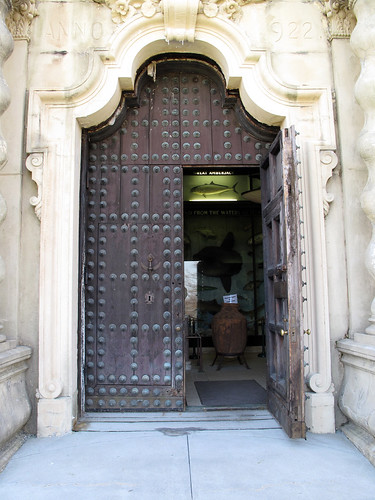
While I recovered from my near faint, Our Lady of the Pentacle went to work, citing some Britishism about grumbling. Heroically, she snatched the trusty G10 camera from my pack and procured the shots above and below, detailing the fantastic patinas of the stout iron wrought door that seals the museum off from the outside world. I wondered aloud… why would such a barrier be required in a gated estate surrounded by high masonry walls with a manned guardhouse at the front gate?
from wikipedia
In 1936 and 1937 George Vanderbilt sponsored a renewal of auto races for the Vanderbilt Cup but most important to him was a scholarly interest in the study of marine life. He owned several yachts and used them to conduct scientific expeditions all over the globe. His voyages conducted important research in expeditions to Africa in 1934 and aboard the schooner Cressida, he made an ocean journey in 1937 to the South Pacific notably in Sumatra that carried out a systematic study of more than 10,000 fish specimens (434 species in 210 genera).
His fifth major expedition was on the schooner Pioneer in 1941 to the Bahamas, Caribbean Sea, Panama, Galapagos Archipelago and Mexican Pacific Islands.
He established the George Vanderbilt Foundation for scientific research but outside academic circles, his important work has mostly been overshadowed by the lavish lifestyles and the Vanderbilt mansions of some of the other members of the Vanderbilt family.

– photo by Our Lady of the Pentacle
Outside, beneath the burning thermonuclear eye of god itself, I began to feel more like myself. Our Lady adjured me to rest while she grabbed her shots.
from nytimes.com
Swift changes of temperature and a wide variation in scenery are all part of the day’s run if one happens to motor in portions of North Africa as did William K. Vanderbilt, Jr., in some journeyings which he describes in The Journal of the Automobile Club of America.

– photo by Our Lady of the Pentacle
The forbidding door, we were told by museum staff, once had needle like spikes protruding from it. The door faces the seaward side of the hill, where the Alva once docked in Northport, and delivered those things it had dredged up out of the dark and cold sea to the clean sands of the Long Island. Who can guess what sort of creatures Vanderbilt and his crew made congress with as they travelled around the globe?
from nytimes.com
William K. Vanderbilt, Jr., was arrested in Long Island City on a charge of speeding his automobile through the streets of that city last evening. He was only overtaken and arrested after a lively chase, which extended from Jackson Avenue and Beach Street to the viaduct of the Newtown Creek Bridge which crosses Jackson and Borden Avenues, where he was compelled to slow up in order to pass under the viaduct.
– photo by Our Lady of the Pentacle
Recovering, I managed to resume my activities, and Our Lady of the Pentacle insisted I step away from the Hall of the Fishes and walk with her in light- for a time.
check out this pdf of the “Bulletin of Vanderbilt Marine Museum, Volume 3, Scientific Results of the Cruises of the Yacths “Eagle” and “Ara”, 1921-1928, William K. Vanderbilt, commanding” at decapoda.nhm.org
Final Vanderbilt Museum post tomorrow…


 The Newtown Pentacle