Posts Tagged ‘occult’
pale garden
 |
 |
 |
|||
| The first posting in this series was “City of Marble and Beryl“, from the 7th of April in 2010. | 1 | The second posting in this series was “effulgent valleys“, from the 7th of May in 2010. | 1 | The third posting in this series was “Strange Prayers “, from the 7th of June in 2010. | |
June 27, 2010

– photo by Mitch Waxman
There are more shots in the following series up at my flickr page, if you care to view a few more of them. On the 27th of June, the day after a full moon, I found a white candle in front of the seeming altar. A few other incidentals were scattered about.

– photo by Mitch Waxman
Two cigars were in place, both had been lit at some point, but not smoked.

– photo by Mitch Waxman
There was a curious residue in the grass, which looked to me like candle wax or some other sort of resinous substance.
July 26, 2010

– photo by Mitch Waxman
The 26th of July was a full moon, and I showed up the day of… just to see if any preparatory elements had appeared for the night’s ceremony. There were charred bits of grain and burned bone in the spot where the candle wax or resin was last month.

– photo by Mitch Waxman
The white candle was smashed, probably by groundskeepers during routine mowing. I actually ran into a groundskeeper on this trip, an amiable but suspicious man who volunteered “I see all kinds shit up around here, bottles- knives- whatnot” when I queried him about the spot.
August 26, 2010

– photo by Mitch Waxman
The full moon was on the 24th in August, and obligation kept me from St. Michael’s until the 26th. Luckily, whoever is working this ritual site is fastidious, whereas the groundskeeping crew were concentrating on other more… modern… sections of the cemetery.

– photo by Mitch Waxman
This time around, there was a pan of what looked like peanuts (a kind of nuts at least), beans, and some sort of grain floating about in a frothy bath of water. There was intense rain just the day before, and the water very well might have been a natural accumulation.

– photo by Mitch Waxman
This time around, the candle was green, and nestled close to the altar.

– photo by Mitch Waxman
Melted white wax was also apparent.

– photo by Mitch Waxman
Additionally, there was a broken egg in the grass.
September 23, 2010

– photo by Mitch Waxman
Almost disappointed that “my man” didn’t show up on the moon of September 23rd, a humble narrator instead decided to think about the history of the place and the set of assumptions I’ve been operating under in recording this macabre series of scenes.

– photo by Mitch Waxman
First, the things I know for certain. The frequency of events at this location have been dropping off, after a flurry of activity at the start of the holy year at Easter. The site is set up along the meridian points of a compass, and it seems to have been following a lunar calendar since the early summer.

– photo by Mitch Waxman
Meridian points.

– photo by Mitch Waxman
South

– photo by Mitch Waxman
East

– photo by Mitch Waxman
West

– photo by Mitch Waxman
North and approximately 100-150 yards away.

– photo by Mitch Waxman
North and approximately 175 yards away. Bingo.

– photo by Mitch Waxman
Clockwork.

– photo by Mitch Waxman
A plate of great price, north of the new site.

– photo by Mitch Waxman
An odd necklace just south.

– photo by Mitch Waxman
Can this be a medicine bag?

– photo by Mitch Waxman
Just East was this torn apart bird. My first instinct was that this was a kill by one of the many felines which patrol the cemetery,

– photo by Mitch Waxman
But this isn’t how cats kill, and the bird’s sundered remains were all present and the tell tale signs of carnivorous consumption were absent.
scenes familiar, and loved

– photo by Mitch Waxman
Exhausted, determined to return to my lonely paths and isolated experiences, the only solace possible for an Outsider such as myself is amongst the tomb legions. Exertion and social obligation has brought me, repeatedly within the last few months, amongst the vivacious and brightly lit corridors of the human infestation and forced me into uncomfortable and uncontrolled interaction with those who thrive in such circumstance. Gaunt yet flabby, the squamous shadow of your humble narrator is cast comfortably in only one place- the fossilized heart of this Newtown Pentacle.
Welcome back, to Calvary.
from wikipedia
Calvary Cemetery is located at 49-02 Laurel Hill Blvd. in Woodside in the New York City borough of Queens, New York. The cemetery is managed by the Trustees of St. Patrick’s Cathedral, New York. It is one of the oldest and largest cemeteries in the United States. In 1847, faced with cholera epidemics and a shortage of burial grounds in Manhattan, the New York State Legislature passed the Rural Cemetery Act authorizing nonprofit corporations to operate commercial cemeteries. Old St. Patrick’s Cathedral trustees had purchased land in Maspeth in 1846, and the first burial in Calvary Cemetery there was in 1848. By 1852 there were 50 burials a day, half of them the Irish poor under seven years of age

– photo by Mitch Waxman
At the center of Calvary Cemetery, First Calvary that is, is a concrete temple which functions as a mortuary chapel in addition to maintaining an abbreviated schedule of Mass. The noted Catholic architect Raymond F. Almirall, responding to the request of Archbishop Farley in 1903, designed this beaux arts masterpiece to be constructed for the then princely sum of $200,000. Farley conceived of this place, and the subterranean structure beneath it, after a trip to the Holy See in Rome.
for more on Archbishop Farley, from google books
In 1884 Pope Leo XIII made him private chamberlain with the title monsignor, and Cardinal McCloskey appointed him permanent rector of the church of Saint Gabriel, New York, where he remained until he was made archbishop. In 1891 he was madevicar-general of the archdiocese of New York. In 1892 he was made domestic prelate to Leo XIII, and in 1895 prothonotary apostolic, all of which positions gave him special privileges. In December 1895 he was consecrated titular bishop of Zeugma, and became assistant to the archbishop of New York. When the see of New York became vacant by the death of Archbishop Corrigan (1902), the lists of names sent to Rome by the suffragan bishops and permanent rectors each had at the head the name of Bishop Farley as first choice for archbishop. He received his appointment from Leo XIII, but the pallium was conferred under Pius X, on 15 Sept. 1902. He was the fourth archbishop of New York and governed one of the largest Roman Catholic dioceses in the world. He was the metropolitan of the ecclesiastical province of New York, which is composed of eight dioceses outside the archdiocese which includes also the Bahama Islands; six in the State of New York and two in New Jersey. The author of the ‘Life of Cardinal McCloskey,’ Archbishop Farley was also a contributor to various magazines, and took great interest in movements for the social welfare of the city. He was created cardinal by Pope Pius X, 27 Nov. 1911. At the time of his death (1918) the archdiocese of New York comprised a Catholic population estimated at 1,350,000; 1,117 priests; 388 churches; parochial schools attended by 91,140 children; 25 orphanages; 27 hospitals, and other institutions, benevolent and educational.

– photo by Mitch Waxman
Beneath the chapel, as it was designed, there is meant to be a two square acre catacomb whose only connection to the surface world is a shaft which rises some fifty feet to the surface. The Chapel itself utilizes the normal cruciform plan favored by the Roman Catholics since antiquity, and is some 60×120 feet, and a cupola rises some 90 feet above level ground and is crowned by a statue of the “Risen Christ”.
The cavern beneath the chapel is similarly in a the shape of a cross and designed as a mausoleum for the fallen priests of the city.
from google books, a popular mechanics article about the place
From the architect’s point of view, the most unusual feature is the method of construction of the dome and the groined vault on which it rests, both of which are regarded by experts as feats in reinforced concrete construction. The dome is 40 ft. across and the height from the floor to the lantern is 38 ft. It rises 50 ft. higher from that point and its total weight is 360 tons. The vault has eight penetrations, four large and four small, and both the lining of golden yellow brick and the pink Minnesota sandstone trimmings are held in place simply by adhesion to the concrete. In order to build this dome, it was necessary to build a falsework with all the accuracy of a mould, so that the brick could be laid against the forms, and the concrete with its steel reinforcement placed in the moulds. When the concrete had set, the falsework was removed, and the great dome stood as an imposing architectural crown to the structure, as well as a feat in construction.
The crypts or catacombs are for the burial of the priests of the diocese of New York, under the charge of which the cemetery is maintained. At present, but one section of the catacombs has been completed with accommodations for twenty-four bodies in the concrete niches. But the section can be extended underground in four directions, and at any time an addition for seventy-two more bodies can be made. For a cryptal burial there is a lift set into the floor of the chapel to lower the body to the level of the crypts.

– photo by Mitch Waxman
Despite my mongrel familiarity with this place, your humble narrator has always avoided entering the chapel due mainly to a combination of cowardice and empathy.
Imagine the reaction of some wholesome priest or grieving parishioner when seeing this scuttling alien shamble into their sanctum sanctorum. They might look up and see an odd creature in a dirty black raincoat, with its widely separated glassy eyes and tightly stretched fish belly white skin betraying the presence of yellowing bone and rotting organ beneath, and question the faith that keeps them here. How could a merciful god allow an abomination such as myself to exist- a furtive fuligin clad thing stinking of the Newtown Creek’s corruptions- let alone enter the most hallowed ground in the Archdiocese while the thermonuclear eye of god still shines down from on high? Certainly at night such manifestations of the macabre can be expected, but during the day?
It’s usually best for all that I remain at the side of the room, the rear of the bus, and near the end of the line- lest lightning strike another in error.
from wikipedia
The Rural Cemetery Act led to Queens being a borough of cemeteries. Queens is home to 29 cemeteries holding more than five million graves and entombments, so that the “dead population” of the borough is more than twice the size of its live population. The large concentration of cemeteries on the border of Brooklyn and Queens is another effect of the law. Under the Act, each individual cemetery organization was limited to no more than 250 acres (1 km²) in one county, but some organizations circumvented that limit by purchasing larger parcels straddling the boundaries of two counties. As result, 17 cemeteries straddle the border between Queens and Brooklyn. As with Queens, the “dead population” of Brooklyn is estimated to exceed its living population. In 1917 a state legislator from Queens complained that the law and the concentration of cemeteries that it had produced resulted in more than one-fifth of Queens’ land being exempt from property tax. As of 1918 more than 22,000 acres (89 km2) of land in Queens were owned by private tax-exempt cemeteries. Under current New York law, all cemetery property is exempt from property taxation, but current law allows the governments of Brooklyn, Queens, and certain other New York counties to limit the establishment of new cemeteries within their boundaries.

– photo by Mitch Waxman
Nevertheless, this day, I mustered the tiny sparks of manhood within me and drawing a sharp breath- entered the chapel. Which was… disappointing. “Rather mundane, and shabbily maintained given the pristine groundskeeping and manicured care given the monuments outside” was my initial reaction. Also, it was rather dark within, and I was forced to use the camera flash in addition to setting my camera to a high ISO setting. Notice, if you would, the lack of dust in the air of the place- which would be catching and reflecting the flash back at the lens- backscatter as its called.
This is a rather important point, as we’ll discuss later on in the post.
from wikipedia
The term backscatter in photography refers to light from a flash or strobe reflecting back from particles in the lens’s field of view causing specks of light to appear in the photo. This gives rise to what are sometimes referred to as orb artifacts. Photographic backscatter can result from snowflakes, rain or mist, or airborne dust. Due to the size limitations of the modern compact and ultra-compact cameras, especially digital cameras, the distance between the lens and the built-in flash has decreased, thereby decreasing the angle of light reflection to the lens and increasing the likelihood of light reflection off normally sub-visible particles. Hence, the orb artifact is commonplace with small digital or film camera photographs.

– photo by Mitch Waxman
My main concern was finding the possible location of the fifty foot shaft mentioned in the paragraph above, which is meant to be at the center of the building. The mosaic floor has obviously suffered the effects of use and a century of weathering, but there was this metal edged structure in it that was roughly the size and shape of a standard coffin. Unless I’m missing my guess, this is the hatch to that shaft.
I have been wrong before, so don’t take my word for it, but according to my researches, this is where it SHOULD be- and it fits the description as put forward in the Popular Mechanics article linked to above.
from wikipedia
The first place to be referred to as catacombs were the underground tombs between the 2nd and 3rd milestones of the Appian Way in Rome, where the bodies of the apostles Peter and Paul, among others, were said to have been buried. The name of that place in late Latin was catacumbae, a word of obscure origin, possibly deriving from a proper name, or else a corruption of the Latin phrase cata tumbas, “among the tombs”. The word referred originally only to the Roman catacombs, but was extended by 1836 to refer to any subterranean receptacle of the dead, as in the 18th-century Paris catacombs.

– photo by Mitch Waxman
The cavern below is meant to house individually cemented cells for the dead clerics, and these individual resting places- as well as the ossuary that eventually houses their more enduring remains in the Italian and French manner- is lined with stone quarried from the domed hills of Vermont- a nearby northern state of sylvan wildernesses which produce and maintains a vast mythology even in this age of reason and ration.
One wonders why the alluvial deposits of the Green Mountain state were called upon to line and ornament this unseen chamber, and if it might have relation to the odd occurrences in and around Townshend Vermont in 1927 and 1928.
from wikisource.org
The whole matter began, so far as I am concerned, with the historic and unprecedented Vermont floods of November 3, 1927. I was then, as now, an instructor of literature at Miskatonic University in Arkham, Massachusetts, and an enthusiastic amateur student of New England folklore. Shortly after the flood, amidst the varied reports of hardship, suffering, and organized relief which filled the press, there appeared certain odd stories of things found floating in some of the swollen rivers; so that many of my friends embarked on curious discussions and appealed to me to shed what light I could on the subject. I felt flattered at having my folklore study taken so seriously, and did what I could to belittle the wild, vague tales which seemed so clearly an outgrowth of old rustic superstitions. It amused me to find several persons of education who insisted that some stratum of obscure, distorted fact might underlie the rumors.
The tales thus brought to my notice came mostly through newspaper cuttings; though one yarn had an oral source and was repeated to a friend of mine in a letter from his mother in Hardwick, Vermont. The type of thing described was essentially the same in all cases, though there seemed to be three separate instances involved – one connected with the Winooski River near Montpelier, another attached to the West River in Windham County beyond Newfane, and a third centering in the Passumpsic in Caledonia County above Lyndonville. Of course many of the stray items mentioned other instances, but on analysis they all seemed to boil down to these three. In each case country folk reported seeing one or more very bizarre and disturbing objects in the surging waters that poured down from the unfrequented hills, and there was a widespread tendency to connect these sights with a primitive, half-forgotten cycle of whispered legend which old people resurrected for the occasion.
What people thought they saw were organic shapes not quite like any they had ever seen before. Naturally, there were many human bodies washed along by the streams in that tragic period; but those who described these strange shapes felt quite sure that they were not human, despite some superficial resemblances in size and general outline. Nor, said the witnesses, could they have been any kind of animal known to Vermont. They were pinkish things about five feet long; with crustaceous bodies bearing vast pairs of dorsal fins or membranous wings and several sets of articulated limbs, and with a sort of convoluted ellipsoid, covered with multitudes of very short antennae, where a head would ordinarily be. It was really remarkable how closely the reports from different sources tended to coincide; though the wonder was lessened by the fact that the old legends, shared at one time throughout the hill country, furnished a morbidly vivid picture which might well have coloured the imaginations of all the witnesses concerned. It was my conclusion that such witnesses – in every case naive and simple backwoods folk – had glimpsed the battered and bloated bodies of human beings or farm animals in the whirling currents; and had allowed the half-remembered folklore to invest these pitiful objects with fantastic attributes.

– photo by Mitch Waxman
Mission accomplished, and thankful that I happened into the place when it was deserted, your humble narrator decided to crack out a few more shots. Again, I messed around a little with exposure settings, hoping to combat the limited amount of available light within the structure. I emphatically state that beyond brightness and contrast, basic sharpening and color temperature adjustments- these shots are unaltered. The camera raw files are available for examination, and upon request, will be made downloadable.
from wikipedia
A camera raw image file contains minimally processed data from the image sensor of either a digital camera, image scanner, or motion picture film scanner. Raw files are so named because they are not yet processed and therefore are not ready to be printed or edited with a bitmap graphics editor. Normally, the image is processed by a raw converter in a wide-gamut internal colorspace where precise adjustments can be made before conversion to a “positive” file format such as TIFF or JPEG for storage, printing, or further manipulation, which often encodes the image in a device-dependent colorspace. These images are often described as “RAW image files”, although there is not actually one single raw file format. In fact there are dozens if not hundreds of such formats in use by different models of digital equipment (like cameras or film scanners).
Raw image files are sometimes called digital negatives, as they fulfill the same role as negatives in film photography: that is, the negative is not directly usable as an image, but has all of the information needed to create an image. Likewise, the process of converting a raw image file into a viewable format is sometimes called developing a raw image, by analogy with the film development process used to convert photographic film into viewable prints. The selection of the final choice of image rendering is part of the process of white balancing and color grading.
Like a photographic negative, a raw digital image may have a wider dynamic range or color gamut than the eventual final image format, and it preserves most of the information of the captured image. The purpose of raw image formats is to save, with minimum loss of information, data obtained from the sensor, and the conditions surrounding the capturing of the image (the metadata).

– photo by Mitch Waxman
Palpable and real, visits to First Calvary are draining experiences, from a psychic point of view. You are surrounded by rich imagery and the text screeds that adorn the monuments, which means that whether you want to or not, the names of those who are interred here are being read subconsciously and forcing themselves into your mind. The territory surrounding the place is the tautologically fabulous properties which comprise the Queens bank of that maligned font of inspiration which is the Newtown Creek (The Creeklands, as I call them), and the intricate steel lacing of bridge and rail that confines and contains whatever might be lurking beneath it. The experience is overwhelming, from a sensory point of view, and drains the experiencer of both cognitive alertness and physical energy. In short, after a 75-90 minute interval spent here, you want nothing more than to just lie down on the soft grass and sleep.
from wikipedia
Orb artifacts are captured during low-light instances where the camera’s flash is implemented, such as at night or underwater. The artifacts are especially common with compact or ultra-compact cameras, where the short distance between the lens and the built-in flash decreases the angle of light reflection to the lens, directly illuminating the aspect of the particles facing the lens and increasing the camera’s ability to capture the light reflected off normally sub-visible particles. The orb artifact can result from retroreflection of light off solid particles (e.g., dust, pollen), liquid particles (water droplets, especially rain) or other foreign material within the camera lens. The image artifacts usually appear as either white or semi-transparent circles, though may also occur with whole or partial color spectrums, purple fringing or other chromatic aberration. With rain droplets, an image may capture light passing through the droplet creating a small rainbow effect.

– photo by Mitch Waxman
So, here you are.
By the standards set by pop culture, the little white shape you see in the above shot at the “11 o’clock” position is a ghost orb, in a photograph shot at the Calvary Cemetery Chapel at 11:03 am on October 8th, 2010. Or dust.
What do you think? Click through to the larger size of the shot above at flickr and check it out at higher resolution.
blurred outlines

– photo by Mitch Waxman
As always, Lords and Ladies of Newtown, your humble narrator finds himself overwhelmed by obligation and social fealty. To be seen by so many diminishes me.
The recent uprooting of Newtown Pentacle HQ from its Matthews Model Flat environ and consequent move to new digs here in ruby lipped Astoria has been arduous, and has resulted in the quite uneven schedule of postings you’ve no doubt noticed. Unfortunately, such is life when well lived, but the apogee of exertion has been met and the routine returns to normal.
As normal as it gets, here in the Newtown Pentacle, that is.
from the New York Herald, Jan. 6, 1895
Fires in the home of Adam Colwell, 84 Guernsey Street, Greenpoint, Brooklyn — that, in 20 hours, preceding noon, Jan. 5th, when Colwell’s frame house burned down, there had been many fires.(6) Policemen had been sent to investigate. They had seen furniture burst into flames. Policemen and firemen had reported that the fires were of unknown origin. The Fire Marshal said: “It might be thought that the child Rhoda started two of the fires, but she can not be considered guilty of the others, as she was being questioned, when some of them began. I do not want to be quoted as a believer in the supernatural, but I have no explanation to offer, as to the cause of the fires, or of the throwing around of the furniture.”

– photo by Mitch Waxman
Despite the agonizing series of efforts and appointments which moving one’s domicile requires, and a concurrent and badly timed series of familial and fraternal obligations, once I heard about the pyrokinetic history of 84 Guernsey Street in Greenpoint- I made the time to go get some shots of the place. This era of rapid real estate development that we are experiencing has taught me to strike when the iron is hot- for the subject you desire to explore very well might be gone the next day.
also from the New York Herald, Jan. 6, 1895
Colwell’s story was that, upon the afternoon of Jan. 4th, in the presence of his wife and his step-daughter Rhoda, aged 16, a crash was heard. A large, empty, parlor stove had fallen to the floor. Four pictures fell from walls. Colwell had been out. Upon his return, while hearing an account of what had occurred, he smelled smoke. A bed was afire. He called a policeman, Roundsman Daly, who put out the fire, and then, because of unaccountable circumstances, remained in the house. It was said that the Roundsman saw wall paper, near the shoulder of Colwell’s son Willie start to burn. Detective Sergeant Dunn arrived. There was another fire, and a heavy lamp fell from a hook. The house burned down, and the Colwells, who were in poor circumstances, lost everything but their clothes. They were taken to the police station.
Captain Rhoades, of the Greenpoint Precinct, said: “The people we arrested had nothing to do with the strange fires. The more I look into it, the deeper the mystery. So far I can attribute it to no other cause than a supernatural agency. Why, the fires broke out under the very noses of the men I sent to investigate.”
Sergeant Dunn — “There were things that happened before my eyes that I did not believe were possible.”

– photo by Mitch Waxman
Pyrokinesis is actually a term coined by the novelist Stephen king for his novel “Firestarter”, although tales of the psychic ability to ignite fires abound in popular mythology and historical records. One is reminded of Mr. A.W. Underwood- a fellow known as the “Human Blowtorch” who was a phenomenon in the 19th century.
from the New York Herald, Jan. 7, 1895
Policemen and firemen artfully tricked by a pretty, young girl.” Mr. J.L. Hope, of Flushing, L.I., had called upon Captain Rhoades, telling him that Rhoda had been a housemaid in his home, where, between Nov. 19 and Dec. 19, four mysterious fires had occurred. “Now the Captain was sure of Rhoda’s guilt, and he told her so.” “She was frightened, and was advised to tell the truth.”
And Rhoda told what she was “advised” to tell. She “sobbed” that she had started the fires, because she did not like the neighborhood in which she lived, and wanted to move away: that she had knocked pictures from the walls, while her mother was in another part of the house, and had dropped burning matches into beds, continuing her trickeries after policemen, detectives, and firemen had arrived.
The Colwells were poor people, and occupied only the top floor of the house that burned down. Colwell, a carpenter, had been out of work two years, and the family was living on the small wages of his son. Insurance was not mentioned.

– photo by Mitch Waxman
Greenpoint is a very, very strange place- apparently.
also from the New York Herald, Jan. 7, 1895
The police captain’s conclusion was that the fires that had seemed “supernatural” to him, were naturally accounted for, because, if when Rhoda was in Flushing, she set things afire, fires in her own home could be so explained. Rather than to start a long investigation into the origin of the fires in Flushing, the police captain gave the girl what was considered sound and wholesome advice.
And — though it seems quaint, today — the girl listened to advice. “Pretty young girls” have tricked more than policemen and firemen. Possibly a dozen male susceptibles could have looked right at this pretty, young girl, and not have seen her strike a match, and flip it into furniture; but no flip of a match could set wall paper afire.
The case is like the case of Emma Piggott. Only to one person’s motives could fires be attributed: but by no known means could she have started some of these fires.
strange prayers

– photo by Mitch Waxman
For the first post on this curious altar- “City of Marble and Beryl”, in Astoria’s St. Michael’s Cemetery – click here
For the second post on this curious altar- “Effulgent Valleys“, in Astoria’s St. Michael’s Cemetery – click here
for a link to a google map, showing the location as recorded by GPS, click here
As the moon waxes to full, anticipation has found a home in the heart of your humble narrator, for the ritual site in St. Michael’s beckons. These shots are from May 28, 2010, one day after the full moon- which is referred to as the “hare’s moon” by antiquarians and occultists alike.
As is usual, the photographs are “forensic in nature”, and reveal the scene exactly as found and in situ, and nothing was manipulated or even touched.
from wikipedia
It is traditional to assign special names to each full moon of the year, although the rule for determining which name will be assigned has changed over time (e.g., the blue moon). An ancient method of assigning names is based upon seasons and quarters of the year. For instance, the Egg Moon (the full moon before Easter) would be the first moon after March 21, and the Lenten Moon would be the last moon on or before March 21. Modern practice, however, is to assign the traditional names based on the Gregorian calendar month in which the full moon falls. This method frequently results in the same name as the older method would, and is far more convenient to use.
The following table gives the traditional English names for each month’s full moon, the names given by Algonquian peoples in the northern and eastern United States, other common names, and Hindu and Sinhala names.[9] Note that purnima or pornima is Sanskrit for full moon, which has also become the Malay word for full moon purnama. Full moon days are sacred according to Buddhist tradition and called Poya in Sinhala, the dominant language of the Buddhist majority of Sri Lanka.

– photo by Mitch Waxman
The big question, of course, is “how are the folks who are working this ritual site getting in?”. St. Michael’s is quite secure, surrounded by corporate office parks and highways and locked tight behind stout fences. Well, not so stout, as a little exploration of the border fences showed several apertures and obvious breaches. I guess if someone wants to, they’re going to get in.
from wikipedia
The monthly cycle of the moon, in contrast to the annual cycle of the sun’s path, has been implicitly linked to women’s menstrual cycles by many cultures, as evident in the links between the words for menstruation and for moon in many resultant languages. Many of the most well-known mythologies feature female lunar deities, such as the Greek goddesses Selene and Phoebe and their Olympian successor Artemis, their Roman equivalents Luna and Diana, Isis of the Egyptians, or the Thracian Bendis. These cultures also almost invariably featured a male Sun god.
Male lunar gods are also frequent, such as Nanna or Sin of the Mesopotamians, Mani of the Germanic tribes, the Japanese god Tsukuyomi, Rahko of Finns and Tecciztecatl of the Aztecs. These cultures usually featured female Sun goddesses.
The bull was lunar in Mesopotamia (its horns representing the crescent). See Bull (mythology) and compare Hubal. In the Hellenistic-Roman rites of Mithras, the bull is prominent, with astral significance, but with no explicit connection to the moon.
Also of significance is that many ancient pagan religions and societies are orientated chronologically by the Moon as opposed to the sun. One common example is Hinduism in which the word Chandra means Moon and has religious significance particularly during the Hindu festival Karwa-Chouth.
The moon is also worshipped in witchcraft, both in its modern form, and in Medieval times, for example, in the cult of Madonna Oriente.

– photo by Mitch Waxman
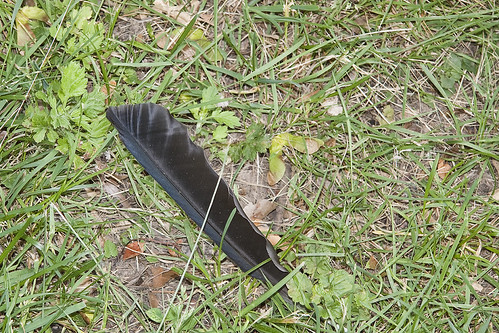
This time around, the feathers scattered around were black, and completed rather than shredded. The quills were also still attached.
from wikipedia
Madonna Oriente or Signora Oriente (Lady of the East), also known as La Signora del Gioco (The Lady of the Game), are names of an alleged religious figure, as described by two Italian women who were executed by the Inquisition in 1390 as witches.
The story which they are reported to have told is an elaborate and fantastical tale of occult religious rituals practised at the houses of wealthy individuals in Milan, Italy, where a woman known as the Madonna Oriente, possibly regarded as a goddess by her followers, performed magical acts such as the resurrection of slaughtered animals.
The two women, Sibilla Zanni and Pierina de’ Bugatis, were brought before the Inquisition first in 1384, and with their story apparently dismissed as fantasy, were sentenced only to minor penance. When they were investigated again in 1390, however, they were charged with consorting with the Devil, condemned, and executed.
While there is no evidence that the organized group described by the women actually existed, their testimonies are remarkably similar to those of several other groups in Italy and greater Europe, such as the followers of Richella and ‘the wise Sibillia’ in 15th century Northern Italy, the Benandanti of 16th and 17th century Northern Italy, the Armiers of the Pyrenees, the Romanian Căluşari, Livonian werewolves, Dalmatian kresniki, Hungarian táltos and Caucasian burkudzauta.
– photo by Mitch Waxman
The last batch of feathers observed were white, and suggested plucking. These were large and dark in color. I shot off the camera flash on the above shot, in the hope that certain ornithological enthusiasts known to be Newtown Pentacle readers might hazard an attempt at classification.
from wikipedia
The pregnancy of Coatlicue, the maternal Earth deity, made her other children embarrassed, including her oldest daughter, Coyolxauhqui. As she swept the temple, a few hummingbird feathers fell into her bosom. Coatlicue’s fetus, Huitzilopochtli, sprang from her womb in full war armor and killed Coyolxauhqui, along with her 400 brothers and sisters. He cut off her limbs, then tossed her head into the sky where it became the moon, so that his mother would be comforted in seeing her daughter in the sky every night.

– photo by Mitch Waxman
The main ritual focal remains the same, but candles and offerings have been altered from previous months. The candles are red and purple, and there are two cigars.
from wikipedia
Moon magic is the belief that working rituals at the time of different phases of the moon can bring about physical or psychological change or transformation. These rituals have historically occurred on or around the full moon and to a lesser extent the new moon. Such practices are common amongst adherents of neopagan and witchcraft systems such as Wicca. Witches in Greek and Roman literature, particularly those from Thessaly, were regularly accused of “drawing down the moon” by use of a magic spell. The trick serves to demonstrate their powers (Virgil Eclogues 8.69), to perform a love spell (Suetonius Tiberius 1.8.21) or to extract a magical juice from the moon (Apuleius Metamorphoses 1.3.1). These beliefs would seem to be consistent with many other cultures traditions, for instance; casting of the i ching is often done during the full moon’s apex.

– photo by Mitch Waxman
One cigar is approximately in the same position as the last one was, on April 30th.
this link from wikipedia actually refers to Santeria, which is not what I think we’re seeing here, but the spirit of it is correct
“The colonial period from the standpoint of African slaves may be defined as a time of perseverance. Their world quickly changed. Tribal kings and families, politicians, business and community leaders all were enslaved in a foreign region of the world. Religious leaders, their descendants, and the faithful, were now slaves. Colonial laws criminalize their religion. They were forced to become baptized and worship a god their ancestors had not known who was surrounded by a pantheon of saints. The early concerns during this period seem to indicate a need for individual survival under harsh plantation conditions. A sense of hope was sustaining the internal essence of what today is called Santería, a misnomer for the indigenous religion of the Lukumi people of Nigeria.
“In the heart of their homeland, they had a complex political and social order. They were a sedentary hoe farming cultural group with specialized labor. Their religion based on the worship of nature was renamed and documented by their masters. Santería, a pejorative term that characterizes deviant Catholic forms of worshiping saints, has become a common name for the religion. The term santero(a) is used to describe a priest or priestess replacing the traditional term Olorisha as an extension of the deities. The orishas became known as the saints in image of the Catholic pantheon.” (Ernesto Pichardo, CLBA, Santería in Contemporary Cuba: The individual life and condition of the priesthood)
As mentioned, in order to preserve their authentic ancestral and traditional beliefs, the Lukumi people had no choice but to disguise their orishas as Catholic saints. When the Roman Catholic slave owners observed Africans celebrating a Saint’s Day, they were generally unaware that the slaves were actually worshiping their sacred orishas. In Cuba today, the terms “saint” and “orisha” are sometimes used interchangeably.

– photo by Mitch Waxman
The second was inserted into the “Gran Poder” red candle.
from wikipedia
A classic Quimbanda ritual, called a trabalho, consists of several parts: a motive, dedication to a spirit, a marginal location, the metal or clay (earthy) material, an alcoholic drink, scent, and food (usually a peppered flour-palm oil mixture, sometimes called miamiami). An example of a trabalho is as follows:
Trabalho 1: ” A work of great force, under the protection of [Exu] Tranca Ruas das Almas (Block-Streets-of-the-Souls), to eliminate an enemy. “
- Go to a crossroads of Exu on a Monday or Friday near midnight, if possible in the company of a member of the opposite sex;
- greet Ogum with a bottle of light beer, a white or red candle, and a lighted cigar;
- greet Exu Sir Block-Streets-of-the-Souls by opening seven bottles of rum (cachaga) in the form of a circle, lighting seven red and black candles, and offering seven cigars;
- put inside a vase (alguidar) and mix the following: manioc flour (farinha da mesa), palm oil (azeitede-dendd), and peppers;
- put on the ground in the middle of the circle the name of the person whom one wishes to hurt, and, using a knife, stab this with violence, asking Exu to attend to one’s request.”
Depending on the purpose of the ritual, aspects of the trabalho will change. For instance, if one desires to seek justice from Exu they will use white candles, rum and a written request. Therefore, certain colors denote different motives in a ritual: white symbolizing an honest and justice-bound motive and red and black representing an aggressive and illicit motive. Other rituals substitute the harsh or spicy smell of cigars for the sweet smell of carnations, thus symbolizing the transformation between harming and helping rituals. Likewise, rituals involving female spirits (Pomba Giras) are less aggressive in their performance. A trabalho to obtain a woman is as follows:
Trabalho 7: “to obtain a woman. “
On a Monday or Friday night, go to a female crossroads (T-shaped rather than plus-shaped) and greet Pomba Gira by pouring a little rum, ” or better yet, champagne or anisette (aniz)”;
- place two pieces of cloth (pano) on the ground, one red and the other black, and on top of this put five or seven red roses in the shape of a horseshoe;
- fill a cup of good quality with champagne or aniz;
- put the name of the desired person in the cup or in the middle of the horseshoe;
- sing a ponto (song) and thank Pomba Gira.

– photo by Mitch Waxman
The purple candle had melted out, its wax incorporating into the loam.

– photo by Mitch Waxman
On the other side of the hill, flies were buzzing about this tumbled stone. There seemed to be some kind of carbonized “stuff” on it, almost a greasy smear of ash.
Crimes typically associated with ritual violence include: trespassing, vandalism, church desecration, theft, graffiti, arson, extortion, suicide, kidnapping, ritual abuse, animal sacrifice, and ritual murder. Trespassing related to ritualistic crime usually involves persons entering private areas such as woods, barns, and abandoned buildings for the purpose of having an isolated place to worship. Since most occult theologies are nature based, rituals are frequently held outdoors and altars are often constructed of natural elements. Vandalism most often associated with occult crime includes cemetery and church desecration. The most common types of cemetery desecration attributed to occult groups are digging up graves, grave robbing, and tampering with human corpses or skeletons. This is frequently motivated by religious beliefs that require human bones to fulfill specific rituals. Church desecration frequently includes destroying Bibles, urinating and defecating on holy objects and furniture, tearing crucifixes off walls, and destroying rosaries and crucifixes. It is important to note that the motivations behind such vandalism can also be attributed to hate crimes. Thefts from Christian churches, Jewish synagogues, hospitals, morgues, medical schools, and funeral homes are often linked with ritual violence. Items that are most often taken include cadavers, skeletal remains, blood, and religious artifacts that are considered sacred: crucifixes, communion wafers, wine, chalices, and so on. Frequent motivations for these thefts are that particular groups require actual holy artifacts or human organs, bones, and the like for their rituals.

– photo by Mitch Waxman
The material on its surface was vegetable in nature, but it was stuck to something whose adhesive qualities were strong enough to resist strong breezes and attract a number of largish black and green flies.
from nypost.com
Two of Queens’ largest parks are hotbeds for animal sacrifices, according to park rangers and advocates.
Longtime Parks Department ranger Joe Puleo told The Post that killing animals for ritualistic reasons in the city is widespread, but that Forest Park and Highland Park are the most common locations.
Perpetrators of the outlawed act are rarely busted because they perform their bloody rituals in the dead of night, and the two parks no longer have 24-hour patrols due to budget cuts.
“They are never caught, because they are careful, and they never do it during the day. They do it at night when no one is around,” Puleo said.

– photo by Mitch Waxman
Lords and Ladies of Newtown, there is a hidden cult at work amongst you, amongst the moon shadowed tomb legions of Astoria.
effulgent valleys

– photo by Mitch Waxman
I went over to St. Michael’s Cemetery again last week to see if there were any developments on the ritual site which Our Lady of the Pentacle and I found a few weeks ago. A hypothesis of mine that this ritual site is being “worked” on a lunar schedule seems to be bearing fruit.
For the first post on this curious altar- “City of Marble and Beryl“, in Astoria’s St. Michael’s Cemetery- click here
for a link to a google map, showing the location as recorded by GPS, click here

– photo by Mitch Waxman
Intriguing are the differences between the last set of offerings, ritual devices, and this grouping, although the setting remains the same. Also, to be absolutely clear- this is not staged in any way, and represents exactly what I observed in situ.

– photo by Mitch Waxman
The brownish cylinder appeared to be a cigar, and the white candle’s wick was blacked but the wax was nearly pristine.

– photo by Mitch Waxman
A set of bleached bones seemed to have been arranged in some non random pattern.

– photo by Mitch Waxman
There were also holes punched in the dirt, which could just be the action of wildlife of course, but the soil of the graveyard was depressed inward without the characteristic mound of surface tailings left behind by those that burrow. It appeared that something had been stuck into the soil.

– photo by Mitch Waxman
Also, amongst the bones, were coins.

– photo by Mitch Waxman
To the north was a glass with a white candle inside of it, approximately 25 feet away.

– photo by Mitch Waxman
The candle’s glass was broken, if that means anything.
– photo by Mitch Waxman
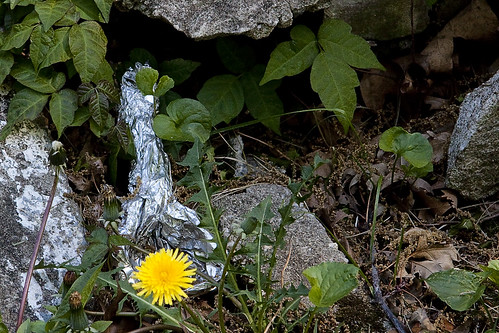
On the west face, this ladle shaped molding of aluminum foil was extant.

– photo by Mitch Waxman
Here’s the whole scene, the center stone seems to be the main altar- it’s where the cigar, bones, and coins as well as the unconsumed candle were observed. The ladle was to the west, on the downward slope, and candle in the glass to the north at the right of the shot.

– photo by Mitch Waxman
The line of monuments in this section are very old, and many of the legends on the stones are faded away, here in St. Michael’s St. George section.


 The Newtown Pentacle