Posts Tagged ‘photowalk’
terrible movement
A bit more on the tugboat scene.

– photo by Mitch Waxman
Boy oh boy, it’s like the old days at Newtown Pentacle lately, huh? Tugboats, tugboats, tugboats… That’s a Bouchard articulated tug and barge combo motoring along under the Bronx Whitestone Bridge. This tug is heading out of the Westchester Creek inlet section of the East River and heading towards Manhattan. That’s the Throgs Neck Bridge behind the tug and Bronx Whitestone in the lower third of the shot. Both bridges were designed by the great Othmar Amman.
This is the view from the NYC Ferry’s Soundview landing, in the Bronx, btw.

– photo by Mitch Waxman
A few years ago, I was seemingly obsessed with photographing tugs. Whereas I’m still drawn to the subject, and remain utterly fascinated by all things maritime industrial, there’s really only so many ways to shoot and frame a tug shot. Additionally, a few of my friends with whom I shared this fascination for towing vessels have passed away in recent years, and it feels sort of weird and not as much fun to be the “last man standing.” Used to be that shots like these would get sent around in late night emails to my little cadre of fellow enthusiasts, who would in turn send what they got that particular day to me.
Such is life, and death, in the big city – I suppose.

– photo by Mitch Waxman
A humble narrator is having a furiously busy week roll through the calendar as you’re reading this. Yesterday, I got to interact with some highly placed people at NYC DOT regarding the new pathways which will be introduced into Maspeth and Sunnyside by the soon to be finished Kosciuszcko Bridge bike and pedestrian path. One offered them the experiential thing, taking them for a walk around the place. Officialdom knows far more about the streets of NY than any regular person can, but generally they know these things from paper maps, politics, and spreadsheets. “Being there” in the flesh, seeing trucks parked on the broken sidewalks and crossing hazardous intersections, is a whole different thing. Last night, a friend of mine – Pat Dorfman – received the “Sunnysider of the Year” award from the Sunnyside Chamber of Commerce, so I had to show up and take a pic or two of the awards ceremony. My dogs were barking by the time I got home and settled in on the couch.
As you’re reading this, I’m probably at a polyandrion in Blissville, walking an ornithological enthusiast around. Then, I’ve got a call in meeting at 4… it never ends.
Tomorrow, I’ll tell you about two events I’m doing with Newtown Creek Alliance at the end of the month – but hold the dates of April 23 and 28th for now.
“follow” me on Twitter- @newtownpentacle
Buy a book!

“In the Shadows at Newtown Creek,” an 88 page softcover 8.5×11 magazine format photo book by Mitch Waxman, is now on sale at blurb.com for $30.
alive in
Things that pull or push other things, in today’s post.

– photo by Mitch Waxman
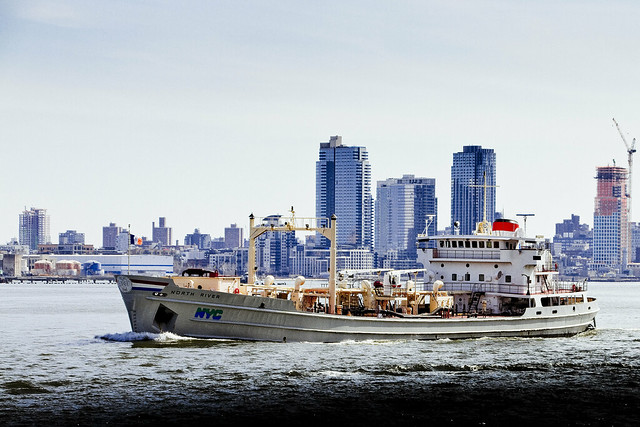
So, that NYC Ferry trip I mentioned in yesterday’s April Fools post? As it happened, a humble narrator hit a fortuitous moment in terms of river traffic when boarding that particular boat. Everywhere I pointed the lens, there seemed to be something going on. For the curious – this was the Soundview route, which I boarded at East 34th street over in the City, after taking the Astoria line from Hallets Cove to that location.
A few people have asked me (in real life or “meat space”) if I have some sort of relationship with the NYC Ferry people since I keep on mentioning them. The answer is “sort of,” since I do know a couple of people who work at Hornblower through the old NY Harbor crowd. A while back I did a blog post for NYC Ferry about what to do and see nearby their Astoria dock, an effort which I was recompensed for with a free 30 day pass on their boats. That’s pretty much the size of it, except for the taxes we all pay to the City which heavily underwrite the $2.75 fare. I’m just a fare paying passenger, and one who really enjoys getting out on the water – even if it was a particularly cold and blustery March afternoon.

– photo by Mitch Waxman
Spotted this rather smallish tug at Hells Gate, towing a couple of barges of what looked like either gravel or uncooked asphalt. That’s the Wards/Randalls island combine in the background, the shoreline of which hosts a staggering amount of municipal infrastructure. The NYC DEP has a combination of wastewater and sludge dewatering facilities on the shoreline mirroring Astoria Park, there’s the Hell Gate railroad Bridge and the East River span of the Triborough Bridge complex as well. Just yesterday, I was making plans with a couple of people to spend a day on the Island(s) and get to know the place a bit better.
Used to be two islands, Randalls and Wards, but… y’know… Robert Moses.

– photo by Mitch Waxman
Coming from the south/west, another tug was spotted transversing Hells Gate. That’s the Astoria Park shoreline, and you can just make out the nascent skyline of LIC’s Court Square neighborhood peeking out over the bare trees behind the bridge. I’ve been told that even with modern vessels, you have to “pick your battles” with the swift currents in this section of the river lest you end up burning up half your fuel supply fighting its ebb and flow.
One time I was sitting in Astoria Park, right alongside the Hell Gate masonry seen above, and taking pics. I started laughing while watching some rich guy in a speedboat gunning his engines against the current, but his boat was just barely holding position agains the incoming flood tide. This isn’t necessarily the case with tugs and other overpowered boats, of course, but fuel costs are what rule the roost in the shipping and towing business. How much you “spend to earn” is where an experienced versus inexperienced crew and scheduler make all the difference. Same thing is true with shipping by rail and trucks.

– photo by Mitch Waxman
Another fuel barge and tug combination was passed, while the camera’s point of view was looking north westwards over Randalls/Wards Island towards the Little Hell Gate Bridge and the roads leading to Triborough’s toll plazas. Good timing, thought I, as a CSX train set was transiting over the elevated rail tracks connecting to Hell Gate’s East River Arch Bridge (which connect to the NY Connecting Rail Road tracks in Queens) and heading for the Bronx. I think the next stop for the CSX rig will be Owls Head yard in the Bronx, but that’s just a guess.
What do I know?

– photo by Mitch Waxman
Luckily, I had outfitted the camera with zoom lens for the trip. It’s a Sigma, the 18-300 f3.5, which provides the “all in one” functionality needed for this sort of excursion. One thing about the East River and its various tributaries and estuarial bays is that you are going to want to shoot both wide and long, sometimes flipping back and forth several times in just five minutes. Given that you’re on a boat, speedily moving through the water and with all kinds of weird particulates circulating in the air column… you want to limit the number of lens flops you do.
I can recommend the Sigma, btw. I also have and love their 18-35 f1.8.

– photo by Mitch Waxman
What was that I was just saying about zooming in?
“follow” me on Twitter- @newtownpentacle
Buy a book!
“In the Shadows at Newtown Creek,” an 88 page softcover 8.5×11 magazine format photo book by Mitch Waxman, is now on sale at blurb.com for $30.
indelible mark
Some new gear on display in today’s post.
– photo by Mitch Waxman
One is always hunting around on camera oriented websites for new bits of gear, lenses, gew gaws, doohickeys, and or doodads which might make my life a bit more interesting as I wander around the City of Greater New York with a camera. There’s a couple of Chinese camera sites that I keep an eye on, which are really hit and miss on the “get what you pay for” front, but recently I decided to take a chance on a manual focus lens which promised a built in series of polarizing filters that would produce an extraordinary result. This is a 65mm prime, with a decidedly small aperture (f4-11) range, but it’s optical formula and clever mechanical plan is designed to allow the user to see both above and below the surface of water bodies at the same time. It’s offered by a company I never heard of before – the Mumma Cei, Xi, & Akkuseh (MCXA) group and is manufactured by something called the Szeihaloud Cooperative. Google translate tells me that Szeihaloud means “great maker” or something, and that their glass factory is located in the dry regions of northwest China. That’s odd, normally electronics gear comes from the coastal cities of the south, but nothing ventured nothing gained. MCXA’s site claims that there’s something special in the mineralogy of the sands of the region they’re located in which lends unique qualities to their ground glass products. At least that’s what I think they’re saying… Chinese website version of English, if y’know what I’m saying…
What the heck, it was only a hundred bucks. I’m glad that I ordered the thing.

– photo by Mitch Waxman
First – MCXA’s 65mm lens, which they call the X-51, is an ergonomic nightmare. It’s got all these jangly little knobs on it for independently manipulating the eight linear polarizer filters housed within the barrel. Said barrel is plastic, and when I unwrapped my little care package from the Silk Road region the interior of the box actually had some kind of orange powdery substance which smelled vaguely of cinnamon mixed with saffron inside of it, a scent that made me a bit woozy. The lens was packed in a sealed plastic bag so that wasn’t too much of an issue. The glass itself was nice and sharp, which was surprising, once I got it past f 5.6. It’s pretty heavy, and manual focus is a chore, especially with those eight knobs arrayed around the focus ring.
The startling part was that the thing actually worked as promised, allowing me to photograph both the surface details of the waters of the East River (pictured above) and provided visual egress to that which lurks below while I was riding on a NYC Ferry last week. I look forward to putting the thing on a tripod and seeing what can be revealed at Newtown Creek.
Of course, the lens and camera were set for a daylight exposure formula, so sub surface features were darkened.

– photo by Mitch Waxman
MCXA has another bizarre lens I’m now interested in, which promises Flouroscope like qualities, allowing you to peer “under the surface” and revealing the internal structures of both animals and plants. They call it the “God Emperor of lenses,” or at least that’s what Google Translate says the series of Chinese characters on its offer page means. I tell you, the Chinese century looks like it’s going to be a lot of fun. As is my habit, new glass and other camera gear is typically acquired during the tax filing season of the early spring.
I usually like to add a new lens to my kit every April, and especially so on April the 1st.
“follow” me on Twitter- @newtownpentacle
Buy a book!
“In the Shadows at Newtown Creek,” an 88 page softcover 8.5×11 magazine format photo book by Mitch Waxman, is now on sale at blurb.com for $30.
mental cast
A few more odds and ends today.

– photo by Mitch Waxman
One is still attempting to dig himself out of a self created content hole; wherein a combination of weather, personal ennui, and “busy doing other stuff” factors have seen me record a historic low number of images in the month of March. I’m working on a couple of follow up books to the “In the Shadows at Newtown Creek” volume, as well as trying to figure out a tour schedule for the summer months. I’m behind on every possible schedule you can name, as a note.

– photo by Mitch Waxman
The shots in today’s post are actually from February, which were captured on a NYC Ferry ride. Today’s post is a placeholder, offered in place of a “regular” posting which would might offer some proverbial meat on the bone.
Hopefully, by next week I’ll be all current and caught up on my backlog. I currently have a few hundred raw file photos that I haven’t even looked at yet on my hard drive, so once I slog through that…

– photo by Mitch Waxman
There really isn’t enough coffee to drink these days…
“follow” me on Twitter- @newtownpentacle
spectacled stranger
A few things to say, I have.

– photo by Mitch Waxman
To start with, this Saturday the 30th of March is the 110th anniversary of the opening of the Queensboro Bridge. It’s the official moment that you can stick a pin into for when Queens stopped being an agricultural backwater and began to develop into its modern form. Queens Plaza and the Sunnyside Yards occurred shortly thereafter, and then the subways began rolling and everything we know as Queens today began to get built up. If you’re crossing her on Saturday, tip your hat and offer the old girl a salutation. Extra karma points will be awarded if you say “Gustav Lindenthal.”
Lots of people cross that bridge everyday, unfortunately just last night that included the crew of loathsome sentience which calls itself the NYC EDC. They’re the ones who want to deck over the Sunnyside Yards. “Once in a lifetime opportunity,” they say. “Bring Queens into the 21st century” is also offered. Queens, and Queensboro made it just fine into the 21st century without the NYC EDC, although the bridge had to suffer the indignity of being renamed for Ed Koch. That wasn’t EDC’s fault, it was Bloomberg. The reason that the EDC was in Queens yesterday is sort of Bloomberg’s fault, as he elevated Dan Doctoroff to a position of influence and is a fellow whom our current Mayor (who is supposed to hate Bloomberg, right?) is under the sway of. Don’t forget, it was Doctoroff who kicked off this whole “deck the yards” thing in 2014.

– photo by Mitch Waxman
Two evenings last week, I found myself in “private” meetings with members of EDC’s planning teams. Other folks were in the room, of course. We discussed open space and green space, transit and sewage, design and architecture. I insisted that our nomenclature for the conversations omitted usage of the word “will” in favor of “if” when referring to the possibilities of this project of theirs. There’s a few careers riding on this one, for the well bred and extremely well educated power brokers at the “public benefit” corporation called the New York City Economic Development Corporation. I’d point out, and I did during the meetings, that EDC doesn’t have the greatest track record. Amazon, the Staten Island Ferris Wheel, Brooklyn’s Bush Terminal… the list goes on and on.
At every juncture, I reminded them that I actually thought highly of the intellect and skills and pure moxy of their team, but that I view them as nothing more than an invading army sent in from Manhattan to destroy my home.
For some reason they were wounded by this statement. I guess that like any other abusive parent or bully, EDC wants you to thank them for and enjoy your beatings. It’s in your own best interest, as they’re doing this to help you, right?

– photo by Mitch Waxman
I’ve told EDC multiple times that they will not be allowed to do to Queens what they’ve done to Manhattan. For any of y’all EDC people reading this, I haven’t even gotten started yet on ensuring that it won’t. You’ll hear drums, first. Then the bagpipes. That’s when you’ll know it’s officially begun. You should pick some other community to fuck with, or wait for us to die out. There’s a line here in Queens, the same one you stepped on with Amazon, and my neighbors and I are standing on the other side of it.
I’m going to be conducting a free walk in LIC on the 30th of March, this Saturday afternoon. The Sunnyside Yards project has roared back to life in the aftermath of the Amazon debacle, and since the Manhattan people are going to all sorts of effort to get this thing done… Click here for details on the “Skillman Corridor” walk.
Buy a book!

“In the Shadows at Newtown Creek,” an 88 page softcover 8.5×11 magazine format photo book by Mitch Waxman, is now on sale at blurb.com for $30.


