Posts Tagged ‘photowalk’
shining city

– photo by Mitch Waxman
Gantry Plaza State Park, along the waterfront in the Tower Town section of Long Island City, offers fine panoramas of the shield wall of Manhattan’s east side. Some of my friends tell me that Long Island CIty is best exploited photographically in the early morning, when the burning thermonuclear eye of god itself is still in the east, illuminating the Shining City. For me it’s sunset.
from nysparks.state.ny.us
Gantry Plaza State Park is a 12-acre riverside oasis that boasts spectacular views of the midtown Manhattan skyline, including the Empire State Building and the United Nations. Enjoy a relaxing stroll along the park’s four piers or through the park’s manicured gardens and unique mist fountain. Along the way take a moment to admire the rugged beauty of the park’s centerpieces – restored gantries. These industrial monuments were once used to load and unload rail car floats and barges; today they are striking reminders of our waterfront’s past. With the city skyline as a backdrop and the gantries as a stage, the park’s plaza is a wonderful place to enjoy a spring or summer concert or to enjoy the Macy’s Fourth of July fireworks display.Recreational facilities include basketball courts, playgrounds, handball courts, and a fishing pier with its own cleaning table.

– photo by Mitch Waxman
The funny thing, of course, if that if a 19th century citizen of the independent cities of Long Island City or Manhattan were to observe the modern scene- their first question would be “What happened to all the ships and factories?”.
from fordham.edu
Shipyards lined both the Manhattan and Brooklyn banks of the East River. In the heyday of New York’s port, the ships being built were primarily square-rigged crafts made of wood, especially oak. The raw materials for ships were readily available on the mainland and the labor force in New York did not lack members, especially during the 19th century, when immigrants were pouring in from Europe en masse. While Europeans experimented with the building of iron ships, Americans perfected the art of building the wooden ship.
Renowned for the quality and style of the ships it manufactured, the Port of New York was also known for the sheer quantity of ships that were built there. The East River was the most concentrated area of shipbuilding in the United States. The three greatest shipyards of the East River were probably the Webb-Eckford yard, the Bergh-Westervelt yard, and the Brown-Bell yard. These produced some of the most famous ships and made a fortune in the business, but they represent only a small fraction of the multiple and diverse shipyards dominating the East River.
Commercial yards made up a vast majority of the East River shipbuilding industry, but the government also took advantage of the area to establish a shipyard. The New York Naval Shipyard was established on the site of a former mercantile shipyard, located on the Brooklyn bank, in 1801. It built and outfitted approximately 100 vessels during the War of 1812 and was called upon again during the Civil War to build nine-gun steam sloops and eight-gun side-wheel double-enders. Established by John Quincy Adams, the New York Naval Shipyard continued to build ships well into the 20th century, until it was finally abandoned in 1966.

– photo by Mitch Waxman
The East River was once bursting with industry, and was lined by docks. Famously dangerous, the docks of New York and its corollary municipalities were the first melting pot. When a ship’s cargo was being unloaded and a new one loaded, a process that might take as long as a week, the crews of itinerant sailors would pass the time in flophouses and bars which lined the waterfront. Established society shunned the waterfront, with its temporary populations of tattooed sailors and the mongrel contagion of ideas and exotic possibilities they carried with them.
from earlysda.com
At about 8 o’clock P. M., two lines of people were formed to march each side of the street. Wax candles, about three inches in circumference and four feet long, were now lighted, and given into the hands of each man in the procession. The corpse, which was richly dressed, and adorned with fresh flowers, was placed in a little basket with four handles, four little boys carrying it. It looked like a sweet little child asleep. The procession, with the priest ahead of the child in the middle of the street, and two long lines of men with lighted candles on each side, was rather an imposing sight in the dark night. The walk was about one mile and a half, to an ancient-looking stone church in the upper town. As we passed into the church I saw one of the flagging stones of the floor raised up, and a small pile of bones and dirt beside it. The consul told me the little child was to be put in there. The child was set down by the altar. The priest occupied but a few moments in speaking, then took up a long-handled cup or ball, perforated with holes like a grater, through which, as he uttered a few words, he sprinkled the child with what they call holy water, some of which, whether by accident or otherwise, feel on us who stood at the head of the procession. After this part of the ceremony, all but the child returned in order with the procession. Mr. Harden, the consul, on returning, told me how the child would be disposed of. Two black slaves would strip it of all its clothing, cover it with quick-lime to eat off its flesh, then pound it down in that hole with the other bones and dust, until the stone would lie in its place again. They would have its clothing for their labor. Thus, in this dilapidated charnel-house, and place for divine worship, they disposed of their dead. I was told that Paraiba was one of the oldest towns in South America, being of nearly three hundred years’ standing.
After disposing of our cargo here, we invested our funds in hides and skins, and sailed for New York. After a pleasant and prosperous passage of some thirty days, with the exception of cold, freezing storms on our coast, we arrived at the quarantine ground several miles below the city of New York about the last of March, 1826. As we had no sickness on board, I was allowed the privilege on Sunday of taking my crew with me to hear service at the Dutch Reformed church. This was the first religious assembly I had met with since I covenanted to serve God, and I enjoyed it much. It seemed good to be there. In a few days we were relieved from quarantine, and I was made glad in meeting my companion and sister in New York. My brother F. took my place on board the Empress for another South American voyage, and I left for Fairhaven, to enjoy for a season the society of my family and friends, after an absence of some twenty months.
Like something from the 19th century…

– photo by Mitch Waxman
Big Allis from the Roosevelt Avenue bridge on a cold and humid day, belching Dickensian clouds of steam out over the East River.
from wikipedia
Big Allis, formally known as Ravenswood No. 3, is a giant electric power generator originally commissioned by Consolidated Edison Company (ConEd) and built by the Allis-Chalmers Corporation in 1965. Currently owned by Transcanada Corp., it is located on 36th Avenue and Vernon Boulevard in western Queens, New York.
During 1963, Allis-Chalmers announced that ConEd had ordered the “world’s first MILLION-KILOWATT unit…big enough to serve 3,000,000 people.” This sheer scale helped the plant become popularly known as “Big Allis”.
At the time of its installation, it was the world’s largest energy generating facility. It is located on the Ravenswood site, consisting of Units 1, 2, 3 and 4, as well as several small Gas Turbines (GTs), and an oil farm. The site overall produces about 2,000 MW, or approximately 16% of New York City’s current energy needs. The current installed capacity of Big Allis is around 980 MW.
The Ravenswood, Queens site also includes a steam generation plant consisting of four B&W boilers, commonly known as “The A House”, owned by Con Edison but run by employees of Transcanada. It helps in the supply of steam to Manhattan.
Project Firebox 1

Project Firebox, 2447 – photo by Mitch Waxman
Found in Maspeth, across the street from a string of late in the game Matthews Model Flats.
Whoops… I am told this is actually in Elmhurst, not Maspeth.
Thus spake the Hermetic Hungarian…
Guest Blogger Hermetic Hungarian returns today, to discuss a curious institution found on the upper west side of Manhattan
The New York Buddhist Church and its statue of Shinran Shonin
The New York Buddhist Church, 331 – 332 Riverside Drive, is a Japanese “True Pure Land” (Japanese Jodoshinshu) Buddhist temple, founded in 1938.
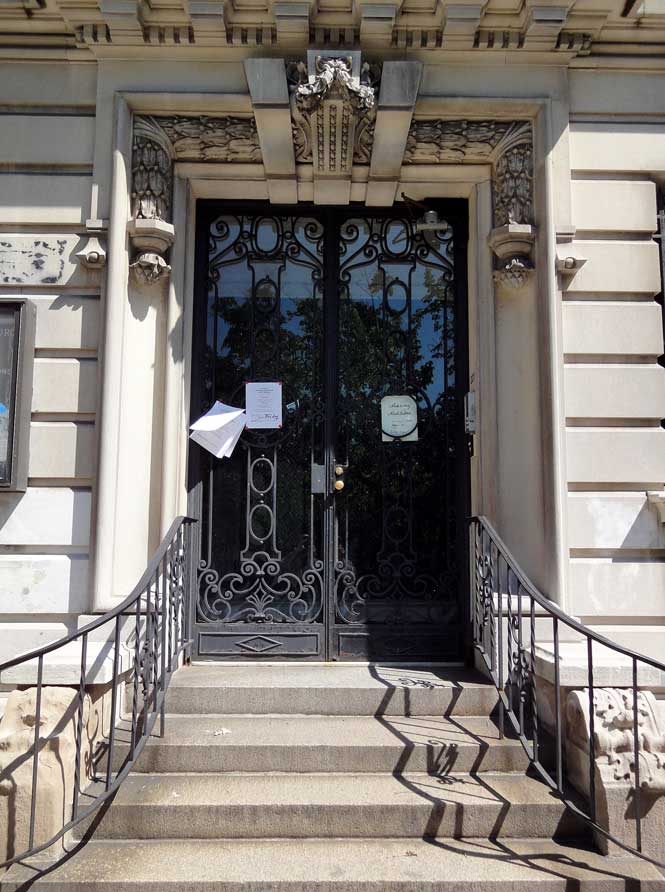
– photo by the Hermetic Hungarian
331 Riverside Drive, the main building, was formerly the Marion Davies House, built in 1902 in the Beaux Arts style by architects Janes & Leo. 332 Riverside Drive, the annex and social center, was built in 1963 in the then-popular International Style by architects Kelley & Gruzen.
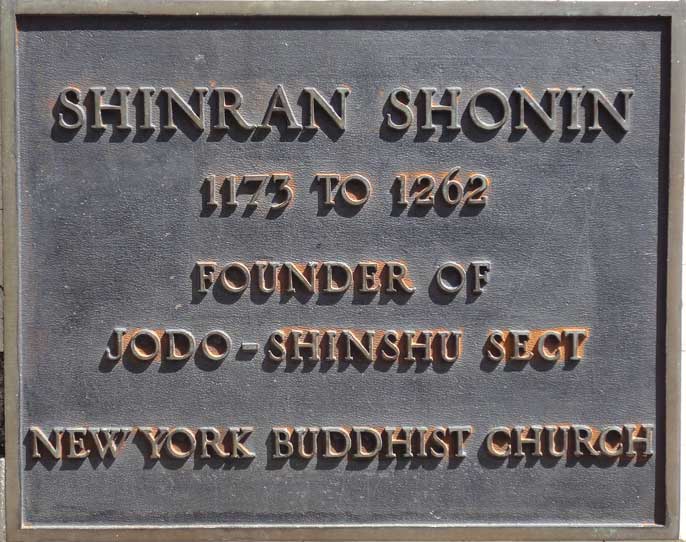
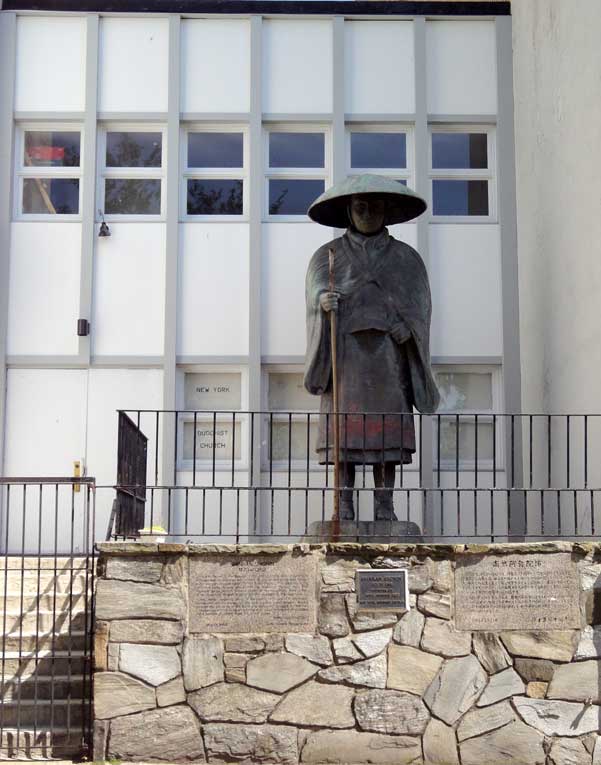
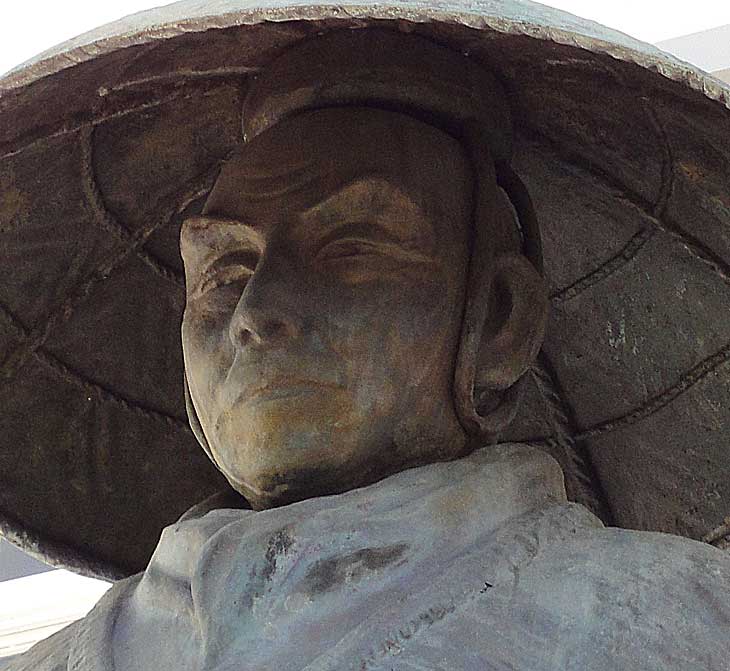
Standing in front of the annex, looking out across the Hudson River, is a tall bronze statue of Shinran Shonin (1173 – 1262), the founder of the Japanese True Pure Land school. Statues like this one grace the entrances of Pure Land Buddhist temples worldwide. However, this particular statue was originally in Hiroshima and survived the atomic bomb.
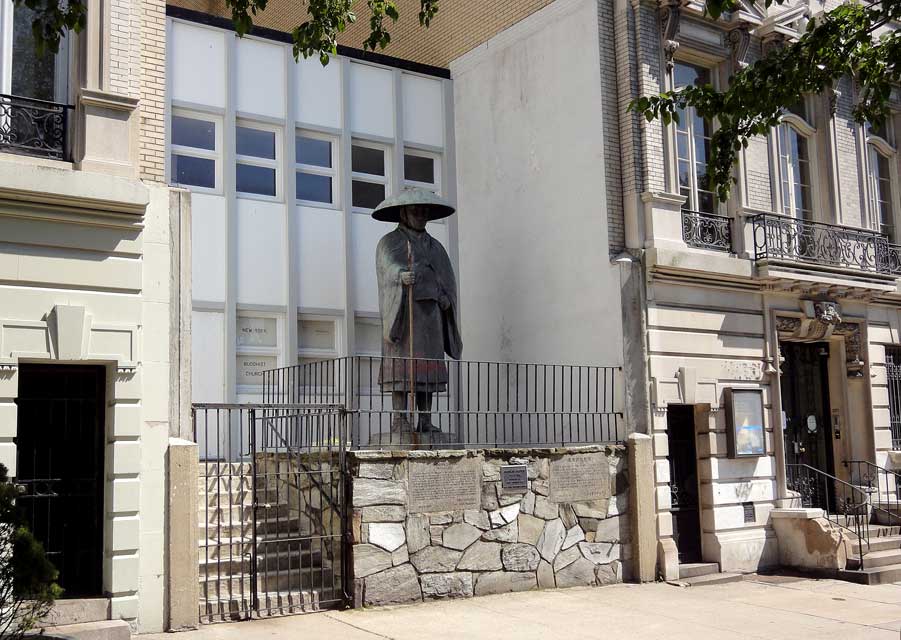
– photo by the Hermetic Hungarian
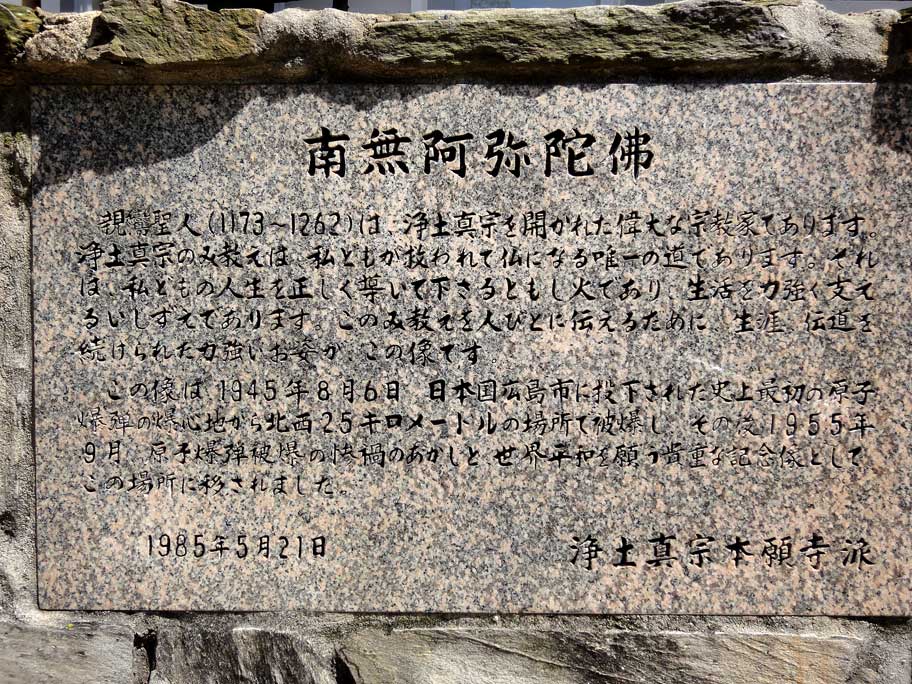
This statue originally stood about 8,000 feet from Hiroshima’s ground zero. It was one of the few cultural artifacts to survive the blast from that close distance. The statue was brought to the United States and installed in its its current location in 1955. Besides being a symbol of the founder of the Pure Land School, it is a reminder of both the terrible devastation wrought by atomic weapons and of fervent hopes for world peace.
Every August 5th at 7:15pm – corresponding to 8:15am August 6th, Hiroshima time — the temple bell is sounded, and the Buddhist and local communities gather around the statue, silently commemorating the Hiroshima bombing.
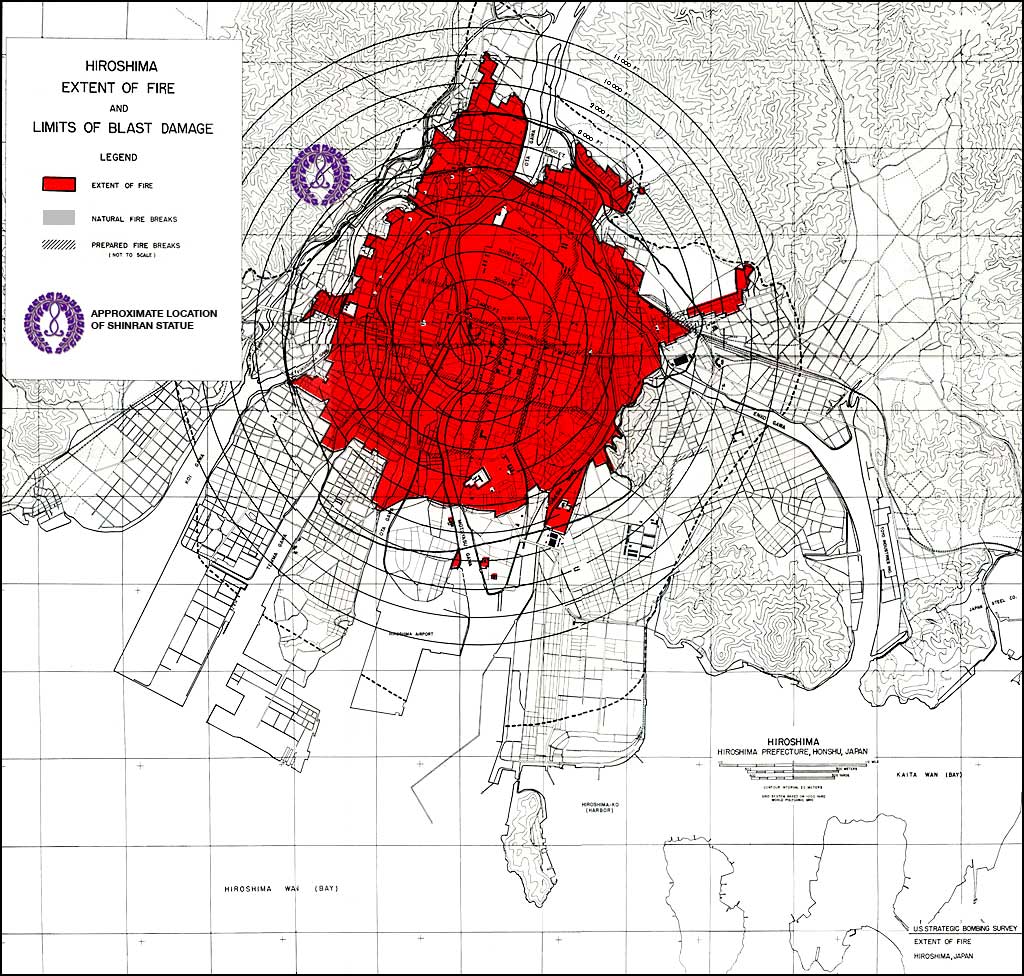
Shinran was born into a powerful Regent family in 1173. Shinran was inducted into the Imperial Court-sponsored Esoteric (Japanese Tendai ) Buddhist community. This esoteric school had been brought from China in the 8th century, and was a favorite among the nobility and educated classes. It was a complex, intellectual, esoteric, and demanding school which required difficult practices of its adherents. For 20 years Shinran tried without success to follow the practices. He became disillusioned, and wanted to leave the monastery to study a simpler Buddhism being taught in Kyoto.
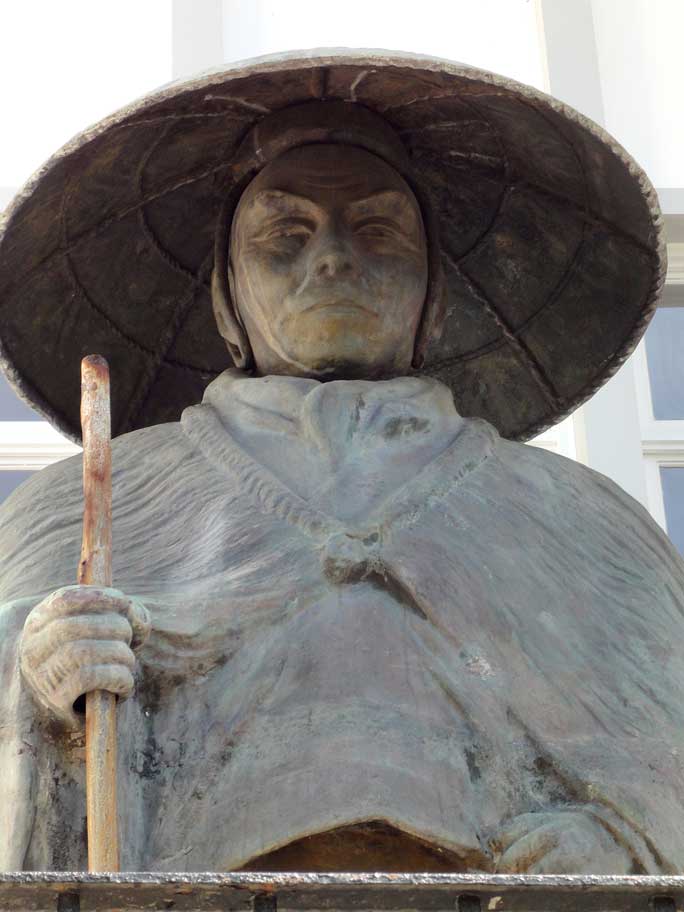
– photo by the Hermetic Hungarian
Because of his abandonment of the Court-supported school, Shinran was exiled to the provinces to live as a commoner, with farmers, merchants, fishermen, and artisans. Living away from the heady atmosphere of the monastery, Shinran soon realized that if he himself was unable to perform the difficult practices required by the Buddhist schools of the nobility, surely people with little education who were busy eking out a living from day to night had little chance of achieving enlightenment through the then-accepted means. He felt strongly that there must be another way – after all the Buddha’s original teaching was one of universal enlightenment.
Having studied with earlier teachers of Pure Land, Shinran was familiar with the teachings which detailed the Buddha Amida’s (Sanskrit Amitabha) vows not to become a fully enlightened Buddha until everyone who had relied upon him had become enlightened.
– photo by the Hermetic Hungarian
The primary practice of Pure Land Buddhists, whether Japanese, Chinese, Vietnamese, or Korean, is chanting the name of Amida Buddha. In Japanese the chant is “Namu Amida Butsu”, translated as “I humbly bow to Amida Buddha”.
– photo by the Hermetic Hungarian
The external manifestation of this practice is that if one chants with sincerity and respect, asking for Amida Buddha’s help and guidance, then one will be reborn in the Pure Land in the West from which enlightenment is possible for ordinary people.

– photo by the Hermetic Hungarian
The corollary is that no matter how difficult and rigorous the practices undertaken in this life, it is almost impossible for ordinary people to transcend mundane existence. Pure Land practitioners place not just their faith but their hopes for eventual enlightenment in the hands of Amida Buddha.
– photo by the Hermetic Hungarian
The internal manifestation of Pure Land practice is that chanting name of Amida Buddha helps practitioners realize that the Pure Land is here and now, within ourselves. Faith in Amida Buddha awakens a deep spirituality, gratitude, and humility in the practitioner. This in turn allows the practitioner to live in the Pure Land while living in the world. And the physical act of chanting slowly leads the practitioner to inner calmness and fosters insight into true reality.
– photo by the Hermetic Hungarian
Pure Land Buddhism has the largest number of adherents of any Buddhist school in the world. In Japan alone there are over 10,000 Pure Land temples. Throughout China and Vietnam there are an unknown number of Pure Land temples, due to historic governmental suppression of religion; however, Pure Land is the largest Buddhist school in both countries. Pure Land has also greatly influenced Korean and Tibetan Buddhist practices. Buddhist practice is heterogenous, and different schools adapt each others’ practices when appropriate.
The members of the New York Buddhist Church, and their leader Rev. T. Kenjitsu Nakagaki, serve the Japanese community of Manhattan with Sunday services, Japanese dharma classes, and special events. They also warmly welcome welcome anyone seeking to understand more about Pure Land, offering services, classes, and discussions in English, hoping to embrace the wider community. They have been enthusiastically welcoming anyone interested for the last 72 years.
after cycles incalculable

– photo by Mitch Waxman
The Romans had one of their very practical holidays scheduled for this week of the year, a mostly forgotten rite called the Lemuralia.
from wikipedia
In Roman religion, the Lemuralia or Lemuria was a feast during which the ancient Romans performed rites to exorcise the malevolent and fearful ghosts of the dead from their homes. The unwholesome spectres of the restless dead, the lemures or larvae were propitiated with offerings of beans. On those days, the Vestals would prepare sacred mola salsa, a salted flour cake, from the first ears of wheat of the season.

– photo by Mitch Waxman
The notion of vengeful ghosts, whom the Romans would call- in hushed whispers- the Larvae is ancient and seems to be bred into the human specie.
Those who celebrated the Lemuralia, walked barefooted, washed their hands three times, and threw nine times black beans behind their backs, believing by this ceremony to secure themselves against the Lemures (Varro, Vita pop. Rom. Fragm. p241, ed. Bipont.; Servius, ad Aen. I.276).

– photo by Mitch Waxman
The Egyptians had their Khu, and China has the Hungry Ghosts, even the Inuit tradition carries a haunting cadre of supernormal entities.
from wikipedia
In Roman mythology, lemures (singular lemur) were shades or spirits of the restless or malignant dead, and are probably cognate with an extended sense of larvae (sing. larva = mask) as disturbing or frightening. Lemures is the more common literary term but even this is rare: it is used by Horace, and by Ovid in his Fasti. Lemures may represent the wandering and vengeful spirits of those not afforded proper burial, funeral rites or affectionate cult by the living: they are not attested by tomb or votive inscriptions. Ovid interprets them as vagrant, unsatiated and potentially vengeful di manes or di parentes (ancestral gods of the underworld). To him, the rites of their cult suggest an incomprehensibly archaic, quasi-magical and probably very ancient rural tradition. Much later, St. Augustine describes both the lemures and the larvae as evil and restless manes that torment and terrify the living: lares, on the other hand, are good manes.

– photo by Mitch Waxman
Of course, our life here in the Newtown Pentacle is defined by more mundane concepts and material realizations. The Larvae we experience in early May, like these enigmatic critters found near the Hunters Point Ave. Station on Skillman Avenue, are decidedly “normal” and also happen to be native New Yorkers.
Your humble narrator has stumbled before, but with extensive comparison to extant critter speciation via the google… I’m going to go out on a limb here and proclaim these squirming masses of endless hunger Malacosoma Americanum!!! That’s the Eastern Tent Caterpillar to you, Lords and Ladies!!!
and apologies for the “out on a limb” pun- couldn’t resist…
(and also, I could be totally wrong- but these guys look like Malacosoma Americanum to me- if you can confirm or deny, please leave a comment)
from wikipedia
The newly hatched caterpillars initiate the construction of a silk tent soon after emerging. They typically aggregate at the tent site for the whole of their larval life, expanding the tent each day to accommodate their increasing size. Under field conditions, the caterpillars feed three times each day, just before dawn, at mid-afternoon, and in the evening after sunset. During each bout of feeding the caterpillars emerge from the tent, add silk to the structure, move to distant feeding sites en masse, feed, then return immediately to the tent where they rest until the next activity period. The exception to this pattern occurs in the last instar when the caterpillars feed only at night. The caterpillars lay down pheromone trails to guide their movements between the tent and feeding sites. The insect has six larval instars. When fully grown, the caterpillars disperse and construct cocoons in protected places. The adult moths (imago) emerge about two weeks later. They are rather strictly nocturnal and start flying after nightfall, then possibly stop some hours before dawn. Mating and oviposition typically occur on the same day as the moths emerge from their cocoons; the females die soon thereafter.

– photo by Mitch Waxman
Positively raining down from the trees, vast chaotics of these crawlers were observed the other day trying to cross Skillman Avenue, heading eastward.
The Eastern Tent Caterpillar, Malacosoma americanum (Fabricius) is reported to have been present in the United States since the 1600’s, and is responsible for forming unsightly silk-webbed nests at branch forks. Their population peaks every 8 to 10 years, when large infestations can completely defoliate trees in late spring/early summer.

– photo by Mitch Waxman
Virtually impossible to find footing which did not render a horrible and crushing extermination, I nevertheless scuttled forth and picked my way amongst them. In the back of my mind, I wondered what evolutionary adaptations they might have developed to accommodate the environmental hostility of this section of Long Island City. There is a High School across the street, of course- surrounded by the tunnels, trains, highways, bridges, and the cemented reality of an area defined by the junction of the main waterway of the Newtown Creek with its bubbly tributary- the canalized Dutch Kills. Just a block away is the Empty Corridor.
from esf.edu
These caterpillars produce the conspicuous silken tents commonly seen in the spring on branches of favored host trees. The tents consist of numerous layers of dense silk webbing which contain much excrement and numerous molted skins.
The female moths are dull reddish-brown with a wing expanse of 1 1/2 to 2 inches. Males are smaller. The front wings of each are crossed by two whitish, oblique, parallel lines.
Mature larvae, or caterpillars, are 2 to 2 1/2 inches long. The head and body are generally deep black. There is a white stripe along the back of the body and a row of oval, pale blue spots on each side. There are many short, irregular brownish markings on the side of each body segment. Long, fine, brown hairs sparsely clothe the body.

– photo by Mitch Waxman
These wriggling americans were pursuing some unknown goal in the direction of that High School, and the actions of automotive traffic along Skillman Avenue upon their migration is a detail best left unheralded. Vast hatcheries of avian predators swirled above.
from nysipm.cornell.edu
Manual destruction of egg masses and tents is an excellent way to control populations. Be advised that the hairs on caterpillars may be irritating to skin.
Twigs encased by egg masses should be pruned out. Tents can also be pruned out or be destroyed by winding around a stick or with a strong jet of water (the best time to destroy tents is before caterpillars leave to feed). Do not attempt to burn tents as this can cause more harm than good.
Tent destruction has another benefit in that it exposes caterpillars to birds and other natural enemies which can help keep populations in check. Eastern tent caterpillars are parasitized by braconid, ichneumonid, and chalcid wasps.
Other control options are available: Bacillus thuringiensis var. kurstaki is useful in the early spring when applied to young larvae, as is insecticidal soap which should be used when caterpillars are out of tents and feeding on leaves. Take care to avoid applying soaps in unsuitable weather conditions (like hot temperatures) as this can lead to phytotoxicity and leaf damage.

– photo by Mitch Waxman
The univoltine holocaust playing out all around me forced me to rumination, a meditative practice whose purpose is to ward off the periodic moments of panic and fainting which have so afflicted me in the past. Feckless quisling and physical coward both, your humble narrator revels in heroic tales of the past, for the future is a paralysis of logical progressions and dire portent.
from wikipedia
The origin of the festival of All Saints celebrated in the West dates to May 13, 609 or 610, when Pope Boniface IV consecrated the Pantheon at Rome to the Blessed Virgin and all the martyrs; the feast of the dedicatio Sanctae Mariae ad Martyres has been celebrated at Rome ever since. The chosen day, May 13, was a pagan observation of great antiquity, the culmination of three days of the Feast of the Lemures, in which the malevolent and restless spirits of the dead were propitiated. Liturgiologists of the Middle Ages based the idea that this Lemuria festival was the origin of that of All Saints on their identical dates and on the similar theme of “all the dead”.
The feast of All Saints, on its current date, is traced to the foundation by Pope Gregory III (731–741) of an oratory in St. Peter’s for the relics “of the holy apostles and of all saints, martyrs and confessors, of all the just made perfect who are at rest throughout the world”, with the day moved to November 1.

– photo by Mitch Waxman
Negative thoughts, though, on a sunny warm day in the City of Greater New York will only attract attention to you. Best to throw open the psychic windows and air the mental house out, clean up and organize for the coming summer. Perhaps the Romans had something after all, the Lemuralia was always accompanied by a general cleaning of the home, a spring cleaning.
from wikipedia
On Sunday, 13 May 1917, ten year old Lúcia Santos and her younger cousins, siblings Jacinta and Francisco Marto, were tending sheep at a location known as the Cova da Iria near their home village of Fátima in Portugal. Lúcia described seeing a woman “brighter than the sun, shedding rays of light clearer and stronger than a crystal ball filled with the most sparkling water and pierced by the burning rays of the sun.” Further appearances are reported to have taken place on the thirteenth day of the month in June and July. In these, the woman exhorted the children to do penance and to make sacrifices to save sinners. The children subsequently wore tight cords around their waists to cause pain, abstained from drinking water on hot days, and performed other works of penance. Most importantly, Lúcia said that the lady had asked them to pray the rosary every day, repeating many times that the rosary was the key to personal and world peace. This had particular resonance since many Portuguese men, including relatives of the visionaries, were then fighting in World War I.
According to Lúcia’s account, in the course of her appearances, the woman confided to the children three secrets, now known as the Three Secrets of Fátima.

– photo by Mitch Waxman
The Lemures are always with us, after all, and they’ll always be back.
Have a good day on the 13th of May, eat something bad for you with someone you love- and fellows- wash your hands and throw some black beans around the neighborhood later. You never know.
I really have to recommend against walking bare footed, however.


