Posts Tagged ‘photowalk’
The Hermetic Hungarian responds

Down under the Hell Gate Bridge Onramp- DUHGBO – photo by Mitch Waxman
A recent posting- Hungry Ghosts– detailed the lengthy and pedantic debate over the merits of Film vs. Digital photography enjoyed by myself and that erudite Manhattanite known to long time readers of this Newtown Pentacle as the Hermetic Hungarian.
The Hungarian responds:
32. Not 22. Two times 16. And they are all great. Ain’t gonna scan ’em. Projected ’em from my 2-1/4″ slide projector. Dee-lish.
And it’s not that I dislike digital, it’s that there is no digital equivalent of black & white. A photo-chemical process which leaves traces of its origins throughout the process. Palimpsests. Ghosts.
I’m probably gonna get a G-11 or used G-10 (it was the stupid human interface that put me off the S-90, not to mention Adobe’s brain-dead policies) to fool with while I wait for version 2 of Leica’s digital M-9 to come out. Upon which I will then be able to attach all but two of my 14 Leica lenses. (To be fair, one of my lenses can only go on my vintage 1948 Leica IIIf due to the extreme distance the rear element projects into the body. It would kill a modern body with a built-in meter).
–Légmentesen Magyar AKA “HH”

Review Ave. trucking – photo by Mitch Waxman
Back on track tomorrow, with a proper posting, did you realize we’re in the midst of the Lemuralia?
effulgent valleys

– photo by Mitch Waxman
I went over to St. Michael’s Cemetery again last week to see if there were any developments on the ritual site which Our Lady of the Pentacle and I found a few weeks ago. A hypothesis of mine that this ritual site is being “worked” on a lunar schedule seems to be bearing fruit.
For the first post on this curious altar- “City of Marble and Beryl“, in Astoria’s St. Michael’s Cemetery- click here
for a link to a google map, showing the location as recorded by GPS, click here

– photo by Mitch Waxman
Intriguing are the differences between the last set of offerings, ritual devices, and this grouping, although the setting remains the same. Also, to be absolutely clear- this is not staged in any way, and represents exactly what I observed in situ.

– photo by Mitch Waxman
The brownish cylinder appeared to be a cigar, and the white candle’s wick was blacked but the wax was nearly pristine.

– photo by Mitch Waxman
A set of bleached bones seemed to have been arranged in some non random pattern.

– photo by Mitch Waxman
There were also holes punched in the dirt, which could just be the action of wildlife of course, but the soil of the graveyard was depressed inward without the characteristic mound of surface tailings left behind by those that burrow. It appeared that something had been stuck into the soil.

– photo by Mitch Waxman
Also, amongst the bones, were coins.

– photo by Mitch Waxman
To the north was a glass with a white candle inside of it, approximately 25 feet away.

– photo by Mitch Waxman
The candle’s glass was broken, if that means anything.
– photo by Mitch Waxman
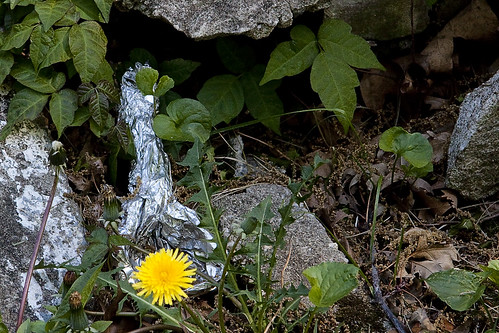
On the west face, this ladle shaped molding of aluminum foil was extant.

– photo by Mitch Waxman
Here’s the whole scene, the center stone seems to be the main altar- it’s where the cigar, bones, and coins as well as the unconsumed candle were observed. The ladle was to the west, on the downward slope, and candle in the glass to the north at the right of the shot.

– photo by Mitch Waxman
The line of monuments in this section are very old, and many of the legends on the stones are faded away, here in St. Michael’s St. George section.
Circumnavigation 2

– photo by Mitch Waxman
Onboard the Circle Line, as it passed the Lower Manhattan Financial District, I spotted a couple of interesting things. The Meagan Ann tugboat was pulling a barge of shredded autos, which were reduced to their basic components at an industrial location found along that canalized exemplar of municipal neglect called the Newtown Creek, just up the river.
Here’s a shot of that Newtown Creek auto shredding operation which I took last year:

– photo by Mitch Waxman

– photo by Mitch Waxman
Meagan Ann is a twin-engine, 2,250 HP coastal towing tug, built in 1975 and rebuilt in 1988, approximately 81 feet long and formerly known as the Scorpius. It is owned and operated by Donjon Marine towing, Inc.
from donjon.com
Since its incorporation in 1966, Donjon Marine has established and continues to seek long-term client relationships in a world where limited business resources demand a constant balancing of expenditures. Beginning with its foundation in the New York area as a pioneer in marine salvages services, Donjon has grown to become a leader in both conventional and environmental dredging. Our areas of expertise also include recycling, land and marine demolition, pollution control and remediation, heavy lift transport, marine transportation and landfill remediation/site management. Donjon and its affiliates maintain offices, assets and personnel throughout the Northeast, with operations spanning the globe.

– photo by Mitch Waxman
Also witnessed by your humble narrator were regular comings and goings of Helicopter flights from the East River Piers found alongside the Financial District. It’s a Eurocopter AS-350B-2 Ecureuil, based at the West 30th street Heliport and operated by Liberty Helicoptors.
The largest helicopter sightseeing and charter service in the Northeast. Liberty Helicopters is currently the only authorized helicopter sightseeing company in New York City. We began in the charter business on April 22, 1986 and added sightseeing tours of New York City originating from the VIP heliport on September 6th, 1990. At that time, Liberty had begun an aggressive plan selling in both the domestic and international markets. Using our strong customer base afforded us the opportunity to open a second location at the downtown Manhattan heliport in 1995. Liberty Helicopters was not only the first company to operate sightseeing tours from this multi-million dollar facility, but also the first to offer our customers the convenience of two Manhattan locations. On May 1, 2004, we opened a third heliport at the Paulus Hook Pier located in the newly developed area of the Colgate section of Jersey City, N.J. In addition to our “once in a lifetime” helicopter tours, this facility operates both commuter and sightseeing ferry services, making it a very accessible facility to Manhattan.

– photo by Mitch Waxman
Of course, once we reached the grandest structure in the entire megalopolis (if you consider New York City to be composed of individual parts as opposed to being one gigantic system of transit, power, and satellite cities that stretches for hundreds of miles in every direction) your humble narrator forgot all about Sludge boats, Tugs, and aircraft. I’m always amazed at the scale and classical proportions of the Brooklyn Bridge.
from wikipedia
The Brooklyn Bridge is one of the oldest suspension bridges in the United States. Completed in 1883, it connects the New York City boroughs of Manhattan and Brooklyn by spanning the East River. At 5,989 feet (1825 m), it was the longest suspension bridge in the world from its opening until 1903, and the first steel-wire suspension bridge.
Originally referred to as the New York and Brooklyn Bridge, it was dubbed the Brooklyn Bridge in an 1867 letter to the editor of the Brooklyn Daily Eagle, and formally so named by the city government in 1915. Since its opening, it has become an iconic part of the New York skyline. It was designated a National Historic Landmark in 1964.

– photo by Mitch Waxman
If it hasn’t been recommended to you yet, by me or others, I have to sing the praises of “The Great Bridge by David McCullough” which details the design and construction of the Brooklyn Bridge as well as providing a real “slice of life” about 19th century New York City. My preference for audiobooks is satisfied by the version available at apple’s iTunes store, and you could do worse things with your hard earned money than pick up the print edition at amazon.
from wikipedia
Born and raised in Pittsburgh, McCullough attended Yale University, earning a degree in English literature. His first book, The Johnstown Flood, was published in 1968; he has since written seven more on topics such as Harry S. Truman, John Adams, and the Brooklyn Bridge. McCullough has also narrated multiple documentaries, as well as the 2003 film Seabiscuit; he also hosted American Experience for twelve years. Two of McCullough’s books, Truman and John Adams, have been adapted into a TV film and mini-series, respectively, by HBO. McCullough’s next work, about Americans in Paris between the 1830s to the 1930s, is due out in 2010.

– photo by Mitch Waxman
I don’t remember who the quote is attributed to, but the Ken Burns PBS documentary “Brooklyn Bridge” embedded a notion into me a while back that “all of modern heroic New York began with the building of the Brooklyn Bridge”. I tend to agree with this maxim.
from endex.com
After sixty years of political, financial and technical discussions (including a 6 lane tunnel proposal in the 1830’s), John Roebling’s plan was approved, the New York Bridge Company was formed and, in 1869, construction of the bridge finally began.
The bridge was built over 14 years in the face of enormous difficulties. Roebling died as a result of an accident at the outset; a fire in the Brooklyn Caisson smoldered for weeks; Roebling’s son, Washington, who took over as chief engineer, suffered a crippling attack of the bends during the construction of the Manhattan Caisson, and continued to direct operations, sending messages to the site by his wife, Emily. After the towers were built, a cable parted from its anchorage killing two people; there was fraud perpetrated by the cable contractor.
In the end, John Roebling’s prediction that the promenade above the deck will be “of incalculable value in a crowded commercial city” was justified, together with his perhaps most noted statement, claiming that “the great towers…will be ranked as national monuments. …As a work of art, and a successful specimen of advanced bridge engineering, this structure will forever testify to the energy, enterprise, and wealth of that community which shall secure its erection.”
On May 24, 1883, with schools and businesses closed, the Brooklyn Bridge, also referred to as the “Great East River Bridge”, was opened. Scores of people attended this spectacular ribbon cutting event. Over 100 years later, its renowned beauty & stature is still admired by many New Yorkers & tourists alike.

– photo by Mitch Waxman
The shot above is actually from last year (2009), but gives a good sense of the intricate series of roads and onramps that allow Manhattan traffic egress to the bridge.
from pbs.org
- Although he was physically able to leave his apartment, Washington Roebling refused to attend the opening celebration honoring his remarkable achievement.
- The bridge opened to the public on May 24, 1883, at 2:00 p.m. A total of 150,300 people crossed the bridge on opening day. Each person was charged one cent to cross.
- The bridge opened to vehicles on May 24, 1883, at 5:00 p.m. A total of 1,800 vehicles crossed on the first day. Vehicles were charged five cents to cross.
- Today, the Brooklyn Bridge is the second busiest bridge in New York City. One hundred forty-four thousand vehicles cross the bridge every day.
hungry ghosts

– photo by Mitch Waxman
On a recent sunlit afternoon, the Hermetic Hungarian ventured forth from the Shining City once again. Recovered from a spell of bad dreams which our recent visit to the Grand Ave. Bridge- with all its loathsome implications- had awakened in him, the studied recluse announced that a new digital camera was in his possession which needed a test drive. Always an atavist and luddite, the Hermetic Hungarian (HH from this point on) had already decided that it was inferior to the chemical emulsion process of image capture- film- which he has spent much time mastering.
This, like the Mac vs. PC debate, is a conversation that your humble narrator does not wish to have anymore.
from wikipedia
Operating system advocacy is the practice of attempting to increase the awareness and improve the perception of a computer operating system. The motivation behind this may be to increase the number of users of a system, to assert the superiority of one choice over another or out of brand loyalty, pride in an operating system’s abilities, or to persuade software vendors to port specific applications or device drivers to the platform.
Operating system advocacy can vary widely in tone and form, from published comparisons to heated debates on mailing lists and other forums. In its most extreme forms it can veer into zealotry. Advocates are often normal users who devote their spare time to advocacy of their operating system of choice; many have a deep and abiding interest in the use, design and construction of operating systems and an emotional investment in their favourite operating system.

– photo by Mitch Waxman
Allow me to lift the curtain for this post- and talk shop.
Once upon a time, in the brash days of youth, I too shot film. I carried a Yashica FX3 fully manual, 1984 vintage camera, which I still have. Unfortunately, the cost of the film itself and the consequent expense of development and printing cramped my urge to shoot and shoot. For years, I had a goofy point and shoot 35mm camera, which has long disappeared into gadget heaven. When the Canon Elph’s first came out, I was hooked on digital and haven’t looked back since. Yes, the recording medium of film is capable of capturing and storing FAR more information than a digital shot can- even today. But- as I’ve mentioned in the past- I work in the advertising industry.
from nycgovparks.org
Astoria Park, on the west shore of Queens, extends from south of the Triborough Bridge to north of the Hell Gate Bridge. With a panoramic view of the skyscrapers of midtown Manhattan in the south to the Hell Gate channel in the north, the scenery presents the diverse landscape of New York City. The Hell Gate channel, formed by faults deep underground, contains some of the deepest water in New York Harbor. Its treacherous reefs bear picturesque names such as “Hen and Chickens,” “Pot Rock,” “Bread & Cheese,” and “Bald Headed Billy.”
Throughout the centuries the stunning natural beauty of this location has attracted visitors and settlers. Before the arrival of European colonists, a trail passed by the site, and an Indian village flourished at Pot Cove. Local inhabitants grew maize on the shores, fished in Hell Gate, and drew water from Linden Brook, a small stream that still flows under Astoria Park South. In the mid-1600s the Dutch parceled out this land to various owners, including William Hallet whose grant embraced hundreds of acres. During the American Revolution, several British and Hessian regiments were stationed in the area. On November 25, 1780 the frigate Hussar and its five-million-dollar cargo sank to the bottom of Hell Gate, where despite some removal of cannons, the treasure still remains.

– photo by Mitch Waxman
What used to happen when a photo entered the agency was that a medium or large format “chrome”- which is a sort of giant slide- would be handed off from photographer to agency (and still does, sometimes). This chrome would then be photostat reproduced (in the very old days) and it’s “for position only or F.P.O.” representation would be worked into a mechanical board so that the printer would understand where to place it or “strip it in”. When the Macintosh came along, the chrome would instead be scanned, at first by highly specialized devices called drum scanners and later by advanced versions of tabletop scanners.
The digital scan actually matters more than the original at this moment, and the tipping point from film to digital was reached when the ad agencies began requesting digital files from their photographers.
from omh.state.ny.us
Kirby Forensic Psychiatric Center, a maximum security hospital of the New York State Office of Mental Health (OMH), opened in 1985 and provides secure treatment and evaluation for the forensic patients and courts of New York City and Long Island. Most patients are received through the courts under Criminal Procedure Law (CPL) or through the OMH Commissioner’s office via the New York State Code of Rules and Regulations (NYSCRR) regarding hospitalization of the mentally ill.
Treatment is provided in accordance with the current standards of professional care outlined by the Joint Commission of Accreditation of Health Organizations (JCAHO) and is carried out with respect for each patient’s privacy and rights, in agreement with his/her level of functioning and need for security. KFPC has an active staff education program as well as academic affiliations with several metropolitan area colleges and universities, to help assure quality treatment and state of the art care.
and from wikipedia
The Manhattan Psychiatric Center is a New York-state run psychiatric hospital on 125th Street on Ward’s Island in New York City. As of 2009 it had 509 beds. The current building is 14-stories tall.
The hospital’s roots date to 1848 when Ward’s Island was designated the reception area for immigrants. Some additional structures were originally part of Blackwell’s Island Lunatic Asylum, which opened around 1863.
The building was significantly enlarged in 1871, and a Kirkbride Plan style building was built. After the immigration entry shifted to Ellis Island in 1892 the state took it over from Manhattan in 1899 and expanded it even further. At the time, it had 4,400 beds and was the largest psychiatric hospital in the world.
At the time it was one of two psychiatric hospitals for residents of Manhattan that had been take over by the state. The other psychiatric hospital would become the Central Islip Psychiatric Center in Central Islip, New York. Both hospitals were referred to as Manhattan State Hospital.
It later became the Manhattan Psychiatric Center. The facility is currently run by the New York State Office of Mental Health.

– photo by Mitch Waxman
Its taken the camera companies a while to catch up with the desktops, but they’re getting close- the high end Canons, for instance, do 25.3 megapixel shots (which I’ve retouched and let me say that these are well wrought images).
My current cameras- the Canon G10 and Canon T1i both hit 15 megapixels, giving me ample detail and clarity. I’ve got fairly quick SDHC cards in them, which allows burst shooting, and at any given time I’m ready to pop off a couple of thousand exposures. The batteries in both are rechargeable, and once the photos are copied to my desktop- the cards are formatted and used over and over. Film never offered me this kind of freedom to just shoot and shoot.
from wirednewyork.com
The massive beauty and advanced technology of the Hell Gate Bridge (more properly the New York Connecting Railroad Bridge) contrast sharply with nineteenth-century descriptions of the channel that it spans. Named for the dangerous rocks and perilous waters at the confluence of the East and the Harlem Rivers, Hell Gate is surrounded by Manhattan, Queens, and three islands: Wards, Randalls, and Roosevelt (formerly called Blackwell’s, then Welfare). Philip Hone (1780 -1851), writing of an 1844 visit there, described “the delightful scene: the clumps of fine old trees clothed in the gorgeous foliage of autumn, the lawn still bright and green, the mild, refreshing breeze, the rapid waters of Hell Gate covered with sailing vessels and steamboats -all combined to present a picture of consummate beauty.“

– photo by Mitch Waxman
HH, however, feels limited by digital- as do other “old school” photographers encountered during my long walks through and around the Newtown Pentacle. He lugs around a gigantic medium format film camera, which is a best of breed sort of machine. Coney Island Mike, another friend of the Pentacle, also decries the prevailing winds of technological advancement and pines for some 1970’s golden age of film availability and creative darkroom techniques.
I really do see the point, as mentioned above, film does capture and contain more information than any digital image can- so far.
from wikipedia
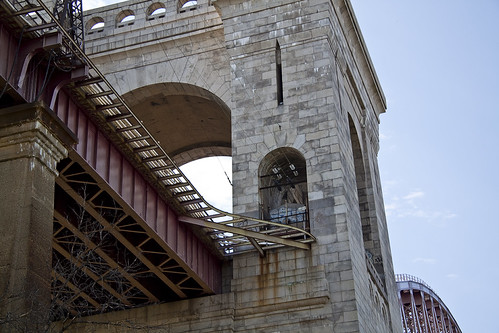
Construction was overseen by Gustav Lindenthal, whose original design left a gap of 15 feet (4.6 m) between the steel arch and the masonry towers. Fearing that the public assumed that the towers were structurally integral to the bridge, Lindenthal added aesthetic girders between the upper chord of the arch and the towers to make the structure appear more robust. The original plans for the piers on the long approach ramps called for a steel lattice structure. The design was changed to smooth concrete to soothe concerns that asylum inmates on Ward’s and Randall’s islands would climb the piers to escape.
The engineering was so precise that when the last section of the main span was lifted into place, the final adjustment needed to join everything together was 1⁄2 inches (12.7 mm). The bridge was completed on September 30, 1916.
– photo by Mitch Waxman
Back at my day job as photo retoucher and advertising industry print production specialist, however, I can tell you that its the digital file that’s going to the printer- not a piece of film. That makes anything shot in film second generation at best. Of course, many of the images I present here are highly processed- shot in raw format, sharpened or color corrected in photoshop, or produced by esoteric digital sleight of hand like “tilt shifting” or HDR.
(all the shots in this post are “straight” shots, raw files which were fed through my normal workflow)
from nycroads.com
PROVIDING A MUCH-NEEDED RAILROAD CONNECTION: In 1892, Oliver W. Barnes, an engineer associated with Pennsylvania Railroad president Alexander J. Cassatt and bridge designer Gustav Lindenthal, conceived plans for the Hell Gate Bridge. Cassatt saw the Hell Gate project – originally called the “East River Arch Bridge” – as an opportunity to bring rail traffic from Pennsylvania Railroad routes in New Jersey and points west through New York City to New England. The project was to also tie into the Long Island Rail Road routes, in which the Pennsylvania Railroad had a controlling interest. Meanwhile, Lindenthal saw the Hell Gate project as his chance to construct his Hudson River Bridge, a suspension bridge with a 2,800-foot-long main span that would have been the longest in the world. That same year, the New York Connecting Railroad was incorporated to help realize this plan.
In 1904, Lindenthal, who oversaw the opening of the Williamsburg Bridge and the construction of the ongoing Manhattan Bridge and Queensboro Bridge projects, was chosen as consulting engineer and bridge architect by the Pennsylvania Railroad, which had just acquired the New York Connecting Railroad. Under these auspices, Lindenthal was engaged in a project to connect the tracks of the Pennsylvania Railroad in New Jersey, the Long Island Rail Road in Queens, and the New York, New Haven and Hartford Railroad in the Bronx. Although the project allowed Lindenthal to design the Hell Gate span, it would not include his long-sought goal: a great suspension bridge across the Hudson River. Instead, the Pennsylvania Railroad decided to use exclusive tunnels for rail traffic across the Hudson and East rivers.

– photo by Mitch Waxman
One of the mantras that I’ve followed since my heady days at art school (School of Visual Arts) where I studied Illustration and Comic Book art is that you don’t need to use expensive mediums to make a good image. In accordance, my friends and I used to draw comics on brown paper bags or whatever other commonplace material we could procure. Later on in life, I will admit to the occasional red sable brush purchase, but by and large most of my “kit” came from staples and I’ve done comic cover art that was colored with Crayola Markers in the past.
I try to follow this philosophy with photography, which is the greatest way to spend money- short of crack addiction- that America has ever found.
from wikipedia
On June 15, 1904, the General Slocum caught fire and burned to the waterline in New York’s East River. At the time of the accident she was on a chartered run carrying members of St. Mark’s Evangelical Lutheran Church (German Americans from Little Germany, Manhattan) to a church picnic. An estimated 1,021 of the 1,342 people on board were killed. The General Slocum disaster was the New York area’s worst disaster in terms of loss of life until the September 11, 2001 attacks.[2] The events surrounding the General Slocum fire have appeared in a number of books, plays and movies through the years.

– photo by Mitch Waxman
Fantasies about radio triggers and tripods that cost more than my first car bounce in my head, and I fiend for trick and ultra wide angle lenses. I pore over the BH Photo catalog in the manner of a fetishist, but it’s just camera pornography to me. I can barely afford to feed my little dog Zuzu these days, and Our Lady of the Pentacle has suggested homespun garments for next winter. HH however, insists that no digital camera he’s yet found suits him. I suggested either a Canon G10 or G11 to him, or if portability was a consideration- the very attractive Canon S90.
from wikipedia
Amtrak is no longer required by law, but is encouraged, to operate a national route system.[ Amtrak has some presence in all of the 48 contiguous states except Wyoming and South Dakota. Service on the Northeast Corridor, between Boston, Massachusetts, and Washington, D.C., as well as between Philadelphia and Harrisburg, Pennsylvania, is powered by overhead wires; for the rest of the system, diesel locomotives are used. Routes vary widely in frequency of service, from three trips weekly on the Sunset Limited (Los Angeles, California, to New Orleans, Louisiana), to weekday service several times per hour on the Northeast Corridor, (New York City to Washington, D.C.) Amtrak also operates a captive bus service, Thruway Motorcoach, which provides connections to train routes.
The most popular and heavily used services are those running on the Northeast Corridor (NEC), which include the Acela Express, and Northeast Regional. The NEC serves Boston, Massachusetts; New York City; Philadelphia, Pennsylvania; Baltimore, Maryland; Washington, D.C.; and many communities between. The NEC services accounted for 10.0 million of Amtrak’s 25.7 million passengers in fiscal year 2007. Regional services in California, subsidized by the California Department of Transportation are the most popular services outside of the NEC and the only other services boasting over one million passengers per annum. The Pacific Surfliner, Capitol Corridor and San Joaquin services accounted for a combined 5.0 million passengers in fiscal year 2007.

– photo by Mitch Waxman
These shots, of course, were accomplished with my increasingly trusty DSLR- the Canon T1i, but the vast majority of photos you’ve endured at this blog have emanated from the Canon G10. The S90 is functionally a G10 with a smaller lens and form factor, will be dramatically discounted around Christmas, and HH ordered one to try out. That’s how we ended up in Astoria Park. Originally, we planned on walking the Triborough Bridge, but last minute information reached me that the Bridge has a series of “Photography Prohibited” signs posted and we decided that it just wasn’t worth the potential hassles with the law.
That’s what the eggheads call a “chilling effect on civil liberties” in action, by the way.
from railroad.net
As a retired TBTA sgt, I can definetly state that photography IS STRICTLY FORBIDDEN on all bridges & tunnels operated by that agency. This edict has been in effect for many years, but it was not strictly enforced before 9/11/01. It is now. Signs prohibiting “filming” are, (and have been all along) posted at all facilities. Summonses can, & usually will be issued (criminal court “C’ summonses) to filmers/videotapers who are seen “filming” on TBTA property (mainly bridges, tunnels and toll plazas, but also in other areas under control of the TBTA).

– photo by Mitch Waxman
Over the course of an hour or so, your humble narrator cracked out a couple of hundred exposures, a few of which were good enough to “show”. HH shot 22. I had mine “developed” and online within 48 hours (I was busy) and HH waited a full week for his transparencies to be shipped to him. Are HH’s shots superior to mine? I still don’t know, because he hasn’t managed to scan them yet. I’m not mocking him, nor deriding film, just stating that immediacy is a selling point for me as well.
As a good American, I crave and demand instant satisfaction, sometimes for urges I don’t know I have yet.
from wikipedia
Ward’s Island is situated in the East River in New York City. Administratively it is part of the borough of Manhattan. It is bridged by rail to the borough of Queens by the Hell Gate Bridge and it is joined to Randall’s Island to the north by landfill. The two Islands together are run by the Randall’s Island Sports Foundation under a partnership agreement with the New York City Department of Parks and Recreation. Together, the two islands form New York County’s Census Tract 240, which had a total population of 1,386 living on 2.2 km² of land area, according to the United States Census, 2000.
Viaducts leading to the Robert F. Kennedy Triborough Bridge and Hell Gate bridges pass overhead. Vehicular access is by the Little Hell Gate bridge from Randall’s Island, while a narrow pedestrian and bicycling bridge, Ward’s Island Bridge, links the island to the east side of Manhattan in Harlem.

– photo by Mitch Waxman
The Hermetic Hungarian of course, feels the least melancholy when surrounded by relict technologies. The upper west side rooms he occupies enjoy shelves of watch making equipment and rare mechanisms which originate in the darkest corners of Europe. His current project is to end time mechanically, freezing the world’s motion by the actions of a vast clockwork which he is assembling in accordance with instructions found on a scroll that might be written in Sanskrit that HH claims were scribed by some mad monk.
At my insistence, he has not installed a battery or self winding mechanism on the device, so sleep easily, my Lords and Ladies of Newtown.
from wikipedia
The Bhavacakra is represented as being held by the jaws, hands, and feet of a fearsome figure who turns the wheel. The exact identity of the figure varies. A common choice for the figure is Yama, the god of death or Kala the lord of time. This figure is also known as the “Face of Glory” or Kirtimukha.
There is always a figure or symbol in the upper left and the upper right. The exact figure or symbol varies; common examples include the moon, a buddha, or a bodhisattva. In the picture of the Tibetan Bhavacakra in Sera, Lhasa the clouds take the shapes of certain Buddhist symbols, eg. svastika.
Searching for Gilman

– photo by Mitch Waxman
For several months I have been searching Calvary Cemetery in a non systematic manner for 2 particular locations. Thwarted time and again by false leads and incorrect addressing, both sites have remained elusive. One grave is the final resting place of Tess Gardella– the actress who portrayed Aunt Jemima- and the other is that of an enigma from the early 20th century whose name was Gilman.
from wikipedia
Aunt Jemima is a trademark for pancake flour, syrup, and other breakfast foods currently owned by the Quaker Oats Company. The trademark dates to 1893, although Aunt Jemima pancake mix debuted in 1889. The Quaker Oats Company first registered the Aunt Jemima trademark in April, 1937.
The name “Jemima” is biblical in origin. Jemima is the King James Version’s rendering of the feminine Hebrew name יְמִימָה (Yəmīmā), the first of Job’s daughters born to him at the end of his namesake book of the Bible.
The term “Aunt Jemima” is sometimes used colloquially as a female version of the derogatory label “Uncle Tom”. In this context, the slang term “Aunt Jemima” falls within the “Mammy archetype”, and refers to a friendly black woman who is perceived as obsequiously servile or acting in, or protective of, the interests of whites. The 1950s television show Beulah came under fire for depicting a “mammy”-like black maid and cook who was somewhat reminiscent of Aunt Jemima. Today, the terms “Beulah” and “Aunt Jemima” are regarded as more or less interchangeable as terms of disparagement in popular discourse.

– photo by Mitch Waxman
Somewhere in the viridian depths of Calvary Cemetery lies an unremarked merchant from Massachusetts, who died in an accident along the delirious Newtown Creek in 1931. No obituary I can find discusses him, and Gilman slid unnoticed into the hallowed loam of Calvary’s charitable sections. His anonymity came to an end when, according to neighborhood sources and contemporary diarists, a relict 3 masted schooner arrived at the Penny Bridge docks and ordered an eccentric monument be erected on Gilman’s resting place. The captain of that black ship, a leathery bastard named Marsh, collected Gilman’s belongings and sailed via Newtown Creek to the East River, turning North toward Hell Gate- ultimately disappearing into the mists of Long Island Sound heading for New England.
from noaa.gov
Click here for : Hell Gate and Its Approaches
This nautical chart depicts Hell Gate, a narrow channel on the East River, at the confluence of the Harlem River, which connects Long Island Sound with New York Harbor. The chart shows Hell Gate in 1851, which is the year that the U.S. Army began blasting ledges and rocks within Hell Gate to ensure safe passage through the channel.

– photo by Mitch Waxman
Rumors that this man was the same Gilman mentioned by members of the Boston Police Department in 1920, in connection with investigations into a string of sensational murders and for connections to a certain group of anarchists thought to be operating within the city. The Back Bay area of Boston, of course, is associated with the illustrious architect Arthur Delevan Gilman– but there doesn’t seem to be any involvement with Calvary’s mysterious Gilman other than a tangential coincidence of names.
from wikipedia
The Back Bay neighborhood was created when a parcel of land was created by filling the tidewater flats of the Charles River. This massive project was begun in 1857. The fill to reclaim the bay from the water was obtained from Needham, Massachusetts. The firm of Goss and Munson, railroad contractors, built 6 miles (9.7 km) of railroad from Needham, and their 35-car trains made 16 trips a day to the Back Bay. The filling of present-day Back Bay was completed by 1882; filling reached the existing mainland at Kenmore Square in 1890, and finished in the Fens in 1900. The project was the largest of a number of land reclamation projects, beginning in 1820, which, over the course of time, more than doubled the size of the original Boston peninsula. It is frequently observed that this would have been impossible under modern environmental laws.
Back Bay’s development was planned by architect Arthur Gilman with Gridley James Fox Bryant. Strict regulations produced a uniform and well-integrated architecture, consisting mostly of dignified three- and four-story residential (or once-residential) brownstones.

– photo by Mitch Waxman
Both saint and sinner alike can be found in the emerald devastations of First Calvary- governors, mayors, and priests share in the loam with common laborer and notorious gangster. There are multitudes here, vast tomb legions awaiting only the advent of their messiah to rise and walk the earth. Gilman is amongst the many, lost in the crowd. I will find him, and the notable monument raised in his honor- it is just a matter of time.
from wikipedia
While the Christian doctrine of resurrection conforms to Jewish belief, there is, however, a minority point of view, held by certain Jewish mystics and others,[who?] which asserts that those Jewish beliefs are in contradiction with the resurrection as taught by Isaiah (Isaiah 8:16 and 26:19) and Daniel (12:1 and 13) in which the resurrection was understood as being a doctrine of physical ‘Rebirth’.
Jesus appears to have been in general agreement with the position held by the Pharisees, as illustrated by his response to a question regarding marriage at the resurrection (Matthew 22:23-32, Mark 12:18-27 and Luke 20:27-40).
Most Christian churches continue to uphold the belief that there will be a general resurrection of the dead at “the end of time”, as described Paul when he said, “…he hath appointed a day, in the which he will judge the world…” (Acts 17:31 KJV) and “…there shall be a resurrection of the dead, both of the just and unjust.” (Acts 24:15 KJV).
Many of the early Church Fathers cited the Old Testament examples listed in the Judaism section above as either foreshadowing Jesus’s resurrection, or foreshadowing or prophesying a future resurrection of all the dead.

– photo by Mitch Waxman
Gilman, I have no first name or exact date of interment- which intensifies the difficulty in locating him- was supposedly a dealer in far eastern art. What his purpose was in coming to the Newtown Pentacle remains shadowed. Veiled references to the illegal importation of statuettes from the south Pacific, and distribution of these items to radical theosophists and heretic Masons in the Greenpoint and Maspeth neighborhoods can be gleaned from antiquarian sources but nothing definite enough for the consideration of the Lords and Ladies of Newtown has emerged. The statuettes it is said, are the product of the lost Saudeleur culture from Nan Madol found on fabled Pohnpei, and an item of particular interest to certain occultists.
from wikipedia
Nan Madol was the ceremonial and political seat of the Saudeleur dynasty, which united Pohnpei’s estimated 25,000 people. Set apart on the main island of Pohnpei, it was a scene of human activity as early as the first or second century AD. By the 8th or 9th century islet construction had started, but the distinctive megalithic architecture was probably not begun until perhaps the 12th or early 13th century.
Little can be verified about the megalithic construction. Pohnpeian tradition claims that the builders of the Lelu complex on Kosrae (likewise composed of huge stone buildings) migrated to Pohnpei, where they used their skills and experience to build the even more impressive Nan Madol complex. However, this is unlikely because radiocarbon dates have placed the construction of Nan Madol prior to that of Lelu. Like Lelu, one major purpose of constructing a separate city was to insulate the nobility from the common people.
A local story holds that when Nan Madol was being built a powerful magician living in the well inhabited region on the northwest of the island was solicited, and that his help was a major factor in completing the buildings. In particular, he was responsible for supplying the huge stone “logs” used in much of Nan Madol by “flying” them from their source to the construction site.
…Supposedly there was an escape tunnel beginning at the center of Nan Madol and boring down through the reef to exit into the ocean. Scuba divers continue to look for this “secret” route, but so far a complete tunnel has yet to be discovered.

– photo by Mitch Waxman
Gilman is meant to have been killed in a curious accident on the Queens bank of Newtown Creek in Blissville, when a bail of paper fell from a second story warehouse window along the negligent shoreline of the Newtown Creek. Crushed, the peculiar condition of his body was remarked on by several hardened Detectives used to such sights. Speculations that he had been previously deformed by Polio or some other childhood disease were made, but before our era of “antigenic vaccination as public policy” was enacted, monstrous alterations of the human form by disease organisms were a common sight. Disfigurements caused by Smallpox and Leprosy or the ravages of Tertiary Syphilis are seldom observed by we happy few that enjoy the luxury of western modernity.
from wikipedia
Tertiary syphilis usually occurs 1–10 years after the initial infection, however in some cases it can take up to 50 years. This stage is characterized by the formation of gummas, which are soft, tumor-like balls of inflammation known as granulomas. The granulomas are chronic and represent an inability of the immune system to completely clear the organism. They may appear almost anywhere in the body including in the skeleton. The gummas produce a chronic inflammatory state in the body with mass effects upon the local anatomy. Other characteristics of untreated tertiary syphilis include neuropathic joint disease, which is a degeneration of joint surfaces resulting from loss of sensation and fine position sense (proprioception). The more severe manifestations include neurosyphilis and cardiovascular syphilis. In a study of untreated syphilis, 10% of patients developed cardiovascular syphilis, 16% had gumma formation and 7% had neurosyphilis.
Neurological complications at this stage can be diverse. In some patients manifestations include generalized paresis of the insane, which results in personality changes, changes in emotional affect, hyperactive reflexes and Argyll-Robertson pupil. This is a diagnostic sign in which the small and irregular pupils constrict in response to focusing the eyes, but not to light. Tabes dorsalis, also known as locomotor ataxia, a disorder of the spinal cord, often results in a characteristic shuffling gait.

– photo by Mitch Waxman
Somewhere, amongst those who eternal lie, is Gilman. The disturbing detail that troubled the Detectives who investigated the reports of his death, the one that made for saloon conversation and idle speculation by neighborhood wags, was the fact that this deceased dealer in illicit eastern art had six fingers on both hands and that these polydactyl appendages were webbed all the way to the nail beds. Not much could be said about Gilman’s face, for the rodent population of Newtown Creek had discovered him long before the Police did.
Additionally, his shorter than normal legs also bore long healed scars that suggested some intense surgical experience- participation in the Civil War was speculated on by area Police, when Gilman would have been a young man. Amongst his few possessions was a watercolor postcard of some southern Plantation labeled as “Carfax Plantation, James River, Virginia”, which was quite out of place in the pockets of a Massachusetts trader who died alone during the middle of the night along Newtown Creek. Further speculations held out the possibility that Gilman hailed from a degenerate or illegitimate offshoot of the famed Gilman family of Exeter, New Hampshire.
Where and who is he? Where is Gilman?
from wikipedia
Winthrop Sargent Gilman (1808-1884) was head of the banking house of Gilman, Son & Co. in New York City. He was born in Marietta, Ohio to merchant Benjamin Ives Gilman and Hannah (Robbins) Gilman. Benjamin Ives Gilman, born in 1766, was a native of Exeter, New Hampshire, where his ancestors were among the most prominent early settlers and where he graduated in the first class of the Phillips Exeter Academy.
In 1837 Winthrop Sargent Gilman let the abolitionist Elijah Parish Lovejoy hide his printing press in one of Gilman’s warehouses in Alton, Illinois. In the ensuing riot the angry mob burned Gilman’s warehouse to the ground and killed Lovejoy. Following the Alton riots, Gilman moved to New York City and entered the family banking business.
He was married to Abia Swift Lippincott Gilman, who in 1900 narrowly escaped burning to death from a gasoline torch in front of the Charles Scribner mansion at 12 East Thirty-eighth Street.
Winthrop Gilman had an abiding interest in science and built a private observatory at his home ‘Fern Lodge’ at the Palisades, New York, where he frequently observed meteors.


