Posts Tagged ‘photowalk’
merry sounds

– photo by Mitch Waxman
Wandering through Manhattan on Saturday the 24th of April, your humble narrator suddenly found himself in a throng of colorfully dressed people. Willfully, I denied myself the opportunity to ask anyone what was going on, and instead preferred total ignorance of the significance of such a gathering.
Why?
Because sometimes it’s important to let New York show you what it wants you to see and not ask too many questions.

– photo by Mitch Waxman
Ethnographic assumptions suggested to me that this crowd most likely had its origins on the mysterious subcontinent of India, based on observable physical features and style of dress. Also, many people were eating what I recognized as Indian food. Further trespass into the unknown would assert that these folks are most likely Sikh’s. Such ideations of national specificity hatch from the particular head wrappings and sheer physical size of the men.

– photo by Mitch Waxman
Crowded, with what seemed to be thousands of children dashing about in panics of joy, there was a cacophony of conversation and color all around me. Spoken in some foreign tongue, foreign to me at least, their language carried a certain lilting and almost musical tone in utterance- which, I noted- were backed up by a seemingly simultaneous stream of information manifested by a secondary language of hand postures. I have noted that Indian people “speak with their hands” in the past, a cherished tradition of all New Yorkers here in the Shining City.

– photo by Mitch Waxman
On 25th street, this enigmatic fellow was intently focused on what seemed to be either religious devotions or preparation of a ceremonial space. The little palace had flowers pinned to it, and seemed to a be a focal point for many of the men to gather and greet each other. On the corner of Madison, the female percentage of the crowd fell off somewhat. That’s when I realized this was a parade of some kind.

– photo by Mitch Waxman
Scuttling to an out of the way spot, your humble narrator wondered if the variegated colors of the garb had any significance, and whether it denoted society or affiliation or caste. Musing about whether or not these might be gang colors in some far away place or time, a magnificent cast of characters then passed by- reminding me of a costumed group of super heroes.

– photo by Mitch Waxman
Sikh’s, if Sikh’s these folks be, are known to exhibit great physical size- which distinguishes them from their more economically built Asian neighbors. This isn’t scientific, just a personal observation- if I see an Indian Guy who’s over 6 foot and well over 200 pounds, I always think “Sikh”. Afghans also are quite stoutly built, but Sikh men are huge.

– photo by Mitch Waxman
Your humble narrator continued his long scuttle back to Queens, where- odds are- many of these people likely dwell. There are several Sikh temples near and in Astoria, and I’ve been trying to work up the courage to visit one. I’m intrigued, but I like churches best from the outside. Always… I must remain outside.

– photo by Mitch Waxman
If anyone can identify this event, or positively assess the identity of the crowd, please share.
A few quick notes…
Final Vanderbilt mansion post is coming tomorrow, sorry, got busy with something… in the meantime though-

– photo by Mitch Waxman
As a reminder, Forgotten-NY and the Newtown Historical Society are giving a tour of Elmhurst, Queens this weekend. Kevin Walsh and Christina Wilkinson will be leading the tour, check out newtownhistorical.org or forgotten-ny.com for more. Act fast, if there are any tickets left, they’re going fast.

– photo by Mitch Waxman
I also would remind you, Lords and Ladies of Newtown, about the excursions being offered by the Working Harbor Committee this year. An upcoming “Sunset cruise” has piqued my interests, and I would highly recommend the experience.

– photo by Mitch Waxman
Also, the Queens Chronicle recently asked your humble narrator to comment on the plight of the LIC Millstones. Check out the article here.
St. Patrick’s Cathedral

– photo by Mitch Waxman
A trappist abbot named de LeStrange, hiding in New York from the oppressions of the Corsican antichrist- Bonaparte- in 1813, purchased this land on 5th avenue between 50th and 51st streets from the Jesuits for $10,000.
from saintpatrickscathedral.org
While her cornerstone was laid in 1858 and her doors swept open in 1879, it was over 150 years ago, when Archbishop John Hughes announced his inspired ambition to build the “new” Saint Patrick’s Cathedral.
In a ceremony at Old Saint Patrick’s Cathedral, Archbishop Hughes proposed “for the glory of Almighty God, for the honor of the Blessed and Immaculate Virgin, for the exaltation of Holy Mother Church, for the dignity of our ancient and glorious Catholic name, to erect a Cathedral in the City of New York that may be worthy of our increasing numbers, intelligence, and wealth as a religious community, and at all events, worthy as a public architectural monument, of the present and prospective crowns of this metropolis of the American continent.”
Ridiculed as “Hughes’ Folly,” as the proposed, near-wilderness site was considered too far outside the city, Archbishop Hughes, nonetheless, persisted in his daring vision of building the most beautiful, Gothic Cathedral in the New World in what he believed would one day be “the heart of the city.” Neither the bloodshed of the Civil War, nor the resultant lack of manpower or funds, would derail the ultimate fulfillment of Hughes’ dream and Architect, James Renwick’s bold plan.
Through the generosity of 103 citizens who pledged $1,000 each and the collective “pennies” of thousands of largely Irish, immigrant poor, Hughes’ vision became a shining reality.

– photo by Mitch Waxman
After the Trappists returned to France, following the downfall of Napoleon, the land lay feral and abandoned- and was set aside for future usage as a cemetery. The Archbishop of New York, an Irishman named John Joseph Hughes (who also created the Parochial School System, I would add) decided in 1853 to replace the “old” St. Patrick’s on Mulberry Street with something a little finer.
from wikipedia
He was consecrated bishop on January 7, 1838 with the titular see of Basileopolis. He succeeded to the bishopric of the diocese of New York on December 20, 1842 and became an archbishop on July 19, 1850, when the diocese was elevated to the status of archdiocese. He campaigned actively on behalf of Irish immigrants, and attempted to secure state support for religious schools. He protested against the United States Government for using the King James Bible in public schools, claiming that it was an attack on Catholic constitutional rights of double taxation, because Catholics would need to pay taxes for public school and also pay for the private school to send their children, to avoid the Protestant translation of the Bible. When he failed to secure state support, he founded an independent Catholic school system which was taken into the Catholic Church’s core at the Third Plenary Council of Baltimore, 1884, which mandated that all Parishes have a parochial school and that all Catholic children be sent to those schools.
He founded Manhattan College, St. John’s College (now Fordham University), the Academy of Mount St. Vincent {now (College of Mount Saint Vincent)and Marymount College. and began construction of St. Patrick’s Cathedral. He served until his death. He was originally buried in old St. Patrick’s Cathedral and was exhumed and reinterred in the crypt under the altar of the new cathedral.

– photo by Mitch Waxman
Prominent and favored by the powers that were, an engineer and architect named James Renwick Jr. designed the Cathedral. It is virtually impossible for the New Yorkers of this 21st century to understand the prestige of building a cathedral (primarily) for the Irish in the 19th century. A brogue was the price of admission to city government back then, and the stereotypical Irish cop, fireman, and politician were manifest archetypes.
from wikipedia
Renwick was born into a wealthy and well-educated family. His mother, Margaret Brevoort, was from a wealthy and socially prominent New York family. His father, James Renwick, was an engineer, architect, and professor of natural philosophy at Columbia College, now Columbia University. His two brothers were also engineers. Renwick is buried in Green-Wood Cemetery in Brooklyn, New York, with his wife and father.
Renwick was not formally trained as an architect. His ability and interest in building design were nurtured through his cultivated background, which granted him early exposure to travel, and through a broad cultural education that included architectural history. He learned the skills from his father. He studied engineering at Columbia, entering at age twelve and graduating in 1836. He received an M.A. three years later. On graduating, he took a position as structural engineer with the Erie Railroad and subsequently served as supervisor on the Croton Reservoir, acting as an assistant engineer on the Croton Aqueduct in New York

– photo by Mitch Waxman
Many additions have been made to Renwick’s original design, including a dwelling for the Archbishop and Rectory. Every generation has found some reason to alter and magnify the structure, which is the seat of the Archdiocese of New York. The Archdiocese of New York is a larger Catholic organization than exists in many countries.
from wikipedia
Work was begun in 1858 but was halted during the Civil War and resumed in 1865. The cathedral was completed in 1878 and dedicated on May 25, 1879, its huge proportions dominating the midtown of that time. The archbishop’s house and rectory were added from 1882 to 1884, and an adjacent school (no longer in existence) opened in 1882. The towers on the west façade were added in 1888, and an addition on the east, including a Lady chapel, designed by Charles T. Mathews, was begun in 1901. The stained-glass windows in the Lady Chapel were designed and made in Chipping Campden, England by Paul Vincent Woodroffe between 1912 and 1930. The cathedral was renovated between 1927 and 1931 when the great organ was installed and the sanctuary enlarged.

– photo by Mitch Waxman
The Roman Catholic Archdiocese of New York, Archidioecesis Neo-Eboracensis, covers some 480 parishes and ministers to the roughly 2.5 million believers in its territory. St. Patrick’s is the ceremonial center of the organization.
from wikipedia
The Roman Catholic Archdiocese of New York covers New York, Bronx, and Richmond counties in New York City (coterminous with the boroughs of Manhattan, The Bronx, and Staten Island, respectively), as well as Dutchess, Orange, Putnam, Rockland, Sullivan, Ulster, and Westchester counties in New York state. There are 480 parishes. The Archdiocese of New York is the metropolitan see of the ecclesiastical province of New York which includes the suffragan dioceses of Brooklyn, Albany, Buffalo, Syracuse, Rochester, Ogdensburg, and Rockville Centre.

– photo by Mitch Waxman
Major renovations to the structure, particularly the altars happened during the tenure of Cardinal Francis Spellman. Spellman was a firebrand priest and political operator cast in the Medici mold, with a long list of foes and allies, and an anti-communist. He also figures into the history of Calvary Cemetery, prominently.
from wikipedia
Vehemently anti-Communist, Spellman once said that “a true American can neither be a Communist nor a Communist condoner” and that “the first loyalty of every American is vigilantly to weed out and counteract Communism and convert American Communists to Americanism”. He was firm supporter of Joseph McCarthy. In 1949, when gravediggers at Calvary Cemetery in Queens went on strike for a pay raise, the Cardinal accused them of being Communists and recruited seminarians from St. Joseph’s Seminary as strikebreakers. He described the actions of the gravediggers, who belonged to the Food, Tobacco, Agricultural, and Allied Workers Union of America, as “an unjustified and immoral strike against the innocent dead and their bereaved families, against their religion and human decency”. The strike was supported by such figures as Dorothy Day and Ernest Hemingway, who wrote a scathing letter to Spellman. Spellman defended Senator Joseph McCarthy’s 1953 investigations of Communist subversives in the federal government, stating at an April 1954 breakfast attended by the Senator that McCarthy had “told us about the Communists and about Communist methods” and that he was “not only against communism—but … against the methods of the Communists”.

– photo by Mitch Waxman
It was actually the Old St. Patrick’s Cathedral people from the Five Points who founded Calvary Cemetery in Queens, but it’s the New Cathedral’s offices that have dominion over the marble heart of the Newtown Pentacle today.
The Trustees also displayed a keen foresight in acquiring property for cemetery use and also great diligence and prudence in caring for and managing the cemeteries. In 1829, a tract of land was purchased, on what is not 50th Street, for use as a cemetery.
The purchased gave rise to much criticism because the property was so far beyond the city limits. This property was later used as the site of St. Patrick’s Cathedral.
Property closer to the city limits was acquired in 1832. Located between 11th and 12th Streets, from Avenue A to 1st Avenue, this parcel of land known as the 11th Street Cemetery, was opened for interments in 1833 and was used for the burial of Catholics until the year 1848.
Before that date, the Trustees came to the conclusion that the rapidly growing Catholic population of New York made necessary the acquisition of more cemetery property. It was decided that a large parcel of land would be necessary to satisfy the cemeteryrequirements of a growing population and so in 1845, the Trustees purchased the ALSOP Farm, consisting of 115 acres in Newtown Township, Long Island.

– photo by Mitch Waxman
The center of Manhattan’s urban life lay far south of 50th street when the Cathedral was built. What Times and Herald Square are to modernity, Union Station was. The great press and tumult of tenement New York, where the “old” St. Patrick’s Cathedral still stands, did not appeal to the Irish who had “made it” into the bourgeois class via the seeming experiment in social Darwinism which was called the Five Points.
from wikipedia
The neighborhood took form by about 1820 next to the site of the former Collect Pond, which had been drained due to a severe pollution problem. The landfill job on the Collect was a poor one, and surface seepage to the southeast created swampy, insect-ridden conditions resulting in a precipitous drop in land value. Most middle and upper class inhabitants fled, leaving the neighborhood completely open to the influx of poor immigrants that started in the early 1820s and reached a torrent in the 1840s due to the Irish Potato Famine. It was situated close enough for a walking commute to the large mercantile employers of the day in and around the dockyards at the island’s southern tip, but it was far enough away from the built-up Wall Street area to allow a total remake of character.
At Five Points’ “height,” only certain areas of London’s East End vied with it in the western world for sheer population density, disease, infant and child mortality, unemployment, prostitution, violent crime, and other classic ills of the urban destitute. However, it was the original American melting pot, at first consisting primarily of newly emancipated African Americans (gradual emancipation led to the end of slavery in New York on July 4, 1827), and newly arrived Irish.
The rough and tumble local politics of “the ould Sixth ward” (The Points’ primary municipal voting district), while not free of corruption, set important precedents for the election of non-Anglo-Saxons to key offices. Although the tensions between the African Americans and the Irish were legendary, their cohabitation in Five Points was the first large-scale instance of volitional racial integration in American history. In the end, the Five Points African American community moved to Manhattan’s West Side and to the then-undeveloped north of the island.

– photo by Mitch Waxman
When first built, St. Patrick’s towered over the surrounding area’s building stock. The 20th century put an end to that, especially when the Rockefellers built their 22 acre “center” around it. Rockefeller center represents a composite eight million square feet of commercial real estate, spread out amongst 19 skyscrapers.
from wikipedia
Rockefeller Center is a complex of 19 commercial buildings covering 22 acres (89,000 m2) between 48th and 51st streets in New York City. Built by the Rockefeller family, it is located in the center of Midtown Manhattan, spanning the area between Fifth Avenue and Sixth Avenue. It was declared a National Historic Landmark in 1987.

– photo by Mitch Waxman
Eight Archbishops of the Roman Catholic church are entombed in St. Patrick’s, 6 of whom held the office of Cardinal. 4 other officers of the See are entombed here as well- including the Haitian “venerable” Pierre Toussaint who is on the road to being declared a Saint.
from wikipedia
Venerable Pierre Toussaint (1766 – June 30, 1853) was born in Haïti. He learned to read and write and he came to New York from Haiti in 1787. In New York, he became an apprentice to one of the city’s leading hairdressers.
Pierre Toussaint quickly became a popular abolitionist. He was freed from slavery when his owner died in 1807 and later became quite wealthy. He fell in love with another slave, Juliette Noel, and purchased her freedom when she was only fifteen years old. Noel married Toussaint and together they set out to help those in need in New York City. They opened their home as a shelter for orphans, a credit bureau, an employment agency and refuge for priests and poverty stricken travelers. Toussaint also funded money to build a new Roman Catholic church in New York, which became Old St. Patrick’s Cathedral on Mulberry Street.

– photo by Mitch Waxman
I was in the area, having met with a new advertising client- a rare thing in the last few years due to the “Great Recession”- and was thunderstruck by the quality of the light hitting St. Patrick’s. The mirror surfaces of the hideous internationalist style office buildings- expressions of anti republic quasi fascism to my opinion- act as enormous “gelled’ light sources illuminating the Neo-Gothic structure they surround.

– photo by Mitch Waxman
An observation and opinion:
I rail against “LeCorbusier” and the “International Style” a lot. My opinion is that of a consumer, not an architect or engineer. Life as a freelance commercial artist in New York City has taken me to a lot of places and office buildings over the years, and the worst ones are those where only the bosses get to look out a window every now and then. I’ve worked for ad agencies or corporate graphics operations in:
- World Trade Center (which swayed uncomfortably, was huge and drafty, and difficult to get lunch)
- Empire State (cramped and dark, with lousy bathrooms)
- Chrysler Building (same complaints as Empire)
- Worldwide Plaza (not too bad, although environmental ventilation sucks)
- Rockefeller Center itself (in one of the original 19 and one of the Internationals on sixth avenue… there’s an enormous underground complex down there, by the way- guys ride around in little carts with flashing lights- looks just like you’d think Area 51 would)
- Saatchi Building (aces! and I used to watch Fireboats training on the Hudson from my desk)
The best buildings to work in are generally below 23rd street, however, the ones whose former lighting system- gas pipes- are still visible. Today, many of those gas pipes carry high speed fiber optic cables. Windows are openable, you are close to the street, and lunch options are abundant. There’s a real mix of people on the sidewalks, and such intercourse between strangers is critical to democracy and identification of one’s self as being part of a community.
City of Marble and Beryl

– photo by Mitch Waxman
Note: One of those things that your humble narrator is guilty of is a tendency, when confronted with something alien or unknown, to “fill in the blanks” via an inexact mixing of logical supposition and impressionist reasoning. The opposite of exactitude, this can result in wild ideas and false assumptions being presented and accepted as fact. I would love to tell you which cultic group these artifacts belong to- but the fact is that I just don’t know. Certain assumptions can be hazarded, based on cursory resemblance and observed phenomena, but they will be guesses. Don’t assume my interpretation of things is correct.
Witness, then, what I observed in St. Michael’s Cemetery on the Saturday before Easter- April 3rd, 2010- right about here.

– photo by Mitch Waxman
In St. Michael’s, there is a hill which faces East and whose tombstones are very old. The graves are in a state of disrepair, and the stones are found to be in a ruined state. This is no fault of the Cemetery, which maintains its grounds in a meticulous fashion, instead it is merely time and weather which have worked their havoc on the monuments. Perambulating through the grounds on Saturday with Our Lady of the Pentacle, we found this scene.

– photo by Mitch Waxman
A variety of Afro-Cuban syncretic faiths use similar iconography, but the one which most of the english speaking community is passingly familiar with is called Santeria (aka Regla de Ocha, La Regla Lucumi, or Lukumi). This appeared to be Santeria to me at first- because of the particular color scheme of the candles (red white and blue) and the co-mingling of coinage and sacrificial bones. But the Santeria folks generally do their thing indoors, in a ritual space consecrated and blessed by their own padrinos, just like the Catholics. Graveyards are usually avoided for rituals as they are negative places.

– photo by Mitch Waxman
My observation has been that the local latino populations in Astoria tend to be South rather than Central American, and the geographic heritage of Santeria is Caribbean and Central American. Afro-Cuban religion sprang up amongst the African Slaves brought to the New World to work the sugar and tobacco fields who were forced to adopt Roman Catholicism. Voodoo in Haiti and Louisiana, Hoodoo in the American South- all products of the French empire- with Santeria, Obeah, and Palo progeny of the Spanish.
The other great Catholic nation that held huge numbers of west africans as livestock was Portugal, and it did so in Brazil- where Umbanda, Candomblé, Macumba, and Quimbanda originate. Brazil is in South America, of course, and there are tremendous populations of Brazilians living nearby St. Michael’s in surrounding Astoria. This is some of that logical supposition I warned you about…

– photo by Mitch Waxman
Folk magic sites like this raise the ire of Eurasian morals, as ritual animal sacrifice is kept out of sight in our modern communities, and commoditized as Kosher or Halal or Organic meat. Blood sacrifice and submission to cultural norms, from circumcision to ear piercings to the elaborate face paint called “cosmetics”, are part of our daily lives. This sort of visceral aftereffect of some unfortunate avian’s end, however, is disturbing. No less though, than a crucifixion or any other blood ritual.

– photo by Mitch Waxman
One of the many ridiculous totems tucked away in my jacket pocket is a small magnetic compass. When I began these long walks around what I would someday call the Newtown Pentacle, it served me well, and today it revealed that this ritual space was lined up exactly on the cardinal points of my trusty little friend.
The scattering of bottles, bones, coins, and candles sits east of the stone which is aligned north south in the long dimension, and its anterior face is west facing. This will become increasingly important.
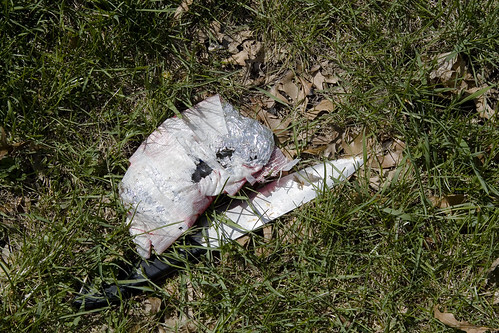
– photo by Mitch Waxman
This little package and knife are north east of the monument which I’ll be referring to as an altar. I did not open it, of course, it is against Newtown Pentacle policy to actually touch any of the odd things I come across, like the Pulaski Bridge, with bare skin. This whole neighborhood could use a good scrub, if you ask me.

– photo by Mitch Waxman
As always, if you click any of these images- a new window will open up its Flickr Page. Clicking the “all sizes” button found there will take you to progressively larger incarnations- all the way up to “actual pixels”. Check these out, I’ve spent some time trying to figure out what’s inside of the package. Do any of you sharp eyed Ladies and Lords of Newtown out there wish to hazard a guess? Use the “leave a comment” link.

– photo by Mitch Waxman
Seeing the blade and little kidney shaped package gave the whole scene a somewhat sinister air, and that’s when I remembered to check what else might be found on the cardinal meridians of the compass.

– photo by Mitch Waxman
The western facing of the altar sits at the pinnacle of a muddy ridge, which bears much subsidence. The underpinnings of the stone, and declination of the hill itself, fall away rapidly. These candles were observed.

– photo by Mitch Waxman
Nothing special about one of them, the other was unusual. Both red.

– photo by Mitch Waxman
The west facing side of the scene, from the bottom of the little hill. Note the tumbled and disorganized state of the masonry. North is to your left, south to the right.

– photo by Mitch Waxman
Moving north, a white candle .

– photo by Mitch Waxman
Back on top of the hill, directly east of the white candle above, and north of the main altar.

– photo by Mitch Waxman
A green and a pink candle on a dish of “some quality”.

– photo by Mitch Waxman
West of altar, a tumbled monument, with odd etchings on it. Can this be some sort of language?

– photo by Mitch Waxman
South of altar, west side of hill, a plastic bottle with some sort of red/brown liquid in it.

– photo by Mitch Waxman
Notice that the ground is depressed here, as if something very heavy- like a tombstone- had been moved recently.

– photo by Mitch Waxman
Just at the other end of the divot was this foil wrapped bottle which looked like it had been in the ground for a long time. Notice how the moss grows right up to it.

– photo by Mitch Waxman
Top of hill, south side, looking north across site. There are feathers scattered around the grass, mainly just north of the altar. Click here for a flickr page which shows some detail of the feathers.

– photo by Mitch Waxman
There was also this upside down cross.
Newtown Creek, and the Mountains of Madness

– photo by Mitch Waxman
A Friday, on March 19th the Hermetic Hungarian had left his laboratory workshop (a set of rooms on Manhattan’s decadent Upper West Side where he is exploring the deeper meanings and implications of esoteric 19th century clockworks) and ventured forth to Newtown.
The Hermetic Hungarian, referred to as HH from this point on, is a pale and sickly genius who has been intrigued by the presence of certain atavist religions and the persistence of modern adherents to these sects who remain extant along the poison shores surrounding an ancient industrial center called the Newtown Creek. HH had procured an automobile for the day’s exertions- as his fragile health precludes him from the long walks favored by your humble narrator which are so pedantically detailed at this- your Newtown Pentacle.

– photo by Mitch Waxman
Returning from a day of exploration, which first described the extensive branching of the transportation network referred to as “The Great Machine“, we proceeded to the currently undefended border of Maspeth and storied Greenpoint and crossed the Grand Avenue Bridge. HH was searching for evidences of a grandiose clockwork mechanism which long hours of research and supposition have led him to believe existed in the days of Trolley and Rail. Influenced by his metaphysical beliefs, which are both Hasidic and Buddhist in nature, the HH’s itinerary required his trip to be brief- and after spending an afternoon exploring the ancient climes of Newtown, Bushwyck, and Greenpoint- and we headed back toward a transportation artery that would allow him egress back to the Shining City and his hierophant isolations.

– photo by Mitch Waxman
On our return, the bascule mechanisms of the Pulaski Bridge suddenly sprang to life, allowing egress to the Newtown Creek for shipping. The first watchtower on the Creek, the Pulaski is also the busiest of its bridges. While traffic on the Newtown Creek is a shadow of what it once was, there is still a significant industrial presence on the maritime highway that requires connection with the vast enterprises of New York Harbor- especially the petrochemical empires that line the shores of the Kill Van Kull in distant… Staten Island. Additionally the car shredders and other recycling facilities, which bless Newtown with their labor, utilize barges to move their wares to distant customers.

– photo by Mitch Waxman
In this case, it is the petrochemical shipping industry which commanded the opening of the Pulaski Bridge, as evidenced by the appearance of the DBL 28 fuel Barge, a 28,000 BBL double hull tank barge (which conforms to the Oil Pollution Act of 1990’s requirements- no mean feat) which was built in 2006 and weighs some 2,146 gross tons.
from allbusiness.com
The 28,000 bbl capacity DBL 28 measures 297.6-feet in length, with a 54-foot beam and 13-foot depth. The DBL 28 is the first of a series of eight units currently in production at BMF for K-Sea. DBL 28 is coupled with an existing K-Sea tug using the state-of-the-art Beacon JAK 200 tug/barge Push-Pin coupler system, which is designed to increase operating efficiency and enhance safety and reliability by operating as a dual mode ITB. The series of barges are manned, non self-propelled, double hulled with a raked shaped bow, with six cargo tanks. The barges are classed Lakes, Bays & Sound (Inland) Tank Barges, ABS +A1 Oil Tank Barge, and USCG certified. The barges are being constructed primarily for bunkering and harbor service in ports on the U.S. East Coast.

– photo by Mitch Waxman
The fuel Barge was being guided by the K-Sea Davis Sea, a 2,000 HP 95 gross ton, 77 foot long tug whose mast spires nearly 57 feet over the water. Online sources describe the Davis Sea as possessing 6 foot diameter propeller screws, which are powered by twin engines, and as having been built in 1982.
from k-sea.com
K-Sea Transportation Partners L.P., headquartered in East Brunswick, New Jersey, is a leading provider of marine transportation, distribution and logistics services in the U.S. From locations in New York, Philadelphia, Norfolk, Seattle and Honolulu, K-Sea operates a large fleet of tugs and tank barges that serves a wide range of customers, including major oil companies, oil traders and refiners.

– photo by Mitch Waxman
The Davis Sea, of course, is named for the oceanic area along the coast of Eastern Antarctica which abutts the Shackleton and West ice shelfs. Lying along the Indian Ocean side of the polar wasteland, it is the coldest, windiest and driest section of the southern pole. Eastern Antarctica is still largely unknown to man, except by aerial and satellite observation- although the Soviet and American hegemonies established scientific research bases as early as the 1950’s in the relatively ice free coastal areas. Today, all of the great nations are represented in scientific exploration of this final frigid frontier.

– photo by Mitch Waxman
The Gamburtsev Mountain Range as well as the prominences of the Transantarctic Mountains, and the East Antarctica Ranges are amongst the oldest ranges on Earth, although some of these great structures are quite nearly buried beneath the glaciers they have formed. Hostile to normal terrestrial life, these mountains of madness are rumored to contain and house several obscure occult constructs including “The black pit,” “the carven rim,” “the protoShoggoths,” “the windowless solids with five dimensions,” “the nameless cylinder,” “the elder Pharos,” “Yog-Sothoth,” “the primal white jelly,” “the color out of space,” “the wings,” “the eyes in darkness,” “the moon-ladder,” “the original, the eternal, the undying,” and other queer occult concepts.

– photo by Mitch Waxman
Of course, your humble narrator digresses, influenced by a day spent with the limitless intellect of the Hermetic Hungarian- and the Davis Sea pictured above is merely a tugboat making it’s way down an urban waterway, and is not the seat of some cosmic horror which would shatter our notion of civilization and man’s place in the universal order.
The HH began frantically gesturing at me as I stood on the roadway of the Pulaski Bridge just then, lost down the soda straw reality of a telephoto lens.

– photo by Mitch Waxman
Its purpose accomplished, the drawbridge had returned to its vehicular roadway duties, and traffic flow between Greenpoint and Long Island City was about to resume. Angry at the inconveniences offered by the delay, anxious drivers were about to rocket forth into Queens, and would have hardly afforded a specimen such as myself the luxury of not being ground to paste beneath their spinning wheels.

– photo by Mitch Waxman
The Davis Sea proceeded up the Creek, no paddles required or missed. She sauntered past FreshDirect and the Newtown Creek Waste Water Treatment Plant at Whale Creek, churning the languid gelatins which line the Newtown Creek as it went. This must be a difficult course, as there is so little room for error in piloting the narrow and tightly populated channel.

– photo by Mitch Waxman
That is Calvary Cemetery on the horizon, with industrial Queens occupying the left side of the image. Just beyond is the Greenpoint Avenue Bridge and the significant petrochemical facilities- recently upgraded and enlarged and enjoyed by those on the Brooklyn shore – that adjoin it.

– photo by Mitch Waxman
Forced to begin speeding up, the Hermetic Hungarian allowed me one or two last shots of the Davis Sea as it passed into that world of ancient mariners and atavist custom which typify Newtown, while angry motorists behind us employed their horns to display displeasure at our lack of enthusiasm for leaving the scene. Their horns formed a mocking chorus, an antiphonal response to our absent haste whose sound can be described only as…
“Tekeli-li! Tekeli-li!” “Tekeli-li! Tekeli-li!” “Tekeli-li! Tekeli-li!”
Driven to madness by the sound, the Hermetic Hungarian began babbling madly, repeating the names of subway stops as we drove.


