Posts Tagged ‘Pittsburgh’
Objects in motion…
Tuesday

– photo by Mitch Waxman
That’s Pittsburgh’s ‘T’ light rail coming off of the Panhandle Bridge, and hurtling towards the Station Square stop on the south side of the Monongahela River. Hurtling is probably overstating it, but there you are. One had used the service to go to that self same stop after a bit of a hullabaloo, ridden the Monongahela Incline to Grandview Avenue atop Mount Washington, and was proceeding on foot down the north face of the landform in a manner diagonal. It was hot in Pittsburgh, with rising humidity, but a pleasant breeze.
A humble narrator was shvitzing heavily due to the ambient dew point and temperature. That’s the suss.

– photo by Mitch Waxman
The PJ McArdle roadway, as this ‘truss pontem’ on the north face of Mt. Washington is called, is where one scuttled. This is the “upper” section being explored in these posts, if you want to see the “lower” section – or any of the times that this structure has been discussed – click here.
One had a whole other plan for the rest of the day as it led into evening, of course. Remember that bar I had found, the one with the nearby rail road tracks? Yessir, that’s where I was going.

– photo by Mitch Waxman
That’s the same bridge pictured above, which the T is seen riding on in the first shot of today’s post, and is offered for completeness’s sake. “Up, down, all around,” that’s my motto. One navigated his scuttling towards the ‘rails to trails’ pathway.
As mentioned in prior posts, this was a fairly warm day in Pittsburgh. I hadn’t drank anything at all (water, Gatorade, etc.) since leaving HQ about 4-5 hours previously, and one was a bit parched by this point. That’s another big difference between NYC and Pittsburgh – no bodegas to stop into and grab either the Gatorade or bottle of cold water from.

– photo by Mitch Waxman
I cannot walk past that rusty earth mover above without taking a shot of it, can’t tell you why. My plan was to spend an actual evening at the brewery, including having dinner there. On my way into Pittsburgh from Dormont, a couple of younger guys on the T were talking and passing a phone back and forth looking at pictures. I overheard one of them said ‘heritage unit,’ and I couldn’t help but but in and ask if they were railfanning.
Somewhat sheepishly they said no, and then ‘kind of.’ I told them where I’d be in the evening and invited them to join in, and eventually they met up with me at the Sly Fox Brewery.

– photo by Mitch Waxman
This spot is gentrification, Pittsburgh style. The centerpiece of this spot is a building which used to be the world’s largest terminal warehouse or something like that. A NYC real estate developer bought it and refashioned it as ‘The Highline,’ which is branded with a silhouette of the pre Hudson Yards NYC skyline. Odd choice, that.
It’s quite reminiscent of the Bush Terminal complex in South Brooklyn, but is a little less ‘head up its own ass’ than that NYC EDC clusterfuck in Sunset Park is. The project doesn’t seem to have ‘landed’ well, other than the brewery, and observationally speaking they’ve had trouble attracting commercial tenants. Perhaps, then, it is actually just like the Bush Terminal in Brooklyn.
So, what am I doing, hanging at a gentrifier/yuppie place? Dinner, drinks, and a show. That’s what.

– photo by Mitch Waxman
The show got started. I like this spot, in particular, because of the grade crossing, with its obligatory signal bells and barrier arms. You get a few minutes of warning that a train is coming, allowing for the setting up of the camera and positioning of the photographer.
That’s CSX #62 coming into view, my fellow nerds. The first of many, as it turned out.
Tomorrow – an absolute parade of CSX’S Choo-Choo trains on the Pittsburgh Subdivision.
“follow” me on Twitter- @newtownpentacle
Buy a book!
“In the Shadows at Newtown Creek,” an 88 page softcover 8.5×11 magazine format photo book by Mitch Waxman, is now on sale at blurb.com for $30.
Domestic interlude
Thursday

– photo by Mitch Waxman
Everything got a bit orange when another of those Canadian Wildfire plumes blew into Pittsburgh for about a day a few weeks ago. Didn’t matter, as urgent business was at hand. If you’ve never had a dog, allow me to explain the situation.
Puppies, in particular, but all Dogs go through phases of doing stuff that drives their humans crazy. These phases come and go, and eventually the dog realizes that the best course of behavioral action is one that results in a wonderland of care and material comfort. Puppies roll through a new cycle about every three or four days.

– photo by Mitch Waxman
I’ve introduced y’all to Moe the Dog before, and he’s a great little guy most of the time. There’s some rough spots that Our Lady of the Pentacle and myself are working on training out of him, but overall he’s going to be a good dog when he matures.
On this particular day, the household mission was to render him as tired as we could, as Moe had just entered the ‘bitey asshole’ phase. Luckily, Pittsburgh has just the medicine for this sort of thing, and we took him to Southside Park along the Monongahela River for a looooooong walk on a wooded urban trail. He got to menace rabbits, birds, and possibly spotted a beaver whom he wished to murder. Moe’s ire was also directed towards those multitudes of squirrels which are along the route. Upon returning home, he peed in the living room and then went to sleep on the couch. Upon awaking roughly 130 minutes later, he bit me in the crotch.
At the time of this writing, ‘bitey asshole’ has transitioned into ‘I’m so cute, please scratch my ears’ followed by violent ‘zoomies’ where he leaps about while snapping his jaws. Can’t wait to see what happens next. I might need to contact the Marines for help.

– photo by Mitch Waxman
That’s the Monongahela River, incidentally. Everything smelled like BBQ in Pittsburgh due to the smoke plume. Moe enjoyed himself.
I’m too old for this shit.
“follow” me on Twitter- @newtownpentacle
Buy a book!
“In the Shadows at Newtown Creek,” an 88 page softcover 8.5×11 magazine format photo book by Mitch Waxman, is now on sale at blurb.com for $30.
Home, boys
Wednesday

– photo by Mitch Waxman
Pittsburgh is so damn cool. Yes, it absolutely blows walking up hills like this one a block from HQ. It’s also fairly challenging to walk down that particular hill. It’s so steep here that the various municipalities of Pittsburgh (Pennsylvania is a commonwealth, which has a very odd way of doing business as compared to the more familiar organization of a “State” like New York or New Jersey) maintain hundreds of of municipal staircases and foot bridges just so people can get around on foot.
The housing stock is disturbingly heterogenous.

– photo by Mitch Waxman
Homogeneity seems to occur when some historical builder had a largish lot to fill. Porches and yards are pretty common. This shot is from a neighboring town where the Fallowfield stop on the T is found. Wish I could say what the town/area is called, but my ignorance remains somewhat palpable. Heck – I’ve just gotten to the point where I’m beginning to understand the broad strokes of driving to various areas of interest and or the neighborhoods they’re found in, let alone knowing the nitty gritty stuff.
I’ve also started using ‘heck’ a hell of a lot mutha effin more. Potty talk isn’t really appreciated here in Pittsburgh. Being from Brooklyn, this deletes about half of my vocabulary.

– photo by Mitch Waxman
Also mentioned in a prior post, I’m bringing a few of my older lenses out of retirement. This one is an old favorite, the Sigma 18-35mm f1.8. I was waving it around in my back yard recently, testing how it responded to the alien experience of being attached to a mirrorless camera. I was looking for a subject to put the thing through a few paces, and realized that although I’d mentioned the Mobile Oppression Platform many times now, I’d never shown off the ride.
Now seriously… doesn’t the MOP look like the kind of thing an Imperial Stormtrooper from Star Wars would drive around in? Whatever… 39 mpg, Lords and Ladies, 39 mpg. I stop strangers on the street and tell them that.
Back tomorrow.
“follow” me on Twitter- @newtownpentacle
Buy a book!
“In the Shadows at Newtown Creek,” an 88 page softcover 8.5×11 magazine format photo book by Mitch Waxman, is now on sale at blurb.com for $30.
It’s a bit like going fishing…
Tuesday

– photo by Mitch Waxman
Railfanning has never been my ‘thing.’ I certainly like taking pictures of trains, but the whole hobby of driving off at 5 in the morning to some remote trackway in order to see a train roll through is just counter to my whole dealie.
Keep moving. That’s my thing. If there isn’t a train going through between when you arrive and depart, it isn’t ‘meant to be.’ Standing around with a camera dangling off of you makes you ostentatious, and the meaner elements of street life will become attracted to you. Crooks or cops, who needs the trouble.
Tsuris, amirite?

– photo by Mitch Waxman
It is surprisingly difficult to get a decent photo of a moving train. It’s moving faster than the human eye would suggest, the machine itself is huge and literally bigger than a house, and there’s a ton of fiddly details which are vibrating about and also moving independently as the thing rolls by you. You have to set up the shot in advance; get the exposure right, figure out a composition, aperture and ISO. Even then…
I have a trick for vehicles of any type, which is to focus in on the strut at the edge of the windshield closest to you, which the intersecting plane of the driver’s side window trails away from. Learned that one when shooting the long running ‘cool cars’ series of posts I had going back in Queens.

– photo by Mitch Waxman
All of the train shots in this post were gathered over something like 30-40 seconds, which speaks to how fast these things are actually moving. Each exposure is in the neighborhood of 1/1000th of a second, at ISO 800 and F8. That’s when the burning thermonuclear eye of God itself is floating directly overhead in late afternoon/early evening, and light is bouncing around everywhere. Like I said – ain’t that simple shooting trains.
Back to railfanning, that’s not what I’m doing with this latest fascination of mine. Instead, I’m trying to conquer a difficult subject and develop a muscle memory for the act so that when I encounter it happening in the future, an understanding of the settings are intuitive. Like I said, these trains really are moving quick. Additionally, Pittsburgh sits squarely in a nest of rail tracks.

– photo by Mitch Waxman
CSX 968 (an ES44AC-H, I’m told), wasn’t carrying anything too exciting, mainly cargo boxes and tanker cars. One is still working out when the most frequent activity takes place along this Pittsburgh Subdivision of theirs, but limited experience suggests that it’s early mornings and evenings. There’s traffic all day, of course, but in terms of frequency I’ve observed a lot more activity at the edges of the day.
For a few years before COVID, I’d developed an acumen for what times of day the NY&Atlantic outfit in Long Island City were most likely going to be doing something along Newtown Creek.

– photo by Mitch Waxman
The head of the snake, as mentioned, is the singularly interesting section of the train for me. I’ve seen shots of these trains moving military equipment around – tanks and the like – and that’s a sight I’d like to record, so I do pay attention. Mostly normal cargo, followed by a coal or coke train, rinse/repeat, that’s what you mostly get here.
As the title would suggest, I keep on having the sensation you get when fishing a waterway for the first time. You drop a hook, dangle the bait, and hope for the best. Sometimes you get one train over the course of a couple of beers worth of time (I’m a nurser, drives my friends crazy. They’re starting their third and I’m finishing my first) and sometimes you get five. Seriously, I don’t know how the foamers do it, I don’t have the patience.

– photo by Mitch Waxman
All fixed up after a couple of belts, and with several photos on my camera card, I gathered myself together and headed off for the T light rail and a ride back home. That’s a blue line one crossing the Panhandle Bridge, I live along the Red Line.
Back tomorrow with something somewhat different.
“follow” me on Twitter- @newtownpentacle
Buy a book!
“In the Shadows at Newtown Creek,” an 88 page softcover 8.5×11 magazine format photo book by Mitch Waxman, is now on sale at blurb.com for $30.
Day late, dollar short
Monday
– photo by Mitch Waxman
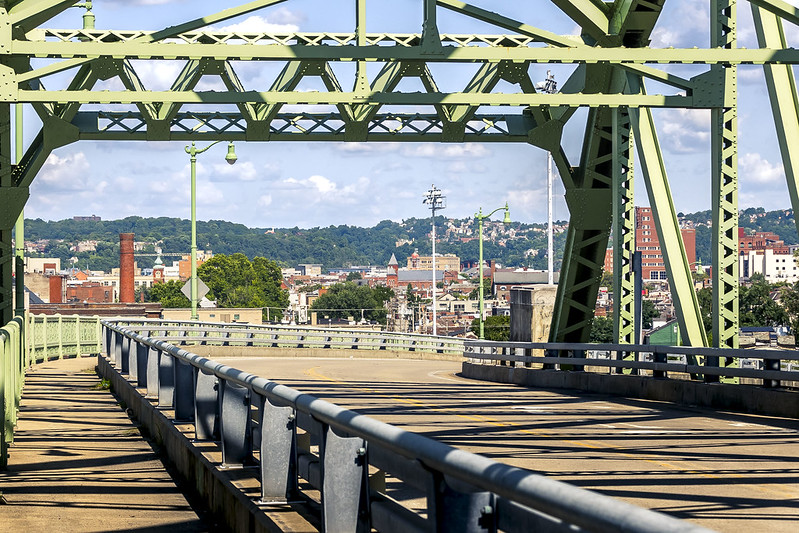
As mentioned last week, a longish walk found me scuttling along the pedestrian/bike path of the PJ McArdle Roadway here in Pittsburgh, which connects the prominence of Mount Washington with the South Side Flats section found on the banks of the Monongahela River. I entered the roadway path at about the halfway point, leaving the upper section for a future walk.
There are some pretty impressive points of view available along this path, although negotiating your way to it is pretty terrifying as you need to cross several vehicle lanes which all lead into a primary crossing and tunnel leading out of the city.
– photo by Mitch Waxman
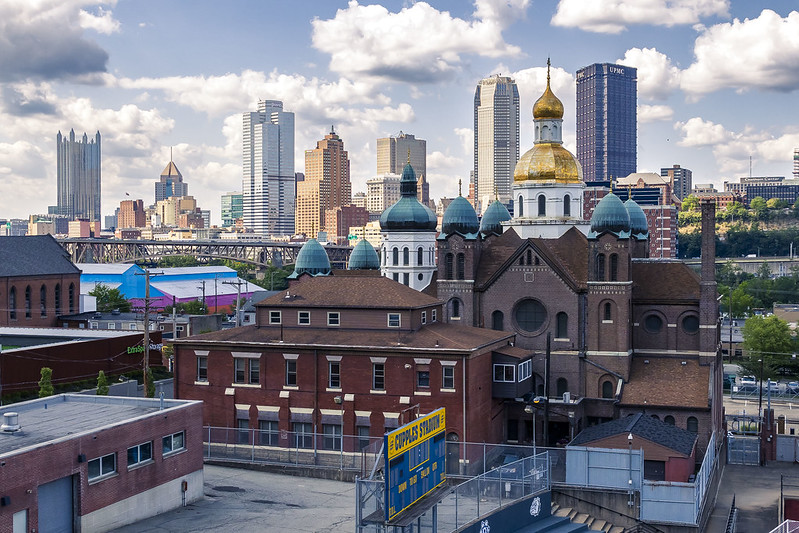
My desire was to wrap up the walk at a spot I’ve become pretty entranced by, which also happens to host a brewery with outdoor tables. Further enhancement of my personal joy in this matter is provided by the bar’s proximity to a fairly busy set of freight rail tracks. The icing on my proverbial cake is provided by the fact that the tracks involve an at-grade street crossing, meaning that gizmos with signal bells with flashing lights and lane blocking arms activate when a train is nearing so I get advance notice of the approaching locomotive, and subsequently the time to run over and get into position.
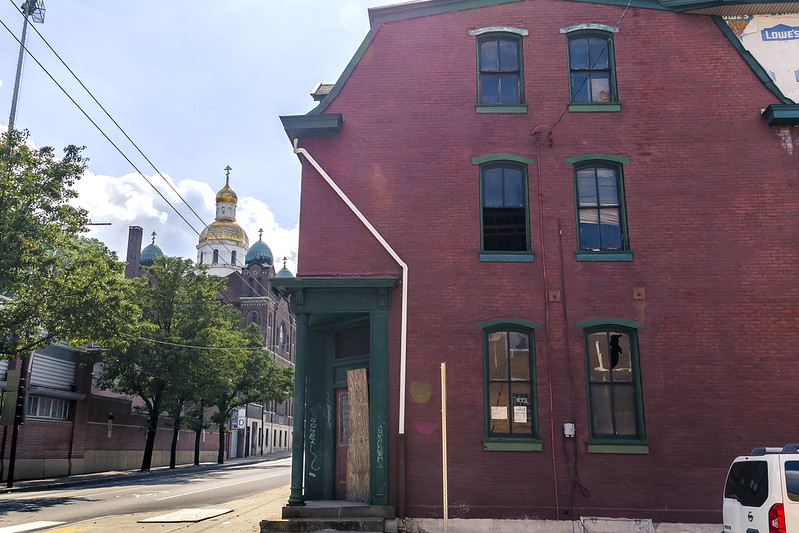
That would be later on in the evening, though, and I wasn’t done kicking my feet about. This ‘zone’ in Pittsburgh hosts a lot of relict building stock, much of it seeming to date back to the early 20th and late 19th centuries.
– photo by Mitch Waxman
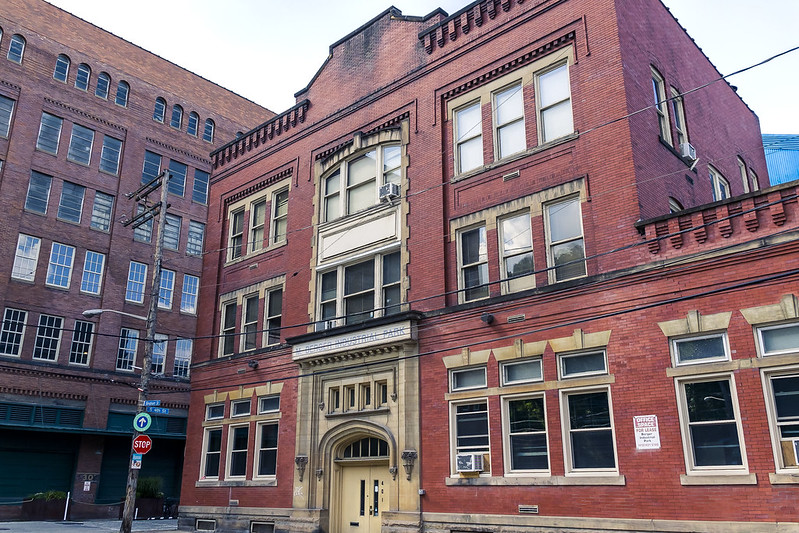
I should mention that I’m making a concerted effort to not get all ‘history boy,’ quite yet, here in Pittsburgh. Partially, it’s because a series of existential issues concerning the ‘now’ are occupying my time. Also, I’m not really planning on becoming the walking encyclopedia that I was in NYC. Whatever happens to drift into my head and lodge there is osmotic gravy, but I’m currently not involved in any form of research.
That building above is pretty interesting, to me, at least.
– photo by Mitch Waxman
After looping and scuttling about for a bit, one decided to head towards the ultimate destination for the evening – that aforementioned brewery. It’s a part of some gentrification scheme being pushed by a NYC real estate developer, wherein they’re making the same mistakes here that they made at the Bush Terminal in South Brooklyn. Saying all that, I don’t care anymore about stuff like that, and all I wanted was to pour a couple of pints of cold beer into the talkie hole on my face.
I enjoy the solitude and anonymity here in Pittsburgh. For the last several years along Newtown Creek it became a standard thing, for instance, to have a garbage truck driving by and hearing the driver shout out “where ya goin today, Mitch?” Once I was actually stopped by a DSNY crew who asked me to let the city councilman know about a broken water main that nobody cared about fixing which was getting in their way. It got fairly weird, being me. I like being some random bloke with a camera, again.

– photo by Mitch Waxman
Frustrating is how I describe the situation when I’m approaching a set of rail tracks here in Pittsburgh, and I’ve just missed the opportunity to photograph a train. The only shot I really want from a freight train is one of the head of the snake – the locomotive engine.
Wasn’t a big deal, since my plan involved an hour and change of sitting on the keister and drinking, but still…
– photo by Mitch Waxman
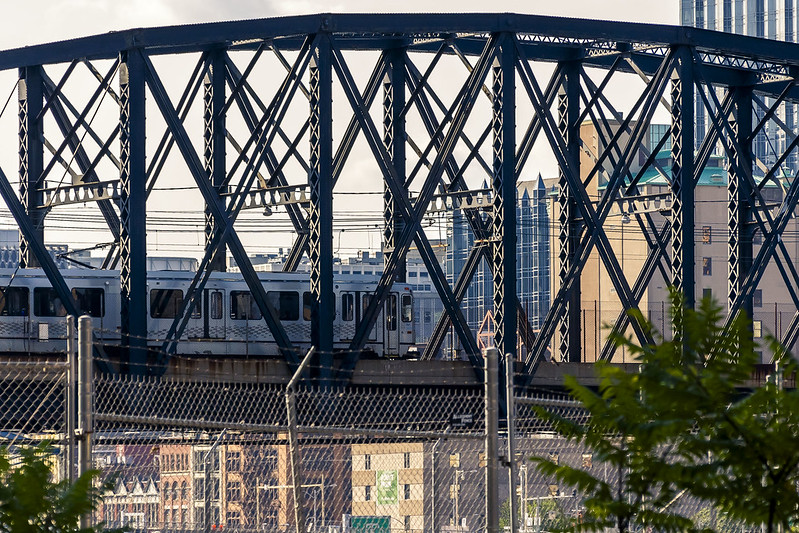
This spot has a fairly nice view of the Panhandle Bridge, which the T light rail uses to cross the Monongahela River, so I zoomed in on that while I was waiting for the show to come to me. When the train’s grade crossing signal alert bells started ringing again, I’d pay my tab and head back home. Luckily, they serve pretty good suds at this watering hole.
Back tomorrow.
“follow” me on Twitter- @newtownpentacle
Buy a book!
“In the Shadows at Newtown Creek,” an 88 page softcover 8.5×11 magazine format photo book by Mitch Waxman, is now on sale at blurb.com for $30.


