Posts Tagged ‘queens’
suitable apparatus
– photo by Mitch Waxman
As the redolent cargo of my camera card revealed- this “Grand Walk”, a panic induced marathon which carried your humble narrator across the East River from St. Patrick’s Old Cathedral in Manhattan into Williamsburg and up Grand Street to Maspeth and the baroque intrigues of the Newtown Creek– wound down into it’s final steps on Laurel Hill Blvd.
Examining the images recorded on my camera, photos which I don’t remember taking, the ineluctable feeling that something was missing from the modern scene was inescapable.
from wikipedia
Nichols, along with his son Charles W. Nichols, helped organize the merger of 12 companies in 1899 to create General Chemical. Under his leadership, the company grew its asset base and increased its earnings threefold, making Nichols a force in America’s fledgling chemical industry. His vision of a bigger, better chemical company took off when he teamed up with investor Eugene Meyer in 1920. Nichols and Meyer combined five smaller chemical companies to create the Allied Chemical & Dye Corporation, which later became Allied Chemical Corp., and eventually became part of AlliedSignal, the forerunner of Honeywell’s specialty materials business. Both men have buildings named after them at Honeywell’s headquarters in Morristown, New Jersey. His original plant along the Newtown Creek in Queens is infamous for its legacy of pollution. Nichols is rumored to have once emptied vats of excess sulfuric acid into the creek rather than sell it cheaply to a businessman he had no respect for.

– photo by Mitch Waxman
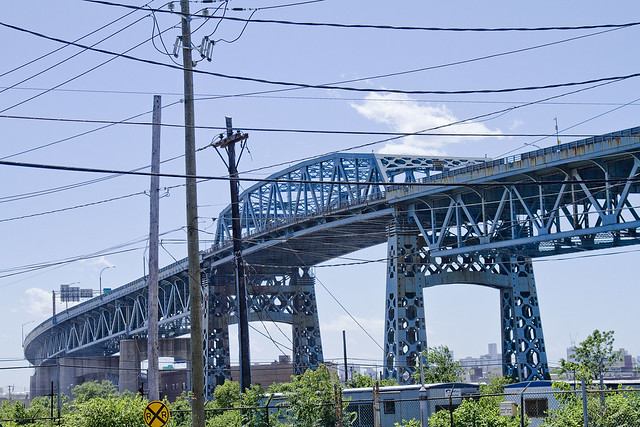
Nichols Chemical, from which the legendary Phelps Dodge Laurel Hill plant would someday sprout, would have been found along the Newtown Creek nearby the thrice damned Kosciuszko Bridge – which is itself doomed and consigned to the stuff of future reminiscence. At it’s apex, this industrial site employed 17,500 people and squatted along some 36 square acres of the Creeklands.
The tallest chimneys in the United States (at the time) stabbed at the sky from here, painting the Newtown sky with poison effluvium whose pH content was sufficient to cause marble and granite to melt like ice cream left to the merciless gaze of the burning thermonuclear eye of god itself.

– photo by Mitch Waxman
The Kosciuszko Bridge is slated for demolition and replacement in a few short years of course, and this scene will irrevocably alter when a modern structure is put in place. The high flying bridge was built large to accommodate the sort of ocean going craft which were common in the 1930’s- cargo and passenger vessels with enormous smokestacks that would have been serviced and outfitted by other corporations just up the Creek.
Additionally, the war department held certain intentions and reserved the option to sequester battleships in Newtown Creek, with the intentions of protecting the vital industrial center from a safe inlet, were an invasion of North America attempted by hostile European adversaries via New York Harbor.
When a manufacturing establishment decides to increase its output fivefold; when it decides to tear down its present buildings and put up new ones; and when it owns valuable waterfront which is marketable at a high price, that concern considers carefully the question whether it will remain in its present location or move to some other. Now our friends above mentioned would doubtless at once aver that, if this concern was a New York concern and found itself in this situation, there could be but one answer—”To Jersey for us”— or to some other place near land’s end where land can be purchased for a song, where government regulations are unknown and where, in addition, the manufacturer would find himself surrounded by a great and aching void.
But all these prophesies are as wormwood and the pessimists are confounded. Over In the wilds of Queens there Is a place—look it up on the map—called Laurel Hill.
Laurel Hill is not a place of beauty. The undulating hills in them neighborhood are covered with cemeteries, rocks, and ugly houses and through the midst of it all (lows the far-famed Newtown Creek, covered at all times during the day and night with busy water craft. But Laurel Hill is one of the most important manufacturing districts in Greater New York and Newtown Creek is one of the foremost commercial arteries in or about NewYork City.

– photo by Mitch Waxman
One of the aphorisms which has emerged in my studies of Newtown Creek and the surrounding communities is this: “all roads lead to Calvary“.
Whether it be ancient ferry lines which fed the street car roads, or the occluded pathways of the aboriginal Mespaetche and Decadent Dutch, all the roads of western Queens and North Brooklyn point inevitably to this spot. Semi conscious during this “Grand Walk”, your humble narrator nevertheless found himself at the corner of Laurel Hill Blvd. and Review Avenue once again, standing before the great and sacred Polyandrion of the Roman Catholic church in New York City.
Perhaps the foremost industry at Laurel Hill is the Nichols Copper Company. To this factory each year come by boat and by rail thousands of tons of copper, some of it in the raw state— the ore—and much of it already in bars ready for the final refining. The copper is refined here and put into a variety of forms and shapes ready for the market. The raw material comes in from the Lake Superior region, from Mexico, and even from more distant South America. The finished product goes to manufacturers in all parts of the world. The annual value of this product is over $60,000,000, and there are between seventeen hundred and eighteen hundred men engaged in converting the raw copper into the refined product which has made this factory famous tne world over.
In this factory, located within Greater New York, there is three times as much copper refined as in any other factory in the United States.

– photo by Mitch Waxman
Here lies Tammany, the Dead Rabbits, and a good percentage of those colorful characters who populated the “Bloody Sixth Ward” of the Five Points in 19th century New York. Here lies the Newsboy Governor, the “Original Gangster“, and the rightful heirs to the throne of Ireland rest within the ground consecrated by the legendary prelate called “Dagger John” alongside the “Fighting 69th” and “the 21” and the “Abbot“. Here is the secretive cruciform shaped repository which contains the remains of thousands of priests and nuns, in a catacomb which lies some 50 feet below the Almirall Chapel.
Additionally, here might be found the grave of a man who died in 1718, lying with both his descendants and his african slaves in the only Protestant burial ground entirely contained by a Catholic cemetery in North America.
And from above, that thing in the Sapphire Megalith which neither thinks nor breathes but instead hungers, watches.
from Illustrated history of the borough of Queens, New York City, 1908, courtesy google books
The Alsop family was also among the early settlers. Richard Alsop, the first of the name to locate here, came at the request of his uncle, one Thomas Wandell, who was said to have left England because he had become involved in a quarrel with Oliver Cromwell, though this report is doubtful, for it is known that Wandell was living at Mespat Kills in 1648, or before Charles I was put to death. He had secured a considerable tract of land by patents and purchase which he left to his nephew, Richard Alsop. The family he founded became extinct in 1837 when the last of the name died without issue.
pitiably inferior

– photo by Mitch Waxman
In the last posting describing this “Grand Walk” from Manhattan’s St. Patrick’s Old Cathedral to Astoria in Queens, the section of modern day Maspeth which lies between the Grand Street and Kosciuszko Bridges was offered to you as “a gateway to hell”.
Allow me to explain, and describe what happened to the towns of Berlin and Blissville.
from Annual report, Issue 4 By New York (State), 1884, courtesy google books
On the line of the Long Island city division, known as the Manhattan Beach railway, pig-styes and cow stables are numerous, and in an offensive and filthy condition.
The nuisances herein before described and found chiefly upon the Montauk division (south shore) of the Long Island railroad and upon the Long Island city division of the New York and Manhattan Beach railway.
George Aekerman’s fat boiling establishment on the flats of Newtown creek, Queens county side of it and near Metropolitan avenue, uses open kettles, presses oil from fish and renders fat from butchers’ scrap.

– photo by Mitch Waxman
Prior to the Civil War, there were two communities remote from Manhattan by the standards of the time, which earned their living agriculturally and benefitted from the vernal wonders offered by access to the Newtown Creek.
A sparkling wetland, Newtown Creek and its various tributaries spread many miles beyond their modern boundaries. Dutch Kills once extended to the foot of the Queensboro Bridge, and Maspeth Creek stretched halfway to modern day Flushing. Newtown Creek’s main body was known in the hinterlands of Bushwick, and English Kills was reported to share headwaters with the Cripplebush and Wallabout Creeks as well as its well known parent.
also from Annual report, Issue 4 By New York (State), 1884, courtesy google books
Pig-styes and cow-stables — The inspectors describe six of these nuisances as being near and a little west of the Woodside railroad station. In the first one were found sixty pigs, thirty-two cows and six goats, besides many other domestic animals.
The stables and the filthy condition of keeping manure must, if possible, be corrected. The animals are mostly kept upon “hotel swill,” which is boiled on the premises in open kettles and fed to the animals.
Grease is boiled and treated by Peter McArdles, whose premises and their contents are described as exceedingly offensive. The gases escaping from the agitators or boiler render the atmosphere of the locality offensive.
The establishment of Walter Bownes, in the woods, between the old Astoria road and Greenpoint avenue, is found to be exceedingly offensive, a reeking nuisance, where horses are killed and their remains utilized.

– photo by Mitch Waxman
When the iron road came, however, along with the great polyandrion of the Catholics- Blissville contracted toward Greenpoint Avenue, and Berlin was all but swallowed into the earth. First Mills, then Distilleries, and finally Industrial Factory complexes followed the rail and took root here. The stories of the Night Soil and Offal docks and the bone boilers and the acid manufacturers are passed down, but there are tidbits- enigmatic mentions in century old press pieces which hint at the commonplace terminology and “way that things are” that defined that world.
I read a lot of very old newspapers.
That’s how I discovered the term “Swill Milk”, and found another of those horrible facets for which the jewel called Newtown Creek is known worldwide.
from Archives of pediatrics, Volume 11, 1894 courtesy google books
The first series of experiments began August 25th, 1876, with milk obtained by several agents early in the morning from the following sources:
- Park milk, i.e.,- combined milk from a number of cows at Prospect Park. These cows were healthy, had good pasturage, and were well cared for. The milk obtained was taken from the cows in the presence of the purchaser and may be considered as equal to the best country milk.
- Rushmore’s milk, i.e., milk obtained from the Rushmore depot for milk in Brooklyn. Mr. Rushmore was one of the largest milk dealers and of good reputation. The milk furnished by him came from Queens County, L. I., and was obtained from the cows in the afternoon of the day preceding the morning of the one in which it was bought by my agent. Such milk represented very well the milk sold in cities at that time by the most reliable dealers. In 1876, little, if any, milk was shipped from dairies in bottles and with the care that is now exerted in certain quarters to keep it sweet and pure.
- Grocery milk, i.e., milk obtained from an ordinary grocery in the tenement-house district of the city. Where the milk came from and how long it had been in the grocery was not ascertained.
- Grain milk, i.e., milk obtained direct from cows through a dealer in milk living in the outskirts of the city, owning a few cows, fed almost entirely on brewers’ grains, with no pasturage except what a poor vacant lot afforded. They were poorly cared for.
- Garbage milk, i.e., milk obtained direct from cows fed on house refuse, much of which was decomposed. Cows were in the outskirts of the city and poorly cared for.
- Distillery milk, i.e., milk obtained direct from cows fed almost entirely on hot distillery slops or refuse obtained from a distillery at Blissville. These cows were in very poor condition.

– photo by Mitch Waxman
Just the other night, while regaling our Lady of the Pentacle with tales of grisly import and putrefaction over dinner, your humble narrator let slip about the so called Sludge Acid trade.
Before I go off on a Sludge Acid trip, I’d just like to note the part of Rust Street/56th Drive/Review Avenue this photo represents would have been right in the natural course of Maspeth Creek and I would be standing in about eight feet of water if this was 1811.
Remember, the ground anywhere within a mile or two of Newtown Creek in Queens was swamp and marshland, a tidal zone. The surface we walk and drive on is actually pilings and fill, and the ground water mixes freely with Creek water.
from Annual report, Volume 1 By New York. State Engineer and Surveyor, 1913
The topography of the region between Newtown creek and Flushing river shows the valley of Maspeth creek extending inland nearly to the present main line of the Long Island railroad at Winfield, and the marshes of Flushing river and its tributary Horse brook extending from Flushing bay to Grand street, Elmhurst, the valley of the latter continuing nearly to tho railroad. Another area of low marsh land, known as Train’s meadows, extends from a point in Flushing bay just south of Sanford Point and North Beach to Woodsidc. Separating tho eastern and western valleys is the ridge of glacial drift about three-quarters of a mile wide and from 40 to 50 feet high.

– photo by Mitch Waxman
OK, in the 19th century it was standard industrial practice to boil the organic or putrescent waste of Cities (dead animals, kitchen waste, rotted meat of all kinds, and human feces or “Night Soil”) in sulphuric acid in order to free valuable chemicals from the material. The waste product was called Sludge Acid, which contained all sorts of fatty residues and undigestible bits of connective tissue and filth. At Newtown Creek, where one might do whatever one’s conscience allowed one to do, it was dumped directly and untreated into the water. Most reports describe the exhaust pipes as being below the surface, so as to cause lethal gases to percolate and dissipate. Further, wherever one of these outlets might lie, an accompanying pool of the bubbling mess could be observed.
On the Brooklyn side of the Creek, back at the confluence of Metropolitan and Grand, there was a business who sent crews out to collect this free bounty and return it to their mill. They had a way to filter the stuff and concentrate the acid back into a commercial product which they would then resell or repurpose, what we’d call recycle. The fats, oils, and other nasties went back into the Creek by a delivery method of open ditches and spillways.
from anacostia.com
New York & Atlantic Railway began operation in May 1997 of the privatized concession to operate freight trains on the lines owned by Long Island Rail Road. The railway serves a diverse customer base and shares track with the densest passenger system in the United States.

– photo by Mitch Waxman
What happened to Berlin was first called Nichols Chemical, later Phelps Dodge. The copper refinery had a long history of troubles in the area, including being forced to build the tallest chimney in the Untied States to waft emanations away from surrounding neighborhoods. Phelps even went so far as to establish a “Potemkin Village” vegetable garden at the top of Berlin hill to demonstrate that their factory posed no risk to life and limb.
What happened to Blissville, however, had nothing to do with life.
In the meeting of trustees, Sept. 19, 1845, it was announced that the Alsop Farm, consisting of about 115 acres, in Newtown Township, Long Island, had been secured for a cemetery. The deeds are dated Oct. 29, 1845. On July 31, 1848, at a special meeting of the board, it was resolved that “the cemetery at Newtown Creek, recently consecrated in part, should be called Calvary, and placed at the disposal of the public; that after August 2d the 11th Street burial-ground, as well as the free vault at 50th Street, should be permanently closed.”
Calvary Cemetery began to be used August 4, 1848. The first interment was that of Esther Ennis. Sections 1, 2, 3, 4, and 5 had been previously blessed. No record is preserved, however, of the ceremony.

– photo by Mitch Waxman
Legendary are the tales of the industries which lined the shorelines of the Creek itself. Van Iderstines and Cord Meyer’s, and a dozen smaller operations which all were in the rendering or fertilizer business. An unbroken line of rotting filth, oil refineries, and distilleries extended from the Greenpoint Avenue Bridge all the way to Furman Island (at modern day Maspeth Avenue) where the greatest and worst of them all- Peter Cooper’s Glue Factory- could be found.
A third rail topic of the environmental crowd which is never discussed or mentioned is exactly what the toll of siting a cemetery might entail. Calvary Cemetery in particular went to great pains to isolate their grounds hydrologically, installing a vast system of subterrene drains, catch basins, and sewers upon the high ground of Laurel Hill. The first interment in Calvary was 1848, but the place didn’t start to fill in any great numbers before the late 1850’s. One of the least commented upon and surely grandest civil works projects of the early 19th century went on here, removing some 300 million tons of soil from the hill in the name of conquering the land.
Often, I ponder what effect the pure tonnage of decaying human meat- suffused with formaldehyde and other preservatives- means for the water table.
from The Index, Volume 5 By Free Religious Association (Boston, Mass.), 1874, courtesy google books
A single cemetery of Brooklyn,—Calvary,—the principal cemetery of the Roman Catholic Church,—there were, in a single year, nine thousand interments,—about forty per cent, of the whole city dead. The procession of hearses thither is incessant. The ground is not a large one, and the dead He there in layers three or four deep in places, the upper ones being so near the surface that the effluvium taints the air. Yet the medical inspector who gives the numbers contents himself with remarking: “The records of this city of the dead exhibit singularly instructive records of the nationalities and ages of the decedents belonging to that religious denomination!” That here is a pressing danger who will deny?
putrescent juice

– photo by Mitch Waxman
My long, indeed “Grand Walk”- a semi conscious amble whose path is revealed only by images found on my camera card sometime later- had carried me from Manhattan to the Grand Street Bridge. A revelation and totem of the political border of Queens and infinite Brooklyn, it would not be inappropriate to describe it as a former gateway to hell itself.
Not quite 100 years ago, the sky would have been black with the product of smokestacks, and every surface exposed to their fumes would be painted with a greasy residue of the worst kind of filth imaginable.
from Harper’s weekly, Volume 38, 1894- courtesy Google books
AN INSALUBRIOUS VALLEY.
The city of Brooklyn, having purged itself of the malodorous political institutions that were so long a blot upon its southern border, might well turn its attention to some nuisances of a more literally malodorous kind that flourish along its northern border, a detailed description of which will be found in another column of the Weekly’. It appears that in an early day the valley of Newtown Creek, which is the boundary between Kings and Queens counties, was selected by various manufacturers as an eligible site for the location of factories. The location was then far on the outskirts of the city, and no doubt quite unobjectionable. A great variety of institutions were set iu operation here, including those useful and necessary but unpleasant factories whose purpose it is to transform the animal refuse of a city into merchantable produce. The gases generated by these factories had an odor almost unendurable, as any one can testify who was accustomed to travel on the Long Island Railroad from the Thirty-fourth Street ferry in years gone by. But so long as railroad passengers were the only sufferers, nothing could be done to abate the nuisance, and there were for a long time no residents near to make complaint, as the growing city very naturally held back at a respectful distance from so undesirable a neighborhood.

– photo by Mitch Waxman
If one did not frequent the district, the smell would be overwhelming but the sense most offended would likely be the visual faculties. There are things which ordinary people should not see or know too much about. The customs and mores of the graveyard come to mind, and so does the imagery produced on the battlefield or on the inside of a slaughterhouse.
Amidst the farms of oil tanks and forests of chimneys, without gazing too deeply, one would notice the mounds of dead horses and dogs first- then, the tons of human shit would come into focus.
from The Sanitary Era, Volume 1, 1887, courtesy google books
Newtown Creek — No city in the Union has so foul a pest hole at its boundaries as Brooklyn. The sludge acid discharged from the works of the Standard Oil Company seems to possess an ominous potency for stirring up the sewage in the creek, and its black and thickened current seethes with bubbles of sulphuretted hydrogen. The shores, banked with this acid and with nameless filth, empoison the atmosphere at low water, while every rising tide seems to free a new supply of sludge. When to the oil industry is added the manufacture of fertilizers and a plenitude of pigs along Queens County shore, the sources of supply for a great nuisance or a grievous plague are discernible to all but official eyes and nostrils. Newtown Creek should be filled up, though not with sludge acid, and the nuisance makers removed to a distance. Our, Health Commissioner is authority for the statement that “You might as well try to fight the devil as the Standard Oil Company.”

– photo by Mitch Waxman
At this spot on the Newtown Creek, where the bone boilers and fat renderers rubbed shoulders with glue factories and manure manufacturers and acid factories, infernal mountains of organic waste materials were gathered. Necessary for the industrial pursuits of these corporate entities- the rail brought Manhattan and Brooklyn’s putrescent garbage, human waste, dead animals and anything else which once lived to them.
There was one company whose particular specialty was recovering useful chemicals from rotting cow and pig blood, produced in fantastic amounts by the armies of butchers staffing the slaughterhouses of New York and the abattoirs of Brooklyn.
No. 4—Grand Street Bridge—
The contract for the construction of this bridge was awarded to Bernard Rolf, on August 7, 1900, at an estimated cost of $173.379.90. The bridge should have been completed on October 21, 1901, but it was fourteen months later, December 26, 1902, before it could be used, and then for only part of the day; and it was not until February 5, 1903, that it was accepted and declared open for traffic.
The contractor presented claims for extra allowances, and a committee, consisting of the late Mr. C. C. Martin, Consulting Engineer; the then Deputy Commissioner, and the Engineer in Charge, reported a finding, which was accepted by the contractor and the City. The total cost of the bridge was $172,748.06.
Several important changes were found necessary in the operating machinery; New end wedges have been put in place and steel bearings have replaced certain cast-iron ones. One hand-turning gear has been installed. Stationary signal lamps, showing white and red, have been placed at the ends of the draw span. Hanging platforms have been erected at the ends of the draw span, and a platform built around the centre pier. These platforms have more than paid for themselves in the cost of repairs and erection. The railing has been painted, and the draw is working satisfactorily.

– photo by Mitch Waxman
Maspeth, troubled motherland of Queens, lays claim to this corner of the Creeklands in modernity and when exiting the Grand Street Bridge onto Grand Avenue (it changes to Avenue as it enters Queens, transmogrifies into Broadway at the heart of historic Newtown at Queens Blvd., and loops into Astoria finally terminating nearby Hallets Cove at the East River) one can say one has been there, although the lovely hills and quaint homes by which one might normally distinguish Maspeth are not present here.
Heaps of fecal matter and rotting pestilence, along with storm clouds of buzzing insects, are mentioned in first hand accounts gathered over a multiple decade period regarding this area.
from Illustrated history of the borough of Queens, New York City, 1908 courtesy google books
The untold thousands who travel every year to and from the places of amusement on the shore of the Atlantic Ocean, or to and from the large race-tracks, ride along the anything but beautiful banks of Newtown Creek, and gain from them their impression of what the borough is. This is the first impression, and therefore the strongest, and it is difficult to dispel it, for the majority of people stick to a conviction once formed, and are loath to change it, even in the face of powerful arguments. Nobody likes to admit that he was wrong or mistaken in his judgment; it is rather human to defend a position once taken.even after one has begun to doubt its correctness. And it is no exaggeration to state that perhaps ninety per cent of all the people passing through Queens Borough know nothing of it except that it contains dismal swamps, railroad yards and factories distributing evil smells and ugly to the last degree.

– photo by Mitch Waxman
Odd, the shot above and others not published indicate that my so called “Grand Walk” took an unexpected turn at this point, leaving Grand and turning North at Page Place. This is the first deviation from common street car and trolley routes which my dreaming gait carried me through.
I must have seen one of the odd cats which frequent or inhabit the area, a polydactyl line which has been mentioned in prior postings of this, your Newtown Pentacle.
from The City record, Volume 6, Part 4, 1878, courtesy google books
Newtown creek ior many years has been a source of nuisance. It receives the contents of several of the large sewers ot Brooklyn. From above Penny Bridge to the East river are factories of various descriptions, oil refiners, fat inciters, gut cleaners, distilleries, car stables, super-phosphate factories, ammonia works, varnish works, and last, but not least, immense piles of stable manure, stored for future shipment, the refuse from all of which runs into the creek, and polluting the waters to such an extent as to have killed all the fish. At low tide acres of land, covered to the depth of several inches with fat, the refuse of the oil-stills, are exposed. At high tide the oily portion of this refuse floats on the surface of the water, still giving forth its characteristic tarry odor. To add to this, many oil works, when the storage tanks are full, run their waste alkali and even their sludge-acid into the creek ; in the latter case giving rise to the well known sludge smell. During the visit of Drs. Chandler and Janeway, on the 14th inst., the material flowing from the drains at the Franklin Oil Works and at Pratt s Refinery was tested and found to be decided acid, affording proof that the sludgeacid was being discharged as above stated.
Frequently during the agitation of the oil with the oil of vitriol the covers of the agitating tanks are left open and the tfl-smefling fumes are allowed to escape into the air.
Near by are also melters boiling fat in open kettles, a method long since abandoned in New York. The stench from all these various operations is very offensive. There is a preference on the part of the manufacturers of fertilizers to manipulate the sludge-acid in the vicinity of the oil works, especially during hot weather, since it is asserted that if sludge-acid is diluted soon after its flow from the agitator, about twenty-five per cent, of it readily separates as tar, but if allowed to stand for forty eight hours in warm weather it becomes thick and ropy, the tar rises slowly and is removed with difficulty and only in small quantities. Moreover, transportation of the extra bulk of tar increases its cost to the consumer. On the other hand, as the acid is sold by yearly contract, as soon as the storage tanks are full, the refinery has no object In its further preservation and naturally allows the surplus to run into the creek.

– photo by Mitch Waxman
Imagine the scene, a century past, in this place where the industrial revolution happened. Further, let us speculate whether the bone boilers and fat renderers would sell their services as “recycling” in our modern context with it’s sophisticate euphemism. See the smoking stacks atop the mills, smell the rich perfume offered by the offal docks, hear the machines and pumps grinding away, touch the cadaverous piles of rot, taste the world which was.
Who can guess, all there is, that might be buried down there?
from Annual report of the State Board of Health of New York, 1883, courtesy google books
Simon Steinfel’s rendering establishment, which is on Furman’s island in Newtown creek (and within the limits of Newtown), gives off very offensive emanations for a long distance in the course of the railway route. Great quantities of decomposing animal matters were found upon the premises in barrels and otherwise packed in readiness for rendering.
- Kirkman & Sons’ rendering establishment, near Steinfel’s, boil and render fat and scrap in open kettles.
- At John C. Muller & Co.’s bone-black factory, at the same place as above mentioned, imported and domestic bones are burned, after being boiled in open kettles to remove all fat. The bone-tar, one of the results of bone varnish, is mixed with soft coal and burned as fuel. It is very offensive.
- C. Meyer’s bone-black factory, at the same place and of essentially the same business, is very offensive. The odor is described by the inspectors, who are expert chemists, as being extremely pungent and sickening. They say: It is doubtful if this industry can be carried on without being offensive constantly. The drainage of all these works on Furman’s island, on Newtown creek, as here described, passes out through an open ditch into the creek.
- Henry Berau’s rendering establishment on Newtown creek has the contract for removing dead animals from Brooklyn. This place is tributary to that of Preston’s, already described. His business is exceedingly offensive, and too near the populous cities and their suburbs.
- These several places are sources of constant offensiveness to railway travelers, and few have any idea of the sources whence the stenches come.
- Brooklyn Excavating Co.’s dumping of night soil is carried on near the border of Brooklyn city-lines, between Grand street and North Second street, only 300 feet from the railroad track. The stench from the nuisance is exceedingly offensive.
- Benjamin Eosenzweig’s fat rendering near Newtown creek, near the railroads, is excessively offensive, the work being carried on from seven in the evening till five in the morning.
- G. W. Baker’s fertilizer factory, close by the railroad track, between Grand street and Metropolitan avenue, is excessively offensive. It manufactures rotten bone manure, tank sediment manure and neatsfoot oil.
A Free Newtown Creek Boat Tour
Forgive the break in narrative for a moment, Lords and Ladies, but I have something very cool to offer you today.

– photo by Mitch Waxman
A free Newtown Creek Boat tour will be offered as part of the “City of Water Day” event on July 16th, and I’m hoping that those of you who were unable to afford or attend the May 21st “Hidden Harbor” tour can join us on a trip up the Newtown Creek.
I’m going to do half of the narration and lead the tour, and one of Newtown Creek Alliance’s environmental experts will be onboard to discuss the ongoing Superfund saga and the finer points of recent developments involving the Greenpoint Oil Spill settlements and other environmental issues.
This tour will not be going all the way to the heart of darkness at English Kills (as the May 21 Hidden Harbor tour did), as we are limited by time and schedule, but will definitely include DUPBO, DUGABO, DUKBO, and approach the 3.1 mile mark at the Grand Street Bridge (DUGSBO).
The comfortable NY Water Taxi vessel I’ve been assigned will be leaving at 12:15 (sharp) from, and returns at 1:45 PM to, Governor’s Island. Governors Island will be served by free ferry service that day, please check the City of Water Day site for details and scheduling.
this free tour fills up quickly, so don’t wait.

– photo by Mitch Waxman
Additionally, I’ll be presenting a 30 minute version of my “Magic Lantern” show on the Creek afterwards as part of the “Water-Rama: A Symposium on Our Harbor” event. It’s scheduled for 3:30 PM on July 16th.
Explore the length and breadth of Newtown Creek, the troubled waterway which forms the border of Brooklyn and Queens, with photographer and Newtown Creek Alliance member Mitch Waxman. The modern conditions and history of the Newtown Creek and its tributaries will be revealed, and the startling possibilities offered by it’s renewal and revitalization during the Superfund era will be discussed.
Project Firebox 24

– photo by Mitch Waxman
On the corner of Vernon Avenue at 38th, in venerable Ravenswood, stands this soldier of the city.
Clearly overburdened by duty, task, and “what could happen”- it nevertheless stands a lonely vigil as the throbbing harmonics of Big Allis wash over and through it.
What sights has it known, here in the fortress neighborhood of western Queens, and what stories might it tell?


