Posts Tagged ‘queens’
LIC Millstones updates
To begin with, the so-called “LIC Millstones” are a pair of colonial era industrial artifacts, which have incontrovertibly survived into modernity- in Queens. Quite a controversy is afoot about them, which I’ve been actively involved in. Recent developments bear some attention, and the whole story needs a roundup:
First, an explanation of the importance of these items- from a Newtown Pentacle posting of 3/23/10
I’ve been helping out on the fledgling LIC Millstones blog, and have just uploaded a little history lesson from Bob Singleton of the Greater Astoria Historical Society that explains just what the heck a millstone is and why it matters that a significant and totemic piece of Queens from the colonial days is sitting in a construction zone in Queens Plaza. Here’s the vid:
Second, from an LIC Millstones Blog posting of 3/18/10, by your humble narrator:

– photo by Mitch Waxman
So, after all the noise and argumentative tumult of a public meeting- here’s where the LIC Millstones are being stored. Rephrase that as where they’re being left.

– photo by Mitch Waxman
Are due diligence and respect being paid to these historic artifacts? What else, all around our community, is being treated so roughly?
Third, from an LIC Millstones Blog posting of 3/23/10. also by your humble narrator:

– photo by Mitch Waxman
Yes, the Millstones (actually one of them, the other is still embedded in the sidewalk) are in this crate, the one at the center of the shot.
No, there has been not a single move made by any of our elected officials to protect these colonial era artifacts.
Observation tonight (it was raining too hard to risk the camera) showed that a delivery of construction materials has been piled around the crate.
This is kind of a hard issue to evangelize our busy neighbors about, as we are all struggling to make our rent and find time for friends and family, let alone give two ****’s about a pair of 400 year old industrial artifacts. There is something wrong though, in our community, isn’t there?
You can smell it in the air, whether the breeze is coming off the Newtown Creek or Big Allis. A disconcerting sense of change, with long time residents being swept away by progress. What is being lost, and who is profiting from it?
Fourth, from an LIC Millstones Blog posting of 4/2/10, also by your humble narrator:

Ring-a-ring-a-roses – photo by Mitch Waxman
Windmills must be tilted at, I always say, or in this case millstones. Witness with me, if you would, the state of the LIC millstones on the 26th of march, 2010. It is my habit, when time permits, to walk across the Queensboro Bridge. Often, I find myself walking back to Astoria’s rolling hills through Queens Plaza.

A pocket full of posies – photo by Mitch Waxman
The LIC Millstones remain in the little triangle in Queens Plaza, and continue to be shielded from the non stop truck and automobile traffic by a flimsy chain link fence. The netting affixed to the fence had been torn away by a recent squall of stormy weather.

Hush! hush! hush! hush! – photo by Mitch Waxman
Survivors of the 17th century, the artifacts housed here are an artifact of the agrarian industries that populated Queens before, during, and after the Revolutionary War. It is very likely that some number of the 163 African American slaves known to have been held in Newtown in 1755 were employed in operating these millstones. We won’t know for certain, because scholarly access to them is being denied for unguessable reasons by those municipal authorities who hold tenancy over them.
Fifth, from a Queens Chronicle article of 4/15/10, for which I was interviewed
Hidden under a crate and surrounded by heavy construction material, the current condition of the already worn Colonial-era millstones in Queens Plaza has preservationists outraged. They say the lack of concern for these historic artifacts that have been part of the streetscape since the 1600s is shameful.
“The manner in which these historical artifacts are being handled and stored is ludicrous,” said Mitch Waxman, an Astoria resident and contributor to the Long Island City Millstones blog, which was formed by Dutch Kills community members.
In the past, millstones drove the economic wheel of Western Queens. In pairs, they were designed to be used in wind or watermills, to grind staple foods like corn or wheat into flour. According to the LIC blog, in the mid 1600s the millstones were part of the Jorrisen’s Mill. Some disagree and claim the stones arrived from Holland, acting as weight on a West Indies trading ship.
Now, the 400-year-old artifacts remain in the triangular intersection of Queens Plaza, behind fencing, trapped in the midst of the construction that is currently underway.
“Given the way they’re being stored and handled, they’ll either be crushed by a truck or just disappear,” Waxman said.“Ultimately, who will care? This seems to be the governing principle over their handling right now.”
According to Christina Wilkinson, president of the Newtown Historical Society, the millstones are believed to be the oldest man-made objects in the borough created by European settlers.
Wilkinson is one of the preservationists who have been actively seeking to have the millstones removed from the location at Queens Plaza and be placed in a museum gallery where they can be protected.
Sixth, from this STUNNING POST at Queenscrap, dated 4/19/10- in which the response from the Landmarks Preservation Commission is revealed:
Here was the response to an application for review from the Landmarks Preservation Commission. Note these are not colonial artifacts, but a “distinctive sidewalk” (even though they will not be in the sidewalk for much longer)- and the actual letter courtesy scribd.com
City of Marble and Beryl

– photo by Mitch Waxman
Note: One of those things that your humble narrator is guilty of is a tendency, when confronted with something alien or unknown, to “fill in the blanks” via an inexact mixing of logical supposition and impressionist reasoning. The opposite of exactitude, this can result in wild ideas and false assumptions being presented and accepted as fact. I would love to tell you which cultic group these artifacts belong to- but the fact is that I just don’t know. Certain assumptions can be hazarded, based on cursory resemblance and observed phenomena, but they will be guesses. Don’t assume my interpretation of things is correct.
Witness, then, what I observed in St. Michael’s Cemetery on the Saturday before Easter- April 3rd, 2010- right about here.

– photo by Mitch Waxman
In St. Michael’s, there is a hill which faces East and whose tombstones are very old. The graves are in a state of disrepair, and the stones are found to be in a ruined state. This is no fault of the Cemetery, which maintains its grounds in a meticulous fashion, instead it is merely time and weather which have worked their havoc on the monuments. Perambulating through the grounds on Saturday with Our Lady of the Pentacle, we found this scene.

– photo by Mitch Waxman
A variety of Afro-Cuban syncretic faiths use similar iconography, but the one which most of the english speaking community is passingly familiar with is called Santeria (aka Regla de Ocha, La Regla Lucumi, or Lukumi). This appeared to be Santeria to me at first- because of the particular color scheme of the candles (red white and blue) and the co-mingling of coinage and sacrificial bones. But the Santeria folks generally do their thing indoors, in a ritual space consecrated and blessed by their own padrinos, just like the Catholics. Graveyards are usually avoided for rituals as they are negative places.

– photo by Mitch Waxman
My observation has been that the local latino populations in Astoria tend to be South rather than Central American, and the geographic heritage of Santeria is Caribbean and Central American. Afro-Cuban religion sprang up amongst the African Slaves brought to the New World to work the sugar and tobacco fields who were forced to adopt Roman Catholicism. Voodoo in Haiti and Louisiana, Hoodoo in the American South- all products of the French empire- with Santeria, Obeah, and Palo progeny of the Spanish.
The other great Catholic nation that held huge numbers of west africans as livestock was Portugal, and it did so in Brazil- where Umbanda, Candomblé, Macumba, and Quimbanda originate. Brazil is in South America, of course, and there are tremendous populations of Brazilians living nearby St. Michael’s in surrounding Astoria. This is some of that logical supposition I warned you about…

– photo by Mitch Waxman
Folk magic sites like this raise the ire of Eurasian morals, as ritual animal sacrifice is kept out of sight in our modern communities, and commoditized as Kosher or Halal or Organic meat. Blood sacrifice and submission to cultural norms, from circumcision to ear piercings to the elaborate face paint called “cosmetics”, are part of our daily lives. This sort of visceral aftereffect of some unfortunate avian’s end, however, is disturbing. No less though, than a crucifixion or any other blood ritual.

– photo by Mitch Waxman
One of the many ridiculous totems tucked away in my jacket pocket is a small magnetic compass. When I began these long walks around what I would someday call the Newtown Pentacle, it served me well, and today it revealed that this ritual space was lined up exactly on the cardinal points of my trusty little friend.
The scattering of bottles, bones, coins, and candles sits east of the stone which is aligned north south in the long dimension, and its anterior face is west facing. This will become increasingly important.
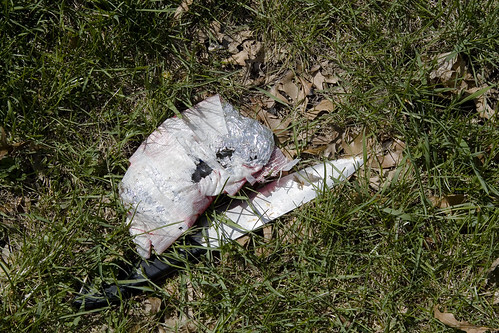
– photo by Mitch Waxman
This little package and knife are north east of the monument which I’ll be referring to as an altar. I did not open it, of course, it is against Newtown Pentacle policy to actually touch any of the odd things I come across, like the Pulaski Bridge, with bare skin. This whole neighborhood could use a good scrub, if you ask me.

– photo by Mitch Waxman
As always, if you click any of these images- a new window will open up its Flickr Page. Clicking the “all sizes” button found there will take you to progressively larger incarnations- all the way up to “actual pixels”. Check these out, I’ve spent some time trying to figure out what’s inside of the package. Do any of you sharp eyed Ladies and Lords of Newtown out there wish to hazard a guess? Use the “leave a comment” link.

– photo by Mitch Waxman
Seeing the blade and little kidney shaped package gave the whole scene a somewhat sinister air, and that’s when I remembered to check what else might be found on the cardinal meridians of the compass.

– photo by Mitch Waxman
The western facing of the altar sits at the pinnacle of a muddy ridge, which bears much subsidence. The underpinnings of the stone, and declination of the hill itself, fall away rapidly. These candles were observed.

– photo by Mitch Waxman
Nothing special about one of them, the other was unusual. Both red.

– photo by Mitch Waxman
The west facing side of the scene, from the bottom of the little hill. Note the tumbled and disorganized state of the masonry. North is to your left, south to the right.

– photo by Mitch Waxman
Moving north, a white candle .

– photo by Mitch Waxman
Back on top of the hill, directly east of the white candle above, and north of the main altar.

– photo by Mitch Waxman
A green and a pink candle on a dish of “some quality”.

– photo by Mitch Waxman
West of altar, a tumbled monument, with odd etchings on it. Can this be some sort of language?

– photo by Mitch Waxman
South of altar, west side of hill, a plastic bottle with some sort of red/brown liquid in it.

– photo by Mitch Waxman
Notice that the ground is depressed here, as if something very heavy- like a tombstone- had been moved recently.

– photo by Mitch Waxman
Just at the other end of the divot was this foil wrapped bottle which looked like it had been in the ground for a long time. Notice how the moss grows right up to it.

– photo by Mitch Waxman
Top of hill, south side, looking north across site. There are feathers scattered around the grass, mainly just north of the altar. Click here for a flickr page which shows some detail of the feathers.

– photo by Mitch Waxman
There was also this upside down cross.
Update on the Calvary Knots

– photo by Mitch Waxman
The first thing I would say is that the name on the card does not match those on the monument. The second would be to ask you to read through this posting- Tales of Calvary 4- Triskadekaphobic Paranoia from November of 2009 which describes this odd arrangement in some detail. In the comments thread at that post, please take note of a former Calvary employee’s possible explanation of what is going on here. Third, here’s the latest addition to the knots, a mass card which has appeared just at the outset of spring.

– photo by Mitch Waxman
Despite the intervening brutalities of a New York winter, the knotted cords and stick persisted in their intended places, as evinced above. Realize, of course, that the equinoxes mark special dates on the magickal calendar and cultic activity is ripe at the quarters of the solar and lunar cycle- both Passover and Easter fall near the equinox, for example. At these times of year, if you seek- ye shall find.

– photo by Mitch Waxman
I’m not certain, however, what significance a mass card carries. Not being an adherent of the Roman Catholic religion, I’ve nevertheless purchased them when friends and associates have suffered a loss, and offered them up to grieving families. My assumption has always been that they represent some sort special devotion or ceremony which will be performed by the priestly caste, but I remain ignorant of their purpose. As mentioned above, however, the names on the monument do not match the one on the mass card.
I’m keeping an eye on this “tree fed by a morbid nutrition” here at the ossified heart of the Newtown Pentacle in Calvary Cemetery.
And don’t miss tomorrow’s post, which discusses additional weirdness found at St. Michael’s Cemetery just this past weekend.
Newtown Creek, and the Mountains of Madness

– photo by Mitch Waxman
A Friday, on March 19th the Hermetic Hungarian had left his laboratory workshop (a set of rooms on Manhattan’s decadent Upper West Side where he is exploring the deeper meanings and implications of esoteric 19th century clockworks) and ventured forth to Newtown.
The Hermetic Hungarian, referred to as HH from this point on, is a pale and sickly genius who has been intrigued by the presence of certain atavist religions and the persistence of modern adherents to these sects who remain extant along the poison shores surrounding an ancient industrial center called the Newtown Creek. HH had procured an automobile for the day’s exertions- as his fragile health precludes him from the long walks favored by your humble narrator which are so pedantically detailed at this- your Newtown Pentacle.

– photo by Mitch Waxman
Returning from a day of exploration, which first described the extensive branching of the transportation network referred to as “The Great Machine“, we proceeded to the currently undefended border of Maspeth and storied Greenpoint and crossed the Grand Avenue Bridge. HH was searching for evidences of a grandiose clockwork mechanism which long hours of research and supposition have led him to believe existed in the days of Trolley and Rail. Influenced by his metaphysical beliefs, which are both Hasidic and Buddhist in nature, the HH’s itinerary required his trip to be brief- and after spending an afternoon exploring the ancient climes of Newtown, Bushwyck, and Greenpoint- and we headed back toward a transportation artery that would allow him egress back to the Shining City and his hierophant isolations.

– photo by Mitch Waxman
On our return, the bascule mechanisms of the Pulaski Bridge suddenly sprang to life, allowing egress to the Newtown Creek for shipping. The first watchtower on the Creek, the Pulaski is also the busiest of its bridges. While traffic on the Newtown Creek is a shadow of what it once was, there is still a significant industrial presence on the maritime highway that requires connection with the vast enterprises of New York Harbor- especially the petrochemical empires that line the shores of the Kill Van Kull in distant… Staten Island. Additionally the car shredders and other recycling facilities, which bless Newtown with their labor, utilize barges to move their wares to distant customers.

– photo by Mitch Waxman
In this case, it is the petrochemical shipping industry which commanded the opening of the Pulaski Bridge, as evidenced by the appearance of the DBL 28 fuel Barge, a 28,000 BBL double hull tank barge (which conforms to the Oil Pollution Act of 1990’s requirements- no mean feat) which was built in 2006 and weighs some 2,146 gross tons.
from allbusiness.com
The 28,000 bbl capacity DBL 28 measures 297.6-feet in length, with a 54-foot beam and 13-foot depth. The DBL 28 is the first of a series of eight units currently in production at BMF for K-Sea. DBL 28 is coupled with an existing K-Sea tug using the state-of-the-art Beacon JAK 200 tug/barge Push-Pin coupler system, which is designed to increase operating efficiency and enhance safety and reliability by operating as a dual mode ITB. The series of barges are manned, non self-propelled, double hulled with a raked shaped bow, with six cargo tanks. The barges are classed Lakes, Bays & Sound (Inland) Tank Barges, ABS +A1 Oil Tank Barge, and USCG certified. The barges are being constructed primarily for bunkering and harbor service in ports on the U.S. East Coast.

– photo by Mitch Waxman
The fuel Barge was being guided by the K-Sea Davis Sea, a 2,000 HP 95 gross ton, 77 foot long tug whose mast spires nearly 57 feet over the water. Online sources describe the Davis Sea as possessing 6 foot diameter propeller screws, which are powered by twin engines, and as having been built in 1982.
from k-sea.com
K-Sea Transportation Partners L.P., headquartered in East Brunswick, New Jersey, is a leading provider of marine transportation, distribution and logistics services in the U.S. From locations in New York, Philadelphia, Norfolk, Seattle and Honolulu, K-Sea operates a large fleet of tugs and tank barges that serves a wide range of customers, including major oil companies, oil traders and refiners.

– photo by Mitch Waxman
The Davis Sea, of course, is named for the oceanic area along the coast of Eastern Antarctica which abutts the Shackleton and West ice shelfs. Lying along the Indian Ocean side of the polar wasteland, it is the coldest, windiest and driest section of the southern pole. Eastern Antarctica is still largely unknown to man, except by aerial and satellite observation- although the Soviet and American hegemonies established scientific research bases as early as the 1950’s in the relatively ice free coastal areas. Today, all of the great nations are represented in scientific exploration of this final frigid frontier.

– photo by Mitch Waxman
The Gamburtsev Mountain Range as well as the prominences of the Transantarctic Mountains, and the East Antarctica Ranges are amongst the oldest ranges on Earth, although some of these great structures are quite nearly buried beneath the glaciers they have formed. Hostile to normal terrestrial life, these mountains of madness are rumored to contain and house several obscure occult constructs including “The black pit,” “the carven rim,” “the protoShoggoths,” “the windowless solids with five dimensions,” “the nameless cylinder,” “the elder Pharos,” “Yog-Sothoth,” “the primal white jelly,” “the color out of space,” “the wings,” “the eyes in darkness,” “the moon-ladder,” “the original, the eternal, the undying,” and other queer occult concepts.

– photo by Mitch Waxman
Of course, your humble narrator digresses, influenced by a day spent with the limitless intellect of the Hermetic Hungarian- and the Davis Sea pictured above is merely a tugboat making it’s way down an urban waterway, and is not the seat of some cosmic horror which would shatter our notion of civilization and man’s place in the universal order.
The HH began frantically gesturing at me as I stood on the roadway of the Pulaski Bridge just then, lost down the soda straw reality of a telephoto lens.

– photo by Mitch Waxman
Its purpose accomplished, the drawbridge had returned to its vehicular roadway duties, and traffic flow between Greenpoint and Long Island City was about to resume. Angry at the inconveniences offered by the delay, anxious drivers were about to rocket forth into Queens, and would have hardly afforded a specimen such as myself the luxury of not being ground to paste beneath their spinning wheels.

– photo by Mitch Waxman
The Davis Sea proceeded up the Creek, no paddles required or missed. She sauntered past FreshDirect and the Newtown Creek Waste Water Treatment Plant at Whale Creek, churning the languid gelatins which line the Newtown Creek as it went. This must be a difficult course, as there is so little room for error in piloting the narrow and tightly populated channel.

– photo by Mitch Waxman
That is Calvary Cemetery on the horizon, with industrial Queens occupying the left side of the image. Just beyond is the Greenpoint Avenue Bridge and the significant petrochemical facilities- recently upgraded and enlarged and enjoyed by those on the Brooklyn shore – that adjoin it.

– photo by Mitch Waxman
Forced to begin speeding up, the Hermetic Hungarian allowed me one or two last shots of the Davis Sea as it passed into that world of ancient mariners and atavist custom which typify Newtown, while angry motorists behind us employed their horns to display displeasure at our lack of enthusiasm for leaving the scene. Their horns formed a mocking chorus, an antiphonal response to our absent haste whose sound can be described only as…
“Tekeli-li! Tekeli-li!” “Tekeli-li! Tekeli-li!” “Tekeli-li! Tekeli-li!”
Driven to madness by the sound, the Hermetic Hungarian began babbling madly, repeating the names of subway stops as we drove.
Terminal Destination

– photo by Mitch Waxman
As mentioned in the past, your humble narrator is often employed by the advertising industrial complex to perform the job function of “photo retoucher”. What that means, essentially, is that I use photoshop to remove the mustaches and wrinkles from photos of pretty people or create elaborate images that might be composited from as many as a dozen photos (use this head, that shirt, these legs, and put these sneakers on him- for instance). This particular specialization of advertising, there are thousands, takes place on the “production” side of things. Non glamorous, we are not the “madmen” types. The madmen are in Account (a business division which handles numbers, legalities, and client relations) or Creative (strategists, art directors, copywriters). Account makes the deal, Creative imagines up the strategic thinking, Production manufactures it.

– photo by Mitch Waxman
Creatives are irascible individualists, who will follow an idea right over a cliff if you let them, but that’s what production is there for. We’re the safety net beneath their intellectual trapeze act, an often 24 hour a day operation that churns out the actual ads you encounter under the close supervision of Creative and the sceptic oversight of Account. There is an expected error rate of zero in this business, and a vast support staff exists around these core services. Retouching is part of that, as well as- proof reading, human resources management, information technologies, and to a certain extent- photography. It’s all about client service, and ensuring that that all bases are covered.
Again- an expected failure rate of zero.

– photo by Mitch Waxman
Our Lady of the Pentacle is also employed in the breakneck advertising industry. An ad agency which recruited her is actually the reason that she left Britain behind and came to New York, an unlucky event as it made her geographically vulnerable to the questionable charms of an inferior specimen such as myself.
Brilliant and successful, Our Lady (in her current incarnation) found need for a photographer to accompany her team around a client’s place of business one day in January, but had no budget. A feckless quisling and traitor to joy, I nevertheless was enlisted to join with the team and explore the client’s property with perfect freedom to just shoot as many photos as I wanted to (as well as dozens of shots of kiosks, signs, counters, and other ad specific duties- and within certain ground rules as the federal government takes security here VERY seriously, and one is normally denied such opportunity by the cold reality of the Terror Wars).
Many of the shots I took are in the hands of Our Lady of the Pentacle, but these were just for me. Welcome to JetBlue’s Terminal 5, at John F. Kennedy International Airport.

– photo by Mitch Waxman
Designed by an architecture firm which mankind knows as Gensler, a multinational firm based in San Francisco, Terminal 5 is a nearly billion dollar complex of runways, passenger waiting areas, and a state of the art check in facility. The design stats on the place sound made up; a facility designed to handle 250 flights a day, 26 gates, 20 security checkpoints, 625,000 square feet, 20 million passengers a year- and as construction started some 4 years after 911- it is task built with security in mind.
I’ll tell you, though, that these Gensler folks understand light.

– photo by Mitch Waxman
Clever gels and tinted windows cast the “brand colors” of the airline about the terminal, and made for brilliant swatches of color. The warm and cold colors also happened to concur with the colors of New York’s state flag, which is coincidence as far as I know, but lucky for both parties. The structure performed its central function though, and navigating its cavernous depths was intuitive.

– photo by Mitch Waxman
A central atrium provides access to the long banks of passenger gates, with retail vendors strategically arranged. The quality of light in these bays is spectacular.

– photo by Mitch Waxman
Those Gensler folks are good with light, I tell you.

– photo by Mitch Waxman
Terminal 5’s central theme is curvilinear, attempting to invite the sensation of soaring. Incidentally, just in case you’re thinking I’m writing some sort of ad puffery, forget that. The place really is gorgeous, form and function are quite balanced. If this was an ad, you’d know it.

– photo by Mitch Waxman
The baggage Carousels, for instance, don’t look this good at LaGuardia or Heathrow. The place is also impeccably clean, but then again, it is a recently completed structure.

– photo by Mitch Waxman
One of the constraints on photography I was under that day, and appropriately so, was to not capture images of the check in area or the security apparatus and personnel. There is a Casino level of security here, with watchers being watched by those who are watched- I’m pretty sure that they have ninjas on staff somewhere, but our attendant guided us away from troubles and escorted us through the steady stream of passengers and explained our activity to inquiring constables.

– photo by Mitch Waxman
To advertising people, jaded and scarred, my mention of the trip through here was greeted with “oh yeah, that’s cool”- but antiquarians and neighborhood cranks immediately asked “did you get into TWA – the Saarinen building?”.

– photo by Mitch Waxman
One of the world’s great buildings is just outside Terminal 5, the TWA World Flight Center, and was built by a genius named Eero Saarinen. Still undergoing renovation and repair, it is an iconic structure and its future seems quite bright. This is the rear of the building, incidentally.

– photo by Mitch Waxman
It was time to leave, with Our Lady’s team needing to return to the Shining City and take up once more the reigns of advertising, and for your humble narrator to scuttle mournfully home to sun kissed Astoria.


