Posts Tagged ‘Queensboro Bridge’
Queensboro trapeze

– photo by Mitch Waxman
Oh, how I love it when they forget to close the gates…
recently observed was this aerial ballet beneath the Queensboro bridge in LIC. They seemed to either be ConEd or one of its subcontractors, busily working on some byzantine facet of… what I suspect… to be the steam pipes that follow the underside of the great bridge from the Ravenswood Station (aka Big Allis) to Manhattan.
from wikipedia
The New York City steam system is a district heating system which carries steam from central power stations under the streets of Manhattan to heat, cool, or supply power to high rise buildings and businesses. Some New York businesses and facilities also use the steam for cleaning and disinfection.
The New York Steam Company began providing service in lower Manhattan in 1882. Today, Consolidated Edison operates the largest commercial steam system in the world, now known as Con Edison Steam Operations, providing steam service to nearly 2,000 customers and serving more than 100,000 commercial and residential establishments in Manhattan from the Battery at the southern tip of Manhattan to 96th Street uptown. Roughly 30 billion lbs. (just under 13.64 megatons) of steam flow through the system every year.

– photo by Mitch Waxman
Pithy comments were overheard from the crew’s supervisor regarding your humble narrator, and I can’t necessarily blame them. Who wants to be photographed by some stranger while at work?
from wikipedia
In 1823, Con Edison’s earliest corporate entity, the New York Gas Light Company, was founded by a consortium of New York City investors. In 1824 New York Gas Light was listed on the New York Stock Exchange, it has the record for being the longest listed stock on the NYSE.
In 1884, six gas companies combined into the Consolidated Gas Company. The New York Steam Company began providing service in lower Manhattan in 1882. Today, Con Edison operates the largest commercial steam system in the world, providing steam service to nearly 1,600 commercial and residential establishments in Manhattan from the Battery to 96th Street.
Con Edison’s electric business also dates back to 1882, when Thomas Edison’s Edison Electric Illuminating Company of New York began supplying electricity to 59 customers in a square-mile area in lower Manhattan. After the “War of Currents”, there were more than 30 companies generating and distributing electricity in New York City and Westchester County. But by 1920 there were far fewer, and the New York Edison Company (then part of Consolidated Gas) was clearly the leader.
In 1936, with electric sales far outstripping gas sales, the company incorporated and the name was changed to Consolidated Edison Company of New York, Inc. The years that followed brought further amalgamations as Consolidated Edison acquired or merged with more than a dozen companies between 1936 and 1960. Con Edison today is the result of acquisitions, dissolutions and mergers of more than 170 individual electric, gas and steam companies.
Circumnavigation 4

– photo by Mitch Waxman
After sliding past the Williamsburg Bridge, the Circle Line narrator began to talk about Queensboro (he called it 59th street bridge- grrrr) and didn’t mention the Newtown Creek. Tourists wouldn’t want to hear about that story, I guess. One thing that really annoyed your humble narrator were the constant references to pop culture icons like the Seinfeld sitcom and the Spiderman movies. Realization that that’s what tourists have as touchstones for NYC is obviated, but still… blurring the line between fantasy and reality is a real issue in the modern world.
from wikipedia
George Louis Costanza is a fictional character in the American television sitcom Seinfeld (1989–1998), played by Jason Alexander. He has variously been described as a “short, stocky, slow-witted, bald man” (by Elaine Benes and Costanza himself), “Lord of the Idiots” (by Costanza himself), and as “the greatest sitcom character of all time”. He is friends with Jerry Seinfeld, Cosmo Kramer, and Elaine Benes. George appears in every episode except for “The Pen” (third season). The character was originally loosely based on Seinfeld co-creator Larry David, but surnamed after Jerry Seinfeld’s real-life New York friend, Mike Costanza.

– photo by Mitch Waxman
The power of cinema and television to present a cogent and absorbing telling of historical events is actually a dangerous thing. Again, I realize that the tourists aboard the Circle Line aren’t looking for hardcore history, but there’s a lot to say about the Queensboro bridge that doesn’t involve the Green Goblin or George Costanza. History is made not by accurate or cogent catalogs of events, but by distribution. The reason we know about Aristotle or Voltaire is that MANY copies of their work were made, distributed across a wide area, and were quoted by others. This means that distaff copies of their work survived the fires and floods. This means that to future eyes, the surviving copies of Spiderman and Goodfellas might be all they have.
Which makes me wonder if Pliny the Younger might have been the Dean Koontz of his time.
from wikipedia
As they watch over May in the hospital, Mary Jane tells Peter she has a crush on Spider-Man, and Peter expresses his own feelings for her. Harry catches them holding hands and tells his father about their love for each other. Now knowing that Spider-Man has feelings for Mary Jane, the Goblin lures him to the top of the Queensboro Bridge by taking Mary Jane and a Roosevelt Island Tramway car full of children hostage, then drops both at the same time. Spider-Man saves them all, but the Goblin takes him to an abandoned building for a fight. Spider-man eventually defeats and unmasks the Goblin, and Norman dies after asking Peter not to tell Harry that he (Norman) was the Goblin.

– photo by Mitch Waxman
As the boat passed Roosevelt Island, the looming hotel construction sites of Queens Plaza rise behind it. Within a few years, tens of thousands of Queens Plaza and Dutch Kills hotel rooms will be serving the self same tourist trade which is satisfied by attractions like these Circle Line cruises. Perhaps this is what we New Yorkers are destined to become, apes in a steel and glass cage put on display for foreigners as we live out our funny lives. Just like on Seinfeld.
from wikipedia
Tourism in New York City includes nearly 47 million foreign and American tourists each year. Major destinations include the Empire State Building, Ellis Island, Broadway theatre productions, museums such as the Metropolitan Museum of Art, and other tourist attractions including Central Park, Washington Square Park, Rockefeller Center, Times Square, the Bronx Zoo, South Street Seaport, New York Botanical Garden, luxury shopping along Fifth and Madison Avenues, and events such as the Tribeca Film Festival, and free performances in Central Park at Summerstage and Delacorte Theater. The Statue of Liberty is a major tourist attraction and one of the most recognizable icons of the United States. Many New York City ethnic enclaves, such as Jackson Heights, Flushing, and Brighton Beach are major shopping destinations for first and second generation Americans up and down the East Coast.

– photo by Mitch Waxman
Of course, the folks whose lives are a little too funny can be found on Ward’s Island at the psychiatric hospitals that serve the City of Greater New York. I’m never quite sure which building is which in this complex, as your humble narrator is convinced that getting too close to a madhouse would be injurious to his freedoms, but this is either the 509 bed Manhattan Psychiatric Center (I lean toward this) or the maximum security Kirby Forensic Psychiatric Center. The Circle Line narration didn’t mention either.
from soundportraits.org
There seem to be two constants to life on Ward 2-West. One of these is violence. The state considers the staffers who work on the ward to hold the single most dangerous job in New York, with the highest injury rate of any profession. The other constant on the ward is noise. There is nowhere to escape it, although there is one patient who seems to have adapted to it quite well. His name is Peter, and you can always find him at the front of the dayroom, hunched over a table peacefully drawing with yellow plugs stuffed deep into his ears. He is about 50 years old, has curly brown hair and a graying beard, gentle eyes behind thick glasses. Before committing his crime, Peter was a successful commercial artist. Today he’s working on a still life with pastels.

– photo by Mitch Waxman
Amongst the more pleasant realities of the trip was this view of the Hell’s Gate with its two spans- the Triborough Bridge(s) and the Hellgate railroad Bridge. The plane taking off from nearby LaGuardia airport was pure serendipity.
from wikipedia
Hell Gate is a narrow tidal strait in the East River in New York City in the United States. It separates Astoria, Queens from Randall’s Island/Ward’s Island (formerly two separate islands that are now joined by landfill).
It was spanned in 1917 by the New York Connecting Railroad Bridge (now called the Hell Gate Bridge), which connects the Ward’s Island and Queens. The bridge provides a direct rail link between New England and New York City. In 1936 it was spanned by the Triborough Bridge (now called the Robert F. Kennedy Bridge), allowing vehicular traffic to pass between Manhattan, the Bronx, and Queens.

– photo by Mitch Waxman
The Hellgate Bridge has long graded approaches which sprawl out all the way to the Sunnyside Yards on one side and continental North America on the other, providing a freight and rail link between the archipelago of islands which form this City-State of ours. Triborough’s approaches and ramps are almost too numerous for me to count.
from wikipedia
The Robert F. Kennedy Bridge, better known as the Triborough or Triboro Bridge, is a complex of three separate bridges in New York City, United States. Spanning the Harlem River, the Bronx Kill, and the Hell Gate (part of the East River), the bridges connect the boroughs of Manhattan, Queens, and The Bronx via Randall’s Island and Ward’s Island, which are joined by landfill.
Often historically referred to as simply the Triboro, the spans were officially named after Robert F. Kennedy in 2008.

– photo by Mitch Waxman
As the boat motored past Ward’s Island, where the Canadian theatrical provocateur’s called Cirque du Soleil had set up a circus tent, the Amtrak Acela rumbled over the Hellgate tracks. The last part of this trip that I can claim intimacy with until we returned to the Hudson, the Circle Line continued Northward.
Venturing into the “not part of my beat” areas of the City of Greater New York which your humble narrator is least familiar with- specifically the northeast sections of Manhattan and La Bronx, I actually got see a few things I didn’t even suspect…
from wikipedia
Acela Express (often simply Acela) is Amtrak’s high-speed rail service along the Northeast Corridor (NEC) in the Northeast United States between Washington, D.C., and Boston via Baltimore, Philadelphia, and New York. It uses tilting technology which allows the train to travel at higher speeds on the sharply curved NEC without disturbing passengers, by lowering lateral centrifugal forces, based on the concept of banked turns.
Acela Express trains are the only true high-speed trainsets in the United States; the highest speed they attain is 150 mph (240 km/h), though they average less than half of that. Acela has become popular with business travelers and by some reckoning has captured over half of the market share of air or train travelers between Washington and New York. Between New York and Boston the Acela Express has up to a 37% share of the train and air market.
LIC Millstones updates
To begin with, the so-called “LIC Millstones” are a pair of colonial era industrial artifacts, which have incontrovertibly survived into modernity- in Queens. Quite a controversy is afoot about them, which I’ve been actively involved in. Recent developments bear some attention, and the whole story needs a roundup:
First, an explanation of the importance of these items- from a Newtown Pentacle posting of 3/23/10
I’ve been helping out on the fledgling LIC Millstones blog, and have just uploaded a little history lesson from Bob Singleton of the Greater Astoria Historical Society that explains just what the heck a millstone is and why it matters that a significant and totemic piece of Queens from the colonial days is sitting in a construction zone in Queens Plaza. Here’s the vid:
Second, from an LIC Millstones Blog posting of 3/18/10, by your humble narrator:

– photo by Mitch Waxman
So, after all the noise and argumentative tumult of a public meeting- here’s where the LIC Millstones are being stored. Rephrase that as where they’re being left.

– photo by Mitch Waxman
Are due diligence and respect being paid to these historic artifacts? What else, all around our community, is being treated so roughly?
Third, from an LIC Millstones Blog posting of 3/23/10. also by your humble narrator:

– photo by Mitch Waxman
Yes, the Millstones (actually one of them, the other is still embedded in the sidewalk) are in this crate, the one at the center of the shot.
No, there has been not a single move made by any of our elected officials to protect these colonial era artifacts.
Observation tonight (it was raining too hard to risk the camera) showed that a delivery of construction materials has been piled around the crate.
This is kind of a hard issue to evangelize our busy neighbors about, as we are all struggling to make our rent and find time for friends and family, let alone give two ****’s about a pair of 400 year old industrial artifacts. There is something wrong though, in our community, isn’t there?
You can smell it in the air, whether the breeze is coming off the Newtown Creek or Big Allis. A disconcerting sense of change, with long time residents being swept away by progress. What is being lost, and who is profiting from it?
Fourth, from an LIC Millstones Blog posting of 4/2/10, also by your humble narrator:

Ring-a-ring-a-roses – photo by Mitch Waxman
Windmills must be tilted at, I always say, or in this case millstones. Witness with me, if you would, the state of the LIC millstones on the 26th of march, 2010. It is my habit, when time permits, to walk across the Queensboro Bridge. Often, I find myself walking back to Astoria’s rolling hills through Queens Plaza.

A pocket full of posies – photo by Mitch Waxman
The LIC Millstones remain in the little triangle in Queens Plaza, and continue to be shielded from the non stop truck and automobile traffic by a flimsy chain link fence. The netting affixed to the fence had been torn away by a recent squall of stormy weather.

Hush! hush! hush! hush! – photo by Mitch Waxman
Survivors of the 17th century, the artifacts housed here are an artifact of the agrarian industries that populated Queens before, during, and after the Revolutionary War. It is very likely that some number of the 163 African American slaves known to have been held in Newtown in 1755 were employed in operating these millstones. We won’t know for certain, because scholarly access to them is being denied for unguessable reasons by those municipal authorities who hold tenancy over them.
Fifth, from a Queens Chronicle article of 4/15/10, for which I was interviewed
Hidden under a crate and surrounded by heavy construction material, the current condition of the already worn Colonial-era millstones in Queens Plaza has preservationists outraged. They say the lack of concern for these historic artifacts that have been part of the streetscape since the 1600s is shameful.
“The manner in which these historical artifacts are being handled and stored is ludicrous,” said Mitch Waxman, an Astoria resident and contributor to the Long Island City Millstones blog, which was formed by Dutch Kills community members.
In the past, millstones drove the economic wheel of Western Queens. In pairs, they were designed to be used in wind or watermills, to grind staple foods like corn or wheat into flour. According to the LIC blog, in the mid 1600s the millstones were part of the Jorrisen’s Mill. Some disagree and claim the stones arrived from Holland, acting as weight on a West Indies trading ship.
Now, the 400-year-old artifacts remain in the triangular intersection of Queens Plaza, behind fencing, trapped in the midst of the construction that is currently underway.
“Given the way they’re being stored and handled, they’ll either be crushed by a truck or just disappear,” Waxman said.“Ultimately, who will care? This seems to be the governing principle over their handling right now.”
According to Christina Wilkinson, president of the Newtown Historical Society, the millstones are believed to be the oldest man-made objects in the borough created by European settlers.
Wilkinson is one of the preservationists who have been actively seeking to have the millstones removed from the location at Queens Plaza and be placed in a museum gallery where they can be protected.
Sixth, from this STUNNING POST at Queenscrap, dated 4/19/10- in which the response from the Landmarks Preservation Commission is revealed:
Here was the response to an application for review from the Landmarks Preservation Commission. Note these are not colonial artifacts, but a “distinctive sidewalk” (even though they will not be in the sidewalk for much longer)- and the actual letter courtesy scribd.com
Crazy Bastards

– photo by Mitch Waxman
Obligations and appointments in Manhattan during the early part of the day afforded me an opportunity to take advantage of yesterday’s relatively warm weather, and walk home along the Queensboro bridge.
Pleasant walk, except for a bicyclist who aggressively charged past me on the pedestrian side of the walk (the side with the little people icons painted on the pavement is for pedestrians, not the side with the little bicycle icons which is for bicycles). I politely… really… informed him that he was meant to be in his appointed lane, and the yuppie coward rode a short distance away and then gave me the finger. I shouted expletives, hurled defamatory accusations, and bellowed threats involving breaking his finger off and repositioning it elsewhere on his body. He then gave me two fingers and rode off.
Vehicles on the streets of New York, ALL VEHICLES, should require an operators license, insurance, and an identifying license plate- all things being equal… imho.
Anyway, while muttering profane and unutterable invocations to certain unknowable entities designed to bring a flaming case of psoriasis raining down upon this optic yellow lycra lad, I noticed an amazing scene. This has to be one of the world’s craziest jobs, standing on one foot at what has to be something like 200-225 feet over the East River on a windy day.
from nydailynews.com
The $25-million modernization project will keep the Roosevelt Island tram closed until Sept. 2., leaving riders without their quickest mode of transportation between the island and the East Side of Manhattan.
Commuters can still take the F train, the Q102 bus, or take $1 shuttle buses to the Queens Plaza subway station and the E, G, R and V trains.

– photo by Mitch Waxman
NY1’s morning news had run a story yesterday, which had penetrated through my morning fog, about the Roosevelt Island Tram being shut down for repairs, and then I happened across these Crazy Bastards making it happen.
from ny1.com
While the F train does stop on the island for its 14,000 residents, they say they expect more crowded trains and longer commute times. The four-minute tram ride carries two-million people a year.
“It’s going to be terrible. It’s going to be awful,” said a Roosevelt Island resident. “It’s going to add at least a half hour to my commute, which is already long.”
“We hope it’s only six months and not, you know, nine months or a year before it comes back,” said another. “I have doubts.”

– photo by Mitch Waxman
Creek Week continues later on tonight- sorry for the delay, but I’m still straightening out a few details in the next post, and I just wanted to share these photos while “the pixels were still drying”.
highly visible
Broadway near Steinway Street – photo by Mitch Waxman
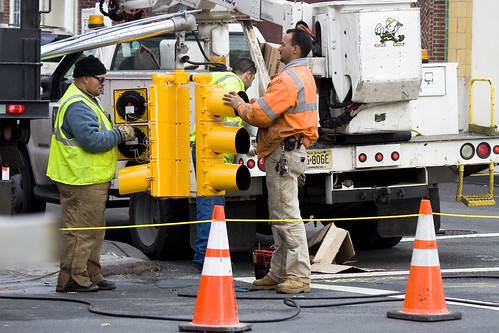
As your humble narrator scuttles from place to place, turning over rocks to see what blind albino abnormalities might lurk beneath, a significant amount of road construction is encountered. New York is always in a state of near collapse and an army of municipal and contractor labor is kept busy filling in the cracks. Conflicted over sneaking pictures of these folks, I nevertheless find them fascinating, for the high visibility colors they wear excite the eye.
from workzonesafety.org
Title: ANSI/ISEA 107-2004: Revised American National Standard for High-Visibility Safety Apparel and HeadwearAbstract: This standard provides a uniform, authoritative guide for the design, performance specifications, and use of high-visibility and reflective apparel including vests, jackets, bib/jumpsuit coveralls, trousers and harnesses. Garments that meet this standard can be worn 24 hours a day to provide users with a high level of conspicuity through the use of combined fluorescent and retroreflective materials. The revised version of the standard expands the product coverage to include high-visibility headwear. It also contains additional testing procedures for knitted fabrics used as background material, and eliminates tests from the previous edition that added no value. Publisher: International Safety Equipment Association

Third Avenue Manhattan – photo by Mitch Waxman
If it won’t blind or distract the crews, don’t forget that this is heavy industry and quite dangerous work, try turning on the camera flash when photographing them. The reflective fabrics, technically retroreflective fabrics (which function like a Cat’s eyeshine), will blaze up and be the brightest point in the photo. New York City street signs also function in a similar fashion, and even the weakest flash will light them up from blocks away. Try it, especially on a dark and stormy day, the effects are somewhat unpredictable and often produce a prismatic and surreal photo.
from simplifiedsafety.org
Class 1: needs to be conspicuous and use retroreflective materials not less than 25mm in width.
- Used when workers are well separated from traffic
- Vehicle speeds of less than 25 mph
- Parking attendants
- Shopping cart retrievers
- Warehouse workers
- Roadside/sidewalk maintenance workers
- Delivery vehicle drivers
Class 2: maintains superior visibility and are more conspicuous than the Class 1 garments. Minimum width of retroreflective material used on these is not less than 35mm.
- Used when workers are on or near roadways
- Vehicle speeds of 25 to 50 mph
- Roadway construction workers
- Utility workers
- Survey crews
- Law enforcement personnel
- Crossing guards
- High-volume parking lot or toll-gate attendants
- Airport baggage handlers and ground crews
- Railway workers
- Emergency response personnel
- Accident site investigators
Class 3: has greatest visibility. Maintains more retroreflective material than Class 2 and must have sleeves with retroreflective material between the shoulders and elbows. Not less than 50mm wide of retroreflective material.
- Used for workers in high risk situations
- Allows them to be seen from a minimum distance of 1,280 ft.
- Vehicle speeds of greater than 50 mph
- Roadway construction workers
- Utility workers
- Survey crews
- Emergency response personnel

31st street, Astoria – photo by Mitch Waxman
All of the municipal and construction rules are meant to conform to the national OSHA specifications, but individual city organizations have their own wrinkle on safety gear. MTA workers, for instance, are often observed wearing goggles and ear protection as they work. No doubt, this is due to individual union agreements and task specific requirements.
from nysdot.gov
All DOT employees, contractor employees and visitors must wear protective helmets and high visibility construction apparel while working within a highway right of way or contract limits. Flaggers must wear high visibility traffic control apparel when directing or spotting traffic. High-visibility apparel is not required for employees and visitors when they are within a completely enclosed cab constructed of steel frame and glass, or inside a motor vehicle.

37th avenue, Dutch Kills – photo by Mitch Waxman
NYFD, of course, has the most stringent series of rules for its crews. In the shot above, a 5 alarm fire at an industrial warehouse was belching black smoke into the street, but the firefighters are clearly identifiable through the murk- due to camera flash. Be careful around NYFD however, as they’re kind of busy people, and you don’t want to distract them. Also, should there be any piezoelectric activated equipment in use- DO NOT use your flash for fear of activating something.
from fasny.com
Back in November of 2008, there was a lot of confusion about the use of high-visibility vests at roadway incidents due to a new Federal Highway Administration (FHWA) Rule. The new regulation, Rule 634, stated that “All workers within the right-of-way of a Federal-aid highway who are exposed either to traffic (vehicles using the highway for purposes of travel) or to construction equipment within the work area shall wear high-visibility safety apparel.”
That regulation created a dilemma for fire departments who were truly interested in protecting their personnel. The training classes and material used by the Emergency Responder Safety Institute (ERSI) for years has suggested the use of high-visibility garments for public safety personnel when working around traffic. NFPA 1500, the Firefighter Health and Safety Standard has included a requirement for firefighters to wear safety vests at traffic incidents in the last two most recent editions. NIOSH Line of Duty Death Investigations have also included recommendations for responders to wear highly visible flagger vests when exposed to moving traffic. In the fire service community it was generally understood that the vests were not appropriate personal protective equipment (PPE) for personnel who were actively engaged in firefighting operations because those garments are not designed for exposure to fire, heat flame or hazardous materials. Rule 634, as originally published however did not outline any exemptions for firefighters engaged in direct firefighting operations and that created the dilemma.

Bridge Plaza North, Queens Plaza – photo by Mitch Waxman
The shot above is fascinating to me, for reasons that have little to do with the safety equipment exhibited. The trench that this trio is working in is down by Queens Plaza, and the cutaway shows a historical record. Notice the top layer of asphalt, then two distinct layers of cobblestones, then dirt and rock fill. Asphalt- modern, cobbles 1- the construction of the Queensboro bridge and associated roadways, cobbles 2- the pre bridge street, dirt and fill- that’s a 19th century, civil war era street. I’d love to have an archaeologist sift through this trench, but there’s nothing of historic importance in Queens… according to the City.
Note- the Charles Rudebaker wiki quote below… I’m a little squirrely on this particular wikipedia entry. The only info I could find on Rudebaker, a New Yorker who supposedly invented the Traffic Cone, parroted this exact wording all across the net. Take it with a grain of salt, until I can find out more. It very well might be a “false meme” which is a sort of “Lulz“.
from wikipedia
Traffic cones, also called road cones, highway cones, safety cones or construction cones, are usually cone-shaped markers that are placed on roads or footpaths to temporarily redirect traffic in a safe manner. They are often used to create separation or merge lanes during road construction projects or automobile accidents, although heavier, more permanent markers or signs are used if the diversion is to stay in place for a long period of time.
Traffic cones were invented in 1914 by Charles P. Rudebaker. Although originally made of concrete, today’s versions are more commonly brightly-coloured thermoplastic or rubber cones. Not all traffic cones are conical. Pillar shaped movable bollards fulfil a similar function.


 The Newtown Pentacle