Posts Tagged ‘South Park’
More Montour, please, and onions
Friday

– photo by Mitch Waxman
A humble narrator likes to ‘kill two birds with one stone’ as much as possible. Our Lady of the Pentacle announced that we had arrived at a shortfall in terms of the stock of fresh fruits and vegetables in our refrigerator, with said statement coinciding with one of my ‘every other day’ jaunts of exercise schedule. We have been buying this form of comestible from a farm’s retail operation, in Pittsburgh’s South Park suburb, which is about a 30 minute drive from HQ. Coincidentally, one of the sections of the Montour Trail is about a 10 minute drive from said farm stand. Hence…
I didn’t think that there would be much interest in seeing the onions, apples, broccoli, cucumbers and other stuff which I bought later on. On the other hand, the Montour Trail is freaking great. The veg was delicious, btw.

– photo by Mitch Waxman
This is a former rail road right of way, and the Montour Railroad’s primary occupation once revolved around coal. You can read all about the company at this Wikipedia link, the Montour Trail at this Wiki page, and for a series of visits I’ve made to the various sections of the trail click here.
There are several ‘rail to trail’ locations all over Pittsburgh, which make for an ideal form of scuttling. You’re separated from traffic, mostly, and the trails are surrounded largely by woodlands. There’s critters and often flowing water, and every so often a Porta Potty is encountered if you were in the mood to have a tinkle. The surface of the trail is generally asphalt or crushed limestone at railroad grade (1 foot of elevation for every hundred feet horizontally), and you could theoretically follow this path from Pittsburgh all the way to Washington D.C. on a bike, or on foot. There’s also several designated camping sites located along the Montour, with the path proceeding through the gorgeous Laurel Highlands and into the Western Maryland Panhandle. Appalachia, amirite?

– photo by Mitch Waxman
Saying all that, I ain’t taking a 152 mile long walk just to end up in D.C., and I’m trying to visit somewhat more local sections of the trail, bit by bit. On this particular day, one was taking a short walk of less than 4 miles. 2 miles in, 2 miles out and back to the dedicated parking lot where I left the Mobile Oppression Platform. Cardio, yo.
Why do I call my car the ‘Mobile Oppression Platform’? Well, back in Queens, where I was the chair of Community Board 1’s transportation committee, one had to regularly endure the performative outrage and politcial ire of the bicycle people. If somebody got hit by a car, it was emblematic or whatever snake oil they were selling this week or that. One particular eidelon of the street safety crowd describes automobiles as – alternatively – ‘two ton death machines,’ or ‘mobile oppression platforms.’ She didn’t realize that Dr. Zoidberg from the TV cartoon Futurama had got there first. When Toyota insisted I give the car a name, Mobile Oppression Platform is what I chose. You can use M.O.P for shortness’ sake.

– photo by Mitch Waxman
All in all, a very pleasant experience was enjoyed by a humble narrator, although the path in this section wasn’t exactly rich in features you’d want to point a camera at. I was quite interested in this masonry bridge, however, due to its stoutness. The point of this walk was walking, exercising the internally lubricated parts of my legs, and first elevating and then sustaining my heart rate for an interval.
The constancy of my walking around thing is something I’m commanded to do by the team of physicians who help me maintain a median level of health. Running would work too, but I only run when something is chasing me. Also, running offers up a spate of other possible injuries you could incur during the act or over time. Overall regular practice of long distance walking is a fairly low impact form of exercise which offers a number of other benefits. I always bring the camera along to keep it interesting, and to push me into going new places.
Give me a choice, I’d be sitting at home in a La-Z-Boy chair, which was the very first thing I bought after moving here last year. That’s some chair, I tell’s ya…

– photo by Mitch Waxman
After about two miles I encountered an obstacle, pictured above, and that served up as good a moment as any to reverse course and head back to the M.O.P.
There is a moving waterbody found alongside this section of the Montour Trail, which is called Montour Run. It’s the water which that stout masonry bridge spans. I’m pretty sure it’s engineered, likely something the rail people created as a drainage system for their berm riding trackway. Don’t know, I’m putting 2+2 together and presuming.

– photo by Mitch Waxman
Thankfully, I found an open sewer or two along the way, which poured their filth and degradation into it. Ahhh… What am I without sewage to talk about, after all? It was a fine concoction, whose miasma told me it was residential and maybe a couple of days old. I learned many things on Newtown Creek, including how to effectively smell from a fellow called ‘Ned the Nose.’
I made it back to the M.O.P. in fine fettle after walking a bit of the Montour Trail, and then drove over to the farm’s market building to fetch the requested vegetables and fruit. A few weeks ago, I bought peaches at that joint which were the size of frigging softballs, but that’s another story. This time around, the hero of the effort were these freakishly large tomatoes. I also bought a basketball sized Cabbage.
Back next week with something a bit different, at this – your Newtown Pentacle.
“follow” me on Twitter- @newtownpentacle
Buy a book!
“In the Shadows at Newtown Creek,” an 88 page softcover 8.5×11 magazine format photo book by Mitch Waxman, is now on sale at blurb.com for $30.
Oliver Miller Homestead
Tuesday
– photo by Mitch Waxman
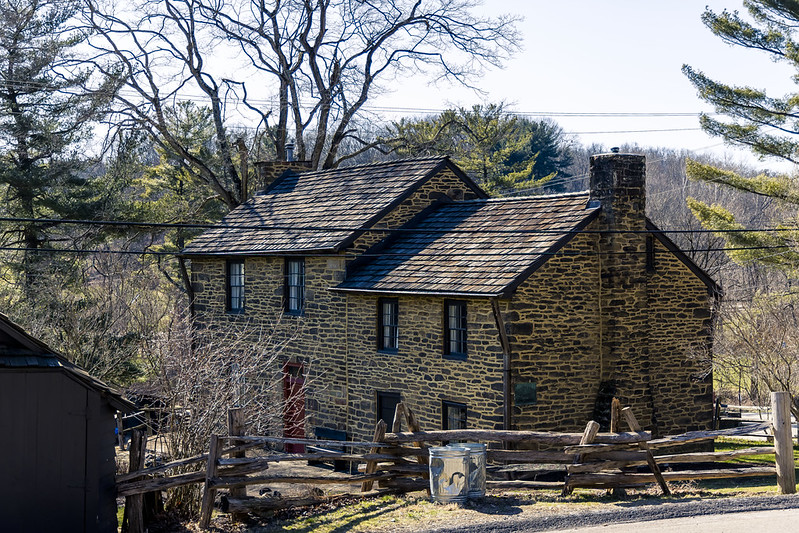
I swear that I had no idea about this, when I parked the car. An errand had found me in the neighborhood of South Park, in Pittsburgh’s South Hills, nearby the neighborhood of Bethel Park. The spot I had chosen to park nearby is a water and fountain feature called “The Cascades,” which as it turns out hasn’t opened for the warm seasons yet. After meeting a family of Deer, I took a short walk and found myself at the Oliver Miller Homestead public museum, where American Citizens first took up arms against George Washington and the newly created United States in 1794.
This is, I’m told, where the first shots fired of the Whiskey Rebellion were let loose. For those of you who didn’t pay attention in high school history class, or fell asleep during the endlessly boring lessons about the Articles of Confederation in 10th Grade, allow me to summarize our country’s very first tax revolt in a somewhat modern vernacular.

– photo by Mitch Waxman
Back in the day, the fledgling United States was drowning in debts which the Rebellion had incurred in pursuit of chasing the British Crown away. President Washington signed into law a tax on distillates like Rum and Whiskey. Agriculture enthusiasts had long been in the habit of distilling excess or surplus grains like rye, barley, wheat, and even corn into liquors. This is an old European trick, preserving summertime calories in a manner which could also coax the party spirit out of people. Also, in the days prior to the Germ Theory of Disease, your best bet to sterilize the water you were about to drink was to add a bit of the good stuff to it. They didn’t know that’s what they were doing, of course, but it was. Clean drinking water is one of the technologies seldom pointed to as creating the modern era, but there you are. This practice of adding a shot’s worth of an alcohol drink into your water is why rum or whiskey were a part of soldier’s rations right up to the 20th century.
To pay down the National Debt of $54 million, (current worth of that number would be $1,476,850,909.09 today) Washington and the list of famous names he worked with in Congress enacted the Whiskey Tax. To say that this went down like a lead balloon with the Frontier types (Lewis and Clark left for their journey to the west from Pittsburgh, literally the last outpost of European Civilization in those days, until you got to the Spanish holdings) in Western Pennsylvania and the Ohio Valley is a bit of an understatement. Many of these “Frontiersmen” had actually served under Washington during the rebellion.

– photo by Mitch Waxman
There’s a great account of the conflict which led to the Whiskey Rebellion becoming a shooting war in this post at Mt. Lebanon Magazine. Suffice to say that a tax collector came here to the Miller Homestead on July 15 in 1794. That drew a crowd, which soon became an incensed mob, and the Tax collector and Sheriff had to run for their lives. By the time that the Tax collector – one John Neville – was able to summon army troops to help him enforce the law, that angry mob had transformed into a Rebel Militia. Things went pretty much as you’d expect at that point, with trained soldiers on each side shooting at each other and farm buildings burning down.
Things soon progressed to the point that George Washington, President of the United States, assembled an army of 12,000 soldiers and was personally leading them – as a General – towards Pennsylvania. You can read all about it here, but you should have paid more attention to it back in 10th grade.

– photo by Mitch Waxman
Thomas Jefferson repealed the Whiskey tax in 1802 when he became President, and he blamed all the bloodshed and trouble in the region on his rival Alexander Hamilton, who had pushed Washington and Congress into accepting fiscal reality regarding the debts.
The Miller property was colonized in 1772, and the original deal here was a log cabin on a farm with several “out” buildings – a barn for the animals, a house for the slaves, etc. The log cabin was replaced in 1830, and the modern homestead building is called a “Stone Manse.” This is a protected historic place, and when the surrounding South Park was opened in 1931, the Miller Homestead was turned into a public museum.

– photo by Mitch Waxman
I observed several other small structures, including the cabin above and a “spring house” which hosted a large basin and fresh water bubbling up into it from below. The site was closed when I visited, but a humble narrator crossed the boundary while trying to save a butterfly from a predatory bird. That’s my story, sticking with it.
This was all just lucky serendipity for me, incidentally. As mentioned, I had no idea this was here, and somehow I made a beeline for it.

– photo by Mitch Waxman
South Park is pretty amazing, actually. There’s an animal preserve section nearby this spot which has Bisons living on it. Pictured above is a barn, which struck my fancy enough to take a picture.
Back tomorrow.
“follow” me on Twitter- @newtownpentacle
Buy a book!
“In the Shadows at Newtown Creek,” an 88 page softcover 8.5×11 magazine format photo book by Mitch Waxman, is now on sale at blurb.com for $30.
Nothing but blue skies
Monday

– photo by Mitch Waxman
That’s the Homestead Grays Bridge pictured above, spanning the Monongahela River. I don’t have much to say about it other it was lit up all pretty like on a recent Sunday afternoon when I was passing through. The last week has been pretty much overcast or super rainy here in Pittsburgh. Annoyingly so.
At any rate, one managed to get out and about a few times last week when it wasn’t raining or dire.

– photo by Mitch Waxman
An errand of a somewhat pedantic nature, actually a series of such errands, found me nearby something I’ve been wanting to take a gander at – Pittsburgh’s South Park. It’s another one of the mega massive public amenities hereabouts. I was in the neighborhood and had an hour or so to spare before needing to head back to HQ, so I picked out a random destination within the 2,000 square acre urban park to aim myself at.
When I pulled the Mobile Oppression Platform into a parking lot, a big pile of deer were roaming about. They stuck around for a few minutes and posed for pictures before scampering off into a wooded section.

– photo by Mitch Waxman
There’s an actual traffic roundabout in the park, something very common in Europe but not so much in the USA. As it turns out, the random spot I chose to pull the car over has an enormous “historicity” to it, but I’ve always been lucky when it comes to stumbling across places with an interesting past.
More on all that tomorrow, at your Newtown Pentacle.
“follow” me on Twitter- @newtownpentacle
Buy a book!
“In the Shadows at Newtown Creek,” an 88 page softcover 8.5×11 magazine format photo book by Mitch Waxman, is now on sale at blurb.com for $30.


 The Newtown Pentacle