Posts Tagged ‘weirdness’
Why I hate Ms. Heather

– photo by Mitch Waxman
God damn that genius monkey in Greenpoint, she got here before me. The brilliant, prolific, and blazing Ms. Heather of NY Shitty beat me to this location, AND, she worked the same “angle” on it that I was going to use, months before I even found the place.
If you aren’t familiar with nyshitty’s world of North Brooklyn, the incisive sartorial “eye”, that unique sense of humor- you must live in Manhattan or something.
I found this place in on Vandam Street in Blissville, while on my way to the haunting elevations of First Calvary one fine afternoon, and started shooting.
My, what a wonderful posting this will make, muttered your humble narrator to himself. He forgot about the way that Ms. Heather kicks ass, every day.
from newyorkshitty.com
If you disagree with anything I have posted, wish to correct something I might have overlooked and/or fudged; or simply want to chime in I’m all for it. In fact, I encourage this. I want this site to be a public forum where north Brooklynites and New York Shittites (if not in locality, at heart) can talk shop. Respectfully.
Terse and even downright angry is acceptable. What I will not tolerate is abuse. Be it directed at me or other commenters. In other words, if what you have in mind has an “ism” to describe it don’t bother. I won’t approve it.
The more surly and self-righteous among you might decry this as a denial of your “free speech”. It isn’t. This web site is powered by free speech. My free speech. If you have something you want to say so badly that is circumscribed by my (albeit vague) terms of use, start your own blog. It’s your right too. Go for it.
Otherwise, I look forward to hearing from you!

– photo by Mitch Waxman
Brooklyn Vault Light Co., with an address?
Easy post, and it will make the lords and ladies believe my personal mythology of “omniscient and timeless wisdom” when I reveal a forgotten industrial corridor to them. Oh, how wise will I seem.
Then… I get back to Newtown Pentacle HQ here in fuligin haired Astoria and begin my researches, and discover that the thrice damned Ms. Heather presented this location- and its associated history- in a concise and attractive post well before I had even found the site.
How does she do it? Relentless, she is like an ocean- tidal, ever present, timeless.
from villagevoice.com
The accounts of Greenpoint life that make up most of New York Shitty aren’t all as negative as the name implies. “It was initially premised on the dog-shit problem in my community,” Miss Heather tells us. “I reached my breaking point one day when I was coming home from the Franklin Corner Store laden with bags of groceries. I was literally dodging dog bombs every two or three feet.”
Her first public service when she started New York Shitty in 2006 was a series of “Crap Maps” of the Brooklyn neighborhood where she’s lived for 10 years. Then, she says, “something happened I could never have anticipated: People started paying attention.”

– photo by Mitch Waxman
All I can tell you, gentle readers, is that to learn the tale of this iron lid and the meaning of its enigmatic typography- you must visit her and know her wisdom- click here.
I would also mention that I’m kind of a gigantic fan of Chez Shitty, in case you haven’t put that together yet. If you’re not- you should be.
mother of invention

– photo by Mitch Waxman
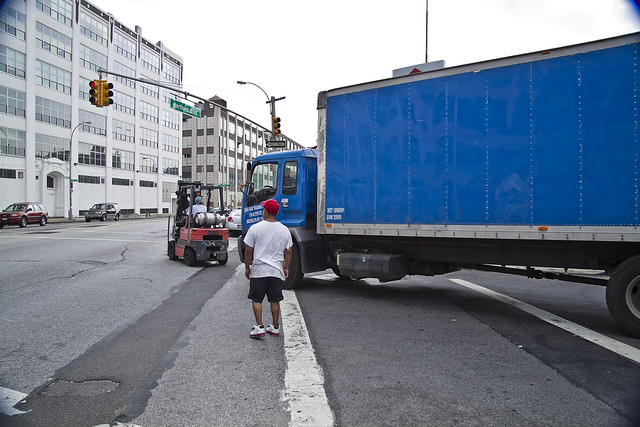
Another recent bit of serendipity experienced during a random walk, this time a bit further down Northern Blvd. and directly across the street from the Standard Motor Products building on 39th street, it seems that the good fellows who operate this largish delivery truck had experienced an unlucky turn when its engine suddenly stranded them. Luckily, they seemed to have a tiny red forklift on board, of a sort which I’ve always heard referred to as a “Bobcat”.
from wikipedia
Forklifts are rated for loads at a specified maximum weight and a specified forward centre of gravity. This information is located on a nameplate provided by the manufacturer, and loads must not exceed these specifications. In many jurisdictions it is illegal to remove or tamper with the nameplate without the permission of the forklift manufacturer.
An important aspect of forklift operation is that most have rear-wheel steering. While this increases maneuverability in tight cornering situations, it differs from a driver’s traditional experience with other wheeled vehicles. While steering, as there is no caster action, it is unnecessary to apply steering force to maintain a constant rate of turn.
Another critical characteristic of the forklift is its instability. The forklift and load must be considered a unit with a continually varying centre of gravity with every movement of the load. A forklift must never negotiate a turn at speed with a raised load, where centrifugal and gravitational forces may combine to cause a disastrous tip-over accident. The forklift are designed with a load limit for the forks which is decreased with fork elevation and undercutting of the load (i.e. load does not butt against the fork “L”). A loading plate for loading reference is usually located on the forklift. A forklift should not be used as a personnel lift without the fitting of specific safety equipment, such as a “cherry picker” or “cage”.

– photo by Mitch Waxman
The inert truck was borrowing its motive power from the smaller and self propelled tool. Its driver clearly seemed embarrassed by all the attention he garnered. Several of us stood on the corners, males all, sporting broad smiles and cheering him on while he waited for a red light to turn. This sort of situation appeals to we men, I don’t know why, but it does.
I was betting on either the inadequate chain just sundering into constituents, or the forklift burning out its transmission before it moved the giant blue vehicle more than a couple of feet.
from wikipedia
A high-tensile chain, also referred to as a transport chain, is a link chain with a high tensile strength used for drawing or securing loads. This type of chain usually consist of broad (thick/heavy) metal, oblong torus-shaped links for high strength. All the links of the chain are usually identical, and on the ends are usually two hooks of the appropriate size and strength to slide easily over one chain link but small enough not let the links slip by. When the ability to grasp the load is required, a slip hook is used.
The chain used for tire chains on tractors and some automobiles for better traction is very similar; usually consisting of the same type of link, especially so for snow chains; however, instead of being a single chain, it is more of a network of interconnected chains with no hooked ends; the size and design of the network depending on the tire it was intended for.

– photo by Mitch Waxman
The signal turned, and that tiny forklift and its driver wouldn’t let anything like the laws of Physics or the limits of engineering stop them from getting the truck moving.
Whom, indeed, says that an ant can’t move a rubber tree plant? Whom?
from wikipedia
They usually range in size 4 to 7 m in length, with smaller or larger sizes existing but being rare in North America. They usually have a garage door-like rear door that rolls up. On some box trucks, the cargo area is accessible from the cab through a small door.
Box trucks are usually used by companies that need to haul appliances or furniture. They are also used as moving trucks which can be rented from companies such as U-Haul or Ryder.
In North America, Ford, Dodge and Chevrolet/GMC have historically been the most common manufacturers of conventional cab/chassis to which various producers (called body builders or upfitters) attach the box that holds cargo. Isuzu, Mitsubishi Fuso and UD/Nissan Diesel have been the most common marketers of cabover-type medium duty cab/chassis used as platforms for box trucks. In North America, these trucks can range from Class 3 to Class 7 (12,500 lb. to 33,000 lb. gross vehicle weight rating, or GVWR).
– photo by Mitch Waxman
The drivers around these parts- borderland and angle between Sunnyside, Astoria, and Dutch Kills- are not exactly a sagacious or patient lot. Normal practice for them is to hit their horns in the quarter second before the traffic light goes from red to green, and to accelerate precipitously in an effort to “beat the lights”. Queens Plaza is nearby, and their probable destination of Manhattan- unlike Queens- is a heavily regulated and well policed thicket of traffic jams. This is their last chance to see the sky.
Well… not for long.
from wikipedia
A gross vehicle weight rating (GVWR) is the maximum allowable total mass of a road vehicle or trailer when loaded – i.e including the weight of the vehicle itself plus fuel, passengers, cargo, and trailer tongue weight.
The difference between gross weight and curb weight is the total passenger and cargo weight capacity of the vehicle. For example, a pickup truck with a curb weight of 4,500 pounds (2,041 kg) might have a cargo capacity of 2,000 pounds (907 kg), meaning it can have a gross weight of 6,500 pounds (2,948 kg) when fully loaded.

– photo by Mitch Waxman
Witness the tenacity and determination of the American workforce- its inchoate improvisations and hazard ridden solutions that keep the machines running no matter what, its complete disregard for official procedure and personal safety -unstoppable, indefatigable, the children of necessity.
from wikipedia
New York State Route 25A (NY 25A) is a New York State highway and the main east–west route for most of the North Shore of Long Island, running from the Queens Midtown Tunnel in the New York City borough of Queens at its western terminus to Calverton in Suffolk County at its eastern end.
Known for its scenic route through decidedly lesser-developed areas such as Brookville, Fort Salonga, Centerport, and the Roslyn Viaduct, 25A begins as 21st Street in Long Island City. As you go farther through 25A, it is then known as Jackson Avenue for a short period and is variously named Northern Boulevard east of Queens Plaza (NY 25), North Hempstead Turnpike, Main Street, Fort Salonga Road, and North Country Road. It merges with NY 25 for approximately 1.5 miles (2.4 km) in Smithtown.
torment of the Brachyura

– photo by Mitch Waxman
Your humble narrator is a carnivore, as mentioned in the past, despite a somewhat advanced state of understanding of the realities of feedlot and abattoir.
Human beings are ultimately predatory apes, and the greasy taste of flesh is prized by most. Displays of comestible items are commonly observed amongst the human hives, but when one is moving through a neighborhood whose residents enjoy exotic fare- like Manhattan’s famous Chinatown in this case – the careful observer might be rewarded with visions of the fanciful or alien.
from wikipedia
Homo Necans: the Anthropology of Ancient Greek Sacrificial Ritual and Myth is a book on ancient Greek religion and mythology by Walter Burkert, which won the Weaver Award for Scholarly Literature, awarded by the Ingersoll Foundation, in 1992. The book’s core thesis is that when paleolithic man became a hunter, in spite of the generally omnivorous orientation of the great apes, lack of a predator instinct was made up for by turning patterns of intra-species aggression against the prey: Homo necans means “man the killer”. Thus, the animal hunted by ancient man automatically acquired aspects of an equal, as if it were of one of the hunter’s relations. In a first attempt at applying ethology to religious history, Burkert confronts the power and effect of tradition in uncovering traces of ancient hunting rituals so motivated in historical animal sacrifice and human sacrifice (by his thesis unified as deriving from the same fundamental principle) in specific historical Greek rituals with relevance to human religious behaviour in general. Burkert admitted that a decisive impulse for the thesis of Homo Necans derived from Konrad Lorenz’ On Aggression (1963).
The thesis set out in the first chapter, “Sacrifice, hunting and funerary rituals”, is an extension of the hunting hypothesis, which states that hunting as a means of obtaining food was a dominant influence on human evolution and cultural development (as opposed to gathering vegetation or scavenging). The guilt incurred in the violence of the hunt was reflected in sacred crimes, which through rituals of cleansing and expiation served to unify communities.

– photo by Mitch Waxman
A carnivorous glutton your humble narrator may be, but empathy and indignation arose in him when confronted with this display.
Sure that this is a time tested and necessary technique intended to display the freshness and nutritional validity of this cast of crustaceans, demanded by clientele, a certain bile nevertheless rises. Western prejudice no doubt colors my point of view, as the same overt revulsion does not rise at the sight of a counter of European butchers meat.
Paradoxical, but to my reasoning, there isn’t a display of crucified and disemboweled cows overhanging the refrigerated section at the supermarket. Vegan friends would disagree, but I guess it depends on your point of view, and “Krabs ain’t Kosher” either.
from wikipedia
Crabs make up 20% of all marine crustaceans caught, farmed, and consumed worldwide, amounting to 1½ million tonnes annually. One species accounts for one fifth of that total: Portunus trituberculatus. Other commercially important taxa include Portunus pelagicus, several species in the genus Chionoecetes, the blue crab (Callinectes sapidus), Charybdis spp., Cancer pagurus, the Dungeness crab (Metacarcinus magister) and Scylla serrata, each of which yields more than 20,000 tonnes annually.

– photo by Mitch Waxman
It really was just the simple fact that the Cast of Crabs in the bushel bucket beneath this macabre marquee were subtly scuttling which disturbed me and drew this comment.
I am also aware, of course, that given the chance- those in the basket would consume those above them with abandon.
from wikipedia
The problem of animal suffering, and animal consciousness in general, arises primarily because animals have no language, leading scientists to argue that it is impossible to know when an animal is suffering. This situation may change as increasing numbers of chimps are taught sign language, although skeptics question whether their use of it portrays real understanding. Singer writes that, following the argument that language is needed to communicate pain, it would often be impossible to know when humans are in pain. All we can do is observe pain behavior, he writes, and make a calculated guess based on it. As Ludwig Wittgenstein argued, if someone is screaming, clutching a part of their body, moaning quietly, or apparently unable to function, especially when followed by an event that we believe would cause pain in ourselves, that is in large measure what it means to be in pain.[98] Singer argues that there is no reason to suppose animal pain behavior would have a different meaning.
Bottle Alley

– photo by Mitch Waxman
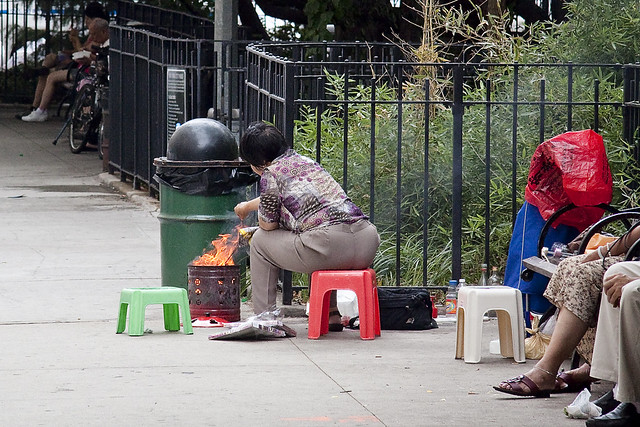
Baxter Street just past Leonard, I noticed this woman tending a little fire. She was part of a small group who were gathered at the Baxter Street side of the Mulberry Bend, where Jacob Riis described Bottle Alley. Getty Images has a watermarked preview image of the place, as photographed by Jacob Riis in 1901 here.
from wikipedia
In Chinese tradition, the fifteenth day of the seventh month in the lunar calendar is called Ghost Day and the seventh month in general is regarded as the Ghost Month (鬼月), in which ghosts and spirits, including those of the deceased ancestors, come out from the lower realm. Distinct from both the Qingming Festival (in Spring) and Chung Yeung Festival (in Autumn) in which living descendants pay homage to their deceased ancestors, on Ghost Day, the deceased are believed to visit the living.
On the fifteenth day the realms of Heaven and Hell and the realm of the living are open and both Taoists and Buddhists would perform rituals to transmute and absolve the sufferings of the deceased. Intrinsic to the Ghost Month is ancestor worship, where traditionally the filial piety of descendants extends to their ancestors even after their deaths. Activities during the month would include preparing ritualistic food offerings, burning incense, and burning joss paper, a papier-mache form of material items such as clothes, gold and other fine goods for the visiting spirits of the ancestors.
– photo by Mitch Waxman
Far eastern correspondent Armstrong happened to be with me this day, welcome company for my otherwise lonely walks, and informed me that this lady was burning “ghost items”- but that it was the wrong season for the Hungry Ghosts. Armstrong further iterated that someone dear to this lady had either died recently, or that it might be the anniversary of a death. Suddenly, your humble narrator remembered an enigmatic fixture observed within the section of St. Michael’s Cemetery in Astoria which is remarkable for the quantity of monuments which display asiatic scripts. Also, this is a photo of an offering of “ghost bucks“, also at St. Michael’s.
also from wikipedia
The Ghost Festival is celebrated during the seventh month of the Chinese Lunar calendar. It also falls at the same time as a full moon, the new season, the fall harvest, the peak of Buddhist monastic asceticism, the rebirth of ancestors, and the assembly of the local community. During this month, the gates of hell are opened up and ghosts are free to roam the earth where they seek food and entertainment. These ghosts are believed to be ancestors of those who have forgotten to pay tribute to them after they had died, or those who have suffered deaths and were never given a proper ritual for a send-off. They have long needle-thin necks because they have not been fed by their family, or it is a sign of punishment so they are unable to swallow. Family members offer prayers to their deceased relatives, offer food and drink and burn joss paper. Such paper items are only valid in the underworld, which is why they burn it as an offering to the ghosts that have come from the gates of hell. The afterlife is very similar in some aspects to the material world, and the paper effigies of material goods would provide comfort to in the afterlife. People would also burn other things such as paper houses, cars, servants and televisions to please the ghosts.[2] Families also pay tribute to other unknown wandering ghosts so that these homeless souls do not intrude on their lives and bring misfortune and bad luck. A large feast is held for the ghosts on the fourteenth day of the seventh month, where everyone brings samplings of food and places them on the offering table to please the ghosts and ward off bad luck.

– photo by Mitch Waxman
Photography makes you rude, exposing the nosey side of your personality- the “yenta”. You’re not just prying into someone else’s life, you are actually recording it and signing your name under their moment as “photgrapher”. Perhaps you really do steal a piece of someone’s soul when you take their picture… it would certainly explain why the politicians and Mel Gibson are the way they are.
Your humble narrator, who was once actually chased across Astoria by a crowd of old Greek ladies screaming “terrorist… camera… terrorist”, has learned the best thing to do is smile and feign genuine connection when they turn around and catch me. This is hard for me- a direct interaction with a stranger- but I’ve observed how humans act, and can create a convincing simulacra of the behavior set.
I’ve been told, though, that my attempt at acting nice is rather creepy- mainly this, but mixed with some of this and a smidge of that.
from wikipedia
There are many superstitions and taboos surrounding the Hungry Ghost Festival. Spirits are thought to be dangerous, and can take many forms, including snakes, moths, birds, foxes, wolves, and tigers. Some can even use the guise of a beautiful man or woman to seduce and possess. One story refers to a ghost who makes the form of a pretty girl and seduces a young man until a priest intervenes and sends the spirit back to hell. Possession can cause illness and/or mental disorders. During the 7th month children are advised (usually by an elder in the family) to be home before dark, and not to wander the streets at night for fear a ghost might possess them. Swimming is thought to be dangerous as well, as spirits are believed to have drowned people. People will generally avoid driving at night, for fear of a “collision”, or spiritual offence, which is any event leading to illness or misfortune. While “ghosts” is a common term used throughout the year, many people take on the phrase “backdoor god” or “good brother” instead so as not to anger the gods. Another thing to avoid is sampling any of the food placed on the offering table, as doing this can result in “mysterious illness”. Any person attending a show at an indoor entertainment venue (Getais) will notice the first row of chairs is left empty. These seats are reserved for the spirits, and it is considered bad form to sit in them. After an offering has been burnt to the spirits, stepping on or near the burnt area should be avoided, as it is considered an “opening” to the spirit world and touching it may cause the person to be possessed.

– photo by Mitch Waxman
The photo I’m not showing is the one after this, where this woman shot me a polite and slightly shy grin. I went on my way, hoping to minimize my intrusions, as she had ghosts that needed feeding.
from wikipedia
Yan Wang (traditional Chinese: 閻王), also called Yanluo (traditional Chinese: 閻羅) is the god of death and the sovereign of the underworld. He is also the judge of the underworld, and decides whether the dead will have good or miserable future lives. Although ultimately based on the god Yama of the Hindu Vedas, the Buddhist Yan Wang has developed different myths and different functions from the Hindu deity. Yan Wang is normally depicted wearing a Chinese judge’s cap in Chinese and Japanese art. He sometimes appears on Chinese Hell Bank Notes.
Guǐ (鬼) is the general Chinese term for ghost, used in combination with other symbols to give related meanings such as gweilo (鬼佬), literally “ghost man”, used to refer to white people, and mogwai (魔鬼) meaning “devil”. Derived symbols such as 魇 (chui) meaning “nightmare” also carry related meanings. There are many types of Guǐ:
- Diào Sǐ Guǐ (吊死鬼): The ghost of someone who has been hanged, either in execution or suicide
- Yóu Hún Yě Guǐ (游魂野鬼):
- The wandering ghost who has died far away from his/her hometown or family, especially when his/her body and spirit haven’t been sent back to home.
- The wandering ghost of the dead, including vengeful spirits who take their revenge, hungry ghosts and playful spirits who may cause trouble during the Hungry Ghost Festival.
- Guǐ Pó (鬼婆): A ghost that takes the form of a kind and friendly old woman. They may be the spirits of servants who used to work for rich families, and who have returned to help around the house.
- Nǚ Guǐ (女鬼): The ghost of a woman who has committed suicide due to some injustice such as being wronged or sexually abused. She returns to take her revenge.
- Yuān Guǐ (冤鬼): The ghost of someone who have died a wrongful death. They roam the world of the living, depressed and restless, seeking to have their grievances redressed.
- Shuǐ Guǐ (水鬼): The spirit of someone who drowned and continues living in the water. They attack unsuspecting victims by dragging them underwater and drowning them to take possession of the victim’s body.
- Wú Tóu Guǐ (无头鬼): A headless ghost who roams about aimlessly.
shivering gargoyles

– photo by Mitch Waxman
Gilman, Gilman, Gilman.
That note, attached to governmental correspondence, was signed Gilman. Impossible, unbelievable, and beyond sane reasoning… Gilman. As your humble narrator scuttled along in miserable mood, that certain day, I became convinced that my name was being called from some unknown point beyond the bulkheaded fence lines adorning that sewer fed ribbon of urban lore called the Newtown Creek.
I first heard the voice, while deep in denial at the Pulaski Bridge, a whispered gutteral which seemed like an isolated phenomena.
from wikipedia
Tutti Acceptance typically contains the concept of approval, it is important to note that in the psychospiritual use of the term infers non-judgmental Acceptance is contrasted with resistance, but that term has strong political and psychoanalytic connotations not applicable in many contexts. By groups and by individuals, acceptance can be of various events and conditions in the world; individuals may also accept elements of their own thoughts, feelings, and personal histories. For example, psychotherapeutic treatment of a person with depression or anxiety could involve fostering acceptance either for whatever personal circumstances may give rise to those feelings or for the feelings themselves. (Psychotherapy could also involve lessening an individual’s acceptance of various situations.)
Notions of acceptance are prominent in many faiths and meditation practices. For example, Buddhism’s first noble truth, “All life is suffering”, invites people to accept that suffering is a natural part of life. The term “Kabbalah” means literally acceptance.

– photo by Mitch Waxman
Isolating myself in a guilty agony, hiding behind dark sunglasses and a long iPhone playlist which had finally wound- inevitably- to the darker side of Patti Smith, I skirted the Creek and made for the River of Sound.
Overwhelmed by its inevitability of oligarchy, I noticed that the auditory hallucination that my name was being called from the water had abided, and the decision to make haste for the safety of almond eyed Astoria was wise, back to the loving arms of Our Lady of the Pentacle and the unquestioning devotion of my little dog Pazuzu.
from wikipedia
Karma is the belief held by some major religions that a person’s actions cause certain effects in the current life and/or in future life, positively or negatively.
For example, if a person always does good deeds then it is believed that he or she will be “rewarded” for his or her behavior with fortunate events such as avoiding fatal accident or winning the lottery. If he or she always commits antagonistic behaviors, then it is believed that he will be punished with unfortunate events.
According to Buddhism, inequality amongst living beings is due not only to heredity, environment, “nature and nurture”, but also to Karma. In other words, it is the result of our own past actions and our own present doings. We ourselves are responsible for our own happiness and misery. We create our own Heaven. We create our own Hell. We are the architects of our own fate.
Perplexed by the seemingly inexplicable, apparent disparity that existed among humanity, a young truth-seeker approached the Buddha and questioned him regarding this intricate problem of inequality:
“What is the cause, what is the reason, O Lord,” questioned he, “that we find amongst mankind the short-lived and long-lived, the healthy and the diseased, the ugly and beautiful, those lacking influence and the powerful, the poor and the rich, the low-born and the high-born, and the ignorant and the wise?”
The Buddha’s reply was:
“All living beings have actions (Karma) as their own, their inheritance, their congenital cause, their kinsman, their refuge. It is Karma that differentiates beings into low and high states.”
He then explained the cause of such differences in accordance with the law of cause and effect.

– photo by Mitch Waxman
Slipping and stumbling, my denial and self imposed hermitage blossomed into anger and rage, surely- the note signed by Gilman was nothing of the sort. The same agencies which have directed their gaze upon me are attempting to rub my nose in their power and my inability to react.
from wikipedia
Environmental determinism, also known as climatic determinism or geographical determinism, is the view that the physical environment, rather than social conditions, determines culture. Those who believe this view say that humans are strictly defined by stimulus-response (environment-behavior) and cannot deviate.
The fundamental argument of the environmental determinists was that aspects of physical geography, particularly climate, influenced the psychological mind-set of individuals, which in turn defined the behaviour and culture of the society that those individuals formed. For example, tropical climates were said to cause laziness, relaxed attitudes and promiscuity, while the frequent variability in the weather of the middle latitudes led to more determined and driven work ethics. Because these environmental influences operate slowly on human biology, it was important to trace the migrations of groups to see what environmental conditions they had evolved under.

– photo by Mitch Waxman
Attempting to bargain with this malicious universe called New York City, a foul harlot indeed, I wandered into the empty corridor in a tightly compressed state of mind. Encounters with security men, and other creatures of the street not mentioned in the posting, formed a silo of despair about me.
from wikipedia
“Forbidden fruit” is any object of desire whose appeal is a direct result of the knowledge that it cannot or should not be obtained or something that someone may want but is forbidden to have. The metaphorical phrase forbidden fruit refers to the Book of Genesis, where it is the fruit of the Tree of Knowledge of Good and Evil eaten by Adam and Eve in the Garden of Eden. As a result of their decision to eat the fruit, Adam and Eve lost their innocence, became separated from God and were exiled from the garden where they were forced to adopt agriculture under less than desirable circumstances for a living.

– photo by Mitch Waxman
Finally, as the vapor dulled sunbeams cast those queer shadows which form the tenebrous patterns distinctive of the Newtown Creek and its tributaries during the humid and hot months, your humble narrator was forced into acceptance of the notation- written in atavist hand on a scrap of brown kraft paper which smelled of salted cod- as genuine.
from wikipedia
The Qur’an doesn’t name this tree and it is always referred to as “the tree”. Muslims believe that when God created Adam and Eve, He told them that they could enjoy everything in the Garden but this tree, and so, Satan appeared to them and told them that the only reason God forbade them to eat from that tree is that they would become Angels or become immortals.
When they ate from this tree their nakedness appeared to them and they began to sew together, for their covering, leaves from the Garden. As a result of their sin, they were removed from heaven and placed on Earth to live and die. Consequently, they repented to God and asked for his forgiveness and were forgiven. It was decided that those who obey God and follow his path shall be rewarded with everlasting life in Heaven, and those who disobey God and stray away from his path shall be punished in Hell.

– photo by Mitch Waxman
By the time I came to Dutch Kills, at the Hunter’s point avenue bridge, I had managed to subsume this fact when I noticed that the hallucination had returned. A gurgling echo, which could have easily been the sound of some unknown machine reverbing along the cement, or some far off car stereo, or some physical effect caused by playing the music on my headphones too loudly for too long.
And I noticed that the vegetation along the shoreline was stained with the colour, and it was swaying against the breeze.
from wikipedia
The Biblical description of the garden says :
Now a river flowed out of Eden to water the garden; and from there it divided and became four rivers. The name of the first is Pishon; it flows around the whole land of Havilah, where there is gold.[…] The name of the second river is Gihon; it flows around the whole land of Cush. The name of the third river is Tigris; it flows east of Assyria And the fourth river is the Euphrates.
There have been a number of claims as to the actual geographic location of the Garden of Eden, though many of these have little or no connection to the text of Genesis. Most put the Garden somewhere between Najaf and Kufa in the Middle East.

– photo by Mitch Waxman
One thing I can tell you, lords and ladies of Newtown, is that the search for Gilman- rather than being retarded by this mysterious missive- will be redoubled. Whoever Gilman was, somebody in a high position does not want his story told. The note, written in old timey handwriting, is worrisome.
Gilman, who -and perhaps, what – were you?
from wikipedia
In many myths the chthonic serpent (sometimes a pair) lives in or is coiled around a Tree of Life situated in a divine garden. In the Genesis story of the Torah and Biblical Old Testament the Tree of the Knowledge of Good and Evil is situated in the Garden of Eden together with the tree of immortality. In Greek mythology Ladon coiled around the tree in the garden of the Hesperides protecting the entheogenic golden apples.
Similarly Níðhöggr (Nidhogg Nagar) the dragon of Norse mythology eats from the roots of the Yggdrasil, the World Tree.
Under yet another Tree (the Bodhi tree of Enlightenment), the Buddha sat in ecstatic meditation. When a storm arose, the mighty serpent king Mucalinda rose up from his place beneath the earth and enveloped the Buddha in seven coils for seven days, not to break his ecstatic state.


 The Newtown Pentacle