Archive for August 2009
Lurking… in fear- or Astoria to Calvary, part 2
Here’s a google map (including part 1 of this walk).

Dwyer Square -photo by Mitch Waxman
Perhaps…
The world knows all that it ought to know of Western Queens, and would remain merry in the satisfied ignorance of modernity- were it not for we Newtownicans who force it to disgorge its centuried secrets to feed the ravenous panopticon. Shudder at revelations of this history, found at our altar of a forgotten cosmos, for its implications may force one to experience monstrous alterations of dream. No rock in this part of the great city can be overturned without portent, or absent the mocking laughter of those who once walked these titan arcades of the Newtown Pentacle.
from the nyc.gov website
Located in the northwestern Queens neighborhood of Astoria, Dwyer Square lies near an old Native American trail (Woodside Avenue) that served as the main road from western Queens to the village of Newtown during the early American Colonial Period. The road ran along a tongue of dry land between the swamps of Long Trains Meadow (towards present day Jackson Heights), Wolf Swamp (towards present day Maspeth), and Burger’s Sluice (along present day Northern Boulevard). Hessians during the American Revolution (1775-1783) garrisoned this strategic point. In 1713 Isaac Bragaw, a descendant of one of the earliest French Huguenots in New Amsterdam, purchased this land. During the early 19th century, William Gosman purchased the farm. (Gosman is also known for having surveyed and laid out the area’s streets around 1875). Also nearby lies Northern Boulevard, an important six mile road connecting Flushing to Hunters Point.
It was originally named Jackson Avenue for Turnpike President John C. Jackson, whose leadership and efforts made the road possible. Costing nearly $40,000 and opening on July 13th, 1860, the highway was originally composed of milestones, a gravel roadbed and a tiny tollhouse and gate where travelers would pay a nine cents fee for passage. Foot traffic, however, was free.
In September 1980, the City of New York rededicated Dwyer Square. The square contains a flagpole with a yardarm that flies the United States, City of New York, and Parks flags; brick and concrete walkways; benches; and five trees, including three Japanese pagoda trees (Sophora japonica), a honey locust (Gleditsia tricanthos), and a green ash tree (Fraxinus pennsylvanica).

48th street between Northern Blvd. and 37th avenue looking west -photo by Mitch Waxman
At the commercialized intersection of 48th street and Northern Blvd. make a right and find the spot where- in 1932 the Madison Square Garden Bowl attracted a degenerate population of gamblers and all those friends and companions of night who accompany the sporting life- and near the spot selected by the US Army in WW2 to locate its titanic mail sorting and postal concentration operation– and close to where Ronzoni’s Pasta Mill stood- is today a shopping mall anchored by discount stores and an ice cream shop.
Gaze west upon the terrible grandeur of the shield wall of Manhattan, lying beyond Newtown across the River of Sound. By the 1970’s, this industrial complex had decayed and fallen prey to the greater malaise which infected New York until just recently. Described to the Newtown Pentacle as abandoned buildings and brick lots, it was home to vermin of all descriptions.
Apocryphal stories passed down by native Astorians speak of queer pock marked and needle scarred characters conducting odd rites in these ruined industrial sites as early as the 1970’s, with the officials in City government only intervening in these midnight gatherings when carelessly lit fires began to plague the area and a jump in the rate of suicide and violent robbery was commented on by many. A whispered Queens patois answers questions put to these lifelong Newtownicans about the place, apocryphally saying that it was where drug fiends and street gangs would hold congress, spending their nights amongst the oddly shaped shadows cast by streetlight streaming through broken windows (typical of similar vacant properties in the greater city, during that degenerate period of shattered and diminished expectations).

LIRR crossing at 48th street and 37th avenue -photo by Mitch Waxman
A side effect of the medications which maintain my frail physique in some semblance of balance- an exotic cocktail representing the highest pinnacle of the chemist’s art- is a vulnerability to an outward bodily manifestation of my subconscious notions- both gross and ridiculous. Without obvious provocation, a series of terrified and hysterical shrieks may emerge from my throat, owed entirely to my nervous and cowardly temperament. These nervous attacks are some surface manifestations of a deeper sensitivity, and suggest the buried neuroses which compel my quixotic and noisome nature. I have learned, when this humiliating condition is approaching, that by changing my course and altering my visual environment, I can often prevail against these terrors by resetting my nervous equilibrium.
It is terrible to have one’s mind couched in such an inferior physical example of the specie, and I have often considered alternatives. Oh, mankind, like a leaf- you.
So, we’re making a left onto a vestigial remnant of an earlier street grid, one that existed before the 800 pound gorilla and the Sunnyside Yard came to town- 37th avenue.

S.E.M./Signals Street Light Yard -photo by Mitch Waxman
On the south side of the street lies the elevated trackbed of the LIRR, and a series of garages which until recently served the nearby Sunnyside Yards. Many businesses in this area, which is defined by the gargantuan rail yard, have had their leases vacated by the MTA and LIRR recently. Sunnyside Yards is about to expand. On the north side of the street are two enormous structures, the first of which is a municipal building- the S.E.M./Signals Street Light Yard. Its yard, which consumes most of its lot, houses stores of street furniture and municipal hardware- and the sturdy employees of the place reveal their kind hearted nature by the carefully cared for colony of cats seen stalking the yard fencelines. Obviously capable hunters, some of the cats carry half eaten things that squeal and scream.

S.E.M./Signals Street Light Yard -photo by Mitch Waxman
I couldn’t find much out about this enigmatic and clearly decaying structure, but I did find a link to the New York City DOT Street design manual. (6.8 meg pdf). Other than that, I can find no proof at the Dept. of Buildings that this structure exists. It is anomalous, but clearly it can be photographed, which confirms it is no phantasmagoria nor an hallucination.

S.E.M./Signals Street Light Yard -photo by Mitch Waxman

“No Photography Allowed” -photo by Mitch Waxman
Across the street from the anomalous facility are a recently emptied series of garage sheds which were utilized by the Sunnyside Yards as some sort of machine shop. Signage disallows photography, but should mention grafiti instead. Such street scrawls, the joy of adolescent boys worldwide, is evidential of the lack of attention paid to security by civil and private authorities to these places that are not visible from their shining towers in Manhattan. Disturbingly, the graffiti writers are provided with both time and opportunity to pursue their art, which adorns every train viaducts and even the offshore Brooklyn Bridge moorings. One wonders who and what else may wander these streets looking for just such an opening, and what esoteric desires they may be seeking to fulfill.
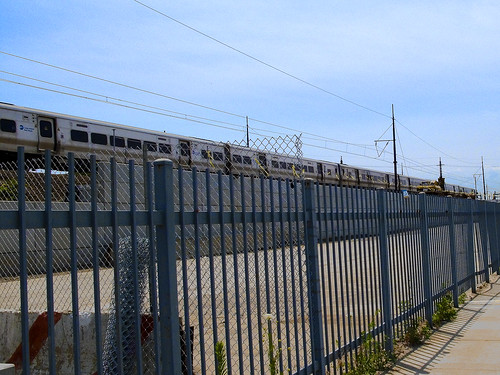
LIRR -photo by Mitch Waxman
Like Jason tied to his mast before the fabled Sirens, my attention was suddenly centered and transfixed. My eyes blurred as the powerful air horn of a LIRR train heading for eastern Long Island passed a construction site- screaming wildly in accordance with federal regulations. Unbalanced by the sudden rush of air and sound, I staggered forward several steps to avoid falling, and became transfixed by the nearby construction site. Such variability and inability to stay focused in the face of visual stimuli is undoubtedly the end product of an undisciplined childhood, an upbringing upon which I insisted on despite the best efforts of my simple parents.

LIRR track work -photo by Mitch Waxman
Up until just a year ago, this was a weed choked dumping ground for area residents and passing building contractors. The engineers of the LIRR have recently reinforced the track bed with structural steel and are in the process of armoring it in a wall of cement tile, as part of the larger East Side Access Project . I am not sorry, for I hated both antique wreckage and hellish vegetation which polluted the artificial ridge and occluded viewpoints of these gleaming trains as they carry their mutitudes back and forth to Manhattan.

New York Presbyterian Church – “stitched panorama” photo by Mitch Waxman
click here to see the ridiculously large original- warning-BIG FILE
Across the street is an enormous Church complex, the New York Presbyterian. It has all the appearance of a fortress, complete with a guardhouse possessed of mirrored windows and a retinue of antennae and cameras, but this would be normal for any structure of this size which abuts one of the largest and most important rail yards in North America. The curious asiatic script found on the church’s signage, and indeed the characteristic wide grin and relaxed countenance of the members of the congregation I have observed show all the hallmarks of origins on the Korean Peninsula. This is an assumption of course, based solely on study of New York’s ever shifting demography.
Here’s what archi-tourist had say:
This massive church is located in a strange area between the suburban, automobile landscape of Northern Boulevard and the planned community of Sunnyside Gardens. The LIRR passes alongside the church and 37th Avenue, adding to the feeling that the church doesn’t really belong to any place, any neighborhood.
The plan is basically split into three areas: a large congregation space fronted by the large wall of translucent panels and the church’s entry, the art-deco front on 37th Avenue now containing classrooms and other small spaces , and a series of metal-clad shells concealing the exit stairs required for the large, 2,500-seat sanctuary. All is surrounded by acres of parking, some at the level of the entry, some one-story below grade on the building’s north side.
It’s the building’s north side and its series of angular, metal scallops that gives the church its most striking feature, even though this facade is the most removed from the entry, the road, and the railway. It’s also ironic that so much effort was expended on a feature that’s rarely used, as these pieces cover the exit stairs from the sanctuary. But perhaps that’s the point; that the design needed some sort of POW or hidden surprise that couldn’t find its way into the art deco piece or the main sanctuary.
They seem like very nice people, despite the forbidding appearance of the structure that houses their church. The adoption of Protestant Christianity by a large segment of the Korean population was facilitated relatively recently, as it turns out.

New York Presbyterian Church – photo by Mitch Waxman
from wikipedia
In 1884, two American missionaries came to Korea: Henry Appenzeller, a Methodist, and Horace Underwood, a Presbyterian.[2] Emphasizing the mass-circulation of the Bible (which had been translated into Korean between 1881 and 1887 by the Reverend John Ross, a Scottish Presbyterian missionary inManchuria), the Protestant pioneers also established the first modern educational institutes in Korea. The Presbyterian Paichai School (배재고등학교) for boys was founded in 1885, and the Methodist Ehwa girls’ school (이화여자고등학교) followed a year later. These, and similar schools established soon afterwards, facilitated the rapid expansion of Protestantism among the common people, and in time enabled the Protestant faith to overtake Catholicism as the leading Christian voice in Korea.
and
Korean Americans in America have historically had a very strong fundamentalist and conservative Christian heritage. Between 70% and 80% identify as Christian; 40% of those consist of immigrants who were not Christians at the time of their arrival in the United States. There are about 2,800 Korean Christian churches in the United States, as compared to only 89 Korean Buddhist temples; the largest such temple, Los Angeles’ Sa Chal Temple, was established in 1974.

Stop, make left on 43rd street -photo by Mitch Waxman
A wall of shadowed brick will greet you as you reach 43rd street, and you must choose as I am forced to- do you return to Northern Blvd. and the greater world beyond- whose every path leads to the great gleaming metropolitan city and its myriad pleasures? Or will you choose to take a left handed path, and plunge deeper- ever deeper- worming your way into the darker heartlands of the Newtown Pentacle?

43rd street and 37th avenue -photo by Mitch Waxman
Steadying myself and resolute to continue, I stopped on the corner to consider 37th avenue and noted the sudden change in environmental conditions after crossing the street. A tenebrous darkness clings to this corner- the smell of mildewed wood and nitre dripping cement- mixed with urine- colors the air a yellowish brown. Somewhere nearby, is something that reeks of degenerate humanity.
note: I’m not kidding about the weird darkness here, check it out in google street view.
Moving south on 43rd street, and passing beneath a steel bridge which is manned by an actual troll… a sort of creature whose name the local Croatians might roughly translate into english as a “Sin-Eater“.

Crossing the angles between spaces -photo by Mitch Waxman
But brave this trollish hazard we will, my ladies and lords of Newtown, for the strange energies which course through the ground in these intermediate zones- which are neither one neighborhood nor another– these places- they are just existential hinterlands which reside in the angles found between them.
And we are on the verge of entering the most progressively designed, rationally proportioned, and ultimately verdant section of the long walk from Astoria to Calvary. Netownicans, we are about to pass under and over and enter into the Sunnyside.
Catching up with the Pentacle

Newtown Creek Bulkhead Fungus – photo by Mitch Waxman
Terms coined by the Newtown Pentacle in recent posts for future usage by the Real Estate Industry when the economy cycles back up-
DUPBO– Down under the Pulaski Bridge Onramp
DUGABO– Down under the Greenpoint avenue Bridge Onramp
DULIE– Down under the Long Island Expressway
DURFKO- Down under the Robert F. Kennedy Bridge Onramp
aka
DUTBO– Down under the Triborough Bridge Onramp
DUKBO– Down under the Kosciuszko Bridge Onramp
DUTZBO– Down under the Tappan Zee Bridge Onramp
DUGWO– Down under the George Washington Bridge Onramp
Sorry for the “clip show” today, I’m running a little late on my schedule, and the next “Astoria to Calvary” photowalk installment will be ready tomorrow.
also: Click here for a fascinating experience one pedestrian had down by Gantry Plaza Park. This is precisely the sort of thing that I’m constantly droning on about…
Also, something I found while doing research on Northern Blvd.- or how Robert Moses almost did to western Queens what he did to the South Bronx.
Astoria zen

Astoria Matthews Model Flats, 31st ave. and 44th street – photo by Mitch Waxman
31st avenue and 44th street is very close to being the apex of an enormous hill which is buried deep below the masonry of modern Astoria. 1 block from the ancient pavings of Newtown Road, which knew British and Hessian armies- and later carried an iron ribbon of Trolley Tracks, and is 2 blocks from Broadway.
31st avenue was, in gentler times, called Jamaica Avenue and 44th street was called 14th avenue. Broadway and 30th (Grand) avenue nearby are the main commercial strips.
Now, I’m taking a shortcut today, and will refer you to Forgotten-NY’s page on the Street Name Necrology of Astoria rather than try to explain the whole affair, as it confuses me, and they are brilliant and own an encyclopedic collection of old maps.
This is an interesting neighborhood, and it is where our Newtown Pentacle is headquartered. 44th street between 30th and 31st avenues is bookended by 1928 vintage Matthews Model flats– “model new law tenements” which fill nearly half of the block in an unbroken line of Kreischer yellow brick. There are 6 units in each building, with the 4 story bookends on each corner. It is a working class section of the ancient village, and it always has been. The surrounding blocks were farms as late as the early 20th century, and despite a long period of abuse and neglect beginning in the late 1950’s the current property owners are performing careful maintenance on these historic structures.

44th street between Newtown Road and Broadway – photo by Mitch Waxman
As you walk down the hill toward Northern Blvd., which is actually a striking drop in elevation for so short a space, the building stock becomes typical of the early 20th century. Enormous, well designed apartment houses line 44th street beginning at Newtown Road- giving way on the Broadway intersection to 3 and then 2 family houses with garages. One or two relict examples of the federal style townhouse, so popular in Long Island City, incongruously continue to stand in centuried glory beneath the burning eye of the Newtown sun.

LIC Turn Verein detail – photo by Mitch Waxman
After the civil war, Long Island City incorporated and became a haven for heavy industry and mechanized production in the Hunters Point, Dutch Kills, and Ravenswood neighborhoods. Astoria developed along the lines of a bedroom community, with the exception of the Steinway factory on the North side.
The huge populations that teemed into New York from European origins in the 19th century, to serve as labor in the new factories, often arrived in tsunami waves of a single ethnicity- resulting in the classic perception of “the XXX’s are taking over!”, followed by the next generation of the “XXX’s” declaring “the YYY’s are taking over!”.
A teacher of mine at college was a genius named Will Eisner, and he did a novel on this phenomena called “Dropsie Avenue” about his old block in the Bronx. If you dig this blog, you will LOVE Dropsie Avenue, available at amazon and other places.
In 1875, Astoria was a German town. Deutche was spoken on the streets, taught in schools, and the population of the area read newspapers shipped in from Vienna and Berlin. They were very much in tune with a radical new political theorem called trade-unionism, which promised to unite the workers of the world against the decaying masters of the middle ages- the aristocracy- and a new menace to the working man called the Industrialist. They also believed that mankind could be bettered and brought into communion with god- by exercise and good diet and education and abstention from the sins of the industrial world.
One must comment on what must have been going through the minds of these people- the whole world was at war, the greatest empire ever known was crumbling, and an antichrist (himself a Turner) had crowned himself emperor of France. And here they were, in post civil war New York City, safe as houses.

LIC Turn Verein detail – photo by Mitch Waxman
So, these Germans built a Turn Verein in Long Island City, on the corner of Broadway and 14th avenue (44th street) near Schuetzen Park, to better mankind through the example of Physical Culture.
The structure currently serves as a catering hall for the Chian Federation, a local Greek ethnic society (island of chios). There are some surprising events here at times. Last winter, for instance, a high ranking member of either the Pakistani or Bangladeshi government held a rally here and was feted amongst the expatriate communities who emigrated into the neighborhood. Mostly, it just seems to do private parties and neighborhood events. This represents two more demographic shifts in Astoria, one finishing up and one just beginning.

LIC Turn Verein detail – photo by Mitch Waxman
The “Turners’, as they call themselves, are still around- here’s their website, and the Newtown Pentacle is pleased to let them tell their own story.

LIC Turn Verein detail – photo by Mitch Waxman
These folks are the inheritors of a genteel middle class society, industrial workers who were considered skilled craftsmen. Known world wide for their skills in working metals and wood alike, the Germans of the 19th century were recruited in large numbers to come to New York, and they were glad to leave behind the catastrophic events which were in living memory of these new Americans. The concept of the coming “fin de siècle” was very much in their minds. It’s part of the reason behind the 19th century religious revival movement, suffrage (New York allowed women to vote in 1917), anti-slavery, and temperance movements all were at their apogee in the final years of the 1900’s. The 20th century is all “-ism’s” in the same way the 19th century is all “movements”, and the 21st seems to be about the “-ists”.

44th street between Northern Blvd. and 34th avenue- photo by Mitch Waxman
Leaving the 19th century, and heading south toward Northern Blvd. the neighborhood suddenly turns a bit seedy, and at night- queer groups of adolescent troublemakers congress with baser elements of Astoria’s underworld in the desolate shadows of sodium light. That’s the west side of the street, though, and on the east- you’ll find some lovely typography adorning the cavernous garage that serves Major Auto World.

Northern Blvd, 44th st., 35th avenue intersection- photo by Mitch Waxman
Looking to your right, you’ll see the Citbank megalith, and Manhattan hidden behind that white sign on the right hand side. We’re not going this way, just reminding you- gentle reader- to look both ways before you cross. Northern Blvd. is more properly described as a six lane highway which is a primary artery connecting vehicle traffic in western Queens with Manhattan via the Queensborough Bridge and the highways leading eastward to Long Island which intersect it on the north shore of Queens. It also serves as a shortcut route to LaGuardia airport for knowledgeable taxi drivers.

Northern Blvd at 44th street, south side- photo by Mitch Waxman
Directly in front of you will be the major world entrance. If you’re an automotive enthusiast, buy a hot dog and go shopping, they have a LOT of used cars.

Northern Blvd at 44th street, looking east- photo by Mitch Waxman
From the appearance of the automobile, this section of Northern Blvd., formerly the Trolley car thoroughfare called Jackson Ave.– and before that the Jackson… oh no…
…alright, here we go-
John C. Jackson was president of the Hunters Point, Newtown and Flushing Turnpike Company, which built Jackson Avenue as a toll road. It allowed ships from Long Island Sound to drop their cargo on the North Shore of Queens, allowing them to avoid the dangerous and crowded East River and Hells Gate- and the infamously criminal controlled docks of Long Island City and Manhattan. Cargo traffic was first transported by mule barge, then wagon team, and eventually electrified Trolleys and automotive vehicles. It also connected the isolated villages of the north shore of Queens with the economic superpowers of the East River metroplex and the world beyond through the Port of New York. It is precisely the freight that the Long Island Railroad was originally sited to carry.
in 1921, Jackson ave. was renamed Northern Blvd., which fit the rational, progressive, and scientific spirit of a world recovering from the shattering horror of the Great War.

Northern Blvd at 45th street, looking east- photo by Mitch Waxman
I first noticed this place a few years ago. It is very well wrought, and has the appearance of a hollywood set piece. I’ve been looking around for quite a while, and scrounging through the usual sources, but I kept on coming up blank on the history of this place. Were I not such an awkward and contentious being, I would have considered calling the realtor advertising the edifice as available. You may have noted my preferences in referential hyperlinking to public information, as I subscribe to the Cory Doctorow theorem that “information WANTS to be free”, but in this case, I need to refer you to copyrighted materials.
Luckily, the footsteps I take around the Newtown Pentacle have been walked by others with an eye for the strange- the antiquarian- the hidden.

Northern Blvd at 45th street, Packard building- photo by Mitch Waxman
A significant resource to the amateur antiquarian here in the Newtown Pentacle is the Greater Astoria Historical Society, the officers of which hold the key to vast archives of historical artifacts and esoteric knowledge. Close examination of their publications, and websites, revealed an identity for this enigmatic holdout from the early 20th century.

Northern Blvd at 45th street, Packard building- photo by Mitch Waxman
This was a Packard dealership in 1929.
Packard Automobiles – from wikipedia
Packard was an American luxury automobile marque built by the Packard Motor Car Company of Detroit, Michigan, and later by the Studebaker-Packard Corporation of South Bend, Indiana. The first Packard automobiles were produced in 1899 and the last in 1958.

Northern Blvd between 45th and 46th streets, Packard building- photo by Mitch Waxman
The building currently houses a series of shops and small offices, and is carved up into small spaces. The GAHS photo below shows the structure in its heyday of 1929, as a two level automotive showroom. Amazing- I love Astoria.
Check out this link to the Greater Astoria Historical Society’s smugmug page– this is the same building, in 1923.
I cannot recommend highly enough the purchase of their excellent Long Island City book.

We’re plunging into a new photowalk, Lords and Ladies of Newtown, from Astoria to Calvary. This has been part one.
Walking down the street, one day…
Click here for a quicktime movie (not quite a megabyte) of the band playing as the parade passed by- I promise, this is as close to multimedia as we will ever get- but the sound of the parade really does add a lot of punch to the photos and text.
note:
File is served from my currently inert comic book site- weirdass comics, which is actually quite safe for work and all that netnanny stuff. It’s a giant mess right now, I can’t even find things there anymore. A redesign will be taking place over the winter. Suggestions are welcome.
Check out the Story of Phil comic or our dumb youtube video for why we called the comics site by such an outlandish name. This is the comic everybody always wants to see, by the way, the autobiographical one about the “health issue” I’ve alluded to in previous posts that led me into this whole “walking the earth with my camera” thing…
So, as I was scuttling around the edges of man’s world at Robert Moses’s greatest creation today, suffering from the diaphoresis I am so prone to as we await harvest moon here in the Newtown Pentacle and suffer through these riotous days of riotous August. I was wearing a ridiculous white “Renegade” brand cowboy hat (purchased at Boot World in Las Vegas, no less, where I didn’t pay anything even close to what the link is asking for it) and carrying my trusty camera around, preparing for a future post on the magnificent Hell Gate Bridge-
– when I spied a gathering group of Italian devotees accompanied by a Police Escort.

Orsogna Mutual Aid Society -photo by Mitch Waxman
The band started to play as it turned the corner, and I gambled I could outpace the parade to gain a vantage point from which to photograph it further up 21st street.

Orsogna Mutual Aid Society -photo by Mitch Waxman
I also thought to turn on the griffin italk app on my iphone. The music in the link above (here it is again).

Orsogna Mutual Aid Society -photo by Mitch Waxman
Later, after the parade had turned the corner onto 18th street, a gregarious woman approached me and we talked briefly about who they were and who I was.

Orsogna Mutual Aid Society -photo by Mitch Waxman
A vital intellect was alive in her eyes as she explained the long history of the Orsogna Mutual Aid Society (which is located on 18th street here in Astoria), and its filial ties to their ancient homelands in the fable shrouded and castellated towns of the Abruzzo region, in the Italian province of Chieti, as well as the story of how the statue came to New York City.

Orsogna Mutual Aid Society -photo by Mitch Waxman
She was very nice and invited me to visit the Society to see him in his proper place, sometime.

Orsogna Mutual Aid Society -photo by Mitch Waxman
I love Astoria. A Roman from 2,000 years ago would recognize these traditions, and this kind of gathering. The Roman would probably think the Triborough Bridge onramp was an aqueduct.
(hey, this part of Astoria is “Down Under the Triborough Bridge Onramp” aka “Down Under the Robert F. Kennedy Bridge Onramp”- I like DUTBO, but reject DURFKO)

Orsogna Mutual Aid Society -photo by Mitch Waxman
Soon, the statue of the Saint appeared. I’m not at all qualified to say which saint it is, of course- if someone reading this can fill that in- please leave me a comment and I’ll incorporate your information.

Orsogna Mutual Aid Society -photo by Mitch Waxman
The NYTimes briefly mentions the Orsogna Mutual Aid Society in an article related to Italian-America efforts at aiding the victims of an earthquake in Italy in April of 2009.

Orsogna Mutual Aid Society -photo by Mitch Waxman
Turns out that August 15th in 2009 is a feast day for both Catholic and Eastern Orthodox Churches.
Not Whippoorwills, just Pigeons

30th road and 45th street, Astoria -photo by Mitch Waxman
Vestigial. 30th road is a truncated street in Astoria that runs between 44th street and 47th street and then reappears between Crescent Street and Vernon Blvd at the East River. Newtown Pentacle Headquarters is located in a nearby Matthews Model Flat, and 30th road is a favorite destination for our beloved mascot and sentry- a stout little mutt named Pazuzu- who is easily rattled by the traffic and tumult of the busy thoroughfares of 30th and 31st avenues which define this area called Astoria Heights.
One afternoon, on a brisk January day, Zuzu (as we affectionately call her) and I were effecting our normal patrol of the neighborhood when she suddenly froze in place. Even over the din of my headphones, blaring their ever present diatribe of postmodern historical interpretations and para-political podcasts, the grating call of the Columbidae drew my attention. Luckily, I had my trusty pocket camera with me, and saw what one city council member would render a crime take place.

30th road and 45th street, Astoria -photo by Mitch Waxman
A lady walked past my canine companion and I, an older woman of small stature, with bags of crumbled and stale baked goods in her wizened fingers. It was her for whom the birds flocked, and in her honor had the fowl begun their antiphonal opera.
The dog grew excited and nervous, her agitation activated as much by the movements of such a large number of birds, as by the presence of nearby foodstuffs.

30th road and 45th street, Astoria -photo by Mitch Waxman
Further observation over the next few weeks met this kind soul of Astoria arriving at the same time every day to feed her unctious mob of avian admirers, her arrivals always heralded by the flock swelling to great numbers awaiting her.
Such behaviors are remarkable when one considers the vast metropolis surrounding our quaint old village whose skies are both their playground and larger habitat.
On more than one occasion, I attempted to converse with her- but a stern countenance and heavily accented reproach was my reply. Pazuzu, a gregarious and good natured dog possessed of an always friendly disposition, was far more insulted than I by the rebuff as she was hoping for an introduction to the birds.

30th road and 45th street, Astoria -photo by Mitch Waxman
There are several individuals who feed the fowl in this part of Astoria through the long dark months of gotham’s winter. One often spies heaped piles of bread and stale cake crumbled on the sidewalk. Especially if one is in the company of an always ravenous mongrel named Pazuzu.
Another point of view on Pigeons is provided by…
Pigeon Control Advisory Service
A great NYtimes magazine article on PICAS and their philosophy of Pigeon Control
Zuzu offers her own bird control services to the public for a modest fee, contact us for availability.


 The Newtown Pentacle