Archive for October 2009
Open Sesame, Pulaski, Says A Me
Just as a note, this is the 100th post at Newtown Pentacle.

– photo by Mitch Waxman
The burning thermonuclear eye of the Newtown sun burst through the occluding clouds of a murky sky, as I crossed the Pulaski Bridge. With the objective of Queens in sight, barriers suddenly sprang into action, and alarm bells rang. The motive engines of the Pulaski began grinding in those deep pilings sunken on both sides of that vexing mystery called the Newtown Creek, and the roadway of the Bascule bridge rose… ominously.
Newtown Pentacle did a fairly thorough posting on the Pulaski Bridge a while back called DUPBO, check it out here.

– photo by Mitch Waxman
The basso horn of an unidentified tug drew the attentions of that small group of obstructed pedestrians and unlucky cyclists which I found myself a part of. In the central lanes of the bridge, angry drivers changed automotive gears from drive to park. Some switched off their engine ignitions and muttered obscene phrases in a great variety of tongues.
A bascule drawbridge of paralell counterweight design, the Pulaski Bridge was overseen by New York City Commissioner of Public Works Frederick Zurmuhlen, and the general contractor was the Horn Construction Company, with steel and expertise supplied by Bethlehem Steel. It opened in September of 1954 at a cost of $9,664,446.25- a reconstruction of the bridge in 1994 cost $40 million. It carries six lanes of vehicular traffic, and is a primary link between north Brooklyn and western Queens.

– photo by Mitch Waxman
Clumsily, I climbed atop the roadway barrier, in an attempt to gain a better vantage. Normally, this would be a death defying balancing act, as traffic would be hurtling out of Long Island City at many times the posted speed limit. Even so, the mere 3 and one half foot elevation was enough to set off my timid side of nature, and vertigo nearly claimed me.

– photo by Mitch Waxman
This lone tugboat, which I cannot identify, is heading up the creek empty. This would suggest its coming to pick up a barge, but your guess is as good as mine.

– photo by Mitch Waxman
The inner works of the bridge as it extends to its euclidean apex. The stresses inflicted on the superstructure of this bridge by such actions are beyond my meager ability to calculate, as tons of steel move effortlessly into position and into a shaky balance.

– photo by Mitch Waxman
The tug passed by, as I could tell by the action of my ears, but was occluded visually by the bridge’s roadway. The struggles of its engines as they churned those hatefully gelatin waters of the Newtown Creek caused vibrations which shuddered out as they traveled against the raised members of the Pulaski Bridge.

– photo by Mitch Waxman
Overcome by the unique harmonic and its drug-like effects upon my overly sensitive equilibrium, I missed the Tug’s passage by seconds (in the center of the above shot), due to both a bungled manipulation and inexpert handling of camera settings.

– photo by Mitch Waxman
Bells rang out again, and the Pulaski bridge transformed itself back into a vehicular roadway, and the steel wall of Long Island City appeared.
A shrine in Greenpoint
from wikipedia:
Greenpoint is largely middle class and multi-generational; it is not uncommon to find three generations of family members living in this community. The neighborhood is sometimes referred to as “Little Poland” due to its large population of working-class Polish immigrants, reportedly the second largest concentration in the United States after Chicago. Greenpoint is not only populated with Polish immigrants and Polish-Americans, a significant population of Hispanics can be found north of Greenpoint Avenue. Italian Americans and Irish Americans can be found in the southeastern section of Greenpoint.

– photo by Mitch Waxman
Walking the blasted earth of storied Greenpoint- after visiting the Temple of Cloacina– Our Lady of the Pentacle and myself decided to visit the Newtown Creek Nature Walk, and on our way encountered this roadside shrine on Provost Street.
European custom often places such tributes at the scene of a fatal accident or tragedy along roadsides. Greece, in my own observation, is noteworthy for the quality and design of such shrines. In Crete, a freestanding steel structure whose paramount is a miniature of an Orthodox Church complete with glass doors and votive candles is commonly on sale in hardware stores and garden centers. Such shrines line the mountain roads, clustering around sharp turns and narrow lanes.
I am ignorant of the slavic tongues, but research for this post has been revelatory.
Could this have been the car involved in the crash? Location wise, this would be the spot- Provost between Huron and Green.

– photo by Mitch Waxman
Sadly, this memorial honors a pretty young guy. Newtown Pentacle, on behalf of our readers, offers our sympathies to the family and friends of the occupants of the car.
badly translated excerpt from Polish language news site seusa.info
Recall Daniel Skiba died tragically in a car accident on Saturday. Returning together with club colleague from Europe crashed its annual black Acura TL Type S sports car even owinęło around the tree at the intersection of Huron St.. and Provost St. He had no chance of survival, she was taken to hospital.

– photo by Mitch Waxman
The tradition of memorial devotions seen here, undoubtedly created by loving friends and intimate relations, goes back a very long way in Polish culture.
Just as a footnote, I’ll mention that I consider the history of the Poles as another of the important “forgotten tales” in the history of the world alongside the Ottomans, Toltecs, and Khmer. I did a post about Pulaski (both bridge and szlachta) a while back, which is a good jumping off point for the Polish story.
from polandpoland.com
Should you ever travel the roads of Poland, it won’t be long before you notice either a religious figure, cross, statue, or a building that resembles a little house or miniature chapel along the roadside. These small religious chapels or shrines are commonly called roadside or wayside shrines. In Polish, they are called kapliczki. These shrines were often built at the expense of individuals, families and sometimes entire villages to publicly thank a saint or God for a benefit or blessing received. In the case of smaller shrines they acted as a remembrance for a tragedy or crime. Recently constructed shrines are usually on a much smaller scale and most often mark the spot where a fatal traffic accident occurred.

– photo by Mitch Waxman
from polamjournal.com
The word origin of kapliczka is distinctly Christian. As far back as the 7th century, a small building containing the coat and relics of St. Marcin began to be called capella, a diminutive of the Latin cappa, meaning cover or cloak. In countries accepting Christianity, capella became a common term for every small building outside of a church that gave shelter to a religious object or figure. In Poland, the term emerged as kapla, kaple, and eventually kaplica, meaning chapel. Kapliczka, a diminutive of kaplica, refers to something smaller than an actual chapel; the words today, however, are used almost interchangeably
Polish ethnographers claim that kapliczki, or roadside shrines, have their origins in ancient pagan traditions and Christian religious beliefs. In the times of our ancient pagan ancestors, the outer boundaries of a village or the place where two roads met, was considered to be an evil place where unfriendly spirits waited to pounce upon the unsuspecting traveler. By the same token, certain trees were seen as having magical powers. Water also had magical properties. Pagan shrines were placed at the feet of such sites and various cult activities occurred here. With the acceptance of Christianity, old beliefs and rites were hard to abandon. Our ancestors sought to protect their old beliefs yet incorporate the new faith. As a result, many kapliczki are found near trees that were believed to have magical powers such as linden, birch or sycamore trees. The mighty oak had similar properties as did evergreens. The linden, for instance, was considered especially sacred as protection against lightening and evil spirits. Later, within the Christian realm, the linden tree was dedicated to the Blessed Virgin Mary. Sycamore leaves had the power to remove spells, but were also utilized on St. John’s Eve as window and door decorations to prevent entry by witches.
Apple Juice, OHNY 2009
Caveat- What I know about electrical engineering wouldn’t produce enough charge to power an LED. Also, some of the information I’m passing on is sourced back to Open House New York flyers distributed at the event (just for proper attribution), handed out and written by Robert W. Lobenstein– General Superintendent of NYC Transit titled “A Walk Through History”. If I get something wrong, please contact me and we’ll make any appropriate corrections.

This isn’t actually the MTA Substation site- its around a block away and a completely different structure. Its just such good typography…- photo by Mitch Waxman
MTA Substations transmogrify high voltage Alternating Current charges, which flows from a central generator or powerhouse, into the 625 volts Direct Current electrifying the “third rail” which the fleets of Subway cars feed upon to gain their motive action- and fuel the various devices and systems found onboard a modern train (or rapid transit, to be accurate. The term train generally refers to a self actuating mechanism with a mobile locomotive powerplant – or engine- driving the action).
from ohny.org
MTA Substation
225 W 53rd St/ Broadway , New York
neighborhood: Midtown
opendialogue Sat 11 am, 1 pm tours with Robert Lobentstein, General Superintendent Power of Operations of NYC MTA Transit.
Maximum people: 25 per tour
building date: 1901, opened 1904
architect: Heins & LaFarge
other architects/consultants: William Barclay Parsons, McKim, Mead & White

– photo by Mitch Waxman
In the same year that Aleister Crowley wrote his “Book of the Law“, and the General Slocum carried away 1,021 souls at Hells Gate, and Robert Oppenheimer was born- the NYC Subway opened its doors for business (your humble narrator is used to passing the buck on certain subjects- the NYFD for instance- there are REAL experts out there who know far more than me. In the Subway story business, these folks are the tops).
In 1904, the nascent transit system was powered by a vast dynamo mill constructed on west 59th street between 11th and 12th avenues which fed AC current to eight substations (later combinations of IRT below and above shifted the nomen of the units in this group to the “teens”. One became eleven, eight became eighteen) which includes this site.
This is Substation 13.
the Gothamist blog was also here, and they got a great series of photos- lots of stuff I missed or just bungled the shot. Click here for a look.

– photo by Mitch Waxman
Here at Substation 13, “giant red buttons which must never be pushed” abound. A sinister and pervasive electronic hum, the sound of nearby modern solid state rectfier equipment busily converting a pulsating flow of gigajoules uncounted, permeates the dark and dusty building. The old substation rotary works went offline in 1999.
from timeout.com
MTA Substation
What it is: One of the MTA’s original power stations, tucked beneath a midtown street.
Why go? Opened in 1904, this is one of eight original IRT substations that served the subway system (for some perspective, there are now 215). View modern generators, as well as historic rotary converters, the subway’s earliest power source.

– photo by Mitch Waxman
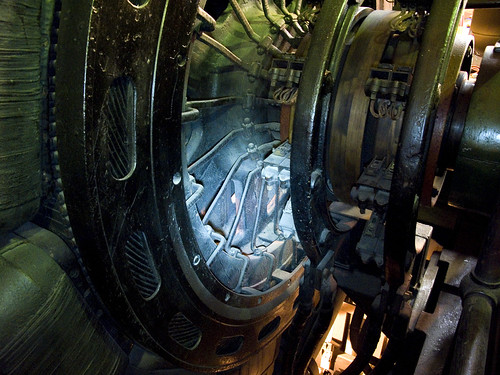
Specialized and redundant armatures of steel are required to support the weight of each of these 50 ton rotary converters, and to withstand the stresses induced by their operation, although the actual truss that supports them is made from hardwoods. Grounded plating is incorporated into the brick and cement clad structure of the substation, vouchsafing neighboring buildings against electrical manifestations and stray voltage.
from joeclipart.com
It opened in 1904, the same year as the first subway. The mayor, governor and, apocryphally, Thomas Edison and Nikola Tesla, among other dignitaries, arrived at the substation-warming party in horse-drawn buggies.
Old #13 has operated continuously since and today powers the 1 line, which old-timers still call the IRT. Although it houses sinister-looking modern equipment, the substation serves as a de facto museum because it contains original machinery, the centerpiece of which is the Westinghouse 1,500 kilowatt rotary converter. Incredibly, this 50-ton wheel didn’t go offline until 1999.

– photo by Mitch Waxman
The converter devices themselves were a constant point of photographic interest for me, the sort of “big” technology that a comic book supervillain might decorate his lair with. On one wall, an animation cel from a Popeye cartoon showed the post Spinach effect of multiple converters spinning within the distaff sailor’s bicep muscle.
from nycsubway.org
Because suitable real estate was difficult to find in the built-up downtown areas, contractor McDonald suggested that some of the sub-stations be placed underground. In February 1901 he requested the aid of the Rapid Transit Commission in acquiring the right to excavate under public lands at City Hall Park, Union Square, and Longacre (Times) Square. McDonald’s contract made him responsible for the purchase of all lands for power facilities and he hoped to cut down his expenses by using city rather than private property. After consulting its lawyers, the Board decided that it lacked authority to grant this request. McDonald had to build his sub-stations above ground.
It was desirable to have the distribution distance to the subway as short as possible after conversion to direct current at the sub-stations. In the downtown areas McDonald obtained sites no more than one-half block from the route. In the far less crowded up-town locations, the Simpson Street and the Hillside Avenue sub-stations were nearly adjacent to the track.
Two adjoining city lots, each 25×100 feet had to be purchased to house sub-station equipment. The resulting 50 foot width allowed installation of eight to ten rotary converters with their sets of transformers. In Sub-station #13 on West 53rd Street, foundations were laid for ten rotaries; the remaining seven were built to receive eight rotaries.
Foundations for eight to ten rotary converters was a provision for the future. The original 1901 Westinghouse contract called for only 26, 1,500-kilowatt rotary converters, or four to five per sub-station. In 1909 Westinghouse responded to a second call, this time for 3,000-kilowatt units. In the plans for the 1916-1918 general system expansion, additional contracts to both Westinghouse and General Electric provided 4,000-kilowatt rotaries, some of which replaced the older 1,500-kilowatt machines. During expansion, [page 330] Sub-station 11 at Park Place was demolished, and its replacement, a half block from the original site was equipped with 4,000-kilowatt units. In 1923 additional 4,000-kilowatt General Electric and Westinghouse units were installed.
The remaining seven of the original eight IRT sub-stations are still standing. Number 19 on West 132nd Street is no longer in use and its equipment has been removed. The others still operate daily [in 1978] with equipment from the earliest installations. [The last of the rotary converter equipment has since been retired.]
– photo by Mitch Waxman
Notoriously, your humble narrator is almost always “a day late and dollar short”, and the fabled “caving rig” lighting setup I’ve been working on for nearly a year was still incomplete when the OHNY event happened. I was lucky enough to be carrying a powerful LED electric torch by happenstance, which allowed some of these exposures sufficient quality for publication at Newtown Pentacle. Quite dark, Substation 13 awaits a creative application of lighting- perhaps the good folks at Strobist can gain access to the site sometime in the future and construct an application of proper illumination.
also from nycsubway.org
Each rotary converter stood in its own hard-wood frame. The frame was not bolted to the Portland cement foundations; the rotary weight was expected to hold the unit in place. The rotaries were the heaviest equipment of the sub-station. Two hand-operated cranes, at the front of each sub-station on the main floor, were provided for the rotary installation and service.

– photo by Mitch Waxman
Vast banks of machinery, replete with switches and glassed in gauges, line the walls of Substation 13. I’ve avoided posting photos of the more modern equipment, for a variety of reasons- mainly its not as cool looking, and the light was so bad I couldn’t get a non blurry shot.
from wikipedia
When the first subway opened between 1904 and 1908, one of the main service patterns was the West Side Branch, running from Lower Manhattan to Van Cortlandt Park via what is now the IRT Lexington Avenue Line, 42nd Street Shuttle, and IRT Broadway – Seventh Avenue Line. Both local and express trains were operated, with express trains using the express tracks south of 96th Street. Express trains ran through to Atlantic Avenue in Brooklyn during rush hours, while other express trains and all local trains turned around at City Hall or South Ferry.

– photo by Mitch Waxman
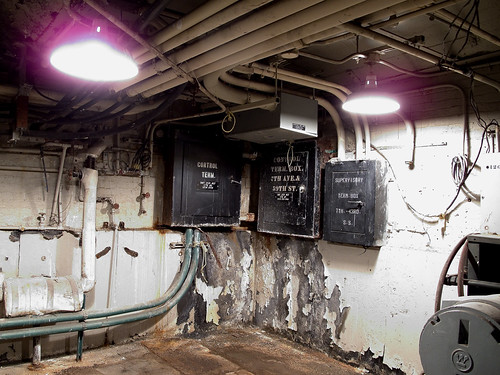
A labyrinth of access tunnels and manholes marks the lower level of Substation 13, whose mouldering brick and disintegrating concrete speaks to the infiltration and regular egress of flood waters. Apertures in the roof of the subterranean level look up into the rotary converters, and the walls are lined with empty sockets which once allowed electrical conduits to snake through the masonry.
from mta.info
New York City’s first official subway system opened in Manhattan on October 27, 1904. The Interborough Rapid Transit Company (IRT) operated the 9.1-mile long subway line that consisted of 28 stations from City Hall to 145th Street and Broadway.

– photo by Mitch Waxman
The art practiced by those engineers of the MTA who serve the modern system has -over the years- witnessed installation of 215 solid state converters, which are largely sited in deep underground vaults and inaccessible side tunnels hidden below the streets of New York City. Consolidated Edison– an electrical trust given stewardship over the metropolitan power grid- also used to maintain multitudinous converter substations for its commercial customers, but these too have been abandoned in favor of the more reliable and less labor intensive solid state rectifiers of the type now used by MTA. This room in particular, was original equipment, and was referred to as “the Manhole” where the Direct Current lines from the generator exited the soil and entered Substation 13. The atmosphere literally pulsed with latency.
from wikipedia
Electro Magnetic Fields (EMF) measurements are measurements of the magnetic or electric field taken with particular sensors or probes. These probes can be generally considered as antennas although with different characteristics. In fact probes should not perturb the electromagnetic field and must prevent coupling and reflection as much possible in order to obtain a precise measure. EMF measurements are nowadays becoming important and wide spread in different sectors to assess environmental and human exposure to non-ionizing radiation in many contexts.
– photo by Mitch Waxman
MTA has sold off many of its relict and offline substation buildings, which have been cross purposed by the modern world to “the needs of the now”. A lumber warehouse, a Chinese noodle factory, an auto repair shop, even a movie theatre- are amongst the modern vocations enjoyed by some of these solidly built structures.
from google books,
a little Congressional Office of Technology Assessment reporting on the effect on Human Physiological Parameters of exposure to high energy power lines (from the New York State Power Line Project).

– photo by Mitch Waxman
Purveyors of the paranormal- who are undergoing a period of intense public interest in recent years due to the influence of several popular television series and a prevailing political fashion that interprets world events through a supernatural lensing of fin de siècle prophecy – speak about arrangements of electrical equipment and their concurrent electromagnetic field fluctuations as creating an environment which alters human perception. If this theory holds water, I would imagine the men and women who worked here might have some stories to share- and probably a union beef against the City.
but seriously…
here’s a map from nycsubway.org of the system in 1904 when it opened. The crane above was one of many hand operated technologies that allowed the early system to come together. Workers would lift the 50 ton converters for maintenance and repairs using it.

– photo by Mitch Waxman
New York Open House is a yearly event wherein the architectural and civil engineering treasures of New York City that are normally off limits to the general public are exhibited by their stewards. For more info, and to sign up for notifications of next year’s event- proceed to OHNY.org.
After the Fire

– photo by Mitch Waxman
In the posting “Weird Synchronicity“- from September 8th of 2009- I commented on the odd coincidence that a Dutch Kills factory that I was preparing a post on was immolated at the very same time that its photos were uploading to the interwebs. On a rainy saturday a few weeks later, I made it a point of stopping by to see what remained. The inset shots are obviously pre fire, and the whole setting is at the end of the “Empty Corridor” in Long Island City.
(empty corridor is a term entirely of my own invention, by the way. I also call Gantry Plaza state park down by Queenswest “that piers thingie by the Battery Park City thing” and call the RFK Bridge- Triborough)

– photo by Mitch Waxman

– photo by Mitch Waxman
Devastation seemed pretty selective, but I imagine that a couple of weeks of attention for a demolition crew, -whose presence and arts are evidenced by the clean cut lines of separation observed in the structures- would involve a thorough scouring for salvage. Metals are still quite the recyclable item, although the bottom has dropped out of the cardboard recycling game.

– photo by Mitch Waxman
As longtime readers know, I never cross a fenceline or knowingly trespass. These shots were taken from the sidewalk, which in this case, is the glass and steel ceiling of an underground vault connected to this fallen structure. The back of this property abuts the Dutch Kills. I must admit to having used the weed choked frontage of this former factory for… the elimination of bodily waste… in the past. This embarrassing acknowledgment is ventured solely to comment on the elaborate and long habited homeless camp that existed just 16 inches from the sidewalk and which was hidden by the thorny foliation issued by the Dutch Kills. Whoever it was that lived there had opened a hole into this vault, whose depths swallowed the light of my trusty electric flashlight.

– photo by Mitch Waxman
No trace of the former residents is observed, they seem to have disappeared into the same manner as that duo from 50th avenue and 27th street who lived in a broken down car that burned away- and that enigmatic man with no legs who lived under the Pulaski Bridge’s Queens tower. Curious.

– photo by Mitch Waxman

– photo by Mitch Waxman
From Fox 5:
A massive fire is burning in a two-story warehouse in Long Island City, Queens.
The flames broke out at around 6 a.m. at 50-10 27th Street and 50th Avenue.
Giant plumes of smoke from the blaze are covering the western side of the Long Island Expressway just before the Queens Midtown Tunnel.
Expect delays of at least 25 minutes on the Expressway.
NY Traffic Authority Ines Rosales recommends drivers in the area take he 59th Street Bridge or get off on the Queens Boulevard and take the Queens Borough Bridge.
There are no reports of injuries.
and from ny1.com
A three-alarm fire in Long Island City was brought under control just after 9 this morning, but not until after it caused major congestion on the Long Island Expressway.
The fire broke out just before 6 o’clock inside an empty warehouse at 50th Avenue and 27th Street, just below the LIE.
The smoke reduced visibility on the roadway and briefly forced its closure.
Fire officials say the heat from the fire was intense, forcing firefighters to fight the flames from the outside of the building.
“We originally sent people in, but it was deemed unsafe, too much fire and a whole building that had been vacant,” said FDNY Deputy Chief Bob Maynes. “So we were worried about the safety of our firefighters.”
About 150 firefighters were needed to bring the fire under control.
The flames completely destroyed the facade of the building and took off most of the roof.
Three firefighters were treated for minor injuries.
Fire marshals have begun their investigation into the cause of the fire.
Skillman avenue weirdness

-photo by Mitch Waxman
Resplendent with autumnal glee, your humble narrator was enjoying an aimless amble. An avenue of approach from Astoria to the debris choked lanes of the veiled Newtown Creek, I’ll often walk down Skillman Avenue and marvel at the wonders of the Sunnyside Yard as I go. Just at the intersection of 47th avenue, I saw what appeared to be an enormous Latte which was spilled into the street.
Conjecture and wild fancy filled my mind, as I thought of legendary creatures– with their cries of “Tekeli-li“. Closer examination though, revealed a different and far more logical origin for the odd phenomena.

-photo by Mitch Waxman
When the commanding officers of the FDNY are met with the challenges presented by a vehicle fire, their ultra modern methodologies and techniques call for the application of firefighting foam in lieu of water- which would merely spread the conflagration.
The foam extinguishes the various petroleum fed sources of the flame, and coats non burning components in a cooling embrace which suppresses further ignition. The foam spreads its expanding mass out and over any flammable material which might have escaped the vehicle and might be pooling nearby. When the foam dries out, the pictured crunchy residue remains.
For more on firefighting foam, check out the ubiquitous wikipedia reference here.
And it does look like a giant spilled Latte.


 The Newtown Pentacle