Archive for December 2009
ChristmAstoria 2

– photo by Mitch Waxman
Let me preface today’s post by mentioning that the anagrammatic transposition of Santa and Satan is no accident.
Given the macabre sense of humor that the most high god itself is suggested to have by scripture- making its arch enemy transmogrify into a nice old man who gives presents to children- on its birthday- is exactly the sort of thing one would expect from the sun god of a desert people.
If you think about it, Santa is principally red in color and flies about with a wild hunt of magickal herd animals. He is also invulnerable to chimney fires and possessed of a menacing laugh. Ergo- Santa Claus (saint nick) might actually be Satan (old nick). This link will be handy on Christmas eve, as the Strategic Air Command’s NORAD will be tracking the demon as it makes its way south from the polar wastelands toward the Newtown Pentacle.
from wikipedia
Numerous parallels have been drawn between Santa Claus and the figure of Odin, a major god amongst the Germanic peoples prior to their Christianization. Since many of these elements are unrelated to Christianity, there are theories regarding the pagan origins of various customs of the holiday stemming from areas where the Germanic peoples were Christianized and retained elements of their indigenous traditions, surviving in various forms into modern depictions of Santa Claus.

– photo by Mitch Waxman
In the early days of the American Colonies, which modern politics and propaganda instruct its citizenry to believe was a time of “freedom and liberty”, personal or non standard expressions of religion were frowned upon. Of course, that was up north in New England. New York City and its citizens are actually the authors of the modern Christmas.
Thomas Nast created the visuals in 1863 for “Harper’s Weekly”, Washington Irving turned Sinterklaas into Santa Claus in 1809’s “A History of New York” and also inserted the reindeer and sleigh, Clement Clarke Moore (whose family got their start in colonial Newtown) is said to have written “Twas the night before Christmas” in 1823, and the NY Sun published the famous “Yes Virginia, there is a Santa Claus” in 1897.
from wikipedia
Christmas celebrations in Puritan New England (1620-1850?) were culturally and legally suppressed and thus, virtually non-existent. The Puritan community found no Scriptural justification for celebrating Christmas, and associated such celebrations with paganism and idolatry. The earliest years of the Plymouth colony were troubled with non-Puritans attempting to make merry, and Governor William Bradford was forced to reprimand offenders. English laws suppressing the holiday were enacted in the Interregnum, but repealed late in the 17th century. However, the Puritan view of Christmas and its celebration had gained cultural ascendancy in New England, and Christmas celebrations continued to be discouraged despite being legal. When Christmas became a Federal holiday in 1870, the Puritan view was relaxed and late nineteenth century Americans fashioned the day into the Christmas of commercialism, liberal spirituality, and nostalgia that most Americans recognize today.

– photo by Mitch Waxman
In modern times, the garish lighting adorning Astoria is also equipped with tiny electronic speakers which blare endless loops of the first movement of “Jingle Bells”. Were one prone to paranoid and conspiratorial thinking, it would seem that some vast cabal of industrial and economic powers have convinced the citizenry of these United States to consume electricity unabashedly. Such thinking is faulty, however, as the tradition of christmas lights is far older than the nation- isn’t it?
from wikipedia
The first known electrically illuminated Christmas tree was the creation of Edward H. Johnson, an associate of inventor Thomas Edison. While he was vice president of the Edison Electric Light Company, a predecessor of today’s Con Edison electric utility, he had Christmas tree light bulbs especially made for him. He proudly displayed his Christmas tree, which was hand-wired with 80 red, white and blue electric incandescent light bulbs the size of walnuts, on December 22, 1882 at his home on Fifth Avenue in New York City. Local newspapers ignored the story, seeing it as a publicity stunt. However, it was published by a Detroit newspaper reporter, and Johnson has become widely regarded as the Father of Electric Christmas Tree Lights. By 1900, businesses started stringing up Christmas lights behind their windows. Christmas lights were too expensive for the average person; as such, electric Christmas lights did not become the majority replacement for candles until 1930.

– photo by Mitch Waxman
Just to ensure that the Newtown Pentacle doesn’t accidentally cause a remonstrance to spring up, we need to give equal time to all faiths in these ChristmAstoria posts- thus- December 23 is the date on which a surprisingly large number of Americans will celebrate Festivus. Watch out for feats of strength being performed, and gather round the Aluminum pole, its time for the airing of grievances.
from wikipedia
The practice of putting up special decorations at Christmas has a long history. From pre-Christian times, people in the Roman Empire brought branches from evergreen plants indoors in the winter. Christian people incorporated such customs in their developing practices. In the fifteenth century, it was recorded that in London, it was the custom at Christmas for every house and all the parish churches to be “decked with holm, ivy, bays, and whatsoever the season of the year afforded to be green”. The heart-shaped leaves of ivy were said to symbolise the coming to earth of Jesus, while holly was seen as protection against pagans and witches, its thorns and red berries held to represent the Crown of Thorns worn by Jesus at the crucifixion and the blood he shed.
and just as a note- this is the Anniversary of Vincent van Gogh cutting off his ear lobe in 1888
ChristmAstoria 1

– photo by Mitch Waxman
ChristmAstoria 2009…
The annual occurrence of Christmas adorns the tired streets of ice struck Astoria with electrical garlands of questionable taste, speakers blare seasonally appropriate melodies from their lamp post perches, and vast hordes of shoppers seek to acquire, transport, and then dispense a bounty of trade goods. Such peculiar behavior garners no small amount of comment from the large middle eastern and southeast Asian communities within the ancient village, who are not willing to miss out on what seems to be a lot of fun, and they eventually join in and play along with the odd custom.
from Charles Dickens “A Christmas Carol“, original text from wikisource.org
Nobody ever stopped him in the street to say with gladsome looks “My dear Scrooge, how are you? When will you come to see me?”. No beggars implored him to bestow a trifle, no children asked him what it was o’clock, no man or woman ever once in all his life inquired the way to such and such a place, of Scrooge. Even the blind men’s dogs appeared to know him; and when they saw him coming on, would tug their owners into doorways and up courts; and then would wag their tails as though they said “No eye at all is better than an evil eye, dark master!”.

– photo by Mitch Waxman
Amongst the tangled thickets of cable TV, telephone, and emergency power supply cables (still in place some 3 1/2 years after the Great Astoria Blackout), one might observe the extensive holiday decorations installed by the local Business Improvement District Council and Municipal authorities. On Steinway Street, in particular, an oppressive bleating of holiday music is inescapable, and endless loops of holiday songs considered to be inoffensive and nonsectarian drone cheerily on. They do not play “Onward, Christian Soldiers” for instance.
from wikipedia
Ebenezer Scrooge is the principal character in Charles Dickens’ 1843 novel, A Christmas Carol. At the beginning of the novel, Scrooge is a cold-hearted, tight fisted and greedy man, who despises Christmas and all things which engender happiness. A quote from the book reads “The cold within him froze his old features, nipped his pointed nose, made his eyes red, his thin lips blue, and he spoke out shrewdly in his grating voice …” His last name has come into the English language as a byword for miserliness and misanthropy, traits displayed by Scrooge in the exaggerated manner for which Dickens is well-known. The tale of his redemption by the three Ghosts of Christmas (Ghost of Christmas Past, Ghost of Christmas Present, and Ghost of Christmas Yet to Come) has become a defining tale of the Christmas holiday. Scrooge’s catchphrase, “Bah, humbug!” is often used to express disgust with many of the modern Christmas traditions.

– photo by Mitch Waxman
To appreciate ChristmAstoria, however, one must visit its fertile climes at night.
Ever conscious of social status and standing, given to vulgar displays of tasteless consumption and wild imaginings on the subject of real estate development, the population of Astoria does not disappoint when competing with neighbors for the attentions of holiday tourists. Even the police cameras and red light robotics clustered around the corner of Broadway and Steinway Street look positively resplendent when illuminated by such redolent regalia.
from nallon.com
The prevailing economic theory of the early nineteenth century was the acceptance of the unrestrained free market. It is a theory that still has its supporters today. Just before Christmas in 1983, Ed Meese, then the Presidential counsellor to US President Ronald Reagan and later Reagan’s Attorney General, made a speech to the National Press Club. He said, “Ebenezer Scrooge suffered from bad press in his time. If you really look at the facts, he didn’t exploit Bob Cratchit.” Meese went on to explain that “Bob Cratchit was paid 10 shillings a week, which was a very good wage at the time… Bob, in fact, had good cause to be happy with his situation. He lived in a house not a tenement. His wife didn’t have to work… He was able to afford the traditional Christmas dinner of roast goose and plum pudding…
So let’s be fair to Scrooge. He had his faults, but he wasn’t unfair to anyone. The free market wouldn’t allow Scrooge to exploit poor Bob… The fact that Bob Cratchit could read and write made him a very valuable clerk and as a result of that he was paid 10 shillings a week.” Factually Bob’s wage according to Dickens was fifteen shillings a week not ten shillings ( Bob had but fifteen bob a-week himself; he pocketed on Saturdays but fifteen copies of his Christian name; and yet the Ghost of Christmas Present blessed his four-roomed house ) but the thrust of Meese’s argument was that the ‘free market’, better known to economic theorists as laissez-faire , served Bob well and had provided him with a living wage to feed his family. Ed Meese omitted to say that the free market economy in England in the 1840’s, a period that became known as the ‘Hungry Forties’, was in deep depression and an excess of labour was keeping wages low. Cratchit could hardly ask for more when there were many willing to take his place and for probably for much less.
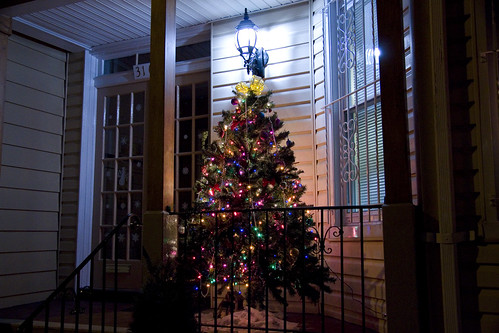
– photo by Mitch Waxman
Such public exertions have always fascinated your humble narrator, who would never be caught up in such wild fancy. A deadly seriousness and focused purpose should be the hallmark of a day well and profitably spent, without all of this pageantry and jumping about. Get back to work, all of you… bah…
from wikipedia
John Elwes [née Meggot or Meggott] (a.k.a. “Elwes the Miser”), MP, Esquire, (7 April 1714 – 26 November 1789) was a Member of Parliament (MP) in Great Britain for Berkshire (1772 – 1784) and a noted eccentric and miser, believed to be the inspiration for the character of Ebenezer Scrooge in Charles Dickens’ A Christmas Carol…
…He went to bed when darkness fell so as to save on candles. He began wearing only ragged clothes, including a beggar’s cast-off wig he found in a hedge and wore for two weeks. His clothes were so dilapidated that many mistook him for a common street beggar, and would put a penny into his hand as they passed. To avoid paying for a coach he would walk in the rain, and then sit in wet clothes to save the cost of a fire to dry them. His house was full of expensive furniture but also molding food. He would eat putrefied game before allowing new food to be bought. On one occasion it was said that he ate a moorhen that a rat had pulled from a river. Rather than spend the money for repairs he allowed his spacious country mansion to become uninhabitable. A near relative once stayed at his home in the country, but the bedroom was in a poor state. So much so, that the relative was awakened in the night by rain pouring on him from the roof. After searching in vain for a bell, the relative was forced to move his bed several times, until he found a place where he could remain dry. On remarking the circumstance to Elwes in the morning, the latter said: “Ay! I don’t mind it myself… that is a nice corner in the rain!”
Incidentally, this link came up while searching around for Dickens- Funniest thing I’ve seen since “Rap Chop“. “A Christmas Carol” A Gateway to Communism and the Occult! – from parody site Landover Baptist
also, just as a note: This is the anniversary of the Lincoln Tunnel opening for business in 1937.
Remember, Remember- the 21st of December

Pour me a drink and I’ll tell you some lies – photo by Mitch Waxman
An axial tilt of loathsome memories, shifting identities, and unrealized vengeance torments your humble narrator and makes him thankful that December 21st is, indeed, the shortest day of the year. The long nocturne of the Solstice, however, is no cause for celebration here in the Newtown Pentacle.
Solstice indicates that the Famine Months of January and February are upon us. The ancient Hellenes would enact the barbarous Lenaia bacchanal on solstice, and the Maenads would feast upon human flesh. It was also the central night of a week long Babylonian festival called Zagmuk, a celebration of divine Marduk’s victory over the darkness called the Anunnaki and their champion- the chaos dragon Tiamat. In modernity, in the nation of Mali, the Amma Cult of the atavist Dogon will sing and offer boiled millet at the conical altar of their high god.
from dailyworldbuzz.com
Today is the Celebration of Winter Solstice Traditions – Monday, December 21, 2009 marks the Winter Solstice traditions, and this is the announcement of the official start of the winter in the Northern Hemisphere. Winter Solstice is also known as Yule.
More precisely, winter solstice will take place at 12:47 pm EST (1747 GMT) on Dec. 21. It is a date that will also mark the shortest day and longest night.
Winter solstice falls every year around Dec. 21. It is because of the earth’s axial tilt, which is farthest away from the sun at its maximum of 23° 26′. At this time of the year, the sun is closer to the horizon, thus giving out least amount of daylight therefore shortening the day and lengthening the night.
But there is a bright side to it. Starting Tuesday, the days will start getting longer, leading to summer solstice, which in 2010 will fall on June 21. At that time, the day will be the longest with the daytime lasting for about 15 hours compared to 9 hours on Monday.

Long Island City is ready for an undead invasion, so are parts of Greenpoint – photo by Mitch Waxman
Tonight- Cernunnos- the Horned God of the Wiccans, who the Arabs call Dhu’l Qarnayn, will be reborn after being ritually slain on October 31st.
December 21st is a special day in history, signs and portents abound.
Disraeli and Stalin were born in 1879 and 1804 respectively, Pierre and Marie Curie identified radium in 1898, Elvis had his famous meeting with Nixon in 1970, Ireland finally won its independence from a large and aggressive neighbor in 1948 and Snow White and the Seven Dwarves premiered in 1937. Oh… and then there was Apollo 8.
from wikipedia
Apollo 8 was the first human spaceflight mission to achieve a velocity sufficient to allow escape from the gravitational field of planet Earth; the first to be captured by and escape from the gravitational field of another celestial body; and the first crewed voyage to return to planet Earth from another celestial body – Earth’s Moon.

shot on June 21st 2009 – Summer Solstice – photo by Mitch Waxman
Do not be surprised if you see oddly costumed people beating out unfamiliar melodies on drums today as you make your way around the great metropolitan city. Gatherings of initiates are sure to form, and wild orgiastic dancing will ensue.
Can you be sure, were you to find yourself caught up in some modern celebration in Long Island City or Greenpoint, that you weren’t in the company of flesh eating Maenads? Or that you hadn’t become one yourself? Your humble narrator, lords and ladies of Newtown, will be casting one eager eye at that rivulet of arrested misery called the Newtown Creek- in particular.
from souledout.org
At certain ancient cairns in Ireland the sun only reaches deep inside on the winter solstice, only on that one day is the inner chamber lit … like the celestial body of male Sun impregnating the Mother Earth with rays of light.
At the winter solstice the sun reaches its southernmost position in the northern hemisphere perspective (**), and begins to move northward as it enters into the cardinal, earth sign Capricorn. Through the ages, the period when the sun moves northward again ~ from the winter solstice to the summer solstice ~ has been regarded as a festival season. In many lands and civilizations the winter solstice season has been associated with the coming of a Sun-God to save the world ~ bringing light and fruitfulness to the earth, and bringing hope to humanity.

Gabled roof of netherlandish design, windows glowing with a strange colour, Astoria Church – photo by Mitch Waxman
Of course, this whole rumination on the Solstice takes place against the dominant culture’s winter holiday season. For the better part of a month, ritual feasting and familial gift giving consumes the modern mind. This period of the year, beginning with “Thanksgiving”, culminates in Advent/Yule/Christmas and ends with celebration of a calendar cycling.
1,096 days ago, I was in a hospital bed, and hadn’t yet experienced the pale ecstasies found in the glass strewn alleys and loamy graveyards of the Newtown Pentacle. 26,309 hours ago…
The darkest day, the longest night- my hour of the wolf is an interval of brutal introspections- here at Pentacle HQ in the ice choked heart of Astoria.
Note: Please say a quiet devotion for the ever patient and long suffering “Our lady of the Pentacle” today… she’s going to have to put up with and listen to this kind of maudlin revisionist crap all day…
from wikipedia
In many countries Advent was long marked by diverse popular observances, some of which still survive. In England, especially in the northern counties, there was a custom (now extinct) for poor women to carry around the “Advent images”, two dolls dressed to represent Jesus and the Blessed Virgin Mary. A halfpenny coin was expected from every one to whom these were exhibited and bad luck was thought to menace the household not visited by the doll-bearers before Christmas Eve at the latest.
In Normandy, farmers employed children under twelve to run through the fields and orchards armed with torches, setting fire to bundles of straw, and thus it is believed driving out such vermin as are likely to damage the crops. In Italy, among other Advent celebrations, is the entry into Rome in the last days of Advent of the Calabrian pifferari, or bagpipe players, who play before the shrines of Mary, the mother of Jesus, the Italian tradition being that the shepherds played these pipes when they came to the manger at Bethlehem to pay homage to the infant Jesus. It is the second most important tradition behind Easter for Roman Catholics.
In recent times the commonest observance of Advent outside church circles has been the keeping of an advent calendar or advent candle, with one door being opened in the calendar, or one section of the candle being burned, on each day in December leading up to Christmas Eve.
and just as a note: December 21 is also the anniversary of the Pilgrims landing on Plymouth Rock and getting the whole “America thing” started.
Calvary Cemetery Section
I’ve done so many posts on the place that I thought a catch-all page was in order- This will live in the menus to the right of the screen, and will be added to as more posts on the place are added.
Walking Widdershins to Calvary
-photo by Mitch Waxman
Click here to preview this photowalk in a google map
Hunters Point avenue intersects with the ancient course of Greenpoint Avenue at the degenerate extant of Long Island City. The Queens Midtown Expressway also comes back down to earth here, feeding Manhattan vehicular traffic to all points east. This is a very busy intersection, so be mindful of traffic, as fellow pedestrians are rare.
As with anyplace else in Queens you’d want to see, Forgotten-NY has been through here before. Click here for their page on Blissville and Laurel Hill.

– photo by Mitch Waxman
Addled as we are by the manipulations of the political class during the 20th century, with its “ism’s” and “movements“, Newtownicans have lost sight of the fact that the Newtown Creek was the center of the world for those who dwelt here in the 19th century. Before the American Civil War, the banks of the Newtown Creek were lined with homes built to the highest aesthetic standard, and peppered with grand hotels which catered to the sportsman and recreational fisherman. It was into this pastoral wildrness that the Calvary Cemetery was embedded in 1848, and which it sought to blend into with its fine arboreal stock and tasteful mastery of the art of landscaping.
It seems odd to us- sitting in our comfortable climate controlled and fully electrified homes and offices, to put a cemetery like this- with its ornate stonework and elaborate masonry, so close to the polluted industrial zones of the nearby Newtown Creek. Calvary spreads atavistically across a deserted and blasted landscape in our 21st century, surrounded by the trampled nest and discarded remnants of the industrial revolution.

Calvary Cemetery at 48th street – photo by Mitch Waxman
As one proceeds up the glacier carved hillocks that define northwestern Queens- climbing away from the terrors of Laurel Hill and leaving the malefic secrets of Maspeth and the Newtown Creek behind, the intrepid pedestrian will pass under and above an arcade of highways and find second Calvary.
Old Calvary is the original cemetery- second, third, and fourth Calvary are the metastasized and sprawling additions to the venerable original- and a significant portion of the Cemetery Belt.

-photo by Mitch Waxman
Just across the street from the site of the former LIRR Penny Bridge station. Easily accessed via the street, upon crossing the gates of Calvary, one will find a staircase carven into the hill by whose ascent the Newtown acropolis may be obtained. Cresting over the surrounding neighborhoods, and soaring over the Newtown Creek’s former wetlands, Calvary Cemetery keeps its secrets buried in centuried silence. Looking south toward Brooklyn, the Kosciuszko bridge approach of the Brooklyn Queens Expressway looms over its passage, carrying millions of vehicles over and across the necropolis of New York City.

Tales of Calvary 1 – The O’Briens
– photo by Mitch Waxman
Hallowmas, or All Saints Day, is coincident with the running of the NYC Marathon’s tumult laden course. The secular spectacular merely whets the appetite of your humble narrator for the open skies and sacred vantages found along those unhallowed backwaters of an urban catastrophe called the Newtown Creek.Calvary Cemetery– dripping in centuried glory- sits incongruously in an industrial moonscape stained with aqueer and iridescent colour. It’s marble obelisks and acid rain etched markers landmark it as a necropolis of some forgotten civilization.
Today, I determined to ignore the psychic effects of the graveyard, which are both palpable and remarkable. Resolving to climb to the highest point on this Hill of Laurels, my aim was to discover whose grave would occupy such a socially prominent spot. Secretly, I hoped to discover some celebrity or famous mobster’s resting place. Instead I found the O’Brien’s.

Tales of Calvary 2 – Veterans Day
-photo by Mitch Waxman
21 Roman Catholic Union soldiers are interred amongst the 365 acres of first Calvary Cemetery in Queens, nearby the cuprous waters of the much maligned Newtown Creek.
The wars of the 20th century, terrible in scope and vulgar in effect, cause us to overlook these men whovouchsafed the American Republic in the 19th century as we focus in on the veterans of the second thirty years war which modernity myopically calls World Wars One and Two. Woodrow Wilson proclaimed a federal holiday called Armistice Day in 1919, celebrating the anniversary of the legal end of the first World War in 1918. Congress agreed, seven years later, and then took six years to pass an act which made Armistice day an official United States federal holiday celebrated on November 11 annually.
Ed Rees, a populist Representative from the state of Kansas during the post World War 2 era, spearheaded a successful campaign in 1953 to have “Armistice Day” reclassified as “All Veterans Day” so as to include the veterans of WW2, and the ongoing conflicts fought by our “permanent government” on the world stage.

Tales of Calvary 3 – Rumors and stories
-photo by Mitch Waxman
Swirling, my thoughts.
A vast and byzantine pattern which extends beyond even the coming of the Europeans into the mist of olden days, traced by rail and road, reveals itself step by step as the burning eye of god itself leads me to and fro across the glass strewn Newtown Pentacle.
Bits of information, nuggets of pregnant fact, theosophical themes and mystic iconography obfuscating itstruths and meaning, a maelstrom of barking black dogs crowds my mind. Cowardly and infirm, I run to the grave.
Solace is found amongst the tomb legions, and the nepenthe of their silence.

Tales of Calvary 4 – Triskadekaphobic Paranoia
– photo by Mitch Waxman
Near the crest of one of Calvary Cemetery’s hills, can be found what I’ve described in previous posts as “a tree that is fed by some morbid nutrition”.
A convenient afternoon vantage point for photographing the Johnston mausoleum and a frequent destination, a Hallowmas (nov. 1) stroll through Calvary revealed some interesting goings on beneath the swollen boughs of this loathsome landmark.

Tales of Calvary 5 – Shade and Stillness
– photo by Mitch Waxman
In the past, the desolating loneliness and isolation which define my internal dialogue have been described to you simply – I’m all ‘effed up.
Shunned by those considered normal, my human– all too human- nature forces visceral desires for companionship. Lacking fellowship amongst the the living, one instinctively reaches out for those things which are no longer- or have never been- alive. That odd man in the filthy black raincoat that you might glimpse as you drive past the graveyard, scuttling along taking pictures of sewers and odd boxes in the Cemetery Belt- might very well be your humble narrator.
I was at Calvary Cemetery, intent on investigating the puzzling knots I had observed, beneath a hilltop tree- fed by some morbid nutrition, when I came across the Sweeney monument.

Tales of Calvary 6 – The Empire State Building and the Newsboy Governor.
– photo by Mitch Waxman
Looming, in this place, is the megapolis. Here lies Tammany, gazing eternally upon their work. The city. The great city.
The greatest and last of their projects is promontory above the shield wall of Manhattan, a familiar vista of Calvary Cemetery offered as an iconic representation by most.
The tower called the Empire State building was built, almost as an act of pure will, by a former newsboy from South Street.

Some old movies

– photo by Mitch Waxman
Sometimes, a humble narrator needs to admit defeat, kick off his shoes (which are showing signs of having picked up some of that queer colour observed around the odd shimmerings of the Newtown Creek) and soak in some passive entertainment.
courtesy of the Prelinger archives at archive.org–
1940 ethnic New York–
Focusing in on the “new community” concept of the ethnic melting pot in 1940. This is Roosevelt era propaganda, incidentally. First push to what NewSpeak calls multiculturalism (not for it or against it, just what it is).
![[item image]](https://i0.wp.com/ia301541.us.archive.org/2/items/Aroundth1940/Aroundth1940.gif "[item image]")
page link with info and multiple movie versions:
Unfit For the Living (ca. 1949)-
Robert Moses Propaganda, selling Public Housing as Panacea. Shows building of Alfred E. Smith Houses and makes the case for slum clearance with the promise of an ideal life in New York City Public Housing Projects.
![[item image]](https://i0.wp.com/ia301515.us.archive.org/0/items/FortheLi1949/FortheLi1949.gif "[item image]")
page link with info and multiple movie versions:
Social Class in America (ca. 1957)-
One of the “nose on your face” third rail topics in American Politics, which is not discussed in a modern “identity politic” defined culture. Poor people have a whole lot more in common with each other as a social class than they do with their ethnic groups. Dividing the city into groups based on how they comb their hair is Tammany Hall at its finest, there’s only 2 groups- the bosses and everyone else.
![[item image]](https://i0.wp.com/ia311028.us.archive.org/2/items/SocialCl1957/SocialCl1957.gif "[item image]")
page link with info and multiple movie versions:
Manhattan Waterfront (ca. 1937)-
Incredible infrastructure pornography for the tugboat and bridge fetishist crowd. Shots from Shore Road by Astoria Park of Hellgate and Triboro Bridges. Also, Manhattan waterfront shanty towns of indigent labor- not something that normally gets edited into the story of heroic modern New York.
![[item image]](https://i0.wp.com/ia301515.us.archive.org/3/items/ManhattanWat/ManhattanWat.gif "[item image]")
page link with info and multiple movie versions:
One of the money shots in the film is contrasted by the photo below, shot in summer of 2009.

– photo by Mitch Waxman
Despotism (ca. 1946)-
![[item image]](https://i0.wp.com/ia301516.us.archive.org/1/items/Despotis1946/Despotis1946.gif "[item image]")
A terrifying warning from “the greatest Generation” about how to determine how close to despotism your community is- which virtually predicts the modern United States after the first decade of the 21st century. Really, watch this one, scariest thing you’ll see today.
page link with info and multiple movie versions:

– photo by Mitch Waxman
and just as a note: December 18 is Robert Moses’s Birthday.


 The Newtown Pentacle