Archive for February 2010
Esoteric Trains at Corona Yard
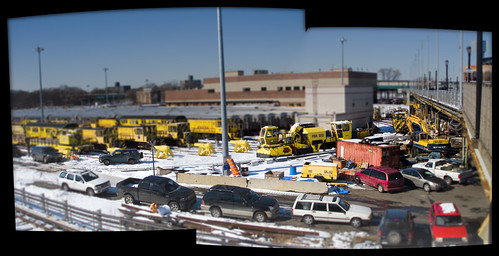
– photo by Mitch Waxman
Leaving the broad shoulders of Astoria for a days hike, your humble narrator found himself at the Corona Yard staring over a fence at some of the MTA’s less familiar kit. This is where the 7 train sleeps, and also where one can observe an assortment of “work trains”. Said “work trains” are specialists, non passenger, and rarely seen or commented on by the public. While crossing the pedestrian ramp from Roosevelt Avenue to Flushing Meadow Corona Park, I was on the lookout for the “snow train”, but that wasn’t what I found.
from nydailynews.com
“It’s like your household snow blower but a million times bigger,” agency engineer Edward Macina said late Wednesday as the five-car diesel train chugged past the silent expanse of Kennedy Airport.
The train is a key component in the agency’s comprehensive snow-battle plan.
A six-foot cylindrical brush attached to the front sweeps snow into an even wider metal tube.
Snow is then blasted away — far away — from the rails from the mouth of a chute about eight feet in the air.
The machine can launch the snow 200 feet, removing 3,000 tons of snow an hour. Macina, project manager in the car equipment department, joked ‘Snow Eater’ might be an appropriate nickname.

R125 Ballast Regulator – photo by Mitch Waxman
Corona Yard is a rail fan’s dream. Active rolling stock sits quietly in the sunlight next to a historical catalog of the MTA’s former workhorses and modern utility trains.
from wikipedia
Corona Yard is the yard facility in Flushing, in the New York City borough of Queens, that serves the IRT Flushing Line (7) of the New York City Subway. It is located in Flushing Meadows-Corona Park, near Citi Field, the National Tennis Center, and the site of the 1939 and 1964 World’s Fairs.
Corona Yard opened in 1928 and has seen various models of cars, including Steinway Low-Vs, Brooklyn-Manhattan Transit Corporation/BMT Qs, R12s, R14s, R15s, World’s Fair R36s in 1964, and R62As. It also contains the Casey Stengel Bus Depot.
On August 16, 2006, the original 1928 shop building was demolished, and was replaced by a new, modern shop.

Ballast Tamper TP239 – photo by Mitch Waxman
This mechanism, for instance is a “Ballast Tamper”, which is a track maintenance and repair unit.
from wikipedia
A ballast tamper or tamping machine is a machine used to pack (or tamp) the track ballast under railway tracks to make the tracks more durable. Prior to the introduction of mechanical tampers, this task was done by manual labour with the help of beaters. As well as being faster, more accurate, more efficient and less labour-intensive, tamping machines are essential for the use of concrete sleepers since they are too heavy (usually over 250 kg) to be packed into the ballast by hand.
Early machines only lifted the track and packed the ballast. More modern machines, sometimes known as a tamper-liner or tamping and lining machine, also correct the alignment of the rails to make them parallel and level, in order to achieve a more comfortable ride for passengers and freight and to reduce the mechanical strain applied to the rails by passing trains.

– photo by Mitch Waxman
Hey, those are “Redbirds” back there, weren’t they all supposed to be coral reefs by now?
from wikipedia
Redbird is the name given to 1,408 New York City Subway cars of the following types: R26, R28, R29, R33 ML, R33 WF, R36, and R36 WF. These cars were painted a deep red to combat graffiti, which had become a major problem In the late 1970s and early 1980s. The deep red color was referred to as Gunn Red in honor of its originator David L. Gunn, who was the head of the New York City Transit Authority during this period. Initially entering service in various colors, these cars received the new paint scheme between 1984 and 1989. Some R17s were also given this paint scheme in 1985/86, but were retired well before the name “Redbird” caught on.

– photo by Mitch Waxman
This long walk from Astoria to Flushing Meadow Corona Park will be explored in the coming days, here at your Newtown Pentacle, in the first postings of this new “Year of the Metal Tiger“.
An amazing factoid turned up in researching this walk is that Roosevelt Avenue (the 5 miles which extend from the Great Machine at Queens Plaza all the way out to Willets Point) was designated a National Millennium Trail in the year 2000. This places Roosevelt Avenue alongside the Appalachian Trail in cultural importance, but somehow I think that’ll be forgotten next time someone wants to build a 40 story tower condo along it. We’ll get into this in some detail in the coming days…
from wikipedia
A ballast regulator is a piece of rail transport maintenance of way equipment used to shape and distribute the gravel track ballast that supports the ties in rail tracks. They are often used in conjunction with ballast tampers when maintaining track.
Tales of Calvary 11- Keegan and Locust Hill

– photo by Mitch Waxman
The monument to Charles Keegan is a familiar one to those who visit First Calvary Cemetery with any regularity. Close to the gates on Greenpoint Avenue, one does not need to penetrate too deeply into the viridian devastations of the place to find it. Keegan was a firefighter, a Foreman of Hook and Ladder No. 4 who was killed during the pursuit of his duties on the 15th of September in 1882 at the conjunction of Meeker Avenue and the loathsome Newtown Creek.
nytimes.com has an article on the Locust Hill Refinery Fire, which presents the grisly details of that night and describes the tragic death of both Keegan and Captain Stuart Duane (whose death counts as one of the most horrible exits from this mortal coil I’ve ever encountered)

– photo by Mitch Waxman
Before the night was over and the vast fire contained, oil barges set aflame by the terrific explosions and spreading flames had been carried all the way to the Penny Bridge, which ended up being consumed itself by fire. The far larger Standard Oil works up the Creek were protected from this spreading conflagration by an ad hoc boom deployed by Firefighters across the Creek, said boom was composed of empty barges and logs. The entire blaze began when lightning struck the petroleum reservoir tanks of Sone & Fleming at the Locust Hill Refinery sparking a fire which spread insidiously across the 18th ward, during a severe thunderstorm.
arrts-arrchives.com has many fascinating images for the antiquarian community to marvel over, but of interest for readers of this posting will be this shot from 1852 (that’s the Newtown Creek, kids, see Calvary in the upper right corner- click image for a larger view at the arrts-archives.com site) showing the Penny Bridge that was burned away.


– photo by Mitch Waxman
By 1929, the independent oil companies around the Newtown Creek were absorbed by the Standard Oil Trust, parent of the modern Exxon and Mobil corporations. Standard Oil, of course was the guilty party concerning the Greenpoint Oil Spill.
William DONALD, proprietor of the Locust Hill Oil Works, where the fire originated, testified that when he reached the fire he saw the only way to save anything was to draw off the oil. By five o’clock in the morning one-half had been drawn off. About twenty minutes later the tank boiled over and filled the yard with burning oil. KEEGAN was near the tank at the time, with several men employed in the works and some firemen. They ran and escaped except KEEGAN, whom the witness afterwards heard was missing. There was about six hundred barrels of crude oil in the tank.
Abominable Snowman of Astoria

– photo by Mitch Waxman
Zuzu, our noble dog and faithful subject, demanded reasonable access to the amenities of curb and hydrant and so compelled- I grabbed the camera and we went out into the storm. On the corner of 45th and Broadway, we came across this sinister homunculus.

– photo by Mitch Waxman
Mastery over snow and ice is but one of Zuzu’s many abilities, but her foot pads are vulnerable to ice melting chemicals and road salt. Her pads were prepared for the saline ponds and frozen mounds with an application of Musher’s Wax, which is a commercial variant of Beeswax. We left her comical coats and sweaters at home, since there really was no point in them as Zuzu was punching in and out of snow banks. Cry Havoc, and let slip, declareth the dog, and we went to Newtown Rd. and 43rd street.

– photo by Mitch Waxman
It was decided that Broadway, where we just were, would be a superior spot to sniff. As always, the corner grocery is open. Somehow, these guys had power back during the Astoria black out in 2006, and their sandwich counter is both clean and surprisingly affordable. They even make home made yogurt! Zuzu stared at this corner for a while, it was probably since she knows that this is where yogurt comes from.

– photo by Mitch Waxman
Giving my loyal canine a moment of privacy, Zuzu went about her business while I stared up into the trees. A dogs life has so little dignity, offering a moment of discretion when they need to powder their noses is only polite. Cleaning up her steaming dog egg, I realized that the snow was again taking a turn for the worse. So did Zuzu.

– photo by Mitch Waxman
Zuzu got cold, or hungry, and decided it was time to go home at this point. I followed.

– photo by Mitch Waxman
Zuzu during warmer times.
Siderodromophobia

– photo by Mitch Waxman
This is another of those posts where someone will say “so, a train went by, huh? wow”, so let’s just get that right out of the way- Jan 20, Pulaski Bridge. So, tongue firmly in cheek, today’s session of the Newtown Pentacle…
Thankfully- as the nytimes.com site re-presents the reportage found in an AP feed instead of reporting on it themselves – it seems the psychiatric industrial complex is nearing the completion of the latest iteration of their operators manual for “normal” minds, called the DSM-5. All ‘effed up, your humble narrator has in the past detailed the multitudes of phobias, syndromes, and disorders which he falls victim to on a daily basis, and looks forward to the new volume which will offer the promise of even more vaguely defined and loosely described psychological states to hypochondriacally self diagnose and cling to.
from wikipedia
The DSM-IV-TR states, because it is produced for the completion of Federal legislative mandates, its use by people without clinical training can lead to inappropriate application of its contents. Appropriate use of the diagnostic criteria is said to require extensive clinical training, and its contents “cannot simply be applied in a cookbook fashion”. The APA notes diagnostic labels are primarily for use as a “convenient shorthand” among professionals. The DSM advises laypersons should consult the DSM only to obtain information, not to make diagnoses, and people who may have a mental disorder should be referred to psychological counseling or treatment. Further, a shared diagnosis/label may have different etiologies (causes) or require different treatments; the DSM contains no information regarding treatment or cause for this reason. The range of the DSM represents an extensive scope of psychiatric and psychological issues or conditions, and it is not exclusive to what may be considered “illnesses”.

– photo by Mitch Waxman
The DSM-4 has provided me with endless hours of enjoyment, allowing me to embrace the fullness of just how crazy I actually am. Regarded as a feckless quisling (I am the #1 and 2 hits at google for this term!) and physical coward, such a collection of “very bad ideas” is a treasure trove of joy to which I can ascribe every quirk of personality or failing of character to, a series of nails to hammer into my flesh. Luckily, the psycho net is broadly cast with a fine mesh- so I’ll have a lot of company in the mad ward. Especially when the enormous number of Newtown Pentacle readers who also suffer from Siderodromophobia reel away from their computers in horror after witnessing this posting.
Personality Disorder Not Otherwise Specified
This category is for disorders of personality functioning that do not meet criteria for any specific Personality Disorder. An example is the presence of features of more than one specific Personality Disorder that do not meet the full criteria for any one Personality Disorder (“mixed personality”), but that together cause clinically significant distress or impairment in one or more important areas of functioning (e.g., social or occupational). This category can also be used when the clinician judges that a specific Personality Disorder that is not included in the Classification is appropriate. Examples include depressive personality disorder and passive-aggressive personality disorder (see Appendix B in DSM-IVTR for suggested research criteria).

– photo by Mitch Waxman
For a while, I’ve been entertaining “Agoraphobia Without a History of Panic Disorder” but I really do enjoy being outside- scuttling in a fugue state along these Newtown streets beneath the burning thermonuclear eye of god itself in my filthy black raincoat while avoiding others and satisfying my suspicious notions which only I can see and reporting my findings here in vague, metaphorical, and overelaborate language. This doesn’t strictly adhere to AGWAHOPD.
I also really like “Avoidant personality disorder” for its self loathing, mistrust, and hypersensitivity to criticism. I do have a thin skin, after all, but lately- I’m leaning “schizotypal personality disorder”, baby. SPD, yo.
Schizotypal personality disorder, from wikipedia
A disorder characterized by eccentric behaviour and anomalies of thinking and affect which resemble those seen in schizophrenia, though no definite and characteristic schizophrenic anomalies have occurred at any stage. There is no dominant or typical disturbance, but any of the following may be present:
- inappropriate or constricted affect (the individual appears cold and aloof);
- behaviour or appearance that is odd, eccentric, or peculiar;
- poor rapport with others and a tendency to social withdrawal;
- odd beliefs or magical thinking, influencing behaviour and inconsistent with subcultural norms;
- suspiciousness or paranoid ideas;
- obsessive ruminations without inner resistance, often with dysmorphophobic, sexual or aggressive contents;
- unusual perceptual experiences including somatosensory (bodily) or other illusions, depersonalization or derealization;
- vague, circumstantial, metaphorical, overelaborate, or stereotyped thinking, manifested by odd speech or in other ways, without gross incoherence;
- occasional transient quasi-psychotic episodes with intense illusions, auditory or other hallucinations, and delusion-like ideas, usually occurring without external provocation.

– photo by Mitch Waxman
Man, that’s me! Point by point! Psych!
I don’t know why I’m so happy, though, it sounds like a nightmare.
Nightmare disorder, from wikipedia
Nightmare disorder, or dream anxiety disorder, is a sleep disorder characterized by frequent nightmares. The nightmares, which often portray the individual in a situation that jeopardizes their life or personal safety, usually occur during the second half of the sleeping process, called the REM stage. Though such nightmares occur within many people, those with nightmare disorder experience them with a greater frequency. The disorder’s DSM-IV number is 307.47.
Don’t Know Jack

– photo by Mitch Waxman
Social obligations carried your humble narrator to the teeming streets of New York City’s famous Chinatown over the weekend, where this enigmatic ovum was observed. Alien to my eyes, this is a Jack Fruit, which is apparently one of asian cuisine’s most popular cultivars. Ignorant of the pacific tropics and their unique biota, my initial thought upon encountering the Jack Fruit was that it was a pod not unlike those utilized by the “Body Snatchers” during one of the many attempts to infiltrate human society by extraterrestrials during the 1950’s. Turns out that the Jack Fruit has been a part of the Asian diet since Ashoka the Great ruled India in 250 BC. The name Jack Fruit is derived from the Portuguese term for it- Jaca, after the Malaysian Chakka.
from wikipedia
The jackfruit (Artocarpus heterophyllus or A. heterophylla) is a species of tree in the mulberry family (Moraceae), which is native to parts of South and Southeast Asia. It is the national fruit of Bangladesh. It is called Kanthal (কাঁঠাল) in Bangla, Katahar (कटहर) in Nepali, Panasa (पनस) in Sanskrit, Katahal (कटहल) in Hindi, Nangka in Bahasa Indonesia,Halasu (ಹಲಸು) in Kannada, Panasa in Telugu, Pala in Tamil (is one of the three auspicious fruits of Tamil Nadu),Chakka in Malayalam language, Phanas in Marathi language and पणस in Konkani language. It is well suited to tropical lowlands. Its fruit is the largest tree borne fruit in the world, seldom less than about 25 cm (10 in) in diameter.

photo from wikipedia

– photo by Mitch Waxman
Armstrong, the Newtown Pentacle’s far eastern correspondent and expert on asian dessert items, simply states that the Jack Fruit is delicious. After a lifetime spent in New York City, with the limited compliment of American staple fruits (banana, citrus, apple, grape, peach, tomato) and their variants available, it is a real pleasure to see that the latest waves of immigration are expanding the variety of foodstuffs. I’ve seen other exotic and alien crops, Durrians and Yuca for example, on sale in Queens markets in the last couple of years. Even the local supermarket here in Astoria carries a remarkable variety.
from crfg.org
In Malaysia and India there are named types of fruit. One that has caused a lot of interest is Singapore, or Ceylon, a remarkable yearly bearer producing fruit in 18 months to 2-1/2 years from transplanting. The fruit is of medium size with small, fibrous carpels which are very sweet. It was introduced into India from Ceylon and planted extensively in 1949. Other excellent varieties are Safeda, Khaja, Bhusila, Bhadaiyan and Handia. In Australia, some of the varieties are: Galaxy, Fitzroy, Nahen, Cheenax, Kapa, Mutton, and Varikkha. None of these appear to be available in the US at this time.
Yet, even as the ever changing ethnic waves bring new and exciting comestibles with them, other traditions fall away. Corned Beef does not sweat in bar room steam tables anymore, I haven’t seen the Krishnas making rice and beans in Thompson Square Park for a while, Jewish Deli is virtually extinct, and…
What ever happened to the Bear Claw?
do they still exist in sticky sweetness, within the City of New York?
more on this Bear Claw business to come…


 The Newtown Pentacle