
Nichole East posted this video on Flickr documenting an exorcism performed by her neighbors last week. She also snapped the above photo of the friendly note she left them. (Thanks, Greg Long!)
Altissima quaeque flumina minimo sono labi

– photo by Mitch Waxman
Note: One of those things that your humble narrator is guilty of is a tendency, when confronted with something alien or unknown, to “fill in the blanks” via an inexact mixing of logical supposition and impressionist reasoning. The opposite of exactitude, this can result in wild ideas and false assumptions being presented and accepted as fact. I would love to tell you which cultic group these artifacts belong to- but the fact is that I just don’t know. Certain assumptions can be hazarded, based on cursory resemblance and observed phenomena, but they will be guesses. Don’t assume my interpretation of things is correct.
Witness, then, what I observed in St. Michael’s Cemetery on the Saturday before Easter- April 3rd, 2010- right about here.

– photo by Mitch Waxman
In St. Michael’s, there is a hill which faces East and whose tombstones are very old. The graves are in a state of disrepair, and the stones are found to be in a ruined state. This is no fault of the Cemetery, which maintains its grounds in a meticulous fashion, instead it is merely time and weather which have worked their havoc on the monuments. Perambulating through the grounds on Saturday with Our Lady of the Pentacle, we found this scene.

– photo by Mitch Waxman
A variety of Afro-Cuban syncretic faiths use similar iconography, but the one which most of the english speaking community is passingly familiar with is called Santeria (aka Regla de Ocha, La Regla Lucumi, or Lukumi). This appeared to be Santeria to me at first- because of the particular color scheme of the candles (red white and blue) and the co-mingling of coinage and sacrificial bones. But the Santeria folks generally do their thing indoors, in a ritual space consecrated and blessed by their own padrinos, just like the Catholics. Graveyards are usually avoided for rituals as they are negative places.

– photo by Mitch Waxman
My observation has been that the local latino populations in Astoria tend to be South rather than Central American, and the geographic heritage of Santeria is Caribbean and Central American. Afro-Cuban religion sprang up amongst the African Slaves brought to the New World to work the sugar and tobacco fields who were forced to adopt Roman Catholicism. Voodoo in Haiti and Louisiana, Hoodoo in the American South- all products of the French empire- with Santeria, Obeah, and Palo progeny of the Spanish.
The other great Catholic nation that held huge numbers of west africans as livestock was Portugal, and it did so in Brazil- where Umbanda, Candomblé, Macumba, and Quimbanda originate. Brazil is in South America, of course, and there are tremendous populations of Brazilians living nearby St. Michael’s in surrounding Astoria. This is some of that logical supposition I warned you about…

– photo by Mitch Waxman
Folk magic sites like this raise the ire of Eurasian morals, as ritual animal sacrifice is kept out of sight in our modern communities, and commoditized as Kosher or Halal or Organic meat. Blood sacrifice and submission to cultural norms, from circumcision to ear piercings to the elaborate face paint called “cosmetics”, are part of our daily lives. This sort of visceral aftereffect of some unfortunate avian’s end, however, is disturbing. No less though, than a crucifixion or any other blood ritual.

– photo by Mitch Waxman
One of the many ridiculous totems tucked away in my jacket pocket is a small magnetic compass. When I began these long walks around what I would someday call the Newtown Pentacle, it served me well, and today it revealed that this ritual space was lined up exactly on the cardinal points of my trusty little friend.
The scattering of bottles, bones, coins, and candles sits east of the stone which is aligned north south in the long dimension, and its anterior face is west facing. This will become increasingly important.
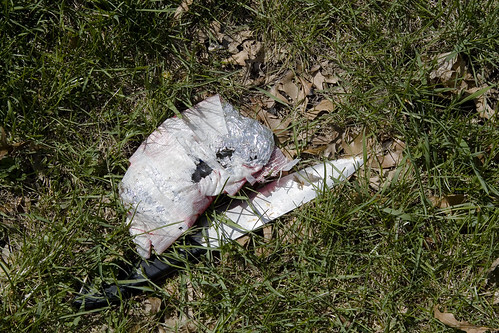
– photo by Mitch Waxman
This little package and knife are north east of the monument which I’ll be referring to as an altar. I did not open it, of course, it is against Newtown Pentacle policy to actually touch any of the odd things I come across, like the Pulaski Bridge, with bare skin. This whole neighborhood could use a good scrub, if you ask me.

– photo by Mitch Waxman
As always, if you click any of these images- a new window will open up its Flickr Page. Clicking the “all sizes” button found there will take you to progressively larger incarnations- all the way up to “actual pixels”. Check these out, I’ve spent some time trying to figure out what’s inside of the package. Do any of you sharp eyed Ladies and Lords of Newtown out there wish to hazard a guess? Use the “leave a comment” link.

– photo by Mitch Waxman
Seeing the blade and little kidney shaped package gave the whole scene a somewhat sinister air, and that’s when I remembered to check what else might be found on the cardinal meridians of the compass.

– photo by Mitch Waxman
The western facing of the altar sits at the pinnacle of a muddy ridge, which bears much subsidence. The underpinnings of the stone, and declination of the hill itself, fall away rapidly. These candles were observed.

– photo by Mitch Waxman
Nothing special about one of them, the other was unusual. Both red.

– photo by Mitch Waxman
The west facing side of the scene, from the bottom of the little hill. Note the tumbled and disorganized state of the masonry. North is to your left, south to the right.

– photo by Mitch Waxman
Moving north, a white candle .

– photo by Mitch Waxman
Back on top of the hill, directly east of the white candle above, and north of the main altar.

– photo by Mitch Waxman
A green and a pink candle on a dish of “some quality”.

– photo by Mitch Waxman
West of altar, a tumbled monument, with odd etchings on it. Can this be some sort of language?

– photo by Mitch Waxman
South of altar, west side of hill, a plastic bottle with some sort of red/brown liquid in it.

– photo by Mitch Waxman
Notice that the ground is depressed here, as if something very heavy- like a tombstone- had been moved recently.

– photo by Mitch Waxman
Just at the other end of the divot was this foil wrapped bottle which looked like it had been in the ground for a long time. Notice how the moss grows right up to it.

– photo by Mitch Waxman
Top of hill, south side, looking north across site. There are feathers scattered around the grass, mainly just north of the altar. Click here for a flickr page which shows some detail of the feathers.

– photo by Mitch Waxman
There was also this upside down cross.

– photo by Mitch Waxman
The first thing I would say is that the name on the card does not match those on the monument. The second would be to ask you to read through this posting- Tales of Calvary 4- Triskadekaphobic Paranoia from November of 2009 which describes this odd arrangement in some detail. In the comments thread at that post, please take note of a former Calvary employee’s possible explanation of what is going on here. Third, here’s the latest addition to the knots, a mass card which has appeared just at the outset of spring.

– photo by Mitch Waxman
Despite the intervening brutalities of a New York winter, the knotted cords and stick persisted in their intended places, as evinced above. Realize, of course, that the equinoxes mark special dates on the magickal calendar and cultic activity is ripe at the quarters of the solar and lunar cycle- both Passover and Easter fall near the equinox, for example. At these times of year, if you seek- ye shall find.

– photo by Mitch Waxman
I’m not certain, however, what significance a mass card carries. Not being an adherent of the Roman Catholic religion, I’ve nevertheless purchased them when friends and associates have suffered a loss, and offered them up to grieving families. My assumption has always been that they represent some sort special devotion or ceremony which will be performed by the priestly caste, but I remain ignorant of their purpose. As mentioned above, however, the names on the monument do not match the one on the mass card.
I’m keeping an eye on this “tree fed by a morbid nutrition” here at the ossified heart of the Newtown Pentacle in Calvary Cemetery.
And don’t miss tomorrow’s post, which discusses additional weirdness found at St. Michael’s Cemetery just this past weekend.

– photo by Mitch Waxman
A Friday, on March 19th the Hermetic Hungarian had left his laboratory workshop (a set of rooms on Manhattan’s decadent Upper West Side where he is exploring the deeper meanings and implications of esoteric 19th century clockworks) and ventured forth to Newtown.
The Hermetic Hungarian, referred to as HH from this point on, is a pale and sickly genius who has been intrigued by the presence of certain atavist religions and the persistence of modern adherents to these sects who remain extant along the poison shores surrounding an ancient industrial center called the Newtown Creek. HH had procured an automobile for the day’s exertions- as his fragile health precludes him from the long walks favored by your humble narrator which are so pedantically detailed at this- your Newtown Pentacle.

– photo by Mitch Waxman
Returning from a day of exploration, which first described the extensive branching of the transportation network referred to as “The Great Machine“, we proceeded to the currently undefended border of Maspeth and storied Greenpoint and crossed the Grand Avenue Bridge. HH was searching for evidences of a grandiose clockwork mechanism which long hours of research and supposition have led him to believe existed in the days of Trolley and Rail. Influenced by his metaphysical beliefs, which are both Hasidic and Buddhist in nature, the HH’s itinerary required his trip to be brief- and after spending an afternoon exploring the ancient climes of Newtown, Bushwyck, and Greenpoint- and we headed back toward a transportation artery that would allow him egress back to the Shining City and his hierophant isolations.

– photo by Mitch Waxman
On our return, the bascule mechanisms of the Pulaski Bridge suddenly sprang to life, allowing egress to the Newtown Creek for shipping. The first watchtower on the Creek, the Pulaski is also the busiest of its bridges. While traffic on the Newtown Creek is a shadow of what it once was, there is still a significant industrial presence on the maritime highway that requires connection with the vast enterprises of New York Harbor- especially the petrochemical empires that line the shores of the Kill Van Kull in distant… Staten Island. Additionally the car shredders and other recycling facilities, which bless Newtown with their labor, utilize barges to move their wares to distant customers.

– photo by Mitch Waxman
In this case, it is the petrochemical shipping industry which commanded the opening of the Pulaski Bridge, as evidenced by the appearance of the DBL 28 fuel Barge, a 28,000 BBL double hull tank barge (which conforms to the Oil Pollution Act of 1990’s requirements- no mean feat) which was built in 2006 and weighs some 2,146 gross tons.
from allbusiness.com
The 28,000 bbl capacity DBL 28 measures 297.6-feet in length, with a 54-foot beam and 13-foot depth. The DBL 28 is the first of a series of eight units currently in production at BMF for K-Sea. DBL 28 is coupled with an existing K-Sea tug using the state-of-the-art Beacon JAK 200 tug/barge Push-Pin coupler system, which is designed to increase operating efficiency and enhance safety and reliability by operating as a dual mode ITB. The series of barges are manned, non self-propelled, double hulled with a raked shaped bow, with six cargo tanks. The barges are classed Lakes, Bays & Sound (Inland) Tank Barges, ABS +A1 Oil Tank Barge, and USCG certified. The barges are being constructed primarily for bunkering and harbor service in ports on the U.S. East Coast.

– photo by Mitch Waxman
The fuel Barge was being guided by the K-Sea Davis Sea, a 2,000 HP 95 gross ton, 77 foot long tug whose mast spires nearly 57 feet over the water. Online sources describe the Davis Sea as possessing 6 foot diameter propeller screws, which are powered by twin engines, and as having been built in 1982.
from k-sea.com
K-Sea Transportation Partners L.P., headquartered in East Brunswick, New Jersey, is a leading provider of marine transportation, distribution and logistics services in the U.S. From locations in New York, Philadelphia, Norfolk, Seattle and Honolulu, K-Sea operates a large fleet of tugs and tank barges that serves a wide range of customers, including major oil companies, oil traders and refiners.

– photo by Mitch Waxman
The Davis Sea, of course, is named for the oceanic area along the coast of Eastern Antarctica which abutts the Shackleton and West ice shelfs. Lying along the Indian Ocean side of the polar wasteland, it is the coldest, windiest and driest section of the southern pole. Eastern Antarctica is still largely unknown to man, except by aerial and satellite observation- although the Soviet and American hegemonies established scientific research bases as early as the 1950’s in the relatively ice free coastal areas. Today, all of the great nations are represented in scientific exploration of this final frigid frontier.

– photo by Mitch Waxman
The Gamburtsev Mountain Range as well as the prominences of the Transantarctic Mountains, and the East Antarctica Ranges are amongst the oldest ranges on Earth, although some of these great structures are quite nearly buried beneath the glaciers they have formed. Hostile to normal terrestrial life, these mountains of madness are rumored to contain and house several obscure occult constructs including “The black pit,” “the carven rim,” “the protoShoggoths,” “the windowless solids with five dimensions,” “the nameless cylinder,” “the elder Pharos,” “Yog-Sothoth,” “the primal white jelly,” “the color out of space,” “the wings,” “the eyes in darkness,” “the moon-ladder,” “the original, the eternal, the undying,” and other queer occult concepts.

– photo by Mitch Waxman
Of course, your humble narrator digresses, influenced by a day spent with the limitless intellect of the Hermetic Hungarian- and the Davis Sea pictured above is merely a tugboat making it’s way down an urban waterway, and is not the seat of some cosmic horror which would shatter our notion of civilization and man’s place in the universal order.
The HH began frantically gesturing at me as I stood on the roadway of the Pulaski Bridge just then, lost down the soda straw reality of a telephoto lens.

– photo by Mitch Waxman
Its purpose accomplished, the drawbridge had returned to its vehicular roadway duties, and traffic flow between Greenpoint and Long Island City was about to resume. Angry at the inconveniences offered by the delay, anxious drivers were about to rocket forth into Queens, and would have hardly afforded a specimen such as myself the luxury of not being ground to paste beneath their spinning wheels.

– photo by Mitch Waxman
The Davis Sea proceeded up the Creek, no paddles required or missed. She sauntered past FreshDirect and the Newtown Creek Waste Water Treatment Plant at Whale Creek, churning the languid gelatins which line the Newtown Creek as it went. This must be a difficult course, as there is so little room for error in piloting the narrow and tightly populated channel.

– photo by Mitch Waxman
That is Calvary Cemetery on the horizon, with industrial Queens occupying the left side of the image. Just beyond is the Greenpoint Avenue Bridge and the significant petrochemical facilities- recently upgraded and enlarged and enjoyed by those on the Brooklyn shore – that adjoin it.

– photo by Mitch Waxman
Forced to begin speeding up, the Hermetic Hungarian allowed me one or two last shots of the Davis Sea as it passed into that world of ancient mariners and atavist custom which typify Newtown, while angry motorists behind us employed their horns to display displeasure at our lack of enthusiasm for leaving the scene. Their horns formed a mocking chorus, an antiphonal response to our absent haste whose sound can be described only as…
“Tekeli-li! Tekeli-li!” “Tekeli-li! Tekeli-li!” “Tekeli-li! Tekeli-li!”
Driven to madness by the sound, the Hermetic Hungarian began babbling madly, repeating the names of subway stops as we drove.

– photo by Mitch Waxman
It’s what the gulls say.
As described in earlier posts, my mother has been ill, which has necessitated travel to and from… Staten Island… on the part of your humble narrator to safeguard her interests. I won’t bore you with the horrible realities of geriatric care in the City of Greater New York, but will instead share the way that I’ve passed the time while traveling back and forth from Astoria to… Staten Island.
Luckily, a fairly straight forward course exists, the R line connects western Queens with Manhattan, and its last stop in the Shining City is South Ferry- where the Staten Island Ferry docks at the Whitehall Terminal.
from nyc.gov
The following New York City Department of Transportation (NYCDOT) Staten Island Ferry Passenger Rules of Conduct shall be adhered to by all passengers to ensure the safety of the public and all employees.
1. No disorderly conduct or behavior that may be deemed unsafe or disruptive.
2. No littering. Place all trash and garbage in the receptacles provided.
3. No spitting or creating of any other unsanitary condition.
4. Lying down on seats and benches within the terminals and vessels is prohibited.
5. Feeding of any animal within the ferry terminals or on any vessel is prohibited.
6. Smoking is prohibited onboard the vessels and within all enclosed spaces in the terminals. Smoking is allowed only in designated open areas.
7. Distribution or posting of any literature or advertisements without a NYCDOT permit is prohibited.
8. Unauthorized carrying of a firearm or weapon within the terminals or on the ferries is prohibited.
9. No person shall skateboard, roller skate or ride a bicycle, scooter or any other vehicle or device (except a wheelchair required for transit) on or through any part of the terminals or ferries. Bicycles and non-motorized scooters must be walked through the terminals and ferries and board the vessel via the lower level.
10. Commercial use of video, photography or audio recording equipment without a NYC permit is prohibited.
11. Playing any audible device without the use of earphones is prohibited. Audible devices include but are not limited to radios, game devices and video/audio playback devices.
12. Pets, other than service animals as defined by the Americans with Disabilities Act, are not allowed in the facilities and/or onboard the ferry boats, unless they are caged and/or muzzled.
13. Destruction, graffiti, or marking of any facility or vessel is prohibited.
14. During an emergency all passengers shall follow the direction of NYCDOT facility personnel or vessel crew members.

– photo by Mitch Waxman
The short trip across NY Harbor passes the Narrows and the nearby Kill Van Kull which provide ocean going craft with a pathway to the titanic facilities of Port Elizabeth Newark. On the Staten Island side, the Ferry docks into the St. George terminal.
A vast industry is at work on the water though, wholly visible in the weird and dynamic lighting generated by that queer luminance filtering through the humid valences which typically occlude the burning thermonuclear eye of god itself during seasonal transitions from winter to spring here in the City of New York.
from wikipedia
The St. George Ferry Terminal is one of two terminals of the Staten Island Ferry with the other being South Ferry which is located on the southern tip of Manhattan near Battery Park. The Staten Island Ferry runs 24 hour service between both terminals.
Staten Island Ferry terminal at South Ferry in Lower Manhattan
Today the Staten Island Ferry annually carries over 19 million passengers on a 5.2 mile (8.4 km) run that takes approximately 25 minutes each way. Service is provided 24 hours a day, every day. Each day approximately five boats transport about 75,000 passengers during 104 boat trips. Over 33,000 trips are made annually.
During rush hours, ferries usually run every 15 and 20 minute intervals, decreasing to 30 minutes during the mid-days and evenings. During very late or early morning hours (the midnight hours) a ferry is provided once every 60 minutes. During the weekends ferries run every 30 and 60 minutes. In November 2006, additional ferries running every 30 minutes were provided during the weekend morning hours – the most significant change in the ferry schedule for about 3 decades.

– photo by Mitch Waxman
The Staten Island Ferry moves at a good speed, generating airborne turbulence that attracts avian opportunists. Floating in the boreal slipstream of the great ship, gulls and other harbor entities accompany weary citizens on their cross harbor commute. The commuters entertain themselves with magazines, newspapers, and gadgets while out on the water- where a 24 hour heavy industrial work schedule is maintained. Pictured above are the tugs Frederick E. Bouchard and Linda Moran.
From his first voyage at eleven years of age as a cabin boy on a sailing ship bound for China, Captain Fred Bouchard knew that shipping would be his life. By 1915, he was the youngest tugboat captain in the Port of New York.
NY Times Article from June 8, 1900
Woman and Child Saved (by Captain Bouchard)
On July 30, 1916, while on watch of the tug C. GALLAGHER of the Goodwin, Gallagher Sand Co., Captain Bouchard witnessed the infamous Black Tom Explosion, which detonated $22 Million dollars worth of WW I munitions. Always one to set out to accomplish what few others could, he took his tug from the Long Dock at Erie Basin in Brooklyn and headed for New Jersey. Amongst continuing explosions, which blew the glass panes and lights out of his tug, he worked to rescue the 4,000-ton Brazilian steamer TIJOCA RIO, and the schooner GEORGE W. ELEZY, of Bath, ME. Later the US District Court awarded the Captain a salvage award and an additional award for personal bravery, which totaled $9,000. He quickly invested the salvage award to create his own company, Bouchard Transportation Company, which was incorporated in 1918.

– photo by Mitch Waxman
The enormous orange car carrier cargo ship is being guided by the Miriam Moran, a 3,000 hp tug. The cargo ship, Tancred, is operated by the Wallenius Wilhelmsen company, and is just the latest ship of the historic Norwegian-America Line to bear that name. Maritime nomenclature refers to Tancred as a RORO- or Roll on and Roll off cargo ship.
from theshipslist.com
The company Wilh. Wilhelmsen was founded in Tønsberg in 1861 by Morten Wilhelm Wilhelmsen as a brokering and ship chandlering company and eventually became the largest Norwegian shipping company. In 1865 he entered shipowning when he purchased a share in the barque MATHILDE. The company’s first steamship, the TALABOT was purchased in 1887.
In 1901 the company progressed into liner services and in 1911 in partnership with Fearnley & Eger, established the Norwegian Africa and Australia Line. At the same time, the two companies took over the Norway Mexico Gulf Line.
By 1914 The Straits, China and Japan were added to the schedule and by this time the company was trading world wide. Although mainly a cargo company, many of their ships had accommodation for up to 12 passengers. In 1913 the company acquired it’s first oil tanker and by 1918 owned ten of these ships and had moved their operations to Oslo. In the inter war years, the liner trade was greatly expanded and the tankers and tramp ships gradually sold.
In 1920 Wilhelmsen took over the sole management of the Norwegian Africa and Australia Line and the Norway Mexico Gulf Line. In World War two, 26 of the company’s ships were lost, but were rapidly replaced after the war.
In 1969, Wilhelmsen, Fearnley & Eger and A. F. Klaveness jointly established Barber Lines. Later Wilhelmsens took over ownership and in 1975 established Barber Blue Sea Line jointly with Brostroms and Blue Funnel Line of Liverpool. In the 1970s, the company diversified into the offshore oil industry but sold their interests in this activity in 1995. The same year, Wilhelmsen’s acquired the Norway America Line. In 1999, The company formed a joint company with Wallenius of Sweden to operate both companies under the name of Wallenius Wilhelmsen Lines and still trades today.

– photo by Mitch Waxman
Tancred is capable of transporting thousands of automobiles in one ocean going structure. It was built at the Sumitomo Heavy Industries shipyard in Japan in 1987, has a gross tonnage (fully loaded) of 48,676, and is some 195.05 meters long. That’s 639.927822 feet, roughly one eighth of a mile. The fact that Tancred is riding so high in the water suggests that it has disgorged its cargo at the nearby Port of Newark.
from wilhelmsen.com
The PCTC (Pure Car and Truck Carrier) MV Tancred is one of three vessels built by Sumitomo Heavy Industries, Japan and she was delivered in April 1987. The vessel is specially suited for cars and trucks but she has also flexibility to carry other project cargo. MV Tancred has a total capacity of 5930 cars (RT43) or 552 trucks. Her sisterships are MV Tai Shan and MV Takara. The ship is built to the class of DNV (Det Norske Veritas) with the following designations DNV +1A1, Car Carrier MCDK, PET EO.

– photo by Mitch Waxman
Miriam Moran, of course, is operated by Moran Towing and was built at the McDermott Shipyard in LA in 1979.
from fundinguniverse.com
The Moran Towing Corporation, Inc. is the largest privately owned tugboat company operating on the East Coast of the United States and a leader in oil and dry-bulk barge transportation. A family-owned business for more than a century, the company was purchased in 1994 by a group of investors headed by Paul R. Tregurtha and James R. Baker, who were also principals in the Mormac Marine Group and the Interlake Steamship Company.
Although it was incorporated in 1905, Moran Towing traces its origins to 1855, when Michael Moran, a 22-year-old immigrant from Ireland, used money he saved as a muleskinner on the Erie Canal to buy a barge. Five years later, after acquiring several more barges, Moran headed to New York City, where he set himself up as a tugboat agent. In 1863, he paid $2,700 for half interest in the Ida Miller, a 42-ton, steam-driven harbor towboat.
By the 1880s, Moran Towing was an established company serving the busy New York Harbor, and in 1883, Michael Moran was asked to serve as commodore of the tugboat division for the 1883 ship parade celebrating the centennial of the British evacuation during the Revolutionary War. After the parade, Michael Moran continued to use the title “Commodore.” His son, Eugene F. Moran Sr., then 11 years old, recalled in Tugboat: The Moran Story, “Nothing, since he established himself in New York, gave him a greater sense of accomplishment than the name of commodore…. He had become a personality among seafaring men.” Almost 70 years later, The New Yorker would describe Michael Moran as a “bold but pious” man who “often found it necessary to use a fleshly approach in refining the general spirit. Upon finding a couple of his subordinates drunk and brawling, he would seize them and start banging their heads together, meanwhile crying out admonitions mixed with Scripture.”
Michael Moran also started the company tradition of naming tugboats after family members in 1881, when he christened the Maggie Moran, the first tug built for Moran Towing, for his first wife, Margaret. About the same time, he began the tradition of painting a block letter “M” in white on the black smokestacks of his tugboats.
When Moran Towing was incorporated in 1905, Michael Moran, then 73, was president of the company, and Eugene Sr., then 33, was vice-president. That same year, Moran Towing set a record for long-distance hauls when it towed a barge from New York to San Francisco, 13,220 miles around Cape Horn. Michael Moran died a year later and was succeeded as president by his son, who quickly developed a reputation of his own.

– photo by Mitch Waxman
As mentioned, the Staten Island Ferry does not dally, and one must not prevaricate when photographing onboard. The whole journey across the harbor takes approximately 25-30 minutes and is currently free.
from siferry.com
The Staten Island Ferry provides 20 million people a year (60,000 passengers a day not including weekend days) with ferry service between St. George on Staten Island and Whitehall Street in lower Manhattan.
The ferry is the only non-vehicular mode of transportation between Staten Island and Manhattan. NYC DOT operates and maintains the nine vessel fleet as well as the St. George Ferry Terminal on Staten Island, Whitehall Ferry Terminal in Manhattan, the City Island and Hart Island Facilities, The Battery Maritime Building and all floating dock building equipment.
The Staten Island Ferry is run by the City of New York for one pragmatic reason: To transport Staten Islanders to and from Manhattan. Yet, the 5 mile, 25 minute ride also provides a majestic view of New York Harbor and a no-hassle, even romantic, boat ride, for free! One guide book calls it “One of the world’s greatest (and shortest) water voyages.”
From the deck of the ferry you will have a perfect view of The Statue of Liberty and Ellis Island. You’ll see the skyscrapers and bridges of Lower Manhattan receding as you pull away and coming into focus again as you return.
A typical weekday schedule involves the use of five boats to transport approximately 60,000 passengers daily (109 daily trips). During the day, between rush hours, boats are regularly fueled and maintenance work is performed. Terminals are cleaned around the clock and routine terminal maintenance is performed on the day shift. On weekends, three boats are used (75 trips each Saturday and 68 trips each Sunday).
Over 35,000 trips are made annually.

– photo by Mitch Waxman
Mom is doing better, but still has a long way to go before she returns from disease to ease. Literal in my thinking, I often find myself lost in the technical aspect of words like “disease”- literally a lack of ease. I’m all ‘effed up.
It’s like the gulls say: ia, ia, ia

– photo by Mitch Waxman
In just a couple of weeks, a cool thing to do just might be hanging out with Kevin Walsh of Forgotten-NY and the Newtown Historical Society in Elmhurst.
Newtown Historical Society Walking Tour of Elmhurst – April 18th
The Newtown Historical Society, in conjunction with Forgotten-NY.com, will be hosting a walking tour of Elmhurst on Sunday, April 18th, 2010 at 2pm. We will meet at the token booth of the Grand Avenue-Newtown station on the R line at Broadway and Queens Blvd. Cost is $20 for non-members, $5 for members. Includes the guide services of Forgotten-NY’s Kevin Walsh and an informative historical pamphlet. Non-members will also receive a 1-year NHS membership.
Please RSVP to newtownhistory@gmail.com or call 718-366-3715 and leave your name, phone number and number of participants.

– photo by Mitch Waxman
Benefit to you, Lords and Ladies of Newtown, both spiritually and photographically- is found in the upcoming schedule of Working Harbor Summer Sunset Hidden Harbor Tours. I will be on the June 15th tour, for sure. Check out the Newtown Pentacle posting on last year’s June 15th excursion here:
from workingharbor.com
Working Harbor Committe of New York/New Jersey. Here are the dates & times for our 2010 series of Summer Sunset Hidden Harbor Tours® :
Tickets are on sale now. Click Here to purchase
And thats not all…..
We will announce some additional special tours soon, including Newtown Creek, Circumnavigation of Staten Island and, by popular request, Tugboat Rides!

– photo by Mitch Waxman
Also, and this is goofy, just like my little dog Zuzu- pictured above- but this is from the amazing boingboing– and yes- its NYC
Nichole East posted this video on Flickr documenting an exorcism performed by her neighbors last week. She also snapped the above photo of the friendly note she left them. (Thanks, Greg Long!)


 The Newtown Pentacle