Archive for May 2010
the king in yellow, brick

Matthews Model Flats, Astoria – photo by Mitch Waxman
As mentioned in the past, Newtown Pentacle HQ is embedded within one of the few corner to corner blocks of Matthews Model Flats remaining in Astoria, Queens. This is also one of the postings where I’m thinking out loud, so if your humble narrator is in error, let me know.
Yellow bricks, which once distinguished much of western Queens, compose the street faces of these buildings. This particular stretch of Matthews flats in Astoria is just about a hundred years old (1911), as is a lot of the building stock in what I’ve been told was called “the German Section”- “back in the day”. Model tenements, as they were known, and while walking my little dog Zuzu one morning I began to ponder those bricks. Those yellow bricks.
Everywhere you go, from Ridgewood to Greenpoint, Maspeth and Astoria- you see those bricks.
from an EXCELLENT illustrated history of Brick manufacturing in the New World at brickcollecting.com
The first bricks in the English colonies in North America were probably made in Virginia as early as 1612. New England saw its first brick kiln erected at Salem, Massachusetts in 1629. The Dutch colonists in New Amsterdam imported yellow bricks from Holland, which imparted a Dutch character to the architecture of the city. The excellent quality and abundance of local clays in the colonies made it unnecessary to import bricks from across the Atlantic. Brick-making centers developed in Fort Orange (what is now Albany), New York; near Philadelphia, Pennsylvania; and Burlington and Trenton, New Jersey, as well as along the Raritan River.

Grand 30th avenue, Astoria – photo by Mitch Waxman
One of the real pleasures encountered when working on postings for this, your Newtown Pentacle, are the moments when I suddenly have to research something mundane because I realize that I actually know nothing about the subject. In this case, it’s bricks.
A couple of years ago, I pursued knowledge of industrial Honey production– How, exactly, do all those millions of gallons of honey get to the little bottles in your supermarket? What can the industrial process be, I asked. The answers are pedantic, complex, and suffice to say that China is the world’s Honey superpower and that Honey was arguably the first industrial commodity.
The story of these yellow Kriescher bricks however, has something for everyone.
also from brickcollecting.com
The Manhattan Fire Brick and Enameled Clay Retort Works (as described in New York Illustrated (New York: D.Appleton & Co., 1876) was located on East 15th Street near the East River. Henry Maurer learned the fireclay manufacturing business in his uncle’s firm, Maurer & Weber, and then established his own firm which relocated from New York and Staten Island to Maurer, New Jersey, in 1874
There were several firms in New York City that took advantage of the nearby deposits of fire clay and manufactured both clay retorts and fire bricks. In 1845 Balthazar Kreischer established a fire-brick works in Manhattan, later known as the New York Fire Brick and Clay Retort Works; Kreischer acquired a fire-clay deposit on Staten Island in 1852 and established a works there which eventually replaced the Manhattan factory (his son’s house, the Charles Kreischer House and the workers’ houses for the company, the Kreischerville Worker’s Houses are both designated New York City Landmarks). Joseph K. Brick established the Brooklyn Clay Retort and Fire Brick Works in 1854. The Maurer & Weber Company later known as the Manhattan Fire Brick and Enameled Clay Retort Works, opened in 1863.
In 1868 John Cooper established a business, later known as the Greenpoint Fire Brick and Sewer Pipe Works, at 413-421 Oakland Street, Brooklyn. While there were 350 fire brick manufacturers in the United States in 1895, the New York-New Jersey area remained one of the major fire brick manufacturing centers.
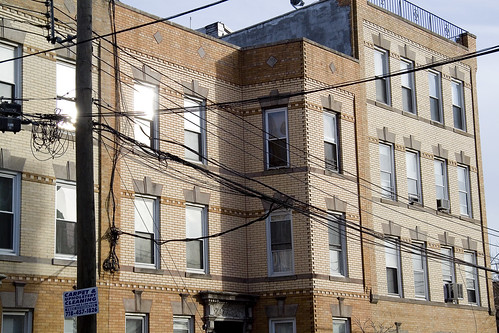
Matthews Houses – photo by Mitch Waxman
19th century businessmen were either merchant princes or robber barons, depending on your point of view. Both are accurate, but suffice to say that communities of labor would cluster around the industrialist, corollary industry would arise to support growing populations around the main mill, and even competitors would often locate in their vicinity to take advantage of locale and the skilled worker population. This is why you find financial, garment, and flower districts in Manhattan and its also why Astoria is visually distinct from the neighborhoods around it.
William Steinway was here, and his interests were larger than just pianos. Steinway was a primal force in digging the first Subway Tunnel from Queens to Manhattan (completed by Michael Degnon, of course), and was a major player in the Queens Trolley business. Wealthy, philanthropic, and well regarded by all reports- Steinway’s Piano mill pulled a population to it. Out on Staten Island, Balthazar Kreischer worked a somewhat coarser but technologically sophisticated operation that made… Bricks.
from boards.ancestry.com
…trying to find the descendants of Balthasar KREISCHER (3.13.1813-8.15.1886) of the Kreischer & Sons Brick Company of Staten Island, and interred in The Green-Wood Cemetery of Brooklyn, New York.
Descendants/Family include his 4 daughters Catherine KREISCHER-WEBER, Fredricka P. KREISCHER, Louisa Albertina KREISCHER-STEINWAY and Caroline L. KREISCHER-ELLIS and his 3 sons: Charles C. KREISCHER, Edward B. KREISCHER and George F. KREISCHER. Some Kreischers settled into Brooklyn.
Louisa Albertina KREISCHER-STEINWAY (d. 6.30.1926) married Albert STEINWAY (b. 6.10.1849- d. 5.14.1877), the youngest son of of Steinway & Sons Piano Mfgr. of Astoria, New York, and had 2 daughters: Henrietta Julia STEINWAY and Ella Frederica STEINWAY. Louisa, Albert and Frederick P. Kreischer are interred in the Steinway mausoleum in Green-Wood Cemetery of Brooklyn, NY.

Maspeth Matthews Houses – photo by Mitch Waxman
Both great men were successful and accepted, rich beyond avarice, and had children. Steinway’s son Albert married Kreischer’s daughter Louisa, connecting the two families in business and standing. Both men also had holdings and interests in the burgeoning railroad business, Kreischer an investor in the Vanderbilt’s Staten Island Railroad and Steinway a rail mogul in Queens. Many of these yellow brick homes, so typical of ancient Queens, lie along the route that trolley tracks once followed.
My supposition is that Kreischer received a family discount for moving his product around on Steinway’s rails, and use of Kreischer Brick in a new project bought some good will from the Steinways- known for their generous nature and political connections in New York, Newtown, and the upstart Long Island City with its scandalous political class.
This is theory, of course, but sounds kind of like the way things worked in 19th century New York when the “old boys” club ruled. Again- theory.
from astorialic.org
“It was reported on the street on Friday that Gleason had sold his railway interests to the Steinway syndicate for $275,000. It has been reported for a long time that the Gleason roads did not pay. The road up Borden Avenue to Calvary Cemetery [in Woodside] was not well patronized. There are not many people who go to Blissville [Sunnyside] unless it is to visit the dead. The Blissville people as a rule do not travel much and when they do they patronize the Greenpoint line in preference to Gleason’s, thus his exchequer has suffered, and again the cars to the cemetery are cold this winter, and the conductors lugubrious on account of the scarcity of pennies and passengers, and a traveler after a survey of one of the cars, is tempted to foot it in preference to riding in an open car, as they had to do on Christmas Day.”

St. Joseph’s RC Church, Grand 30th avenue, Astoria – photo by Mitch Waxman
Louisa’s brother Edward, it seems, met a tragic end.
Check out this page at thecabinet.com, which tells a detailed story of that Kreischer Mansion where Edward lost his life, which describes ghostly phenomena and the violent history experienced by those who have inhabited it since.
Also, don’t miss forgotten-ny’s page on the Steinways and Kreischer’s
Thus spake the Hermetic Hungarian…
Guest Blogger Hermetic Hungarian returns today, to discuss a curious institution found on the upper west side of Manhattan
The New York Buddhist Church and its statue of Shinran Shonin
The New York Buddhist Church, 331 – 332 Riverside Drive, is a Japanese “True Pure Land” (Japanese Jodoshinshu) Buddhist temple, founded in 1938.
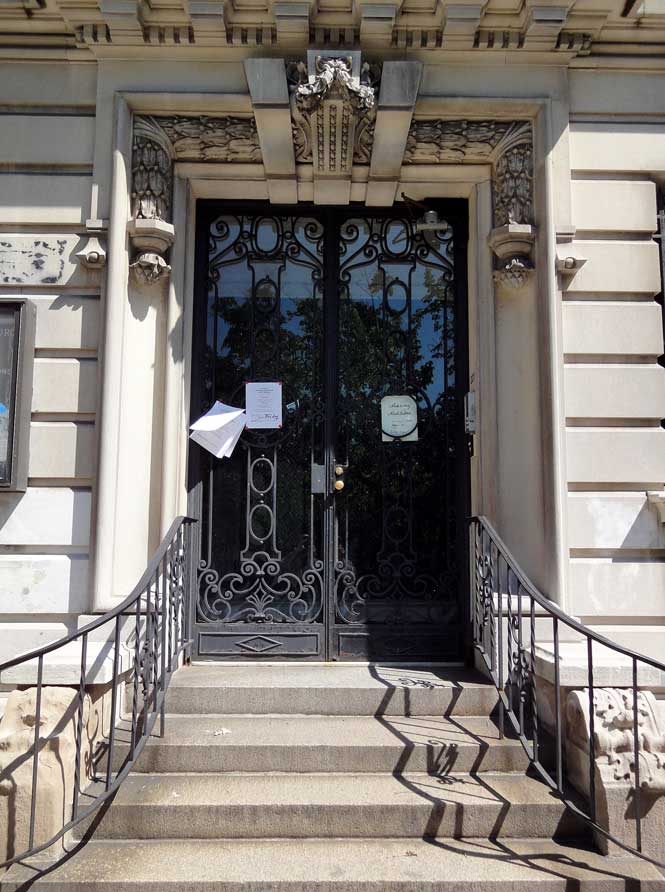
– photo by the Hermetic Hungarian
331 Riverside Drive, the main building, was formerly the Marion Davies House, built in 1902 in the Beaux Arts style by architects Janes & Leo. 332 Riverside Drive, the annex and social center, was built in 1963 in the then-popular International Style by architects Kelley & Gruzen.
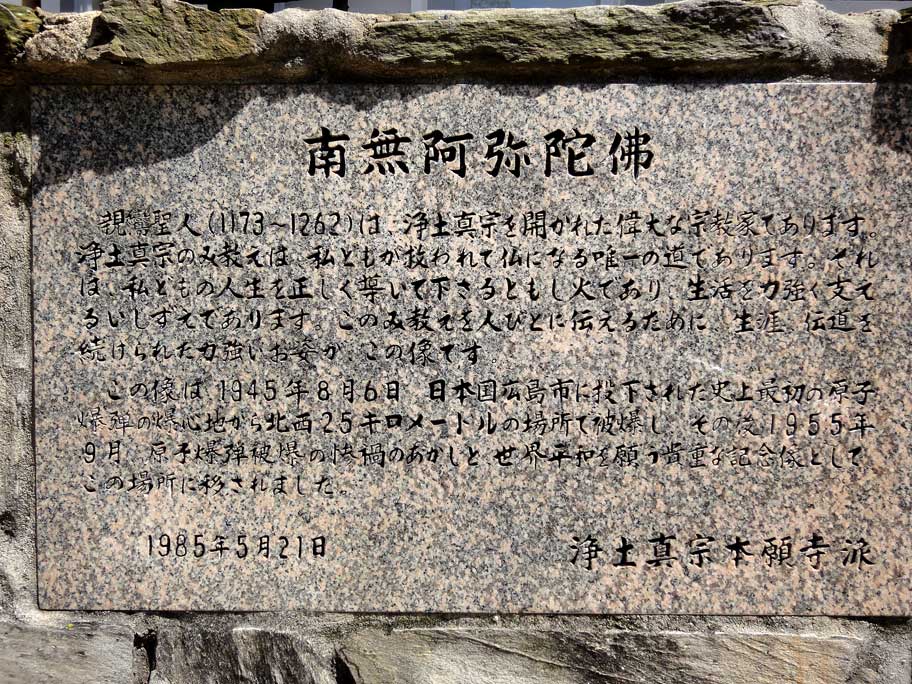
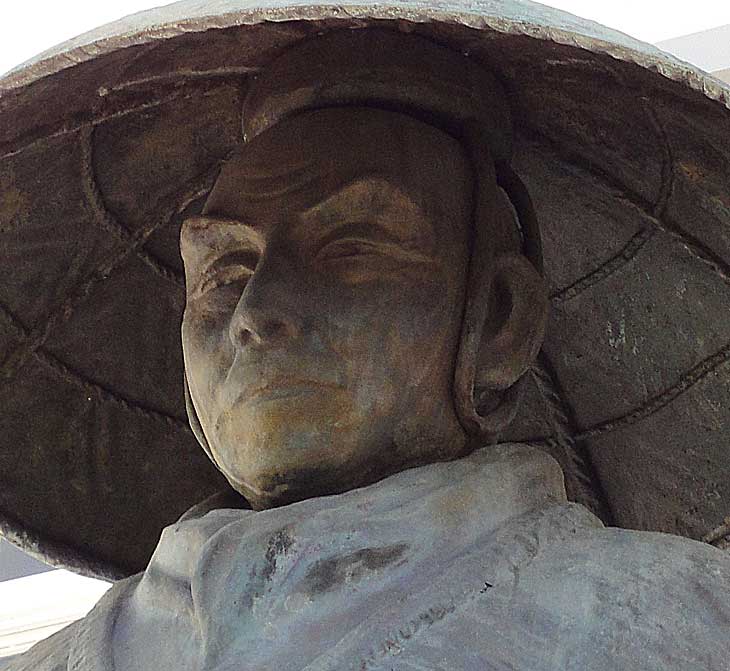
Standing in front of the annex, looking out across the Hudson River, is a tall bronze statue of Shinran Shonin (1173 – 1262), the founder of the Japanese True Pure Land school. Statues like this one grace the entrances of Pure Land Buddhist temples worldwide. However, this particular statue was originally in Hiroshima and survived the atomic bomb.
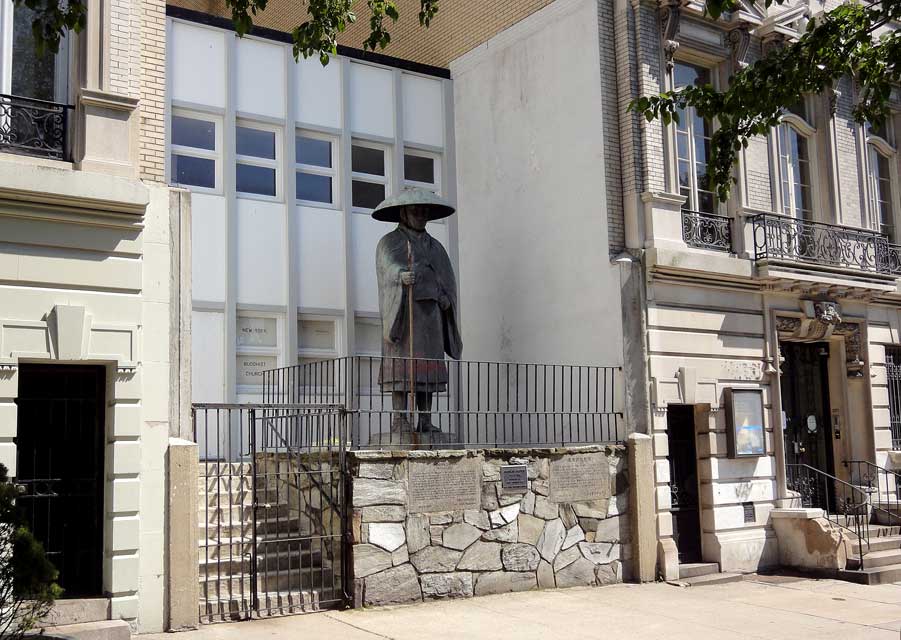
– photo by the Hermetic Hungarian
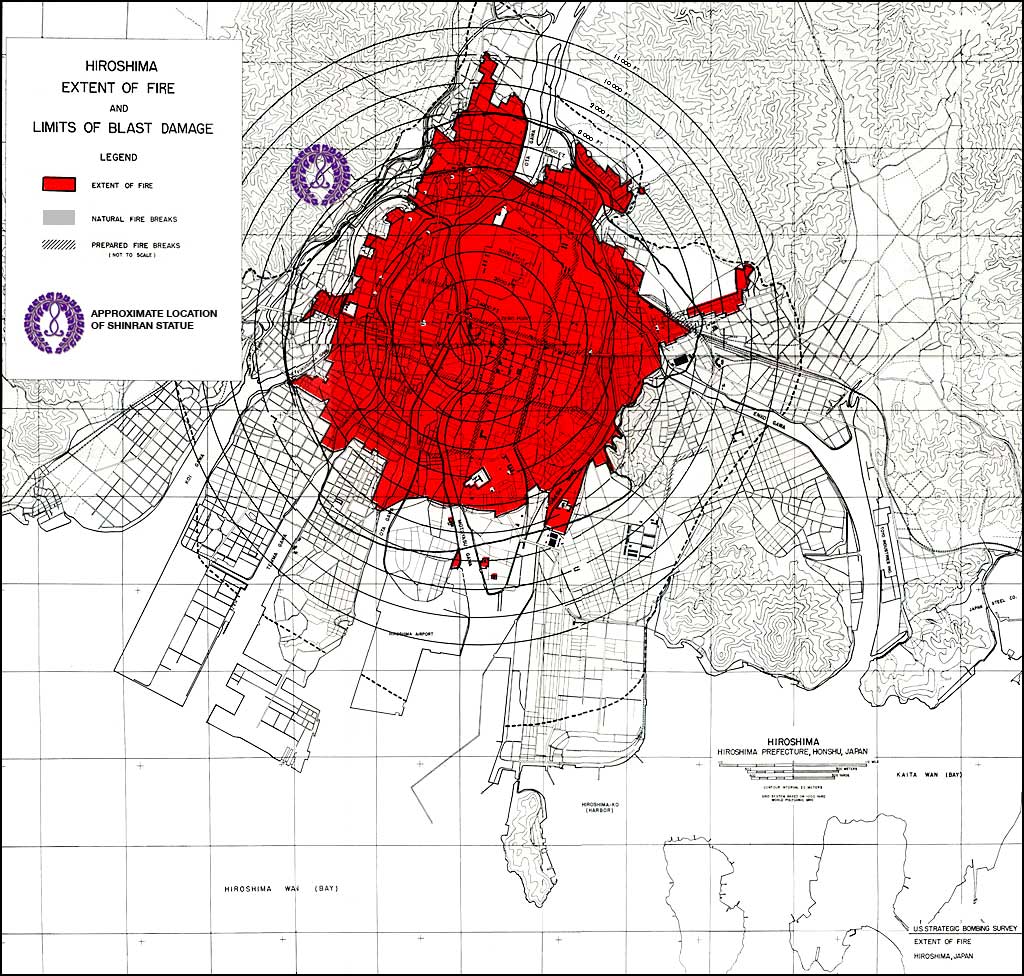
This statue originally stood about 8,000 feet from Hiroshima’s ground zero. It was one of the few cultural artifacts to survive the blast from that close distance. The statue was brought to the United States and installed in its its current location in 1955. Besides being a symbol of the founder of the Pure Land School, it is a reminder of both the terrible devastation wrought by atomic weapons and of fervent hopes for world peace.
Every August 5th at 7:15pm – corresponding to 8:15am August 6th, Hiroshima time — the temple bell is sounded, and the Buddhist and local communities gather around the statue, silently commemorating the Hiroshima bombing.
Shinran was born into a powerful Regent family in 1173. Shinran was inducted into the Imperial Court-sponsored Esoteric (Japanese Tendai ) Buddhist community. This esoteric school had been brought from China in the 8th century, and was a favorite among the nobility and educated classes. It was a complex, intellectual, esoteric, and demanding school which required difficult practices of its adherents. For 20 years Shinran tried without success to follow the practices. He became disillusioned, and wanted to leave the monastery to study a simpler Buddhism being taught in Kyoto.
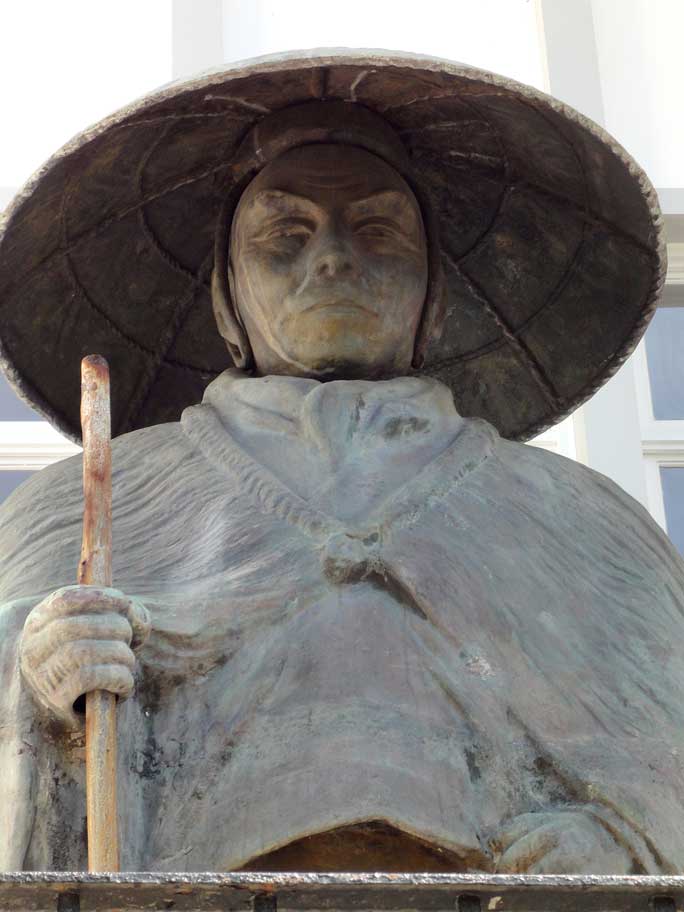
– photo by the Hermetic Hungarian
Because of his abandonment of the Court-supported school, Shinran was exiled to the provinces to live as a commoner, with farmers, merchants, fishermen, and artisans. Living away from the heady atmosphere of the monastery, Shinran soon realized that if he himself was unable to perform the difficult practices required by the Buddhist schools of the nobility, surely people with little education who were busy eking out a living from day to night had little chance of achieving enlightenment through the then-accepted means. He felt strongly that there must be another way – after all the Buddha’s original teaching was one of universal enlightenment.
Having studied with earlier teachers of Pure Land, Shinran was familiar with the teachings which detailed the Buddha Amida’s (Sanskrit Amitabha) vows not to become a fully enlightened Buddha until everyone who had relied upon him had become enlightened.
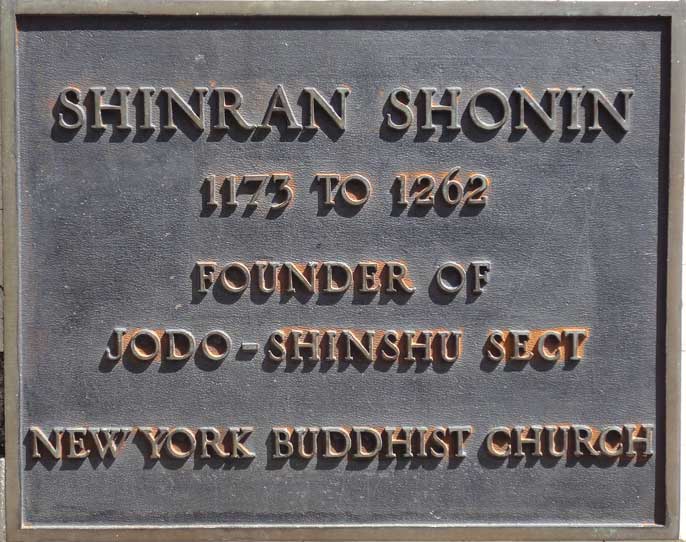
– photo by the Hermetic Hungarian
The primary practice of Pure Land Buddhists, whether Japanese, Chinese, Vietnamese, or Korean, is chanting the name of Amida Buddha. In Japanese the chant is “Namu Amida Butsu”, translated as “I humbly bow to Amida Buddha”.
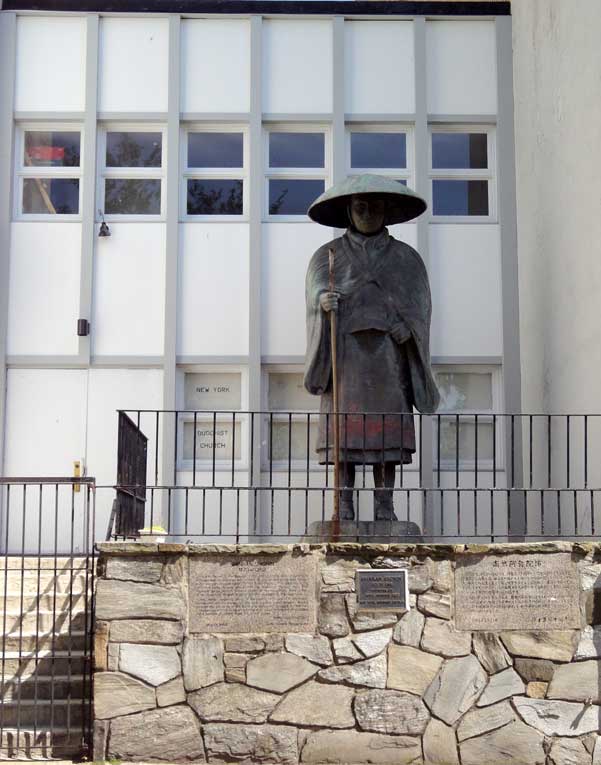
– photo by the Hermetic Hungarian
The external manifestation of this practice is that if one chants with sincerity and respect, asking for Amida Buddha’s help and guidance, then one will be reborn in the Pure Land in the West from which enlightenment is possible for ordinary people.
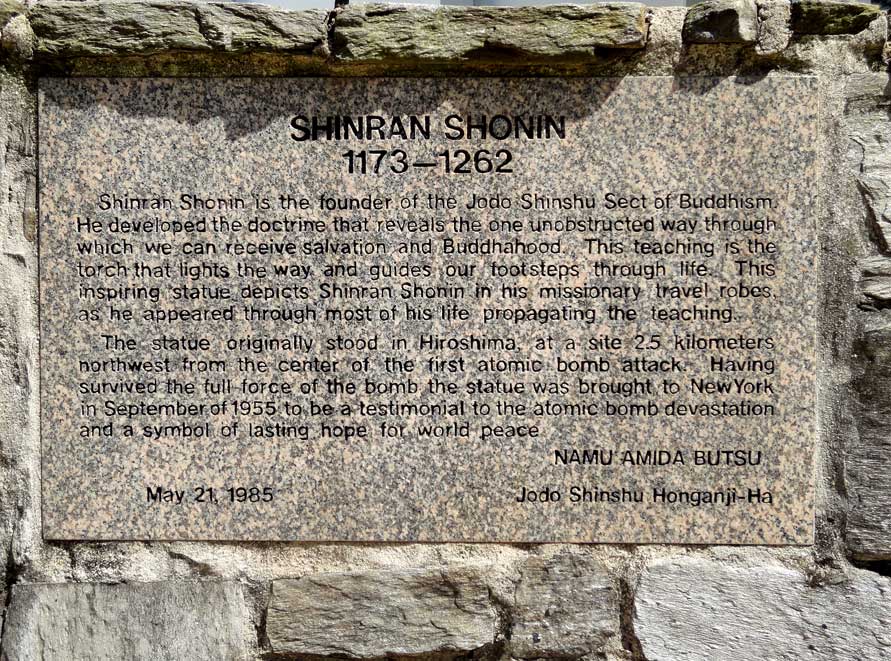
– photo by the Hermetic Hungarian
The corollary is that no matter how difficult and rigorous the practices undertaken in this life, it is almost impossible for ordinary people to transcend mundane existence. Pure Land practitioners place not just their faith but their hopes for eventual enlightenment in the hands of Amida Buddha.
– photo by the Hermetic Hungarian
The internal manifestation of Pure Land practice is that chanting name of Amida Buddha helps practitioners realize that the Pure Land is here and now, within ourselves. Faith in Amida Buddha awakens a deep spirituality, gratitude, and humility in the practitioner. This in turn allows the practitioner to live in the Pure Land while living in the world. And the physical act of chanting slowly leads the practitioner to inner calmness and fosters insight into true reality.
– photo by the Hermetic Hungarian
Pure Land Buddhism has the largest number of adherents of any Buddhist school in the world. In Japan alone there are over 10,000 Pure Land temples. Throughout China and Vietnam there are an unknown number of Pure Land temples, due to historic governmental suppression of religion; however, Pure Land is the largest Buddhist school in both countries. Pure Land has also greatly influenced Korean and Tibetan Buddhist practices. Buddhist practice is heterogenous, and different schools adapt each others’ practices when appropriate.
The members of the New York Buddhist Church, and their leader Rev. T. Kenjitsu Nakagaki, serve the Japanese community of Manhattan with Sunday services, Japanese dharma classes, and special events. They also warmly welcome welcome anyone seeking to understand more about Pure Land, offering services, classes, and discussions in English, hoping to embrace the wider community. They have been enthusiastically welcoming anyone interested for the last 72 years.
Madison Avenue Bridge Centennial

– photo by Mitch Waxman
The last of the bridge centennial parades was held on Wednesday, May 12, 2010. The Madison Avenue Bridge spans the Harlem River and connects Manhattan with the Bronx.
from wikipedia
The Madison Avenue Bridge crosses the Harlem River connecting Madison Avenue in Manhattan with East 138th Street in the Bronx in New York City. The bridge is operated and maintained by the New York City Department of Transportation. It was designed by Alfred P. Boller and built in 1910 to replace and double the capacity of another earlier swing bridge dating from 1884.

– photo by Mitch Waxman
It rained, at this parade.
from nycroads.com
The Madison Avenue Bridge, which today is maintained by the New York City Department of Transportation (NYCDOT), provides two lanes of eastbound and two lanes of westbound traffic between Manhattan and the Bronx. On the Bronx approach, the bridge directly connects to the Major Deegan Expressway (at EXIT 3). On the Manhattan approach, motorists must take side streets to connect to the Harlem River Drive. According to the NYCDOT, the bridge carries approximately 45,000 vehicles per day (AADT).

– photo by Mitch Waxman
American Bridge Company? That was J.P. Morgan, wasn’t it?
from wikipedia
The Harlem River is a navigable tidal strait in New York City, USA that flows 8 miles (13 km) between the Hudson River and the East River, separating the boroughs of Manhattan and the Bronx. Part of the current course of the Harlem River is the Harlem River Ship Canal, which runs somewhat south of the former course of the river, isolating a small portion of Manhattan (Marble Hill) on the Bronx side of the river.

– photo by Mitch Waxman
The indomitable DOT crew that provided electricity and made sure that tents were in place to shield the dignitaries and speakers from the weather. Notice their high visibility safety gear.
from wikipedia
The New York City Department of Transportation (NYCDOT or DOT) is responsible for the management of much of New York City’s transportation infrastructure. Janette Sadik-Khan is the current Commissioner of the Department of Transportation, and was appointed by Mayor Michael Bloomberg on April 27, 2007.
The department’s responsibilities include day-to-day maintenance of the city’s streets, highways, bridges and sidewalks. The Department of Transportation is also responsible for installing and maintaining the city’s street signs, traffic signals and street lights. The DOT supervises street resurfacing, pothole repair, parking meter installation and maintenance, and the management of a citywide network of municipal parking facilities. The DOT also operates the Staten Island Ferry.

– photo by Mitch Waxman
The bridge itself is a rather straightforward swing bridge, with trusses and box girders forming the superstructure for the busy roadway.
from wikipedia
Harlem stretches from the East River west to the Hudson River between 155th Street; where it meets Washington Heights—to a ragged border along the south. Central Harlem begins at 110th Street, at the northern boundary of Central Park; Spanish Harlem extends east Harlem’s boundaries south to 96th Street, while in the west it begins north of Upper West Side, which gives an irregular border west of Morningside Avenue. Harlem’s boundaries have changed over the years; as Ralph Ellison observed: “Wherever Negroes live uptown is considered Harlem.”

– photo by Mitch Waxman
Two young fellows opened a large box and revealed this cake. As soon as I saw it, I knew what must happen next, for I know a secret about politicians…
from wikipedia
Cake is a form of food that is usually sweet and often baked. Cakes normally combine some kind of flour, a sweetening agent (commonly sugar), a binding agent (generally egg, though gluten or starch are often used by lacto-vegetarians and vegans), fats (usually butter, shortening, or margarine, although a fruit purée such as applesauce is sometimes substituted to avoid using fat), a liquid (milk, water or fruit juice), flavors and some form of leavening agent (such as yeast or baking powder), though many cakes lack these ingredients and instead rely on air bubbles in the dough to expand and cause the cake to rise. Cake is often frosted with buttercream or marzipan, and finished with piped borders and crystallized fruit.

– photo by Mitch Waxman
All Politicians love cakes and cameras, and are magnetically attracted to them from wherever they may be in the city.
from wikipedia
To balance local authority along with the centralization of government, the Office of Borough President was established with a functional administrative role derived by having a vote on the New York City Board of Estimate, which was responsible for creating and approving the city’s budget and proposals for land use. The Board of Estimate consisted of the Mayor, the Comptroller and the President of the New York City Council, each of whom were elected citywide and had two votes, and the five Borough presidents, each having one vote.
In 1989, the Supreme Court of the United States, in Board of Estimate of City of New York v. Morris (489 U.S. 688) declared the New York City Board of Estimate unconstitutional on the grounds that the city’s most populous borough (Brooklyn) had no greater effective representation on the board than the city’s least populous borough (Staten Island), this arrangement being an unconstitutional violation of the Fourteenth Amendment’s Equal Protection Clause pursuant to the high court’s 1964 “one man, one vote” decision.
The city charter was revised in 1990 and the Board of Estimate was abolished. The Office of Borough President was retained but with greatly reduced power. The borough budget reverted to the mayor or the New York City Council. A Borough President has a small discretionary budget to spend on projects within the borough. The last significant power of the borough presidents — to appoint a member of the New York City Board of Education — was abolished, with the board, on June 30, 2002.
The two major remaining appointments of a Borough President are one member of the city Planning Commission and one member of the Panel for Educational Policy. Borough Presidents generally adopt specific projects to promote while in office; but, since 1990, Borough Presidents have been seen mainly as the ceremonial leaders of their boroughs. Officially, they advise the Mayor on issues relating to each borough, comment on all land-use items in their borough, advocate borough needs in the annual municipal budget process, appoint Community Boards, chair the Borough Boards, and serve as ex officio members of various boards and committees They generally act as advocates of their boroughs at the mayoral agencies, the city council, the New York State government, public corporations and private businesses.

– photo by Mitch Waxman
Borough President of Manhattan Scott Stringer arrived first, and seemed pleased with the confection.
from wikipedia
Scott Stringer (born 1960) is a New York Democratic politician and the current Borough President of Manhattan. His mother, Arlene Stringer-Cuevas, is a cousin of Bella Abzug and served on the New York City Council. Stringer grew up in the Washington Heights/Lower Inwood neighborhood of Upper Manhattan, attended Manhattan public schools and graduated from the John Jay College of Criminal Justice. In 1983, he became a legislative assistant to Assemblyman, and future Congressman, Jerrold Nadler. During these years, he supported Democratic candidates such as Governor Mario Cuomo. In 1992, Stringer ran for Nadler’s Assembly seat representing the Upper West Side when Nadler replaced deceased Congressman Ted Weiss.

– photo by Mitch Waxman
Bronx Borough President Ruben Diaz, Jr. arrived in a nearly simultaneous fashion, and the two exchanged pleasantries- while eyeing the pastry.
from wikipedia
Ruben Diaz, Jr. (born April 26, 1973) is a Democratic Party politician from the Bronx in New York City, and the son of New York State Senator Rubén Díaz.
Diaz became the Bronx Borough President in April 2009 after representing the 85th Assembly District in the New York State Assembly. When first elected in 1996 he became, at age 23, the youngest member of the New York State Legislature since Theodore Roosevelt.

– photo by Mitch Waxman
The two BP’s electrified the crowd of well wishers, reporters, and invited guests. Diaz also maintained a certain vigil on the cake.
from wikipedia
On February 18, 2009, U.S. President Barack Obama appointed Bronx Borough President Adolfo Carrión, Jr. to the position of Director of the White House Office on Urban Affairs.
When Mayor Michael Bloomberg declared a special election to choose his successor,[64] Diaz was considered the leading candidate for the position of Bronx Borough President.
The special election was held on April 21, 2009. Diaz defeated Republican Party candidate Anthony Ribustello by an overwhelming 87% of the vote, to become the 13th Borough President of the Bronx.
On July 1, 2009 Diaz appointed Delores Fernandez to the reconstituted New York City Board of Education. Fernandez is anticipated to be the sole member of the Board that will have a perspective independent of mayor Michael Bloomberg.
Diaz ended his first summer as borough president by recommending that the New York City Council reject Related Companies’ proposal to turn the Kingsbridge Armory into a shopping mall. In an editorial in the New York Daily News, Diaz wrote he is “fighting to make sure that this development includes ‘living wage’ jobs that offer health insurance.” Related’s proposal is still going through the city’s review process.

– photo by Mitch Waxman
The ceremonies began with the national anthem as sung by members of (I believe) the Choir Academy of Harlem.
from wikipedia
Samuel I. Schwartz, a.k.a. Gridlock Sam, is one of the leading transportation engineers in the United States, and is widely believed to be the man responsible for popularizing the phrase gridlock. Educated at Brooklyn College and the University of Pennsylvania, he originally worked as a cabbie. He eventually held the second-in-command post of Deputy Commissioner in New York City’s transportation department for many years and now operates as a private consultant. One of Gridlock Sam’s newest developments is that of a plan to enhance truck traffic along the Detroit-Windsor border. Today he gives advice in his own column in New York City’s Daily News. He answers questions by mail and alerts readers about traffic patterns.

– photo by Mitch Waxman
Master of ceremonies Sam Schwartz.
from gridlocksam.com
Some thirty-seven years ago I began my professional career as a New York City taxi driver. This provided basic training for maneuvering through the city’s streets. Though trained in science, I switched majors to transportation engineering in graduate school. I thought I would save the subways, but the Transit Authority wouldn’t offer me a job. I ended up as a junior engineer at the old Traffic Department.
Initially I worked developing neighborhood one-way plans but soon I was moved to “Special Projects”. John Lindsay was mayor and proposed many innovative and bold schemes to reduce traffic in Midtown. I spent a lot of time on these plans, working with an old-time traffic engineer named Roy Cottam. One day, Roy spoke of his fears if we closed the streets in the Theater District, the grid system would “lock-up” and all traffic would grind to a halt. Soon we simply juxtaposed the word, and the term gridlock was born.

– photo by Mitch Waxman
There was a general feeling of happiness, despite the wet and cold. Of course, we were all under the tent.
from nycbridges100.org
In the spring of 2007, a group of civic minded individuals realized that several of New York City’s bridges were approaching their 100th anniversary. In order to commemorate the significance of these magnificent spans and their role in making New York City the greatest metropolis in the world, the group formed the NYC Bridge Centennial Commission, a 501 (c) 3 corporation.
The aim of the Commission is to promote the 100th year anniversary of six historic New York City bridges, to educate the public about the bridges’ role in the life of the city, to encourage respect for the history of New York City; to heighten the public’s awareness of the City’s infrastructure and the need to maintain it; and to stimulate the interest of the public in celebrating the centennial of these six bridges.

– photo by Mitch Waxman
Out of nowhere, the Kevin C. Kane, NYFD Marine 6 appeared.
from limarc.org
Kevin C. Kane, N2MEI, was a New York City Firefighter, and a member of LI-MARC. Early on the morning of September 12, 1991, Kevin responded with Engine Com-pany 236 to a fire in at an abandoned apartment house in the East New York section of Brooklyn. Despite the knowledge that there might not be enough hose to reach all parts of the house, Kevin and his fellow firefighters entered the building in search of victims. Shortly thereafter, a section of burning ceiling fell on Kevin. Despite the frantic efforts of his colleagues, they were not able to reach him. Eventually he managed to jump from a window, into the bucket of a fire truck. Having been burned over most of his body, he died the next day. In his honor, The NYFD named a fireboat The Kevin C. Kane, and created the Kevin C. Kane Medal for bravery.

– photo by Mitch Waxman
The kids from the Harry S Truman High School band, and I mean all of them, were just jumping with personality and enthusiasm.
from wikipedia
Marching band is a sport consisting of a group of instrumental musicians and usually dance teams / color guard who generally perform outdoors and incorporate some type of marching (and possibly onto other movements) with their musical performance. Instrumentation typically includes brass, woodwinds, and percussion instruments. Most marching bands use some kind of uniform (often of a military style) that include the school or organization’s name or symbol, shakos, pith helmets, feather plumes, gloves, and sometimes gauntlets, sashes, and/or capes.

– photo by Mitch Waxman
Suddenly, all the spectators were looking south while I was looking west.
from wikipedia
Harry S. Truman High School is a public high school at 750 Baychester Avenue, in the Bronx, New York City, United States. The school is designated as an Empowerment School by the New York City Department of Education, which allows it more autonomy in choosing a curriculum.
Truman High School is one of the remaining large high schools in the Bronx that has not been broken up into a number of small schools. This trend which has been popular in the city has seen South Bronx High School, Evander Childs High School as well as Roosevelt High School split into a number of smaller schools that are still located in the same building.
Truman High is located in the Co-op City section of the Bronx, yet many of the students commute to school from areas as far away as the South Bronx.
The size of Truman High School (over 3000 students) does give it the benefit of having many sports programs and extracurricular activities.

– photo by Mitch Waxman
Marine 6 was starting its own performance.
from wikipedia
Types of Apparatus:
MARINE or Fireboat is a specialized boat outfitted specifically for firefighting capabilities. Its responsibilities include suppression of all fires that occur on water, such as boat fires, pier fires, etc. A Marine Unit also assists land based companies with securing a water supply, as they have the ability to “draft” water from the rivers they operate in.

– photo by Mitch Waxman
Red and blue colorant is added to two of the firehoses…
from wikipedia
The first bridge on this site was constructed by the New York and Harlem Railroad in 1841. It was composed of four 90-foot (27 m)-long box truss spans, three of which were fixed iron spans, while the remaining span was a wooden swing span. In the closed position, the bridge had a clearance of only seven feet above mean high water. Masonry piers supported the four box-truss spans.
In 1867, the wooden drawbridge was replaced with an iron one that gave a clearance of fifty feet. It was very busy. By the 1880s, the bridge was crossed by more than 200 trains a day.
The bridge was soon made obsolete by heavy traffic and dredging of the Harlem River Ship Canal. Alfred P. Boller worked with the railroad to create a new four-tracked swing bridge. The railroad and the city split the cost.
The new bridge was built in conjunction with the Army Corps of Engineers’ project to build the Harlem River Ship Canal. The Park Avenue railroad viaduct was also extended north of 115th Street at the same time. While the bridge was being built, a temporary bridge was built and the old span was demolished.
When the new bridge was finished, it had a 300-foot (91 m)-long steel truss span supported by masonry piers. The new span had a vertical clearance of 25 feet (7.6 m).

– photo by Mitch Waxman
… and a patriotic display is manufactured.
from nycroads.com
During the 1960’s and 1970’s, the Park Avenue Railroad Bridge passed through the hands of several financially ailing railroads, ranging from the New York, New Haven and Hartford Railroad to the Penn Central Railroad. Today, the lift span is operated by the MTA Metro-North passenger railroad.
Recently, the MTA Metro-North Railroad announced a $10 million project to rehabilitate the Park Avenue Railroad Bridge. The bridge control, power and lift systems are now beyond their useful life, and will not be replaced. Instead, the project will remove the moveable elements of the bridge (such as the wire rope and counterweight), and will rehabilitate the foundation. The MTA Metro-North Railroad currently is seeking approval from the U.S. Coast Guard to make this a fixed bridge in order to minimize the cost of rehabilitation.

– photo by Mitch Waxman
The announcement was made that the rest of the ceremony would be kicking off “Bronx Week”, so the entire crowd began to lurch toward the Bronx shoreline.
from wikipedia
In a marching band or a drum & bugle corps, the colorguard is a non-musical section that provides additional visual aspects to the performance. The marching band and colorguard performance generally takes place on a football field while the colorguard interprets the music that the marching band or drum & bugle corps is playing via the synchronized spinning of flags, sabres, rifles, or through dance. The color guard uses different colors and styles of flags to enhance the visual effect of the marching band as a whole. The number of members in a colorguard can vary- some only having a few members while others may have 41 or more. Within the band, colorguard is often referred to as flagline or simply guard.

– photo by Mitch Waxman
The Truman kids led the march off the Madison Avenue Bridge toward the Bronx side.
from wikipedia
The size and composition of a marching band can vary greatly. Some bands have fewer than twenty members, and some have over 500. American marching bands vary considerably in their instrumentation. Some bands omit some or all woodwinds, but it is not uncommon to see piccolos, flutes, clarinets, alto saxophones, and tenor saxophones. E♭ clarinets, alto clarinets, bass clarinets, and baritone saxophones are less common, but can be found in some bands. Bassoons and oboes are very seldom found on a field due to the risk of incidental damage, the impracticality of marching with an exposed double reed, and high sensitivity to weather.
The brass section usually includes trumpets or cornets, mellophones or E♭ alto horns (instead of horns), tenor trombones, baritone horns or euphoniums, and Tubas or sousaphones. E♭soprano cornets are sometimes used to supplement or replace the high woodwinds. Some especially large bands use flugelhorns and bass trombones.
Marching percussion (often referred to as the drumline, battery, or back battery) typically includes snare drums, tenor drums, bass drums, and cymbals and are responsible for keeping tempo for the band. All of these instruments have been adapted for mobile, outdoor use. Marching versions of the glockenspiel (bells), xylophone, and marimba are also rarely used by some ensembles. Historically, the percussion section also employed mounted timpani that featured manual controls.
For bands that include a front ensemble (also known as the pit or auxiliary percussion), stationary instrumentation may include orchestral percussion such as timpani, tambourines, maracas, cowbells, congas, wood blocks, marimbas, xylophones, bongos, vibraphones, timbales, claves, guiros, and chimes or tubular bells,concert bass drums, and gongs, as well as a multitude of auxiliary percussion equipment. Drum sets, purpose-built drum racks, and other mounted instruments are also placed here. Until the advent of the pit in the early 1980s, many of these instruments were actually carried on the field by marching percussionists by hand or on mounting brackets. Some bands also include electronic instruments such as synthesizers, electric guitars, and bass guitar, along with the requisite amplification. If double-reed or string instruments are used, they are usually placed here, but even this usage is very rare due to their relative fragility. Unusual percussive instruments are sometimes used, including brake drums, empty propane tanks, trashcans, railroad ties, stomping rigs, and other interesting sounds.

– photo by Mitch Waxman
Word went around that refreshments could be found, and other entertainments offered, upon our arrival in Deegan Rock Park.
from wikipedia
For parades, bands usually line up in a marching block composed of ranks (rows) and files (columns). Typically, each member tries to stay within his or her given rank and file, and to maintain even spacing with neighboring musicians. It is usually the responsibility of the people at the end of each rank and the front of each file to be in the correct location; this allows other band members to guide to them.
Band members also try to keep a constant pace or step size while marching in parade. This usually varies between 22 and 30 inches (56–76 cm) per stride. A step size of 22.5 inches is called 8-to-5 because the marcher covers five yards (about 4.6 m) in eight steps. A step size of 30 inches is called 6-to-5 because five yards are covered in six steps. Because yard lines on an American football field are five yards apart, exact 8-to-5 and 6-to-5 steps are most useful for field shows.
A drum cadence (sometimes called a walkbeat or street beat) is usually played when the band is marching, sometimes alternating with a song. This is how the band keeps time. Alternately, a drum click or rim shot may be given on the odd beats to keep the band in step. Between songs and cadences, a roll is usually given to indicate what beat in the measure the band is at. Cadence tempo varies from group to group, but is generally between 112 and 144 beats per minute.

– photo by Mitch Waxman
The band played on, as the crowd crossed safely over the flow of Harlem River.
from wikipedia
A musical instrument is constructed or used for the purpose of making the sounds of music. In principle, anything that produces sound can serve as a musical instrument. The history of musical instruments dates back to the beginnings of human culture. The academic study of musical instruments is called organology.
The date and origin of the first device of disputed status as a musical instrument dates back as far as 67,000 years old; artifacts commonly accepted to be early flutes date back as far as about 37,000 years old. However, most historians believe determining a specific time of musical instrument invention to be impossible due to the subjectivity of the definition.
Musical instruments developed independently in many populated regions of the world. However, contact among civilizations resulted in the rapid spread and adaptation of most instruments in places far from their origin. By the Middle Ages, instruments from Mesopotamia could be found in the Malay Archipelago and Europeans were playing instruments from North Africa. Development in the Americas occurred at a slower pace, but cultures of North, Central, and South America shared musical instruments.

– photo by Mitch Waxman
Apparently, the syncopated footsteps of marching bands cause bridge engineers no small amount of worry, but the sturdy old girl didn’t shake a bit.
from wikipedia
The Bronx is divided by the Bronx River into a hillier section in the west, closer to Manhattan, and the flatter East Bronx, closer to Long Island. The West Bronx was annexed to New York City (then largely confined to Manhattan) in 1874, and the areas east of the Bronx River in 1895. The Bronx first assumed a distinct legal identity when it became a borough of Greater New York in 1898. Bronx County, with the same boundaries as the borough, was separated from New York County (afterwards coextensive with the Borough of Manhattan) as of January 1, 1914. Although the Bronx is the third-most-densely-populated county in the U.S., about a quarter of its area is open space, including Woodlawn Cemetery, Van Cortlandt Park, Pelham Bay Park, the New York Botanical Garden and the Bronx Zoo in the borough’s north and center, on land deliberately reserved in the late 19th century as urban development progressed northwards and eastwards from Manhattan with the building of roads, bridges and railways.

– photo by Mitch Waxman
Word was that the cake had already been transported down to Deegan Rock Park, and somehow- Diaz knew it.
from wikipedia
In 1997, the Bronx was designated an All America City by the National Civic League, signifying its comeback from the decline of the 1970s. In 2006, The New York Times reported that “construction cranes have become the borough’s new visual metaphor, replacing the window decals of the 1980s in which pictures of potted plants and drawn curtains were placed in the windows of abandoned buildings.” The borough has experienced substantial new building construction since 2002. Between 2002 and June 2007, 33,687 new units of housing were built or were under way and $4.8 billion has been invested in new housing. In the first six months of 2007 alone total investment in new residential development was $965 million and 5,187 residential units were scheduled to be completed. Much of the new development is springing up in formerly vacant lots across the South Bronx.

– photo by Mitch Waxman
Other Bronx politicos also eagerly followed the charms of the baked goods.
from ilovethebronx.com
Saturday, May 15th through Sunday, May 23rd, 2010
Throughout Bronx Week, residents of the Bronx and visitors from the tri-state region come together to celebrate the people, places, history and businesses of the Bronx. Outdoor performances, trolley tours, health fairs, a salute to volunteers and business workshops are just some of the events in store.
The grand finale is on Sunday, May 23rd, when famous sons and daughters of the borough will return home for induction to the Bronx Walk of Fame on the Grand Concourse, followed by our annual Parade, Food & Art Festival and Concert on Mosholu Parkway.
Bronx Week is the ideal time to remind all New Yorkers that The Bronx is a great place to live, work and play. Don’t Miss The Fun!
For more information on fun Bronx Week events happening in our borough, check back with us using our Bronx Week Calendar page or call 718.590.BRONX

– photo by Mitch Waxman
The lady who was holding this sign was chided by your humble narrator for hiding her face. That was the Madison Avenue Bridge Centennial Parade.
from nypost.com
Bronx Week 2010 kicked off yesterday, May 12, but fear not — all you’ve missed so far was a press conference.
This year’s festive celebration of the borough will include 22 events in only 12 days and culminate in a busy, exciting Grand Finale on Sunday, May 23.
“This time we have organized even more events, while keeping the traditional ones, to celebrate the beauty, culture, talent and development of our neighborhoods,” said Borough President Ruben Diaz, Jr. “No Bronxite should stay home during these many days full of activities.”
Doris Quiñones, executive director of the Bronx Tourism Council, said that this year, for the first time, Bronx Week has been moved up one month earlier.
“We moved it from June to May to make it easier for schools to participate,” she said. “Eighty schools are already scheduled to march in the parade on Sunday, May 23.”
That day is the Grand Finale, which is the big culmination of Bronx Week. In addition to the parade, which starts at noon on Mosholu Parkway, that night will be the famous Bronx Ball, at which the borough’s best and brightest show up in formal attire to dance the night away. This year the ball is under a huge tent at Orchard Beach at 6 p.m. and, as in the past, will have a red carpet, Bronx high school cheerleaders, and will kick off when Borough President Diaz honors a special few.
NY Harbor 5/10/2010
Here’s what I saw on the May 10 Working Harbor Committee tour of NY Harbor, Kill Van Kull, and Port Elizabeth…
after cycles incalculable

– photo by Mitch Waxman
The Romans had one of their very practical holidays scheduled for this week of the year, a mostly forgotten rite called the Lemuralia.
from wikipedia
In Roman religion, the Lemuralia or Lemuria was a feast during which the ancient Romans performed rites to exorcise the malevolent and fearful ghosts of the dead from their homes. The unwholesome spectres of the restless dead, the lemures or larvae were propitiated with offerings of beans. On those days, the Vestals would prepare sacred mola salsa, a salted flour cake, from the first ears of wheat of the season.

– photo by Mitch Waxman
The notion of vengeful ghosts, whom the Romans would call- in hushed whispers- the Larvae is ancient and seems to be bred into the human specie.
Those who celebrated the Lemuralia, walked barefooted, washed their hands three times, and threw nine times black beans behind their backs, believing by this ceremony to secure themselves against the Lemures (Varro, Vita pop. Rom. Fragm. p241, ed. Bipont.; Servius, ad Aen. I.276).

– photo by Mitch Waxman
The Egyptians had their Khu, and China has the Hungry Ghosts, even the Inuit tradition carries a haunting cadre of supernormal entities.
from wikipedia
In Roman mythology, lemures (singular lemur) were shades or spirits of the restless or malignant dead, and are probably cognate with an extended sense of larvae (sing. larva = mask) as disturbing or frightening. Lemures is the more common literary term but even this is rare: it is used by Horace, and by Ovid in his Fasti. Lemures may represent the wandering and vengeful spirits of those not afforded proper burial, funeral rites or affectionate cult by the living: they are not attested by tomb or votive inscriptions. Ovid interprets them as vagrant, unsatiated and potentially vengeful di manes or di parentes (ancestral gods of the underworld). To him, the rites of their cult suggest an incomprehensibly archaic, quasi-magical and probably very ancient rural tradition. Much later, St. Augustine describes both the lemures and the larvae as evil and restless manes that torment and terrify the living: lares, on the other hand, are good manes.

– photo by Mitch Waxman
Of course, our life here in the Newtown Pentacle is defined by more mundane concepts and material realizations. The Larvae we experience in early May, like these enigmatic critters found near the Hunters Point Ave. Station on Skillman Avenue, are decidedly “normal” and also happen to be native New Yorkers.
Your humble narrator has stumbled before, but with extensive comparison to extant critter speciation via the google… I’m going to go out on a limb here and proclaim these squirming masses of endless hunger Malacosoma Americanum!!! That’s the Eastern Tent Caterpillar to you, Lords and Ladies!!!
and apologies for the “out on a limb” pun- couldn’t resist…
(and also, I could be totally wrong- but these guys look like Malacosoma Americanum to me- if you can confirm or deny, please leave a comment)
from wikipedia
The newly hatched caterpillars initiate the construction of a silk tent soon after emerging. They typically aggregate at the tent site for the whole of their larval life, expanding the tent each day to accommodate their increasing size. Under field conditions, the caterpillars feed three times each day, just before dawn, at mid-afternoon, and in the evening after sunset. During each bout of feeding the caterpillars emerge from the tent, add silk to the structure, move to distant feeding sites en masse, feed, then return immediately to the tent where they rest until the next activity period. The exception to this pattern occurs in the last instar when the caterpillars feed only at night. The caterpillars lay down pheromone trails to guide their movements between the tent and feeding sites. The insect has six larval instars. When fully grown, the caterpillars disperse and construct cocoons in protected places. The adult moths (imago) emerge about two weeks later. They are rather strictly nocturnal and start flying after nightfall, then possibly stop some hours before dawn. Mating and oviposition typically occur on the same day as the moths emerge from their cocoons; the females die soon thereafter.

– photo by Mitch Waxman
Positively raining down from the trees, vast chaotics of these crawlers were observed the other day trying to cross Skillman Avenue, heading eastward.
The Eastern Tent Caterpillar, Malacosoma americanum (Fabricius) is reported to have been present in the United States since the 1600’s, and is responsible for forming unsightly silk-webbed nests at branch forks. Their population peaks every 8 to 10 years, when large infestations can completely defoliate trees in late spring/early summer.

– photo by Mitch Waxman
Virtually impossible to find footing which did not render a horrible and crushing extermination, I nevertheless scuttled forth and picked my way amongst them. In the back of my mind, I wondered what evolutionary adaptations they might have developed to accommodate the environmental hostility of this section of Long Island City. There is a High School across the street, of course- surrounded by the tunnels, trains, highways, bridges, and the cemented reality of an area defined by the junction of the main waterway of the Newtown Creek with its bubbly tributary- the canalized Dutch Kills. Just a block away is the Empty Corridor.
from esf.edu
These caterpillars produce the conspicuous silken tents commonly seen in the spring on branches of favored host trees. The tents consist of numerous layers of dense silk webbing which contain much excrement and numerous molted skins.
The female moths are dull reddish-brown with a wing expanse of 1 1/2 to 2 inches. Males are smaller. The front wings of each are crossed by two whitish, oblique, parallel lines.
Mature larvae, or caterpillars, are 2 to 2 1/2 inches long. The head and body are generally deep black. There is a white stripe along the back of the body and a row of oval, pale blue spots on each side. There are many short, irregular brownish markings on the side of each body segment. Long, fine, brown hairs sparsely clothe the body.

– photo by Mitch Waxman
These wriggling americans were pursuing some unknown goal in the direction of that High School, and the actions of automotive traffic along Skillman Avenue upon their migration is a detail best left unheralded. Vast hatcheries of avian predators swirled above.
from nysipm.cornell.edu
Manual destruction of egg masses and tents is an excellent way to control populations. Be advised that the hairs on caterpillars may be irritating to skin.
Twigs encased by egg masses should be pruned out. Tents can also be pruned out or be destroyed by winding around a stick or with a strong jet of water (the best time to destroy tents is before caterpillars leave to feed). Do not attempt to burn tents as this can cause more harm than good.
Tent destruction has another benefit in that it exposes caterpillars to birds and other natural enemies which can help keep populations in check. Eastern tent caterpillars are parasitized by braconid, ichneumonid, and chalcid wasps.
Other control options are available: Bacillus thuringiensis var. kurstaki is useful in the early spring when applied to young larvae, as is insecticidal soap which should be used when caterpillars are out of tents and feeding on leaves. Take care to avoid applying soaps in unsuitable weather conditions (like hot temperatures) as this can lead to phytotoxicity and leaf damage.

– photo by Mitch Waxman
The univoltine holocaust playing out all around me forced me to rumination, a meditative practice whose purpose is to ward off the periodic moments of panic and fainting which have so afflicted me in the past. Feckless quisling and physical coward both, your humble narrator revels in heroic tales of the past, for the future is a paralysis of logical progressions and dire portent.
from wikipedia
The origin of the festival of All Saints celebrated in the West dates to May 13, 609 or 610, when Pope Boniface IV consecrated the Pantheon at Rome to the Blessed Virgin and all the martyrs; the feast of the dedicatio Sanctae Mariae ad Martyres has been celebrated at Rome ever since. The chosen day, May 13, was a pagan observation of great antiquity, the culmination of three days of the Feast of the Lemures, in which the malevolent and restless spirits of the dead were propitiated. Liturgiologists of the Middle Ages based the idea that this Lemuria festival was the origin of that of All Saints on their identical dates and on the similar theme of “all the dead”.
The feast of All Saints, on its current date, is traced to the foundation by Pope Gregory III (731–741) of an oratory in St. Peter’s for the relics “of the holy apostles and of all saints, martyrs and confessors, of all the just made perfect who are at rest throughout the world”, with the day moved to November 1.

– photo by Mitch Waxman
Negative thoughts, though, on a sunny warm day in the City of Greater New York will only attract attention to you. Best to throw open the psychic windows and air the mental house out, clean up and organize for the coming summer. Perhaps the Romans had something after all, the Lemuralia was always accompanied by a general cleaning of the home, a spring cleaning.
from wikipedia
On Sunday, 13 May 1917, ten year old Lúcia Santos and her younger cousins, siblings Jacinta and Francisco Marto, were tending sheep at a location known as the Cova da Iria near their home village of Fátima in Portugal. Lúcia described seeing a woman “brighter than the sun, shedding rays of light clearer and stronger than a crystal ball filled with the most sparkling water and pierced by the burning rays of the sun.” Further appearances are reported to have taken place on the thirteenth day of the month in June and July. In these, the woman exhorted the children to do penance and to make sacrifices to save sinners. The children subsequently wore tight cords around their waists to cause pain, abstained from drinking water on hot days, and performed other works of penance. Most importantly, Lúcia said that the lady had asked them to pray the rosary every day, repeating many times that the rosary was the key to personal and world peace. This had particular resonance since many Portuguese men, including relatives of the visionaries, were then fighting in World War I.
According to Lúcia’s account, in the course of her appearances, the woman confided to the children three secrets, now known as the Three Secrets of Fátima.

– photo by Mitch Waxman
The Lemures are always with us, after all, and they’ll always be back.
Have a good day on the 13th of May, eat something bad for you with someone you love- and fellows- wash your hands and throw some black beans around the neighborhood later. You never know.
I really have to recommend against walking bare footed, however.


 The Newtown Pentacle