Archive for June 2010
enchanting metamorphoses

– photo by Mitch Waxman
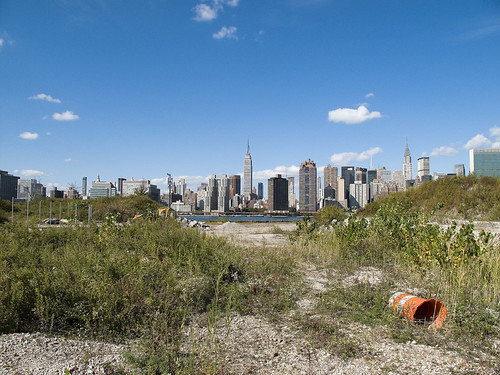
Recent announcements have heralded the formal beginnings of the process which will transmogrify the ancient Hunters Point section of Long Island City irrevocably. The support of overt interests of the Manhattan political elite have been made in public, and the financial and real estate folks are in line behind the project.
Behold, the future home of an estimated 11,000 people, imagine Tower Town.
from nyc.gov
More than 5,000 new apartments are anticipated to be constructed in the primary neighborhood character study area by 2017, including completion of the residential development at Queens West and many other mid-size residential buildings throughout the immediate area. Almost 11,000 new residents are expected in the primary study area as a result of this new construction activity.
As the primary study area (and the secondary study area, discussed below) becomes more densely developed, traffic and pedestrian volumes will increase noticeably from the current levels. Intersections throughout the area will be more congested in the morning, midday, and evening peak hours. The intersections that currently experience some congestion on Vernon Boulevard will be noticeably more congested, with some levels of service D and even LOS F, indicating high to unacceptable delays. In addition, other intersections along Vernon Boulevard in the primary study area will also have moderate to high congestion in the peak hours. On the east-west avenues in the area near the project sites (i.e., 48th, 49th, 50th, and 51st Avenues) traffic volumes are expected to increase slightly.
Pedestrian volumes will also increase in the future without the proposed actions, but sidewalks, corners, and crosswalks will generally continue to operate at acceptable levels. The crosswalk across Vernon Boulevard on the north side of 50th Avenue will, however, become noticeably congested during the morning peak hour, as people cross to enter the subway station there. This crosswalk will operate at LOS E, as will the subway stair closest to the corner (Stair S8). Buses serving the primary study area will also be noticeably more crowded.

– photo by Mitch Waxman
Direct sightlines of the heroic Manhattan skyline will be offered by these new high rise buildings, and soar over the starry old coastline that has known only industrial usage since the first Europeans arrived on the archipelago we know as New York. Its value for industry has long been exhausted, and today it is a brutal waste of land.
also from nyc.gov
The proposed actions would almost double the study area’s population. However, the proposed actions’ mix of affordable and market-rate housing could serve to relieve rather than increase residential market pressure in the study area. Additionally, given the very strong trend already in place in the neighborhood, the new population at Sites A and B would not be expected to introduce or accelerate a trend toward increased market rents in the study area that might cause significant indirect residential displacement. The redevelopment of Site B would introduce new residential uses to the Long Island City industrial area south of Borden Avenue. It is possible that the introduction of this residential use could lead to some limited indirect business displacement because of increased rent pressures. However, the potential for indirect displacement resulting from increased rent pressure is limited, and would not result in significant adverse indirect displacement impacts.

– photo by Mitch Waxman
The new development, a planned community with parks and schools, will extend far from the river- nearly all the way to the Pulaski Bridge with a basketball court and green space sited for the location of the old Vernon Avenue Bridge. The shining city of Queens, and a monument to a revolutionary and aggressive group of city planners, the story of Tower Town has begun.
also from nyc.gov
The Hunter’s Point South Rezoning and Related Actions would allow Site A and Site B to be redeveloped with largely residential buildings with building components ranging in height from
40 to 400 feet. Ground floors would include local retail, lobby, and community facility uses. On Site A, a network of new streets, sidewalks, and bikeways would be developed, creating seven new city blocks from the single 30-acre parcel it is today. Center Boulevard would be continued southward onto Site A and would connect to the rest of the street network. On Site B, it is anticipated that a new publicly accessible private road and open space would roughly bisect the site. The new residential buildings would vary in height, with bases ranging in height from 40 to 70 feet and high rise elements ranging in height from 250 to 400 feet. Nine towers would be developed on Site A, and four towers would be developed on Site B. Ground floors would be occupied by local retail and other commercial uses and community facility uses. A new public school would serve the residents of the buildings and the surrounding neighborhood and create a varied and active streetscape.
In addition, a new public waterfront park would be developed along the East River and Newtown Creek frontages of Site A and a shore public walkway would be developed along the Newtown Creek frontage of Site B. An additional linear public park would also be developed on the south side of 55th Avenue between Center Boulevard and 2nd Street, and a similar public open space would be developed on the south side of the publicly accessible private road on Parcel B, creating a wide boulevard on that street. The new waterfront parks and open spaces on Sites A and B along the East River and Newtown Creek waterfronts would provide greatly increased public access to waterfront views. Wide views of the waterfront and Manhattan would be available from locations throughout the park.
Overall, the proposed actions would change the character of Sites A and B from a commercial and industrial neighborhood to a residential neighborhood. This new residential neighborhood would incorporate retail and park uses that would attract visitors. On both Site A and Site B, pedestrian activity and vehicular activity would increase substantially over existing conditions.
– photo by Mitch Waxman
Tower Town is impossible to argue against, this real estate- former home to rail and ferry docks, and 19th century barge based casinos, and printing plants, and refineries, and power plants- is a blight on the city, and an uncomfortable reminder of that earlier time when brick strewn lots were not remarkable but common.
An economic boom in construction and real estate sales will come, when it is built. A new tax base of luxury and glamour will come to western Queens, and a wildfire of enhanced valuation will spur growth throughout surrounding riverine communities- further enhancing the economy and strengthening their own tax base- Dutch Kills first, then Astoria, and Greenpoint.
Tower Town at Hunters Point South, Atlantic Yards in Brooklyn, Flushing Commons, Willets Point, the Kosciuszko Bridge replacement.
All at once.
from “Air Quality In Queens County” at synapse-energy.com
In the interest of protecting the environment and public health of Northwest Queens, the Natural Resource Defense Council (NRDC) and the Citizens Helping Organize for a Klean Environment (CHOKE) participated in the New York State Article X permitting process for several new power plants proposed in Northwest Queens. One of their objectives was to have a study conducted to analyze the contributors to air pollution in Northwest Queens and to identify possible strategies for improving air quality and reducing risks to public health. As part of the Article X permitting process for its 250 MW Ravenswood Combined Cycle project, KeySpan committed to funding such a study as a community benefit. CHOKE and NRDC contracted with Synapse to conduct this study. The conclusions and recommendations are those of the authors but do not necessarily reflect the position of KeySpan.
One of the reasons that Queens County was chosen for this study is that it is home to many sources of air pollution. In the northwest corner of the county there currently are four large power plants, which together house 46 electric generating units. The county also contains an extensive transportation network that includes the Long Island Expressway, the Brooklyn Queens Expressway, the Grand Central Parkway, two highway bridges, a tunnel to Manhattan, and two airports, along with over 400 miles of arterial and local roads. Queens also has several large industries, and some 2.2 million residents, leading to significant economic activity which contributes to air quality problems.

– photo by Mitch Waxman
A small and insignificant scuttling thing who some might describe as a man, your humble narrator has spent a good deal of time wandering about the lonely industrial frontages of Hunters Point and expended some effort into learning its past. My opinion of this project is meaningless, it is a gathering thunderhead, and Manhattan is coming to Queens. There is just one thing that has been glossed over in mainstream reports about this place…
…this waterfront property…
from a Newtown Pentacle post of 6/7/2009
In 1697, a Dutch sea captain named Peter Praa bought the Bogardus properties and set up farming. He died in 1740, and the land was left to his granddaughter Anne Bennet. Her son, Jacob Diks, inherited next and he passed the land to his daughter- Anna Hunter. In 1817, Hunter, who had three sons, left the land to her children under the proviso that it be sold and the moneys divided evenly between them. This is why the “Mispat” became known as “Hunter’s Point”.

– photo by Mitch Waxman
For the water that promoters of this plan mention is the East River, not the water that has defined it throughout all recorded time.
from a Newtown Pentacle post of 2/28/10:
3.8 miles long, its mouth is directly opposite the Bellevue Psychiatric Hospital in Manhattan, and defines the currently undefended border between North Brooklyn and Western Queens. Estimates state that some 14 million gallons of combined sewage, storm runoff, and industrial waste provide the only flow of water into the Creek. It’s waters are opaque, and in the height of summer turn an unnatural shade of green.
The soft bottom of the waterway is 15-20 feet below the surface of the water, and the hard bottom is occluded by a gelatinous sediment known as “Black Mayonnaise”. Composed of petroleum residues, coal tar, PCB’s, and human excrement- it lies 15 feet thick on the bed. The oxygen content of the water drops precipitously as soon as one leaves the East River. The first of the drawbridges which cross it- known as the Pulaski Bridge, is the borderline beyond which immersion in this water is worthy of full HAZMAT gear and first responders institute biological decontamination procedures for anyone who finds themselves in it.
As I’ve mentioned in the past… the chemicals Putrescine (an organic chemical compound NH2(CH2)4NH2 (1,4-diaminobutane or butanediamine) and Cadaverine (a toxic diamine with the formula NH2(CH2)5NH2)which are produced by the rotting and putrefaction of animal flesh are abundantly found in the Newtown Creek under industrial aliases like Acrylonitrile and are prominent members on the EPA’s list of Volatile Organic Compounds– or VOC’s..
Who can guess, what it is, that may be buried down there?

– photo by Mitch Waxman
Tower Town, you see, will be built along the Creek as well…
…the Newtown Creek…
from epa.gov
“Newtown Creek is one of the most grossly-contaminated waterways in the country,” said Acting Regional Administrator George Pavlou. “By listing the creek, EPA can focus on doing the extensive sampling needed to figure out the best way to address the contamination and see the work through.”
EPA responded to requests by members of Congress to evaluate specific sites along the creek by publishing a September 2007 report that contained a review of past work and recommendations regarding future work at Newtown Creek. The state of New York referred the site to EPA due to the complex nature of the contamination along the creek.
Newtown Creek is part of the core area of the New York-New Jersey Harbor Estuary, which has been designated by EPA as an “estuary of national significance.” Despite the ongoing pollution problems, some residents currently use the creek for recreational purposes such as kayaking, while others catch fish for consumption out of it. Various sediment and surface water samples have been taken along the creek and reveal the presence of pesticides, metals, PCBs, and volatile organic compounds (VOCs), which are potentially harmful contaminants that can easily evaporate into the air.
In the mid -1800s, the area adjacent to the 3.8-mile Newtown Creek was one of the busiest hubs of industrial activity in New York City. More than 50 industrial facilities were located along its banks, including oil refineries, petrochemical plants, fertilizer and glue factories, sawmills, and lumber and coal yards. The creek was crowded with commercial vessels, including large boats bringing in raw materials and fuel and taking out oil, chemicals and metals. In addition to the industrial pollution that resulted from all of this activity, the city began dumping raw sewage directly into the water in 1856. During World War II, the creek was one of the busiest ports in the nation. Some factories and facilities still operate along it, and various adjacent contaminated sites have contributed to its contamination. Today, as a result of its industrial history, including countless spills, Newtown Creek is badly polluted.
exhalted beyond thought

– photo by Mitch Waxman
Police methods are varied, and ingenious.
The NYPD Harbor patrol, staffed by fierce and dedicated mariners, has become quite modern of late. Recently noticed, but in their use for some time, was this Defender class boat patrolling the malign waters of the 21st century. The military variant of this watercraft carries an esoteric catalog of weapons and electronics, but the civilian police version shares only a love for speed and adept maneuvering with it’s Coast Guard cousins, and is not equipped with the high caliber machine gun on its prow.
from safeboats.com
The Defender class comes standard with full cabin to protect the crew from weather and an independent forced air diesel heater, both of which provide the crew with the maximum amount of comfort and minimal fatigue. The Defender has the direct benefit of years of evolutionary USCG Non Standard boat history to maximize its operational availability. Just one sea trial will prove that the Defender Class is unmatched in performance, work ability, fit, finish and quality.

– photo by Mitch Waxman
Vigilant, notice that the officer noticed me taking his picture, which will be apparent if you click through to the larger incarnations of the image found at Flickr. The boat appeared to slice through waves, and it’s general appearance was that of a predator, silvery quick and able to strike at any time it chose. Comic book metaphors ring out, and if outfitted with large wing shaped hydrofoils and a certain insignia, this could very well be the Batboat of the late 1970’s come to life.
from wikipedia
The importance of the container shipping industry is equally matched by its vulnerabilities to terrorist attack. The U.S. maritime system consists of over 300 sea and river ports with more than 3,700 cargo and passenger terminals. The United States and global economies depend on commercial shipping as the most reliable, cost efficient method of transporting goods, with U.S. ports handling approximately 20% of the maritime trade worldwide. The volume of trade throughout the U.S. and the world creates a desirable target for terrorist attack. An attack on any aspect of the maritime system, mainly major ports, can severely hamper trade and potentially affect the global economy by billions of dollars. The security of ports and their deficiencies are numerous and leave our ports vulnerable to terrorist attack. The vulnerabilities of our ports are many, leading to potential security breaches in almost all aspects of the container shipping industry. With the sheer volume of maritime traffic, there is serious concern of cargo/passenger ship hijackings and pirate attack, as well as accountability of the millions of shipping containers transported worldwide. Given the overwhelming number of ships and containers, there are many areas of concern regarding the security of U.S. ports.

– photo by Mitch Waxman
The Harbor Unit sped off, and as it did, I noticed the quick moving harbor pilot launch America nearby. Luckily, I was fairly close to America earlier in the trip, and got a couple of OK shots of a very capable boat. Incidentally, I’ve recently been exposed to a maritime truism that helps to distinguish when to call a water craft “boat” or “ship”. A “ship” can carry and launch a boat, not the other way around.
from uscg.mil
Developed in a direct response to the need for additional Homeland Security assets in the wake of the September 11th terrorist attacks, the Defender Class boats were procured under an emergency acquisition authority. With a contract for up to 700 standard response boats, the Defender Class acquisition is one of the largest boat buys of its type in the world. The 100 boat Defender A Class (RB-HS) fleet began arriving at units in MAY 2002 and continued through AUG 2003. After several configuration changes, most notably a longer cabin and shock mitigating rear seats, the Defender B Class (RB-S) boats were born. This fleet was first delivered to the field in OCT 2003, and there are currently 357 RB-S boats in operation.
The 457 Defender Class boats currently in operation are assigned to the Coast Guards Maritime Safety and Security Teams (MSST), Maritime Security Response Team (MSRT), Marine Safety Units (MSU), and Small Boat Stations throughout the Coast Guard. With an overall length of 25 feet, two 225 horsepower outboard engines, unique turning radius, and gun mounts boat forward and aft, the Defender Class boats are the ultimate waterborne assets for conducting fast and high speed maneuvering tactics in a small deployable package. This is evidenced in the fact that several Defender Class boats are already in operation by other Homeland Security Department agencies as well as foreign military services for their homeland security missions.

– photo by Mitch Waxman
This is the Sandy Hook Pilots Launch Boat “America”. Like her namesake, she’s a tough cookie that can move very quickly, but works way too hard.
from state.nj.us
All pilot vessels are maintained to a high standard, and are equipped with state of the art electronic navigation and communications equipment. All motor boats are equipped with rescue equipment, including a “Life Sling” and davit for man overboard retrieval operations. Pilot boats must operate under severe weather and sea conditions. The hull material of the pilot boats is audio-gauged regularly, and steel/aluminum plating is serviced and/or renewed when required. In general, Planned Maintenance (“PM”) procedures and Service Life Extension Program (“SLEP”) work have prolonged the in-service usage of floating equipment used in the State pilotage system, in many cases well beyond its originally intended design life.
The newest addition to the fleet, the Yankee, a 53 foot aluminum, twin screw pilot launch is stationed at the Sandy Hook pilot base in Staten Island. It is used as part of a fleet of four similar launches at the entrance of the port, and sometimes as a shuttle craft from the base to/from sea.
The fleet of four similar launches – America, Wanderer, Phantom, and Yankee allow a maintenance schedule to exist to address the substantial wear and tear on the boats throughout the year. One boat is always at sea – two others ready to go – one under maintenance.

– photo by Mitch Waxman
Tumultuous, storm prone, and crowded- NY Harbor is an estuarine environment of cross currents and drowned hazards. The archipelago itself must be protected at all costs, lest an out of control cargo ship or barge stray too close to a bridge or waterfront condominium. Experts on the intricate interplay of aquatic course and geographic knowledge, the Sandy Hook Pilots remain redoubtable.
from sandyhookpilots.com
The history of the Sandy Hook Pilots begins in 1694 when the population of New York City was under 3,000. In those days, the harbors of the Northeast were the commercial arteries of the New World. It soon became apparent that the aid to vessels entering and departing the port was necessary, and the Colonial Assembly commissioned a small group of local seamen to assist the ship masters as pilots. This port would eventually become one of the greatest commercial centers of the world.
Double-crested Cormorant, I presume?

– photo by Mitch Waxman
A common sight on the East River and other NY waterways are the diving antics of Cormorants. Breeding colonies of them can be found at several locations- notably U Thant and South Brother Islands. Your humble narrator, amongst other inadequacies, is no expert on ornithology but a bit of research has led me to believe that this is a juvenile Double Crested Cormorant.
from wikipedia
The Double-crested Cormorant (Phalacrocorax auritus) is a member of the cormorant family of seabirds. It occurs along inland waterways as well as in coastal areas, and is widely distributed across North America, from the Aleutian Islands in Alaska down to Florida and Mexico. Measuring 70–90 cm (28–35 in) in length, it is an all-black bird which gains a small double crest of black and white feathers in breeding season. It has a bare patch of orange-yellow facial skin. Five subspecies are recognized.
The Double-crested Cormorant is found near rivers, lakes and along the coastline. It mainly eats fish and hunts by swimming and diving. Its feathers, like those of all cormorants, are not waterproof and it must spend time drying them out after spending time in the water. Once threatened by use of DDT, the numbers of this bird have increased markedly in recent years.

– photo by Mitch Waxman
A diver, the Cormorant feeds on invertebrates like crabs, or vertebrates like fish, and frogs. It swallows its prey head first, after flipping the unfortunate critter into the air. It is said that there is a specie of cormorant which is trained by both Chinese and Japanese fishermen, who affix a metal ring about the captive bird’s neck to discourage swallowing, to accomplish their industry. Apparently, this is a global phenomena.
from heraldryclipart.com
In England, according to Willoughby, they were hoodwinked in the manner of the “Falcons”, ’til they were let off to fish, and a leather thong was tied round the lower part of their necks, preventing them from swallowing the fish. Whitlock tells us “that he had a cast of them manned like Hawks, which would come to hand.” He took much pleasure in them, and relates that the best he had was one presented to him by Mr Wood, Master of the Cormorants to Charles I. (Thomas Bewick’s British Birds-1826). The Cormorants have been used as symbols of nobility, indulgence, and in more modern times a totem for fishermen and a bountiful catch.

– photo by Mitch Waxman
When the Cormorant goes into one of it’s dives, it might go as deep as 25 feet and be underwater for as long as a minute. This particular specimen was diving at Hells Gate, on the East River. One marvels at the idea of training a Cormorant to carry some sort of low light camera to the shattered bottom of Hells Gate, with its current swept carpet of wrecked ships dating back to Dutch times.
from web1.audubon.org
The Double-crested Cormorant is the most numerous and widespread North American cormorant. This large, dark waterbird is the only cormorant that occurs in large numbers inland, near fresh water, as well as on the coast. Cormorants (from the Latin for “sea crow”) are often seen floating low in the water, neck and bill raised, or perching upright near water to dry their outstretched wings.
strange prayers

– photo by Mitch Waxman
For the first post on this curious altar- “City of Marble and Beryl”, in Astoria’s St. Michael’s Cemetery – click here
For the second post on this curious altar- “Effulgent Valleys“, in Astoria’s St. Michael’s Cemetery – click here
for a link to a google map, showing the location as recorded by GPS, click here
As the moon waxes to full, anticipation has found a home in the heart of your humble narrator, for the ritual site in St. Michael’s beckons. These shots are from May 28, 2010, one day after the full moon- which is referred to as the “hare’s moon” by antiquarians and occultists alike.
As is usual, the photographs are “forensic in nature”, and reveal the scene exactly as found and in situ, and nothing was manipulated or even touched.
from wikipedia
It is traditional to assign special names to each full moon of the year, although the rule for determining which name will be assigned has changed over time (e.g., the blue moon). An ancient method of assigning names is based upon seasons and quarters of the year. For instance, the Egg Moon (the full moon before Easter) would be the first moon after March 21, and the Lenten Moon would be the last moon on or before March 21. Modern practice, however, is to assign the traditional names based on the Gregorian calendar month in which the full moon falls. This method frequently results in the same name as the older method would, and is far more convenient to use.
The following table gives the traditional English names for each month’s full moon, the names given by Algonquian peoples in the northern and eastern United States, other common names, and Hindu and Sinhala names.[9] Note that purnima or pornima is Sanskrit for full moon, which has also become the Malay word for full moon purnama. Full moon days are sacred according to Buddhist tradition and called Poya in Sinhala, the dominant language of the Buddhist majority of Sri Lanka.

– photo by Mitch Waxman
The big question, of course, is “how are the folks who are working this ritual site getting in?”. St. Michael’s is quite secure, surrounded by corporate office parks and highways and locked tight behind stout fences. Well, not so stout, as a little exploration of the border fences showed several apertures and obvious breaches. I guess if someone wants to, they’re going to get in.
from wikipedia
The monthly cycle of the moon, in contrast to the annual cycle of the sun’s path, has been implicitly linked to women’s menstrual cycles by many cultures, as evident in the links between the words for menstruation and for moon in many resultant languages. Many of the most well-known mythologies feature female lunar deities, such as the Greek goddesses Selene and Phoebe and their Olympian successor Artemis, their Roman equivalents Luna and Diana, Isis of the Egyptians, or the Thracian Bendis. These cultures also almost invariably featured a male Sun god.
Male lunar gods are also frequent, such as Nanna or Sin of the Mesopotamians, Mani of the Germanic tribes, the Japanese god Tsukuyomi, Rahko of Finns and Tecciztecatl of the Aztecs. These cultures usually featured female Sun goddesses.
The bull was lunar in Mesopotamia (its horns representing the crescent). See Bull (mythology) and compare Hubal. In the Hellenistic-Roman rites of Mithras, the bull is prominent, with astral significance, but with no explicit connection to the moon.
Also of significance is that many ancient pagan religions and societies are orientated chronologically by the Moon as opposed to the sun. One common example is Hinduism in which the word Chandra means Moon and has religious significance particularly during the Hindu festival Karwa-Chouth.
The moon is also worshipped in witchcraft, both in its modern form, and in Medieval times, for example, in the cult of Madonna Oriente.

– photo by Mitch Waxman
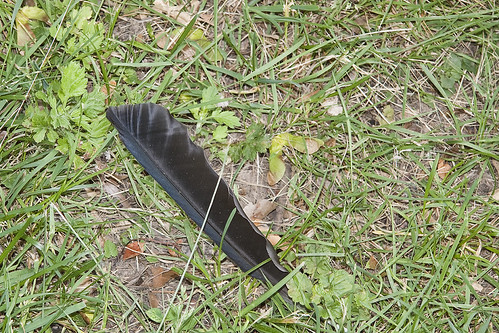
This time around, the feathers scattered around were black, and completed rather than shredded. The quills were also still attached.
from wikipedia
Madonna Oriente or Signora Oriente (Lady of the East), also known as La Signora del Gioco (The Lady of the Game), are names of an alleged religious figure, as described by two Italian women who were executed by the Inquisition in 1390 as witches.
The story which they are reported to have told is an elaborate and fantastical tale of occult religious rituals practised at the houses of wealthy individuals in Milan, Italy, where a woman known as the Madonna Oriente, possibly regarded as a goddess by her followers, performed magical acts such as the resurrection of slaughtered animals.
The two women, Sibilla Zanni and Pierina de’ Bugatis, were brought before the Inquisition first in 1384, and with their story apparently dismissed as fantasy, were sentenced only to minor penance. When they were investigated again in 1390, however, they were charged with consorting with the Devil, condemned, and executed.
While there is no evidence that the organized group described by the women actually existed, their testimonies are remarkably similar to those of several other groups in Italy and greater Europe, such as the followers of Richella and ‘the wise Sibillia’ in 15th century Northern Italy, the Benandanti of 16th and 17th century Northern Italy, the Armiers of the Pyrenees, the Romanian Căluşari, Livonian werewolves, Dalmatian kresniki, Hungarian táltos and Caucasian burkudzauta.
– photo by Mitch Waxman
The last batch of feathers observed were white, and suggested plucking. These were large and dark in color. I shot off the camera flash on the above shot, in the hope that certain ornithological enthusiasts known to be Newtown Pentacle readers might hazard an attempt at classification.
from wikipedia
The pregnancy of Coatlicue, the maternal Earth deity, made her other children embarrassed, including her oldest daughter, Coyolxauhqui. As she swept the temple, a few hummingbird feathers fell into her bosom. Coatlicue’s fetus, Huitzilopochtli, sprang from her womb in full war armor and killed Coyolxauhqui, along with her 400 brothers and sisters. He cut off her limbs, then tossed her head into the sky where it became the moon, so that his mother would be comforted in seeing her daughter in the sky every night.

– photo by Mitch Waxman
The main ritual focal remains the same, but candles and offerings have been altered from previous months. The candles are red and purple, and there are two cigars.
from wikipedia
Moon magic is the belief that working rituals at the time of different phases of the moon can bring about physical or psychological change or transformation. These rituals have historically occurred on or around the full moon and to a lesser extent the new moon. Such practices are common amongst adherents of neopagan and witchcraft systems such as Wicca. Witches in Greek and Roman literature, particularly those from Thessaly, were regularly accused of “drawing down the moon” by use of a magic spell. The trick serves to demonstrate their powers (Virgil Eclogues 8.69), to perform a love spell (Suetonius Tiberius 1.8.21) or to extract a magical juice from the moon (Apuleius Metamorphoses 1.3.1). These beliefs would seem to be consistent with many other cultures traditions, for instance; casting of the i ching is often done during the full moon’s apex.

– photo by Mitch Waxman
One cigar is approximately in the same position as the last one was, on April 30th.
this link from wikipedia actually refers to Santeria, which is not what I think we’re seeing here, but the spirit of it is correct
“The colonial period from the standpoint of African slaves may be defined as a time of perseverance. Their world quickly changed. Tribal kings and families, politicians, business and community leaders all were enslaved in a foreign region of the world. Religious leaders, their descendants, and the faithful, were now slaves. Colonial laws criminalize their religion. They were forced to become baptized and worship a god their ancestors had not known who was surrounded by a pantheon of saints. The early concerns during this period seem to indicate a need for individual survival under harsh plantation conditions. A sense of hope was sustaining the internal essence of what today is called Santería, a misnomer for the indigenous religion of the Lukumi people of Nigeria.
“In the heart of their homeland, they had a complex political and social order. They were a sedentary hoe farming cultural group with specialized labor. Their religion based on the worship of nature was renamed and documented by their masters. Santería, a pejorative term that characterizes deviant Catholic forms of worshiping saints, has become a common name for the religion. The term santero(a) is used to describe a priest or priestess replacing the traditional term Olorisha as an extension of the deities. The orishas became known as the saints in image of the Catholic pantheon.” (Ernesto Pichardo, CLBA, Santería in Contemporary Cuba: The individual life and condition of the priesthood)
As mentioned, in order to preserve their authentic ancestral and traditional beliefs, the Lukumi people had no choice but to disguise their orishas as Catholic saints. When the Roman Catholic slave owners observed Africans celebrating a Saint’s Day, they were generally unaware that the slaves were actually worshiping their sacred orishas. In Cuba today, the terms “saint” and “orisha” are sometimes used interchangeably.

– photo by Mitch Waxman
The second was inserted into the “Gran Poder” red candle.
from wikipedia
A classic Quimbanda ritual, called a trabalho, consists of several parts: a motive, dedication to a spirit, a marginal location, the metal or clay (earthy) material, an alcoholic drink, scent, and food (usually a peppered flour-palm oil mixture, sometimes called miamiami). An example of a trabalho is as follows:
Trabalho 1: ” A work of great force, under the protection of [Exu] Tranca Ruas das Almas (Block-Streets-of-the-Souls), to eliminate an enemy. “
- Go to a crossroads of Exu on a Monday or Friday near midnight, if possible in the company of a member of the opposite sex;
- greet Ogum with a bottle of light beer, a white or red candle, and a lighted cigar;
- greet Exu Sir Block-Streets-of-the-Souls by opening seven bottles of rum (cachaga) in the form of a circle, lighting seven red and black candles, and offering seven cigars;
- put inside a vase (alguidar) and mix the following: manioc flour (farinha da mesa), palm oil (azeitede-dendd), and peppers;
- put on the ground in the middle of the circle the name of the person whom one wishes to hurt, and, using a knife, stab this with violence, asking Exu to attend to one’s request.”
Depending on the purpose of the ritual, aspects of the trabalho will change. For instance, if one desires to seek justice from Exu they will use white candles, rum and a written request. Therefore, certain colors denote different motives in a ritual: white symbolizing an honest and justice-bound motive and red and black representing an aggressive and illicit motive. Other rituals substitute the harsh or spicy smell of cigars for the sweet smell of carnations, thus symbolizing the transformation between harming and helping rituals. Likewise, rituals involving female spirits (Pomba Giras) are less aggressive in their performance. A trabalho to obtain a woman is as follows:
Trabalho 7: “to obtain a woman. “
On a Monday or Friday night, go to a female crossroads (T-shaped rather than plus-shaped) and greet Pomba Gira by pouring a little rum, ” or better yet, champagne or anisette (aniz)”;
- place two pieces of cloth (pano) on the ground, one red and the other black, and on top of this put five or seven red roses in the shape of a horseshoe;
- fill a cup of good quality with champagne or aniz;
- put the name of the desired person in the cup or in the middle of the horseshoe;
- sing a ponto (song) and thank Pomba Gira.

– photo by Mitch Waxman
The purple candle had melted out, its wax incorporating into the loam.

– photo by Mitch Waxman
On the other side of the hill, flies were buzzing about this tumbled stone. There seemed to be some kind of carbonized “stuff” on it, almost a greasy smear of ash.
Crimes typically associated with ritual violence include: trespassing, vandalism, church desecration, theft, graffiti, arson, extortion, suicide, kidnapping, ritual abuse, animal sacrifice, and ritual murder. Trespassing related to ritualistic crime usually involves persons entering private areas such as woods, barns, and abandoned buildings for the purpose of having an isolated place to worship. Since most occult theologies are nature based, rituals are frequently held outdoors and altars are often constructed of natural elements. Vandalism most often associated with occult crime includes cemetery and church desecration. The most common types of cemetery desecration attributed to occult groups are digging up graves, grave robbing, and tampering with human corpses or skeletons. This is frequently motivated by religious beliefs that require human bones to fulfill specific rituals. Church desecration frequently includes destroying Bibles, urinating and defecating on holy objects and furniture, tearing crucifixes off walls, and destroying rosaries and crucifixes. It is important to note that the motivations behind such vandalism can also be attributed to hate crimes. Thefts from Christian churches, Jewish synagogues, hospitals, morgues, medical schools, and funeral homes are often linked with ritual violence. Items that are most often taken include cadavers, skeletal remains, blood, and religious artifacts that are considered sacred: crucifixes, communion wafers, wine, chalices, and so on. Frequent motivations for these thefts are that particular groups require actual holy artifacts or human organs, bones, and the like for their rituals.

– photo by Mitch Waxman
The material on its surface was vegetable in nature, but it was stuck to something whose adhesive qualities were strong enough to resist strong breezes and attract a number of largish black and green flies.
from nypost.com
Two of Queens’ largest parks are hotbeds for animal sacrifices, according to park rangers and advocates.
Longtime Parks Department ranger Joe Puleo told The Post that killing animals for ritualistic reasons in the city is widespread, but that Forest Park and Highland Park are the most common locations.
Perpetrators of the outlawed act are rarely busted because they perform their bloody rituals in the dead of night, and the two parks no longer have 24-hour patrols due to budget cuts.
“They are never caught, because they are careful, and they never do it during the day. They do it at night when no one is around,” Puleo said.

– photo by Mitch Waxman
Lords and Ladies of Newtown, there is a hidden cult at work amongst you, amongst the moon shadowed tomb legions of Astoria.
from Hells Gate, loosed upon the world

– photo by Mitch Waxman
The Friday of memorial day weekend, your humble narrator stumbled into the wilds of Astoria, headed for Astoria Park. Astoria Park is at the western end of Queens, and adjoins the East River, hosting parts of both the mighty Triboro Bridge and the sublime exemplar of bridge engineering called Hellgate. Named for the section of the East River it crosses, Hellgate was my intended destination and subject, and I was hoping for some visually interesting rail traffic to be crossing the great bridge. Frustrated by a gray and humid day, the Acela and other Amtrak traffic was observed, as well as a curious CSX double engine. Then…
from nycgovparks.org
Astoria Park, on the west shore of Queens, extends from south of the Triborough Bridge to north of the Hell Gate Bridge. With a panoramic view of the skyscrapers of midtown Manhattan in the south to the Hell Gate channel in the north, the scenery presents the diverse landscape of New York City. The Hell Gate channel, formed by faults deep underground, contains some of the deepest water in New York Harbor. Its treacherous reefs bear picturesque names such as “Hen and Chickens,” “Pot Rock,” “Bread & Cheese,” and “Bald Headed Billy.”
Throughout the centuries the stunning natural beauty of this location has attracted visitors and settlers. Before the arrival of European colonists, a trail passed by the site, and an Indian village flourished at Pot Cove. Local inhabitants grew maize on the shores, fished in Hell Gate, and drew water from Linden Brook, a small stream that still flows under Astoria Park South. In the mid-1600s the Dutch parceled out this land to various owners, including William Hallet whose grant embraced hundreds of acres. During the American Revolution, several British and Hessian regiments were stationed in the area. On November 25, 1780 the frigate Hussar and its five-million-dollar cargo sank to the bottom of Hell Gate, where despite some removal of cannons, the treasure still remains.

– photo by Mitch Waxman
I’ve become pretty familiar with NY Harbor in the last year, and can identify some of the common types of ships that cross its waters. Every now and then, however, a mysterious craft- an unidentified floating object or UFO if you will- crosses in front of me. Proceeding south, this catamaran (actually a trimaran) was nearly devoid of markings- which is remarkable in itself- and moving at a tremendous clip. Its “colorway” and hull shape instantly said “military” to me, but I could not recognize its specie.
from wikipedia
The first trimarans were built by indigenous Polynesians almost 4,000 years ago, and much of the current terminology is inherited from them. Multihull sailboats (catamarans and trimarans) gained favor during the 1960s and 1970s. Modern recreational trimarans are rooted in the same homebuilt tradition as other multihulls but there are also a number of production models on the market. A number of trimarans in the 19–36-foot lengths (5.8–11 m) have been designed over the last 30 years to be accommodated on a road trailer. These include the original Farrier – Corsair folding trimarans – and original John Westell swing-wing folding trimaran (using the same folding system later adopted also on Quorning Dragonfly) and like trimarans. Many sailboat designers have also designed demountable trimarans that are able to be trailered (like the SeaCart 30 by Oceanlake Marine).
The trimaran design is also becoming more widespread as a passenger ferry. In 2005 the 127-metre trimaran (417 ft) Benchijigua Express was delivered by Austal to Spanish ferry operator Fred. Olsen, S.A. for service in the Canary Islands. Capable of carrying 1,280 passengers and 340 cars, or equivalents, at speeds up to 40 knots, this boat was the longest aluminum ship in the world at the time of delivery. The trimaran concept has also been considered for modern warships. The RV Triton was commissioned by British defence contractor QinetiQ in 2000. In October 2005, the United States Navy commissioned for evaluation the construction of a General Dynamics Littoral Combat Ship (LCS) trimaran designed and built by Austal.

– photo by Mitch Waxman
Evocative, as on one hand it resembled a radar dodging stealth aircraft for the odd angles and aerodynamic shape, on the other it suggested a modern combat tank with its armor designed to deflect rather than defeat ballistic weapons.
The ship, nevertheless, was kicking up a huge wake and was shooting water behind it- some 10-20 feet high- as it rocketed down the East River.
from wikipedia
The littoral zone refers to that part of a sea, lake or river that is close to the shore. In coastal environments the littoral zone extends from the high water mark, which is rarely inundated, to shoreline areas that are permanently submerged. It always includes this intertidal zone and is often used to mean the same as the intertidal zone. However, the meaning of “littoral zone” can extend well beyond the intertidal zone.
There is no single definition. What is regarded as the full extent of the littoral zone, and the way the littoral zone is divided into subregions, varies in different contexts (lakes and rivers have their own definitions). The use of the term also varies from one part of the world to another, and between different disciplines. For example, military commanders speak of the littoral in ways that are quite different from marine biologists.
The adjacency of water gives a number of distinctive characteristics to littoral regions. The erosive power of water results in particular types of landforms, such as sand dunes, and estuaries. The natural movement of the littoral along the coast is called the littoral drift. Biologically, the ready availability of water enables a greater variety of plant and animal life, and the additional local humidity due to evaporation usually creates a microclimate supporting unique types of organisms.
The word “littoral” is used both as a noun and an adjective. It derives from the Latin noun litus, litoris, meaning “shore”. (The doubled ‘t’ is a late medieval innovation and the word is sometimes seen in the more classical-looking spelling ‘litoral’.)

– photo by Mitch Waxman
The “colorway” and camouflage of the craft suggested that the futurists of Britain still have modern adherents, long after the last of the “dazzle ships” were launched.
For those of you not in the know, the Dazzle Ships were an experiment in “breaking up the shape” of large combat vessels against the horizon, an attempt to reduce the visual profile of capital ships and reduce the ability of submariners to target vital areas of said ships. Dazzle works best at distance, which is what modern naval combat is all about.
from wikipedia
At first glance Dazzle seems unlikely camouflage, drawing attention to the ship rather than hiding it, but this technique was developed after the Allied Navies were unable to develop effective means to disguise ships in all weather.
Dazzle did not conceal the ship but made it difficult for the enemy to estimate its type, size, speed and heading. The idea was to disrupt the visual rangefinders used for naval artillery. Its purpose was confusion rather than concealment. An observer would find it difficult to know exactly whether the stern or the bow is in view; and it would be equally difficult to estimate whether the observed vessel is moving towards or away from the observer’s position.
Rangefinders were based on the co-incidence principle with an optical mechanism, operated by a human to compute the range. The operator adjusted the mechanism until two half-images of the target lined up in a complete picture. Dazzle was intended to make that hard because clashing patterns looked abnormal even when the two halves were aligned. This became more important when submarine periscopes included similar rangefinders. As an additional feature, the dazzle pattern usually included a false bow wave to make estimation of the ship’s speed difficult.

– photo by Mitch Waxman
As mentioned, my computer was down for the holiday weekend, but Our Lady of the Pentacle allowed me to use her laptop and I managed to get a few of these images out to that clandestine and anonymous network of maritime enthusiasts and quasi governmental experts who advise, comment, or offer corrections to your Newtown Pentacle. Credit for identifying this craft goes out to them, and I wish that they would allow me to sing praise publicly, but certain conflicts of interest or oaths of secrecy demand that they must always be referred to as “anonymous sources”. In this case, the ultimate sources will be referred to as Daidalos and Icaros (hey, it is Astoria Park).
from wikipedia
It is in images, not in texts that Daedalus is seen with wings; many Greek myths appear to have been invented to make sense of known but inexplicable images. The most familiar literary telling explaining Daedalus’ wings is a late one, that of Ovid: in his Metamorphoses (VIII:183-235) Daedalus was shut up in a tower to prevent his knowledge of his Labyrinth from spreading to the public. He could not leave Crete by sea, as the king kept strict watch on all vessels, permitting none to sail without being carefully searched. Since Minos controlled the land and sea routes, Daedalus set to work to fabricate wings for himself and his young son Icarus. He tied feathers together, from smallest to largest so as to form an increasing surface. The larger ones he secured with thread and the smaller with wax, and gave the whole a gentle curvature like the wings of a bird. When the work was done, the artist, waving his wings, found himself buoyed upward and hung suspended, poising himself on the beaten air. He next equipped his son in the same manner, and taught him how to fly. When both were prepared for flight, Daedalus warned Icarus not to fly too high, because the heat of the sun would melt the wax, nor too low, because the sea foam would soak the feathers.

– photo by Mitch Waxman
Daidalos was actually stumped when the photos arrived, and neither of us could make any sense of the only marking- a string of tiny numbers on the hull- of this unidentified floating object. High flying, Icaros received the shots from the latter, and contacted high ranking members of a certain governmental entity. This entity- let’s just say that they have lots of boats and planes, and boats that are airports, and boats that carry nuclear missiles and stay underwater for months at a time, and a lot of the people who work for it wear white dress uniforms– claimed the ship as theirs!
from wikipedia
From the time of its inception, the military played a decisive role in the history of the United States. A sense of national unity and identity was forged out of the victorious Barbary Wars, as well as the War of 1812. Even so, the Founders were suspicious of a permanent military force and not until the outbreak of World War II did a large standing army become officially established.
The National Security Act of 1947, adopted following World War II and during the onset of the Cold War, created the modern U.S. military framework; the Act merged previously Cabinet-level Department of War and the Department of the Navy into the National Military Establishment (renamed the Department of Defense in 1949), headed by the Secretary of Defense; and created the Department of the Air Force and National Security Council.
The U.S. military is one of the largest militaries in terms of number of personnel. It draws its manpower from a large pool of volunteers; although conscription has been used in the past in various times of both war and peace, it has not been used since 1972. As of 2010, the United States spends about $692 billion annually to fund its military forces, constituting approximately 43 percent of world military expenditures. The U.S. armed forces as a whole possess large quantities of advanced and powerful equipment, which gives them significant capabilities in both defense and power projection.

– photo by Mitch Waxman
What you have just seen, lords and ladies, shooting down the East River at high speed was described as a (JHSV) Joint High Speed Vessel.
A JHSV can comfortably carry 300 fully armed MARINES, or up to 600 in a pinch. Alternatively, it can move multiple main battle tanks- the astounding M1 Abrams. Just so you understand, 600 is near the low end of Battalion strength, and 600 U.S. Marines could probably claim a beachhead in Hell itself if they were asked to. It also has a landing pad for a helicoptor.
This ship is huge… but a helicoptor pad?
from navy.mil
Description
The JHSV program is procuring high-speed transport vessels for the Army and the Navy. These vessels will be used for fast intra-theater transportation of troops, military vehicles and equipment. The JHSV program merges the previous Army Theater Support Vessel (TSV) and the Navy High Speed Connector (HSC), taking advantage of the inherent commonality between the two programs.
JHSV will be capable of transporting 600 short tons 1,200 nautical miles at an average speed of 35 knots. The ships will be capable of operating in shallow-draft ports and waterways, interfacing with roll-on/roll-off discharge facilities, and on/off-loading a combat-loaded Abrams Main Battle Tank (M1A2). Other joint requirements include an aviation flight deck to support day and night air vehicle launch and recovery operations.
JHSV is a commercial-design, non-combatant transport vessel, and does not require the development of any new technology. JHSV is being built to American Bureau of Shipping (ABS) High Speed Naval Craft Guide. Systems onboard will be based on commercial ABS steel vessel rules. As such, it does not require the survivability and ability to sustain damage like the LCS. It has no combat system capability and no ability to support or use LCS mission modules. It will leverage non-developmental or commercial technology that is modified to suit military applications. Select military features include Aviation; Command, Control, Communications, Computers, and (Military) Intelligence; and Firefighting for the Mission Bay. NVR does not apply to any part of JHSV.
As a non-combatant sealift ship, the Navy variant of JHSV will be crewed by civilian mariners, either employed by or under contract to the Navy’s Military Sealift Command. U.S. Army vessels will be crewed by Army craft masters. Both versions will require a crew of approximately 22-40 people, but will have airline style seating for more than 300 embarked forces and fixed berthing for approximately 100 more.
However… This is not a JHSV!!!
This here is the M80 Stiletto.

– photo by Mitch Waxman
Check out this video at youtube which explains the Stiletto’s potential in great detail, and supplies 3D animation for operational scenarios.
With the formal roll-out of the 88-foot Stiletto stealth ship and its cutting-edge “M-Hull” wave-damping design, that legacy takes another step forward. The Stiletto is part of Project WolfPac, which aims to test new concepts of shallow-water and riverine warfare organized around swarms of smaller, affordable ships linked by communications. The Stiletto can slip into shallow waters, launching inflatable boats and even UAVs while serving as a communications hub via its “electronic keel.” Best of all, the M-Hull significantly reduces the pounding its occupants take from waves – poundings that often result in back injuries that cut careers short, or leave sailors with lingering disabilities in later life.
and from wikipedia
The 88-foot (27 m) long vessel has a notable hull design, an M-shaped hull that provides a stable yet fast platform for mounting electronic surveillance equipment or weapons, or for conducting special operations. The hull design does not require foils or lifting devices to achieve a smooth ride at high speeds in rough conditions. Its shallow draft means the M80 Stiletto can operate in littoral and riverine environments and potentially allows for beach landings.
The M80 Stiletto is equipped with four Caterpillar, Inc. C32 1232 kW (1652 HP) engines yielding a top speed in excess of 50 knots (90 km/h) and a range of 500 nautical miles (900 km) when fully loaded. It can be outfitted with jet drives for shallow water operations and beaching.
It has a topside flight deck for launching and retrieving UAVs and a rear ramp that can launch and recover an 11-meter rigid-hull inflatable boat (RIB) or Autonomous Underwater Vehicle (AUV).
It weighs 45 tons unloaded, light enough that it can be hoisted onto a cargo ship, while still able to carry up to 20 tons of cargo in the 1,996 square feet (200 m2) of usable interior space. The ship is 88.6 feet (27.0 m) in length, with a width of 40 feet (12 m) and a height of 18.5 feet (5.6 m), yet has a draft of only 2.5 feet (0.8 m).
The M80 Stiletto is the largest U.S. naval vessel built using carbon-fiber composite and epoxy building techniques, which yields a very light but strong hull. The prototype M80 Stiletto is expected to be in use in less than one year. Ships are expected to cost between $6 and $10 million


 The Newtown Pentacle