Archive for 2010
passive inconspicuousness

– photo by Mitch Waxman
Walking down the Bowery one evening, crossing Delancey. This was recently the heart of darkness in New York, a mere 20 years ago, a desolation row of flop houses and addiction. It is stunning to see its modern incarnation, sitting at the end of the Williamsburgh financial corridor.
from wikipedia
Delancey Street is one of the main thoroughfares of Manhattan’s Lower East Side, running east from the Bowery to connect to the Williamsburg Bridge to Brooklyn. It is an eight-lane, median divided street.
Businesses range from delis to check-cashing stores to bars. Delancey Street has long been known for its discount and bargain clothing stores. Famous establishments include the Bowery Ballroom, built in 1929, Ratner’s kosher restaurant (now closed), and the Essex Street Market, which was built by Mayor Fiorello La Guardia to avoid pushcart congestion on the neighborhood’s narrow streets. As the Lower East Side becomes gentrified, more upscale retail and nightlife establishments have moved in.
Delancey Street is named after James De Lancey, Sr., whose farm was located in what is now the Lower East Side.
A little experiment…

– photo by Mitch Waxman
As you may have noticed, lords and ladies, your humble narrator has been struggling with deadlines and various other problems for the last couple of months which has resulted in a rather less than daily schedule here at your Newtown Pentacle. Part of the reason that postings have become somewhat sporadic is the enormous amount of research that goes into a 1-3 thousand word posting illustrated with photos. Fear not, long winded exposition is not going out of style around these parts, but I’m going to be experimenting a little bit with the format in the next few weeks- bear with me.
The first thing you’ll notice will be that rather than abbreviate the posting schedule- I’m going to be accelerate it. You very well might want to subscribe to the RSS feed for the next several weeks, as there will be multiple posts per day. There will still be the mega posts, and anything newsworthy will get the “full treatment”, but I’m going to bombard you with shorter postings for a bit.
My reasoning is twofold, first- it’s the time of year when I need to be outside, wandering the Newtown Pentacle itself and photographing its subtle implications. The shorter posts will allow me a little more freedom of movement, as they are simpler to accomplish and the photographic assets are extant- second- well… I’ll tell you that one in a little while…
Let me know what you think… Next post will be in a few hours.
subtly vibrant

– photo by Mitch Waxman
Having travelled to the unknown shores of New York’s borough of the Bronx for the recent Madison Avenue Bridge Centennial event, the municipality being a foreign territory to your humble narrator, one of my companions suggested we take advantage of circumstance and head over to the Oak Point Yard and see if anything interesting was happening there. Excitement was had when your humble narrator’s ignorance was punctured as to where the crossing of the Hell Gate Bridge leads to.
from wikipedia
The Oak Point Yard is a freight railroad yard located in the South Bronx, New York City. The yard is owned by CSX Transportation, but is used by CP Rail, New York and Atlantic Railway and the Providence & Worcester Railroad. Amtrak owns and operates two electrified tracks for the Northeast Corridor Line, on the west side of the yard. Freight traffic comes either from the Oak Point Link railway line, the Hell Gate Bridge from Long Island, or from Connecticut via the Northeast Corridor line to the northeast. Freight destined for the Hunts Point Cooperative Market also comes into the yard.

– photo by Mitch Waxman
A freight railroad yard, Oak Point sits in a bleak industrial corridor, populated by weary looking laborers and is typified by heavy municipal infrastructure. High fences and admonitions of trespassing adorn tantalizingly photogenic acres of fuel depots, bridges, and high voltage equipment which are required to keep the larger City in business. This area, part of the infamous and much maligned Hunts Point, is what Newtown Creek must have looked like- back in its day.
from nycedc.com
Hunts Point is located at the confluence of the Bronx River, the East River and the Long Island Sound. Surrounded by water on three sides, the fourth side is bounded by the Bruckner Expressway and the CSX/Amtrak rail corridor. The Bruckner Expressway connects Hunts Point to Interstate-95, the Northeast, the Midwest and the ports of New York and New Jersey.
The Hunts Point peninsula has an area of approximately 690 acres, nearly half of which is occupied by the 329-acre Food Distribution Center. The Food Distribution Center feeds the New York region: fifteen million people in the region consume food distributed through the markets each day. The remainder of the peninsula comprises an industrial neighborhood where a diverse mix of food, manufacturing, construction, utility, municipal, auto-related and waste-related uses coexist. The northwestern portion of the peninsula contains a solid residential community, now home to roughly 12,000 residents.

– photo by Mitch Waxman
Coincidental, as I really didn’t understand what I was looking at while I hung over the barbed wire fences, these are actually kind of interesting trains.
note: 9 times out of 10, the photos and postings exposed to you here- at your Newtown Pentacle- are just found in situ. Often, I have no idea what I’m shooting- it just looks like something that might be interesting and I’ll investigate its possibly dire meaning back at Newtown pentacle HQ later on. Luckily, your humble narrator has always had an eye for that which doesn’t belong, my curse is always to notice everything. Meeting me has often been compared to a cross between a military inspection and appointment with a probing psychologist, an unpleasant experience by all accounts. This is mentioned, solely because I’ve lately been accused of self aggrandizing agenda and political intent, which is not the case. That which is presented here is observable by all but noticed or commented on by few. Always… an Outsider.
It’s what’s known as an “Ultra Low Emission GenSet locomotive”.
from cleantechnica.com
But the new diesel GenSet switcher locomotives can be cranked up as quickly as a truck engine, avoiding the need to leave engines idling for long periods of time, resulting in drastic reductions in pollution and fuel consumption. The GenSet achieves its impressive 80% reduction in nitrous oxide and particulate matter emissions, in addition to approximately 50% CO2 savings capability by monitoring engine idling and switching to a sleep mode after a period of inactivity.
Under the hood of the GenSet are three 700 horsepower Cummins diesel engines. The engines run independently of each other and depending on the need of speed and amperage, 1, 2, or 3 of the engines will be used. When the need goes away, the third will shut down after one minute, after five the second will shut down, the third will go into sleep mode after 15 minutes.
CSX is only in the early stages of rolling out the $1.8 million locomotives, with a total of 9 GenSets in operation by 2009. The company plans to eventually replace the entire switching fleet with the low emission locomotives.

– photo by Mitch Waxman
That’s the actual declination of the ground down there, and the blue bridge observed represents the grade of the surrounding streets.
A cool set of photos of the GenSets by Michael Foley can be found here. And a great page at greenrailnews.com detailing the nitty gritty of the GenSet class can be had here.
from yournabe.com
The Oak Point Rail Yard, a major switching station for the Albany region of CSX, is located in Hunts Point.
The south Bronx, where the yard is located, has the highest rates of asthma of any community in America.
According to Congressman Jose Serrano, the creation of the GenSet locomotives help reduce emissions by requiring less fuel to transport freight than tractor-trailer trucks or even traditional locomotives with single, larger engines.
“I applaud the ongoing efforts of CSX Transportation to move freight through my district with a minimum amount of environmental impacts,” Serrano said. “The growing use of rail freight in the Bronx is already responsible for taking thousands of diesel trucks off the road each year. With this project, CSX is ensuring that its locomotive technology is not only cost effective and efficient but also earth friendly.”

– photo by Mitch Waxman
As commented on in the beginning of this post, the Bronx is unknown country to me. Having grown up in Brooklyn, lived in Manhattan and Queens, my travels have more often taken me to Long Island and Westchester than the Bronx. An intuition tells me that I’m going to have to look in on the place more often.
from csx.com
“Improving air quality and ensuring efficient movement of freight in our region do not need to be mutually exclusive,” said Joel P. Ettinger, Executive Director of the New York Metropolitan Transportation Council. “The technology that will power the new locomotives will reduce NOX and Particulate Matter (PM) emissions and in doing so, will bring us closer to reaching air quality improvement goals established in our Regional Transportation Plan. NYMTC is pleased to have been able to play a role in securing CMAQ funding for these new engines.”
CSXT’s introduction of the GenSet locomotives is part of an overall plan to reduce CO2 emissions associated with its operations by 8% per revenue ton mile by 2011. This commitment was made as part of its participation in the U.S. Environmental Protection Agency (EPA) Climate Leaders Program, a voluntary program for businesses to inventory and reduce greenhouse gas emissions.
CSXT has invested more than $1 billion to upgrade its locomotive fleet with technology that reduces fuel consumption and air pollutant emissions. Through these efforts, the company has improved its fuel efficiency by approximately 80 percent since 1980. By the end of 2009, an additional 1,200 CSX locomotives will be upgraded to further reduce emissions and lower fuel consumption by nearly 10 million gallons. CSX has a long standing commitment to air quality and clean operations.
CSX Transportation Inc. is a principal operating company of CSX Corporation. CSX Corporation, based in Jacksonville, Fla., is one of the leading transportation companies, providing rail, intermodal and rail-to-truck transload services. The company’s transportation network spans 21,000 miles with service to 23 eastern states and the District of Columbia, and connects to more than 70 ocean, river, and lake ports. More information about CSX Corporation and its subsidiaries is available at the company’s web site, www.csx.com.
the king in yellow, brick

Matthews Model Flats, Astoria – photo by Mitch Waxman
As mentioned in the past, Newtown Pentacle HQ is embedded within one of the few corner to corner blocks of Matthews Model Flats remaining in Astoria, Queens. This is also one of the postings where I’m thinking out loud, so if your humble narrator is in error, let me know.
Yellow bricks, which once distinguished much of western Queens, compose the street faces of these buildings. This particular stretch of Matthews flats in Astoria is just about a hundred years old (1911), as is a lot of the building stock in what I’ve been told was called “the German Section”- “back in the day”. Model tenements, as they were known, and while walking my little dog Zuzu one morning I began to ponder those bricks. Those yellow bricks.
Everywhere you go, from Ridgewood to Greenpoint, Maspeth and Astoria- you see those bricks.
from an EXCELLENT illustrated history of Brick manufacturing in the New World at brickcollecting.com
The first bricks in the English colonies in North America were probably made in Virginia as early as 1612. New England saw its first brick kiln erected at Salem, Massachusetts in 1629. The Dutch colonists in New Amsterdam imported yellow bricks from Holland, which imparted a Dutch character to the architecture of the city. The excellent quality and abundance of local clays in the colonies made it unnecessary to import bricks from across the Atlantic. Brick-making centers developed in Fort Orange (what is now Albany), New York; near Philadelphia, Pennsylvania; and Burlington and Trenton, New Jersey, as well as along the Raritan River.

Grand 30th avenue, Astoria – photo by Mitch Waxman
One of the real pleasures encountered when working on postings for this, your Newtown Pentacle, are the moments when I suddenly have to research something mundane because I realize that I actually know nothing about the subject. In this case, it’s bricks.
A couple of years ago, I pursued knowledge of industrial Honey production– How, exactly, do all those millions of gallons of honey get to the little bottles in your supermarket? What can the industrial process be, I asked. The answers are pedantic, complex, and suffice to say that China is the world’s Honey superpower and that Honey was arguably the first industrial commodity.
The story of these yellow Kriescher bricks however, has something for everyone.
also from brickcollecting.com
The Manhattan Fire Brick and Enameled Clay Retort Works (as described in New York Illustrated (New York: D.Appleton & Co., 1876) was located on East 15th Street near the East River. Henry Maurer learned the fireclay manufacturing business in his uncle’s firm, Maurer & Weber, and then established his own firm which relocated from New York and Staten Island to Maurer, New Jersey, in 1874
There were several firms in New York City that took advantage of the nearby deposits of fire clay and manufactured both clay retorts and fire bricks. In 1845 Balthazar Kreischer established a fire-brick works in Manhattan, later known as the New York Fire Brick and Clay Retort Works; Kreischer acquired a fire-clay deposit on Staten Island in 1852 and established a works there which eventually replaced the Manhattan factory (his son’s house, the Charles Kreischer House and the workers’ houses for the company, the Kreischerville Worker’s Houses are both designated New York City Landmarks). Joseph K. Brick established the Brooklyn Clay Retort and Fire Brick Works in 1854. The Maurer & Weber Company later known as the Manhattan Fire Brick and Enameled Clay Retort Works, opened in 1863.
In 1868 John Cooper established a business, later known as the Greenpoint Fire Brick and Sewer Pipe Works, at 413-421 Oakland Street, Brooklyn. While there were 350 fire brick manufacturers in the United States in 1895, the New York-New Jersey area remained one of the major fire brick manufacturing centers.
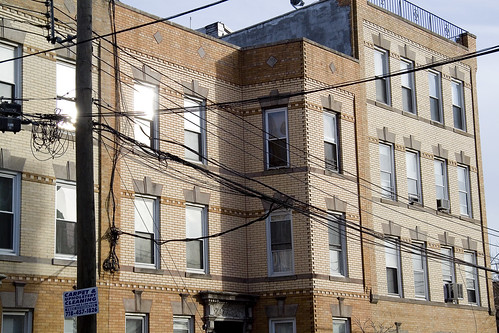
Matthews Houses – photo by Mitch Waxman
19th century businessmen were either merchant princes or robber barons, depending on your point of view. Both are accurate, but suffice to say that communities of labor would cluster around the industrialist, corollary industry would arise to support growing populations around the main mill, and even competitors would often locate in their vicinity to take advantage of locale and the skilled worker population. This is why you find financial, garment, and flower districts in Manhattan and its also why Astoria is visually distinct from the neighborhoods around it.
William Steinway was here, and his interests were larger than just pianos. Steinway was a primal force in digging the first Subway Tunnel from Queens to Manhattan (completed by Michael Degnon, of course), and was a major player in the Queens Trolley business. Wealthy, philanthropic, and well regarded by all reports- Steinway’s Piano mill pulled a population to it. Out on Staten Island, Balthazar Kreischer worked a somewhat coarser but technologically sophisticated operation that made… Bricks.
from boards.ancestry.com
…trying to find the descendants of Balthasar KREISCHER (3.13.1813-8.15.1886) of the Kreischer & Sons Brick Company of Staten Island, and interred in The Green-Wood Cemetery of Brooklyn, New York.
Descendants/Family include his 4 daughters Catherine KREISCHER-WEBER, Fredricka P. KREISCHER, Louisa Albertina KREISCHER-STEINWAY and Caroline L. KREISCHER-ELLIS and his 3 sons: Charles C. KREISCHER, Edward B. KREISCHER and George F. KREISCHER. Some Kreischers settled into Brooklyn.
Louisa Albertina KREISCHER-STEINWAY (d. 6.30.1926) married Albert STEINWAY (b. 6.10.1849- d. 5.14.1877), the youngest son of of Steinway & Sons Piano Mfgr. of Astoria, New York, and had 2 daughters: Henrietta Julia STEINWAY and Ella Frederica STEINWAY. Louisa, Albert and Frederick P. Kreischer are interred in the Steinway mausoleum in Green-Wood Cemetery of Brooklyn, NY.

Maspeth Matthews Houses – photo by Mitch Waxman
Both great men were successful and accepted, rich beyond avarice, and had children. Steinway’s son Albert married Kreischer’s daughter Louisa, connecting the two families in business and standing. Both men also had holdings and interests in the burgeoning railroad business, Kreischer an investor in the Vanderbilt’s Staten Island Railroad and Steinway a rail mogul in Queens. Many of these yellow brick homes, so typical of ancient Queens, lie along the route that trolley tracks once followed.
My supposition is that Kreischer received a family discount for moving his product around on Steinway’s rails, and use of Kreischer Brick in a new project bought some good will from the Steinways- known for their generous nature and political connections in New York, Newtown, and the upstart Long Island City with its scandalous political class.
This is theory, of course, but sounds kind of like the way things worked in 19th century New York when the “old boys” club ruled. Again- theory.
from astorialic.org
“It was reported on the street on Friday that Gleason had sold his railway interests to the Steinway syndicate for $275,000. It has been reported for a long time that the Gleason roads did not pay. The road up Borden Avenue to Calvary Cemetery [in Woodside] was not well patronized. There are not many people who go to Blissville [Sunnyside] unless it is to visit the dead. The Blissville people as a rule do not travel much and when they do they patronize the Greenpoint line in preference to Gleason’s, thus his exchequer has suffered, and again the cars to the cemetery are cold this winter, and the conductors lugubrious on account of the scarcity of pennies and passengers, and a traveler after a survey of one of the cars, is tempted to foot it in preference to riding in an open car, as they had to do on Christmas Day.”

St. Joseph’s RC Church, Grand 30th avenue, Astoria – photo by Mitch Waxman
Louisa’s brother Edward, it seems, met a tragic end.
Check out this page at thecabinet.com, which tells a detailed story of that Kreischer Mansion where Edward lost his life, which describes ghostly phenomena and the violent history experienced by those who have inhabited it since.
Also, don’t miss forgotten-ny’s page on the Steinways and Kreischer’s
Thus spake the Hermetic Hungarian…
Guest Blogger Hermetic Hungarian returns today, to discuss a curious institution found on the upper west side of Manhattan
The New York Buddhist Church and its statue of Shinran Shonin
The New York Buddhist Church, 331 – 332 Riverside Drive, is a Japanese “True Pure Land” (Japanese Jodoshinshu) Buddhist temple, founded in 1938.
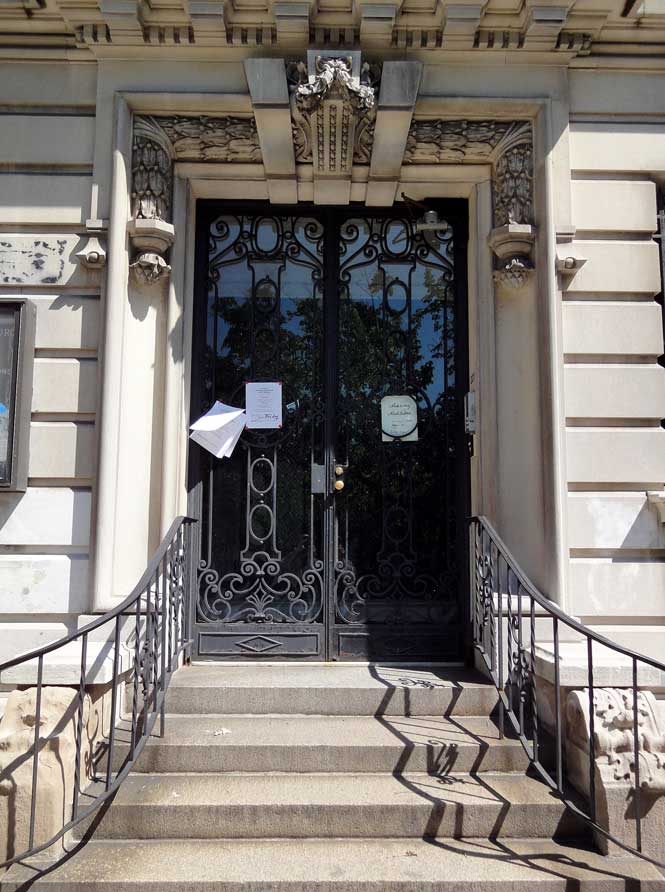
– photo by the Hermetic Hungarian
331 Riverside Drive, the main building, was formerly the Marion Davies House, built in 1902 in the Beaux Arts style by architects Janes & Leo. 332 Riverside Drive, the annex and social center, was built in 1963 in the then-popular International Style by architects Kelley & Gruzen.
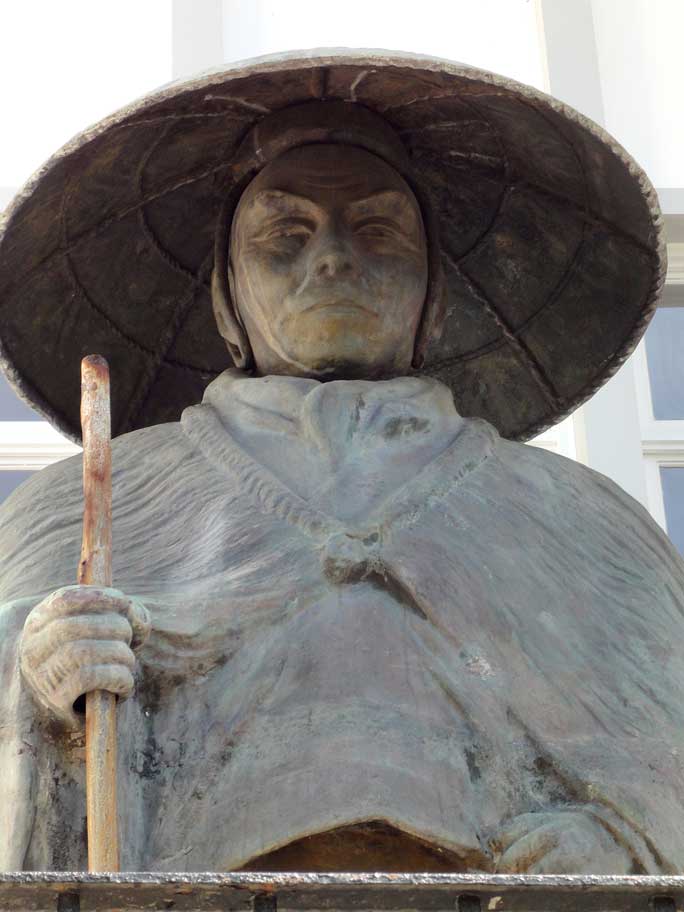
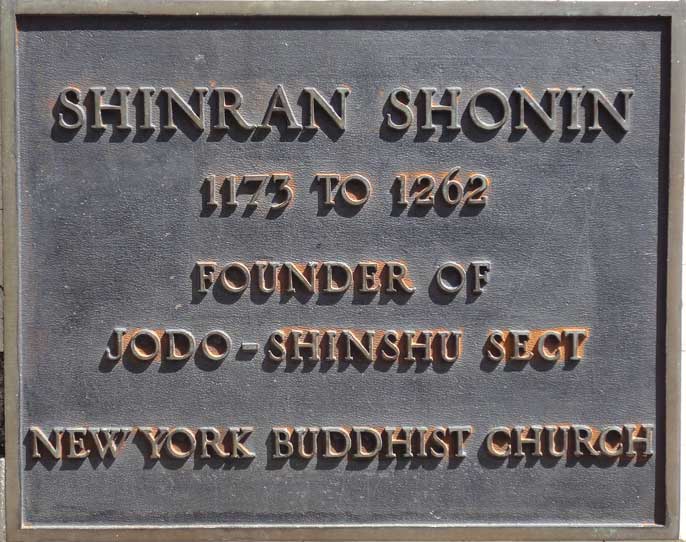
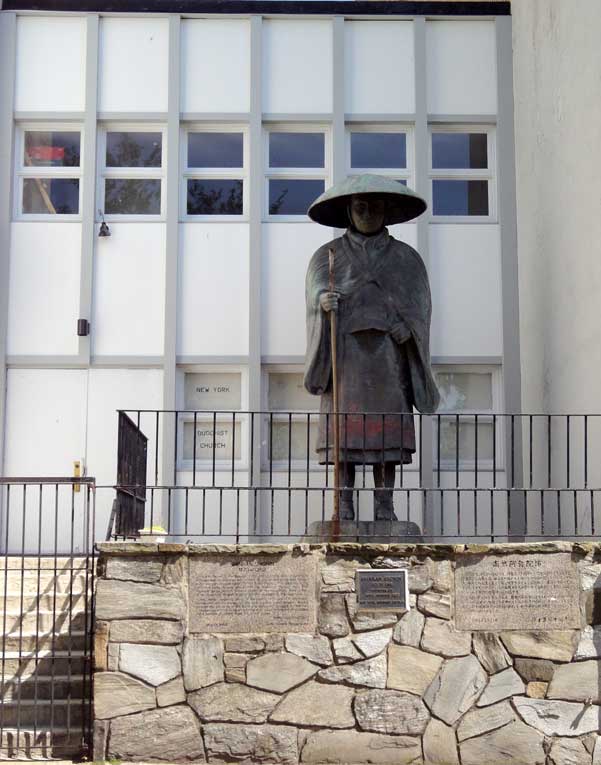
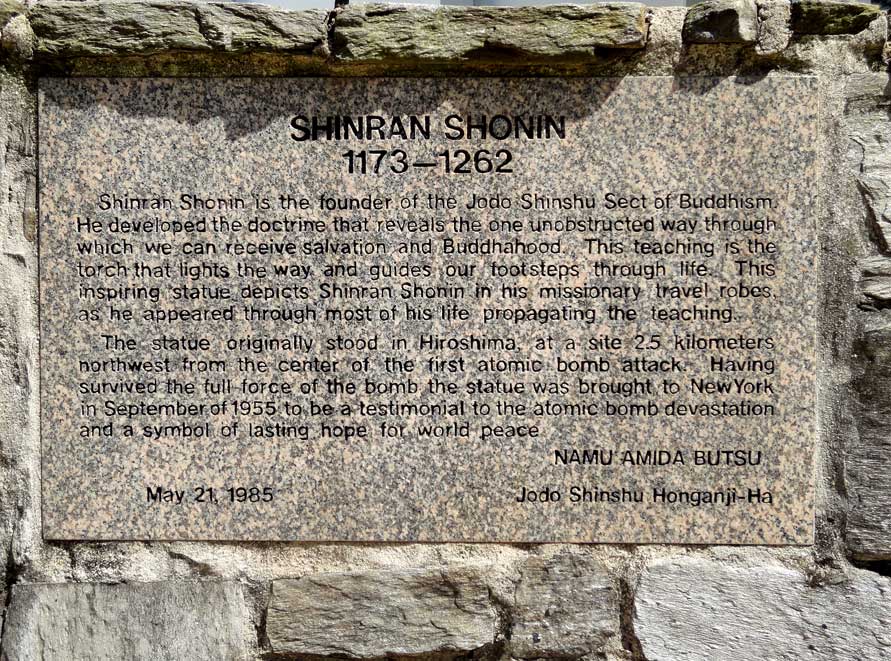
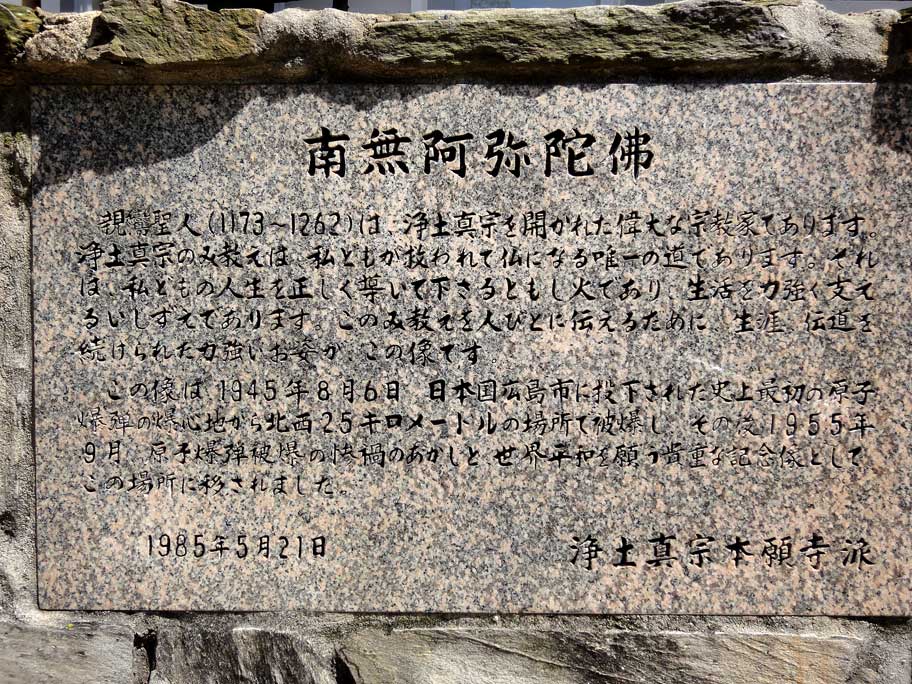
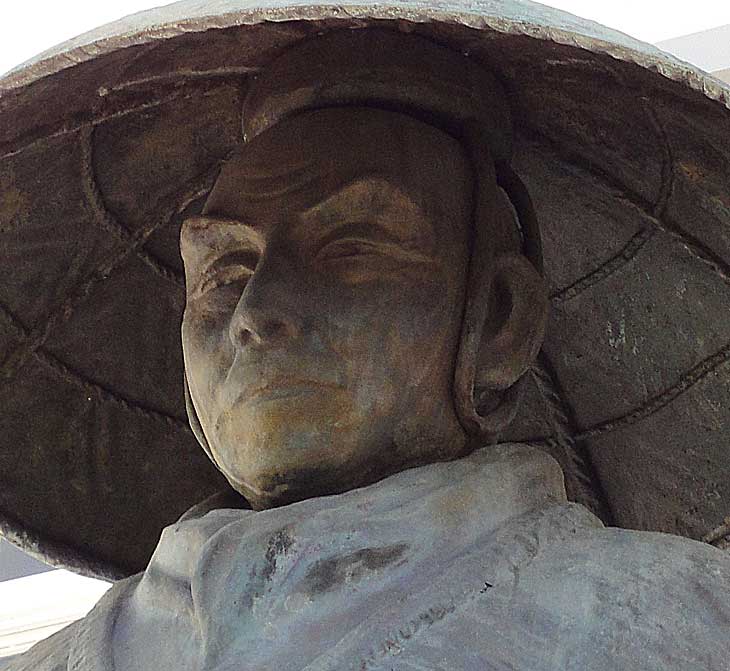
Standing in front of the annex, looking out across the Hudson River, is a tall bronze statue of Shinran Shonin (1173 – 1262), the founder of the Japanese True Pure Land school. Statues like this one grace the entrances of Pure Land Buddhist temples worldwide. However, this particular statue was originally in Hiroshima and survived the atomic bomb.
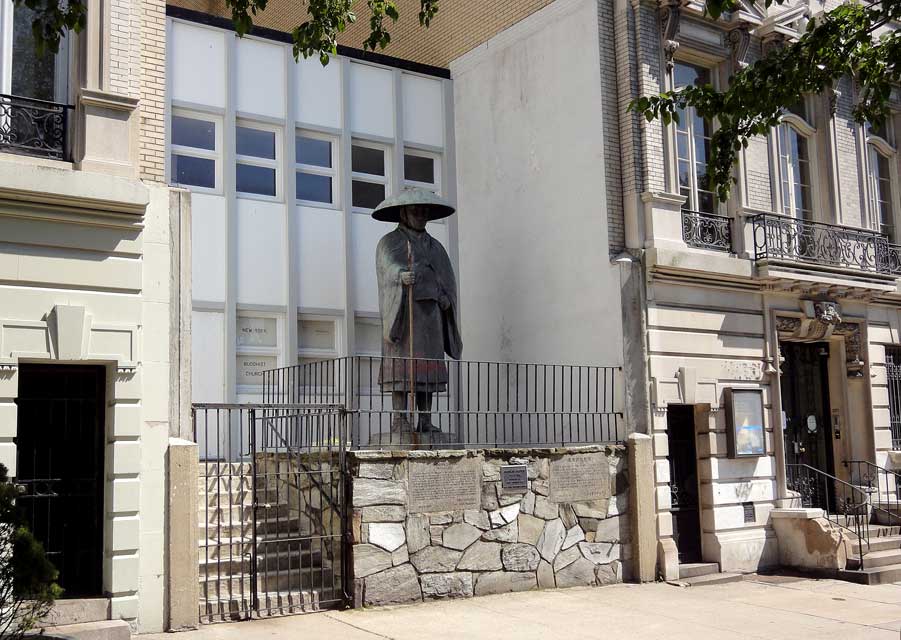
– photo by the Hermetic Hungarian
This statue originally stood about 8,000 feet from Hiroshima’s ground zero. It was one of the few cultural artifacts to survive the blast from that close distance. The statue was brought to the United States and installed in its its current location in 1955. Besides being a symbol of the founder of the Pure Land School, it is a reminder of both the terrible devastation wrought by atomic weapons and of fervent hopes for world peace.
Every August 5th at 7:15pm – corresponding to 8:15am August 6th, Hiroshima time — the temple bell is sounded, and the Buddhist and local communities gather around the statue, silently commemorating the Hiroshima bombing.
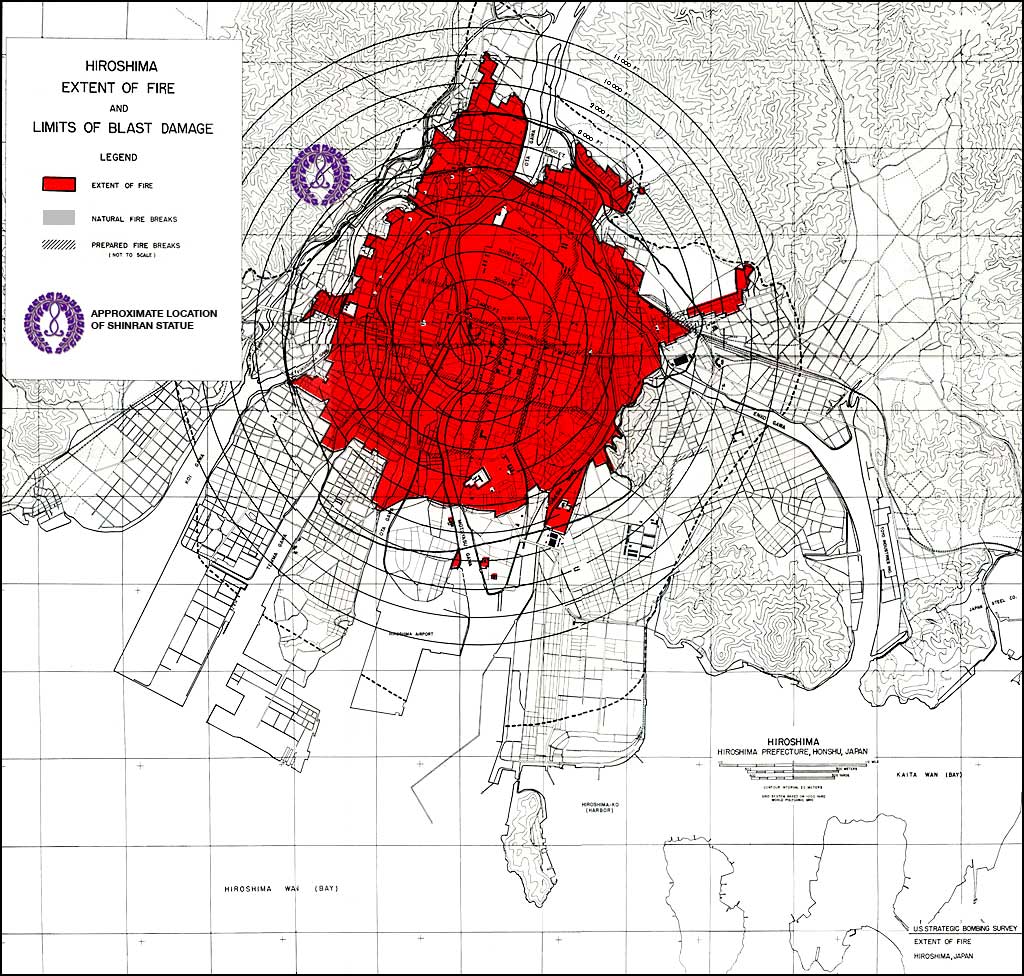
Shinran was born into a powerful Regent family in 1173. Shinran was inducted into the Imperial Court-sponsored Esoteric (Japanese Tendai ) Buddhist community. This esoteric school had been brought from China in the 8th century, and was a favorite among the nobility and educated classes. It was a complex, intellectual, esoteric, and demanding school which required difficult practices of its adherents. For 20 years Shinran tried without success to follow the practices. He became disillusioned, and wanted to leave the monastery to study a simpler Buddhism being taught in Kyoto.
– photo by the Hermetic Hungarian
Because of his abandonment of the Court-supported school, Shinran was exiled to the provinces to live as a commoner, with farmers, merchants, fishermen, and artisans. Living away from the heady atmosphere of the monastery, Shinran soon realized that if he himself was unable to perform the difficult practices required by the Buddhist schools of the nobility, surely people with little education who were busy eking out a living from day to night had little chance of achieving enlightenment through the then-accepted means. He felt strongly that there must be another way – after all the Buddha’s original teaching was one of universal enlightenment.
Having studied with earlier teachers of Pure Land, Shinran was familiar with the teachings which detailed the Buddha Amida’s (Sanskrit Amitabha) vows not to become a fully enlightened Buddha until everyone who had relied upon him had become enlightened.
– photo by the Hermetic Hungarian
The primary practice of Pure Land Buddhists, whether Japanese, Chinese, Vietnamese, or Korean, is chanting the name of Amida Buddha. In Japanese the chant is “Namu Amida Butsu”, translated as “I humbly bow to Amida Buddha”.
– photo by the Hermetic Hungarian
The external manifestation of this practice is that if one chants with sincerity and respect, asking for Amida Buddha’s help and guidance, then one will be reborn in the Pure Land in the West from which enlightenment is possible for ordinary people.
– photo by the Hermetic Hungarian
The corollary is that no matter how difficult and rigorous the practices undertaken in this life, it is almost impossible for ordinary people to transcend mundane existence. Pure Land practitioners place not just their faith but their hopes for eventual enlightenment in the hands of Amida Buddha.
– photo by the Hermetic Hungarian
The internal manifestation of Pure Land practice is that chanting name of Amida Buddha helps practitioners realize that the Pure Land is here and now, within ourselves. Faith in Amida Buddha awakens a deep spirituality, gratitude, and humility in the practitioner. This in turn allows the practitioner to live in the Pure Land while living in the world. And the physical act of chanting slowly leads the practitioner to inner calmness and fosters insight into true reality.
– photo by the Hermetic Hungarian
Pure Land Buddhism has the largest number of adherents of any Buddhist school in the world. In Japan alone there are over 10,000 Pure Land temples. Throughout China and Vietnam there are an unknown number of Pure Land temples, due to historic governmental suppression of religion; however, Pure Land is the largest Buddhist school in both countries. Pure Land has also greatly influenced Korean and Tibetan Buddhist practices. Buddhist practice is heterogenous, and different schools adapt each others’ practices when appropriate.
The members of the New York Buddhist Church, and their leader Rev. T. Kenjitsu Nakagaki, serve the Japanese community of Manhattan with Sunday services, Japanese dharma classes, and special events. They also warmly welcome welcome anyone seeking to understand more about Pure Land, offering services, classes, and discussions in English, hoping to embrace the wider community. They have been enthusiastically welcoming anyone interested for the last 72 years.


 The Newtown Pentacle