Archive for 2010
singular caravan

– photo by Mitch Waxman
The odd ways and methods of thought which your humble narrator exhibits mystify even himself. Walking down Laurel Hill Blvd. one fine day, and upon observing that most mundane and usual of creatures- the Squirrel- I realized that near total ignorance of the studied actuality of the animal was mine.
This happens to me often, sometimes it’s a foodstuff- like honey for instance. “How does one produce Honey industrially?” (which I’ve mentioned before), or “How, exactly, is Jell-O made?”. The latter case, incidentally, produced an answer so horrible and pregnant with latent disgust that I haven’t eaten the stuff since.
If you enjoy gelatin desserts, don’t ever, EVER try to find out. It’s not what you think it is, and the simplest thing to say is that the process for producing the stuff was invented in the 19th century at Newtown Creek…
from wikipedia
The living squirrels are divided into 5 subfamilies, with about 50 genera and nearly 280 species. The oldest squirrel fossil, Hesperopetes, dates back to the Chadronian (Late Eocene, about 40 – 35 million years ago), and is similar to modern flying squirrels.
During the latest Eocene to the Miocene, there were a variety of squirrels which cannot be assigned with certainty to any living lineage. At least some of these probably were variants of the oldest, basal “proto-squirrels” (in the sense that they lacked the full range of living squirrels’ autapomorphies). The distribution and diversity of such ancient and ancestral forms suggests that the squirrels as a group might have originated in North America.
Apart from these sometimes little-known fossil forms, the phylogeny of the living squirrels is fairly straightforward. There are three main lineages, one comprising the Ratufinae (Oriental giant squirrels). These contain a mere handful of living species in tropical Asia. The Neotropical Pygmy Squirrel of tropical South America is the sole living member of the Sciurillinae. The third lineage is by far the largest and contains all other subfamilies; it has a near-cosmopolitan distribution. This further supports the hypothesis that the common ancestor of all squirrels living and fossil lived in North America, as these three most ancient lineages seem to have radiated from there – if squirrels had originated in Eurasia for example, one would expect quite ancient lineages in Africa, but African squirrels seem to be of more recent origin.
The main group of squirrels also can be split up in three, which yields the remaining subfamilies. The Sciurinae contains the flying squirrels (Pteromyini) and the Sciurini, which among others contains the American tree squirrels; the former have often been considered a separate subfamily but are now seen as a tribe of the Sciurinae. The pine squirrels (Tamiasciurus) on the other hand are usually included with the main tree squirrel lineage, but appear to be about as distinct as the flying squirrels; hence they are sometimes considered a distinct tribe, Tamiasciurini.

– photo by Mitch Waxman
These sort of questions are not good ones to ask, as often the answers present casual barbarism and bloody reality in a matter of fact fashion, and such information blackens the heart and calcifies the mind. Would it aid me, in any way whatsoever, to find out that there might have been some carnivorous Ice Age Squirrel the size of a Buffalo or something? Would it not in fact, be somewhat wiser to apply the limited intellect and time left to me on this mortal coil in pursuit of acquiring the sort of skills which would allow me to gather and hoard material wealth to myself?
Perhaps I could apply my time to more fruitful pursuits than those already explored, apply for and attain some sort of professional license and become a realtor or exterminator or something? Perhaps some novel combination of the two would be possible, and certainly more useful than spending an entire day thinking about common urban rodents.
from wikipedia
Squirrels are generally intelligent and persistent animals. In residential neighborhoods, they are notorious for discovering clever methods to circumvent obstacles in order to eat out of bird feeders. Tree squirrels also create minor annoyances by digging in planting pots and flower beds to pull out bulbs which they chew on, to either bury or recover seeds and nuts, and for building nests within human domiciles, including attics and basements. Squirrels use their keen sense of smell to locate buried nuts and can dig extensive holes in the process. Birds, especially crows, will sometimes watch a squirrel bury a nut, then dig it up as soon as the squirrel leaves. Although they are expert climbers, and primarily arboreal, squirrels also thrive in urban environments, where they have adapted to humans.

– photo by Mitch Waxman
Alas, this fascination for the obscure and bizarre marks me, as always… an Outsider… condemned to feel at home only amongst the tomb legions.
from wikipedia
In Norse mythology, Ratatoskr (Old Norse, generally considered “drill-tooth” or “bore-tooth”) is a squirrel who runs up and down the world tree Yggdrasil to carry messages between the unnamed eagle, perched atop Yggdrasil, and the wyrm Níðhöggr, who dwells beneath one of the three roots of the tree. Ratatoskr is attested in the Poetic Edda, compiled in the 13th century from earlier traditional sources, and the Prose Edda, written in the 13th century by Snorri Sturluson. Scholars have proposed theories about the implications of the squirrel.
Ratatosk is the squirrel who there shall run
On the ash-tree Yggdrasil;
From above the words of the eagle he bears,
And tells them to Nithhogg beneath.
Hunters Point Avenue Bridge Centennial, Dec. 11

– photo by Mitch Waxman
Gaze upon it, lords and ladies, a risible talisman of permanence amidst an ever changing industrial landscape… The Hunters Point Avenue Bridge.
A recent post was offered for consideration at this, your Newtown Pentacle, which hinted at certain remarkable events about to occur in its environs and discussed a small part of the rather expansive history of this largish bit of motile steel which spans Dutch Kills.
Glory then, in the announcement of a free walking tour celebrating its centennial.
from nycbridges100.org

NEW YORK CITY BRIDGE CENTENNIAL COMMISSION AND NEWTOWN CREEK ALLIANCE TO HOST WALKING TOUR OVER HUNTERS POINT AVENUE BRIDGE MORNING OF DECEMBER 11TH
The New York City Bridge Centennial Commission (NYC BCC) and Newtown Creek Alliance announced today that they will sponsor a free walking tour of the Hunters Point Avenue Bridge in Long Island City on Saturday, December 11, 2010 at 11 a.m. to celebrate its 100th birthday.
“It’s important to celebrate these milestones as a way to show how much we rely on all these crossings in our day-to-day lives,” said NYC BCC President Sam Schwartz.

– photo by Mitch Waxman
Your tour guides for this centennial event will be Newtown Creek Alliance and Working Harbor Committee’s Bernard Ente, and a certain humble narrator will be assisting him in meager ways.
This location is awfully close to both legendary Greenpoint and to the heart of Long Island City, and quite close to Manhattan via subway. Here’s a google map with the location of the Bridge, and the meet-up point at 21st street and Hunters Point Avenue is called out.
from nycbridges100.org
The original Hunters Point Avenue Bridge dates back to 1874 when the bridge was a wooden structure. From 1874 to 1907 an iron bridge was in place before being replaced in 1910 by a double-leaf bascule bridge. It was again rebuilt in the early 1980s as a single-leaf bascule bridge. Bascule bridges are designed with a counterweight that balances the span as it swings upward (a single leaf lifts up from one end while a double leaf lifts up from both sides in the middle of the span).
The bridge is located between 27th and 30th streets in Long Island City and is situated four blocks east of the Borden Avenue Bridge. The span is 21.8 meters long and has two lanes, one in each direction. It has experienced higher traffic volumes over the last year and a half while the Borden Avenue Bridge has been closed for construction in this heavily industrialized area.

– photo by Mitch Waxman
Spectacular views of Dutch Kills, as well as knowledgeable and unbiased narration, can be had for the price of attendance alone. Attendees are advised to bring cameras, as this is a particularly photogenic section of the Newtown Creek watershed.
from nycbridges100.org
The meeting point for the tour will be at Hunters Point Avenue at 21st Street outside the 7 train station. If you would like to participate, please email tour guide Bernie Ente at info@entephoto.com.
About the NYC Bridge Centennial Commission
The NYC Bridge Centennial Commission is a 501 c 3 non-profit comprised of public and privateorganizations to commemorate the centennials of several NYC bridges and raise infrastructure awareness.
About the Newtown Creek Alliance
The Newtown Creek Alliance represents interests of community residents and local businesses who arededicated to restoring community health and vibrant water dependent commerce along Newtown Creek.

– photo by Mitch Waxman
Dutch Kills is a familiar sight to regular readers of this, your Newtown Pentacle, but must be experienced first hand by all interested in the story of the Newtown Creek. This will not be a rigorous walking experience- sneakers or other comfortable shoes should be sufficient as we won’t be leaving the sidewalk- but if icy conditions occur- use good judgement.
Undoubtedly, it will be cold, and the event will be happening rain, shine, or snow- so gauge your outerwear according to forecasted weather conditions.
For those interested in further discussion with other antiquarians and enthusiasts, we are planning an after event visit to a local diner for coffee, luncheon, and conversation.
from nyc.gov
Hunters Point Avenue is a two-lane local City street in Queens. Hunters Point Avenue is oriented east-west and extends from 21st Street to the Long Island Expressway/Brooklyn Queens Expressway interchange in Queens. The avenue is parallel to and approximately one block south of the Long Island Expressway. The Hunters Point Bridge over Dutch Kills is situated between 27th Street and 30th Street in the Long Island City section of Queens, and is four blocks upstream of the Borden Avenue Bridge. It is a bascule bridge with a span of 21.8m. The general appearance of the bridge has been significantly changed since it was first opened in 1910. The bridge provides a channel with a horizontal clearance of 18.3m and a vertical clearance, in the closed position, of 2.4m at MHW and 4.0m at MLW. The bridge structure carries a two-lane, two-way vehicular roadway with sidewalks on either side. The roadway width is 11.0m, while the sidewalks are 1.8m wide. The width of the approach roadways vary from the width of the bridge roadway. The west approach and east approach roadways are 13.4m and 9.1m, respectively.
The first bridge at this site, a wooden structure, was replaced by an iron bridge in 1874. That bridge was permanently closed in 1907 due to movement of the west abutment, which prevented the draw from closing. It was replaced in 1910 by a double-leaf bascule bridge, designed by the Scherzer Rolling Lift Bridge Company. The bridge was rebuilt in the early 1980′s as a single-leaf bascule, incorporating the foundations of the previous bridge.
Incidentally…
a photo in the same series as the one below was recently exhibited here- in the “from some point in space” posting about Dutch Kills and the Hunters Point Avenue Bridge.

– photo by Mitch Waxman
While doing supplemental research about the place, I came across the following shot embedded in a scanned “google book”, and the two images form an interesting parallel. The BW shot, you see, is from 1921.
Coincidence abounds, but I believe my forebear was shooting from a similar if not same vantage as I would be at some four score and nine years or 24,855 days later.

– Photo from “The Newtown Creek industrial district of New York City By Merchants’ Association of New York. Industrial Bureau”
confines of our kingdom
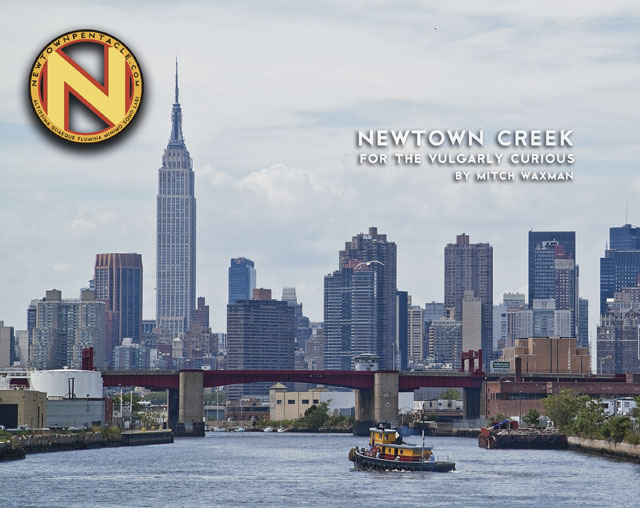
“Newtown Creek for the Vulgarly Curious” is a fully annotated 68 page, full-color journey from the mouth of Newtown Creek at the East River all the way back to the heart of darkness at English Kills, with photos and text by Mitch Waxman.
Check out the preview of the book at lulu.com, which is handling printing and order fulfillment, by clicking here.
Every book sold contributes directly to the material support and continuance of this, your Newtown Pentacle.
shocking coruscations

– photo by Mitch Waxman
Conversation offered by divers and submarine enthusiasts inform this posting, which like your humble narrator, lingers about at Hells Gate.
Explorations of the occluded depths in this area, as reported, reveal a shattered series of reefs and alluvial boulders underlying this region of the East River. In addition there are depressions found in the sediment here, which form enormous cauldron like holes dropping down into the silt choked darkness, and I am informed that such formations are commonly called “pots” by those familiar with such subaqueous geography. Within these pots might be found a hodge podge of archaeological record, but the strong currents above them form venturi effect vortices within, and any who might enter one are considered to be extraordinarily lucky to exit such a feature intact and alive.
from “Myths and Legends of our Own Land, by Charles M. Skinner” at gutenberg.org
Satan appears to have troubled the early settlers in America almost as grievously as he did the German students. He came in many shapes to many people, and sometimes he met his match. Did he not try to stop old Peter Stuyvesant from rowing through Hell Gate one moonlight night, and did not that tough old soldier put something at his shoulder that Satan thought must be his wooden leg? But it wasn’t a leg: it was a gun, loaded with a silver bullet that had been charged home with prayer. Peter fired and the missile whistled off to Ward’s Island, where three boys found it afterward and swapped it for double handfuls of doughnuts and bulls’ eyes. Incidentally it passed between the devil’s ribs and the fiend exploded with a yell and a smell, the latter of sulphur, to Peter’sblended satisfaction and alarm. And did not the same spirit of evil plague the old women of Massachusetts Bay and craze the French and Spaniards in the South?

– photo by Mitch Waxman
Rumors which have persisted since the advent of European colonization suggest that great treasures might by found in these deep eddies and swirling maelstroms of the underwater grottoes. Famously, the wreck of a British ship called “the Hussar” carried a great fortune and many lives down to the bottom of Hells Gate- and the aboriginal inhabitants of the archipelago related stories of a race of giants who originally inhabited these islands that would cross the river by merely stepping across the rocks. Of course, there used to be a lot more rocks, before the Army Corps of Engineers set off the greatest manmade explosion (until Hiroshima) in history to “assure navigability”.
The effort to clear “flat rock”, “frying pan”, “pot rock”, “Flood Rock”, and “Hallet’s Point Reef” was explored in some detail in a Newtown Pentacle Posting of June 5, 2009- “The River of Sound”, and the enigmatic Hells Gate Bridge and its environs was discussed in some detail in the September 23, 2009 posting “A Bright Passage”.
from “Myths and Legends of our Own Land, by Charles M. Skinner” at gutenberg.org
Back in the days before the Revolution, a negro called Mud Sam, who lived in a cabin at the Battery, New York City, was benighted at about the place where One Hundredth Street now touches East River while waiting there for the tide to take him up the Sound. He beguiled the time by a nap, and, on waking, he started to leave his sleeping place under the trees to regain his boat, when the gleam of a lantern and the sound of voices coming up the bank caused him to shrink back into the shadow.
- At first he thought that he might be dreaming, for Hell Gate was a place of such repute that one might readily have bad dreams there, and the legends of the spot passed quickly through his mind: the skeletons that lived in the wreck on Hen and Chickens and looked out at passing ships with blue lights in the eye-sockets of their skulls;
- the brown fellow, known as “the pirate’s spuke,” that used to cruise up and down the wrathfultorrent, and was snuffed out of sight for some hours by old Peter Stuyvesant with a silver bullet;
- a black-looking scoundrel with a split lip, who used to brattle about the tavern at Corlaer’s Hook, and who tumbled into East River while trying to lug an iron chest aboard of a suspicious craft that had stolen in to shore in a fog.
This latter bogy was often seen riding up Hell Gate a-straddle of that very chest, snapping his fingers at the stars and roaring Bacchanalian odes, just as skipper Onderdonk’s boatswain, who had been buried at sea without prayers, chased the ship for days, sitting on the waves, with his shroud for a sail, and shoving hills of water after the vessel with the plash of his hands.

– photo by Mitch Waxman
A busy industrial corridor in the ominous 21st century, the efforts of engineers have rendered Hell Gate tame and predictable, although one might still observe the occasional spiral eddy and acre wide pools of swirling water near the shorelines on windy days. If one watches carefully, a phastasmagorical plethora of animal forms persists in this part of the river- diving cormorants are common, Birds of Prey are present as are riverine and littoral mammalia, and there are said to be other less well known phyla. Every now and then, one might even encounter a U.F.O. (an Unidentified Floating Object).
Who can guess, after all, what is is that may be hiding down there?
from “HISTORY OF QUEENS COUNTY with illustrations, Portraits & Sketches of Prominent Families and Individuals. New York: W.W. Munsell & Co.; 1882.” at bklyn-genealogy-info.com
Hallett’s purchase at Hell Gate Neck included much of the territory later incorporated as the village of Astoria. The original proprietor lived there to the age of about ninety, and was foremost in many early improvements. He divided his property at that point in 1688 between his sons William and Samuel, the former receiving the lands south of the road Since forming Greenoak Street, St. George’s Place, Welling and Main streets and Newtown avenue, the latter the lands lying north of that road.
It is probable that the Indians who sold Hell Gate Neck to William Hallett were of the Canarsie tribe, a clan of reputed power whose jurisdiction extended over the whole of Kings county, the islands in Hell Gate, and, O’Callaghan says, some part of Newtown. A large tract of land including the southwestern portion of the present city was deeded “to the inhabitants of Newtowne, alias Middleburg,” by Pomwaukon and Roweroenesteo of the above tribe, July 9th 1666.

– photo by Mitch Waxman
Indolent, and quite susceptible to environmental stressors, your humble narrator has commented several times about the odd sonic qualities of this patch of the East River. Mighty Triborough never sleeps, and its steel hums continually. Staccato, the traffic over Hells Gate is no less affecting, but it is just not in the same league as the constant oppression of infrasonic drone emanating from Triborough, or the din of nearby heavy industrial activity on Wards Island.
Here is part of a recording made on May 28th of 2010, directly beneath the Triborough Bridge… using the admittedly poor microphone of an iPhone headset… for your consideration…
from wikipedia
After the war ended, Jaspar Ward and Bartholomew Ward took ownership of the island that later carried their surname. Although a small population had lived on the island since as early as the 17th century, the Ward brothers developed the island more heavily by building a cotton mill and building the first bridge to cross the East River in 1807, connecting the island with Manhattan at 114th Street.
The bridge, paid for by Bartholomew Ward and Philip Milledolar, was a wooden drawbridge. The bridge lasted until 1821, when it was destroyed in a storm.After the bridge was destroyed, the island was largely abandoned until 1840, when the island was transformed into a dumping ground for everything unwanted in New York City. Between 1840 and 1930 the island was used for:
- Burial of hundreds of thousands of bodies relocated from the Madison Square and Bryant Park graveyards.
- The State Emigrant Refuge, a hospital for sick and destitute immigrants, opened in 1847, the biggest hospital complex in the world during the 1850s.
- The New York City Asylum for the Insane, opened around 1863.
- An immigration station from 1860 until the 1892 opening of Ellis Island.
- Manhattan State Hospital, operated by the New York State Department of Mental Hygiene when it took over the immigration and asylum buildings in 1899. With 4,400 patients, it was the largest psychiatric institution in the world. The 1920 census notes that the hospital had a total of 6045 patients. It later became the Manhattan Psychiatric Center.
indefinable odors

– photo by Mitch Waxman
Down by Dutch Kills, one must persevere to maintain some inkling of hope for the future of mankind.
Saying that, however, in its own way Dutch Kills is actually quite a lovely place- as storied industrial centers which have seen better days typically are. A canalized waterway, Dutch Kills is a tributary of that languid cautionary tale known as the Newtown Creek, and has been isolated for several seasons from its principate source by emergency bridge construction and a changing industrial landscape. I’m down here a lot of course, most recently in the “from some point in space” posting of November 3rd, which includes an intriguing set of high elevation shots of the area which I recently managed to capture.
from nyc.gov
Hunters Point Avenue is a two-lane local City street in Queens. Hunters Point Avenue is oriented east-west and extends from 21st Street to the Long Island Expressway/Brooklyn Queens Expressway interchange in Queens. The avenue is parallel to and approximately one block south of the Long Island Expressway. The Hunters Point Bridge over Dutch Kills is situated between 27th Street and 30th Street in the Long Island City section of Queens, and is four blocks upstream of the Borden Avenue Bridge. It is a bascule bridge with a span of 21.8m. The general appearance of the bridge has been significantly changed since it was first opened in 1910. The bridge provides a channel with a horizontal clearance of 18.3m and a vertical clearance, in the closed position, of 2.4m at MHW and 4.0m at MLW. The bridge structure carries a two-lane, two-way vehicular roadway with sidewalks on either side. The roadway width is 11.0m, while the sidewalks are 1.8m wide. The width of the approach roadways vary from the width of the bridge roadway. The west approach and east approach roadways are 13.4m and 9.1m, respectively.
The first bridge at this site, a wooden structure, was replaced by an iron bridge in 1874. That bridge was permanently closed in 1907 due to movement of the west abutment, which prevented the draw from closing. It was replaced in 1910 by a double-leaf bascule bridge, designed by the Scherzer Rolling Lift Bridge Company. The bridge was rebuilt in the early 1980’s as a single-leaf bascule, incorporating the foundations of the previous bridge.

– photo by Mitch Waxman
Seldom commented, the Hunters Point Avenue Bridge segments Dutch Kills neatly, and has done so for nigh on a century now. The marshes and streams which once typified the area before the advance of railroad and vast agglutination of industrial installation are long gone, relegated to subterranean sewers and masonry clad spillways, but a century ago- the Hunters Point Avenue Bridge (and its predecessors) allowed egress between the terrestrial isolation of the Long Island City center and the rest of western Queens.
The NY Times, in 1908, commented that Long Island City might someday be known as “A city of bridges” due to the many crossings over the tributaries of the Newtown Creek and the presence of mighty Queensboro at its center.
from federalregister.gov
The Hunters Point Avenue Bridge, at mile 1.4, over the Dutch Kills has vertical clearances of 8 feet at mean high water and 13 feet at mean low water. The existing regulations for the Hunters Point Avenue Bridge in 33 CFR 117.801(d) require the draw to open on signal if at least a one-hour advance notice is given to the drawtender at the Grand Street/Avenue Bridge, the NYCDOT Radio Hotline, or NYCDOT Bridge Operations Office. In the event the drawtender is at the Roosevelt Island Bridge or the Borden Avenue Bridge, up to an additional half-hour delay may occur.
The bridge owner, the New York City Department of Transportation (NYCDOT), submitted bridge opening log data to the Coast Guard for review. The bridge owner plans to operate these bridges with multiple crews of drawtenders. The two-hour advance notice should allow sufficient time for the crews to operate these bridges due to the close proximity of the bridges to each other. Recent yearly openings have been relatively low which will allow the bridge owner to utilize the roving crew concept and still meet the needs of navigation.

– photo by Mitch Waxman
The Hunters Point Avenue Bridge (the 1910 version) was configured differently than the modern structure when first built, although the original was constructed for some $95,214 from plans by the Scherzer Rolling Lift Bridge Company with the dirty work performed by the Duseath Engineering Company of 114 Liberty St. NY. As you’d imagine, there is a certain logic behind the esoterica presented about this obscure little bridge found in a literal “industrial backwater” in Queens.
But… I can’t tell you what is is yet…
from nysdot.gov
About 1900, most of the Newtown Creek was bulkheaded and occupied by about fifty industrial properties. Undeveloped or less developed sections without bulkheads included Dutch Kills, about 2,000 feet of shoreline in Queens just above Dutch Kills with two LIRR lighterage piers, about 1,000 feet of shoreline in Queens near the Penny Bridge, and about 3,500 feet of shoreline downstream of Maspeth Avenue in Brooklyn.15 Dutch Kills, and the Queens side of Newtown Creek, just upstream of Dutch Kills, were developed circa 1905-1912, largely through the efforts of the Degnon Terminal & Realty Company. The Degnon firm created an industrial park with rail and marine access around Dutch Kills between about Hunters Point and 47th Avenue, Dutch Kills subsequently was included within USACE dredging projects. Without federal assistance, Degnon created a 150-foot-wide channel with 2,400 feet of bulkhead, including a turning basin. To create rail links to the development, Degnon helped the LIRR build a new 1,000-acre freight terminal circa 1907 along Newtown Creek east of Dutch Kills on property bought from Calvary Cemetery, including several short piers intended to handle heavy freight such as brick, coal, lumber, and ice. From this terminal, a private Degnon Terminal Railroad was created, largely through local streets. On newly filled marshy margins of Dutch Kills, Degnon Terminal & Realty promoted industrial development both on and away from the water. One iron works and several large building materials firms occupied the Degnon waterfront by the early 1920s. Reconstruction of the two movable bridges over Dutch Kills circa 1908-10 contributed to these developments. On other Degnon lots, large firms included the American Eveready Company and the American Chiclet Company, respective makers of batteries and candy.16 Facilitating this growth was the construction of the Queensboro Bridge (1909) and the start of the operation of the IRT subway line in 1917.

– photo by Mitch Waxman
Unfortunately, I can’t announce the news yet… Let’s just say that it would be a good idea to leave the 11th of December open, and that Long Island City is terrible in its grandeur during the winter months.
More on this will be forthcoming by the end of the week.
from wikipedia
Edward Byrne began his civil engineering career in 1886 with the New York City Aqueduct Commission on the construction of the Croton Water Supply System. It is of interest that on this project he met Robert Ridgway, who also was destined to become a distinguished engineer and an outstanding civil servant.
From 1889 to the close of 1897, Byrne worked on highways and bridges for the old Department of Public Works of New York City.
On January 1, 1898, he joined the Department of Bridges and began a striking and noteworthy service which ended in November, 1933, with his resignation from the position of Chief Engineer of the Department of Plant and Structures (the successor of the Bridge Department), in order to assume the duties of Chief Engineer of the Triborough Bridge. His thirty-six years of service in the Department of Bridges, and its successor, the Department of Plant and Structures, may be divided into two periods.
Borden Avenue Bridge
During this period, he was in charge of bridge construction and maintenance, supervising the construction of the Willis Avenue Bridge over the Harlem River, the Vernon Avenue Bridge, the Borden Avenue and Hunters Point Bridges over Dutch Kills, and the old bridge over Flushing River.

– photo by Mitch Waxman
Also, as a note:
I get asked all the time what these signs mean, what they indicate, and how seriously they should be regarded. The powers that be don’t make it easy to find out, for despite the “for more information” attribution, the City doesn’t go into much detail at nyc.gov/dep about them. Partly, this is due to the vogue followed by municipal authorities in recent years which allows private contractors to perform public work. The contractor is under no obligation to release their work into the public domain, as government workers are, and many important details about our metropolis ends up hidden behind corporate firewalls.
Here’s a little of the Batman type detection required to penetrate a purposely obtuse subject, which is a skill I’ve been developing over the lifetime of this, your Newtown Pentacle.
Quoting from hydroqual.com
The Bowery Bay WPCP is permitted by the NYSDEC under SPDES permit number NY-0026158. The facility is located at 43-01 Berrian Blvd., Astoria, NY, 11105 in the Astoria section of Queens, on a 34.6 acre site adjacent to the Rikers Island Channel, leading into the Upper East River, bounded by Berrian Blvd. and Steinway Street. The Bowery Bay WPCP serves an area of approximately 16,105 acres in the Northwest section of Queens, including the communities of KewGarden Hills, Rego Park, Forest Hills, Forest Hills Gardens, North Corona, South Corona, Lefrak City, Elmhurst, East Elmhurst, Jackson Heights, Maspeth, Woodside, Sunnyside Gardens, Sunnyside, Hunters Point, Long Island City, Astoria, Astoria Heights, Steinway, Ravenswood, and Roosevelt Island.
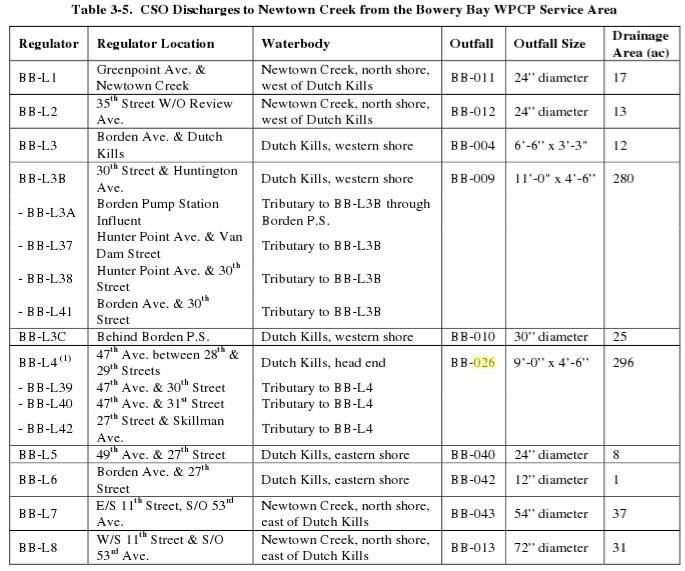
and from the same document this text and chart
The Low Level service area contains 46 regulators, of which 19 interconnected regulators discharge to the Newtown Creek during wet weather through the 13 CSOs. Of these 13 CSOs, 6 discharge to the tributary Dutch Kills (BB-004, 009, 010, 026, 040, and 042), and 6 discharge to Newtown Creek(BB-011, 012, 013, 014, 015, and 043). An additional 2-feet, 8-inches x 4-foot outfall, BB-049, is listed in the Bowery Bay WPCP SPDES permit as discharging to Dutch Kills near 21st Street, but no further information is available such as which regulator it is connected to.


 The Newtown Pentacle