Archive for August 2011
irrepassable gate
– photo by Mitch Waxman
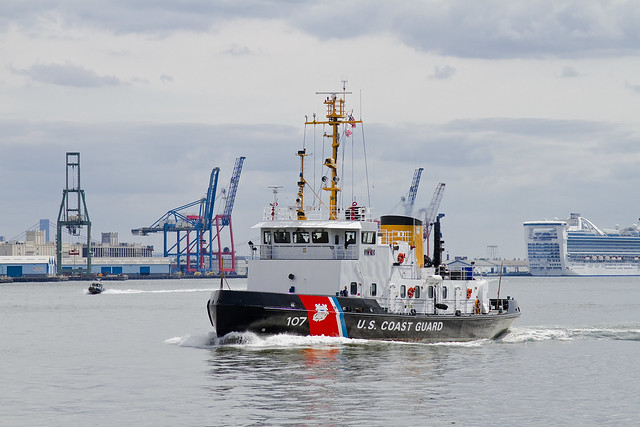
Awhile back, I posted this series of shots to Flickr, and an enigmatic shipping enthusiast from the vast interweb hive mind immediately commented “140′ Bay Class Icebreaking Tug USCGC PENOBSCOT BAY WTGB-107 homeport Bayonne, NJ.”.
From wikipedia
The USCG Bay-class icebreaking tug is a class of 140-foot (43 m) icebreaking tugs of the United States Coast Guard, with hull numbers WTGB 101 through to WTGB 109.
They can proceed through fresh water ice up to 20 inches (51 cm) thick, and break ice up to 3 feet (0.91 m) thick, through ramming. These vessels are equipped with a system to lubricate their progress through the ice, by bubbling air through the hull.

– photo by Mitch Waxman
When focusing in on this ship, I just thought it looked cool. Turns out that this class of vessels has a long and storied past.
Here’s a Coast guard shot of Penobscot Bay in action during the winter…
Here’s the official story, courtesy United States Coast Guard:
from uscg.mil
The 140-foot Bay-class Cutters are state of the art icebreakers used primarily for domestic ice breaking duties. They are named after American Bays and are stationed mainly in Northeast U.S. and Great Lakes.
WTGBs use a low-pressure-air hull lubrication or bubbler system that forces air and water between the hull and ice. This system improves icebreaking capabilities by reducing resistance against the hull, reducing horsepower requirements

– photo by Mitch Waxman
Note: I should mention that members of the USCG have offered me very good, yet unofficial, advice on appropriate maritime footwear in the past- which may render some personal bias on my part for the organization.
The USCG also maintains a short history page on this ship, which can be accessed here.
the dark moor

– photo by Mitch Waxman
Lucid and unwholesome, witness this sky flung perspective of the backbone of New York City- vantaged from several hundred feet above the Newtown Creek and it’s little known tributary- Whale Creek, and high atop the digester eggs of the Newtown Creek Wastewater Treatment Plant.
Gaze in wonder at the majesty of western Queens.
Additionally, click here to see this view reversed, and witness the parallel horizon of infinite Brooklyn.

– photo by Mitch Waxman
That’s the Thomas D. Witte tugboat maneuvering a barge into position at the SimsMetal dock, and the rusty crossing in the background is the non functioning swing bridge which spans the larger Queens side tributary of Newtown Creek called Dutch Kills.

– photo by Mitch Waxman
That’s the LIRR moving along the ancient rail tracks which have blessed the industries and cursed the residents of this area since the early 19th century. The general area that the locomotive track is passing through, employed to this very day by petrochemical interests, is the former Queens location of Standard Oil at Newtown Creek.

– photo by Mitch Waxman
In the distance, from left is Lindenthal’s magnificent Queensboro, the Big Allis power plant, the omnipresent Sapphire megalith, the high flying Long Island Expressway, and a substantial portion of the vast industrial quarters of Long Island City which I call “The Empty Corridor“.
distant ravine

– photo by Mitch Waxman
The final product of my “Grand Walk” which was found on my camera card, which was populated by these puzzling images of centuried statuary lost amongst First Calvary’s emerald devastations.
The figure is life sized, according and conforming to the proportions and stature of the malnourished 19th century. In our modern era of gigantic milk, beef, and grain fed humans, when 6 feet of height is not an uncommon attainment for Italians, Irish, and Chinese alike (all 3 notoriously short statured groups according to historical anecdote), she seems to be a young girl- but this delicate figure conforms to statistical adult height records of 19th century immigrant New York.
We often forget, when discussing fashionable dining trends (locavore or vegan, organic or farm raised- bleh) that the primary goal of our forebears wasn’t ultimately financial acquisition, but was instead a guarantee of basic nutrition.

– photo by Mitch Waxman
Pithy commentary about the fallacies of a modern world, corporatized and commercialized, notwithstanding- attention is called to the plastic baubles which the monument has been adorned with. Such commemorate decoration is commonly observed at area cemeteries, although the rules and bylaws of these institutions publish severe limitations on acceptable grave ornamentation. Unless taste and or propriety are offended, the management seems to allow these minor decorative touches to subsist for a time, after which the activities of groundskeeping and upkeep sweep the place clean.
Behind a fence or near a seldom used entranceway at any of these urban polyandrions, once can easily locate a dumpster containing a polyglot of rotting flowers in cheap vases, joss paper idols, and a cacophony of sentimental or religious trinkets which lie glittering amidst the debris.

– photo by Mitch Waxman
The trinket itself is pedestrian, a childish and injection molded representation of grapes on the vine. What sets me to wonder, and more than wonder, is that undeniable resemblance to the color of the purple bloom worn by the apostate Hibernian and his bizarre companions whose threatening aspect hurled me into a panicked state and meandering escape route through the ancient sections of New York City.
I’ve been queried via private email about this person by several people. Unfortunately, as mentioned in the last posting, I can only remember bits and pieces- but the flower in his lapel matched the color of these plastic beads exactly- of that I can be sure.
What does it mean? I cannot tell you, as it would be madness to attempt the connection of dots between a seemingly random series of events.

– photo by Mitch Waxman
Did your humble narrator, stricken by terror induced delirium, randomly stumble along deeply buried trolley tracks past storefront mystics on Delancey Street and over the Williamsburg Bridge into the heart of 19th century Williamsburg?
It was in the piecing together of these seemingly random shots, in their proper order, that the various historical tidbits began to present themselves, and the journey across the Newtown Creek and through Maspeth led into places which I had never suspected- such as the story of Case’s Crew (the apostate Friends shunned by most, but welcomed here).
Local historical authorities reacted in a bizarre and hostile manner when queried about this group of apostate Friends, I would add. The impression of this exchange puzzled me, but for some, knowledge is meant to be suppressed and zealously hidden away in a vault rather than disseminated freely.

– photo by Mitch Waxman
Often, as I pack up my ridiculous “field kit” and leave the house for one of my “walks” about the vast human hive, I will joke that “I feel like Queens wants me to see something today, probably “that way”- as I gesture in some random direction to Our Lady of the Pentacle or my little dog Zuzu.
Our lady smiles and says “bless”, while Zuzu usually turns around to see what I’m pointing at.
I’ve learned it’s just best to listen to Queens, as it suffers beneath the load it bears for the rest of the City, and simply attempt to understand its terrible story. If some decide to stand in my way, or otherwise obstruct me, they will know what it means to burn away into ignominy and learn the meaning of the words inexorable, irresistible, and merciless.
The story, it’s parable, and the answers to the future offered by this ancient place are too important.

– photo by Mitch Waxman
This “Grand Walk” ended at Greenpoint Avenue, apparently, or at least that’s when the pictures stopped.
The final shot was of the Long Island Expressway from First Calvary, an elevated roadway which hurtles as high as 106 feet above Borden Avenue and that liquid malignity which fills the banks of Dutch Kills. Borden Avenue, of course, is a counterpart to Grand Street in Brooklyn- another ferry to trolley road corridor which has been forgotten and obliterated by modernity.
Ultimately, all roads do indeed seem to lead to Calvary, here in the Newtown Pentacle.
from Documents of the Senate of the State of New York, Volume 5, 18dd, courtesy google books
The road is a double track line laid in the center of Borden avenue, from Vernon to Bradley avenues, and thence a single track along Bradley avenue to Green Point avenue and entrance to Calvary cemetery.
At Vernon avenue a junction is made, and tracks used of the Steinway and Hunter’s Point railroad, along Borden avenue to the Thirty-fourth street ferry slips fronting on East river. A piece of track is laid from Borden avenue along Front street to Third street, a portion of which is used for storing cars, and there is a short side track at the cemetery terminal.
The total length of road now owned and operated from Vernon to Green Point avenues is about one and two-fifths miles, and the portion of the Steinway railroad operated jointly is about one-fifth of a mile, making a total length of road owned, leased and operated by the Long Island City and Calvary Cemetery Railroad Company one and three fifths miles.
Borden avenue is paved with block stone as far south as the drawbridge over the Dutch Kills canal; the remainder of the track is laid upon and along the center of an ordinary earth roadway.
The superstructure is laid with fiat iron street rails where the street is paved, and also along Bradley avenue a distance of onefifth mile.
The general construction of the superstructure is not as permanent in character and condition of maintenance as generally found on surface roads. Ties are widely spaced, and flat rail not thoroughly secured to longitudinal timbers, and the line and surface imperfect. South of the draw-bridge, upon the earth road-bed, the track is laid with light T rails, secured at ends with fish plate, many of which are omitted, causing the ends to form an uneven vertical joint.
From the crossing of the Long Island railroad to Bradley avenue, Borden avenue is a roadway raised up about eight feet above the low flat lands bordering the Dutch Kill and Newton creek, and the portion of the avenue south of the canal is being raised each year, requiring a corresponding raise of superstructure, which may account in part for the imperfect condition of that portion of the tracks; no serious inconvenience can bo experienced, however, as the cars have good, easy springs, and they ride the rail fairly well; yet a thoroughly Constructed, lined and surfaced superstructure would add to the comfort of passengers, and insure greater speed at less outlay of power.
At Calvary cemetery no separate waiting-room is provided, those in hotels being used. At the northerly terminal the covered way and waiting-rooms of the ferry are conveniently near, and afford protection in inclement weather.
paramount desire

– photo by Mitch Waxman
The final series of images which were discovered on my camera card, product of a trance like “Grand Walk” which carried me through an ancient corridor of the megalopolis, corroborated my theory that indeed- all roads always have and always will lead to Calvary.
Calvary Cemetery hosts the hoary remnants of an ancient clan of Anglo Saxons called the Alsops, who are buried in a family plot maintained as separate and distinct from the necropolis which surrounds it. Protestant land, officially, the earliest grave found here is meant to be the one housing the sire of the line- that of Thomas Wandell, but if there was ever a marker it is long vanished.
There are several members and generations of the Alsop family interred here, alongside their unnamed and oft unmentioned African slaves in this hidden corner of the Newtown Pentacle.
The oldest stone extant is that of Richard Alsop, a crumbling example of the carvers art which dates to 1718.
from The Eastern District of Brooklyn By Eugene L. Armbruster, courtesy google books
The Alsop farm, on the Queens County shore of the Newtown Creek, was the grave of Thomas Wandell, the former owner of the farm, who died in 1691. A large part of the farm became the site of Calvary Cemetery, but the Alsop family burial ground, by a reservation to the family, still remains Protestant ground.

– photo by Mitch Waxman
Alsop was quite a fellow by all reports, a very public man who acted as judicial magistrate and executor of inheritances for the simple farmers of Newtown. One of his descendants, John Alsop of Connecticut and Long Island, was a delegate to the Constitutional Conventions which initiated the “American experiment” in the 1770’s and 80’s.
The last of the Alsop line in Newtown – also named Richard Alsop- died without heirs, and a vast plantation estate that stretched along the then vernal Newtown Creek was offered up for sale.
It found interested buyers in a group of Irishmen hailing from Mulberry Street, across the river in New York, who worked for a large firm headquartered in Rome.
from Publication Fund series By New-York Historical Society, courtesy google books
Thomas Wandell, Maspeth Kills. “The last will and Testament of Thomas Wandell of Maspeth Kills in the bounds and limits of Newtown upon Long Island; being subject to sudden sickness and knowing the certainty of death.” Leaves all estate, except the following legacies, to his wife Audry Wandell, and makes her his sole executrix.
I leave to my cousin Richard Alsop, the piece of salt meadow that lieth within his fence, that incompasseth his dwelling house.
Also 2 steers and a case of pistols already in his possession.

– photo by Mitch Waxman
Long has your humble narrator desired to look upon the monument of “he who must not be named” and the long journey which carried me here actually began when I was contacted via “electronic mail” by a stranger who claimed to possess first hand information- an actual burial plot address here at Calvary.
He described himself as belonging to a faction of the “Ancient Order of Hibernians” which had splintered away from the mainstream group in 1921 over a silly doctrinal dispute. His forebears had stored away a copy of the burial and business records of Calvary Cemetery, a singular item since the original documents possessed by the Church were immolated in an outwardly suspicious fire.
Insisting that our meeting be privately attended yet in a public place is what led me to St. Patrick’s Old Cathedral in the first place, a seemingly natural location given the circumstances, and one that might provide certain literary symmetries if the story was later told.
As is habitual for one like myself, an attempt was made at an early arrival, and when my appointee arrived- he was not alone nor was he unobserved.
from Historical records and studies, Volume 1 By United States. Catholic Historical Society, courtesy google books
In the meeting of trustees, Sept. 19, 1845, it was announced that the Alsop Farm, consisting of about 115 acres, in Newtown Township, Long Island, had been secured for a cemetery. The deeds are dated Oct. 29, 1845. On July 31, 1848, at a special meeting of the board, it was resolved that “the cemetery at Newtown Creek, recently consecrated in part, should be called Calvary, and placed at the disposal of the public; that after August 2d the 11th Street burial-ground, as well as the free vault at 50th Street, should be permanently closed.”
Calvary Cemetery began to be used August 4, 1848. The first interment was that of Esther Ennis. Sections 1, 2, 3, 4, and 5 had been previously blessed. No record is preserved, however, of the ceremony.
Formerly, as is well known, every farm had its ” wood-lot” for fuel. The Alsop Farm had reserved 11 acres for this purpose, and the wood-lot has remained undisturbed to the present time. About 30 acres, lying in low ground near the water, were sold many years ago. The remaining 73 95-100 acres of the original Alsop Farm were devoted to and are still used for cemetery purposes.

– photo by Mitch Waxman
It was the sight of his companions that shocked me into flight, as reported in the first post of this series, and I will confess to experiencing a sort of racism that has nothing to do with national origin or ethnicity having been kindled in me. Rather than ethnographic it was something ancestral and instinctual, a genetic memory of some other specie of intelligent ape which our wholesome ancestors saw fit to exterminate in some long ago savannah.
I’m not altogether sure that these 2 companions of his were members of the “human race” itself, you see – with rounded jowls and underdeveloped chins they appeared to have a snout rather than a face- and what hung hairily beneath their wrists are better described as paws rather than hands. Their clothing was unseasonable and several years behind current fashions- flannel jackets and watch caps worn on a warm summer afternoon. The Anti Hibernian I was meant to meet did most of the talking in low whispers, and hoarse grunts were the only responses the two man shaped creatures offered in return which I could make out.
The exact moment which brought on this latest surrender to “one of my states”, triggering a multiple hour flight which carried me across half of New York City in a foot blistering haze, happened when I was peeking out from behind one of the columns at St. Patrick’s Old Cathedral in the manner of some mouse who has just noticed the presence of predators.
also from Historical records and studies, Volume 1 By United States. Catholic Historical Society, courtesy google books
At present there are over five miles of flag walks in Calvary. The cost of the headstones, monuments, etc., is roughly estimated as exceeding $6,000,000. A force of about 150 men is constantly occupied in attending to the burials, adapting and preparing the grounds for future use. A characteristic feature of Calvary, as of all Catholic cemeteries in contradistinction to large burial corporations formed with a view to personal profit, is the provision made for the benefit of the poor and destitute. According to the direction of the ritual and the spirit of Christian charity, the needy are interred as a work of mercy. In fact, more than one tenth of all the burials are gratuitous.
The entire number of interments since the opening of the cemetery in August, 1848, to January, 1898, is 644,761.

– photo by Mitch Waxman
Bits of it, like words on the tip of your tongue, are available to me as fragmented images lensed through the curious distortions of a migraine headache….
- A metallic cylinder of some kind, the thickness of a young child’s index finger, passing between the man who contacted me and his conspirators.
- The oddly green color and outmoded cut and style of the sports jacket worn by the man I was meeting, gaudily ornamented with a purple blossom of unknown breed which emitted a sickly lemon like smell
- The odd juxtaposition of muddy workman boots worn under suit pants seemingly chosen to match the flower.
- The horrible countenance and bestial appearance of his companions, augmented by the jiggling folds produced where their jowled necks became occluded beneath shirt collar.
from the Friends’ intelligencer, Volume 35, courtesy google books
The early history of Friends in Newtown and Maspeth Kills is marred by the irregularities of the Ranters, who claimed to be Friends, and intruded on their meetings.
Such was Thomas Case, who (1674) was forbidden by the Court to entertain the wife of William “Smith. His wife, Mary Case, was fined £5 for interrupting Rev. William Leveridge, while preaching, by saying to him: “Come down, thou whited wall that feedest thyself and starvest the people.” Samuel Scudder sent a long, scandalous letter to Mr. Leveridge.
The Court put Case and Scudder under bonds not “to seduce and disturb the people.”

– photo by Mitch Waxman
But this was not the least, for the event which set off my spell is also contained in one of these glimmer images…
I noticed that all three bore that unmistakable colour often commented on around the Newtown Creek, an iridescent hue which is neither black nor white nor any recognizable color of the wholesome earth, rather it is something alien- like a colour out of space.
When one observes this colour, especially within the elite corridors and behind the mirrored shield wall of the Shining City of Manhattan itself, it is obvious that something from the tainted Creeklands is nearby.
from The annals of Newtown, in Queens County, New York, containing its history from its first settlement, together with many interesting facts concerning the adjacent towns, courtesy openlibrary.org
Mr. Wandell, according to reminiscence in the Alsop family, had been a major in Cromwell’s army ; but, having some dispute with the protector, was obliged to flee for safety, first to Holland, and thence to America.
But some doubt of this may be justly entertained; because Mr. Wandell was living at Mespat Kills in 1648, which was prior to the execution of King Charles, and when Cromwell enjoyed but a subordinate command in the parliamentary army. Mr. Wandell m. the widow of Wm. Herrick, whose plantation on Newtown Creek, (originally patented to Richard Brutnell,) he bought in 1659, afterwards adding to it fifty acres, for which Richard Colefax had obtained a patent in 1652.
On this property, since composing the Alsop farm, Mr. Wandell resided.
He was selected, in 1665, as one of the jury for the trial of Ralph Hall and his wife for witchcraft, (the only trial for witchery in this colony,) and shared the honor of acquitting the accused. Some years later, he made a voyage to England, returning by way of Barbadoes, and, it is supposed, brought with him from England his sister’s son, Richard Alsop, who, about this time, came to America, and was adopted by Mr. Wandell as his heir, he having no issue. He d. in 1691, and was interred on the hill occupied by the Alsop cemetery.
Many years after his death, the silver plate of his cofiin was discovered, in digging a new grave.

– photo by Mitch Waxman
That malign and impossible intelligence which cannot possibly exist in the crown of this “Sapphire Megalith of the Long Island“, a thing which neither thinks nor breathes but instead hungers, gazing down on the folly of knowing the past and chuckling deeply (it does laugh, I am told). Protected and coddled by its mercenary army of human acolytes, it must wonder “what profit can there be in these pursuits?”.
And in the deep past- hidden behind the orthodoxy of 20th century historians- are found hidden references to Hannah Alsop (widow of Richard) having hosted meetings of so called “Friends” (Quakers in modernity) on the Alsop plantation. A nameless cult of some kind, these apostates are remembered only by their presence along Newtown Creek, troublemaking further east on Long Island, and by the colloquial name of “Case’s Crew”.
from Potter’s American Monthly, Volume 1, courtesy google books
There had scarce been any profession of the christian religion among the people of that town. They had scarcely any notion of religion but Quakerism. The Quakers had formerly a meeting there; but many of them became followers of Tho’s. Case, and were called ‘Case’s Crew,’ who set up a new sort of Quakerism, and among other vile principles, condemned marriage and said it was of the Devil, perverting that text of Scripture. ‘The children of the resurrection neither marry nor are given in marriage,’ and they said ‘they were the children of the resurrection.
‘ This mad sort of Quakerism held that ‘they were come already to the resurrection and had their vile bodies already changed.'”


 The Newtown Pentacle