Archive for February 2012
proper turns
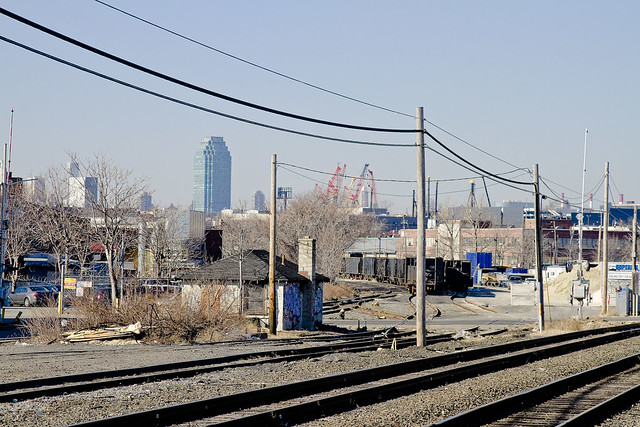
– photo by Mitch Waxman
Once upon a time, this wasn’t the proverbial “wrong side of the tracks”, rather this was the center of town. 18th century residents would ask “what on earth could have happened to Maspeth Creek” were they able, and “where is the Town Dock which DeWitt Clinton himself used- where is it”?
What happened?

– photo by Mitch Waxman
19th Century residents and passerby would inquire what disaster occurred, that Haberman’s and Nichols Chemical and all of Berlin and Blissville have disappeared and been forgotten? What has happened to the great factories, the mills, and the hustle and bustle? Where have all the railroads gone, can one paltry freight line actually be charged with servicing all of Newtown Creek?

– photo by Mitch Waxman
For your humble narrator, a good place to ponder this sort of question has always been the Clinton Diner.
This little oasis has hosted a full group from a bus tour I helped conduct, acts a central meeting point for all sorts of Newtown Creek functions, and has provided a much needed cup of coffee and clean rest room to a half frozen yet quite humble narrator on more than one occasion.
It’s also sitting pretty much on a shoreline that Maspeth Creek once flowed past.

– photo by Mitch Waxman
Accordingly, a “Happy Valentine’s” day shout out to the Clinton Diner is offered today.
It would be meaningless to offer you shots of its interior as it has been featured more than once in the cinema. Witness below the trademark dolly shot of Martin Scorcese in Goodfellas… The window booth that DeNiro and Liotta are sitting in is the one with the “Go Giants” signage in the shot above.
And a happy valentine’s day greeting is offered to you as well, lords and ladies… or a giddy Lupercalia.
The Clinton Diner is found at 5626 Maspeth Ave., Maspeth, NY 11378-2248 (718) 894-3475
traitorous somnolence

– photo by Mitch Waxman
On one of the lonely transmigrations which your humble narrator famously engages in, actually vast pedestrian journeys across the concrete desolations of Western Queens, the walk up 58th street- the former Betts Avenue of colonial era Newtown- might be the loneliest of all. Rimmed by polyandrions of gargantuan acreage, this street hosts no sidewalk to speak of and one must pick ones way in the manner of some roadside mendicant. It is a valley whose cliffs are the masonry walls and iron gates of cemeteries.
This neighborhood is neither Woodside nor Maspeth, it is the angle found between them.
A personal preference is marked for the Eastern side of the street, which follows the stout iron of Mt. Zion’s fences.

– photo by Mitch Waxman
The former home of the so called Maspeth Gypsies, a tribe of Romani whose expulsion by Police in the early 20th century is spoken of in hushed whispers by the Centenarians of ancient Maspeth, Mt. Zion is a cemetery set aside for adherents of the Hebrew faith. It is located across the street from the vastness of 3rd Calvary, a Catholic cemetery. Mt. Zion seems crowded, due to the Hebraic tradition of installing a single occupant in a grave, unlike the Roman Catholic institution across the street.
Its residents, at least in this section of the cemetery, are long gone- most of the stones speak to their passing away in a time period long before even rumors of a Second World War became extant in the community.

– photo by Mitch Waxman
Peeking through the rotting iron of the fences while trudging along the other day, your humble narrator noticed this small offering hidden away between the cast iron palisade and the first row of graves (or last, were you within the parcel).
Similarities to other instances of peasant magick at St. Michael’s Cemetery in Astoria which have been detailed in prior Newtown Pentacle postings should be remarked upon.

– photo by Mitch Waxman
Probably “Afro-Cuban” in origin, the possible etymology of this odd tableau is betrayed by the presence of the Cigar. Tobacco plays a large ritual role in the so called syncretic faiths of Latin and Caribbean religions, and the manufactured item is often used as an offering to the Orisha or Loa- as a symbol of sacrificial wealth or as an embodiment of the virility or power of the magick worker.
Of course, sometimes a cigar is just a cigar, as the oft quoted (and incorrectly attributed) Freudian saying goes.

– photo by Mitch Waxman
The aluminum pan leaning against the monument contained a burnt offering of some kind, which appeared to be a textile wrapped around something occluded from view, and mingled with a piece of thin wood or perhaps the shell of a coconut which has been cut into some sort of odd shape.

– photo by Mitch Waxman
A closer shot of the arrangement. It would appear that some sort of accelerant was used to accomplish the combustion, something that would have burned off quickly like liquor. The fabric seems charred or singed more than immolated, as if the flames were extinguished quickly.
Of course, your humble narrator is no fire inspector nor arson investigation expert (or an authority on afro-cuban syncretic religious practices for that matter), so these callow observations should be considered mere speculation.

– photo by Mitch Waxman
This is not the first time which arcane leave behinds have been personally observed along this wall, which you’ll notice is constructed out of tombstones. A photo has been run here of a hand carved mortar and pestle which contained an odd ashy substance. The image dates back several years which implies that acolytes and devotees of whatever these forces which are being invoked here, in the heart of the Cemetery Belt, have been at work for a very long time.
One wonders, and more than wonders- could the so called Maspeth Gypsies tell us a thing or two about these legend haunted lowlands found at this angle between Woodside and Maspeth?
wild dances

– photo by Mitch Waxman
It’s Maritime Sunday again, here at your Newtown Pentacle, a weekly post which focuses in on and examines some aspect of NY Harbor- or the Sixth Borough as our friends from Tugster call it.
As many of you know, your humble narrator is quite the enthusiast for such matters, and serves as a Steering Committee member for the Working Harbor Committee. This role and set of interests often puts me in a position to witness and photograph interesting circumstance around the harbor, which these “Maritime Sunday” postings endeavor to share.
Today’s spotlight is cast upon the Moran Towing Tug “Kimberly Turecamo”.

– photo by Mitch Waxman
There are quite a few tugs with the surname Turecamo that are operated by Moran Towing, the result of a merger between two towing companies in the age of corporate expansion and conglomeration. The founder of Turecamo Coastal was born on an island in the Tyrrhenian Sea called Isola Lipari, part of the Aeolian Archipelago that straddles the distance between Mount Vesuvius and Mount Etna in fabled Italy. Lipari has a long and sordid history, a story which stretches back in time to the Estruscans, Greeks, and the Romans. The Island was once conquered by Arab Pirates, after all.
This of course, has nothing to do with the Tugboat Kimberly Turecamo, its just nice to know where certain folks hail from. The guy from Cake Boss on the TLC Channel, and Natalie Imbruglia- their dads come from Isola Lipari as well.
Turecamo Coastal and Harbor Towing Corporation was foundeded by Bartholdi Turecamo, who immigrated from Isola Lipari, a small island between the northern coast of Sicily and the southern tip of Italy. As an immigrant Turecamo found work in road construction around New York.

– photo by Mitch Waxman
Kimberly Turecamo, the tug, is from Louisiana. She also was one of the ships which assisted in the evacuation of lower Manhattan on September 11, 2001. One of the great stories from that day, it’s only the persistent modesty of those sailors who managed to move more than a quarter million people out of harms way that prevents this story from pervading the popular imagination.
Sailors are a different breed, and immodest only amongst themselves.
from morantug.com
It is reported that as many as 300,000 people were evacuated from lower Manhattan during an eight hour period following the attacks. When the evacuation first began, Moran had 11 tugs on the scene, each taking as many as 100 people to designated sites around the port, and to New Jersey. “After the initial surge of evacuation, we went down to about five boats on the scene, still working around the clock, and after four or five days we still had two boats working there at the end,” said Keyes. “As soon as the people were taken off, the boats were used for moving emergency crews, equipment and supplies.”
Moran tugs logged a total of 256 hours during the operation, according to Keyes. The tug Turecamo Boys was on the scene longest, with 84 hours logged, followed by Marie J. Turecamo with 51 hours and Margaret Moran with 49 hours. Other tugs involved with the evacuation were Nancy Moran, Brendan Turecamo, Kathleen Turecamo, Diana Moran, Kimberly Turecamo, Miriam Moran, Turecamo Girls and Catherine Turecamo.

– photo by Mitch Waxman
The iconic white “M” on their black stacks, coupled with the scarlet hull and white detailing, make Moran tugs the easiest craft to spot in NY Harbor. As mentioned in the past, there is just something iconic about them, and if you were to ask someone to describe a tugboat blindly- they would probably craft an image of something not unlike the Kimberly Turecamo.
Built in 1980, by McDermott Shipyard of Morgan City, Louisiana (hull #255) as the Rebecca P.
The tug was later acquired by Turecamo Maritime where she was renamed as the Kimberly Turecamo .
In 1998, Turecamo Maritime was acquired by the Moran Towing Corporation where the tug retained her name.

– photo by Mitch Waxman
Kimberly Turecamo is at work in the shot above, guiding a fuel tanker through the narrow Kill Van Kull waterway. The Kill Van Kull at it’s narrowest point, between New Jersey and Staten Island, is a scant thousand feet wide and might boast a depth of merely 40-45 feet above the soft bottom. The cargo ships which come here in pursuit of trade are ocean going vessels whose titan engines would provide a lack of subtlety in handing such conditions.
The Kill Van Kull is a tidal straight, incidentally.
from morantug.com
Moran commenced operations in 1860 when founder Michael Moran opened a towing brokerage, Moran Towing and Transportation Company, in New York Harbor. The company was transformed from a brokerage into an owner-operator of tugboats in 1863, when it purchased a one-half interest in the tugboat Ida Miller for $2,700.
At the time, the Harbor was alive with ships – many of them still sail-powered – and Moran’s enterprise soon grew into a fleet of tugboats. It was Michael Moran himself who painted the first white “M” on a Moran tugboat stack, reportedly around 1880.

– photo by Mitch Waxman
An interesting bit of trivia about the harbor of New York is that its natural depth is a mere 17 feet, but was deepened by the actions of dredging to 24 feet before the end of the 19th century. The large ships of modernity utilize shipping channels which are deeper than the surrounding area, in particular the Ambrose Channel- a 1914 construct.
Ambrose leads the way in from a spectacular natural formation, a depression on the continental shelf called the New York Bight.
The Bight is clove by the terrifying depths of the Hudson Canyon.
from wikipedia
The western edge of Newark Bay was originally shallow tidal wetlands covering approximately 12 square miles (31 km2). In 1910s the City of Newark began excavating an angled shipping channel in the northeastern quadrant of the wetland which formed the basis of Port Newark. Work on the channel and terminal facilities on its north side accelerated during World War I, when the federal government took control of Port Newark. During the war there were close to 25,000 troops stationed at the Newark Bay Shipyard.
Project Firebox 31

– photo by Mitch Waxman
Kingsland Avenue in Brooklyn has seen more than its fair share of apocalyptic infernos, as if regular readers of this blog haven’t heard enough about the Sone and Flemings or Locust Hill refinery fires, and never has a firebox been situated in a more appropriate location. There is still a huge and threatening petroleum industry present in modernity, and this lone sentinel is a first responder on permanent vigil should “it” hit the fan.
cryptical books

– photo by Mitch Waxman
Just to affirm that your humble narrator is a multi disciplinary geek, whose nerd credentials cross into multiple devotions and subjects, today’s post takes us to the Hudson River and specifically- Esopus Island. An unremarkable spit of rock sticking out of the water not far from Kingston, Esopus nevertheless is a touchstone for high weirdness.
If these shots were taken in 1918 rather than 2010- one would have seen a bizarre Englishman crawling along the shorelines painting “Do What Thou Wilt Shall be the Whole of the Law” and “Every Man and Every Woman is a Star” on the stony outcrops in red.
from wikipedia
Crowley began another period of magical work on an island in the Hudson River after buying large amounts of red paint instead of food. Having painted “Do what thou wilt” on the cliffs at both sides of the island, he received gifts from curious visitors. Here at the island he had visions of seeming past lives, though he refused to endorse any theory of what they meant beyond linking them to his unconscious. Towards the end of his stay, he had a shocking experience he linked to “the Chinese wisdom” which made even Thelema appear insignificant.

– photo by Mitch Waxman
The self proclaimed “Great Beast” himself, Aleister Crowley spent much of the First World War in New York City, and the wild speculations that he was acting as an agent of British Intelligence during this time just might hold some water. In 1918, that horrible man decided on a “great magical retirement” (he had run out of money and driven at least two women to alcoholism and madness), shaved his head, and borrowed a tent and canoe from one of the many friends whom he cuckolded.
Here’s an image from a postcard depicting Esopus Island in 1907. In his diaries, Crowley called it Oesopus.
from wikipedia
Aleister Crowley (/ˈkroʊli/ kroh-lee; 12 October 1875–1 December 1947), born Edward Alexander Crowley, and also known as both Frater Perdurabo and The Great Beast, was an influential English occultist, astrologer, mystic and ceremonial magician, responsible for founding the religious philosophy of Thelema. He was also successful in various other fields, including mountaineering, chess and poetry. In his role as the founder of the Thelemite philosophy, he came to see himself as the prophet who was entrusted with informing humanity that it was entering the new Aeon of Horus in the early twentieth century.

– photo by Mitch Waxman
Crowley arrived on the island with scant supplies, and was known to have made a trip back to New York at least once to secure needed items. Local farmers, concerned and curious about their new neighbor, brought comestibles to the odd fellow- a charming and neighborly Yankee tradition. Curiously, the hermit spent his time mediating and translating an ancient Chinese text for his own amusement.
Crowley reported that he experienced an epiphany here, something that would overshadow even his own mystical revelations. Which brings us back to H.P. Lovecraft. For two people who are never supposed to have met, Lovecraft and Crowley had a LOT of friends in common.
from dec.ny.gov
Atlantic sturgeon are the stuff of myth and legends. They are the largest fish to regularly inhabit the Hudson River, reaching 10-12′ in length and weighing in excess of 350 lb. They are a primitive-looking and wonderfully adapted estuarine creature belonging to an order of fishes whose evolutionary origins reaches back at least 100 million years. Sturgeon grow very slowly, taking as long or longer than humans to reach maturity, and rivaling us in longevity, surviving 50 years or more in the wild. The river channel around Esopus Island, up to 60 feet deep, is a known congregation area for adult Atlantic sturgeon.

– photo by Mitch Waxman
Supposedly-
It would seem that one of the simple Yankee farmers who brought Crowley food and provisions was one Paul Rhodes, who would later become a correspondent and friend of Mr. Lovecraft. Rhodes created the only contemporaneous cinematic adaptation of one of Lovecraft’s tales- “The Other Gods” which was screened just once in 1924 for Mdm. Blavatsky’s Theosophical Society.
This should be taken with a grain of salt, as I haven’t been able to find independent confirmation of this timeline and it might be modern imposture. Regardless, witness the short film at the links below- if you dare.


 The Newtown Pentacle