Archive for 2016
uncertain factors
Wash out, man, wash out.

– photo by Mitch Waxman
You’ll recall that at the end of February, there was a Götterdämmerung of a rain storm, one which produced quite a bit of coastal flooding. I got a phone call the day after the storm that declared that the shoreline at Astoria Park had fallen victim to the event. This would be some storm, thought I, which could bring a wave of water up the 15-20 feet from Glass Beach at Hells Gate all the way up to Shore Road.
I had to go take a look.

– photo by Mitch Waxman
From where Newtown Pentacle HQ is located, on Astoria’s Broaday in the 40’s, it’s only a small “schlep” to get to Astoria Park. In a car, it’ll take you around ten minutes, but only because of lights and traffic. It’s a 30 minute walk, or 45 if you lazily saunter.
Along the diagonal path, there’s a lot to see, and since Astoria rules… why not?

– photo by Mitch Waxman
As mentioned above, Shore Road is elevated some 15-20 feet over the East River shoreline at Hells Gate. The rocky beach down there is littered with jetsam, it would be flotsam if it was still suspended in the water column, and the smaller particles of jetsam are mixed in with the gravel and small stones with little bits of river polished glass – hence “Glass Beach.”
Regardless, one reiterates – that would have to be one HELL of a storm to bring the water all the way up to Shore Road from Hells Gate.

– photo by Mitch Waxman
Observations were enacted, and there were two wash outs which had deposited a terrific amount of quite slippery mud onto both sidewalk and street. The trail of soil and vegetation led back uphill to Astoria Park itself, which actually jibed with what I thought to have been the case. It was the park that flooded during the heavy rains, and the river had not in fact risen. If the East River rose 20 feet, waves would be lapping away at Steinway Street’s intersection with Northern Blvd. and we’d be talking about the Sunnyside Yards lake.
Mayor de Blasio would, of course, call it the Sunnyside Yards lake and resort and announce his intentions to install waterfront affordable housing along Skillman Avenue.

– photo by Mitch Waxman
Fairly obviously, the two mud and water flows emanated from the two Bridges over Astoria Park, which gathered the storm water and then fed it down their outfall pipes into and onto the soil in Astoria Park, which caused the “lahar” or slippery mud deposits which were observed on Shore Road.
“follow” me on Twitter- @newtownpentacle
unknown respondent
Sludge Boats, baby, Sludge Boats.

– photo by Mitch Waxman
These shots are actually from the height of that shoulder injury period last month, and represent a desperate desire one acted upon to “shake it off” by indulging in a bit of exercise. The weather was less than cooperative from a light point of view, and the affected limb was less than pleased at the rest of my body moving around, so I decided that since I was in the “hell of pain” I’d simply head over to Hells Gate and indulge the horror.

– photo by Mitch Waxman
Luckily for my diversion starved and somewhat depressed state of mind, the MV Red Hook was observed while debarking from the Wards Island dewatering facility across the river. Wards Island is the end point for the sewage sludge process, which is operated by the NYC DEP. Centrifugal machines are fed the material, which has the consistency of syrup or warm honey at the end of the thickening process at the various neighborhood sewer plants, which is carried here by the DEP’s fleet of “Honey” or Sludge boats. The dewatered material is compressed into “cakes” and sold for use as fertilizer on non food crops such as cotton and Christmas Trees.

– photo by Mitch Waxman
MV Red Hook is one of NYC’s older generation of Sludge Boats, although it’s the newest of its type – having come online in 2012. The newer class of Sludge Boats has been discussed here at Newtown Pentacle before.
from NYC.gov
The Red Hook sludge vessel was built over a three-year period in Brownsville, Texas by Keppel AmFELS. Once completed, it took seven days to make its way to New York City, arriving on November 19, 2008. The vessel has recently completed post-delivery dry-dock inspections and adjustments at the Brooklyn Navy Yard and is ready for service. Each six-person crew consists of a captain, chief engineer, assistant engineer, mate and two mariners. Crews work a 40-hour week divided into 14, 13, and 13 hour shifts. The Red Hook is slightly over 350 feet long, about 53 feet wide, with a depth of slightly over 21 feet. It has eight storage tanks with 150,000 cubic foot capacity equivalent to 1.2 million gallons. The Red Hook weighs over 2,098 long tons and is designed to travel at 12.75 knots or approximately 15 miles per hour. On a typical week, each vessel makes 14 round trips and visits eight wastewater treatment plants.

– photo by Mitch Waxman
All of the DEP’s honey boats will find themselves heading to or from Wards Island periodically, after making their rounds at one of the City’s 14 sewer plants. Hells Gate is a great place to spot them, and Shore Road along Astoria Park is a great place to observe Hells Gate.

– photo by Mitch Waxman
There are many who would agree with me, in my assertion that the view from Shore Road rocks.
“follow” me on Twitter- @newtownpentacle
catenary connections
Just one more from the Creeklands, in today’s post.

– photo by Mitch Waxman
Last weekend, a humble narrator somehow found himself up in Ridgewood on Fairview Avenue off Linden and it was decided that I’d walk home to Astoria since it was a fairly nice afternoon. It’s literally “all downhill,” after all, and not that far. My path carried me down off of the proverbial “ridge” for which the community is named, and down through the valley of tears which the loquacious Newtown Creek flows through.
Once again, my path found me in West Maspeth (or Berlin). Topography is something I notice continually as I wander around Queens, and the area around Newtown Creek is shaped like a sort of soup bowl. Proper Maspeth, as in the Mount Olivette Cemetery area along Grand Avenue, is embedded into the terminal moraine of Long Island – true rock. All of LIC, Astoria – pretty much anything west of the high point in Maspeth, is sitting on a giant pile of glacial till which is supported on the back of a giant underground Boulder called a craton.
Ridgewood literally sits on a rocky ridge which leads north/east to the Maspeth Plateau. Seriously. The British mapped it all out during the Revolutionary war.

– photo by Mitch Waxman
Having a couple of hours of light left before the vampires began to awaken, I decided to wander around a bit after turning up on 48th street. “Up” is apt, as you are climbing away from one of the lowest points in all of New York City which is nearby Maspeth Creek on 49th street. 48th street continues to rise until it meets the Long Island Expressway near Third Calvary Cemetery and crests at Queens Blvd. in Sunnyside (which is built on another elevation, but an elluvial one).
The best way I can describe the up and down nature of the hills leading from Ridgewood to Astoria would be ripples in stone rather than water with Newtown Creek at the center. There’s a conflicting set of ripples leading away from the East River and Bowery Bay which apparent in Ravenswood/Dutch Kills and Astoria, respectively. Hunters Point is flat as a pancake.

– photo by Mitch Waxman
Turning onto 55th avenue, carven into what was once known as “Berlin Hill,” this little house was encountered at 46th street. Before you ask, I have no idea what’s up with the office chair tied to the pole. There are just some things you don’t want to inquire into too deeply. It always amazed me – here in the middle of what can only be described as a “post industrial and apocalyptic” landscape defined by cemeteries and highways and a nearby superfund site – here – people actually live here. Funny thing is, it used to be worse, when the acid factory was still up and running a couple of blocks away.
The people who live here must… have to be some of the most resilient folks on the earth.

– photo by Mitch Waxman
This is DUKBO – Down Under the Kosciuszko Bridge Onramp. A couple of hundred thousand vehicle trips a day rumble through here on the highway alone. There’s heavy trucking businesses, like UPS, and other huge warehouse operations that are busily at work here twenty four hours a day, and there’s nearby freight rail tracks operating at street grade. Enormous fleets of concrete trucks are based here, and the number of light trucks and automobiles that roll through the local streets are uncountable.
And people live here.

– photo by Mitch Waxman
44th street near 54th road, and a line of 20th century row homes which are spectacularly well kept. Acros the street is a yard hosting tower cranes, and a block away is the LIE interchange ramp with the BQE. This is about midpoint on Berlin Hill, and 44th street used to called Locust Street hereabouts.
Locust continued north back then, heading for Sunnyside, before the “House of Moses” first landed on the neighborhood back in the 1930’s. Moses kept coming back to this neighborhood, smashing his roads and bridges into it, until the early 70’s.

– photo by Mitch Waxman
The border between Newtown and Long Island City was just a block away – the Kosciuszko Bridge sits atop it. On the LIC side is Laurel Hill (Calvary Cemetery) in Blissville.
This section of West Maspeth was formally part of Newtown (prior to NY City consolidation) – the municipal entity which had evolved from Dutch colonial to British and later American governance. Newtown county was once enormous and contained a good chunk of what is now Nassau County, but in the context of which I’m speaking – it’s the municipality which was centered in Elmhurst near the intersection of Queens Blvd. and Broadway.

– photo by Mitch Waxman
The first time I wandered through this area, many years ago, I had a very odd conversation with a very skinny and somewhat disheveled fellow standing in front of the home on the corner of 44th and the Queens Midtown Expwy. service road that is pictured above.
He insisted that “he knew that I knew that he knew that I know, and that he knew things which I didn’t know nor could I understand what he knew, but he knew that I knew that he knew and he was ok with that.” I thanked him and moved on, after affirming that he didn’t want me to take his picture.

– photo by Mitch Waxman
The high point of this hill/ripple once called “Berlin” is up on 46th street. As a point of interest, there is no 45th street found between 44th and 46th hereabouts – no doubt to confuse invaders.
As opined endlessly in prior posts, the DOB records for western Queens are spotty, but as far as I’ve been able to determine – the house pictured above and below on 54th avenue dates back to 1915.

– photo by Mitch Waxman
On other rambles through this section, kid’s bicycles and toys have been noticed on both porch and staircase. Not sure if it’s still occupied, but there’s a car parked in the driveway on the other side of this home. Notice how there are no side windows? It’s the last survivor of a series of old row houses – a type of working man’s quarters which folks from New Orleans might call a “shotgun.”

– photo by Mitch Waxman
Passing under the Kosciuszko Bridge, via “used to be 43rd street” I made my way towards 43rd street and headed back to Astoria.
Next week – something completely different!
“follow” me on Twitter- @newtownpentacle
illegitimate assertion
Once, you’d tell the operator you wanted to speak to Hunters Point 3342.

– photo by Mitch Waxman
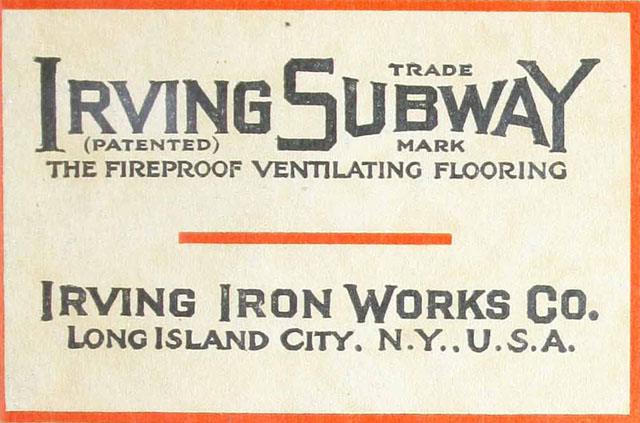
Walter E. Irving opened for business along Newtown Creek’s Dutch Kills tributary in LIC back in 1907, but at first his operation was just another iron and steel works. It wasn’t until 1914 that the company became commonly known as either “Irving Subway Grating” or “Irving Iron Works.”
Their honeycomb steel walkways were offered to both the Subway (as the name would imply) people and to maritime customers. It was the maritime world which made the company rich. Irving, a structural engineer, actually started his business in Astoria in 1902, but it was here on Dutch Kills in “America’s Workshop” that he had both rail and maritime access, and that’s why the company centered its operations in LIC.
Here’s a shot of the place from back in 1915.

– photo by Mitch Waxman
Back then, and by then I mean 1914, 51st avenue was called Third Street, and 27th street was called Creek Street.
There was no Long Island Expressway or Midtown Tunnel, and railroad freight tracks snaked around on every street. If you’re in the neighborhood today, you can still find a lot of those old tracks blistering up through the modern day asphalt. There’s “Belgian Blocks” paved streets here in what I’ve long referred to as “the empty corridor” as well. Belgian Blocks are colloquially referred to as “cobblestones.”

– photo by Mitch Waxman
At its height, when their patented honeycomb steel lattice plates were being installed on merchant and naval ships, and into factorys and industrial boiler rooms, Irving’s facility commanded some 22,000 square feet of the most valuable industrial bulkheads in America here in LIC.
It remains one of the largest properties along Dutch Kills to this day, but as you’ve noticed by now, Irving Subway Grating has left the proverbial building.

– photo by Mitch Waxman
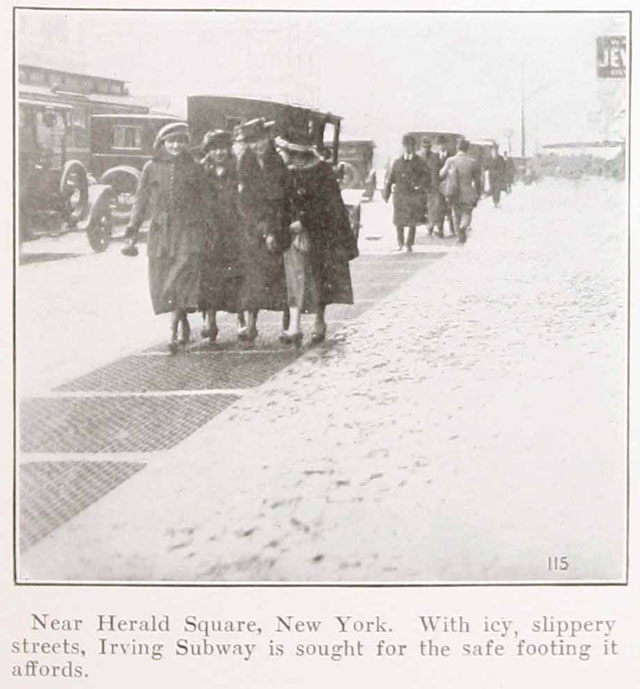
In the early 20th century, Irving employed a staff of about 300, and the facility produced something like 50,000 feet of the honeycomb flooring material a month. The value of the grating was that water, light, and air could move through it – making it perfect for the exterior decking and ladder steps on ships – and that while it had the same strength as a plate of steel, it weighed a significant amount less. It was also appropriate for use in boiler rooms and other industrial applications due to its permittance of ventilation.
Irving also found a place for his products in the steel decking on vehicle and rail bridges, and the United States military would lay his grating down into sand and soil to create stable runways for aircraft in battle zones. Irving received accolades from the War Dept. for his industrial contributions to the Aliied forces’s victory during the Second World War. The NY Subway system, as the name of the product would imply, ate Irving’s products as fast as he could make them. If you work in Manhattan’s Flatiron district, the Tenderloin, or Herald Square, you’re probably already familiar with Irving.
Build a better mouse trap, I guess.

– photo by Mitch Waxman
A Mexican conglomerate called HARSCO bought Irving, and its portfolio of patents, back in 1966. Irving continues as their IKG Industries division today, and they still manufacture those steel grids. I cannot seem to determine exactly when the Irving Plant at Dutch Kills was shut down, nor accurately ascertain the current owners of the property beyond some LLC holding company. There was an enormous fire here in 2009, which burnt away a lot of what was left of the site.
Here’s what I saw of the pre fire Irving Works back when I first starting getting into this whole Creek thing, in a post that clearly illustrated my neophyte status back in 2009.

– photo by Mitch Waxman
Over the last seven years, I’ve watched the Irving site being slowly harvested by metal collectors – The Crows – who have grabbed every inch of copper and aluminum that they can reach. There’s a security fence with a giant hole cut in it along 27th street, but the chained up shopping carts and well fed cat colony nearby the hole indicate that somebody is living here in the ruins.
As I was by myself when these shots were gathered… well… let’s just say it’s not a great idea to barge into a homeless camp in LIC when you’re all alone, so I stuck to the front of the site nearby the hole in case I had to exit quickly. Next time I have a chum along with me, however, I plan on doing a bit more exploring – mainly because there is a lot of cool graffiti in there I want to check out.

– photo by Mitch Waxman
Scenes familiar, and loved, in Long Island City.
“follow” me on Twitter- @newtownpentacle
potential responsibility
Creek Week continues, in today’s post.

– photo by Mitch Waxman
After visiting the Kosciuszko Bridge project, 57th avenue, and then Railroad Avenue, a humble narrator’s dogs were barking and a generally homeward course was adopted. As usual, that meant swinging down Borden Avenue and cutting over to Skillman Avenue on the way back to raven tressed Astoria.
My favorite sections of Newtown Creek to photograph are found in LIC, along this particular tributary of the troubled waterway – called Dutch Kills.
It’s something about the light, I guess.

– photo by Mitch Waxman
I haven’t been around here in a few weeks, and I discovered that a formerly fenced in section of the shoreline adjoining the Borden Avenue Bridge had been cleared away, which offered a few points of view which would have formerly required illegal trespass to capture.
Given such an opportunity, a humble narrator will always take it.

– photo by Mitch Waxman
Looking west, towards what I call the “empty corridor” found under the Long Island Expressway truss.
The LIE is some 106 feet high in this spot over Dutch Kills, and was built so to accommodate the stacks of ocean going vessels which were headed for the Degnon Terminal Turning Basin which is about a half mile away. The Federal War Dept. also required this particular height for the possibility of installing warships in the canal in order to protect the industrial sector in case of foreign invasion forces entering New York Harbor (a real worry, prior to the Atomic Bomb).

– photo by Mitch Waxman
Looking eastwards, you see the sort of scene most life long Queensicans would associate with the words “Newtown Creek.” Still, check out that tuney old truck – cool, huh?
“follow” me on Twitter- @newtownpentacle


 The Newtown Pentacle