Archive for 2016
unsupervised circuit
Life long relationships, ending, in today’s post.

– photo by Mitch Waxman
Back in the late 1980’s, my first job in advertising involved making photostat enlargements and reductions for the senior designers, art directors, and production artists at an agency which specialized in “B2B” marketing involving food service. My job title was “stat boy” and my function, beyond shooting “stats” in a darkroom, was to support whatever the more senior people needed. I worked directly for the “Studio Manager,” who was a friend from College that had graduated a couple of years ahead of me and offered me my first “leg up” into the business. He would often remind me that “shit rolls down hill” and accordingly I would end up performing menial tasks that he was too busy for – ensuring that our supply closet was stocked with pads of paper or paste up supplies, running job bags around the agency for sign off’s and approvals from the various powers that be, that sort of stuff. Think Jimmy Olsen at the Daily Planet, that was me back then. Overall, the job was worth doing, and it taught me a lot about how to survive as an artist in NYC.
One day, the Studio Manager sat me down in front of a brand new Macintosh computer, handed off a pile of floppy disks, and the task was to install a suite of software on the new Mac – which was the very first one that the agency had purchased. That was the first time that I ever opened a new program called “Photoshop” and it was also the first step towards what I ended up doing for a living as a digital production artist and photo retoucher. I’ve seen the entire conversion of the industry from “paste up and mechanicals” to full digital and web production over the intervening decades.
I’ve spent most of my professional life in front of an Apple computer – this post is being written on an iPad, for instance, and every photo you’ve ever seen from me was edited and processed on a desktop Mac tower.

– photo by Mitch Waxman
For a while there, things weren’t going so good for Apple. A lot of bad decisions, coupled with horrendous customer relations, had almost put the computer manufacturer out of business.
Steve Jobs returned to the company, and brought it back from the brink. The phones came along, and Apple suddenly became a mainstream company, and flush with cash. Jobs died, and a new management team took over at Apple, who have unfortunately returned the company to the bad old days. Form has taken primacy over function with this new team, and the entire concept of producing something which could be termed a “professional workstation” began to suffer. Every refinement of the core operating system released over the last decade has been crafted with the idea that its only function is to “monetize” the device, as related to selling me commercial entertainment media, and they have specifically removed capabilities from the device which were and are “mission critical” to my professional life.

– photo by Mitch Waxman
Recent encounters with the company – one where they informed me that a three year old workstation was “obsolete” and that even a simple component replacement would be impossible by the end of this year, another where a two and half year old iPhone with a defective battery (factory issues at the time of manufacture) was also obsolete – have soured me on the whole idea of Apple. The applications which I use in my daily round, the so called “Adobe Suite,” have become platform independent in the decades since a humble narrator was commanded to install them at that B2B agency off of floppy disks, and I’m not at all sure that I want to continue paying premium prices for a device which is considered obsolete by its manufacturer less than 36 months after opening the box.
Why buy a Ducati when a Buick will do?

– photo by Mitch Waxman
These shots, of midtown Manhattan, were gathered while killing time and ruminating on my relationship with Apple at the end of December.
I was waiting out a battery replacement for the aforementioned iPhone, which – it should be mentioned – was performed flawlessly and took exactly one hour, but cost approximately one seventh of what I originally paid for the device. I pushed the folks at the Apple Store for a replacement device, but was told that this would be impossible, but that I could trade my old phone in for a couple of hundred bucks which could be applied towards the purchase of a new one (which would leave a $500 differential). Alternatively, they offered me entry into a contractual program, which would entail me giving the company $30 a month forever afterwards, that would ensure that whenever they released a new model I would receive one. That would mean a $360 per annum payment to Apple, forever and ever.
That’s a corporate tax, and the last straw, frankly.

– photo by Mitch Waxman
One is less than sanguine about being overly exploited by a corporation, but if the service is desirable or needed… I have no problem paying my accountant, nor doctors, nor my local bartender, baker, or butcher what they’re due. Should my bakery suddenly announce that they will require me to pay them a monthly stipend for the privilege of returning moldy bread, however, I will find a new place to shop for my cookies and pie.
Sometimes, one must address the costs of things costing too much, and remember that the costs of customer retention are not too much for a large company. There are other options, always. I’ll miss Apple.
“follow” me on Twitter- @newtownpentacle
squamous aspiration
Constantly disappointing, and complaining, that’s me.

– photo by Mitch Waxman
Winter boredom is anathema to one such as myself. The cold and dark, the thirty five pounds of insulation, the constant flux between the dry and cold air of the out of doors contrasted with the high temperature and humidity found within. The constancy of a drippy nose. Bah.
It’s always been a bit of a mystery to me why some feel the need to jack the heat up to the mid 80’s inside of structures, knowing full well that inhabitants and visitors will be wearing clothing appropriate for the out of doors. The worst culprit on this front seems to be the subway system, where you’ll step off of a station platform whose atmospheric temperature is commensurate with the freezing of water and suddenly find yourself in a hurtling metal box whose ambient air mass is heated to something approaching that of an afternoon in July. Add in the sniffling, coughing, and dripping orifices of the mob…
Well, I’ve often opined that what this City needs is a good plague – and I’m fairly certain that one will eventually start on a Subway in Queens during middle January. Don’t touch that subway pole, if you can help it.

– photo by Mitch Waxman
Ultimately, one is awaiting a particularly personal moment which occurs every year, when a humble narrator’s boredom grows so intense that he has little choice but to brave the cold and head back outside. At this juncture, however, the moment hasn’t arrived, and one has been spending his time reading about the Second Empire period of French history, Otto Von Bismarck, and researching the chemicals which the seething cauldrons of industry produce that are classified as petroleum or coal distillates. One does a lot of reading during this time of the year.
I’ve also read up a bit on Kazakhstan, the Crimean Tartars, and the Deccan Plain on the Indian subcontinent. Briefly, I also looked into the Chicago stock yards and the post civil war meat packing industry as well as the suffragettes of 19th century Brooklyn Heights. I continue to study the rise and fall of the Roman Catholic empire in New York City, which is fascinating. Also reiterated will be the fact that if you enjoy gelatin based desserts – never, ever, inquire too deeply as to what gelatin actually is nor how it is produced for you will never, ever, eat it afterwards. Jello brand gelatin was invented by Peter Cooper in a glue factory on Newtown Creek in the 19th century, which is all you really need to know about it. Isenglass is also soul chilling.
Sexy stuff, I know, but the so called “fin de siècle” of the late 19th and early 20th centuries are when the foundations of our modern civilization were laid down and it remains a certain benchmark from a cultural point of view. Labor unions, representative government (both socialist and capitalist), industrial warfare – all of it was imagined up back then. It’s also when the environment surrounding us began to die off due to anthropogenic reasons. The dominoes were lined up, quite unconsciously, back then for the end of our world.

– photo by Mitch Waxman
“Fin de siècle” is a French expression which gained popularity in the first decade of the 20th century, a part of the run up to the Great War, which indicated that the “end of the cycle” or “end of an age” was apparent. It’s part of a phenomena known as millennial fatalism, wherein a culture believes that the “end of the world” nears. It’s difficult to not think that our culture may have reached its breaking point, given what we see on the nightly news. The fatalism and general horror which the various news organizations pump into our heads is, of course, not accidental. Don’t forget that most of the news gathering and dissemination companies are owned and operated by defense contractors.
I’ve always been an optimist, however. What other choice have you got, ultimately? Winter will come and go, and then… flowers and puppies. That’s the way that the wheel of the year spins, after all.
“follow” me on Twitter- @newtownpentacle
measures appropriate
The Astoria Tumbleweeds doth roll, and the wheel of the year turns.

– photo by Mitch Waxman
The gloomy skies of late December and early January are less than inviting in the City of Greater New York. Cold – and rain – coupled with a general sense of annual ennui and thwarted personal ambition, contribute to a dire outlook and general sense of malaise. Bones creak, tendons stretch painfully, and the extremities are rendered numb as vital fluids retreat towards the core. Regardless, a humble narrator marches forth, in pursuance of presenting the truth of our times in graphic narrative – at this – your Newtown Pentacle.
Raised in the Hebraic culture, it has always struck one such as myself strange that the Goyem cut down trees and drag them into their homes in December, only to cast the dearly held verge aside in January.

– photo by Mitch Waxman
The tumbleweeds of Astoria have been often mentioned here. The corpses of trees abandoned, and carried by the sciroccos of Queens which cause them to drift along the concrete hereabouts unheralded. Thirty, sixty, even ninety days hence – their dehydrated corpses will be observed still rolling around the “via publica” – stripped of their verdance. Wild agglutinations of kindling will be observed sticking out of snow banks, or adorning the abandoned fence lines of construction lots.

– photo by Mitch Waxman
As opined, the native art form of the borough of Queens seems to be illegal dumping, and never has this statement been truer than when the subject of Christmas trees and decorations is brought up. Observance of the habits and mores of the Sanitation department has revealed an unexplainable, and certain, reluctance to collect this particular specie of refuse. Officialdom encourages the gentry to bring the cast away trees to certain locations, usually accessible only by motor vehicle, for mulching in pursuance of creating compost.
As this would require effort on the part of the citizenry, it’s simpler for the average Queensican to just leave the thing on the sidewalk, or dump it along Skillman Avenue, and allow the wind to carry it away.

– photo by Mitch Waxman
Illegal dumping is something that a humble narrator sees everywhere he goes in the borough of Queens. Some of it is simply explained as emanating from low tier building contractors attempting to avoid the cost of disposing of construction waste – manifested as a pile of contractor bags filled with dry wall or plaster that you’ll see under a rail trestle or along an industrial facilities’ fence. There’s the domestic furniture as well, and odd agglutinations of paint cans and sometimes spoiled food stuffs. A recent change in the rules enacted by State and City Governments concerning curb side pickup will undoubtedly be feeding a new phyla of curbside dumping – electronics.
The State of New York recently changed the law regarding electronics disposal, which as of April 1st of this year, make it a fineable offense to place commonly held items on the curb for DSNY pickup. A full list of the offending items can be accessed here, and the City has created intake centers – one in each borough – for electronics to be disposed of legally. In Queens, it’s in College Point, which is fairly distant for most of us and impossible to access without a motor vehicle.
Get ready to witness a new flowering of the native art form of Queens this spring.

– photo by Mitch Waxman
The reason I call it an art form rather than a misdemeanor in our fair Borough is due to the careful placement and juxtapositioning of abandoned trash. Brooklyn? Haphazard and rushed dumping with nary a consideration for negative space. Manhattan and the Bronx? Disorganized piles and middens of trash placed with no aesthetic care. Staten Island? You don’t see a lot of illegal dumping on Staten Island, or at least I don’t. That’s because you’ve got a predominance of DSNY workers living there, and the garbage men like their nests neat.
“follow” me on Twitter- @newtownpentacle
sun choked
Consarned and new fangled gizmos – in today’s post.

– photo by Mitch Waxman
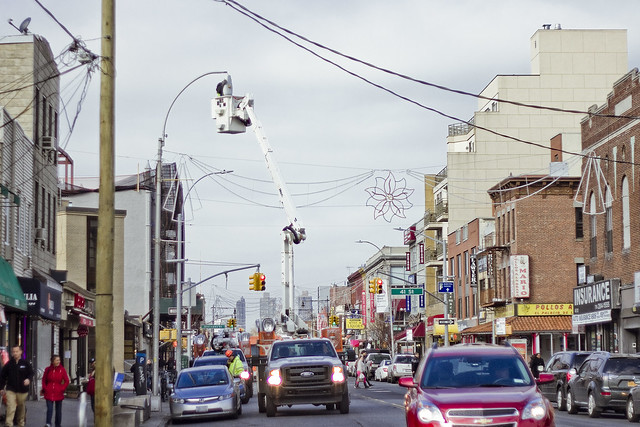
My pal Kevin Walsh of Forgotten-NY is the lamp post guy. You will tremble in your boots when he begins discussing “luminaires” and other mechanistic implementations designed to light the streets of the City of Greater New York. Saying that, here on Broadway in Astoria (and along 34th avenue) between Steinway and 48th street, the inestimable NYC DOT has recently installed the latest generation of street lighting – which are LED fixtures that replace the familiar sodium lighting which has long punctured the sepulchral darkness of Gotham.
– photo by Mitch Waxman
At the start of December, work crews from Weisbach – DOT’s contractor for all things electrical – were observed on the throroughfare in a “cherry picker” truck swapping out the old school sodium lights for the new LED ones. According to official sources “NYC DOT operates the largest municipal street-lighting system in the country, with 262,000 lights on City streets, bridges and underpasses, 12,000 in parks and 26,000 on highways,” and the City plans on replacing every single one of them with the new LED lights.
The effort is expected to reduce the amount (and cost) of electricity consumed in pursuit of lighting the streets by a significant amount, as well as reforming the “carbon footprint” of the municipality. It’s costing us tax payers about $75 million smackers to change out every light, but is expected to save about $6 million a year in energy costs.

– photo by Mitch Waxman
As you’d imagine, the gentry here in Astoria have been busy debating the relative merits of the new lighting. On the plus side, the LED’s produce a brighter light which is quite a bit “whiter” than the old sodium lamps. The actual color of the light is 4300 Kelvin, which is quite a bit “bluer” than the sodium lamps which produced the familiar (and warmer) orange yellow light that all New Yorkers are used to suffering in. The LED light is quite a bit better focused on the street itself, and from a photographic point of view – has brightened things up by around two stops.
Observation and conversation, however, have revealed that the new lights create quite a bit of glare. I wear glasses, so… bother.

– photo by Mitch Waxman
Non empirically speaking, the sodium lamps scattered their light in a globe of illumination whereas the newer lights are a bit more like a reading lamp in design. Drivers have reported to me that on rainy nights the new lights create a problem for them, windshield glare wise, but nothing insurmountable. There’s also people who just don’t like the new color.
Most of Astoria’s Broadway community seems fairly ambivalent/positive about the change, as a note, offering “why would I care, what can you do about it?” as a response to queries such as “what do you think about the new street lights?”.

– photo by Mitch Waxman
There are all sorts of theories on the effects which LED lighting on human perception. Like the shutter of a motion picture projector, the LED’s flicker at a rate which is just outside of normal human perception. Some say that the flicker induces a state of anxiety to the sensitive, but truth be told, I’ve tried to capture it using video capture and have been unable to perceive anything other than steady illumination – no strobing, in other words.

– photo by Mitch Waxman
On the plus side, the directed light is no longer illuminating the residential windows along Broadway, and since I live along the street – I can report that at night my windows are considerably darker than they used to be under the old sodium lights. Additionally, the streets and particularly the sidewalks seem considerably and perceptually brighter.
Everything you could possibly want to know about the new LED lights is answered by this PDF at NYC.gov.

– photo by Mitch Waxman
You can discern the different temperatures of the two lighting systems in the shot above. The avenue (Broadway) is lit by the new and bluish LED’s and the street (44th) by the older and orange sodium light system.
“follow” me on Twitter- @newtownpentacle
cracked vision
Like the cops, you can never find a Taxi when you need one.

– photo by Mitch Waxman
With great interest has a humble narrator been following the dire news which the owners of Taxi fleets have been opining concerning the state of their industry. The first dagger in their hearts were the Boro Cabs – the now familiar fleets of green Taxi’s which are generally operated by independent owners which are forbidden from picking up passengers in Manhattan but can freely ply their trade in the other four boroughs. For one such as myself, the Boro Cabs have been a boon, as I seldom use a cab in the City, but often find myself short of time and needing to move between Greenpoint and LIC in a hurry.
The metered trip, combined with a guarantee that gear allowing the use of a debit or credit card in lieu of cash is onboard and in working condition, have vastly improved hiring a car in the outer boroughs and curtailed the old system of illegal street hails for private car services. The gypsy cab guys would always size you up and try to hit you with an outlandish fee for a trip of a mile or two (any further than that and I’m on the train or bus, yo). Boro Cabs are a giant “yes” check mark on the Michael Bloomberg Mayorality’s “How’d I do” list, IMHO.

– photo by Mitch Waxman
I’ve always been interested in the Taxi business. A favorite Uncle actually drove a Checker Cab, having bought his medallion with his discharge money from the military after WW2. Tales of driving a cab in New York were always gladly related, and as I grew up in a fairly suburban and automobile centric part of Brooklyn (the Canarsie/Flatlands/Old Mill Basin section) there were lots of people I knew who plied the trade. Two close friends of my parents were dispatchers at a taxi company that transformed itself into a corporate “black car” business in the 1980’s as well. My next door neighbor Charlie, he drove a taxi. I even had a couple of friends during college who paid off their tuition by driving cabs on a four p.m. to four a.m. shift. A humble narrator is… shall we say… familiar with the industry – at least by association.
A bit of NYC trivia for you: medallion cabs were mandated to be painted yellow back in 1967.
Suffice to say, the Taxi biz prior to the 1980’s wasn’t exactly lucrative, but you’d make a decent wage. Only, that is, if you owned the Cab’s medallion and the car itself. If not, and all you had was a hack license, you had to work for one of the Fleets, and then as now – you got screwed daily.

– photo by Mitch Waxman
There’s 62,000 yellow cabs in NYC, and according to the 2000 Census, some 82% of the drivers were foreign born.
Notorious scoundrels whose business practices and treatment of its labor pool are reminiscent of the sort of stuff you’d read about in Upton Sinclair’s “The Jungle,” the Taxi fleets are essentially holding corporations with deep pockets that would instantly bid as high as they need to whenever one of the limited number of taxi medallions comes up for sail. They can afford to pay whatever it takes, and roughly half of all the medallions in the City are in the hands of just a few wealthy people. Wealthy people who make a lot of campaign donations.
Good honest graft, as it was known, has always ensured that they’d be able control and rig the game they played via political connections. Additionally… well, let’s just say that this used to be an all cash business which operated in a version of New York City that was fictionalizationed in films like Donnie Brasco and Goodfellas. There’s a reason why news stands, candy stores with comics racks, and coffee shops used to exist too. Cash businesses were good for business.

– photo by Mitch Waxman
In the late 70’s, real estate in what is now called Chelsea and Soho began to heat up and the real gangsters from Wall Street and the Upper East Side were involved. The Taxi fleets which used to operate out of these post industrial neighborhoods were priced out of their traditional homes. A migration began to Long Island City and North Brooklyn, where most of the fleets are based today. The Bronx was never a good choice, although one or two yards are there, as it was considered too far from Midtown Manhattan. LIC, in particular, was a perfect spot, with the Queensboro Bridge and Midtown Tunnel close by to allow a fleet’s quick trip to the happy hunting grounds of midtown.
An all cash business, and one which trafficked in small denominations for that matter, was welcomed by the unofficial economy hereabouts as well. Large specimens of currency could easily be exchanged for “clean” money. Not saying that’s what happened, by the way, but that’s what I’ve been told. I’ve always been told, by a truly odd but direly serious fellow, that he was “working for the United Nations on combatting the gray aliens” so grains of salt are always offered on heresay.

– photo by Mitch Waxman
Like my uncle, a pretty good number of the old Checker drivers seemed to be of the Jewish ethnicity. Always a working class job, “outer borough ethnic white guy” was the fellow who drove a cab when I was a kid. Sort of fellow who said things like “terlet” and “boid.” Despite their abundant populations, there seemed to be few Black or Puerto Rican drivers, as I remember it, until the late 70’s and early 80’s.
Presumptive discrimination ended sometime in the middle 1980’s. That’s when the Taxi industry seemed to turn over its entire workforce (it’s also about when my Uncle retired so it might have been a generational thing) and nearly every cab driver seemed to be from the subcontinent. Indians were replaced within a few years by Pakistanis, who have recently begun to be phased out in favor of Spanish speakers from Central and South America. Industry veterans point to this sort of ethnic turnover claiming that it’s all about union busting, and committed in the name of finding new groups of immigrants willing to drive a cab for a few dollars less per shift than the previous generation. Modern day cab drivers have described a pretty miserable set of rules and conditions to me as set down by the fleet owners – which includes a twist on the old “one minute late, you’re docked an hour’s pay” practices – the sort of thing that went out of style in the 1930’s. That’s the reason why you can’t get a cab between three and four in the afternoon – they have to get back to base and exchange the cab with another driver, and if a minute late…
Uber, Lyft, and the rest of the new taxi services have put a serious dent in the yellow cab business recently. The price of Taxi medallions has actually fallen for the first time ever. Again, half of all medallions are in the hands of a few. This is the latest dagger in the Fleet owner’s collective heart, and they’ve used all of their influence to combat the new competitors. As it happens, many of the drivers for these new services are their former employees. Just like the green Boro Cabs, I’ve found these new services to be efficacious. I’ve also noticed that parked in and around the Fleet lots, there are a lot of obviously not road ready cabs on display sans medallions. The Fleets have actually responded to the competition, it would be noted, by creating their own smart phone apps to compete with the new players. They’ve also continued to happily buy up any medallions that become available, the price of which continues to plummet due to the arrival of Uber and the others – they say.
The Fleet owners are fairly disagreeable people, I am told. Mayor Bloomberg is reported to have been particularly peeved by them – “Bloomberg famously told one of the industry’s more notorious barons that he would “destroy” his “ fucking industry” upon leaving office” as reported by Capital New York.
If business was really as bad as claimed, wouldn’t these cars we see parked on the street be actual ready to work models, rather than dinged up models missing stickers and trimmings? If things are as dire as they are meant to be, wouldn’t the Fleet owners be selling – rather than buying – medallions?
“follow” me on Twitter- @newtownpentacle


 The Newtown Pentacle