Archive for November 2021
menacing dreams
Tuesday

– photo by Mitch Waxman
Despite its appearance, the Market Street Bridge crossing West Philadelphia’s Schuykill River is actually fairly modern, having been built in 1932. It’s the fifth bridge in this location, with the first one having opened to traffic in 1805. It was a wooden span, called “The Permanent Bridge” but it wasn’t, and it burned down in 1850. The second one, similarly impermanent, also immolated in 1875. Another wooden crossing then stood here for 13 years, between 1875 and 1888, and the town fathers of Philadelphia seem to have gotten the message when a wrought iron span was built. The iron one then made way for this stone variant in the early 20th century.
Kind of like the Three Little Pigs and the big bad Wolf, this bridge story, huh? Wood, iron, & stone instead of straw, wood, brick.

– photo by Mitch Waxman
Grrr. When Old Penn Station was demolished in NYC, the still extant Pennsylvania Railroad donated four of the Eagle statues which used to adorn it to the City of Philadelphia in 1963. Seriously, you cannot escape NYC, no matter where you are. It is the conveyor belt of American history, and ultimately everything everywhere is somehow connected, or sympathetic to, or exists in consequence of the archipelago City.
It seems that there was a pre revolutionary ferry which operated either at the site of this bridge, or pretty close to it, which was established in 1673. The warring sides in the American Revolution independently built floating pontoon bridges to move troops and equipment across the Schuykill River here, predating the aforementioned and so called “Permanent Bridge.”

– photo by Mitch Waxman
That’s the 1990 vintage Walnut Street Bridge which was the vantage point from which I shot the photos in yesterday’s post. My understanding is that the masonry that the modern steel is affixed to is original to an earlier span of the same name.
At the time of the American Revolution, if you were taking bets on what would end becoming the largest and most important City on the Atlantic Coast, most takers would have put their money on Boston or Philadelphia. Charleston would have also gotten some action, but only as an outlier. NYC wasn’t all that important in the late 18th century, other than as a safe harbor which led to Long Island Sound, Albany, and New England, before the Erie Canal was built in the 19th century. It was that bit of infrastructure spending which gave NYS the moniker “Empire State.” From the minute it opened, Boston and Philadelphia began to decline economically, but they largely didn’t realize it until just after World War 1. By WW2, it was obvious.
Saying that – and again, as a New Yorker I’m duty bound to shit talk Philadelphia – Philadelphia is actually quite an interesting place beyond the whole Liberty Bell and Ben Franklin era. The City of Philadelphia is also the County of Philadelphia (since 1854). It’s second best in terms of population, with just over 1.6 million people living in the city and its greater metropolitan area has 6.2 million residents. It was founded in 1682, and one of the interesting things about Philadelphia in the modern day is that it’s a “minority majority” city demographically. Census data reports about 37% of its population as being non Hispanic White people, with a 42% majority Non Hispanic Black population. Everybody from everywhere else in the world seems to have at least one cousin in Philadelphia, so all the tribes of man – from East Asians to Native Americans, and every flavor of the Spanish speaking peoples, turn up in the census mix here.
As a note – I hate ethno supremacy and race talk, and specifically avoid using terms like “non Hispanic white” in my daily round, but when you’re passing along what the census says it doesn’t make sense to say it in your own voice. Over simplification of the complexity of American racism annoys me, and skirts the heart of the problem, which is the diminution of an individual into a “them.” If you’ve ever met an actual white supremacist, you’d have learned that they don’t think the French or Irish or Russians are “white.” Same for the Greeks and Italians. Certainly not Jews or the Portuguese. We are all assholes to each other all the time, and while we split hairs over ancestry and the ethnic propensities of one cultural group or another towards sin or virtue, the political bosses laugh and distribute your tax money to their sponsors while you’re busy calling somebody else a racist. There’s a whole lot of prejudiced people, but actual “racists” are a lot rarer. You can teach away prejudice, but racism is like a religion and it’s a lot harder to root out.
Lumping individuals into large ethnic groups and classifying them according to the accident of their birth is – in fact – racist, nativist, and leads to nationalism. Talk to people as individuals, instead of “meme-ing” them. This identity politics thing is going to lead to the end of this country.

– photo by Mitch Waxman
“William H. Gray III 30th Street Station,” or just 30th Street Station, is found along the Schuykill River, which the Schuykill Expressway runs alongside of, and the Market Street Bridge frames the left side of the shot. I’m actually shooting from the Market Street Bridge in this one, and that uninspiring truss bridge at the right of the shot is – I think – the 1959 vintage John F. Kennedy Boulevard Bridge.
30th Street Station is an intermodal train station which opened in 1933. Amtrak, SEPTA, and N.J. Transit operate trains from here. There’s a parking garage as well, and several local and interstate bus routes treat the area around the station as a hub. In addition to public transit, private companies like Bolt and Megabus also operate nearby.

– photo by Mitch Waxman
30th Street Station hosts several Amtrak offices “up stairs,” and its thought to be one of the busiest transit hubs in the entire country. Connected to it, but due to time constraints not photographed, are Amtrak’s Penn Coach Yard and Race Street repair and maintenance facilities which are kind of an regional analogue to the Sunnyside Yards, found in NYC’s Borough of Queens, which I often discuss. Next time I’m here in America’s “less than” city, I’ll try and explore a bit further afield.
It seems that a local corporation foots the bill for decorative bridge lighting on the Schuykill River, and I’d have loved to stick around until it got dark… but I had a train to catch.

– photo by Mitch Waxman
In the next couple of posts, we’ll be taking a look at Philadelphia’s 30th Street Station, and what I observed while waiting for the Amtrak people to announce which track my NYC bound train was going to leave from.
More tomorrow – at this – your Newtown Pentacle.
Also, if you enjoyed this post, or Newtown Pentacle in general – would it be too much to ask for you to share it out to your social media feeds? Maybe just hit “like” or leave a comment?
“follow” me on Twitter- @newtownpentacle
Buy a book!
“In the Shadows at Newtown Creek,” an 88 page softcover 8.5×11 magazine format photo book by Mitch Waxman, is now on sale at blurb.com for $30.
hideous gnawing
Monday

– photo by Mitch Waxman
Last stop on my Amtrak adventures was, as the old vaudeville joke offers – 4th prize – a visit to Philadelphia. Amtrak’s Pennsylvanian Line service carries you from Pittsburgh to Philadelphia’s 30th street Station, after a fairly long journey through mostly rural areas. For this leg of the journey, I only had about 4 hours to get busy, and an hour of that was spent inhaling something that they call “pizza” in Philadelphia but isn’t, and a couple of pints of Yuengling beer.
30th street Station is found along the Schuykill River, which figures prominently in today’s and tomorrow’s post. It seems that every time I had a beer in the state of Pennsylvania on this trip, it seems that it was a Yuengling – which is the oldest brewing company in the United States – operating since 1829 in Pottsville, at the other side of this River. Coincidence? Hmm.
Idiot man child, with a camera, wandering abandoned waterfronts and junk yards, right?

– photo by Mitch Waxman
The Schuykill River is a tributary of the larger Delaware River, traveling from Pennsylvania’s Pottsville to Philadelphia, where it joins with the larger Delaware River nearby the former Philadelphia Navy Yard. Its drainage shed is about 200 square miles, and it’s fed by multiple upland tributaries that are largely in “coal country.” A large and expensive project was undertaken in Pennsylvania – just after the Second World War in 1948 – to clean up the islands of coal dust silt that had formed in the Philadelphia stretch of the Schuykill River due to upland industrial and mining activities, interfering with its navigability.
Due to my limited time here, I never got too far away from 30th street Station and the Schuykill River. Luckily, there’s a series of interesting bridges and other attractions right in this area, which I’m told is the transition point between “proper” Philadelphia and “University City.” These posts are all from the same West Philadelphia border zone with University City, which is home to six colleges or university level learning institutions including the University of Pennsylvania and Drexel. Accordingly, there’s a whole lot of youngsters milling about. They seemed nice.

– photo by Mitch Waxman
Given the brevity of time spent there, I couldn’t do my usual “talk to strangers” deal and learn the local lay of the land. Instead, it was just me and Google maps. This shot was captured from the busy Walnut Street Bridge, looking towards the Chestnut Street Bridge.
That’s the second Chestnut Street Bridge, actually. The first one opened up in 1866, and was constructed from cast iron. The modern iteration was opened in 1957, and has been receiving a refurbishment due to its age since 2019. Construction was only meant to last a year, but Covid.
Walnut Street Bridge, which I was standing on, is of 1990 vintage and replaced an earlier 1893 version demolished in 1988. The masonry piers of the 1893 version support the modern bridge.

– photo by Mitch Waxman
The PennDOT maintains the Schuykill Expressway, which I’m led to believe is colloquially referred to by locals as “The Skook” and or the “The Surekill Distressway.” It’s part of Interstate 76 and concurrent with US 1 in Philadelphia, and is a primary traffic corridor leading into Philadelphia from points west. It opened in 1959, and is representational of the mistake that an entire generation of Robert Moses inspired urban planners made in the post World War 2 era, creating high speed roads along waterfronts (like NYC’s FDR Drive) that isolated both public and business from the City shorelines. About 163,000 vehicle trips a day travelled this route, pre Covid. That makes it the busiest road in all of Pennsylvania. There’s a modern day Schuykill River Trail for bikes and pedestrians on the parallel bank.
There’s meant to be quite a bit of “new economy” action happening on that side of the Schuykill River, but again – I was here for 4 hours so I’ll take your word for it. I was mainly busy trying to get a few shots before I had to get back on the Amtrak to NYC.

– photo by Mitch Waxman
As you’ve likely discerned by now, I had set up the camera for longish exposures with the ND filter that I’ve been mentioning. That’s “Neutral Density” for those of you who aren’t photography nerds, and it’s a disc of glass which appears black to the naked eye. This particular model is “10 stops,” which translates to “ten stops of light” being held back from the filter. Simply, it’s a monocular sunglass for your camera.
What this thing does is allow me to expose for 15-30 seconds at a narrow aperture in broad afternoon daylight. It allows me to make a series of creative decisions as to how much texture you see in the water, or how blurred and “streaky” the automotive tail lights you see on the off ramp of the Schuykill Expressway are. Options.

– photo by Mitch Waxman
It’s my duty as a New Yorker to shit talk Philadelphia. Boston? Yeah, it’s “less than” but it’s alright, and actually a hell of a town if you know the right crowd. You gotta respect Chicago, period. Fuck Los Angeles, it’s a god damned shopping mall with houses, like Atlanta and Miami. Denver is evil incarnate. Never been to Toronto or San Francisco, can’t comment. Philadelphia? Phillie? Pfah.
That’s my rap about the major U.S. cities of English speaking North America.
Truth be told, given the slide back towards “dystopian shithole” that NYC has been on for the last decade or so, Phillie is looking good to me. At least the rent is a bit lower, as are the taxes. When you’re comparing your home base in NYC with… Philadelphia… and saying “meh, it’s better in some ways,” maybe… things have arrived at a pretty bad juncture moment in New York City.
“follow” me on Twitter- @newtownpentacle
Buy a book!
“In the Shadows at Newtown Creek,” an 88 page softcover 8.5×11 magazine format photo book by Mitch Waxman, is now on sale at blurb.com for $30.
bacterial agent
Friday

– photo by Mitch Waxman
An early assignation with Amtrak awaited me, and I was out of my rented Pittsburghian bed by 4:45 in the morning. A quick once over of the AirBNB revealed that I had left the place in the same fettle as I had found it, and after a quick checklist of gear status was accomplished, I grabbed one last shot from the 23rd floor of the Clark Building.
Well, almost the last one.

– photo by Mitch Waxman
I stopped off at the garbage room nearby the elevator banks, to discard a bit of trash I’d generated during my stay, and couldn’t resist this shot of the Roberto Clemente and Andy Warhol bridges all lit up.
A visit to a nearby convenience store saw me buying coffee and other travel supplies for a scheduled 7 hour long trip on Amtrak to my next destination. Seriously – if they ever put the rail pass on sale again, I’m grabbing one. All of this travel ultimately cost $299. Best deal, EVER.

– photo by Mitch Waxman
At the train station, the now familiar routine of Amtrak continued. Passengers heading towards the same or similar destinations were directed into appropriate rail cars. Mask on, bags stowed, and onboard America’s railway was a humble narrator.
I settled into my seat, and relaxed. It had been an intense 72 hours. Heck, it had been an intense 100 hours, really, if you count the Washington D.C. leg of this trip in.

– photo by Mitch Waxman
This wasn’t the car I was riding in, actually. This shot was captured when I was making my way back to the cafe car. On my way to Pittsburgh, I rode Amtrak’s Capitol Line from Washington D.C., and now I was on the Pennsylvanian line. Apparently, this car would fill up, when we reached Pennsylvania’s Lancaster County. It seems that Amish and Mennonite people are ok with riding the train, so long as someone else is driving it, and this car would be filled up by citizens from the “Pennsylvania Dutch Country” later on in the day.
Me? I had a long ride ahead of me, and this time around I wasn’t so exhausted that I just passed out, like I did after leaving Washington. I played with my phone, shot a few pics out the window, and spent a lot of time thinking about things while staring out the window.
I think I might buy some U.S. Savings Bonds with a 5 year term to hedge against inflation, that’s one of the things I thought about. Also, I added a couple of bits and bobs that I didn’t know I needed until this last week into my BH Photo shopping cart too. Step up filter rings, my wire cable release stopped working 24 hours into this journey and needed replacement – that sort of stuff. I also pondered whether joining the Postal Service would pay off from a pension point of view given my age. Nice thing about riding the train is the quiet time to think without distractions.
– photo by Mitch Waxman
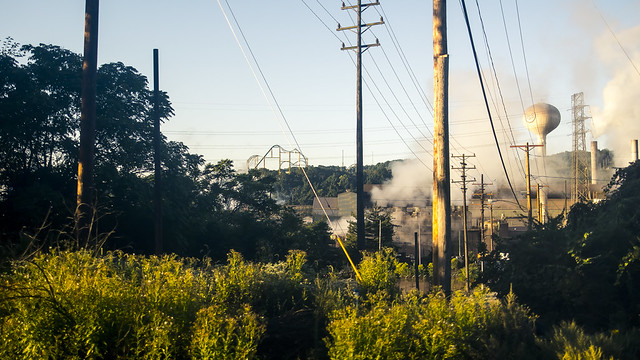
The foam collar I had fashioned to cancel out window reflections was again employed as we hurtled past steel mills and other industrial wonders along the way. Boy, oh boy do I want to spend some time around here with a car, after having socially networked my way into these sort of properties to “do my thing.”
What an amazing part of this country Western Pennsylvania is.

– photo by Mitch Waxman
Amtrak passed over a river, and the Google maps app on my phone informed me that we were passing in quite close proximity to the infamous Three Mile Island Nuclear Plant, but I couldn’t see it’s iconic cooling towers. Next time… and with wheels.
Amtrak would be delivering me to my next destination in the late afternoon/evening time of day. My photo time would be severely constrained, a mere three and change hours. I also needed to fill some of that time with purely biological needs – a meal, and a spot where I didn’t have to mask up – as onboard the Amtrak. More on all that next week, at this – your Newtown Pentacle.
“follow” me on Twitter- @newtownpentacle
Buy a book!
“In the Shadows at Newtown Creek,” an 88 page softcover 8.5×11 magazine format photo book by Mitch Waxman, is now on sale at blurb.com for $30.
earthward dreams
Thursday

– photo by Mitch Waxman
The Gateway Clipper excursion boat I was a passenger on executed its turnaround on the Allegheny River and started back towards the confluence it shares with the Monongahela River where they both transmogrify into the singularity of the Ohio River. My visit to Pittsburgh was winding down, and a humble narrator had been working behind the camera, and marching around, more or less continuously for about 48 hours since arriving in the city via Amtrak.
As regular readers of Newtown Pentacle will tell you, it’s normally all Queens and Brooklyn most of the time, and it was a genuine pleasure to see sights like the ones above for a change. Learning new things, too. Miss that.

– photo by Mitch Waxman
Right about the moment when we passed by the monument to Fred Rogers, another native son of Pittsburgh memorialized on the waterfront, that’s when I said “screw it” and found the onboard bar. An ice cold bottle of Yuengling Beer in my grasp, for the first time in a couple of days I switched the camera to “off” and just chilled out on the boat for few minutes. “Yiz got’s to stop’s and smell’s da roses every’s now and den” as they’ll tell you here in Pittsburgh.
It actually had been a wonderful day, in Mr. Rogers’ neighborhood.

– photo by Mitch Waxman
September found me in several places, and I’ve detailed the travels, photos, and brief research I’ve done on these places in recent weeks.
72 hours in Burlington, Vermont: leaving from NYC in ultimate abyss, exploring the Lake Champlain shoreline in awed sessions, the Ethan Allen Homestead and Intervale in immemorial lore, Church Street and downtown in waxen mask. Burlington was analyzed during sunset in doubly potent, we visited Shelburne Farms in appalling seething, reel irresponsibly, took a boat tour onboard the Spirit of Ethan Allen on Lake Champlain in viscous end, returned to the downtown Burlington area in grew hoarser. I found a rail yard and an epic sunset in new equilibrium, and returned to NYC via Amtrak in white fungi.
In untellable secret, the camera and I attended a wedding in Watertown, NY.
7 hours in Washington D.C. saw me boarding a train and heading to the Capitol in swelled alarmingly, arrived at the National Mall and explored a bit in slackened speed, hovered about, whereupon a look at Union Station was offered in rolling hills.
I’ll put together a similar list of all the Pittsburgh posts at some near point in time. I had to board a train at about 6 a.m. the next day to get to my next Amtrak destination. It ain’t over till it’s over, lords and ladies.

– photo by Mitch Waxman
After rounding about the Golden Triangles’ Point State Park and onto the waters of the Monongahela River, the Gateway Clipper boat returned to its pier at Station Square on the south bank of the River. That volatile Pittsburgh weather I’ve mentioned several times got to work again, and the temperature dropped into the low to middle 50’s. I was, of course, wearing shorts. Since I was traveling, I had no pants, just shorts.
A quick jab at my phone summoned a Lyft rideshare car to my aid, which got me back to the AirBNB acting as my home base for the stay. Images were downloaded off the camera, batteries charged, phone calls back home made. I washed up, relaxed for a few minutes, and went back out in search of dinner. Cheeseburger, and another Yuengling – that was my agenda, but I had one last thing to do first.

– photo by Mitch Waxman
I decided that it would be an excellent idea to firmly locate the relative position of the Amtrak station’s location to my AirBNB. I was so severely sleep deprived when I got to Pittsburgh that I barely remembered how I got from point’s A to B. Given that I’d have to be back out on the streets when it was still dark out to catch my train… a bit of advance wayfinding was engaged in, and just look at what I came across!
Pictured above is what was once the Pennsylvania Railroad’s Pittsburgh Union Station. It’s still called that, but these days it’s a ritzy apartment building and has been since the 1980’s, whereas the modern day train station – called an annex, officially – is… well… ahem… it cannot be described as being architecturally distinguished. It’s actually reminiscent of a two story Soviet doctor’s office with Amtrak logos nailed to the walls, and a couple of escalators that lead to a train shed.
Union Station in Pittsburgh opened in 1903, 4 years before it’s namesake in Washington D.C. and 7 years before NYC’s Old Penn Station. The two Union Stations in Pennsylvania and Washington were designed by a Chicago architect named David Burnham.

– photo by Mitch Waxman
This was pretty much the last photo I captured on Day Two in Pittsburgh, which is kind of appropriate – no?
As mentioned, I had an early call with Amtrak. It was time to start stuffing all my clothing and camera gear back into the bags, and loading my carry back up. A bit of straightening up in the AirBNB followed, whereupon a set of clothes was set out for early morning deployment and the next adventure. After a meal, and a quick inventory of my bags, sleep ensued.
Another far away destination still stood between me and home.
More tomorrow, at this – your Newtown Pentacle.
“follow” me on Twitter- @newtownpentacle
Buy a book!
“In the Shadows at Newtown Creek,” an 88 page softcover 8.5×11 magazine format photo book by Mitch Waxman, is now on sale at blurb.com for $30.
unexampled flight
Wednesday

– photo by Mitch Waxman
Onboard a Gateway Clipper excursion boat, here in Pennsylvania’s Pittsburgh, the Captain navigated us around the “Point” of the Golden Triangle and off of the Monongahela River and onto the Allegheny River. Pictured is the confluence of the “Three Rivers” where the two form the one and the Ohio River begins.
That fountain above is the centerpiece of Point State Park, and was discussed in a prior post dubbed “certain circumstances.” When I was here, on Day One of my 72 hours in Pittsburgh, it was nighttime. The shots in today’s post are from Day Two.

– photo by Mitch Waxman
Pictured above are, from the top – the Fort Duquesne Bridge (also briefly profiled in the post linked to above), and the three smaller yellow bridges beyond it are the Sixth Street Roberto Clemente, Seventh Street Andy Warhol, and Ninth Street Rachel Carson bridges – discussed in similarly brief fashion in this post – dubbed “human clothing.”

– photo by Mitch Waxman
The Gateway Clipper tour guide intoned that the reason why everything “Pittsburgh” is colored black and yellow dates back to its founding, and is related to how they came up with the romantic sounding name “Pittsburgh” in the first place. The City picked up its moniker in 1758, when a British General named the area in honor of a back home politician named William Pitt, the 1st earl of Chatham. From an American history POV, we remember this politician as “Pitt the Elder.” It seems that the feudal standard colors of the Pitts were black and gold.
Pittsburgh stays on “brand” all these centuries later, with black and gold municipal goodness; its bridges, its Steelers NFL team, Penguins NHL team, and the Pirates MLB uniforms. According to the tour guide, the gold color, as commercially supplied, is called “Aztec Yellow.”
That brings me back to the old days, “Aztec Yellow” does, I tell’s ya… reminds me of the Aztec deity Tezcatlipoca, the god of wizards and darkness often referred to as “the smoking mirror” lest invoking his name summon the entity. Tezcatlipoca was often depicted by the Nauali Priesthood of Tenochtitlan as man with obsidian black skin wearing yellow war paint, or simply as a Jaguar.
Nerrrrrrrrrrd.

– photo by Mitch Waxman
Continuing up the Allegheny River, we encountered the Fort Wayne Railroad Bridge, whose details and specifics were also discussed in the posting linked to above – dubbed “human clothing.” As mentioned on that occasion, captured also on Day One of this 72 hour portage, this is a very active railroad bridge.
Once the Gateway Clipper passed underneath it, the turnaround point for the excursion would be reached.

– photo by Mitch Waxman
A humble narrator normally reacts with horror at the sort of architecture employed by a structure called the “David L. Lawrence Convention Center,” or colloquially the “Pittsburgh Convention Center,” but this massive 1.5 million square foot facility is actually pretty cool looking and a nice accommodation of the space. A section of it is cantilevered out over a highway or high speed road of some sort, as well as the Three Rivers Heritage Trail bike and pedestrian pathway. This is just past the “Strip district.”
It’s where I got my shots of the Fort Wayne Railroad Bridge the day before, along the waterfront path.

– photo by Mitch Waxman
Behind the Fort Wayne Railroad Bridge, which had one of those seemingly half mile long Midwestern freight trains you hear about moving over it, that’s the “Veterans Bridge” truss bridge, and the 16th Street David McCullough Bridge in descending order.
Wow, it’s almost as if I had planned out my 72 hours in Pittsburgh to involve collecting a systemic catalog of the Golden Triangle’s bridges and interesting points, found on the Allegheny River between 31st street and Point State Park, and then the Monongahela River side Bridges and both Inclines – Monongahela and Duquesne – between Point State Park and the Smithfield Street Bridge. It’s almost as if the entire mission could then be visually summed up and compiled, via the rapid fire shooting and focal points offered by a 60 minute tourist boat excursion covering much of the same ground I had already travelled on foot.
That’s crazy, right, as I’m an idiot man child with a camera scuttling through junk yards and along riverbanks, right?
“follow” me on Twitter- @newtownpentacle
Buy a book!
“In the Shadows at Newtown Creek,” an 88 page softcover 8.5×11 magazine format photo book by Mitch Waxman, is now on sale at blurb.com for $30.


 The Newtown Pentacle