Author Archive
Megalith

from First Calvary Cemetery – photo by Mitch Waxman
Behemoth, that which exists in the tower has never lived. An ideation of law, insulting to the biologic origins of true life, the corporation is undying and eternal.
from wikipedia
Founded in 1812 as the City Bank of New York, ownership and management of the bank was taken over by Moses Taylor, a protégé of John Jacob Astor and one of the giants of the business world in the 19th century. During Taylor’s ascendancy, the bank functioned largely as a treasury and finance center for Taylor’s own extensive business empire.
In 1863, the bank joined the U.S.’s new national banking system and became The National City Bank of New York. By 1868, it was considered one of the largest banks in the United States, and in 1897, it became the first major U.S bank to establish a foreign department. In 1896, it was the first contributor to the Federal Reserve Bank of New York.
National City became the first U.S. national bank to open an overseas banking office when its branch in Buenos Aires, Argentina, was opened in 1914. Many of Citi’s present international offices are older; offices in London, Shanghai, Calcutta, and elsewhere were opened in 1901 and 1902 by the International Banking Corporation (IBC), a company chartered to conduct banking business outside the U.S., at that time an activity forbidden to U.S. national banks. In 1918, IBC became a wholly owned subsidiary and was subsequently merged into the bank. By 1919, the bank had become the first U.S. bank to have US$1 billion in assets.
In 1910, National City bought a significant share of Haiti’s National Bank (Banque de la Republique d’Haiti), which functioned as the country’s treasury and had a monopoly on note issue. After the American invasion of Haiti, it bought all of the capital stock of the Banque de la Republique. The bank became the target of criticism for what were considered to be monopolistic and unfair banking practices. It initially did not pay the Haitian government interest on surplus money that it deposited in the treasury, which was loaned out by City Bank in New York. After 1922, it began paying interest, but only at a rate of 2% compared to the 3.5% that it paid to similar depositors. Economist and Senator Paul Douglas estimated that this amounted to US$1 million in lost interest at a time when Haiti’s government revenues were less than US$7 million.
Charles E. Mitchell was elected president in 1921 and in 1929 was made chairman, a position he held until 1933. Under Mitchell the bank expanded rapidly and by 1930 had 100 branches in 23 countries outside the United States. In 1933 a Senate investigated Mitchell for his part in tens of millions dollars in losses, excessive pay, and tax avoidance. Senator Carter Glass said of him: “Mitchell more than any 50 men is responsible for this stock crash.”
On 24 December 1927, its headquarters in Buenos Aires, Argentina, were blown up by the Italian anarchist Severino Di Giovanni, in the frame of the international campaign supporting Sacco and Vanzetti.
In 1952, James Stillman Rockefeller was elected president and then chairman in 1959, serving until 1967. Stillman was a direct descendant of the Rockefeller family through the William Rockefeller (the brother of John D.) branch. In 1960, his second cousin, David Rockefeller, became president of Chase Manhattan Bank, National City’s long-time New York rival for dominance in the banking industry in America.

from Jackson Avenue – photo by Mitch Waxman
Leviathan, it challenges legendary Babel, speaking inchoate platitudes in all the tongues of man. From its high seat, an inhuman thing- hungering to metastasize its influence and prominence -gazes greedily upon gotham.
from nytimes.com
The building, designed by Raul de Armas of Skidmore, Owings & Merrill, is handsome, even somewhat refined; its pale blue-green glass and transparent windows are obviously intended to reduce the impact of the vast tower on Long Island City, and to a considerable extent they succeed. This building would be a lot more overpowering still if it had been sheathed in reflective glass, or garnished with ornament from top to bottom. And the shape – a tower with stepped-back corners that rises straight up for most of its height, with small setbacks at the very top to create a hint of a pyramid where the building meets the sky – helps a bit more in reducing the apparent bulk.

from Skillman Avenue – photo by Mitch Waxman
Juggernaut, it leers at the manifest aspirations of both darkest night and the hopes of a most golden dawn, from across the river of sound.
from independent.co.uk
When it emerged a few weeks ago that the codename for a daring $13bn (£6.8bn) bond trade in Citigroup’s London office last summer was “Doctor Evil”, it must have been much more than exasperation felt by the chief executive of the giant bank, Chuck Prince.
The grand strategy – to flood the European bond market and then rebuy at a lower price – had overtones of another fiendishly clever plan: the time when the top brains at Enron, using special vehicles known as “Deathstar” and “Ricochet”, took advantage of electricity blackouts in California to hike energy prices. Or maybe the Citigroup traders were thinking of their colleagues in Italy, who named a deal they struck with doomed food group Parmalat as “Bucerono” – black hole.

from Thomson Avenue – photo by Mitch Waxman
Monolith, it is a sapphire dagger aimed at the heart of God, a cathedral of dark secrets and obscure transactions possessed of the power to topple governments and destabilize entire continents- in mere minutes.
from globalresearch.ca
“Economic mismanagement” is a term used by the Washington based international financial institutions to describe the chaos which results from not fully abiding by the IMF’s Structural Adjustment Program. In actual fact, the “economic mismanagement” and chaos is the outcome of IMF-World Bank prescriptions, which invariably trigger hyperinflation and precipitate indebted countries into extreme poverty.
Pakistan has been subjected to the same deadly IMF “economic medicine” as Yugoslavia: In 1999, in the immediate wake of the coup d’Etat which brought General Pervez Musharaf to the helm of the military government, an IMF economic package, which included currency devaluation and drastic austerity measures, was imposed on Pakistan. Pakistan’s external debt is of the order of US$40 billion. The IMF’s “debt reduction” under the package was conditional upon the sell-off to foreign capital of the most profitable State owned enterprises (including the oil and gas facilities in Balochistan) at rockbottom prices .
Musharaf’s Finance Minister was chosen by Wall Street, which is not an unusual practice. The military rulers appointed at Wall Street’s behest, a vice-president of Citigroup, Shaukat Aziz, who at the time was head of CitiGroup’s Global Private Banking. (See WSWS.org, 30 October 1999). CitiGroup is among the largest commercial foreign banking institutions in Pakistan.

from 5th street – photo by Mitch Waxman
Cumbrous, this megalith is but one of the bothersome encumbrances- physical manifestations- of that unknowable thing dwelling here- which neither breathes- nor feels- or lives.
from washingtonpost.com
…This time, though, the company in jeopardy is truly gigantic. Citigroup is the largest U.S. bank by assets, with $2 trillion on its books. By contrast, Wachovia, which became the biggest bank to be done in by the financial crisis after being forced to sell itself to Wells Fargo this fall, has just over one-third as many assets.
Citigroup engages in almost every form of financial transaction available to banks and investment firms, making it heavily involved with almost every other large financial institution in the world. It is also deeply integrated into the nation’s financial history.
In the 1920s, a firm called First National City Bank started repackaging bad loans from Latin America and selling these to investors as safe securities. These investments collapsed in grand fashion after the 1929 stock market crash and eventually led to a new wave of securities regulation. National City Bank became Citibank, which in turn became a major unit of Citigroup.
Citigroup has incurred billions of dollars in losses in the past 18 months, once again by partly repackaging bad loans into what were viewed as safe securities.

from 23rd street – photo by Mitch Waxman
Diabolic, an untold intelligence works through its army of rapacious acolytes, who interpret its wishes and act brutishly on its behalf. The megalith is a sky flung altar and testimonial to their faith.
from ran.org
In Florida’s Everglades: In March 2007, Citi provided Florida Power & Light with $2.5 billion in financing. FPL is planning to build four new coal-fired power plants in Florida. Located in the heart of the fragile Everglades ecosystem, the Glades County plant would emit 16 million tons of climate-changing carbon dioxide, making it the largest single source of global warming pollution in the state. This plant is waiting on a recommendation from the Florida Utilities Commission. Learn more at Save It Now, Glades!
In Iowa: In early April, Citi amended a financial agreement with Dynegy – the power and utilities company sponsoring the largest build-out of new coal power plants in the U.S. – that will bring its total financial support to $1.8 billion for a company proposing to build 12 coal-fired plants that will emit an estimated 53.3 million tons of C02 annually. This week, Dynegy-owned LS Power plans to apply for permits to build a 750MW coal-fired power plant just east of Waterloo, Iowa. This plant will spew carbon emissions equivalent to nearly a million new cars on Iowa’s roads over its 40-50 year lifetime and pollute eastern Iowa’s waters with heavy metals. Iowans are in a desperate fight to stop it.

from 29th street – photo by Mitch Waxman
Pythonic, serpentine wires snake away from it- infiltrating all corners of the planet in the manner of some fearful Rhiozome– reaching out to its merciless disciples scattered across the nations to do its bidding. Crowned heads in Europe and in the Courts of the Orient favor the beast, unbound and loosed upon the earth.
from wikipedia
On August 26, 2008 it was announced that Citigroup agreed to pay nearly $18 million in refunds and fines to settle accusations by California Attorney General Jerry Brown that it wrongly took funds from the accounts of credit card customers. Citigroup would pay $14 million of restitution to roughly 53,000 customers nationwide. A three-year investigation found that Citigroup from 1992 to 2003 used an improper computerized “sweep” feature to move positive balances from card accounts into the bank’s general fund, without telling cardholders.
Brown said in a statement that Citigroup “knowingly stole from its customers, mostly poor people and the recently deceased, when it designed and implemented the sweeps…When a whistleblower uncovered the scam and brought it to his superiors, they buried the information and continued the illegal practice.”

from Skillman Avenue – photo by Mitch Waxman
Voluminous, the megalith is the highest point on the Long Island, a great nail driven into the contaminant soil and through the heart of the Newtown Pentacle.
Its most famous office building is the Citigroup Center, a diagonal-roof skyscraper located in New York City’s Midtown Manhattan, which despite popular belief is not the company’s headquarters building. Citigroup has its headquarters across the street in an anonymous-looking building at 399 Park Avenue (the site of the original location of the City National Bank). The headquarters is outfitted with nine luxury dining rooms, with a team of private chefs preparing a different menu for each day. The management team is on the third and fourth floors above a Citibank branch. Smith Barney leases a building in the Tribeca neighborhood in Manhattan, the former headquarters of the Travelers Group and famous for its red umbrella sculpture.
In a truly well planned strategy, Citigroup’s real estate in New York City, excluding the company’s Smith Barney division and Wall Street trading division, lie all along New York City’s ‘E’ and ‘V’ subway lines. This means that the Midtown buildings the company inhabits — including 666 Fifth Avenue, 399 Park Avenue, 153 East 53rd street (Citigroup Center) and 1 Court Square (in Long Island City) — are all one stop away from each other. In fact, every company building lies above or right across the street from an ‘E’ or ‘V’ line subway station.

from 28th street – photo by Mitch Waxman
Omniscient, the cyclopean thing in that sapphire obelisk fixes its burning gaze upon the world of men, and trying to avoid it is folly.
from villagevoice.com
Citigroup operates in over 100 countries and, according to the Rainforest Action Network (RAN), which is spearheading the campaign against it, has a hand in some of the most destructive development projects in the world. In Africa, Citigroup acted as chief financial adviser for the Chad/Cameroon Oil and Pipeline Project, which will cut through a rainforest and indigenous lands. In China, Citigroup underwrote bonds for the Three Gorges Dam, which will displace around 2 million people and destroy a rare river ecosystem.
Things you learn from being a ghoul

St. Michael’s Cemetery- photo by Mitch Waxman
As has been mentioned in the past, your humble narrator suffers from a serious health condition, which necessitates regular physical exercise be performed as a curative. These long walks around the Newtown Pentacle, prescriptive in their origins, have made me curious about the things I encounter. Notwithstanding the industrial wonders of Newtown Creek or that clockwork malevolence of marching progress evidenced in Long Island City, desire arises in my heart for quiet… peace… and the company of some semblance of nature.
Here in northwestern Queens, the closest thing to a sylvan glade available to the public for peaceful perambulation are graveyards.

St. Michael’s Cemetery- photo by Mitch Waxman
Despite my great affection for the viridian devastation of Calvary Cemetery, it is quite a long walk from ruby lipped Astoria to the blighted hillocks of Blissville, and in these days of approaching winter- the sun’s journey ends in late afternoon. Calvary will consume you, if you stray too far from the light, and the wise visit it early in the day.
A mere half mile from Newtown Pentacle HQ, however, can be found St. Michael’s. 88 acres of manicured grounds, St. Michael’s is an island of calm in the middle of Astoria. Unlike Calvary, St. Michael’s is a nonsectarian burial ground, and exhibits the legendary diversity of populations for which Queens is renowned worldwide within its loamy depths.
(we’ll be exploring St. Michael’s more thoroughly in future posts, but for now…)
Recently, on one of my ghoulish walks around the place, I encountered strange fruit.
from St. Michael’s
St. Michael’s Cemetery is situated in the borough of Queens in New York City. Established in 1852, St. Michael’s is one of the oldest religious, nonprofit cemeteries in the New York City metropolitan area which is open to people of all faiths. It is owned and operated by St. Michael’s Church, an Episcopal congregation located on the Upper West Side of Manhattan.
The original property for St. Michael’s Cemetery was purchased in 1852 by the Rev. Thomas McClure Peters and occupied seven acres. Over the years St. Michael’s gradually acquired additional land to its present size of approximately eighty-eight acres. Because it was Dr. Peters intention to provide a final dignified resting place for the poor who could not otherwise afford it, areas within the cemetery were assigned to other free churches and institutions of New York City. These areas are still held for the institutions they were assigned. As a service to its diverse constituency, St. Michael’s continues to this day provide burial space for individuals and families from all classes, religions and ethnicities. St. Michael’s reflects the demographic and historical trends of New York City. Walking through the older sections of the cemetery, you will find burials representing the 19th and early 20th century immigrants.
In the late 1980’s St. Michael’s began building community mausoleums in order to more efficiently utilize the remaining unoccupied space and offer attractive, affordable final resting places. Currently, we are planning a new mausoleum complex at 49th Street and Grand Central Parkway Service Road.

St. Michael’s Cemetery- photo by Mitch Waxman
About the size of an orange, or large apple, the ruggose skin of the fruit had a sickly yellow-green coloration. Abundant, the fallen spores were obviously in season. Ignorant of the specificities of arborial lore, nocturnal researches of North American cultivars suggested that this sort of ovum was typical of an Osage Orange- Maclura pomifera to those in the know.
from wikipedia
Osage-orange, Horse-apple, Bois D’Arc, or Bodark (Maclura pomifera) is a small deciduous tree or large shrub, typically growing to 8–15 metres (26–49 ft) tall. It is dioeceous, with male and female flowers on different plants. The fruit, a multiple fruit, is roughly spherical, but bumpy, and 7–15 cm in diameter, and it is filled with a sticky white latex sap. In fall, its color turns a bright yellow-green and it has a faint odor similar to that of oranges.
Maclura is closely related to the genus Cudrania, and hybrids between the two genera have been produced. In fact, some botanists recognize a more broadly defined Maclura that includes species previously included in Cudrania and other genera of Moraceae.
Osajin and Pomiferin are flavonoid pigments present in the wood and fruit, comprising about 10% of the fruit’s dry weight. The plant also contains the flavonol morin.
Recent research suggests that elemol, another component extractable from the fruit, shows promise as a mosquito repellent with similar activity to DEET in contact and residual repellency.

St. Michael’s Cemetery, Maclura pomifera, or Osage Orange fruit – photo by Mitch Waxman
An important plant to the native american cultures, the Osage Orange tree produces wood which is dense and fibrous, ideal for the body of a Bow and it is one of the highest rated “fuel woods“. Resistant to insect and fungus, Osage wood is also prized for use in fenceposts. It grows in the form of a dense thorned thicket surrounding the central trunk, and produces the “orange” which is largely passed over by mammalian scavengers like Squirrels and Raccoons. Prized by Horses and Mules (horse apples), the original range of the tree was confined to the southwest, but its value as a hedge plant and naturally replenishing cattle fence was instrumental in it being planted all over North America.
from horticulture and home pest news
The Osage-orange is native to a small area in eastern Texas, southeastern Oklahoma, and southwestern Arkansas. This region was also the home of the Osage Indians, hence the common name of Osage-orange. White settlers moving into the region found that the Osage-orange possessed several admirable qualities. It is a tough and durable tree, transplants easily, and tolerates poor soils, extreme heat, and strong winds. It also has no serious insect or disease problems. During the mid-nineteenth century, it was widely planted by midwest farmers, including those in southern Iowa, as a living fence. When pruned into a hedge, it provided an impenetrable barrier to livestock. The widespread planting of Osage-orange stopped with the introduction of barbed wire. Many of the original hedges have since been destroyed or died. However, some of the original trees can still be found in fence rows in southern Iowa. Trees have also become naturalized in pastures and ravines in southern areas of the state.
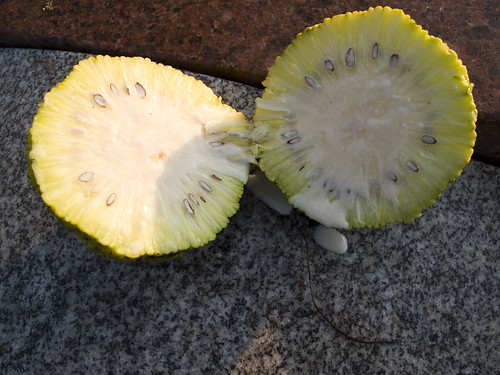
St. Michael’s Cemetery, Maclura pomifera, or Osage Orange fruit – photo by Mitch Waxman
Like all fruiting plants, an animal conspirator is required to complete the life cycle of the Osage Orange, expanding its range via the digestive processes of a ranging forager. Ever efficient, nature would not waste its time producing an energy rich fruit that attracts no living animal to it. Theories abound as to the identity of this partner organism, and an extinct equine is one of the evolutionary vectors theorized to have played this role for the Osage (thought likely due to the browsing preferences of modern Horse and Mule), but an intriguing notion is put forth by Connie Barlow of Harvard’s Arnold Arboretum who offers the theory that the anachronistic fruit of the Osage Orange’s partner animal was in fact a long extinct North American Elephant- the Mammoth.
Practicers of the left handed path of forbidden knowledge prize Osage wood for usage in wands, believing it to be useful when invoking mysterious spirits emanating from the bowels of the earth- those never human elemental intelligences, and the spirit animal guides associated with Native American Shamanic beliefs.
Osage-Orange is a native tree coming from a relatively small area in eastern Oklahoma, portions of Missouri, Texas and Arkansas. While used for centuries by native Americans in its original area for war clubs and bows, it was the first tree Lewis and Clark sent back east from St. Louis in 1804. Yet, with that modest beginning, the Osage-Orange probably has been planted in greater numbers throughout the United States in the 19th and early 20th century than almost any other tree species in North America. Because of its value as a natural hedgerow fence, it made agricultural settlement of the prairies possible, it then led directly to the invention of barbed wire in 1874, and then provided most of the posts for the wire that fenced the West. It is still considered the best wood for making archer’s bows. The Osage-Orange is one of America’s more interesting natives. It has at least two Internet web sites dedicated to keeping Osage-Orange enthusiasts informed (see www.osageorange.com and www.hedgeapple.com).
Happy Thanksgiving.
Working Harbor September Sunset tour 3
Today’s fun is a chunk of H.P. Lovecraft’s The Call of Cthulhu, with photos I shot at the Working Harbor Committee September 15th Sunset tour. For the whole story, at wikisource.org– click here.
All text, of course, is by Lovecraft-

– photo by Mitch Waxman
…I suppose that only a single mountain-top, the hideous monolith-crowned citadel whereon great Cthulhu was buried, actually emerged from the waters. When I think of the extent of all that may be brooding down there I almost wish to kill myself forthwith. Johansen and his men were awed by the cosmic majesty of this dripping Babylon of elder daemons, and must have guessed without guidance that it was nothing of this or of any sane planet. Awe at the unbelievable size of the greenish stone blocks, at the dizzying height of the great carven monolith, and at the stupefying identity of the colossal statues and bas-reliefs with the queer image found in the shrine on the Alert, is poignantly visible in every line of the mate’s frightened description.

– photo by Mitch Waxman
Without knowing what futurism is like, Johansen achieved something very close to it when he spoke of the city; for instead of describing any definite structure or building, he dwells only on broad impressions of vast angles and stone surfaces—surfaces too great to belong to anything right or proper for this earth, and impious with horrible images and hieroglyphs. I mention his talk about angles because it suggests something Wilcox had told me of his awful dreams. He said that the geometry of the dream-place he saw was abnormal, non-Euclidean, and loathsomely redolent of spheres and dimensions apart from ours. Now an unlettered seaman felt the same thing whilst gazing at the terrible reality.

– photo by Mitch Waxman
Johansen and his men landed at a sloping mud-bank on this monstrous Acropolis, and clambered slipperily up over titan oozy blocks which could have been no mortal staircase. The very sun of heaven seemed distorted when viewed through the polarising miasma welling out from this sea-soaked perversion, and twisted menace and suspense lurked leeringly in those crazily elusive angles of carven rock where a second glance showed concavity after the first showed convexity.

– photo by Mitch Waxman
Something very like fright had come over all the explorers before anything more definite than rock and ooze and weed was seen. Each would have fled had he not feared the scorn of the others, and it was only half-heartedly that they searched—vainly, as it proved—for some portable souvenir to bear away.
It was Rodriguez the Portuguese who climbed up the foot of the monolith and shouted of what he had found. The rest followed him, and looked curiously at the immense carved door with the now familiar squid-dragon bas-relief. It was, Johansen said, like a great barn-door; and they all felt that it was a door because of the ornate lintel, threshold, and jambs around it, though they could not decide whether it lay flat like a trap-door or slantwise like an outside cellar-door. As Wilcox would have said, the geometry of the place was all wrong. One could not be sure that the sea and the ground were horizontal, hence the relative position of everything else seemed phantasmally variable.

– photo by Mitch Waxman
Briden pushed at the stone in several places without result. Then Donovan felt over it delicately around the edge, pressing each point separately as he went. He climbed interminably along the grotesque stone moulding—that is, one would call it climbing if the thing was not after all horizontal—and the men wondered how any door in the universe could be so vast. Then, very softly and slowly, the acre-great lintel began to give inward at the top; and they saw that it was balanced.
Donovan slid or somehow propelled himself down or along the jamb and rejoined his fellows, and everyone watched the queer recession of the monstrously carven portal. In this phantasy of prismatic distortion it moved anomalously in a diagonal way, so that all the rules of matter and perspective seemed upset.

– photo by Mitch Waxman
The aperture was black with a darkness almost material. That tenebrousness was indeed a positive quality; for it obscured such parts of the inner walls as ought to have been revealed, and actually burst forth like smoke from its aeon-long imprisonment, visibly darkening the sun as it slunk away into the shrunken and gibbous sky on flapping membraneous wings. The odour rising from the newly opened depths was intolerable, and at length the quick-eared Hawkins thought he heard a nasty, slopping sound down there. Everyone listened, and everyone was listening still when It lumbered slobberingly into sight and gropingly squeezed Its gelatinous green immensity through the black doorway into the tainted outside air of that poison city of madness.
Poor Johansen’s handwriting almost gave out when he wrote of this. Of the six men who never reached the ship, he thinks two perished of pure fright in that accursed instant. The Thing cannot be described—there is no language for such abysms of shrieking and immemorial lunacy, such eldritch contradictions of all matter, force, and cosmic order. A mountain walked or stumbled. God! What wonder that across the earth a great architect went mad, and poor Wilcox raved with fever in that telepathic instant? The Thing of the idols, the green, sticky spawn of the stars, had awaked to claim his own. The stars were right again, and what an age-old cult had failed to do by design, a band of innocent sailors had done by accident. After vigintillions of years great Cthulhu was loose again, and ravening for delight.
Tales of Calvary 5- Shade and Stillness

– photo by Mitch Waxman
In the past, the desolating loneliness and isolation which define my internal dialogue have been described to you simply – I’m all ‘effed up.
Shunned by those considered normal, my human– all too human- nature forces visceral desires for companionship. Lacking fellowship amongst the the living, one instinctively reaches out for those things which are no longer- or have never been- alive. That odd man in the filthy black raincoat that you might glimpse as you drive past the graveyard, scuttling along taking pictures of sewers and odd boxes in the Cemetery Belt- might very well be your humble narrator.
I was at Calvary Cemetery, intent on investigating the puzzling knots I had observed, beneath a hilltop tree- fed by some morbid nutrition, when I came across the Sweeney monument.
The Association for Gravestone Studies makes available this pdf file of a 19th century monumental bronze catalog, incidentally, as well as this discussion of “White Bronze“.

– photo by Mitch Waxman
Unlike the celebrated O’Brien clan, whose final destination is found closer to the apex of Calvary’s hills, the Sweeneys are shadowed by time. Social standing and class status drove the generations buried up here to seek a favorable and expensive bit of real estate, away from the common rabble and poor being laid into marshy trenches at the shallow of the hill in their thousands, and to lie for eternity with “their own kind”.
The princes of the City, and their courts, lie in Calvary Cemetery– not far from worm scarred timbers whose titan bulk restricts an elixir of extinction known as the fabled Newtown Creek from mingling with the blessed soils of Calvary. Unguessable springs of subterrene putrefaction percolating with horrors beyond the grave’s holding flow still beneath the streets of Newtown- vestigial streams and waterways that are imprisoned in masonry and brick tunnels. Directly mixing, in hideous congress, the liquefied effluvia of the long dead found in the hydrologic column of Calvary with the exotic chemistries of Newtown Creek? Who can guess would result?
Whoever the Sweeneys were, their family plot is located in a fairly exclusive area of the 19th century’s ex-population, and pretty close to the top of a hill. What’s odd here, and remarkable, is the enigmatic knots of this token affixed to the Sweeney monument- a trinket which had obviously weathered more than one change of season.
Unknowable implications are suggested by the urgency of this arcane reference found in the New York State Cemetery Law.

– photo by Mitch Waxman
Symbolic gifts to the dead and the placement of totemic representations at graves are expected behaviors, when confronted with the brutal truth of mortality, from individuals who experience the death of a family or peer group member. Every cemetery in the area, the sheer acreage of which -in this case- can be observed from space, has posted regulations on appropriate and allowed markers and monuments. Certain obtuse expressions of grief are disallowed due to the necessary maintenance and landscaping of the grounds, and good taste is enforced.
Another odd set of provisions is found in the Penal Law section of the aforementioned codification of New York’s cemeteries.

– photo by Mitch Waxman
Noticing that that the oddly complex knotting of the cord implied commonality with the nearby red and blue knotted cords, I decided to have a closer look. There was a second color of cordage in the knots, a dirty and weathered yellow which was only present in one spot. The pendulum which the arrangement supported was either cheap electroplated metal or some sort of ruggose plastic. It was a sort of cartouche, an amulet shaped in a manner commonly recognized as a heart, suspended by a twisted tendon of oddly knotted string.

– photo by Mitch Waxman
Suspicious that this might be something other than innocent, and knowing the predilection of certain groups for the usage of bodily liquids in their rites, your humble narrator used a trusty all in one Leatherman brand tool to examine it further. It is important, when walking in the hallowed grounds of Calvary, to try not to touch anything lest something touch you back. Things found there, if they can catch the smell of you, might follow you home and demand to be fed.
Of course, I mean the hundreds of feral cats which stalk Calvary’s hills, and it is best that they stay here where it is always safe for them. Neighborhood gossips- their odd comment phrased with a raised eyebrow and knowing squint- hoarsely whisper the opine: In Calvary Cemetery, no man may kill a cat…
Also from New York State, a manual for the new treasurer, a business plan and model to follow for the mortuary industry’s promise of “Perpetual Care”.
misty water colored memories… but with blood

Long Island City, mouth of Newtown Creek, Greenpoint stitched panorama – photo by Mitch Waxman
Note- I’ve got a turmoil in me right now.
Your humble narrator is pissed off, and this ape is standing at the edge of his personal forest, hurling invective at an unfamiliar thing hanging in the sky called Moon. Rambling ahead, with a few reminisces of New York in “the good old days”.
The disturbing incongruity of modern skyscrapers in the Newtown Pentacle’s panoramic skies, whether commercial spire or residential tower, is horrifying to the residents of victorian relicts such as Long Island City and Greenpoint. All along the rotting infrastructure of the malodorous Newtown Creek, nearly the geographic center of the City of Greater New York, the arrival of a pregnant moment is apparent.
“A river of federal money will wash out the Newtown Creek, and all the poisons in the mud will be hatched out, or so say the G-Men” is my take on the EPA superfund listing of the Creek for now.
I still haven’t parsed everything, that was said in the November 5, 2009 Newtown Creek Alliance meeting at St. Cecilia’s. I made an audio recording of the presentation, and will be listening to it again. Its just that the EPA… the feds… gaining absolute control over a 4 long by half mile wide chunk of New York City for as long as 50 years… that’s 12.5 presidential administrations. 12.5 administrations ago was FDR’s first term.
Speaking of FDR, did you know that his second term Vice President- Henry A. Wallace (responsible for the very successful transformation of dustbowl era agri-businesses from rural homestead into their somewhat modern form) was a well known and public occultist?

Looking east from Newtown Creek Wastewater Treatment Plant catwalk stitched panorama – photo by Mitch Waxman
The New York that my father knew, the one built up in the late 30’s, 40’s, and 50’s, is the one that began crumbling in the 70’s and came crashing down during the 1980’s. Contrary to what you may have read, the Reagan years were not a very nice time, and a soggy malaise hung over both the great city and the nation that exists because of it. Disillusioned by the failures of utopian city planners and those shambolic ideologies which were popularized by academic and journalist alike, the population of New York turned on each other in those days.
Here’s a few of my “new york stories”- I was there, I saw them.

Looking southwest from Queensboro Bridge stitched panorama – photo by Mitch Waxman
A tragedy of Russian scale and tone, “good old days” New York saw violent encounters between strangers became commonplace in a city always on the edge. Back then (late 80’s, early 90’s)- Williamsburg was a blasted out brick lot, blighted, and an island of extreme poverty.

West from Pulaski Bridge facing Manhattan, stitched panorama – photo by Mitch Waxman
Naked hookers plied their trade in Williamsburg on Bedford and Grand, while just beyond- a Motorcycle Club’s shanty was lit by oil drums filled with castaway lumber and litter. The Lower East Side (then known as Alphabet city) was where you spent your time, then, or way uptown above 96th street on the west side- and both neighborhoods had borderlines and “DMZ” areas.
The City belonged to the rats, and you either fought them or ran away. Cowardice was considered an intelligent option back then, just run away- don’t try to fight “them”.

East on Newtown Creek, Kosciuszko Bridge stitched panorama – photo by Mitch Waxman
Once, I saw a businessman 2 blocks north of Grand Central Station on Park Avenue, wearing an expensive vested suit which was the fashion at the time. He walked between two cars, dropped his suit pants, and defecated in the street. You used to pee wherever you wanted to, as well, “back in the day”.
You could smoke tobacco, in designated areas, within New York City hospital wards. There was a magical danish called the Bearclaw, which has since gone extinct in New York City, best quaffed with bitter black coffee. The last Bearclaw I had was in the “New York New York” casino in Las Vegas.

Skillman Avenue, Sunnyside Railyard fence line – photo by Mitch Waxman
Once, I saw a homeless guy junkie- during the early AIDS years- get hit by a cab. His head shot forward toward the asphalt in a parabolic arc with his knees acting as a fulcrum, shattering his face and killing him. This happened on 21st street and 3rd, down the block from the Police Academy. They left him there for 2-3 hours waiting for the morgue to show up because nobody wanted to get AIDS blood on themselves. The bulls set up traffic cones around him.

Sunnyside, Barnett Avenue looking west stitched panorama – photo by Mitch Waxman
That New York City- the one that was a national disaster long before it became the scene of a national disaster, a lamentable metropolis of blood, hate, and too much damn noise- is being built over and carted away. But this is the way of things, here.
Those farms and mills obliterated by rapacious rail barons and their quest to build Sunnyside Yards, do you know who the Payntars were, or their story?

Queensbridge Park, looking west toward Manhattan stitched panorama – photo by Mitch Waxman
The mansions of Ravenswood, gothic palaces built for the ultra rich who made their fortunes on Newtown Creek and in Long Island City, were casually eradicated to make way for mill and dock, and later bridge and housing project. Do you know the story of the Terracotta House?

From George Washington Bridge looking south on upper Manhattan and New Jersey stitched panorama – photo by Mitch Waxman
Once, back in ’93, on 99th and Broadway- some guy was talking on a pay phone in the middle of the night, during an ice storm. You know the kind- the sort of weather that coats every surface in a half inch of clear, slick ice. Urban misery, but quite beautiful.

Astoria 31st Avenue stormy sky stitched panorama- photo by Mitch Waxman
Unfortunately for this fellow on the phone, someone shot him a few times and he must have slumped forward with the phone in his hand. I walked by on my way to the 2 train the next morning and the wind had pushed him backwards, his frozen hand around the receiver and his corpse was swaying stiffly in the february wind. There were bloodcicles.

Long Island City, Hunters Point, mouth of Newtown Creek, Greenpoint stitched panorama – photo by Mitch Waxman
For more on this lost and forgotten civilization, buy an early Ramones album and play it very loud.


